US E-Commerce Last-Mile Delivery Market Snapshot
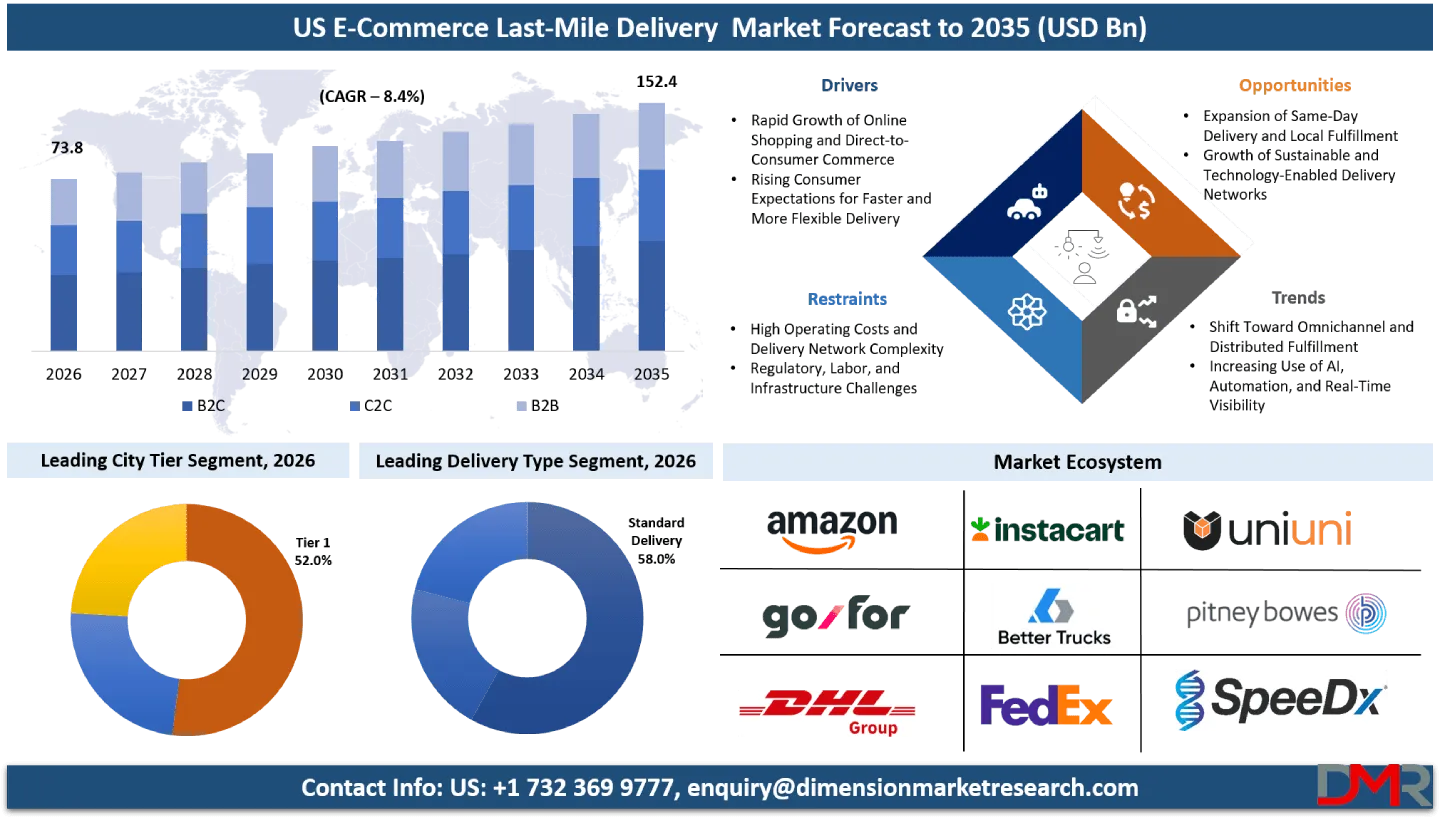
- Market Growth: The US E-Commerce Last-Mile Delivery Market is projected to grow from USD 73.8B in 2026 to USD 152.4B by 2035, at an 8.4% CAGR (2026-2035).
- By Delivery Type: The Standard Delivery segment is expected to lead the market with a 58.0% share in 2026.
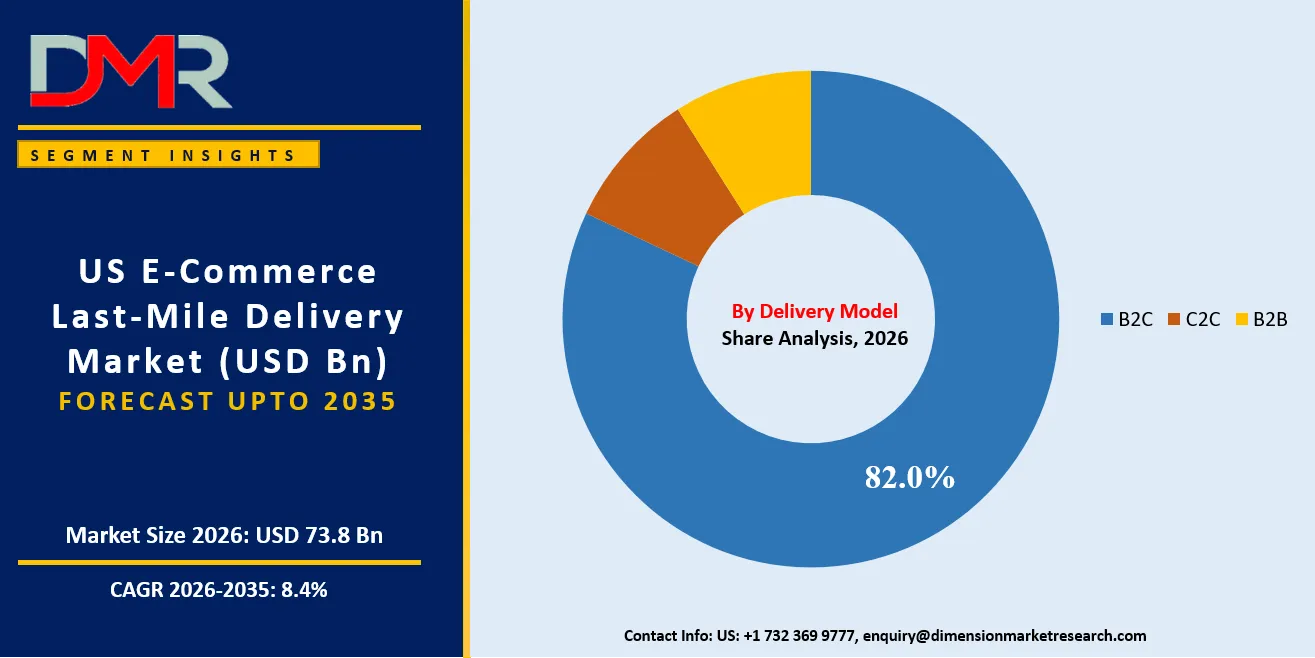
- By Delivery Model: The B2C Delivery segment is projected to dominate with an 82.0% share in 2026.
- By City Tier: Tier 1 Cities are expected to hold the largest market share at 52.0% in 2026.
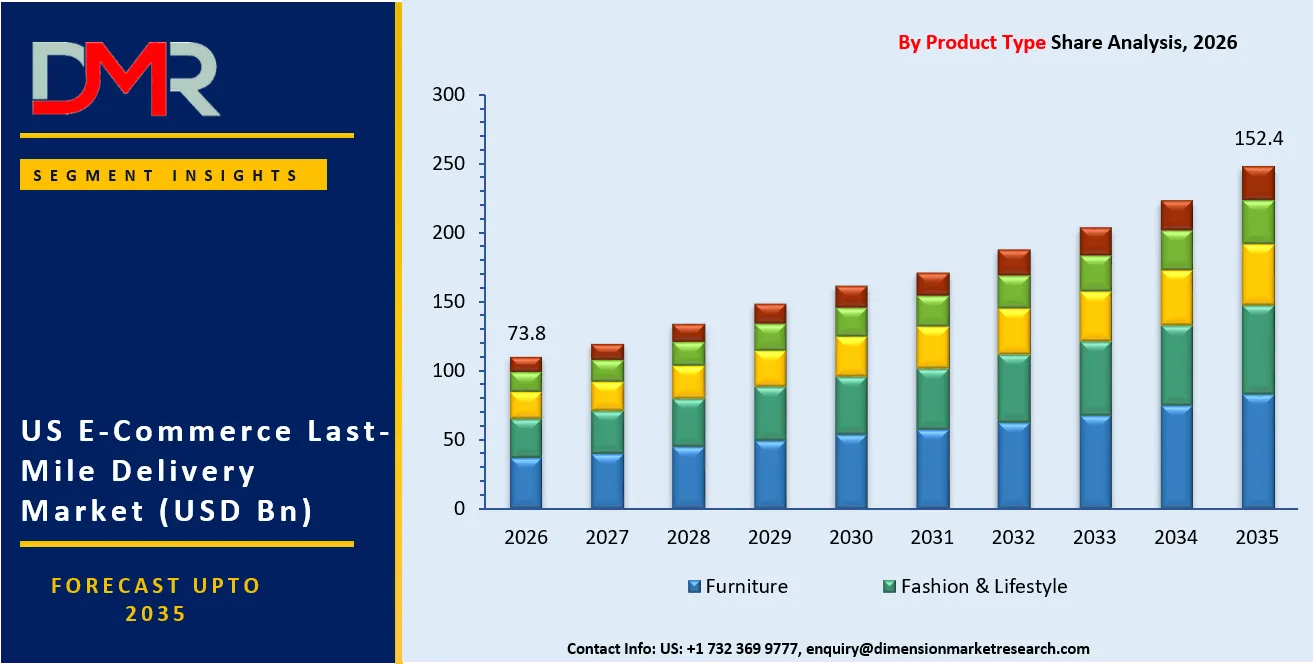
- By Product Type: The Food & Beverages segment is anticipated to lead with a 28.0% share in 2026.
- Major Players: Veho Tech, Inc., FedEx, Better Trucks, Amazon, Inc., UniUni, International Distribution Service plc and Others
What is the US E-Commerce Last-Mile Delivery Market and its Market Size?
The US E-Commerce Last-Mile Delivery Market size is projected to be valued at USD 73.8 billion in 2026 and is projected to reach USD 152.4 billion by 2035, expanding at a CAGR of 8.4% during the forecast period. Last-mile delivery covers the final movement of an online order from a fulfillment center, store, local depot, or micro-fulfillment facility to the customer's delivery address.
ℹ
To learn more about this report –
Download Your Free Sample Report Here
The market is expanding as US consumers increasingly expect fast, flexible, trackable, and reliable delivery options. Standard delivery remains the largest delivery type, accounting for 58.0% of the market in 2026, supported by its balance of cost and service reliability. Same-day delivery is gaining momentum as retailers and logistics providers invest in local inventory, automated fulfillment, route optimization, and distributed delivery networks. B2C delivery leads with an 82.0% share, reflecting strong e-commerce activity across retail, direct-to-consumer brands, grocery, food, fashion, and household products.
Use Cases
- Online Retail Fulfillment: Last-mile networks enable retailers and marketplaces to move consumer orders from warehouses or stores to residential addresses, supporting scalable e-commerce operations and improving delivery reliability.
- Same-Day and On-Demand Delivery: Local fulfillment hubs, crowdsourced fleets, and dynamic routing help businesses meet growing demand for rapid delivery across major metropolitan areas and dense urban markets.
- Grocery and Food Delivery: Temperature-sensitive products require precise delivery windows, real-time tracking, and specialized handling, making last-mile logistics critical for grocery, prepared food, and beverage orders.
- Direct-to-Consumer Shipping: DTC brands rely on third-party logistics providers and parcel carriers to deliver products directly to customers while managing delivery speed, shipping costs, tracking, and returns.
- Returns and Reverse Logistics: Last-mile infrastructure also supports product returns, exchanges, and pickups, helping e-commerce companies improve customer experience while reducing the operational burden of reverse fulfillment.
How AI/Gen AI is Transforming the US E-Commerce Last-Mile Delivery Market?
AI is changing last-mile delivery by improving demand forecasting, route planning, fleet utilization, and delivery-time prediction. Machine learning systems can combine historical order data, traffic conditions, weather, customer preferences, and delivery density to help carriers select more efficient routes. This is important in the US, where urban congestion and high delivery volumes can increase operating costs. AI-based forecasting also helps retailers position inventory closer to customers, supporting faster fulfillment and reducing unnecessary transportation miles. Computer vision and automated sorting can further improve parcel handling at fulfillment and distribution facilities. As e-commerce order volumes grow, these tools are helping logistics operators manage larger delivery networks with fewer manual decisions.
Generative AI is adding another layer by improving customer communication and operational decision-making. AI assistants can summarize delivery issues, answer customer questions, generate proactive delay notifications, and help service teams manage large volumes of delivery inquiries. Logistics companies can also use AI to analyze operational data and identify recurring bottlenecks across delivery zones. The growing use of connected vehicles, telematics, IoT sensors, and real-time tracking creates larger datasets for AI systems to analyze. Over time, the combination of predictive analytics and Gen AI is expected to support more responsive delivery networks, better resource allocation, and more personalized customer experiences. Adoption will depend on data quality, system integration, cybersecurity, and the ability of companies to demonstrate measurable savings.
Market Dynamic
Key Drivers: Rapid Growth of Online Shopping and Direct-to-Consumer Commerce
Rising online retail activity is the primary growth engine for the US e-commerce last-mile delivery market. Consumers now purchase a broad range of products through marketplaces, retailer websites, mobile applications, and DTC channels, creating sustained demand for residential parcel delivery. The expansion of online grocery, food, beauty, electronics, and household categories is also increasing delivery frequency. Retailers are investing in omnichannel fulfillment models that combine stores, warehouses, and local distribution points to shorten delivery distances. This shift is supporting demand for parcel carriers, specialized last-mile providers, crowdsourced fleets, and technology platforms that can handle high order density while maintaining predictable delivery performance.
Rising Consumer Expectations for Faster and More Flexible Delivery
Consumer expectations are moving beyond basic home delivery toward faster delivery windows, accurate tracking, convenient time slots, and flexible pickup options. Same-day and next-day services are becoming important competitive tools, particularly in large metropolitan areas where inventory can be positioned close to customers. Retailers are responding by expanding micro-fulfillment, ship-from-store, and local delivery capabilities. The growth of these models increases the need for advanced route optimization and real-time dispatch systems. It also encourages partnerships between retailers and specialized delivery companies that can provide flexible capacity during peak periods. As delivery experience becomes part of the overall shopping journey, service quality is increasingly influencing customer loyalty and repeat purchases.
Restraints: High Operating Costs and Delivery Network Complexity
High labor, fuel, vehicle, insurance, and maintenance costs remain major constraints for last-mile delivery operators. The final delivery stage is often the most expensive part of the logistics chain because individual orders must be delivered across dispersed residential locations. Urban congestion can increase travel time, while rural routes may require longer distances and lower delivery density. Returns, failed deliveries, and redelivery attempts add further costs. Companies are responding through route optimization, parcel lockers, consolidated delivery models, electric vehicles, and local fulfillment centers. However, the upfront investment required for technology and infrastructure can be challenging for smaller logistics providers and emerging e-commerce businesses.
Regulatory, Labor, and Infrastructure Challenges
Regulatory requirements and labor constraints can limit the efficiency of last-mile networks. Delivery companies must manage evolving rules related to vehicle emissions, urban access, worker classification, safety, and commercial vehicle operations. At the same time, driver availability remains important during seasonal peaks when parcel volumes rise sharply. Urban delivery networks also face limited curb space, traffic congestion, and restrictions on commercial loading. These factors can increase delivery times and operating expenses. Companies are exploring electric fleets, autonomous delivery technologies, lockers, and alternative pickup points to reduce pressure on traditional home delivery. The transition, however, requires capital investment and coordination with local infrastructure and regulations.
Growth Opportunities: Expansion of Same-Day Delivery and Local Fulfillment
Same-day delivery represents a major opportunity as retailers seek to compete on speed and convenience. The segment is projected to account for 15.0% of the market in 2026 and is expected to expand faster than standard delivery. Retailers are increasingly using stores, micro-fulfillment centers, dark stores, and regional hubs as inventory points closer to consumers. This approach can reduce delivery distances and support faster order processing. Third-party logistics providers and specialized last-mile companies can benefit by offering flexible delivery capacity to retailers that do not want to build their own fleets. Continued investment in local inventory visibility, automated picking, and intelligent dispatching should create further opportunities.
Growth of Sustainable and Technology-Enabled Delivery Networks
Sustainability is creating new opportunities across the US last-mile delivery ecosystem. Companies are adopting electric vans, cargo bikes, route optimization, consolidated delivery models, and parcel lockers to reduce fuel use and emissions. Fleet electrification is particularly relevant for predictable urban and suburban routes where vehicles return to a central depot for charging. Technology providers can also support more efficient deliveries by improving load planning and reducing unnecessary miles. The use of AI, IoT tracking, robotics, and autonomous delivery systems may further improve network productivity. As retailers face pressure to balance fast shipping with environmental goals, logistics providers offering measurable emissions reductions may gain a competitive advantage.
Market Trends
Shift Toward Omnichannel and Distributed Fulfillment
US retailers are increasingly moving away from centralized fulfillment alone and adopting distributed delivery networks. Stores and local facilities are becoming fulfillment points that can serve nearby customers more quickly. This trend supports ship-from-store, curbside pickup, buy online and pick up in store, and same-day delivery. Distributed fulfillment can also reduce the distance between inventory and customers, which may improve delivery speed and transportation efficiency. The model requires accurate inventory visibility and strong coordination between retail operations and logistics systems. As more businesses adopt omnichannel strategies, last-mile delivery is becoming closely integrated with inventory management and customer experience platforms.
Increasing Use of AI, Automation, and Real-Time Visibility
Technology adoption is becoming a central trend in the US e-commerce last-mile delivery market. AI-powered routing, predictive delivery estimates, automated dispatching, digital proof of delivery, and real-time parcel tracking are increasingly used to improve operational control. Robotics and automated sorting are also supporting higher throughput in fulfillment and distribution facilities. At the customer level, real-time tracking and proactive notifications are improving delivery transparency. These technologies allow operators to respond more quickly to traffic disruptions, demand changes, and failed delivery attempts. As delivery networks become more complex, integrated technology platforms are expected to play a larger role in improving efficiency and maintaining service quality.
Research Scope and Analysis
The research study on the US E-Commerce Last-Mile Delivery Market provides a detailed assessment of market size, growth trends, demand patterns, competitive dynamics, technology adoption, and emerging opportunities across the US e-commerce logistics ecosystem. The analysis considers the growing role of parcel carriers, specialized last-mile providers, retail logistics networks, crowdsourced delivery platforms, and technology-enabled fulfillment solutions in supporting online commerce.
By Delivery Type
Standard delivery dominated the US E-Commerce Last-Mile Delivery Market with a 58.0% share in 2026, supported by its broad adoption across general merchandise, fashion, electronics, household products, and other non-perishable categories. Standard delivery remains attractive because it provides retailers with a practical balance between shipping cost and customer convenience. Large e-commerce platforms and traditional retailers continue to optimize standard parcel networks through regional fulfillment centers, automated sorting, route planning, and carrier diversification. At the same time, same-day delivery is emerging as the fastest-growing delivery type, with a 15.0% share in 2026.
ℹ
To learn more about this report –
Download Your Free Sample Report Here
Its growth is supported by consumer demand for rapid fulfillment and the expansion of local inventory models. Retailers are increasingly using stores, micro-fulfillment facilities, and urban distribution hubs to position products closer to customers. This shift is creating opportunities for specialized logistics providers and technology platforms that can coordinate high-density delivery operations. Over the forecast period, standard delivery is expected to retain its leading position by volume, while faster services should gain share as retailers compete on speed and convenience.
By City Tier
Tier 1 cities held the largest share of the US E-Commerce Last-Mile Delivery Market at 52.0% in 2026, supported by high population density, strong e-commerce adoption, large retail networks, and substantial demand for rapid delivery services. Major metropolitan areas provide attractive conditions for last-mile operators because high order density can improve route efficiency and support same-day delivery economics.
However, Tier 2 cities are gaining momentum and represented 31.0% of the market in 2026. These markets are benefiting from population migration, suburban expansion, growing digital commerce adoption, and investments in regional fulfillment infrastructure. Retailers are increasingly extending delivery coverage beyond the largest metropolitan areas to capture new consumer demand. The development of regional distribution centers and improved transportation networks is helping logistics providers reach smaller cities more efficiently. Over the forecast period, Tier 2 markets are expected to record strong growth as e-commerce adoption expands and retailers seek to improve nationwide delivery coverage.
By Product Type
Foods & Beverages represented the largest product type segment, accounting for 28.0% of the US E-Commerce Last-Mile Delivery Market in 2026. The segment benefits from rising online grocery adoption, meal delivery demand, convenience-oriented shopping, and the expansion of rapid commerce services. Food and beverage delivery requires reliable fulfillment, accurate delivery windows, and, in many cases, temperature-controlled handling.
These requirements are encouraging retailers and logistics providers to invest in specialized local delivery capabilities. Fashion & Lifestyle followed with a 24.0% share, supported by strong online apparel, footwear, accessories, beauty, and personal care sales. The segment also generates significant returns activity, increasing demand for reverse logistics solutions. Electronics, household products, health and wellness items, and other categories contribute to overall market demand. The increasing diversity of products purchased online is encouraging delivery providers to develop flexible networks capable of handling different package sizes, service requirements, and delivery time expectations.
ℹ
To learn more about this report –
Download Your Free Sample Report Here
By Delivery Model
B2C delivery led the market with an 82.0% share in 2026, reflecting the strong expansion of online retail, direct-to-consumer commerce, grocery delivery, and digital marketplaces. The growth of B2C delivery is closely linked to the increasing number of residential shipments generated by consumers purchasing products through retailer websites, mobile applications, and e-commerce platforms. Retailers and DTC brands are investing in fulfillment networks that can support faster order processing, accurate tracking, and convenient delivery windows. Third-party logistics companies are also expanding their role by providing flexible capacity to brands that lack their own delivery infrastructure.
The B2C model benefits from continued growth in categories such as food, beverages, fashion, beauty, electronics, and household goods. Rising demand for same-day and next-day services is further encouraging the use of local warehouses and store-based fulfillment. As e-commerce penetration increases, B2C delivery is expected to remain the central demand base for the US last-mile ecosystem, while B2B and other specialized models will continue to serve commercial and institutional requirements.
The US E-Commerce Last-Mile Delivery Market Report is segmented on the basis of the following
By Delivery Type
- Next-Day
- Standard
- Same-Day
By Delivery Model
By City Tier
- Tier 3 & Below
- Tier 1
- Tier 2
By Product Type
- Furniture
- Fashion & Lifestyle
- Personal & Household Care
- Foods & Beverages
- More
Competitive Landscape
The US E-Commerce Last-Mile Delivery Market is highly competitive and includes global parcel carriers, postal networks, large retailers, technology-enabled delivery platforms, and specialized last-mile logistics companies.
Key players include:
- Veho Tech, Inc.
- FedEx
- Better Trucks
- Amazon, Inc.
- UniUni
- International Distribution Service plc
- DoorDash, Inc.
- United States Postal Service (USPS)
- RXO, Inc.
- Walmart, Inc.
- GoFor
- Pitney Bowes, Inc.
- Jitsu
- DHL Group
- Sway
- OnTrac
- Instacart, Inc.
- United Parcel Service of America, Inc.
- SpeedX
- Target Corporation
- Dropoff, Inc.
- Uber Technologies, Inc.
Recent Developments
- May 2026: Amazon launches Supply Chain Services, opening freight, fulfillment, and parcel shipping to all businesses, directly competing with UPS and FedEx for third-party logistics.
- May 2026: USPS and DHL eCommerce sign exclusive $10B+ multi-year deal; DHL handles nationwide pickup/sortation across 19 US hubs, USPS delivers to 170M+ locations, scaling domestic operations.
- July 2026: Walmart expands drone delivery to 70 stores nationwide, with aggressive plan to reach 270 locations by end-2027, competing with Amazon Prime Air's 30M customer target.
Report Details
| Report Characteristics |
| Market Size (2026) |
USD 73.8 Bn |
| Forecast Value (2035) |
USD 152.4 Bn |
| CAGR (2026–2035) |
8.4% |
| Historical Data |
2021 - 2025 |
| Forecast Data |
2027 - 2035 |
| Base Year |
2025 |
| Estimate Year |
2026 |
| Segments Covered |
By Delivery Type, By Delivery Model, By City Tier, By Product Type |
| Key Segments |
Delivery Type – Next-Day, Standard, Same-Day;
Delivery Model – C2C, B2C, B2B;
City Tier – Tier 3 & Below, Tier 1, Tier 2;
Product Type – Furniture, Fashion & Lifestyle, Personal & Household Care, Foods & Beverages, More |
| Leading Segment (2026) |
Standard Delivery - 58.0% Share |
| Dominant Delivery Model (2026) |
B2C Delivery -82.0% Share |
| Largest City Tier Segment (2026) |
Tier 1 Cities - 52.0% Share |
| Leading Product Type (2026) |
Foods & Beverages - 28.0% Share |
| Major Players |
Veho Tech, Inc., FedEx, Better Trucks, Amazon, Inc., UniUni, International Distribution Service plc, DoorDash, Inc., United States Postal Service (USPS), RXO, Inc., Walmart, Inc., GoFor, Pitney Bowes, Inc., Jitsu, DHL Group, Sway, OnTrac, Instacart, Inc., United Parcel Service of America, Inc., SpeedX, Target Corporation, Dropoff, Inc., Uber Technologies, Inc. |
Frequently Asked Questions
What is the current size of the US E-Commerce Last-Mile Delivery Market?
▾ The US E-Commerce Last-Mile Delivery Market is valued at USD 73.8 billion in 2026 and is projected to reach USD 152.4 billion by 2035.
What is the growth rate of the US E-Commerce Last-Mile Delivery Market during?
▾ The US E-Commerce Last-Mile Delivery Market is expected to grow at a CAGR of 8.4% during 2026 to 2035.
What factors are driving the growth of the US E-Commerce Last-Mile Delivery Market?
▾ Growth is driven by e-commerce expansion, faster delivery demand, DTC growth, and AI-based logistics adoption.
What are the major challenges restraining the US E-Commerce Last-Mile Delivery Market?
▾ High delivery costs, labor shortages, fuel expenses, and network complexity challenge the US E-Commerce Last-Mile Delivery Market.
Which segment holds the largest share of the US E-Commerce Last-Mile Delivery Market?
▾ The B2C delivery segment leads the US E-Commerce Last-Mile Delivery Market with an 82.0% share in 2026.
Who are the leading companies in the US E-Commerce Last-Mile Delivery Market?
▾ Major companies operating in the US E-Commerce Last-Mile Delivery Market include Veho Tech, Inc., FedEx, Better Trucks, Amazon, Inc., UniUni, International Distribution Service plc, DoorDash, Inc., United States Postal Service (USPS), RXO, Inc., Walmart, Inc., GoFor, Pitney Bowes, Inc., Jitsu, DHL Group, Sway, OnTrac, Instacart, Inc., United Parcel Service of America, Inc. (UPS), SpeedX, Target Corporation, Dropoff, Inc., and Uber Technologies, Inc.
How is AI influencing the US E-Commerce Last-Mile Delivery Market?
▾ AI enhances route optimization, demand forecasting, delivery tracking, automation, and operational efficiency in logistics.
What are the future opportunities and trends in the US E-Commerce Last-Mile Delivery Market?
▾ Future trends include drone delivery, EV fleets, smart lockers, automation, AI logistics, and sustainable delivery solutions.