US Automation in Energy Optimization Market Snapshot
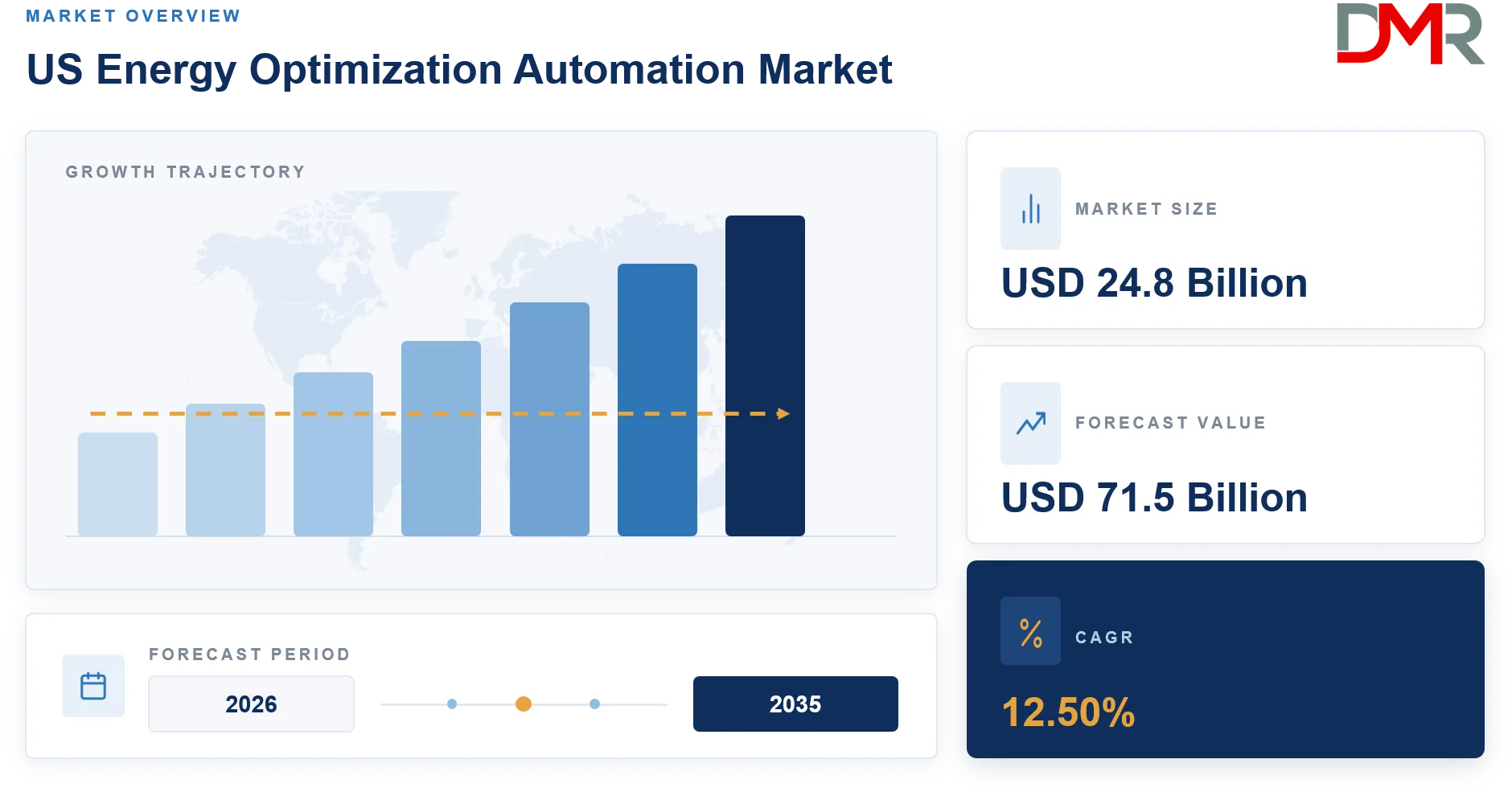
- Market Value: US Automation in Energy Optimization market is valued at USD 24.8 billion in 2026 and is expected to reach USD 71.5 billion by 2035.
- CAGR: US Automation in Energy Optimization market is expected to grow at a CAGR of 12.5% from 2026 to 2035.
- By Technology/Solution Type Segment Analysis: AI/ML-Based Optimization Platforms led the segment with a 28.0% share in 2026.
- By Product Segment Analysis: Software & Platforms led product types with a 45.0% share in 2026.
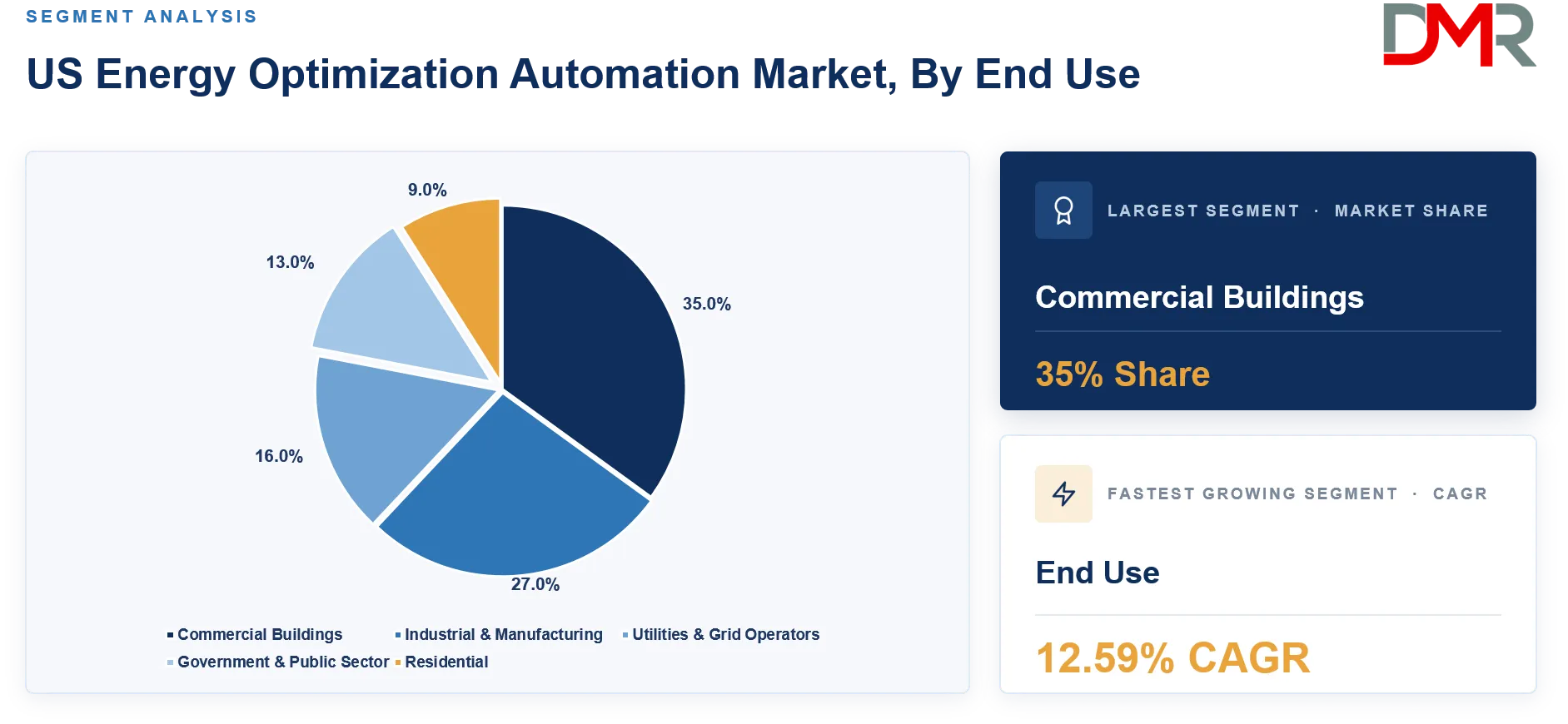
- By End Use Segment Analysis: Commercial Buildings held a 35.0% share in 2026.
- Major Players: Schneider Electric, Siemens, Honeywell, Johnson Controls, ABB and Others.
What is the US Automation in Energy Optimization Market and its Market Size?
The US Automation in Energy Optimization Market size is projected to be valued at USD 24.8 billion in 2026 and is projected to reach USD 71.5 billion by 2035, expanding at a steady CAGR of 12.5% during the forecast period. The market covers software, platforms, control systems, sensors, analytics, connected equipment, and professional services that automatically monitor and improve energy use across buildings, factories, utilities, public infrastructure, and homes.
ℹ
To learn more about this report –
Download Your Free Sample Report Here
Energy optimization automation combines operational technology with cloud software, AI/ML analytics, building management systems, industrial control, smart meters, demand response, and distributed energy management. Demand is expanding as US organizations seek better control over electricity costs, peak demand, equipment performance, and grid interaction. The US Department of Energy reports that buildings account for about 40% of national energy use and roughly 75% of electricity consumption, making automated building and facility optimization a major addressable opportunity.
Use Cases
- Automated HVAC Optimization: Commercial property owners use connected controls and AI/ML models to adjust heating, cooling, ventilation, temperature setpoints, schedules, and airflow according to occupancy, weather, equipment conditions, and electricity prices. This reduces unnecessary runtime while protecting comfort and indoor air quality across single sites and large property portfolios.
- Industrial Energy Optimization: Manufacturers connect motors, compressors, pumps, process equipment, meters, and production systems to industrial energy management platforms. Automation helps detect excessive energy intensity, coordinate high load equipment, identify equipment degradation, and align production schedules with energy cost and operational targets.
- Demand Response Automation: Utilities and large electricity users apply smart controls to adjust flexible loads during peak grid conditions or high price periods. Automated demand response can coordinate HVAC systems, batteries, EV charging, industrial loads, and distributed energy resources without requiring operators to manually control each asset.
- Portfolio Energy Management: Enterprises with multiple buildings use centralized software to compare sites, normalize consumption, identify anomalies, rank energy projects, track utility bills, and automate operating changes. Portfolio management is particularly relevant to retailers, offices, healthcare groups, universities, hospitality operators, and government agencies.
- Distributed Energy Coordination: Energy optimization platforms can coordinate solar generation, battery storage, generators, flexible loads, and grid electricity. Automated controls choose when to consume, store, curtail, or export power according to site demand, tariffs, resilience requirements, and equipment constraints, strengthening the business case for distributed energy resources.
How AI/Gen AI is Transforming the US Automation in Energy Optimization Market?
AI is moving energy optimization from scheduled control toward continuous, condition based decision making. Traditional building and industrial automation often follows fixed setpoints, calendars, or operator commands. AI/ML platforms can instead evaluate sensor data, occupancy, weather, equipment status, historical demand, tariffs, and operational constraints at the same time. This allows systems to identify inefficient operating patterns and recommend or execute changes before excess consumption becomes visible on a monthly utility bill. Siemens, Schneider Electric, Honeywell, Johnson Controls, BrainBox AI, C3.ai, and other suppliers are building analytics, predictive control, and automated optimization into energy and facility platforms.
Generative AI is also expanding the user interface for energy management. Facility teams can increasingly query operational data using natural language, summarize alarms, compare facilities, investigate abnormal energy consumption, and convert complex equipment data into prioritized actions. The larger opportunity is the combination of generative interfaces with domain specific optimization models and automated controls. For decision makers, this can shorten analysis cycles and help smaller engineering teams manage larger asset portfolios. Adoption will still depend on data quality, integration with legacy control systems, cybersecurity, operator trust, and clear rules governing which recommendations can be executed automatically.
Key Drivers in the US Automation in Energy Optimization Market
High Commercial and Industrial Energy Costs Create a Clear Automation Business Case
Energy optimization is gaining board level relevance because electricity and fuel costs directly affect operating margins. US commercial buildings represent a large energy load, while factories depend on motors, compressed air, process heating, cooling, and other energy intensive equipment. EIA data for 2018 identified about 5.9 million US commercial buildings consuming roughly 6.8 quadrillion Btu and spending around USD 141 billion on energy. Automated controls can address waste continuously instead of relying only on periodic audits, which supports demand for software, sensors, analytics, and energy management services.
Electrification and Grid Complexity Increase the Need for Flexible Energy Control
Electrification is adding new controllable loads across facilities, including heat pumps, EV charging, battery systems, electric process equipment, and data center infrastructure. At the same time, distributed solar and storage are creating more complex site energy flows. Organizations need software that can decide when equipment should operate, how much power it should use, and whether electricity should come from the grid, on site generation, or stored energy. This increases demand for automated demand management, distributed energy resource control, forecasting, and smart grid integration.
Restraints in the US Automation in Energy Optimization Market
Legacy Equipment and Fragmented Building Systems Raise Integration Costs
Many US facilities contain equipment installed across several upgrade cycles, which creates mixed protocols, proprietary controls, isolated meters, and incomplete operating data. A new optimization platform may need to connect to existing building management systems, programmable logic controllers, utility meters, sensors, and third party software before advanced automation can operate effectively. Retrofit complexity can lengthen implementation and increase engineering costs, particularly for older buildings and industrial sites where replacing core control infrastructure is not economically practical.
Cybersecurity Risk Limits Fully Autonomous Energy Control
Energy optimization increasingly connects operational technology with enterprise networks, cloud software, remote service teams, and external data feeds. This creates a larger cybersecurity surface for buildings, factories, utilities, and critical infrastructure. Automated systems that can change equipment schedules, electrical loads, or industrial controls require stronger access management, network segmentation, secure updates, and continuous monitoring. Cybersecurity concerns can slow procurement and encourage buyers to favor vendors that demonstrate strong OT security capabilities and compatibility with established industrial security standards.
Growth Opportunities in the US Automation in Energy Optimization Market
Retrofit Automation Across Existing Commercial Building Stock
The existing building base creates a large opportunity because energy optimization does not always require full equipment replacement. EIA estimates that the United States had around 5.9 million commercial buildings in its 2018 CBECS dataset. Cloud based supervisory platforms, wireless sensors, smart meters, gateways, and software overlays can add analytics and automated control to installed building systems. Solutions that work with BACnet and other open protocols can reduce retrofit barriers and extend optimization to offices, retail sites, schools, hospitals, warehouses, hotels, and mixed use properties.
AI Data Centers and High Density Digital Infrastructure
Rapid expansion of AI computing is increasing attention on electricity availability, cooling efficiency, power quality, and capacity planning. Data centers require coordinated management of IT loads, cooling systems, backup power, electrical distribution, and increasingly on site energy resources. Energy automation providers can capture new demand through real time thermal optimization, intelligent cooling, workload aware power management, predictive maintenance, and distributed energy control. Vendors that connect facility systems with power and cooling analytics are positioned to benefit from the growing need for high availability and energy efficient digital infrastructure.
Trends in the US Automation in Energy Optimization Market
Energy Management is Shifting From Dashboards to Automated Action
Energy software is moving beyond visualization and monthly reporting. New platforms increasingly combine monitoring, anomaly detection, forecasting, optimization, and direct control. Schneider Electric promotes AI enabled building controls that automatically adjust energy use, while Siemens integrates AI/ML analytics into platforms such as Building X and building optimization applications. This shift changes the value proposition from identifying inefficiency to correcting it continuously, supporting recurring software revenue and stronger demand for interoperable control platforms.
Open, Cloud Connected and Portfolio Scale Platforms Gain Importance
Large organizations increasingly want a common energy management layer across facilities that may contain equipment from several manufacturers. As a result, interoperability, APIs, BACnet compatibility, cloud connectivity, remote operations, and portfolio analytics are becoming important purchase criteria. The market is also moving toward subscription based software that can be deployed across tens or hundreds of locations. This favors vendors that can combine edge control with centralized data management while allowing critical equipment to continue operating locally when cloud connectivity is interrupted.
Research Scope and Analysis
The US Automation in Energy Optimization Market is segmented based on Technology/Solution Type, Product, End Use, and regional categories. The study provides an in depth analysis of key segments and subsegments, covering their applications, industry adoption, demand patterns, purchasing criteria, technology development, and contribution to overall market growth.
ℹ
To learn more about this report –
Download Your Free Sample Report Here
By Technology/Solution Type;
AI/ML-Based Optimization Platforms dominated the Technology/Solution Type segment with 28.0% of market revenue in 2026. Their leadership reflects a shift from rule based energy management toward predictive and adaptive control. These platforms process equipment, meter, weather, occupancy, operational, and tariff data to identify energy waste and determine better control strategies. Key applications include HVAC optimization, load forecasting, anomaly detection, predictive maintenance, industrial process optimization, peak demand management, and distributed energy coordination. Their advantage is the ability to operate above existing control infrastructure, which can allow building owners and industrial operators to improve performance without replacing every underlying asset. Continued advances in edge computing, digital twins, cloud analytics, and domain specific machine learning are expected to broaden adoption.
By Product;
Software & Platforms accounted for 45.0% of the US market in 2026, making it the leading product category. Software captures growing value because optimization increasingly depends on data aggregation, analytics, forecasting, portfolio management, automated control, reporting, and integration across heterogeneous equipment. Cloud deployment also supports subscription pricing and allows vendors to serve multi site customers without installing a separate management environment at each property. Buyers are seeking solutions that integrate with existing building automation systems, meters, sensors, industrial controllers, distributed energy resources, and utility data. Hardware remains essential for sensing and control, while services support commissioning, integration, maintenance, and energy performance improvement. Software is expected to retain a central role as customers move from equipment specific automation toward enterprise wide energy intelligence.
By End Use;
Commercial Buildings held 35.0% of US Automation in Energy Optimization market revenue in 2026. The segment includes offices, retail facilities, healthcare properties, hotels, educational buildings, warehouses, data centers, and other nonindustrial facilities. Commercial buildings contain large controllable loads such as HVAC, lighting, refrigeration, pumps, ventilation, and increasingly EV charging and battery storage. Building owners can therefore achieve measurable improvements by coordinating equipment schedules, occupancy signals, weather forecasts, utility tariffs, and indoor comfort requirements. The US Department of Energy identifies buildings as a major national electricity consumer, which strengthens the economic importance of building energy management. Portfolio owners are also adopting centralized platforms that allow energy teams to identify poor performing sites and automate corrective actions across multiple locations.
The US Automation in Energy Optimization Market Report is segmented on the basis of the following:
By Technology/Solution Type
- AI/ML-Based Optimization Platforms
- Building Automation & Control Systems
- Industrial Energy Management Software
- Smart Grid & Demand Response Automation
- Others
By Product
- Software & Platforms
- Hardware
- Services
By End Use
- Commercial Buildings
- Industrial & Manufacturing
- Utilities & Grid Operators
- Government & Public Sector
- Residential
Competitive Landscape
The US Automation in Energy Optimization market combines global industrial automation companies, building technology suppliers, energy software specialists, utility focused platforms, and AI optimization vendors. Schneider Electric competes through EcoStruxure energy management, building automation, microgrid, and grid software. Siemens combines Building X, automation systems, digital services, and AI enabled building optimization. Honeywell uses Forge, building controls, cloud analytics, and energy management applications, while Johnson Controls competes through OpenBlue and building management technology.
ABB, Eaton, GE, Rockwell Automation, Emerson, and Trane Technologies bring strong industrial, electrical, HVAC, and control system positions. Software specialists such as GridPoint, EnergyCAP, Facilio, Spacewell Energy, Verdigris, BrainBox AI, Uplight, and C3.ai compete through cloud analytics, AI, utility engagement, energy intelligence, and automated optimization. Competition increasingly centers on measurable savings, integration with legacy systems, portfolio scalability, cybersecurity, interoperability, AI capabilities, and the ability to move from energy insight to automated action.
Some of the prominent players in the US Automation in Energy Optimization Industry are:
- Schneider Electric
- Siemens
- Honeywell
- Johnson Controls
- ABB
- Eaton
- General Electric
- IBM
- GridPoint
- EnergyCAP
- Facilio
- Spacewell Energy
- Verdigris
- BrainBox AI
- Uplight
- C3.ai
- Trane Technologies
- Rockwell Automation
- Emerson
- Enel X
- Others
Technology Analysis
The US Automation in Energy Optimization market is moving toward intelligent, connected control architectures that combine AI/ML models, building automation systems, industrial energy management software, smart meters, edge devices, cloud analytics, and demand response platforms. AI/ML-based optimization platforms held 28.0% share in 2026, showing that buyers increasingly value predictive control over fixed schedules and manual energy monitoring. Modern platforms ingest HVAC, lighting, occupancy, weather, tariff, equipment, and production data to forecast loads and automatically adjust operating parameters. BACnet-enabled building systems, IoT gateways, digital twins, advanced sensors, and API-based integration are improving interoperability across mixed equipment fleets. Edge computing is also gaining importance because critical control decisions can remain local while portfolio analytics run in the cloud. These capabilities support automated HVAC tuning, peak-load management, predictive maintenance, battery dispatch, EV charging coordination, and industrial process optimization, strengthening demand for scalable software-led energy intelligence.
Regulatory Landscape
The US regulatory landscape for energy optimization automation is shaped by federal electricity-market rules, state building codes, energy-efficiency standards, cybersecurity expectations, and utility demand-management programs. FERC Order No. 2222 is particularly important because it removes barriers for aggregated distributed energy resources, including storage, demand response, energy efficiency resources, EV charging, and distributed generation, to participate in organized wholesale markets. This creates a stronger role for automated platforms that can coordinate flexible loads and distributed assets. At the state level, California's 2025 Energy Code took effect on January 1, 2026 and strengthens efficiency, electrification, battery storage, and demand-flexible building strategies for new construction and major alterations. Cybersecurity is also a procurement requirement as building automation and industrial control systems become more connected. NIST SP 800-82 Rev. 3 provides guidance for protecting operational technology, including building automation systems. These rules favor vendors with secure, interoperable, auditable, and grid-responsive solutions.
Recent Developments
- August 2026: Siemens Partners with Electric Power Group to combine grid automation and analytics, creating a solution for proactive U.S. grid management, resilience, and energy optimization.
- June 2026: Schneider Electric launched next-generation EcoStruxure Foxboro software-defined automation technologies, advancing U.S. energy and industrial operations through more flexible, connected control.
- January 2026: Trane Technologies introduced AI Control, an AI-enabled service for Tracer SC+ systems that automates HVAC energy optimization continuously without additional labor or capital investment.
Report Details
| Report Characteristics |
| Market Size (2026) |
USD 24.8 Bn |
| Forecast Value (2035) |
USD 71.5 Bn |
| CAGR (2026-2035) |
12.5% |
| Historical Data |
2021 - 2025 |
| Forecast Data |
2027 - 2035 |
| Base Year |
2025 |
| Estimate Year |
2026 |
| Segments Covered |
By Technology/Solution Type (AI/ML-Based Optimization Platforms, Building Automation & Control Systems, Industrial Energy Management Software, Smart Grid & Demand Response Automation, and Others), By Product (Software & Platforms, Hardware, and Services), and By End Use (Commercial Buildings, Industrial & Manufacturing, Utilities & Grid Operators, Government & Public Sector, and Residential) |
| Regional Coverage |
United States |
Frequently Asked Questions
What is the current size of the US Automation in Energy Optimization Market?
▾ The US Automation in Energy Optimization Market size is USD 24.8 billion in 2026 and may reach USD 71.5 billion by 2035.
What is the growth rate of the US Automation in Energy Optimization Market during?
▾ The US Automation in Energy Optimization Market is projected to grow at a CAGR of 12.5% during 2026-2035.
What factors are driving the growth of the US Automation in Energy Optimization Market?
▾ Energy costs, electrification, AI controls, and grid flexibility drive the US Automation in Energy Optimization Market.
What are the major challenges restraining the US Automation in Energy Optimization Market?
▾ Legacy integration costs and cybersecurity risks restrain growth in the US Automation in Energy Optimization Market.
Which segment holds the largest share of the US Automation in Energy Optimization Market?
▾ AI/ML-Based Optimization Platforms lead the US Automation in Energy Optimization Market with a 28.0% share in 2026.
Who are the leading companies in the US Automation in Energy Optimization Market?
▾ Schneider Electric, Siemens, Honeywell, Johnson Controls, ABB, Eaton, General Electric, IBM, GridPoint, EnergyCAP, Facilio, Spacewell Energy, Verdigris, BrainBox AI, Uplight, C3.ai, Trane Technologies, Rockwell Automation, Emerson, and Enel X are leading companies in the US Automation in Energy Optimization Market.
How is AI influencing the US Automation in Energy Optimization Market?
▾ AI supports predictive control and real-time energy savings in the US Automation in Energy Optimization Market.
What are the future opportunities and trends in the US Automation in Energy Optimization Market?
▾ AI optimization, smart grids, and retrofits create new opportunities in the US Automation in Energy Optimization Market.