Market Overview
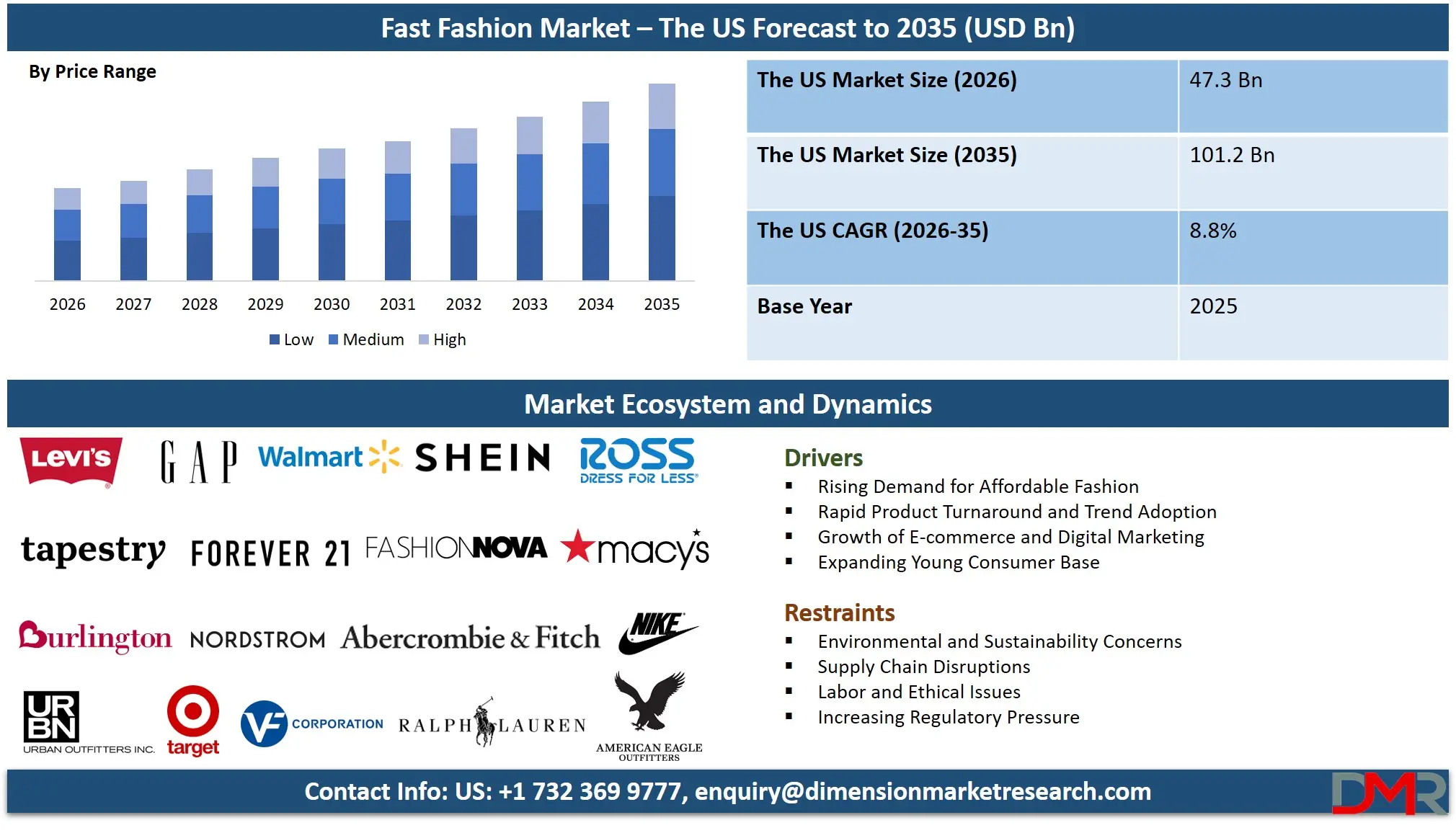
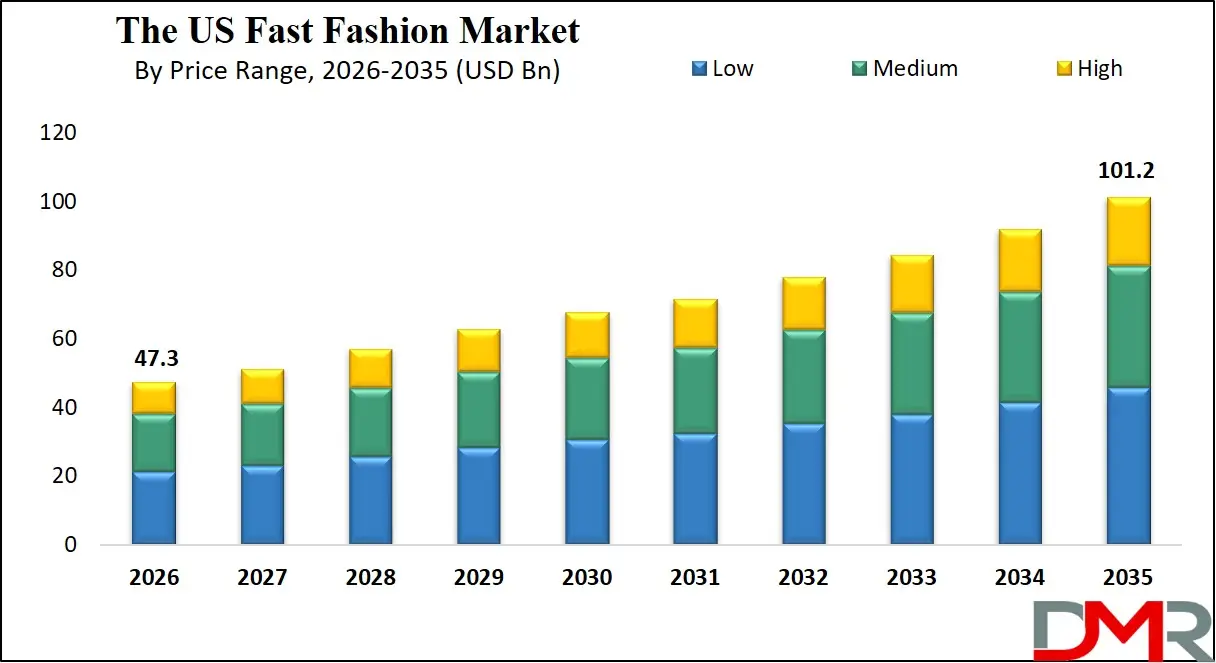
The US fast fashion market size is expected to reach USD 47.3 billion in 2026, and it is further anticipated to reach a market value of USD 101.2 billion by 2035 at a CAGR of 8.8%.
ℹ
To learn more about this report –
Download Your Free Sample Report Here
The US fast fashion market is one of the most dynamic and trend-driven markets for apparel in the world. The fast pace of trends, social media, and consumers' need for affordability and variety drive this market. The major cities in the US, such as New York, Los Angeles, and Chicago, are key trendsetters for fast fashion. The country has an excellent retail infrastructure and highly advanced logistics capabilities.
Fast fashion in the US is now dominated by digital-native brands and omnichannel retailers. Consumers demand ultra-fast turnaround from runway to retail, with weekly product drops and real-time updates. The rise of buy-now, pay-later services, influencer marketing, and resale is significantly impacting purchase behavior for consumers of all demographics.
ℹ
To learn more about this report –
Download Your Free Sample Report Here
The US Fast Fashion Market: Key Takeaways and Other Influencing Factors
- Market Growth Insights: The market is anticipated to reach approximately USD 58.2 billion in 2026 and is projected to expand to around USD 98.5 billion by 2035, growing at a CAGR of 6.0%.
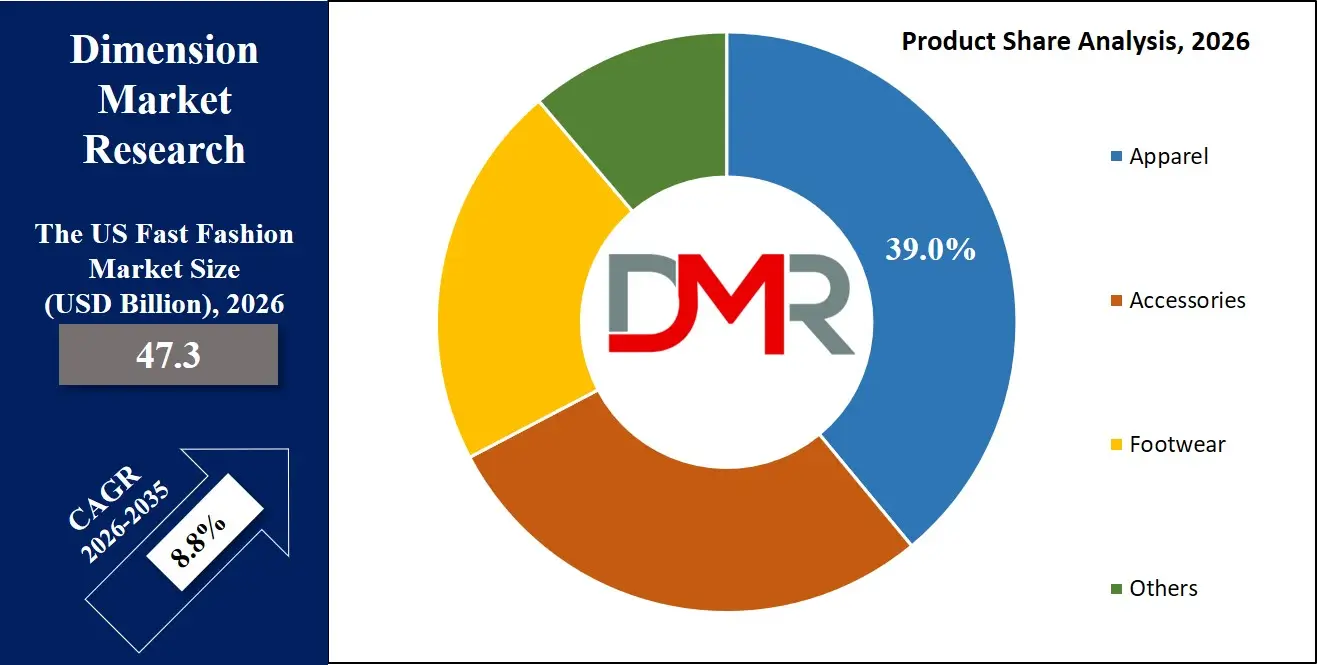
- By Product Insights: Apparel are poised to be the leading segment in this market led by large category of clothing like tops, dresses, and denim, with accessories growing share through impulse-driven social commerce.
- By Price Range Insights: Low price range segment is poised to be the dominant one in the US fast fashion market, attracting Gen Z and millennials looking for trends without heavy spending.
- By Distribution Channel Insights: Online leads the way in the US fast fashion market, especially due to mobile shopping, while offline retains relevance through curated flagship stores and pop-ups.
- By End User Insights: Women account for the majority of fast fashion spending, though men's and children's segments are expanding rapidly due to targeted marketing and subscription boxes.
- U.S. Bureau of Labor Statistics (BLS): An average U.S. household spends around USD 655 on women's apparel per year and USD 406 on men’s and notable footwear expenses, reflecting strong and consistent consumer demand driven by frequent purchasing behavior in the fast fashion market.
- U.S. Environmental Protection Agency (EPA): The United States generates over 11 million tons of textile waste annually, with nearly 85% ending up in landfills, highlighting the environmental impact of fast fashion and increasing pressure for recycling, sustainability initiatives, and responsible consumption practices.
- U.S. Census Bureau: The U.S. apparel market has a large size of over USD 350 billion in terms of value. The U.S. has the largest apparel market in the world. The U.S. apparel market has the advantage of high levels of consumer spending, an advanced retail infrastructure, and the penetration of e-commerce. The U.S. apparel market has the advantage of high levels of consumer spending and the penetration of e-commerce.
Impact of Iran Conflict on the US Fast Fashion Market
The Iranian conflict has had a considerable impact on the US fast fashion industry in the form of cost increases and declining demand. Increases in the price of oil, caused by conflicts affecting the strait of Hormuz, have led to increases in the cost of goods. This has been caused by the increase in the cost of transporting goods, as well as the cost of raw materials. Additionally, the cost of synthetic products has been affected.
The Iranian conflict has also had a negative impact on the US fast fashion industry in the form of declining demand. Increases in the price of oil have reduced the amount of disposable income in the hands of consumers. This has led to a decline in the amount spent on clothing.
The US Fast Fashion Market: Use Cases
- Trend-Driven Apparel Fulfillment Ecosystem: This involves fast response manufacturing and micro-batch production to enable fashion brands to experiment on social media and only scale products that perform extremely well. This results in reduced waste and improved demand forecasting for fast fashion supply chains.
- Influencer-Led Drop Models: This involves fashion brands partnering with influencers on social media platforms such as TikTok or Instagram to promote limited-edition products, which are then sold out quickly. This increases customer engagement as FOMO plays a significant role in fast fashion.
- Rental and Resale Integration: This involves fast fashion brands partnering with companies such as ThredUp or developing their own rental services to increase product life cycles, attract eco-conscious customers, and increase revenue streams while reducing negative environmental impacts.
- Accelerated Urban Same-Day Delivery Models: This involves establishing micro-fulfillment centers in urban areas such as New York City or Los Angeles to deliver fast fashion products within a single day. This allows fast fashion brands to compete favorably with industry leaders such as Amazon.
The US Fast Fashion Market: Market Dynamics
Driving Factors in the US Fast Fashion Market
Social Commerce Explosion
Social commerce platforms such as TikTok Shop, Instagram, and YouTube Shopping have reduced the purchase cycle from product discovery to purchase. Viral challenges and trends on the platform have resulted in the sale of millions of units in a matter of days. The immediate purchase cycle has enabled fast fashion brands to respond instantaneously to consumer demand. Moreover, the integration of seamless checkout facilities has reduced the purchase cycle. Therefore, fast fashion brands are increasingly adopting social commerce as a key marketing strategy to target the youth.
Influencer and Celebrity Collaborations
Collaborations with influencers and celebrities such as Charli D’Amelio and Cardi B have emerged as key demand generators in the fast fashion market. These collaborations help in the sale of products in the fast fashion market. The collaboration generates urgency and exclusivity in the product offerings of the fast fashion brand. The sale of products happens in a matter of hours. Moreover, the collaboration enables the fast fashion brand to attract the attention of the followers of the influencer. The emotional connect between the influencer and the audience has resulted in the success of this marketing strategy in the fast fashion market.
Restraints in the US Fast Fashion Market
High Return Rates
Fast fashion retail is also facing challenges due to high rates of product return from online shopping, which is estimated to be around 30-40%. This is mainly due to inconsistent sizing, low product lifespan, and high impulsiveness due to high-pressure marketing. This is not only creating problems but is also reducing the profit margins of fast fashion retail. Therefore, with increasing competition, fast fashion retail has to invest more in improving product sizing and quality to reduce product return rates.
Regulatory and ESG Pressure
Regulatory and ESG pressure is becoming a major restraint for fast fashion retail. Governments are imposing various regulations and laws regarding environmental and social issues. For example, governments are imposing extended producer responsibility (EPR) regulations on textile products. This means that the producer will be responsible for the disposal and recycling of the product. This is not only creating problems but is also reducing the profit margins of fast fashion retail. Moreover, with increasing pressure from consumers regarding sustainability issues, fast fashion retail is becoming a major challenge. If fast fashion retail fails to comply with these regulations and laws, it will lose market share.
Opportunities in the US Fast Fashion Market
AI-Driven Personalization
Artificial intelligence is revolutionizing fast fashion as it offers highly personalized customer experiences. AI-based recommendation systems analyze consumer behavior and preferences to make suitable product suggestions. Moreover, generative AI allows customers to virtually view products and receive styling tips. This increases consumer satisfaction while reducing returns. This will prove to be a boon for fast fashion as technology continues to improve. Brands can enjoy a competitive advantage in terms of offering highly personalized experiences for their customers.
Circular Business Models
Fast fashion can benefit greatly from circular business models. Resale platforms, clothing rental services, repair services, and recycling are some examples of circular business models. These models can prove to be highly beneficial for fast fashion as they will allow these companies to increase product life while reducing waste. Moreover, these models will open new revenue streams for fast fashion as many consumers are now looking for sustainable products. This will prove to be a boon for fast fashion as technology continues to improve. Brands can enjoy a competitive advantage in terms of offering highly personalized experiences for their customers.
Trends in the US Fast Fashion Market
Ultra-Fast Fashion (1–2 Week Lead Times)
Ultra-fast fashion is revolutionizing fast fashion as these companies are now offering products within a lead time of one to two weeks. Companies such as Shein are now utilizing data analytics to quickly design and deliver products to customers. This is highly efficient as these companies are now able to keep up with consumer demand. Moreover, traditional fast fashion retailers are now forced to keep up with these ultra-fast fashion retailers. This trend has revolutionized fast fashion as these companies are now offering highly efficient services. However, there are still many challenges for these companies as there are many environmental concerns related to fast fashion.
On-Demand Manufacturing
Another emerging trend in the fast fashion market is on-demand manufacturing. It is allowing the market to shift towards the manufacturing of products based on real-time demand. Techniques such as print-on-demand or cut-sew-trim methods enable the market to produce products only after receiving orders or even through pre-orders. It is reducing the chances of overproduction, excess inventory, or waste. The market is shifting towards more sustainable practices with the rise of the sustainability factor. It is providing the market with an alternative way of being profitable while being more environmentally conscious.
The US Fast Fashion Market: Research Scope and Analysis
By Product Analysis
Apparels are projected to dominate the fast fashion market with a wide range of products such as tops, bottoms, dresses, outerwear, and more. They cater to the ever-changing trends in the market. They form the major part of the market in terms of revenue as they require frequent purchase cycles.
ℹ
To learn more about this report –
Download Your Free Sample Report Here
Accessories such as jewelry, bags, belts, and more act as the secondary source of revenue. They are sold along with apparels. Footwear is gaining traction in the market with the rise of influencer trends in affordable sneakers and sandals. Other categories, such as swimwear, loungewear, shapewear, are gaining traction with the rise in lifestyles.
By Price Range Analysis
The low price segment is expected to hold the largest market share in fast fashion due to its high appeal to price-conscious customers, especially Gen Z and millennials looking for fashionable clothing at a low price. The constant replenishment of products creates a sense of urgency for customers to buy on impulse, while the low price eliminates customer reluctance to buy. This allows for high sales volume for companies. Companies can enjoy economies of scale as they source products at a low price and can afford to manufacture products at a low price. Moreover, economic uncertainty favors low-priced products, which increases their market share in fast fashion.
By Distribution Channel Analysis
Online channels are projected to dominate the fast fashion market, accounting for the highest sales due to convenience, wide product selection, and aggressive digital marketing. This is because consumers find it highly convenient and have access to a large number of products and aggressive digital marketing campaigns. Brand websites, Amazon, and Walmart have played a significant role in boosting sales in the fast fashion market. In addition, social commerce has shown significant growth in recent years due to its potential in accelerating sales growth.
By End User Analysis
Women apparel have shown significant growth in the fast fashion market, contributing to the highest sales volume in this market. This is because women purchase more frequently and have access to a large number of products in the fast fashion market. Similarly, men’s fast fashion has shown significant growth in recent years. This is because men have shown increasing interest in streetwear and athleisure wear. Children’s fast fashion has shown stable growth in recent years due to consistent demand for back-to-school season and periodic wardrobe updates. Similarly, the unisex segment has shown significant growth in recent years due to increasing demand for unisex products.
The US Fast Fashion Market Report is segmented on the basis of the following:
By Product
- Apparel
- Accessories
- Footwear
- Others
By Price Range
By Distribution Channel
By End User
- Men
- Women
- Children
- Unisex
Impact of Artificial Intelligence in the US Fast Fashion Market
Artificial Intelligence plays a vital role in revolutionizing the fast fashion industry in the USA. Artificial Intelligence increases efficiency and customer engagement in fast fashion retail. Artificial Intelligence is used to analyze consumer data and social media trends to make predictions on consumer demand. This way, fast fashion retailers can increase efficiency and accuracy in demand prediction. This is important in fast fashion retail as it is a competitive market.
Another role played by Artificial Intelligence in fast fashion retail is customer personalization. Artificial Intelligence plays a vital role in fast fashion retail as it increases customer satisfaction. Artificial Intelligence is used to personalize consumer experiences. This way, fast fashion retailers can increase customer satisfaction. This increases customer loyalty as customers are highly satisfied.
The US Fast Fashion Market: Competitive Landscape
The fast fashion industry in the USA is highly competitive. There are many fast fashion retailers in the USA. The fast fashion industry in the USA is characterized by both domestic and international fast fashion retailers. Companies such as Zara, H&M, and Shein are some of the international fast fashion retailers in the USA. These fast fashion retailers are highly competitive as they are global leaders. Companies such as Gap Inc. and American Eagle Outfitters are some of the domestic fast fashion retailers in the USA.
ℹ
To learn more about this report –
Download Your Free Sample Report Here
Fast fashion retailers are highly competitive as they are both domestic and international. Companies are using e-commerce as a way of marketing their products. This has increased competition as many fast fashion retailers are using social media as a way of marketing their products. Companies are collaborating with influencers to market their products. This has increased competition as many fast fashion retailers are collaborating with influencers.
Some of the prominent players in the US Fast Fashion Market are:
- Nike
- Gap Inc.
- Levi Strauss & Co.
- Ralph Lauren Corporation
- PVH Corp.
- Tapestry Inc.
- VF Corporation
- American Eagle Outfitters
- Urban Outfitters Inc.
- Abercrombie & Fitch Co.
- Forever 21
- Fashion Nova
- Shein
- Target Corporation
- Walmart Inc.
- Macy’s Inc.
- Nordstrom Inc.
- Ross Stores Inc.
- Burlington Stores Inc.
- TJX Companies Inc.
- Other Key Players
Recent Developments in the US Fast Fashion Market
- March 2026: Shein has opened its first returns processing facility in the U.S. in Indiana, aiming to improve its reverse logistics, cut down on shipping costs, and reduce delivery time. The facility is expected to cut operational costs by 20%.
- February 2026: Zara has launched an AI-driven virtual stylist on its U.S. app, allowing for better customer engagement, increased personalization, and an increased average order value by 12%.
- January 2026: H&M has partnered with a textile recycling startup to enable consumers to drop off any clothing item at its physical stores, aiming to promote circular fashion and improve its sustainability drive in the U.S. market.
- December 2025: Forever 21 has relaunched its loyalty program with rewards based on various challenges on social media, such as TikTok, to improve customer engagement, drive sales, and improve its interaction with consumers.
Report Details
| Report Characteristics |
| Market Size (2026) |
USD 47.3 Bn |
| Forecast Value (2035) |
USD 101.2 Bn |
| CAGR (2026–2035) |
8.8% |
| Historical Data |
2021 – 2025 |
| Forecast Data |
2027 – 2035 |
| Base Year |
2025 |
| Estimate Year |
2026 |
| Report Coverage |
Market Revenue Estimation, Market Dynamics, Competitive Landscape, Growth Factors and etc. |
| Segments Covered |
By Product (Apparel, Accessories, Footwear, and Others), By Price Range (Low, Medium, and High), By Distribution Channel (Online, Offline, and Others), By End User (Men, Women, Children, Unisex) |
| Country Coverage |
The US |
| Prominent Players |
Nike, Gap Inc., Levi Strauss & Co., Ralph Lauren Corporation, PVH Corp., Tapestry Inc., VF Corporation, American Eagle Outfitters, Urban Outfitters Inc., Abercrombie & Fitch Co., Forever 21, Fashion Nova, Shein, Target Corporation, Walmart Inc., Macy’s Inc., Nordstrom Inc., Ross Stores Inc., Burlington Stores Inc., TJX Companies Inc., and Other Key Players |
| Purchase Options |
We have three licenses to opt for: Single User License (Limited to 1 user), Multi-User License (Up to 5 Users) and Corporate Use License (Unlimited User) along with free report customization equivalent to 0 analyst working days, 3 analysts working days and 5 analysts working days respectively. |
Frequently Asked Questions
How big is the US Fast Fashion Market?
▾ The US Fast Fashion Market size is estimated to have a value of USD 47.3 billion in 2026 and is expected to reach USD 338.8 billion by the end of 2035.
What is the growth rate in the US Fast Fashion Market in 2026?
▾ The market is growing at a CAGR of 8.8 percent over the forecasted period of 2026.
Who are the key players in the US Fast Fashion Market?
▾ Some of the major key players in the US Fast Fashion Market are Nike, Gap Inc., Levi Strauss & Co., Ralph Lauren Corporation, PVH Corp., Tapestry Inc., VF Corporation, American Eagle Outfitters, and many others.