Market Overview
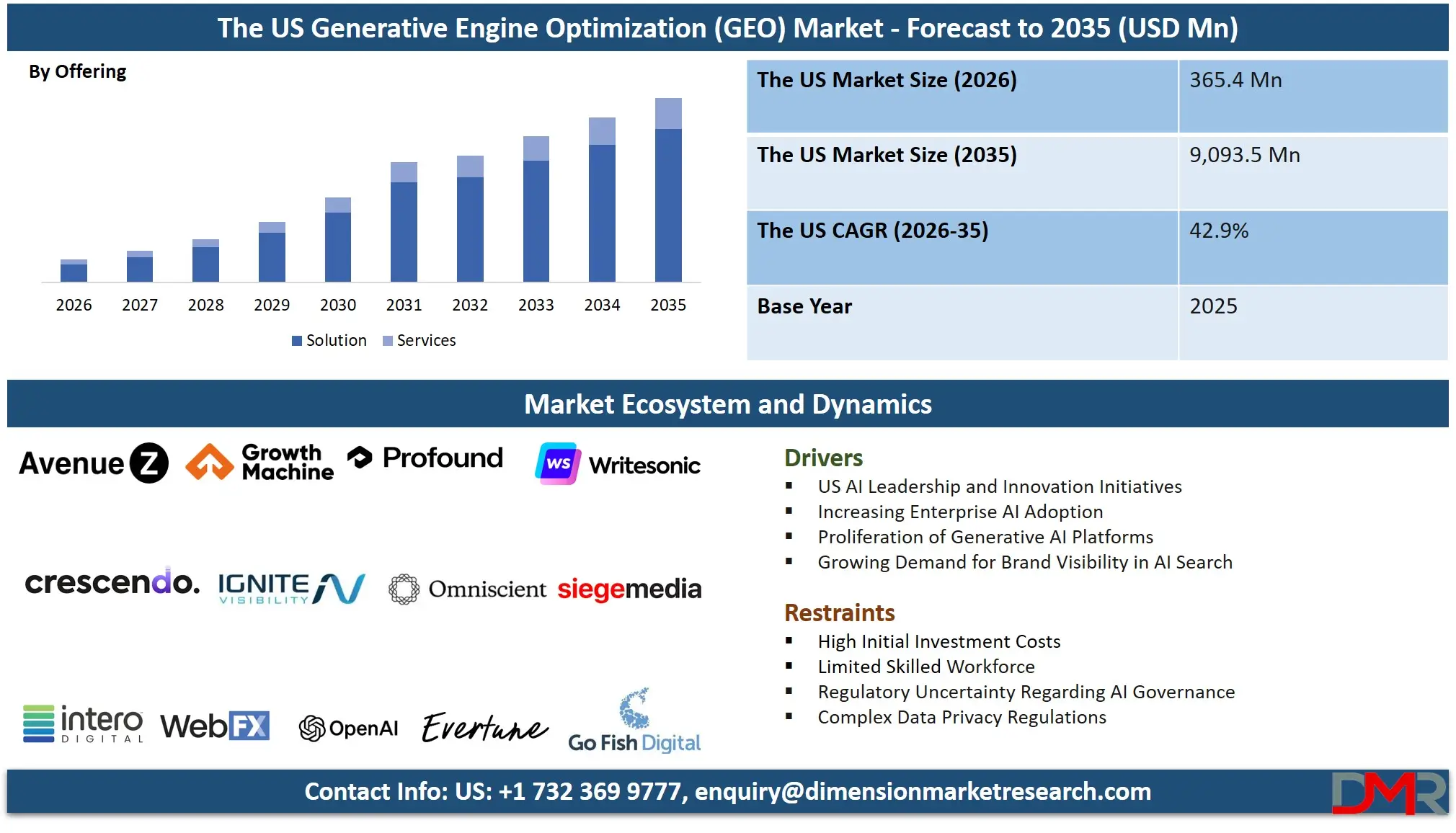
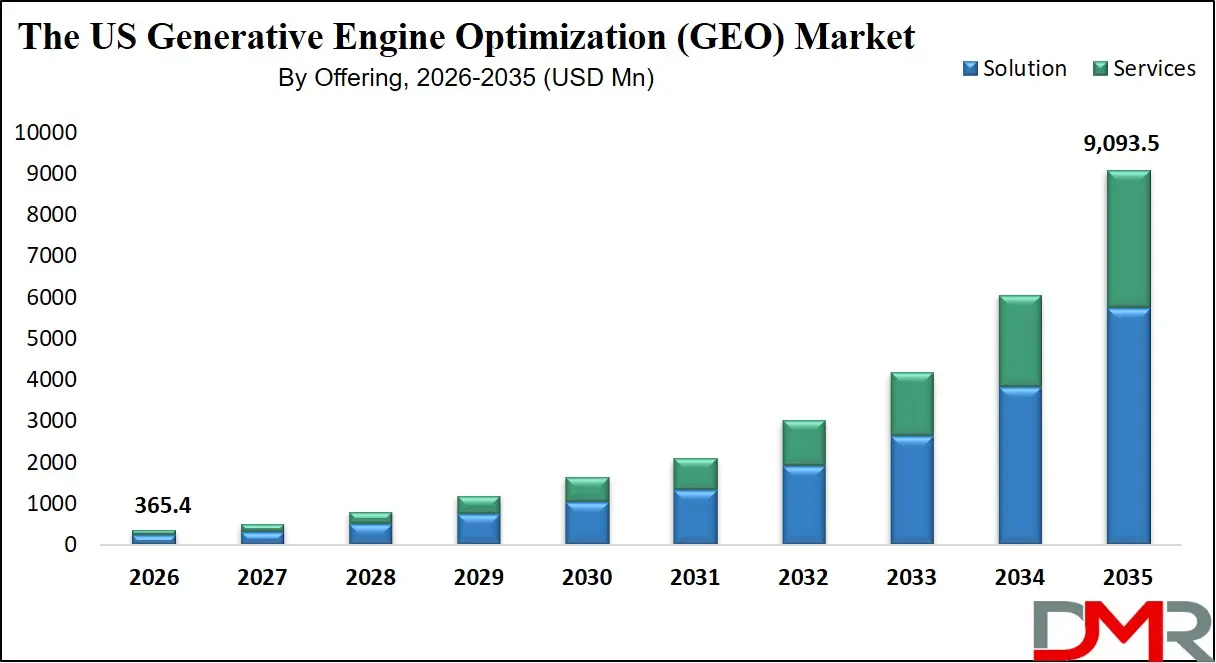
The US Generative Engine Optimization (GEO) Market is projected to reach USD 365.4 million in 2026 which is further forecasted to be valued at USD 9,093.5 million by the end of 2035 at a compound annual growth rate of 42.9% over its forecast period. This rapid expansion highlights GEO as a transformative force within the U.S. digital ecosystem, fueled by the widespread adoption of artificial intelligence, generative search engines, and conversational AI platforms.
ℹ
To learn more about this report –
Download Your Free Sample Report Here
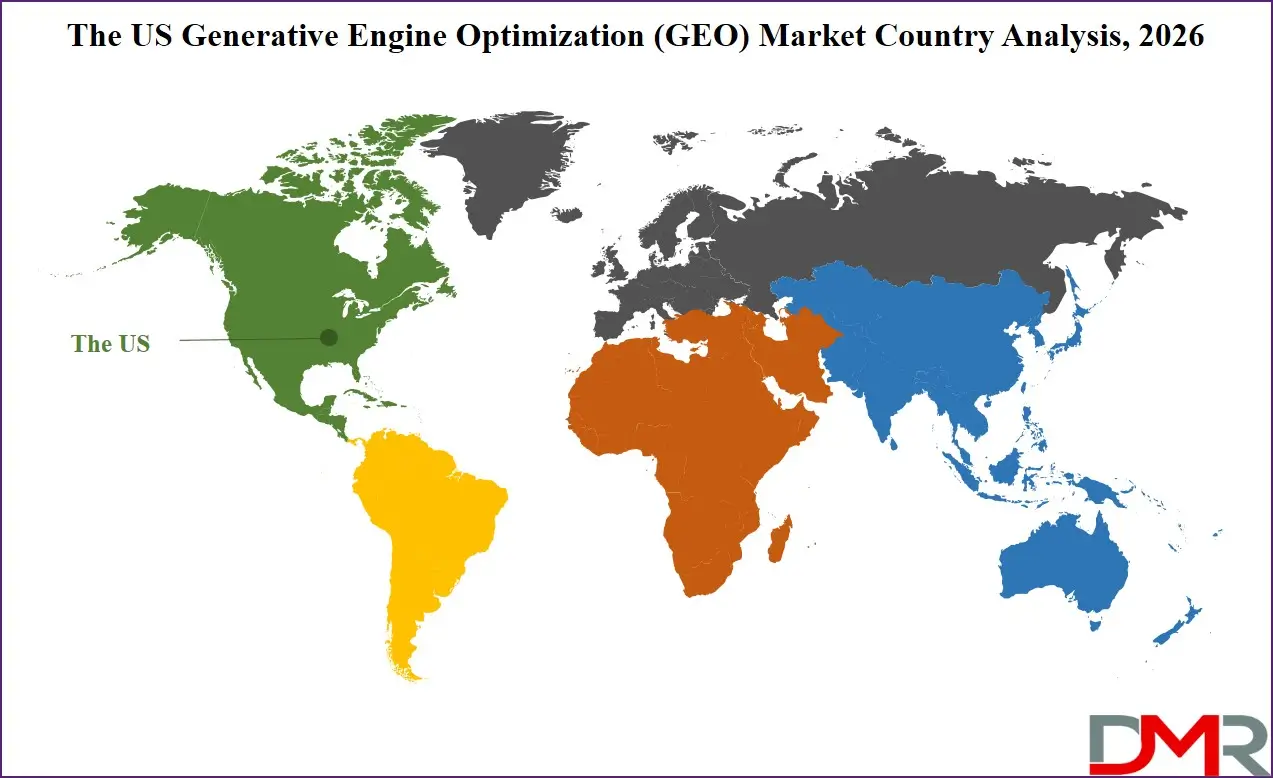
GEO has emerged as a critical discipline in digital marketing, encompassing advanced strategies such as AI content optimization, prompt engineering, structured data enhancement, and semantic search alignment. As generative platforms increasingly replace traditional search paradigms, businesses are prioritizing AI-first visibility strategies to maintain discoverability across dynamic digital interfaces. The U.S., being a hub for AI innovation and home to leading technology companies, is at the forefront of developing and deploying GEO solutions across industries including retail, media, SaaS, and e-commerce.
The market is witnessing a shift toward sophisticated techniques such as knowledge graph optimization, large language model fine-tuning, retrieval-augmented generation, and real-time brand monitoring. These innovations enable enterprises to influence AI-generated outputs, improve contextual relevance, and enhance brand authority in conversational results. The rise of AI-driven search platforms and assistants has significantly accelerated demand for scalable GEO frameworks that ensure consistent and authoritative digital presence.
Key trends shaping the GEO landscape include the transition from traditional SEO to AI-native optimization models, increased reliance on machine learning algorithms, and the integration of predictive analytics for real-time decision-making. Additionally, ethical AI practices—such as transparency, source attribution, and factual accuracy—are gaining importance as organizations aim to build trust and ensure brand safety in automated content environments. The growth of conversational commerce further reinforces the need for precise, intent-driven content optimization.
ℹ
To learn more about this report –
Download Your Free Sample Report Here
Despite strong growth momentum, challenges persist. Regulatory uncertainty surrounding AI governance, evolving data privacy laws, and algorithmic opacity present hurdles for consistent GEO implementation. Moreover, a shortage of skilled professionals with expertise in AI behavior, prompt engineering, and generative optimization may limit rapid adoption.
Overall, the U.S. GEO market is set to redefine digital visibility, offering substantial opportunities for innovation, competitive differentiation, and long-term growth in the AI-driven economy.
The US Generative Engine Optimization (GEO) Market: Key Takeaways
- Market Value: The United States Generative Engine Optimization Market size is estimated to have a value of USD 365.4 million in 2026 and is expected to reach USD 9,093.5 million by the end of 2035.
- By Offering Segment Analysis: Solution is anticipated to dominate this segment in this market as it will hold 68.3% of market share in 2026.
- By Deployment Segment Analysis: Cloud-based GEO solutions is projected to dominate the deployment segment in the US GEO Market with highest market share in 2026.
- By Application Segment Analysis: Content and discoverability optimization is anticipated to dominates the US GEO market with major market share in 2026.
- By End User Industry Segment Analysis: The software and technology sector is projected to dominate the end-user segment in the US GEO market in 2026.
- Key Players: Some of the major key players in the United States Generative Engine Optimization Market are OpenAI, Google, IBM, Microsoft, Salesforce, Oracle, Cognizant, and many others.
- Market Growth Rate: The market is growing at a CAGR of 42.9 percent over the forecasted period.
The US Generative Engine Optimization (GEO) Market: Use Cases
- Healthcare Information Accessibility: Timely delivery of accurate medical information, provider details, and health resources; structured data optimization and authority building play a very critical role in healthcare discoverability.
- Media Content Distribution: Streamlining content metadata, headlines, and article structuring to facilitate the discoverability of media publications and meet the diversified information demands of users across different generative platforms.
- E-commerce Product Discovery: This is about optimization of product content, attributes, and structured data for AI shopping assistants and generative search results to offer accurate, comprehensive, and purchase-ready product information across digital commerce platforms.
- Brand Reputation Management: Brand presence would be managed in AI-generated summaries and responses; advanced GEO techniques ensure that the brand narrative is handled most professionally and accurately represented in conversational AI outputs.
The US Generative Engine Optimization (GEO) Market: Stats & Facts
Pew Research Center
- 21% of U.S. workers use AI at work in 2025, up from 16% in 2024
- 65% of workers rarely or never use AI in their jobs
- 31% of Americans interact with AI several times daily
- 47% of Americans have high awareness of AI, up from 26% in 2022
- 55% of U.S. adults want more control over AI usage
- Only 23% of Americans believe AI will positively impact jobs
Federal Reserve Bank of St. Louis
- Generative AI adoption reached 54.6% in 2025
- Work-related AI adoption increased to 37.4%
- Non-work AI usage reached 48.7%
- AI adoption surpassed early personal computer adoption levels of 19.7% in 1984
Brookings Institution
- 57% of Americans use generative AI for personal purposes
- 40% of users increased AI usage year-over-year
- Around 20% of users apply AI in professional settings
- AI adoption is higher among educated and high-income groups
Harvard Kennedy School
- 39.4% of U.S. adults aged 18–64 use generative AI
- 28% of employed individuals use AI at work
- Nearly 11% of workers use AI daily
- AI adoption is faster than early internet adoption, which was 30.1% in 1998
National Science Foundation
- 33% of software companies use AI
- 25% of data processing firms use AI
- 23% of IT services firms use AI
- 45% of large enterprises (10,000+ employees) use AI
U.S. Census Bureau
- Around 7% of U.S. firms currently use AI
- AI adoption is higher in knowledge-intensive industries
- Large firms show significantly higher adoption than small businesses
NIST / U.S. Government AI Initiatives
- AI Safety Institute established in 2024 to guide AI governance
- Over 200 organizations participate in AI safety collaborations
- Initial funding allocation for AI safety initiatives was USD 10 million
- AI frameworks emphasize risk management, transparency, and validation
U.S. Government & Policy
- 59 AI-related federal regulations were introduced in 2024
- Nearly 700 AI-related bills introduced across 45 states
- 45% of federal agencies have experimented with AI systems
- AI-related government contracts totaled USD 5.2 billion over a decade
The US Generative Engine Optimization (GEO) Market: Market Dynamic
Driving Factors in the US Generative Engine Optimization (GEO) Market
US AI Leadership and Innovation Initiatives
United States' technological leadership underlines innovation away from dependence on traditional search and makes the GEO industry one of the mainstays of the digital economy. Huge investments in AI infrastructure projects like frontier model developments and enterprise AI integrations have been driving growth. In addition, it also comprises AI-friendly policies like supporting open research and reducing innovation barriers, which also attract domestic and international investments. This helps strengthen the nation's standing as a leading technology hub in North America.
Increasing Enterprise AI Adoption
United States enterprises are also developing AI actively with their participation in digital transformation initiatives, increasing the volumes of AI-generated content consumption, which in turn are raising demand for more sophisticated GEO solutions. The upgrading of digital marketing strategies, expansion of AI customer service channels, and the development of better content management systems are easing the way to smoother AI interactions. All these growth drivers increase the digital connectivity of the nation in business and ensure the prosperity of the GEO sector in the AI-driven world economy.
Restraints in the US Generative Engine Optimization (GEO) Market
High Initial Investment Costs
Advanced GEO technologies and specialized talent development require huge capital investment, although the market is very supportive. Smaller enterprises can hardly afford automated optimization tools, proprietary analytics platforms, or AI model integrations. This may impede market growth and further widen the gap between large corporations and SMEs in access to advanced digital visibility solutions.
Limited Skilled Workforce
The GEO industry will have a shortage of professionals who may manage modern techniques like prompt engineering or model behavior analysis. While workforce development is included in national strategies, the pace of its AI adoption outpaces supplies of trained talent. Normally, companies rely on hiring experienced professionals, greatly increasing operational costs. Getting over this restraint will involve considerable investments in education and training programs meant to build a local pool of talent.
Opportunities in the US Generative Engine Optimization (GEO) Market
Integration of Emerging Technologies
The adoption of techniques such as retrieval-augmented generation, automated prompt engineering, and sentiment analysis presents an excellent opportunity for GEO optimization. Automated content structuring and predictive performance analytics cut down operational costs, while AI-powered systems enhance decision-making capabilities. Startups and established firms alike are testing such integrations, which offers an excellent opportunity for technology providers and investors to reach the US GEO market.
Expansion of Enterprise GEO Services
With growing demand for the professional implementation of temperature-sensitive content like regulated industry information, financial services data, and healthcare resources, this enterprise GEO services is developing at a very fast pace. There is also more inflow of investments into specialized consulting and training capabilities. Additionally, AI development in the United States and changing information consumption habits will further contribute to this segment and open doors for value-added service providers through innovative solution design.
Trends in the US Generative Engine Optimization (GEO) Market
Digital Transformation of Content Discovery
The GEO sector in the United States is also becoming a hub of digital transformation due to the initiatives laid down by leading AI companies for integrating optimization across all digital channels. Organizations are leveraging techniques such as knowledge graph integration, entity optimization, and sentiment alignment for real-time visibility, predictive content performance, and extended brand authority. For example, structured data markup provides timely signals to AI models about content relevance, hence reducing any misinterpretations. Entity optimization enhances accuracy in complex information retrieval processes, building trust among AI platforms. This trend significantly improves operational efficiencies, besides being in tune with global AI best practices, and cements the nation's status as a digital innovation hub.
Generative AI Expansion Boosting GEO Demand
This rapid growth has produced high demand in the United States for the sector to implement efficient GEO and content visibility solutions. Digital publishers such as The New York Times and Condé Nast have partnered with leading GEO providers to try to meet today's demanding expectations around AI content representation. The number of automated content optimization tools has been on the rise; there is an increasing level of conversational AI innovation, including the implementation of real-time brand monitoring. As generative AI is increasingly integral to information discovery, this trend is producing real investment in the technical infrastructure of GEO but also increasingly in digital platforms that then tie the operation together in one seamless interface for brands and consumers alike.
The US Generative Engine Optimization (GEO) Market: Research Scope and Analysis
By Offering Analysis
Solution is projected to dominate the offering segment in this market as it will hold 68.3% of market share in 2026. The dominance of solutions in the offering segment of the US GEO Market is owing to rapid AI adoption and digital transformation across the country. Businesses in the US are hugely investing in AI-powered marketing technologies; hence, advanced software solutions are being used to streamline GEO operations, ranging from content optimization tools and analytics platforms to structured data enhancement systems. The United States' technological leadership underlines the emphasis on integrating technology for the effective management of digital presence. It therefore raises demand for AI-enabled optimization tools, knowledge graph solutions, and prompt engineering platforms that help in analyzing AI model behavior with real-time visibility and building authority-critical to maintaining competitive advantage in this rapidly evolving market. Such huge enterprise AI initiatives spur demand for high-class optimization platforms, including automated content scoring systems, visibility monitoring dashboards, and model interaction analyzers.
It will help in the complete interconnectivity of strategic and technical components within a GEO program, thus making its future in the market indispensable. AI, machine learning, and NLP completely depend on this basic software for gathering and synchronizing data within their systems. Growth in the enterprise software industry also adds to the contribution of advanced optimization platforms that streamline the processes of content discoverability. Government-backed innovation zones and initiatives advocate the use of the latest available tools to reduce operational bottlenecks, thus supporting the market of solutions. Hence, solutions remain an integral factor as they provide the actual technological framework for modern GEO management in the US.
By Deployment Mode Analysis
Cloud-based GEO solutions are expected to dominate the share in the deployment segment of the GEO market in the US, owing to the strategic reliance on the cloud infrastructure of the country for digital operations. The United States has vast expanses of digital terrain with a cloud network connecting important economic regions for easier deployment of optimization technologies to enterprises across sectors such as technology, retail, and media. Cloud-based solutions offer flexibility and scalability no other deployment mode can provide. Real-time optimization and continuous monitoring, being very essential, do happen with digital marketing and e-commerce, and also in media industries. There is an unparalleled growth in the number of AI platforms, as, with a growing demand for agile solutions, manifold times the same enterprise would want to expect rapid or continuous updates.
The cloud infrastructure investments involve the expansion of data centers, adding specialized AI regions along major routes, and furthering deployment efficiency. This development also aligns with national AI strategies in positioning the US as a global technology hub. The proximity of technology clusters to cloud providers further cements their position as the main deployment mode for digital optimization. Among many factors, cost-effectiveness comes forward. Compared with on-premises, it has cloud-based solutions at lesser costs for scalability and maintenance, thus making them perfectly fit for enterprise or SMB deployments. The increased use of technologies for automated management, like serverless computing and API integrations, improves the operational efficiency-cum-situation more in enhancing cloud dominance.
By Application Analysis
Content and discoverability optimization is projected to hold the leading position with 32.8% of market share in the application segment of the US GEO Market in 2026, as such a segment is very crucial to assure digital visibility and audience engagement. With the fast growth of AI platforms, digital media, and e-commerce in the United States, the demand for advanced content and discoverability solutions that could handle such growing demand effectively is increasingly felt. Content optimization systems enable businesses under national innovation goals to attain the objective of the US being a global digital hub by ensuring the best content relevance with minimum ambiguity and improved entity authority. Advanced content optimization solutions integrate artificial intelligence, NLP, and knowledge graphs to offer real-time content scoring and seamless prompt response generation that minimizes errors, optimizes information architecture, and improves AI visibility. The increasing adoption of automated content analysis tools underlines the importance of this segment all the more. Besides, smart technologies are increasingly being adopted by enterprises that work in tandem with publishing and distribution systems to help lower response times and meet user expectations.
Further, this segment ensures dominance through the development of growing digital agencies. Most advanced content and discoverability systems have their dependence on such kinds of service providers by serving industries that range from healthcare and BFSI, among others. Supporting the market's demand are also some government initiatives towards developing innovation zones and digital hubs. Due to its immediate effects relating to brand awareness, efficiency within marketing, and satisfaction on the user facet, it keeps its superiority in the market.
By End User Industry Analysis
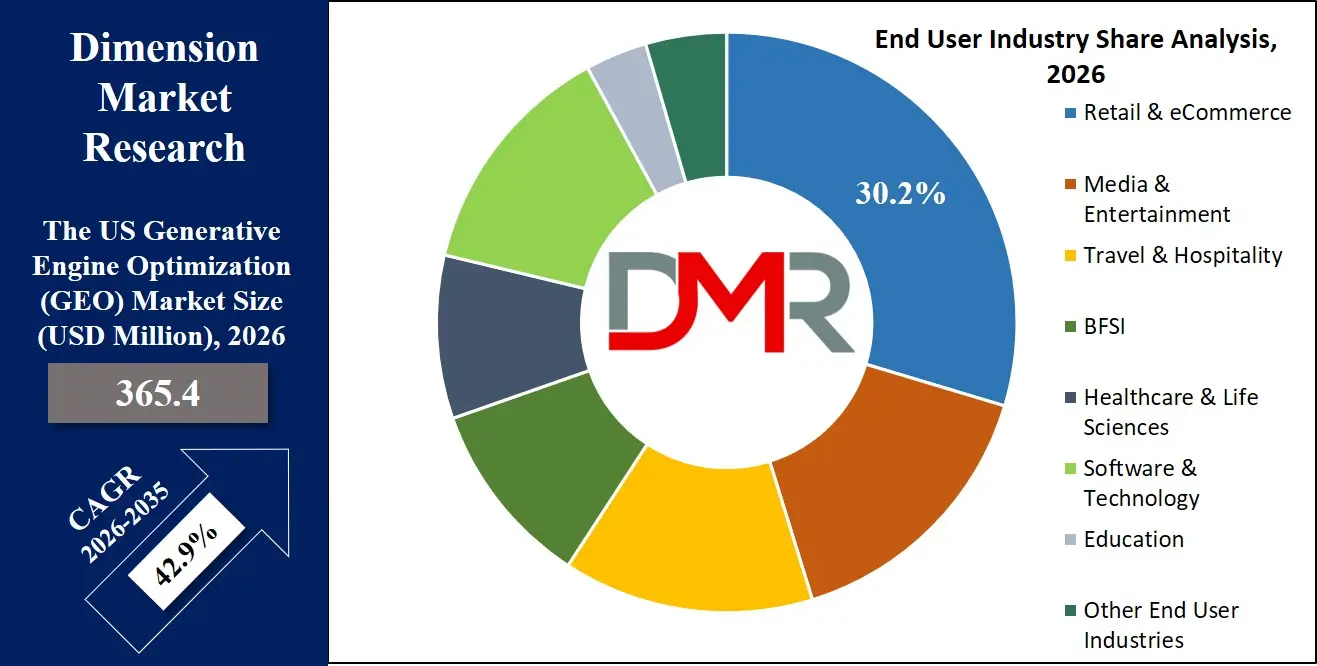
The retail and e-commerce sector is poised to dominate the end-user segment in the US GEO market because this sector has grown at a very fast rate and highly depends on efficient GEO and digital visibility management. AI-powered search is showing growth in the US, driven by a technologically advanced population, in seamless product discovery and purchase intent demand, driving this segment to dominate. The United States' innovation ecosystem emphasizes leadership into core areas, with a key focus on the retail and e-commerce sectors. Further, these segments would need the implementation of high-tech GEO solutions to guarantee accuracy and authority-impacting product content structuring, real-time monitoring of brand presence in AI shopping assistants, and prompt optimization since consumer expectations evolve day by day. Heavy investments have been made in infrastructure and technology not only by leading e-commerce giants like Amazon and Walmart but also by emerging direct-to-consumer players, making the market competitive in reality. Omnichannel strategies for online and offline operations are increasingly integrated by retailers-further raising the requirement for sophisticated GEO systems to ensure products are accurately represented across generative search results.
ℹ
To learn more about this report –
Download Your Free Sample Report Here
The government's support in enhancing the digital infrastructure, thereby establishing innovation hubs, improves the GEO for retail and e-commerce companies. Because these industries are considered major contributors to the US GDP and employment, they are considered one of the most dominant end-users. The retail and e-commerce industry continues to lead with the latest techniques and comprehensive optimization networks in shaping the country's GEO ecosystem.
The US Generative Engine Optimization (GEO) Market Report is segmented on the basis of the following:
By Offering
- Solution
- Content Optimization & Prompt Engineering Tools
- GEO Analytics & Monitoring Tools
- AI Search Visibility Optimization Platforms
- Knowledge Graph & Structured Data Optimization Solutions
- Services
- Consulting & Strategy Design
- Implementation & Integration
- Managed GEO Services
- Training & Enablement
By Deployment Mode
- Cloud-based GEO Solutions
- On-premises GEO Solutions
By Application
- Content & Discoverability Optimization
- Brand & Reputation Visibility
- Commerce & Conversion Enablement
- Data & Model Interaction Optimization
By End User Industry
- Retail & eCommerce
- Media & Entertainment
- Travel & Hospitality
- BFSI
- Healthcare & Life Sciences
- Software & Technology
- Education
- Other End User Industries
Impact of Artificial Intelligence in the US Generative Engine Optimization (GEO) Market
Positive Impacts:
- Enables real-time content optimization and adaptive learning algorithms that continuously improve brand visibility across evolving generative AI platforms and search interfaces.
- Powers predictive analytics capabilities that forecast content performance and user intent patterns for proactive GEO strategy adjustments.
- Automates structured data implementation and knowledge graph integration, reducing manual effort while improving accuracy in AI model interpretation.
- Facilitates personalized content delivery through machine learning algorithms that align with individual user preferences and search behaviors.
Negative Impacts:
- Creates algorithmic bias risks where AI models may favor certain content sources, potentially skewing visibility unfairly across different brands.
- Increases complexity in optimization strategies due to rapidly evolving AI model behaviors and frequent algorithm updates.
- Raises concerns about content homogenization as AI-generated responses may prioritize similar sources, reducing diversity in information discovery.
- Amplifies skill gaps as professionals struggle to keep pace with advanced AI capabilities and specialized optimization techniques.
The US Generative Engine Optimization (GEO) Market: Competitive Landscape
The competitive landscape is fueled by participation, both domestic and international, in the United States Generative Engine Optimization Market, with dissimilar capabilities across AI technologies, digital platforms, and marketing infrastructure. Major companies, therefore, strategize to develop advanced techniques such as machine learning, NLP, and knowledge graph optimization to enhance GEO operations to better competitiveness. The leading players are OpenAI, Google, and Microsoft in AI model development, while in enterprise GEO platforms, the leading players include Salesforce, Oracle, and IBM. These companies leverage the United States' innovation initiatives by aligning their offerings with national priorities meant to attract investments and improve efficiency. It addresses both rising retail and healthcare sectors where these focus more on niche capabilities: content optimization and brand visibility management, while specialized GEO agencies have emerged, providing end-to-end solutions in strategy and implementation.
ℹ
To learn more about this report –
Download Your Free Sample Report Here
Mergers and partnerships are common strategies that allow companies to expand service portfolios and reach. For instance, technology companies partnering with marketing agencies enhance data-driven decision-making and operational agility. While the leading companies are competitive, innovation in the fields of automated optimization, real-time monitoring, and predictive analytics separates the leaders. These opportunities are likely to come along with an intense competitive landscape for both established players and new entrants, with strong governmental support for developing innovation zones.
Some of the prominent players in the US Generative Engine Optimization (GEO) Market are:
- Evertune AI
- Profound
- Writesonic
- Relevance AI
- Go Fish Digital
- Siege Media
- Victorious
- Omniscient Digital
- Directive
- Growth Machine
- WebFX
- Intero Digital
- Ignite Visibility
- Brafton
- Direct Online Marketing
- Obility
- Avenue Z
- SEO Image
- Crescendo Agency
- Black Propeller
- Other Key Players
Recent Developments in the US Generative Engine Optimization (GEO) Market
- March 2026: Adobe Inc. announced the expansion of its AI-driven content optimization capabilities within its Experience Cloud platform, integrating generative engine optimization features to help brands tailor content for AI-powered search and discovery systems.
- February 2026: Microsoft Corporation introduced advanced optimization tools within its Copilot ecosystem, enabling enterprises to optimize digital content for generative AI search engines and conversational interfaces, strengthening its position in the GEO landscape.
- January 2026: Google LLC enhanced its Search Generative Experience (SGE) framework, allowing businesses to better structure and optimize content for AI-generated search responses, marking a significant shift toward GEO-focused strategies.
- December 2025: Salesforce, Inc. launched new AI-powered marketing cloud features that support generative content optimization, enabling enterprises to improve visibility across AI-driven search and recommendation engines.
- November 2025: HubSpot, Inc. introduced generative AI-based SEO and GEO tools within its platform, helping marketers optimize content for both traditional and AI-driven search ecosystems.
- October 2025: Advertising Week New York 2025 featured dedicated sessions on generative engine optimization, highlighting strategies for optimizing brand presence in AI-powered search environments.
- September 2025: OpenAI expanded enterprise capabilities for content generation and optimization, enabling businesses to align digital content with generative AI discovery systems.
- August 2025: Meta Platforms, Inc. announced enhancements to its AI advertising tools, enabling better optimization of content for AI-driven recommendations and discovery across its platforms.
- July 2025: Content Marketing World 2025 emphasized GEO strategies, focusing on optimizing content for generative AI engines and conversational search platforms.
- June 2025: IBM Corporation expanded its Watsonx AI platform with tools supporting enterprise-level content optimization for generative AI systems and automated search environments.
Report Details
| Report Characteristics |
| Market Size (2026) |
USD 365.4 Mn |
| Forecast Value (2035) |
USD 9,093.5 Mn |
| CAGR (2026–2035) |
42.9% |
| Historical Data |
2021 – 2025 |
| Forecast Data |
2027 – 2035 |
| Base Year |
2025 |
| Estimate Year |
2026 |
| Report Coverage |
Market Revenue Estimation, Market Dynamics, Competitive Landscape, Growth Factors and etc. |
| Segments Covered |
By Offering (Solutions and Services), By Deployment Mode (Cloud-based GEO Solutions and On-premises GEO Solutions), By Application (Content & Discoverability Optimization, Brand & Reputation Visibility, Commerce & Conversion Enablement and Data & Model Interaction Optimizations), By End User Industry (Retail & eCommerce, Media & Entertainment, Travel & Hospitality, BFSI, Healthcare & Life Sciences, Software & Technology, Education and Other End User Industries) |
| Country Coverage |
The US |
| Prominent Players |
Evertune AI, Profound, Writesonic, Relevance AI, Go Fish Digital, Siege Media, Victorious, Omniscient Digital, Directive, Growth Machine, WebFX, Intero Digital, Ignite Visibility, Brafton, Direct Online Marketing, Obility, Avenue Z, SEO Image, Crescendo Agency, Black Propeller, and Other Key Players |
| Purchase Options |
We have three licenses to opt for: Single User License (Limited to 1 user), Multi-User License (Up to 5 Users) and Corporate Use License (Unlimited User) along with free report customization equivalent to 0 analyst working days, 3 analysts working days and 5 analysts working days respectively. |
Frequently Asked Questions
How big is the United States' Generative Engine Optimization Market?
▾ The United States Generative Engine Optimization Market size is estimated to have a value of USD 365.4 million in 2026 and is expected to reach USD 9,093.5 million by the end of 2035.
Who are the key players in the United States Generative Engine Optimization Market?
▾ Some of the major key players in the United States Generative Engine Optimization Market are OpenAI, Google, IBM, Microsoft, Salesforce, Oracle, Cognizant, and many others.
What is the growth rate in the United States Generative Engine Optimization Market?
▾ The market is growing at a CAGR of 42.9 percent over the forecasted period.