Market Snapshot
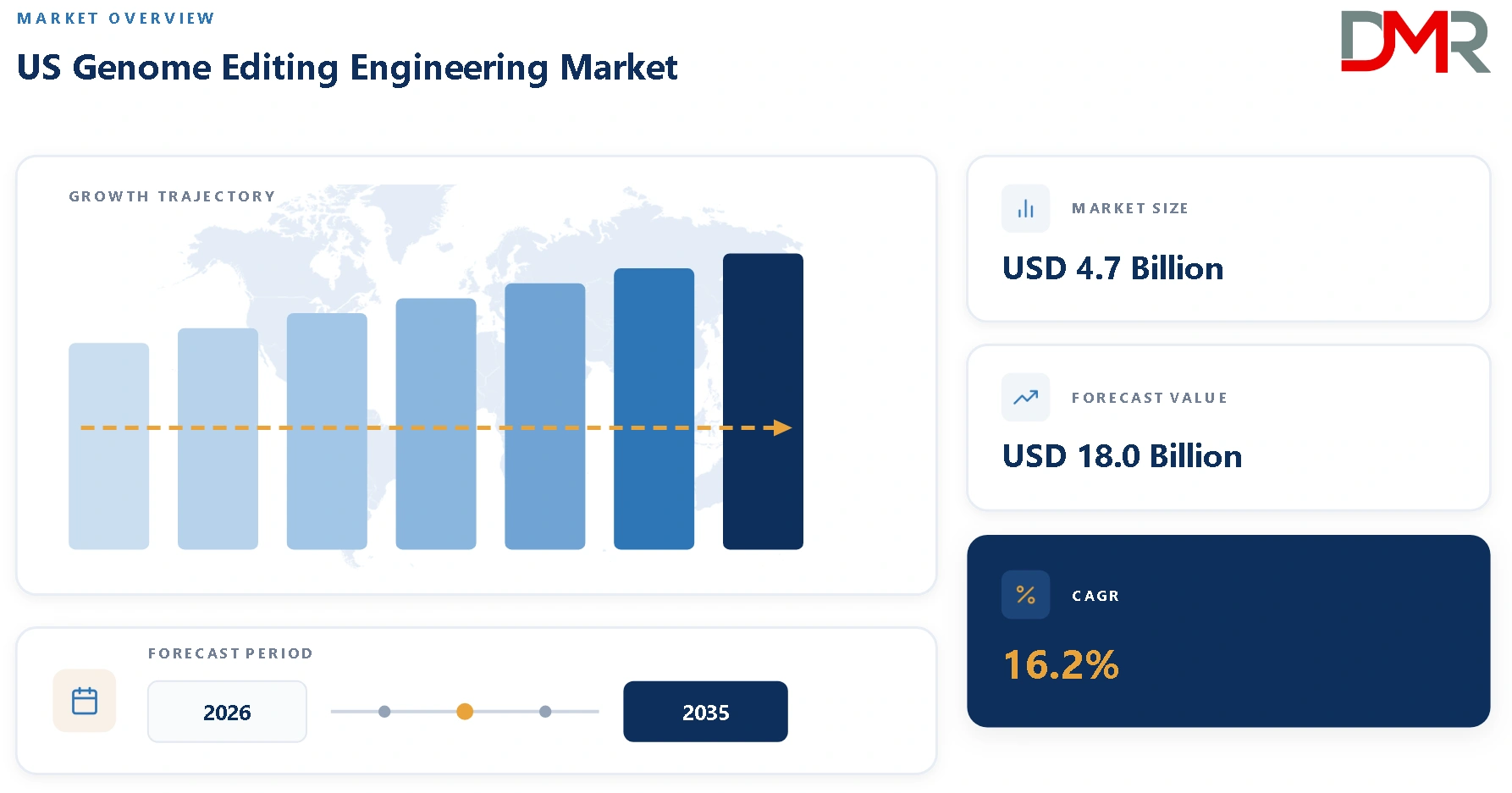
- Market Size (2026): USD 4.7 Bn
- Forecast Value (2035): USD 18.0 Bn
- CAGR (2026-2035): 16.2%
- Leading Technology (2026): CRISPR/Cas9, approximately 58%
- Fastest-Growing Technology: Prime Editing
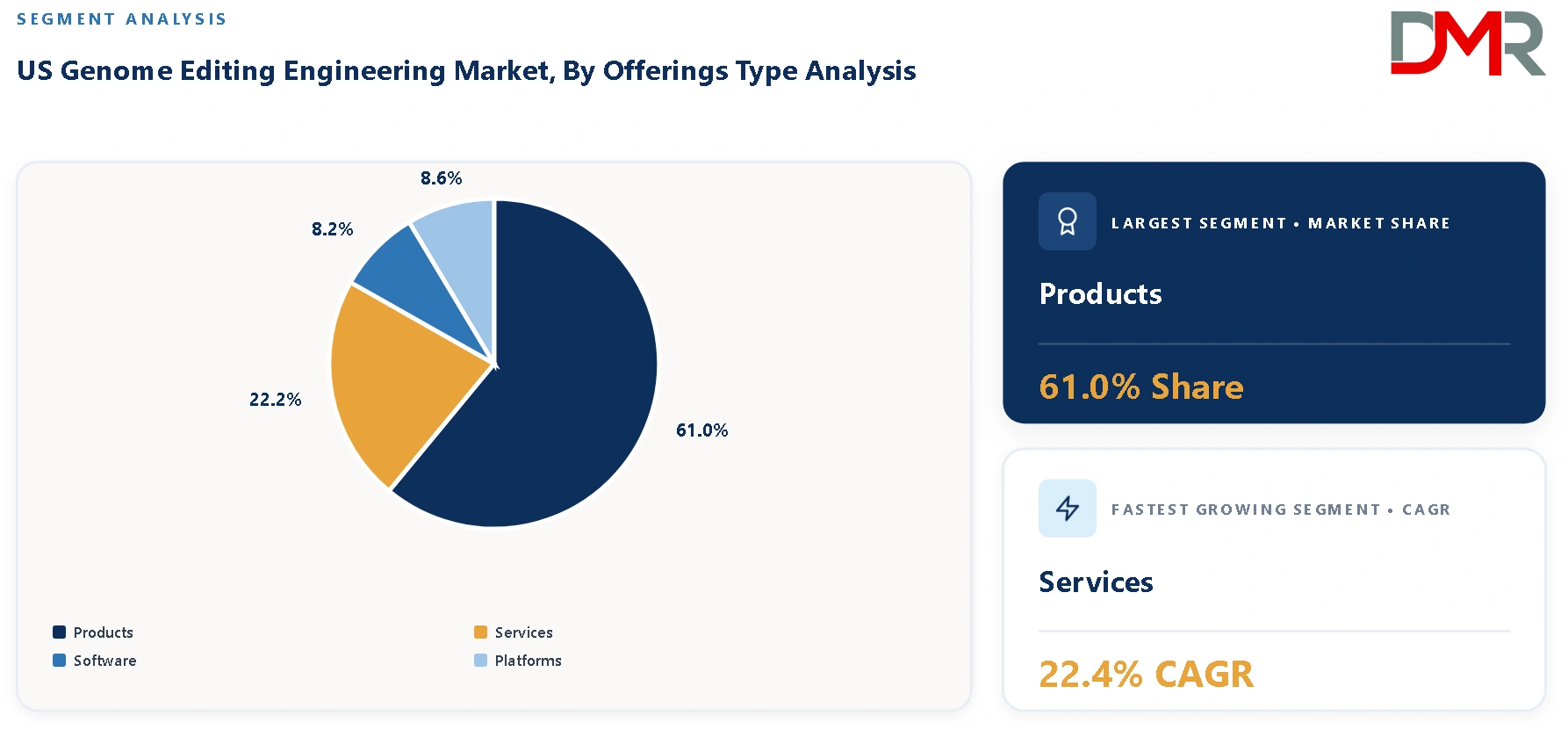
- Leading Offering (2026): Products, around 61%
- Leading End User (2026): Biotechnology & Pharmaceutical Companies, close to 48%
- Key Players: Thermo Fisher Scientific, Danaher, Merck KGaA and others
What is US Genome Editing Engineering Market and its Market Size?
The US Genome Editing Engineering Market size is estimated to reach USD 4.7 Bn in 2026 and is further anticipated to reach USD 18.0 Bn by 2035, at a CAGR of 16.2%.
ℹ
To learn more about this report –
Download Your Free Sample Report Here
The market covers technologies, research products, engineering services, computational tools and supporting workflows used to design, construct, deliver and validate targeted changes to genetic material in the United States. The scope is centered on engineering inputs and platforms rather than the downstream sales of finished gene therapies. It therefore includes editing enzymes, guide RNA systems, libraries, vectors and delivery systems, screening tools, analytical workflows, software and specialized engineering services.
CRISPR/Cas systems remain the operational foundation for much of the market because they provide programmable targeting and can be adapted across research, cell engineering and therapeutic development. Base editing and prime editing expand the engineering toolkit by enabling more precise sequence changes without relying on the same double-strand-break workflow used by conventional nuclease editing. TALENs and zinc finger nucleases retain narrower roles where established intellectual property, target specificity or legacy workflows influence platform selection.
Demand comes from biotechnology and pharmaceutical companies, academic and government research institutions, contract research organizations, diagnostics developers and agricultural biotechnology groups. Buyers increasingly require more than an editing reagent. They assess design software, guide selection, delivery compatibility, sequencing-based validation, off-target characterization, reproducibility and the ability to scale from discovery experiments into preclinical and manufacturing workflows.
The U.S. market is structurally supported by a dense life sciences ecosystem, substantial translational research activity and an established regulatory pathway for human genome editing products. The FDA's January 2024 guidance addresses product design, manufacturing, nonclinical safety and clinical trial considerations for human genome editing products, while 2026 draft guidance has added more detailed expectations around next-generation sequencing and the use of prior knowledge in development. These developments raise validation requirements while also creating clearer development pathways.
Use Cases
- Therapeutic Candidate Engineering: Biotechnology and pharmaceutical R&D teams use genome editing systems to create disease-relevant cell models, validate targets and engineer therapeutic candidates. The workflow can move from guide design to edited-cell screening and sequencing confirmation, helping teams prioritize candidates before committing to larger preclinical programs.
- Cell Line Development: Bioprocess development groups engineer production cell lines to introduce or remove genetic traits that affect productivity, stability or product quality. Automated editing and screening can shorten iteration cycles, allowing teams to compare multiple engineered clones before selecting a manufacturing-ready lineage.
- Functional Genomics: Academic and government laboratories deploy CRISPR libraries and pooled screens to study gene function across large cell populations. The approach changes experiments from one-gene-at-a-time validation toward systematic perturbation, generating datasets that can support target discovery and disease-mechanism research.
- Contract Engineering Services: CROs and specialized genome engineering providers perform guide design, cell editing, clone isolation and analytical validation for customers without full internal infrastructure. Outsourcing allows smaller biotechnology companies to access specialized equipment and expertise while preserving internal resources for therapeutic or product development.
Key Takeaways
- Market Size & Share: The market is estimated at USD 4.7 Bn in 2026 and is projected to reach USD 18.0 Bn by 2035.
- Technology Analysis: CRISPR/Cas9 is expected to account for approximately 58% of 2026 revenue, while prime editing is expanding at a CAGR of 24.6%.
- Offering Analysis: Products are projected to represent around 61% of 2026 revenue as researchers continue to purchase reagents, enzymes, kits, libraries and related consumables.
- Delivery Method Analysis: Ex-vivo workflows are expected to hold approximately 55% of 2026 demand because controlled cell manipulation simplifies editing and downstream characterization.
- Application Analysis: Therapeutic development is projected to represent close to 43% of 2026 demand, while diagnostics is expanding at a CAGR of 23.1%.
- End User Analysis: Biotechnology and pharmaceutical companies are expected to account for roughly 48% of 2026 demand, reflecting the concentration of translational and commercial programs.
How AI/Gen AI is Transforming the US Genome Editing Engineering Market?
AI is becoming an engineering layer around genome editing rather than a replacement for molecular biology. Machine learning models can rank guide RNA candidates, predict sequence-dependent editing behavior and prioritize experimental designs before laboratory testing. Computational workflows can also integrate sequencing results with design records, helping teams identify candidate edits that merit additional validation.
Generative AI has a more targeted role in design and knowledge workflows. LLM document processing can organize literature, assay notes and experimental records, while generative sequence-design systems can propose candidate constructs subject to laboratory validation. Digital twins and predictive models can support process development by modeling editing workflows and expected screening outcomes. The commercial effect is strongest when AI reduces experimental search space, improves traceability and connects design software with laboratory automation.
- Sequence Design: Machine learning can rank guide candidates and prioritize sequences for experimental testing.
- Off-Target Prediction: Predictive models can identify potential unintended editing sites for focused experimental validation.
- LLM Document Processing: Language models can structure literature, experimental notes and regulatory documentation for researcher review.
- Laboratory Automation: AI-assisted scheduling can coordinate editing, cell culture and sequencing workflows across high-throughput platforms.
Key Drivers in the US Genome Editing Engineering Market
Demand is being pulled by the expansion of therapeutic genome editing programs and the increasing need for scalable, validated engineering workflows across biotechnology research.
- Expansion of Translational Genome Editing Programs: More biotechnology programs are moving beyond proof-of-concept experiments into IND-enabling and clinical development workflows. That transition increases demand for higher-quality guide design, controlled delivery, clonal characterization, sequencing and off-target assessment. It also shifts purchasing from basic research reagents toward integrated engineering platforms and specialized services that can support reproducibility and documentation. The commercial mechanism is therefore not simply a higher number of editing experiments; it is a rise in the technical requirements attached to each program. Suppliers that can connect design, editing and analytical validation have an opportunity to capture more value per customer.
- High-Throughput Functional Genomics: Pharmaceutical discovery teams and research institutions are using pooled CRISPR screens, single-cell readouts and multiplex perturbation approaches to interrogate gene function at larger scale. As experimental throughput rises, manual design and clone screening become bottlenecks. This favors automated libraries, standardized reagents, sequencing workflows and computational analysis. The effect is strongest in organizations that operate shared core facilities or multi-project discovery platforms, where a single engineering infrastructure can support many biological programs. Demand consequently shifts toward reproducible systems and service models that reduce the time between perturbation design and interpretable biological data.
Restraints in the US Genome Editing Engineering Market
Genome editing engineering faces technical uncertainty, high validation costs and a regulatory environment that places significant emphasis on genomic integrity and product quality.
- Off-Target and Genomic Integrity Risk: Editing performance cannot be judged only by whether the intended locus changes. Sponsors and research organizations must characterize unintended edits, chromosomal changes and other genomic effects according to the use case. The FDA's 2026 draft guidance specifically addresses NGS-based approaches for evaluating off-target editing and loss of genome integrity in human genome editing products. This increases demand for analytical tools but also raises development cost and data requirements. Smaller developers may therefore rely more heavily on CROs and specialized engineering providers rather than building every validation capability internally.
- Complex Workflow and Capital Requirements: Advanced genome engineering combines molecular biology, cell culture, sequencing, bioinformatics and quality-control infrastructure. Establishing a complete internal workflow can require expensive instrumentation, specialist staff and validated data systems. Delivery method selection adds another layer because in-vivo and ex-vivo approaches impose different engineering constraints. These requirements slow adoption among smaller research organizations and encourage outsourcing. They also create switching costs, since a platform embedded in design, ordering, editing, sequencing and analysis workflows can be difficult to replace without disrupting ongoing programs.
Growth Opportunities in the US Genome Editing Engineering Market
The strongest commercial openings are emerging around precision editing, automated engineering and outsourced development. These areas allow suppliers to capture demand created by the increasing technical complexity of genome editing programs.
- Base and Prime Editing: New editing modalities can address sequence changes that are less suited to conventional nuclease workflows. Their growth creates demand for specialized guide design, delivery optimization, analytical validation and software.
- Integrated Engineering Platforms: Customers increasingly want connected workflows that link design, ordering, editing, screening and sequencing. Platforms that reduce handoffs can command higher value and improve customer retention.
- Outsourced Genome Engineering: Emerging biotechnology companies can use specialized CROs for editing and characterization instead of building full internal infrastructure. This expands the addressable market for engineering services and accelerates program initiation.
Trends in the US Genome Editing Engineering Market
Genome editing is shifting from standalone editing reagents toward integrated, data-rich engineering workflows. The most important changes concern precision, automation, modality diversification and the increasing connection between design and validation.
- Precision Editing: Base editing and prime editing are gaining attention where researchers need targeted sequence changes with different edit profiles from conventional nuclease approaches.
- Single-Cell Integration: Editing screens are increasingly combined with single-cell sequencing and multi-omic readouts to connect perturbations with cellular phenotypes.
- Workflow Automation: Automated liquid handling, sequencing and analysis reduce manual bottlenecks in high-throughput editing and screening.
- Regulatory-Ready Analytics: Developers are placing greater emphasis on traceable sequencing, off-target assessment and documented assay performance as programs move toward clinical development.
Research Scope and Analysis
Segment performance is assessed across technology, offering, delivery method, application and end user. Each axis identifies the sub-segment carrying the largest share of 2026 revenue and the one expanding fastest through 2035, with the engineering or commercial reason behind each position.
ℹ
To learn more about this report –
Download Your Free Sample Report Here
By Technology
CRISPR/Cas9 is projected to hold the largest share by technology in 2026, accounting for approximately 58% of revenue because its programmable targeting, established reagent ecosystem and broad research adoption make it the default editing architecture. ZFNs and TALENs retain specialized use in applications where established workflows or target characteristics matter. Growth, however, is concentrated in prime editing, expanding at a CAGR of 24.6% between 2026 and 2035 as developers pursue precise sequence changes with fewer double-strand-break requirements. The faster trajectory is supported by improvements in guide design, delivery and validation, although editing efficiency and workflow complexity remain important commercialization constraints.
By Offering
Products are expected to lead the offering axis in 2026, representing around 61% of revenue because reagents, enzymes, guide systems, libraries and consumables are required across both research and translational workflows. Services provide an important alternative for organizations that lack specialized editing infrastructure. The steeper trajectory sits with services, expanding at a CAGR of 22.4% through 2035 as biotechnology companies outsource guide design, cell engineering, screening and validation to control capital intensity. Service providers can also differentiate through specialized cell types, delivery methods and sequencing-based characterization, making the segment particularly attractive for complex therapeutic programs.
By Delivery Method
Ex-vivo delivery is projected to account for approximately 55% of 2026 revenue by delivery method because cells can be manipulated and characterized under controlled laboratory conditions before being returned to a biological system. In-vivo workflows have a smaller current base but can eliminate some manufacturing steps when editing can be delivered directly to target tissues. Growth, however, is concentrated in in-vivo delivery, expanding at a CAGR of 20.8% from 2026 to 2035 as lipid nanoparticles, viral vectors and other delivery technologies improve. Safety, biodistribution and editing specificity remain the major barriers to broader adoption.
By Application
Therapeutic development is expected to hold the largest application share in 2026, accounting for close to 43% of revenue because genome editing is increasingly incorporated into target validation, cell engineering and development of genetic medicines. Functional genomics remains a major research use, while diagnostics represents a smaller but technically differentiated opportunity. Growth, however, is concentrated in diagnostics, expanding at a CAGR of 23.1% through 2035 as CRISPR-based detection concepts and molecular assay engineering broaden. Commercial uptake depends on analytical sensitivity, workflow simplicity, regulatory classification and the ability to integrate editing-derived recognition mechanisms into practical testing systems.
By End User
Biotechnology and pharmaceutical companies are projected to represent close to 48% of 2026 revenue because they operate the largest concentration of translational genome editing programs and require repeat access to engineering products, analytical tools and specialized services. Academic and government laboratories remain a major research base, while CROs expand as developers outsource technically demanding workflows. Growth, however, is concentrated in CROs, expanding at a CAGR of 21.7% between 2026 and 2035 as smaller developers seek flexible access to specialized editing infrastructure. The service model is particularly attractive when projects require uncommon cell types, complex delivery or extensive genomic characterization.
The US Genome Editing Engineering Market Report is Segmented Based on the Following
By Technology
- CRISPR/Cas9
- Base Editing
- Prime Editing
- Zinc Finger Nucleases
- TALENs
- Others
By Offering
- Products
- Services
- Software
- Platforms
By Delivery Method
By Application
- Therapeutic Development
- Functional Genomics
- Cell Engineering
- Agricultural Biotechnology
- Diagnostics
- Others
By End User
- Biotechnology & Pharmaceutical Companies
- Academic & Government Research Institutes
- Contract Research Organizations
- Diagnostics Companies
- Agricultural Biotechnology Companies
- Others
Regulatory Landscape
The U.S. regulatory environment is becoming more specific as genome editing moves from laboratory research into clinical development. FDA's January 2024 guidance addresses product design, manufacturing and testing, nonclinical safety and clinical trial considerations for human genome editing products. In April 2026, the agency issued draft guidance on NGS-based safety assessment, emphasizing evaluation of off-target editing and genomic integrity, and in June 2026 it issued draft guidance on leveraging prior knowledge across genome editing development programs. The commercial opening is for engineering and analytics suppliers that help sponsors generate traceable evidence efficiently. The brake is the cost and technical burden of meeting evolving expectations, especially for small developers.
Technology Analysis
Genome editing engineering is moving from conventional nuclease editing toward a portfolio of modalities selected according to the desired genetic change. CRISPR/Cas9 remains the broad platform, while base editing and prime editing address more specific sequence-engineering needs. Delivery, guide design and analytical validation increasingly determine practical performance rather than nuclease choice alone. The commercial opening is for integrated platforms that connect computational design, reagent production, cell engineering and sequencing-based confirmation. The principal risk is workflow complexity: a technically superior editing modality can remain commercially constrained if delivery, efficiency, off-target characterization or manufacturing compatibility is insufficient. As a result, platform suppliers are increasingly competing on complete workflows rather than isolated editing components.
Competitive Landscape
Competition spans large life sciences suppliers, specialist genome engineering companies, therapeutic developers, software vendors and CROs. Large suppliers benefit from established distribution, instrumentation and reagent portfolios, while specialists compete through editing efficiency, modality-specific know-how and engineering services. Software providers are becoming more important as guide design and experimental data management move upstream into computational workflows. The basis of competition is therefore shifting toward integrated capability, reproducibility, validation depth and workflow speed rather than reagent availability alone.
Some of the Prominent Players in the US Genome Editing Engineering Market Are
- Thermo Fisher Scientific
- Danaher
- Merck KGaA
- Bio-Rad Laboratories
- Agilent Technologies
- Revvity
- QIAGEN
- Takara Bio
- New England Biolabs
- Synthego
- GenScript
- Integrated DNA Technologies
- Twist Bioscience
- Benchling
- Charles River Laboratories
- Lonza
- Catalent
- Azenta
- WuXi AppTec
- Aldevron
- CRISPR Therapeutics
- Intellia Therapeutics
- Editas Medicine
- Beam Therapeutics
- Prime Medicine
- Caribou Biosciences
- Cellectis
- Precision BioSciences
- Sangamo Therapeutics
- Tune Therapeutics
- Verve Therapeutics
- Arbor Biotechnologies
- Inscripta
- Mammoth Biosciences
- Sherlock Biosciences
- Pairwise
- Asimov
- EpiCypher
- Horizon Discovery
- Telesis Bio
- Other Key Players
Recent Developments
- In April 2026, the FDA issued draft guidance on NGS-based safety assessment for human genome editing products, strengthening expectations for off-target and genomic-integrity analysis and increasing demand for specialized sequencing and bioinformatics workflows.
- In June 2026, the FDA issued draft guidance on leveraging prior knowledge in human gene therapy products incorporating genome editing, creating a framework for using established CMC, nonclinical and clinical knowledge across development programs.
- In August 2026, the FDA published updated industry FAQs covering cellular and gene therapy development, adding current regulatory context for sponsors working across CMC, nonclinical, clinical and clinical pharmacology disciplines.
- In September 2025, the FDA issued draft guidance on postapproval methods for capturing safety and efficacy data for cell and gene therapy products, reinforcing the importance of long-term evidence generation for advanced genetic medicines.
- In September 2025, the FDA issued draft guidance on innovative clinical trial designs for cellular and gene therapy products in small populations, supporting development strategies relevant to rare-disease genome editing programs.
Report Details
| Report Characteristics |
| Market Size (2026) |
USD 4.7 Bn |
| Forecast Value (2035) |
USD 18.0 Bn |
| CAGR (2026–2035) |
16.2% |
| Historical Data |
2021 – 2025 |
| Forecast Data |
2026 – 2035 |
| Base Year |
2025 |
| Segments Covered |
By Technology, By Offering, By Delivery Method, By Application, and By End User |
| Regional Coverage |
United States |
Frequently Asked Questions
How big is the US Genome Editing Engineering Market?
▾ The US Genome Editing Engineering Market is estimated at USD 4.7 Bn in 2026. The scope covers engineering technologies, products, software, platforms and specialized services used to design, execute and validate genome editing workflows in the United States. It excludes revenue from finished gene therapies as downstream products unless the revenue directly represents an engineering input or service within the defined market.
What is the growth rate of the US Genome Editing Engineering Market?
▾ The US Genome Editing Engineering Market is projected to expand at a CAGR of 16.2% from 2026 to 2035 and reach USD 18.0 Bn by 2035. Growth is supported by therapeutic development, functional genomics, expanding editing modalities and demand for higher-throughput engineering and validation. Regulatory requirements for genomic integrity also increase demand for specialized analytical workflows.
What is driving demand in the US Genome Editing Engineering Market?
▾ Demand is being driven by the expansion of therapeutic genome editing programs and high-throughput functional genomics. Developers require increasingly sophisticated workflows for guide design, delivery, cell engineering, sequencing and off-target assessment. The U.S. research and biotechnology ecosystem supports these activities through concentrated scientific infrastructure, while evolving FDA guidance is increasing the importance of documented safety and analytical validation.
Who are the key players in the US Genome Editing Engineering Market?
▾ Key players include Thermo Fisher Scientific, Danaher, Merck KGaA, Bio-Rad Laboratories, Synthego, GenScript, Twist Bioscience, CRISPR Therapeutics, Intellia Therapeutics, Editas Medicine and Precision BioSciences. The competitive field also includes CROs, software providers and specialized editing companies that compete through workflow integration, modality expertise, engineering services and genomic validation.
Which technology leads the US Genome Editing Engineering Market?
▾ CRISPR/Cas9 is expected to remain the leading technology, accounting for approximately 58% of 2026 revenue. Its advantage comes from broad adoption, programmable targeting, a mature reagent ecosystem and compatibility with research and translational workflows. Prime editing and base editing are gaining faster because they address sequence changes that can be difficult to achieve efficiently with conventional nuclease approaches.
Which technology is growing fastest in US Genome Editing Engineering Market ?
▾ Prime editing is projected to be the fastest-growing technology segment, with a forecast CAGR of 24.6% from 2026 to 2035. Its growth opportunity comes from applications requiring targeted sequence changes without relying on the same double-strand-break mechanism used in conventional CRISPR nuclease workflows. Adoption will depend on improvements in efficiency, delivery, guide design and validation.
Which end user represents the largest demand pool in US Genome Editing Engineering Market ?
▾ Biotechnology and pharmaceutical companies are expected to represent close to 48% of 2026 demand. These organizations operate a large share of translational genome editing programs and require repeated access to editing reagents, design tools, cell engineering services and genomic characterization. CROs are growing faster as smaller developers outsource specialized workflows rather than investing in complete internal infrastructure.