US High-Voltage Cable Diagnostics Market Snapshot
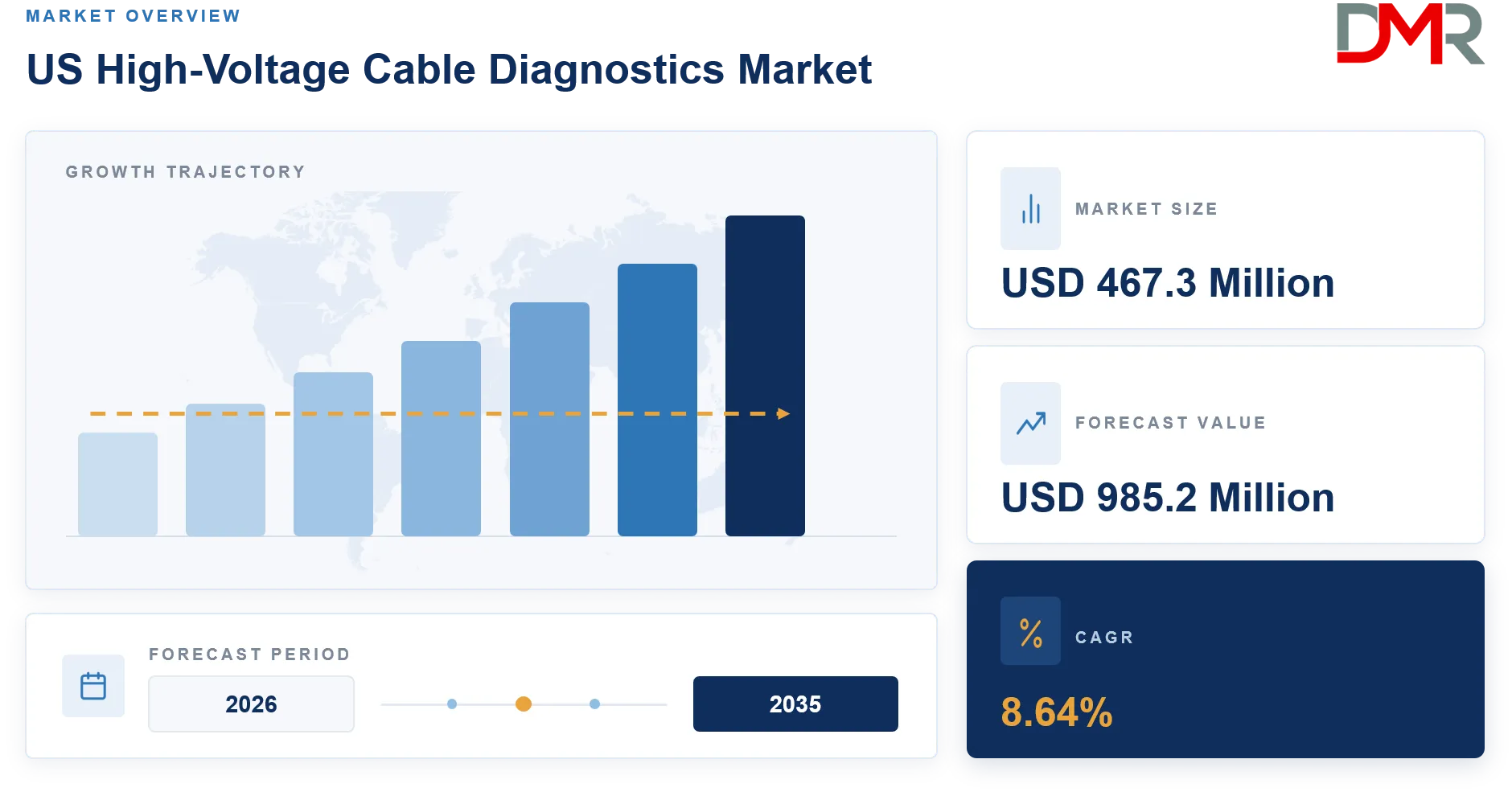
- Market Value: US High-Voltage Cable Diagnostics Market is valued at USD 467.3 million in 2026 and is projected to reach USD 985.2 million by 2035.
- CAGR: US High-Voltage Cable Diagnostics Market is expected to grow at a CAGR of 8.64% from 2026 to 2035.
- By Testing Technology Analysis: Partial Discharge Detection Systems led the segment with a 25.7% share in 2026.
- By Voltage Rating Segment Analysis: 67 kV to 132 kV Range led voltage rating categories with a 29.4% share in 2026.
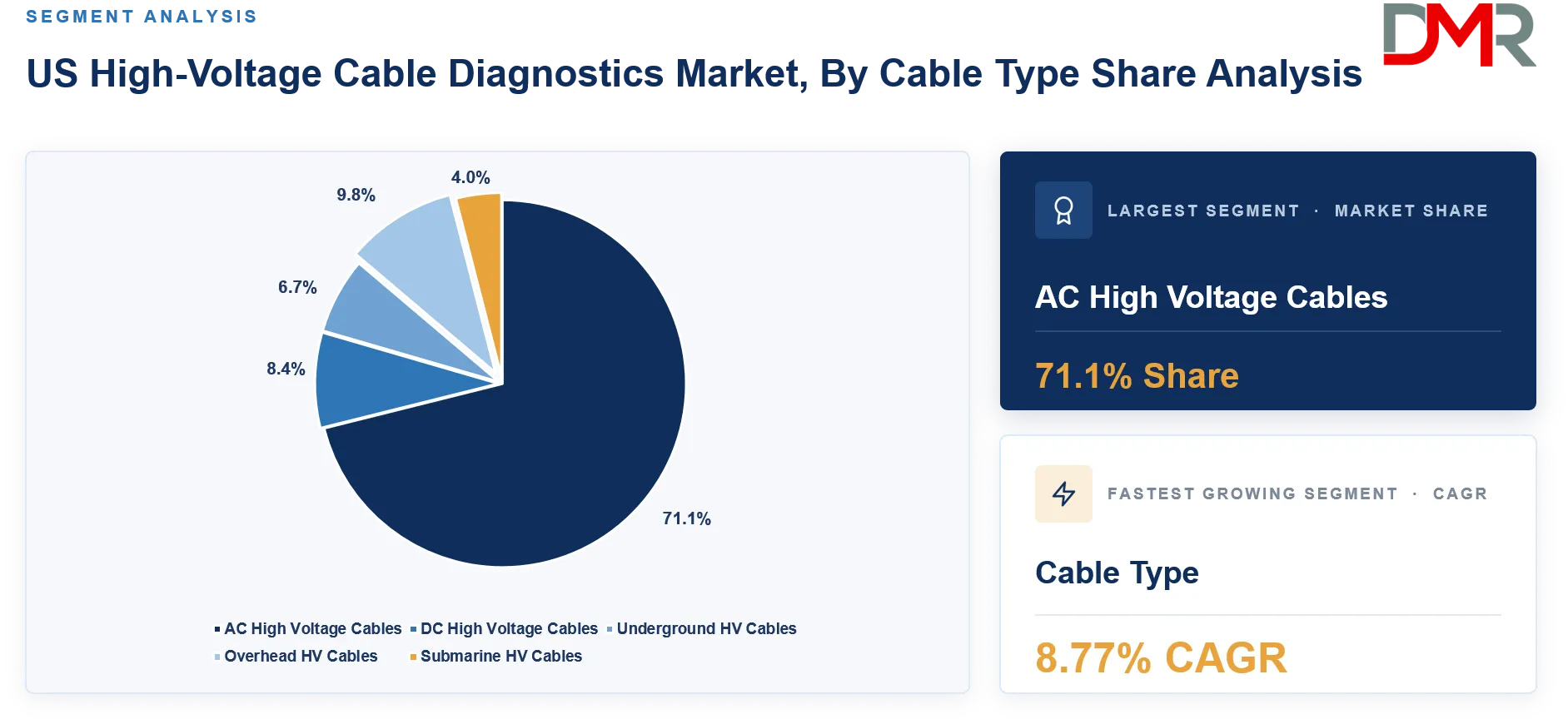
- By Cable Type Industry Segment Analysis: AC High Voltage Cables held a 71.1% share in 2026.
- By Testing Service Type Analysis: Diagnostic Condition Assessment dominated with a 35.2% share in 2026.
- Major Players: HV TECHNOLOGIES Inc., Doble Engineering Company, BAUR USA Corp., OMICRON electronics, and Others.
What is the US High-Voltage Cable Diagnostics Market and its Market Size?
The US High-Voltage Cable Diagnostics Market size is projected to be valued at USD 467.3 million in 2026 and is projected to reach USD 985.2 million by 2035, expanding at a CAGR of 8.64% during the forecast period. The market includes equipment, software, sensors, field services, and condition-assessment technologies used to examine the electrical and insulation integrity of high-voltage power cables. Core diagnostic methods include partial discharge detection, tan delta dielectric-loss measurement, time domain reflectometry, withstand testing, cable fault location, and very low frequency testing.
ℹ
To learn more about this report –
Download Your Free Sample Report Here
Demand is deeply connected with utility reliability programs, underground transmission expansion, renewable generation interconnections, data-center power infrastructure, industrial electrification, and replacement planning for aging cable systems. Diagnostics allow asset owners to identify insulation defects, weak joints, damaged terminations, water-treeing, electrical-treeing, and other degradation indicators before a cable experiences an unplanned outage. For utilities and infrastructure owners, this supports condition-based maintenance and enables capital expenditure to be directed toward cable sections with the greatest technical risk.
Use Cases
- Transmission Cable Condition Assessment: Utilities use partial discharge, tan delta, and complementary diagnostic measurements to evaluate insulation health across high-voltage transmission circuits. Results support repair, replacement, and maintenance decisions while helping grid owners rank cable sections according to technical condition and service risk.
- Commissioning of New Cable Systems: Acceptance and commissioning tests help confirm the integrity of newly installed cables, joints, and terminations before energization. High-voltage withstand tests and partial discharge measurements can identify workmanship defects or installation damage that may otherwise create reliability problems after the circuit enters service.
- Fault Detection and Localization: Time domain reflectometry and cable fault location systems help technicians identify the approximate and precise position of insulation failures or conductor faults. Faster localization reduces excavation requirements, narrows repair zones, and supports quicker service restoration across underground cable networks.
- Predictive Maintenance Planning: Utilities and industrial operators combine periodic measurements with historical diagnostic records to observe changes in cable condition over time. Trending partial discharge activity, dielectric losses, and related indicators helps maintenance teams prioritize interventions before degradation develops into a costly outage.
- Renewable and Critical Infrastructure Testing: Offshore wind links, substations, data centers, rail electrification projects, and large industrial facilities depend on high-capacity cable systems. Diagnostic testing supports commissioning, reliability assurance, and lifecycle management where power interruptions can create significant operational and financial consequences.
How AI and Gen AI are Transforming the US High-Voltage Cable Diagnostics Market?
Artificial intelligence is increasing the value of cable diagnostics by helping operators interpret larger volumes of partial discharge waveforms, monitoring records, thermal information, test histories, and maintenance data. Pattern-recognition models can assist engineers in separating electrical noise from meaningful discharge activity and identifying patterns associated with joints, terminations, insulation voids, or other defects. This capability is particularly relevant to permanent online monitoring systems, where continuously collected data can exceed the volume practical for manual review. Automated classification can therefore shorten assessment cycles and direct engineers toward assets requiring detailed examination.
Generative tools are also beginning to support maintenance workflows by converting diagnostic records into structured summaries, comparing current readings with previous inspections, and organizing recommendations for engineering review. Their strongest commercial role is expected to remain decision support rather than autonomous determination of cable condition. Utilities require traceable measurements, engineering validation, and testing procedures aligned with accepted standards. As sensor coverage grows, the combination of diagnostic instruments, asset-management platforms, and analytical software is likely to shift the market further toward continuous condition intelligence and risk-based maintenance planning.
Key Drivers in the US High-Voltage Cable Diagnostics Market
Aging Grid Assets and Reliability Requirements
Aging transmission and distribution assets are creating sustained demand for high-voltage cable condition assessment across the United States. Cable insulation, joints, terminations, and accessories can deteriorate through electrical stress, thermal cycling, moisture, installation defects, and long service periods. Utilities increasingly need evidence that distinguishes healthy circuits from assets requiring intervention. Partial discharge and dielectric-loss measurements provide condition information that can support risk-based replacement plans, reduce unnecessary cable replacement, and improve maintenance budgets.
Expansion of Transmission Capacity and Large Electrical Loads
US transmission requirements are rising as data centers, advanced manufacturing facilities, industrial projects, generation resources, and other large loads seek grid connections. New transmission corridors, substations, underground links, and interconnection infrastructure create testing requirements during manufacturing, installation, commissioning, and operation. Every new cable circuit introduces joints, terminations, and insulation systems that require validation. This expands demand for high-voltage withstand testing, partial discharge detection, acceptance testing, fault localization, and long-term condition monitoring.
Restraints in the US High-Voltage Cable Diagnostics Market
High Testing Cost and Specialized Skill Requirements
Advanced high-voltage diagnostics can require specialized test equipment, trained engineers, circuit isolation, temporary power sources, safety procedures, and detailed interpretation of measurement results. These requirements increase the cost of comprehensive assessments, especially across dispersed networks. Partial discharge signatures may also be affected by electromagnetic noise and installation conditions. Smaller utilities and industrial sites can therefore prioritize testing only for critical circuits, limiting the frequency and breadth of diagnostic programs even when condition monitoring offers long-term reliability benefits.
Operational Challenges Associated with Offline Testing
Some diagnostic procedures require cables to be removed from normal service, creating scheduling challenges for utilities and facilities with limited redundancy. Outage windows may need coordination among grid operators, maintenance crews, contractors, and customers. High-load periods can further restrict access to important circuits. These limitations encourage adoption of online monitoring but also create complexity because online measurements operate in electrically noisy environments. The market therefore depends on solutions that balance diagnostic accuracy, portability, outage requirements, and operational continuity.
Growth Opportunities in the US High-Voltage Cable Diagnostics Market
Online Monitoring and Condition-Based Asset Management
Permanent and temporary online partial discharge monitoring represents a major growth opportunity as utilities move from periodic inspection toward continuous condition visibility. Sensors installed around cable terminations or grounding connections can collect diagnostic signals while circuits remain energized. When integrated with asset-management systems, these measurements can help identify changes in insulation behavior earlier and support prioritized maintenance. Vendors that combine sensors, analytics, remote access, alarm functions, and engineering interpretation can capture recurring service and software revenue beyond equipment sales.
Offshore Wind, Data Centers, and Underground Grid Infrastructure
High-capacity infrastructure creates attractive opportunities for diagnostic providers because power continuity is economically critical. Offshore wind export cables, underground urban transmission systems, hyperscale data-center campuses, industrial facilities, and electrified transportation networks rely on cable circuits where failure can interrupt large power flows. These projects require factory testing, commissioning, acceptance testing, fault-location capability, and lifecycle assessment. Suppliers able to support multiple test stages can expand relationships from initial equipment validation through long-term monitoring and maintenance services.
Trends in the US High-Voltage Cable Diagnostics Market
Shift from Pass or Fail Testing to Diagnostic Condition Assessment
Cable owners are increasingly seeking more information than a basic withstand result. Diagnostic approaches such as partial discharge and tan delta measurements help engineers understand insulation condition, locate defects, and determine whether degradation is localized or distributed. The trend supports the 35.2% share held by Diagnostic Condition Assessment in 2026. Combining several test methods improves maintenance decisions because each technique measures a different property of the cable system and can provide stronger evidence for repair or replacement planning.
Integration of Portable Testing, Digital Analysis, and Remote Monitoring
Diagnostic systems are becoming more connected and software-driven, with portable instruments, synchronized multichannel measurements, digital data capture, remote monitoring, and automated reporting becoming increasingly important. Equipment manufacturers are integrating partial discharge detection with VLF sources, tan delta testing, time-domain techniques, and cloud-compatible analysis workflows. This reduces the need for separate systems and improves the ability to compare results across test campaigns. Digital records also allow utilities to establish long-term asset histories and identify deterioration trends.
Research Scope and Analysis
The US High-Voltage Cable Diagnostics Market is analyzed across testing technology, voltage rating, cable type, testing service type, application, and end-user categories. The study evaluates equipment and services used in high-voltage cable testing, commissioning, fault analysis, insulation-condition assessment, performance validation, and preventive maintenance. Market assessment considers changing grid requirements, utility capital programs, electrical infrastructure construction, renewable-energy integration, industrial electrification, diagnostic technology adoption, and the transition toward condition-based asset management.
ℹ
To learn more about this report –
Download Your Free Sample Report Here
By Testing Technology
Partial Discharge Detection Systems dominated the testing technology category with a 25.7% share in 2026. Partial discharge measurements are valuable because localized electrical activity can indicate insulation weaknesses in cables, joints, and terminations before complete dielectric failure occurs. The technique can be applied during commissioning, periodic maintenance, troubleshooting, and online monitoring. IEEE guidance covering field diagnostic PD testing supports its established role in shielded power cable assessment. Growing use of digital acquisition, noise separation, defect localization, and permanently installed monitoring systems is widening the segment's application across utility and critical infrastructure networks.
By Voltage Rating
The 67 kV to 132 kV Range segment held the leading 29.4% share in 2026. This voltage band is widely relevant to sub-transmission and regional power delivery infrastructure where underground circuits, substations, urban load centers, and industrial connections require dependable cable performance. Assets in this range encounter significant electrical stress while serving networks where unplanned failures can disrupt substantial customer loads. Diagnostic programs therefore use partial discharge, withstand, tan delta, and fault-location methods to assess cable condition. Continued modernization of sub-transmission networks and connection of expanding loads supports sustained testing demand in this category.
By Cable Type
AC High Voltage Cables accounted for 71.1% of the US market in 2026, reflecting the large installed base of alternating-current transmission and sub-transmission infrastructure. AC cable systems are used across utility grids, industrial power networks, substations, underground corridors, and major infrastructure projects. These systems require testing of cable insulation as well as accessories such as joints and terminations, where defects can generate partial discharge activity. The scale of the existing AC network, combined with new construction and aging-asset programs, generates recurring demand for commissioning tests, diagnostic assessment, fault location, and preventive maintenance services.
By Testing Service Type
Diagnostic Condition Assessment led testing service demand with a 35.2% share in 2026. Rather than replacing cables solely according to age, asset owners increasingly evaluate measurable indicators of insulation condition and operating risk. Condition assessments can combine partial discharge measurements, tan delta results, historical faults, sheath testing, and visual or operational information. This approach helps utilities separate circuits that remain serviceable from assets requiring repair, further testing, or replacement. The segment benefits from utility pressure to improve reliability while allocating maintenance and capital spending more precisely across large cable portfolios.
The US High-Voltage Cable Diagnostics Market Report is segmented on the basis of the following:
By Testing Technology
By Voltage Rating
-
35 kV to 66 kV Range
- 67 kV to 132 kV Range
- 133 kV to 220 kV Range
- 221 kV to 400 kV Range
- Above 400 kV Systems
By Cable Type
-
AC High Voltage Cables
- DC High Voltage Cables
- Underground HV Cables
- Overhead HV Cables
- Submarine HV Cables
By Testing Service Type
-
Routine Factory Testing
- Type Approval Testing
- Acceptance Commissioning Tests
- Performance Validation Testing
- Diagnostic Condition Assessment
By Application
By End-User
Competitive Landscape
The US High-Voltage Cable Diagnostics Market has a competitive structure that combines specialist high-voltage test-equipment manufacturers, global electrical measurement companies, engineering-service providers, utility diagnostic specialists, and diversified power-technology groups. Competition increasingly centers on measurement sensitivity, field portability, noise suppression, defect localization, voltage capability, software usability, online monitoring, standards compliance, technical support, and interpretation expertise. OMICRON electronics and Megger compete across advanced partial discharge and cable-testing workflows, while High Voltage Inc. maintains a strong position in VLF sources, withstand testing, tan delta, and related diagnostic equipment.
Doble Engineering Company and HV TECHNOLOGIES participate through specialized test and diagnostic solutions, while IMCORP, EA Technology, TJ|H2b Analytical Services, Constellation PowerLabs, and electrical-testing contractors strengthen the service-based portion of the market. Siemens Energy and GE Vernova add broader grid technology, engineering, and asset expertise. As utilities adopt condition-based maintenance, competitive differentiation is moving beyond instrument sales toward integrated testing, continuous monitoring, analytics, engineering support, training, and lifecycle asset intelligence.
Some of the prominent players in the US High-Voltage Cable Diagnostics Industry are:
- HV TECHNOLOGIES Inc.
- Doble Engineering Company
- BAUR USA Corp.
- OMICRON electronics
- Megger
- High Voltage Inc.
- HV Diagnostics Inc.
- EA Technology
- Siemens Energy
- GE Vernova
- IMCORP
- TJ|H2b Analytical Services
- Constellation PowerLabs
- NDTECTOR
- Hampton Tedder Technical Services
- Dashiell Corporation
- Wardenclyffe Power Services
- TDS Equipment
- RESA Power
- Asplundh Electrical Testing
- Others
Technology Analysis
The US High-Voltage Cable Diagnostics Market is moving toward integrated digital testing platforms that combine partial discharge detection, tan delta measurement, VLF testing, time domain reflectometry, fault location, and high-voltage withstand functions. Partial discharge remains a core technology because it can identify localized insulation defects in cables, joints, and terminations before failure, while IEEE 400.3-2022 provides active guidance for field PD testing of installed shielded power cable systems.
Vendors are also adding synchronized data acquisition, automated noise filtering, waveform classification, GPS-based fault mapping, cloud-connected records, and remote condition monitoring. These capabilities are shifting utility maintenance from periodic pass-or-fail testing toward condition-based asset management. Growth in data centers, manufacturing loads, renewable interconnections, and transmission expansion is raising the value of continuous diagnostics, especially where outage windows are limited and cable failures carry high restoration costs.
Regulatory Landscape
The US High-Voltage Cable Diagnostics Market operates within a framework shaped by utility reliability obligations, electrical safety rules, engineering standards, and state-level infrastructure requirements rather than a single federal cable-diagnostics regulation. IEEE 400-series guidance is highly influential in field testing of shielded power cable systems, with IEEE 400.3-2022 covering partial discharge detection, measurement, and location for new and service-aged installed cables, joints, and terminations.
Utilities also align testing programs with internal asset-management procedures, NERC reliability expectations for the bulk power system, OSHA electrical safety requirements, and project-specific acceptance specifications. The regulatory effect is strongest in documentation, test repeatability, technician competency, equipment calibration, and defensible maintenance decisions. As DOE identifies rising transmission needs from data centers, manufacturing, industrial loads, and new interconnections, utilities are under greater pressure to maintain reliable assets, supporting more structured commissioning and condition-assessment programs.
Recent Developments
- May 2026: RESA Power expanded high-voltage cable diagnostic capabilities with new mobile testing units deployed across the US, targeting utility and renewable energy clients.
- March 2026: Doble Engineering Company launched an enhanced partial discharge analysis platform integrating AI-driven diagnostics for high-voltage cable systems, improving fault detection accuracy in US grids.
- January 2026: Megger announced strategic partnerships with several US utility providers to deploy advanced very low frequency (VLF) and tan delta testing systems for aging underground cable networks.
Report Details
| Report Characteristics |
| Market Size (2026) |
USD 467.3 Million |
| Forecast Value (2035) |
USD 985.2 Million |
| CAGR (2026-2035) |
8.64% |
| Historical Data |
2021 - 2025 |
| Forecast Data |
2027 - 2035 |
| Base Year |
2025 |
| Estimate Year |
2026 |
| Segments Covered |
By Testing Technology (Partial Discharge Detection Systems, Tan Delta Dielectric Loss Measurement, Time Domain Reflectometry Units, High Voltage Withstand Testing, Cable Fault Location Systems, and Very Low Frequency Testing), By Voltage Rating (35 kV to 66 kV Range, 67 kV to 132 kV Range, 133 kV to 220 kV Range, 221 kV to 400 kV Range, and Above 400 kV Systems), By Cable Type (AC High Voltage Cables, DC High Voltage Cables, Underground HV Cables, Overhead HV Cables, and Submarine HV Cables), By Testing Service Type (Routine Factory Testing, Type Approval Testing, Acceptance Commissioning Tests, Performance Validation Testing, and Diagnostic Condition Assessment), By Application (Power Transmission Networks, Sub-Transmission Distribution, Submarine Cable Systems, Offshore Wind Farm Links, Industrial Power Distribution, Data Center Power Infrastructure, and Rail Transit Electrification), By End-User (Electric Utility Companies, Renewable Energy Developers, Industrial Manufacturing Plants, Commercial Infrastructure Projects, Telecommunications Network Operators, Oil and Gas Sector, and Transportation Infrastructure) |
| Regional Coverage |
United States |
Frequently Asked Questions
What is the current size of the US High-Voltage Cable Diagnostics Market?
▾ The US High-Voltage Cable Diagnostics Market size is valued at USD 467.3 million in 2026, reaching USD 985.2 million by 2035.
What is the growth rate of the US High-Voltage Cable Diagnostics Market during?
▾ The US High-Voltage Cable Diagnostics Market is forecast to expand at an 8.64% CAGR during the 2026-2035 period.
What factors are driving the growth of the US High-Voltage Cable Diagnostics Market?
▾ Grid upgrades, aging cable assets, and reliability needs are driving US High-Voltage Cable Diagnostics Market growth.
What are the major challenges restraining the US High-Voltage Cable Diagnostics Market?
▾ High testing costs, skilled labor needs, and outage constraints restrain the US High-Voltage Cable Diagnostics Market.
Which segment holds the largest share of the US High-Voltage Cable Diagnostics Market?
▾ Partial Discharge Detection Systems lead the US High-Voltage Cable Diagnostics Market with a 25.7% share in 2026.
Who are the leading companies in the US High-Voltage Cable Diagnostics Market?
▾ HV TECHNOLOGIES Inc., Doble Engineering Company, BAUR USA Corp., OMICRON electronics, Megger, High Voltage Inc., HV Diagnostics Inc., EA Technology, Siemens Energy, GE Vernova, IMCORP, TJ|H2b Analytical Services, Constellation PowerLabs, NDTECTOR, Hampton Tedder Technical Services, Dashiell Corporation, Wardenclyffe Power Services, TDS Equipment, RESA Power, and Asplundh Electrical Testing are leading companies in the US High-Voltage Cable Diagnostics Market.
How is AI influencing the US High-Voltage Cable Diagnostics Market?
▾ AI supports the US High-Voltage Cable Diagnostics Market through automated fault analysis and predictive maintenance.
What are the future opportunities and trends in the US High-Voltage Cable Diagnostics Market?
▾ Online monitoring and grid upgrades are key opportunities and trends in the US High-Voltage Cable Diagnostics Market.