Market Overview
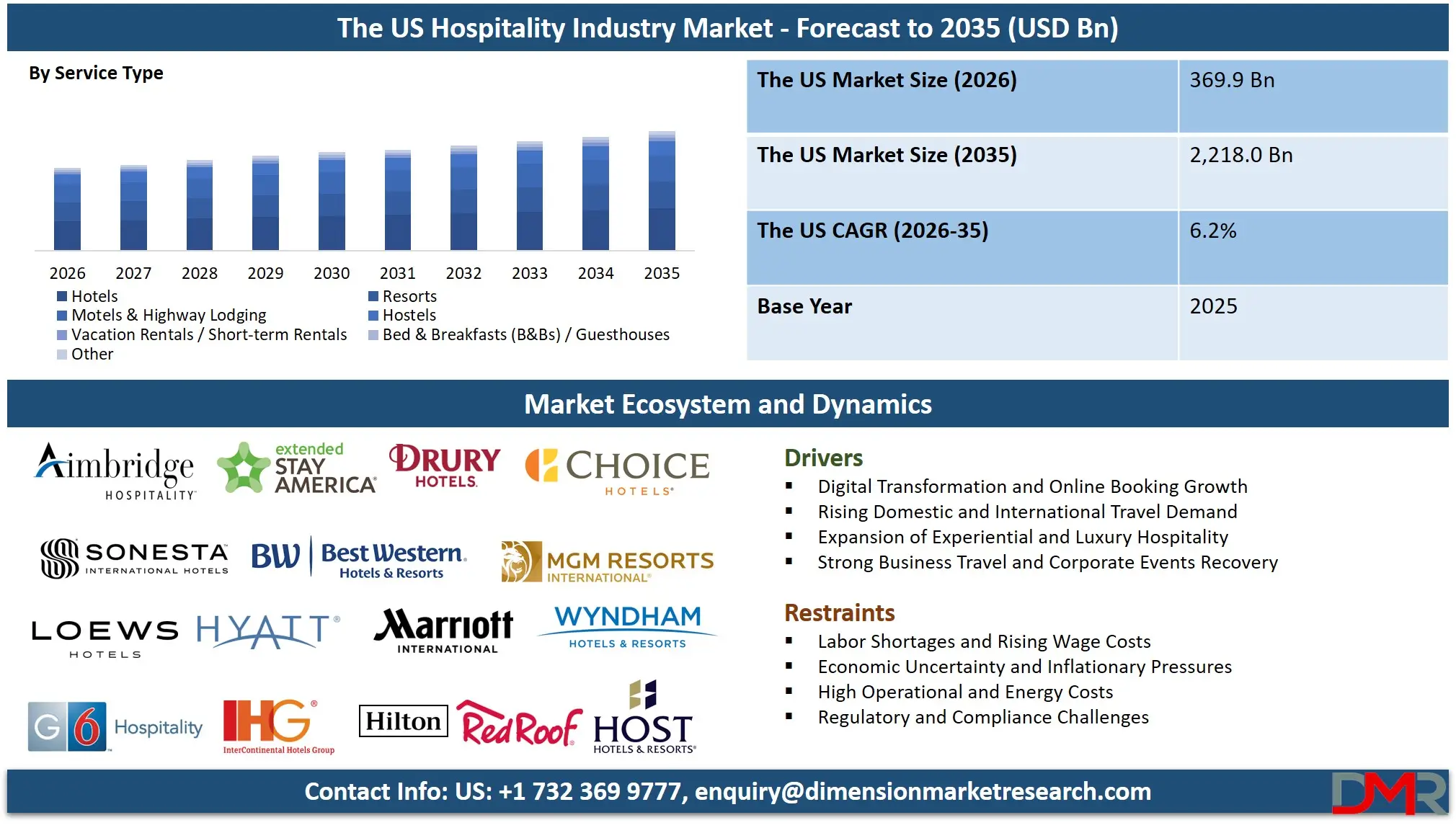
The US hospitality industry market size is expected to reach a value of USD 369.9 billion in 2026, and it is further anticipated to reach a market value of USD 2,218.0 billion by 2035 at a CAGR of 6.2%.
ℹ
To learn more about this report –
Download Your Free Sample Report Here
The US hospitality market is among the most active and largest service ecosystems in the world that boasts of a robust domestic travel and recovering international inbound tourism and high consumer spending on experience, and the continued expansion of digital reservation platforms. Big cities such as New York City, Los Angeles, Chicago, Orlando, Las Vegas and Miami are big accommodation, food and beverage, entertainment and event services centers with well-established infrastructure and a host of hospitality suppliers ranging to low-cost providers.
The United States has been driving its hospitality services to the point of being part of everyday life, with a population that has a high disposable income, the high proportion of people who prefer dining out, and the prevalence of smartphones that have been used to plan their travel and make reservations, among other aspects. Consumers insist on perfect online experiences, tailored offers, instant access, and simple cancellations, and this is the reason why hoteliers, restaurant operators, and event managers are continually forced to become innovative. The more accommodations of other forms such as vacation rentals, boutique hotels and hostels are becoming more accessible, the more options and flexibility in city and leisure destinations.
ℹ
To learn more about this report –
Download Your Free Sample Report Here
The US Hospitality Industry Market: Key Takeaways and Other Influencing Factors
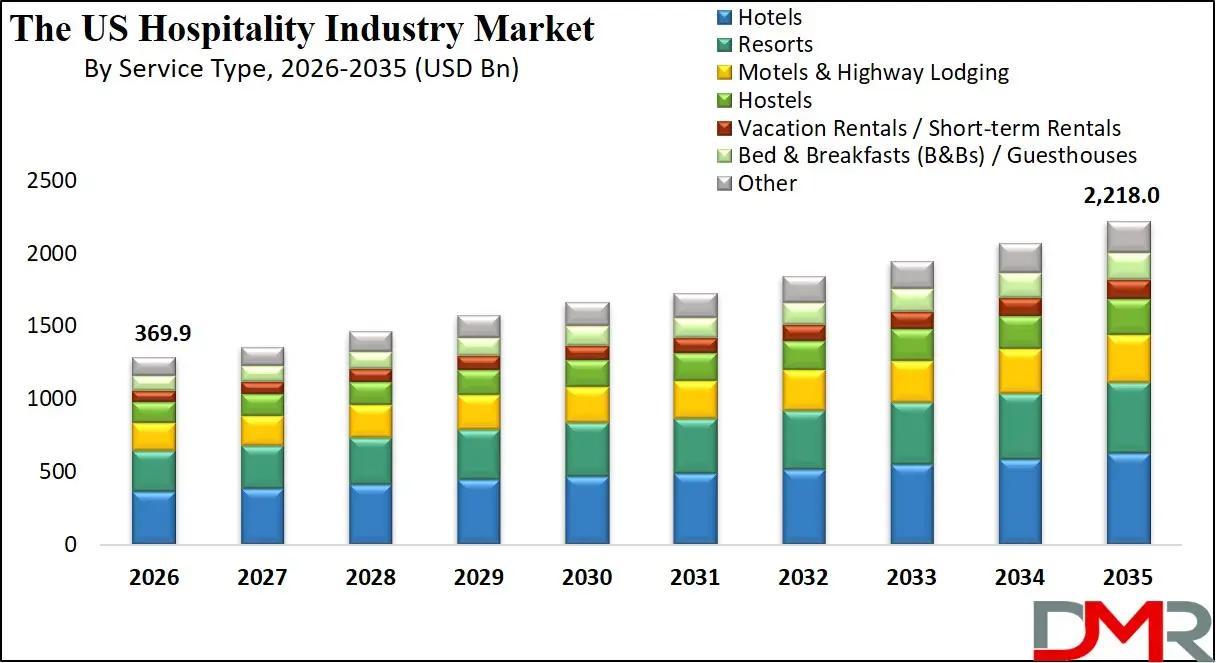
- Market Growth Insights: The market is anticipated to reach USD 1,287.2 billion in 2026 and is projected to expand to around USD 2,218.0 billion by 2035, registering a CAGR of 6.2% during the forecast period.
- By Service Type Insights: Accommodation services (especially hotels and resorts) and food and beverage services (especially full-service restaurants and QSR) continue to be the most popular segments, which are justified by the high consumer expenditure on travel, dining and entertainment in both leisure and business markets.
- By Business Model Insights: The franchise model remains the most prevalent, especially in hotels and fast-service restaurants, because it is scalable, branded, cost-efficient, and best suited to rapid expansion across the diverse landscape of the US urban, suburban and interstate corridor.
- By Booking Channel Insights: Direct booking through brand websites and mobile applications has the biggest and quickest growing segment among big chains, pushed by rewards programs, best price assurances, and consumer preference of fee-free bookings. Online Travel Agencies (OTAs) are also very important in terms of independent properties, discovery, and price comparison.
- Key Players Insights: The key players in the market are Marriott International, Hilton Worldwide, Hyatt Hotels Corporation, Airbnb Inc., MGM Resorts International, Starbucks Corporation, Darden Restaurants and Expedia Group.
- American Hotel & Lodging Association (AHLA): In 2025, more than 1.3 billion hotel room nights have been booked in the United States and this indicates that accommodation demand is still growing strongly. There are more than 55,000 hotel properties in operation in the country, which is in terms of more than 5.6 million guest rooms. In major urban markets, the occupancy rate in hotels was 72% on average in 2025 with resort destinations having a higher rate of 80% during peak seasons.
- US Travel Association: The domestic leisure travel spending amounted to USD 1.1 trillion in 2025, or 85 percent of total travel spending. Inbound international travel to the US was back to 85 million visitors in 2025, and the travelers had spent about USD 250 billion. In 2025, the travel and tourism industry helped in sustaining 9.5 million direct employment and the economy was worth more than USD 2.3 trillion.
- National Restaurant Association: In 2025, the US restaurant industry made more than USD 1.1 trillion in sales, which is a close to 4.0% of the GDP. More than 60% of restaurant orders are currently done through digital channels (app, web or third party delivery) compared to 40% in 2020. The industry has about 15 million employees and is ranked as the second-largest employer of the private sector.
Impact of the Iran Conflict on the US Hospitality Industry Market
The U.S. hospitality industry is being affected by the Iran conflict mainly due to the increase in the cost of operations and the decline in travel demand. The rising tensions have pushed oil prices up with the resultant rise in the costs of fuel to the airlines and consequently the airfare and lowering the frequency of travel. This deters domestic and foreign tourism and the result is a fall in the occupancy rate of the hotels and a decline in the number of bookings made in restaurants, resorts and entertainment centers.
Also, geopolitical uncertainty is taking a toll on consumer confidence leading to travelers postponing or canceling travels. This means that the travel time and costs are indirectly affected by disruptions in international aviation routes and long flight routes, which raises U.S. hospitality revenues. The food, labour, and operations of the hospitality businesses are also getting costlier due to inflationary pressures caused by the rise in energy and supply chain costs. In general, it can be observed that the war is causing short-term demand instability and cost pressures, which are threatening profitability in the hospitality industry in the United States.
The US Hospitality Industry Market: Use Cases
- Bleisure and Workcation Accommodation Ecosystem: This is one of the most important and fast expanding applications of the US hospitality market that is characterized by the integration of business and leisure travel. Major hotel chains are also introducing new and modern technologies that include mobile check-in and check-out, high-speed broadband in all properties, flexible workspace layouts in guest rooms and lobbies, and extended-stay rate structures.
- Convenience-Led QSR and Fast-Casual Dining Expansion: The food and beverage division, especially Quick Service Restaurants (QSR) and fast-casual dining, has been growing at a rapid pace due to changing consumer lifestyles, time scarcity, and the growing popularity of digital ordering, curbside and third-party delivery, and drive-through services.
- MICE and Corporate Event Management: MICE (Meeting, Incentives, Conferences, and Expositions) segment requires high reliability, integration of technology and specialized services. The large hotel properties, Las Vegas, Orlando, Chicago, and Atlanta major convention centers use special event management software, mobile applications that facilitate attendee interaction, hybrid streaming, allowing remote attendance, digital registration, and high-tech audio-visual systems that ensure smooth coordination.
The US Hospitality Industry Market: Market Dynamics
Driving Factors in the US Hospitality Industry Market
Strong Domestic Leisure & Bleisure Travel Growth
The high growth of the flex working schedules, work-at-home policies, and the normalization of the hybrid work schedules have contributed substantially to the growth of domestic travel volumes in the United States. The adoption of travel experiences is speeding up in the face of an expanding customer base of digital-savvy consumers, a high rate of smartphone penetration in booking and itinerary management, and superior loyalty programs offered by airlines, hotels, and OTAs. Consumers are increasingly demanding to receive personalized, mobile-first experiences, including booking and after-stay interactions.
Urbanization and Smart City Development
The hospitality industry in the United States is changing due to the rapid urbanization and massive smart city projects. Significant infrastructure modernization and the creation of sophisticated hospitality ecosystems are being propelled by mega-projects like new expansions of convention centers in Las Vegas, Orlando, and Chicago and transit-oriented developments in cities like Austin, Nashville, and Miami. The growing population density in Sun Belt and coastal cities is creating a high customer density that is necessitating more effective staffing, inventory control, and distribution plans of hotels and restaurants.
Restraints in the US Hospitality Industry Market
High Labor Costs & Persistent Staffing Shortages
The challenge of high operational costs is still very high in the US hospitality market. Wage payments, benefits, training and recruiting have been on a steep increase, which has placed a strain on the profit margins of the operators. The lack of frontline employees, such as housekeepers, servers, cookers, and front desk agents, is a long-term problem of the industry that reduces service hours, limits occupancy, and overloads the current employee base with overtime expenses. With consumers becoming highly sensitive to price increases, it is becoming tougher to strike a balance between cost-efficiency and service quality, particularly, as customers are willing to receive high-touch service quickly.
Inflationary Pressure on Consumer Spending
Disposable income to spend on discretionary travel and dining out has been decreased by inflation especially in food, fuel and airfare. Although demand has been strong, overall, consumers with lower income are trading down to budget-friendly accommodation, eating out less often, and decreasing the duration or frequency of visits. This pressure compels hospitality players to provide more value-based packages, sales offers and loyalty benefits, which squeeze margins. Senior and high-end segments have been more resilient whereas midscale and economy properties are subjected to heavy headwinds.
Opportunities in the US Hospitality Industry Market
AI-Driven Personalization & Automation
The implementation of artificial intelligence in personalizing guests and automating the operations offers a high level of growth in the US hospitality industry. The workload on the front desk can be reduced, as AI-based chatbots and virtual concierge can complete booking changes, frequently asked questions, room service orders, and local recommendations, along with enhancing response times, especially in the busiest times. Predictive analytics facilitate optimization of prices, inventory, and targeted marketing offers depending on the preference of the guest and their booking behavior. Revenue management systems are automated systems that automatically update the rates of the rooms in real time according to the competitor prices and the local events or weather and the demand projections.
Green Hospitality & Sustainable Operations
The concept of sustainability is becoming a major opportunity and point of difference in the hospitality market of the US. Some of the green practices currently being embraced by hospitality operators include energy efficient HVAC and lighting systems, waterless fixtures, waste management and composting systems, sustainable and locally sourced food, and the removal of single-use plastics. The shift to greener operations is being facilitated by government policies and incentives at federal, state and local levels that encourage the reduction of carbon emissions, and green building incentives (e.g. LEED certification, Energy Star). The major hotel chains are also making commitments to net-zero carbon and disclosure of sustainability indicators to investors and consumers. Fuel consumption is also minimized by route optimization of hotel shuttles and delivery vehicles.
Trends in the US Hospitality Industry Market
Contactless & Mobile-First Guest Experiences
Contactless check-in and check-out, mobile room keys, in-app service requests (e.g., housekeeping, maintenance, room service), and mobile payments are changing the US hospitality environment. The technologies, which are being accelerated due to the pandemic, increase efficiency and minimize physical touchpoints and enhance the guest satisfaction experience, providing the travelers with more control over their stay. Large hotel chains have implemented them into their branded applications, whereas independent properties use third-party tools. It is based on real-time analysis of the data about guests, which allows allocating resources more effectively, making more personalized offers, and addressing problems proactively.
Micro-Catering, Ghost Kitchens & Virtual Brands
The emergence of ghost kitchens (commissary kitchens that serve delivery-only food), virtual restaurant brands (digital-only restaurants that use existing kitchen space), and micro-catering centers (located near large hotels and office quarters) is transforming the food and beverage sector of US hospitality. These services help hotels increase room speed, third-party delivery (Uber Eats, DoorDash, Grubhub), and banquet events and reduce kitchen overhead expenses. Virtual brand operators are working with hotel operators to provide more menu options without having to build more kitchen capacity or hire more staff. This is especially pronounced in city hotels that have a small kitchen and in long-stay hotels where the guests want to have diversity.
The US Hospitality Industry Market: Research Scope and Analysis
By Type of Establishment Analysis
The U.S. hospitality industry is projected to dominate by hotels because of their large network, uniformity of services, and good brand image as represented by Marriott International and Hilton Global Holdings. These facilities serve a large variety of clients such as business and leisure travelers, and therefore, they are the main source of revenue. Resorts are also a large segment with a growing need of luxury and experience travel, especially in coastal and tourist-intensive areas. Hostels and guesthouses are still niche but are on the rise among low-end and younger travelers. Ideas such as capsule hotels and ryokan-based accommodation are extremely underrepresented in the U.S. and tend to target certain urban or cultural groups of consumers instead of the general market.
By Service Type Analysis
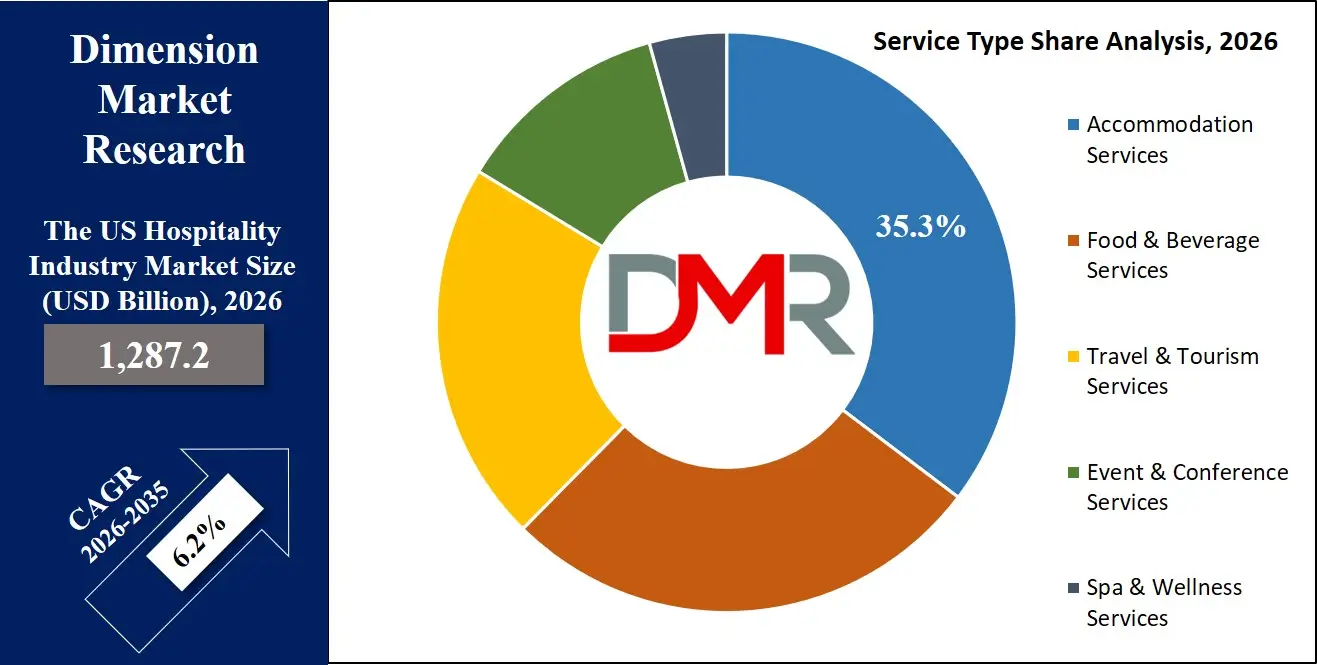
The US hospitality market is expected to be dominated by Accommodation Services (Hotels and Resorts, Motels, Vacation Rentals, Hostels and Serviced Apartments) with high domestic travel demand, the recovery of the international inbound travel, and increased flexibility of alternative accommodation. The biggest sub-segment is Hotels & Resorts because major chains have the advantage of loyalty programs and corporate accounts.
ℹ
To learn more about this report –
Download Your Free Sample Report Here
Vacation Rentals (Airbnb, Vrbo) have been taking a larger share, especially when it comes to family travel, and long-term stays. The remote work and business travel are becoming less distinct, leading to the growth of Serviced Apartments. The second-largest in terms of revenues is Food & Beverage Services (Full-Service Restaurants, Quick Service Restaurants (QSR), Cafes and Bars, Catering Services). The reason why QSR is a leader in terms of transaction volume is because of speed, convenience, and aggressive adoption of digital.
By Business Model Analysis
The US hospitality market is expected to dominate by Franchise Model (e.g. Marriott, Hilton, Choice, Wyndham franchise systems) and QSR (McDonalds, Subway, Dunkin, Taco Bell). Franchising helps to grow fast with minimal capital requirements of the brand owners whereas the franchisees enjoy brand recognition, centralized marketing, and systems. The US has more than 70.0% franchise hotels of its branded hotels. Ownership Model: Often in use in luxury resorts (e.g. Four Seasons properties, Ritz-Carlton), large casino hotels (MGM, Caesars properties), and in many independent boutique hotels and full-service restaurants. The benefit of ownership is that it gives total operational control and the retention of all the profits but the amount of capital required is substantial and it is fully risky. Hotel properties are also significant holders of real estate investment trusts (REITs), which they lease out to management contracts.
By Booking Channel Analysis
This segment is poised to be dominated by Indirect Booking because Online Travel Agencies (OTAs) like Expedia, Booking.com, and Agoda are very important, especially among independent hotels, small chains, and vacation rentals. OTAs are highly visible and booked, which is facilitated by intensive marketing, search engine optimization, and user experience. Their commissions (usually 15-25% of room rate) squeeze margins of the operators, however. Global Distribution Systems (GDS) such as Sabre, Amadeus and Travelport are essential in corporate travel bookings through travel management companies. The Traditional Travel Agents are still relevant with luxury travel, group travel, and complicated itineraries (e.g., multi-city, cruise+hotel packages). There are hotel chains which fill inventory at discounted rates via the offices of Tour Operators and wholesalers during the off-peak season. The fastest-growing channel and the most popular channel among large hotel chains (Marriott, Hilton, Hyatt, IHG) is Direct Booking such as Website and mobile app booking.
The US Hospitality Industry Market Report is segmented on the basis of the following:
By Type of Establishment
- Hotels
- Resorts
- Beach resorts
- Mountain/ski resorts
- All-inclusive resorts
- Motels & Highway Lodging
- Hostels
- Vacation Rentals / Short-term Rentals
- Bed & Breakfasts (B&Bs) / Guesthouses
- Other
By Service Type
- Accommodation Services
- Food & Beverage Services
- Restaurants
- Cafés
- Fast Food Chains
- Travel & Tourism Services
- Tour Packages
- Travel Agencies
- Guides & Interpretation Services
- Event & Conference Services
- Banquet Halls
- MICE (Meetings, Incentives, Conferences, Exhibitions)
- Spa & Wellness Services
By Ownership Type
- Chain-affiliated Establishments
- Independent Establishments
- Franchise Operations
- Government-owned Hospitality Facilities
By Booking Channel
- Direct Booking
- Online Travel Agencies (OTAs)
- Travel Agents / Intermediaries
- Corporate Bookings
- Government / Institutional Bookings
Impact of Artificial Intelligence in the US Hospitality Industry Market
The use of artificial intelligence is facilitating smarter revenue management by constantly examining real-time information, including competitor price, local events, weather predictions, booking lead time and demand trends. This enables hotels and other hospitality providers to dynamically adjust room rates, package offers and upsell opportunities, cutting down revenue leakage and enhancing RevPAR (Revenue Per Available Room). Pricing decisions made by AI-powered systems can be made in milliseconds and react to market dynamics quicker than human revenue managers.
Artificial intelligence is fueling automation in check-in/check-out desks, chatbots to respond to guest questions, robotic baggage handling, automated housekeeping, and predictive maintenance notifications. Automated processes assist hospitality providers to handle large numbers of guests effectively and with minimum human error, shorten waiting periods as well as boost productivity. In F&B, AI is applied in automating the kitchen (robotic fryers, automated pizza makers), inventory management, and waste reduction.
The US Hospitality Industry Market: Competitive Landscape
The U.S. hospitality market is characterized by a highly competitive rivalry between established international brands, innovative independent operators, alternative booking platforms, and technology-driven disruptors, all looking to dominate a sector that is rapidly evolving as a result of evolving consumer preferences, technological adoption, and post-pandemic travel trends. These companies, Marriott International, Hilton Worldwide, Hyatt Hotels Corporation, InterContinental Hotels Group (IHG), and Choice Hotels International, are leading the pack with their large collections of brands, including economy and luxury, global loyalty programs (Marriott Bonvoy, Hilton Honors, World of Hyatt), massive distribution networks, and understanding of complex revenue management. Their competition is aggressive in terms of corporate accounts, group business, and leisure travelers by differentiating their brands, property- level service standards and technology investments.
ℹ
To learn more about this report –
Download Your Free Sample Report Here
Other Accommodations such as Airbnb Inc. and Vrbo (Expedia Group) have completely changed the competitive environment, especially in leisure travel, long-term accommodation, and family holidays. These sites have special features (whole homes, apartments, cabins, houseboats) that are usually cheaper than lodging in hotels when a group does not need to stay overnight. Though they meet regulatory headwinds in certain cities, they still grow and have expanded to experiences and traditional hotel inventory.
Some of the prominent players in The US Hospitality Industry Market are:
- Marriott International
- Hilton Worldwide Holdings
- Hyatt Hotels Corporation
- Wyndham Hotels & Resorts
- Choice Hotels International
- InterContinental Hotels Group (IHG)
- Best Western Hotels & Resorts
- Extended Stay America
- Aimbridge Hospitality
- Sonesta International Hotels
- G6 Hospitality
- Red Roof Inn
- Drury Hotels Company
- Loews Hotels & Co
- MGM Resorts International
- Host Hotels & Resorts
- Pebblebrook Hotel Trust
- Apple Hospitality REIT
- DiamondRock Hospitality
- Airbnb
- Other Key Players
Recent Developments in the US Hospitality Industry Market
- March 2026: Marriott International announced a strategic partnership with Tesla to install high-speed electric vehicle chargers at over 1,500 Marriott properties across the US, supporting sustainability goals and attracting EV-driving guests. The rollout will be completed by 2028.
- February 2026: Hilton Worldwide unveiled a new AI-powered "Conrad Concierge" across its luxury Conrad brand properties in the US, offering personalized itinerary planning, restaurant reservations, and local experience booking via natural language chat, reducing front-desk workload and improving guest satisfaction scores by 22% in pilot properties.
- February 2026: Airbnb Inc. announced a major expansion of its "Airbnb Rooms" category (private rooms in host-occupied homes) with enhanced safety features, verified host profiles, and competitive pricing targeting budget-conscious solo travelers and younger demographics. The move aims to counter softening demand for entire-home rentals in some urban markets.
Report Details
| Report Characteristics |
| Market Size (2026) |
USD 1,287.2 Bn |
| Forecast Value (2035) |
USD 2,218.0 Bn |
| CAGR (2026–2035) |
6.2% |
| Historical Data |
2021 – 2025 |
| Forecast Data |
2027 – 2035 |
| Base Year |
2025 |
| Estimate Year |
2026 |
| Report Coverage |
Market Revenue Estimation, Market Dynamics, Competitive Landscape, Growth Factors and etc. |
| Segments Covered |
By Type of Establishment (Hotels, Resorts, Motels & Highway Lodging, Hostels, Vacation Rentals / Short-term Rentals, Bed & Breakfasts (B&B) / Guesthouses, and Other), By Service Type (Accommodation Services, Food & Beverage Services, Travel & Tourism Services, Event & Conference Services, Spa & Wellness Services), By Ownership Type (Chain-affiliated Establishments, Independent Establishments, Franchise Operations, Government-owned Hospitality Facilities), By Booking Channel (Direct Booking, Online Travel Agencies (OTAs), Travel Agents / Intermediaries, Corporate Bookings, Government / Institutional Bookings) |
| Country Coverage |
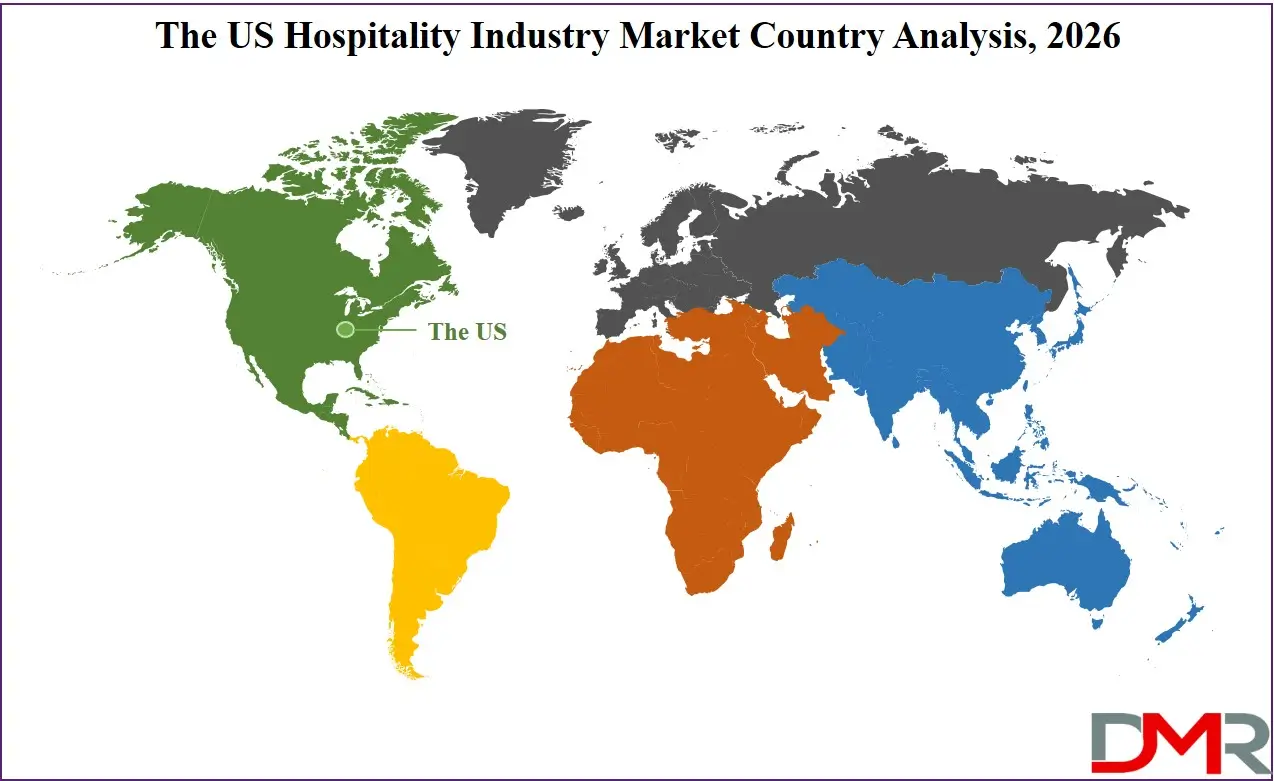
The US |
| Prominent Players |
Marriott International, Hilton Worldwide Holdings, Hyatt Hotels Corporation, Wyndham Hotels & Resorts, Choice Hotels International, InterContinental Hotels Group, Best Western Hotels & Resorts, Extended Stay America, Aimbridge Hospitality, Sonesta International Hotels, G6 Hospitality, Red Roof Inn, Drury Hotels Company, Loews Hotels & Co, MGM Resorts International, Host Hotels & Resorts, Pebblebrook Hotel Trust, Apple Hospitality REIT, DiamondRock Hospitality, Air, and Other Key Players |
| Purchase Options |
We have three licenses to opt for: Single User License (Limited to 1 user), Multi-User License (Up to 5 Users) and Corporate Use License (Unlimited User) along with free report customization equivalent to 0 analyst working days, 3 analysts working days and 5 analysts working days respectively. |
Frequently Asked Questions
How big is The US Hospitality Industry Market?
▾ The US Hospitality Industry Market size is estimated to have a value of USD 1,287.2 billion in 2026 and is expected to reach USD 2,218.0 billion by the end of 2035.
Who are the key players in The US Hospitality Industry Market?
▾ Some of the major key players in The US Hospitality Industry Market are InterContinental Hotels Group (IHG), Best Western Hotels & Resorts, Extended Stay America, Aimbridge Hospitality, Sonesta International Hotels, G6 Hospitality, and many others.
What is the growth rate in The US Hospitality Industry Market in 2026?
▾ The market is growing at a CAGR of 6.2 percent over the forecasted period of 2026.