Market Overview
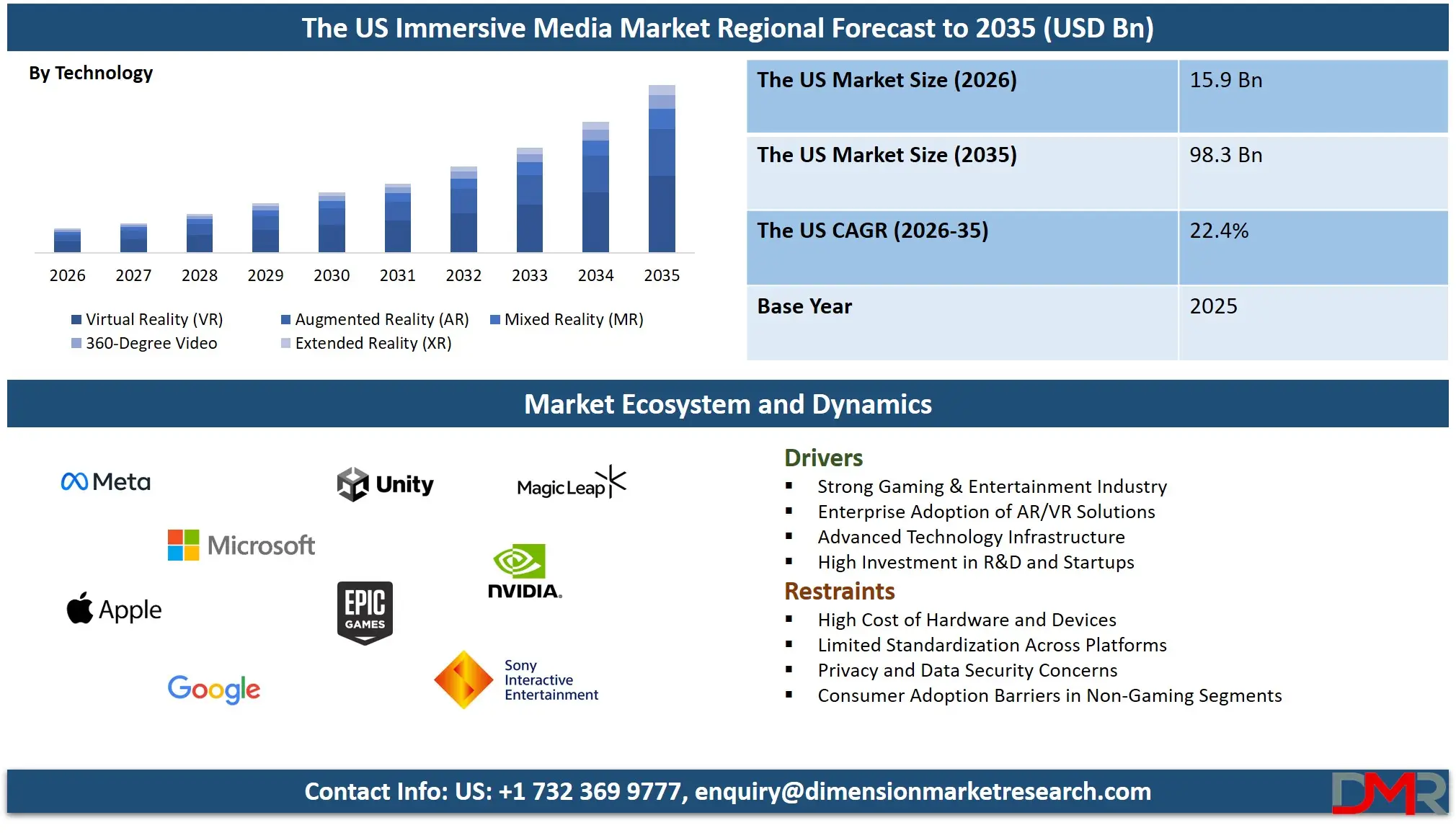
The U.S. immersive media market size is projected at USD 15.9 billion in 2026 and is set to grow at a CAGR of 22.4%, reaching USD 98.3 billion by 2035, driven by VR, AR, MR adoption, immersive content, and enterprise applications.
ℹ
To learn more about this report –
Download Your Free Sample Report Here
Immersive media refers to a collection of technologies and content experiences that fully engage users in interactive digital environments, blending the physical and virtual worlds. It encompasses virtual reality, augmented reality, mixed reality, and extended reality platforms that allow users to interact with three-dimensional digital objects, simulated environments, and multimedia content. These technologies rely on advanced hardware such as head-mounted displays, sensors, cameras, and AR glasses, along with software platforms including game engines, content management systems, and 3D modeling tools. Immersive media is transforming sectors like entertainment, education, healthcare, marketing, and training by providing realistic simulations, interactive storytelling, and experiential engagement that traditional media cannot replicate. The integration of gesture tracking, spatial computing, and real-time rendering makes these experiences more intuitive and impactful, enabling users to participate rather than passively consume content.
The United States immersive media market has witnessed rapid growth driven by widespread adoption of virtual reality and augmented reality applications across gaming, media, training, and enterprise solutions. The expansion of high-speed internet infrastructure, availability of advanced hardware devices, and the growing preference for experiential content have contributed to increased investments by both startups and established technology companies. The market encompasses software platforms for 3D content creation, simulation, and interactive storytelling as well as service offerings including integration, deployment, and consulting. The presence of major industry players and a strong venture capital ecosystem has further accelerated innovation, leading to more sophisticated applications in entertainment, e-commerce, product development, and social media engagement.
ℹ
To learn more about this report –
Download Your Free Sample Report Here
The market also benefits from increasing enterprise adoption of immersive technologies for employee training, remote collaboration, and marketing campaigns. Businesses leverage immersive experiences to enhance customer engagement, reduce operational risks through simulation, and streamline product design processes. Government initiatives and research collaborations are supporting the development of immersive media standards and encouraging wider deployment in commercial and educational sectors, creating a favorable environment for continuous market expansion and technological advancement.
The US Immersive Media Market: Key Takeaways
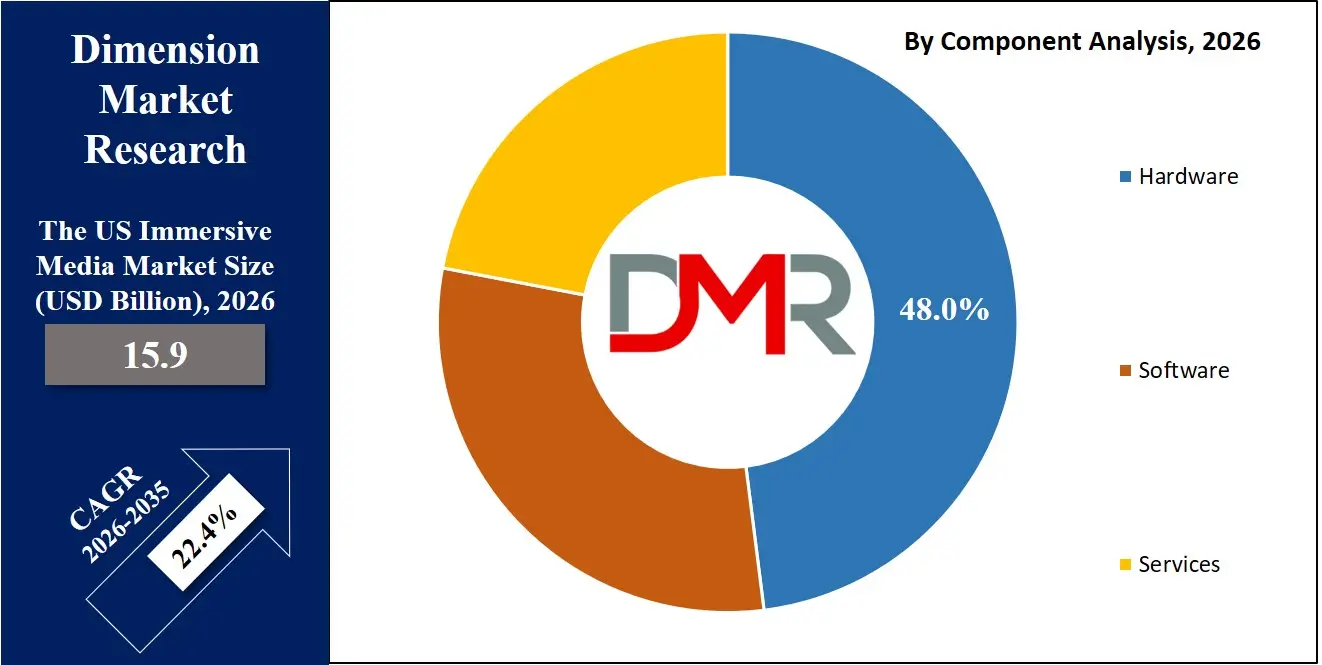
- Hardware Dominance: Hardware is projected to account for 48% of the U.S. immersive media market in 2026, driven by demand for HMDs, AR glasses, sensors, and gesture tracking devices.
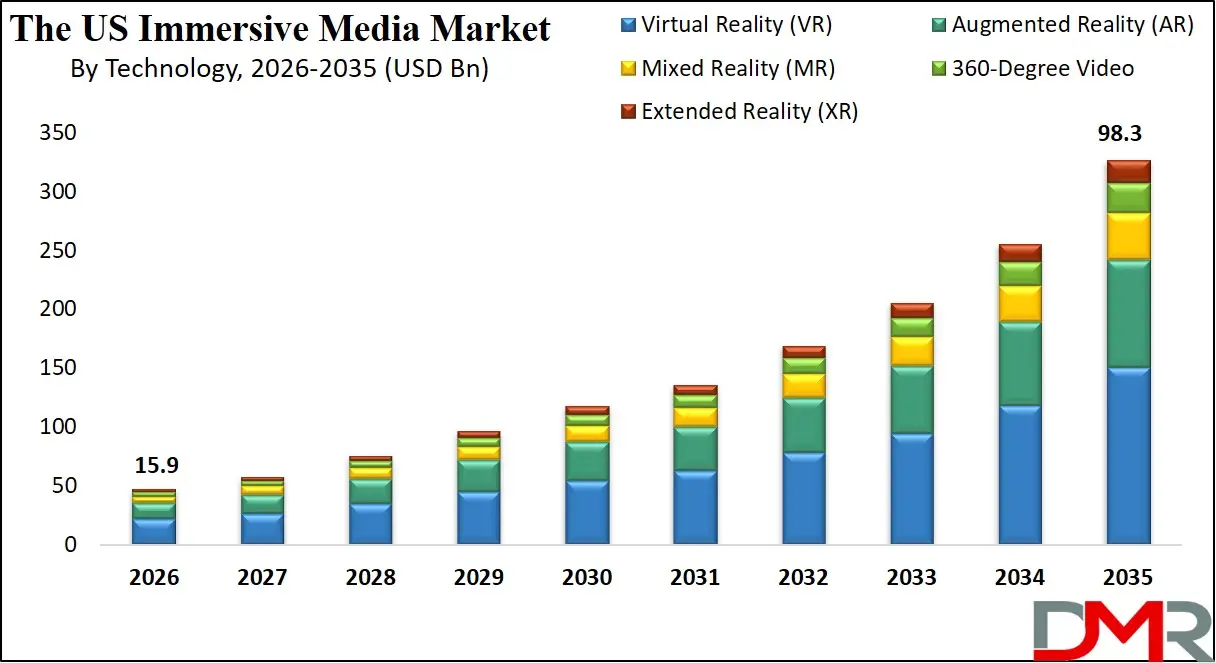
- VR Leads Technology Segment: Virtual reality is expected to capture 46% of the technology share in 2026, highlighting its strong adoption across gaming, training, and enterprise applications.
- Training & Learning Drives Applications: Training and learning applications hold 40% of the market share, reflecting widespread use of VR/AR for corporate training, safety simulations, and educational programs.
- High Market Growth: The U.S. immersive media market is projected to grow from USD 15.9 billion in 2026 to USD 98.3 billion by 2035 at a CAGR of 22.4%, underscoring rapid expansion across sectors.
- Federal Adoption Statistics: Over 1,300 federal employees were trained using immersive technologies in FY 2022–2023 across agencies including USDA, VA, FBI, and EPA, showing growing government deployment.
The US Immersive Media Market: Use Cases
- Gaming and Entertainment: VR, AR, and 360-degree content create interactive gaming and media experiences, boosting engagement and immersive storytelling.
- Enterprise Training and Simulation: Immersive media enables realistic training, safety drills, and scenario-based learning using VR/AR simulations and 3D modeling tools.
- Product Design and Development: AR/VR tools allow virtual prototyping, 3D visualization, and collaborative design, speeding up product development and reducing costs.
- Marketing and Customer Engagement: Brands use AR campaigns, virtual showrooms, and interactive experiences to enhance engagement, showcase products, and drive sales.
The US Immersive Media Market: Stats & Facts
- Federal Agency Use & R&D (U.S. Government Accountability Office – GAO):
- The U.S. Department of Agriculture reported approximately 736 employees trained using immersive technologies in FY 2022–2023 for workforce training and operational applications.
- The Department of Veterans Affairs reported that approximately 414 employees had been trained using immersive technologies in FY 2022–2023.
- The Department of Justice’s Federal Bureau of Investigation trained approximately 136 federal employees using immersive technologies in FY 2022–2023.
- The EPA’s Office of Research and Development used immersive technology to train approximately 25–50 employees in FY 2023.
- At least nine federal civilian agencies reported using immersive technologies for design and planning activities in FY 2022–2023.
- NASA reported using at least 65 different immersive systems, programs, or activities for 14 different purposes in FY 2022–2023.
- The U.S. Department of Commerce reported using AR, MR, VR, immersive rooms, and simulators at least once per week in FY 2022–2023.
- The Department of Health and Human Services reported using AR, MR, VR, immersive rooms, and simulators at least once per month in FY 2022–2023.
- The Department of Homeland Security reported at least 10 different immersive technology systems and applications in FY 2022–2023 across multiple components.
- USDA reported using immersive simulators, VR, and AR at least once per month across multiple offices in FY 2022–2023.
- DHS reported using simulators daily, immersive rooms weekly, and VR at least monthly in FY 2022–2023.
The US Immersive Media Market: Market Dynamic
Driving Factors in the US Immersive Media Market
Rapid Adoption of AR/VR Technologies
The U.S. immersive media market is driven by widespread adoption of augmented reality and virtual reality solutions across gaming, entertainment, and enterprise sectors. Increasing deployment of mixed reality and extended reality platforms enhances interactive experiences, enabling users to engage with 3D content, simulations, and immersive storytelling.
Advancements in Hardware and Connectivity
Technological improvements in head-mounted displays, sensors, gesture tracking devices, and AR glasses, combined with high-speed 5G networks, are accelerating the deployment of immersive media solutions. Enhanced graphics processing, real-time rendering, and cloud-based platforms support seamless virtual experiences and interactive applications.
Restraints in the US Immersive Media Market
High Cost of Devices and Infrastructure
The significant investment required for VR/AR hardware, software licenses, and immersive content platforms limits adoption among small businesses and individual consumers. High costs of headsets, sensors, and integration services act as a barrier to widespread deployment.
Limited Skilled Workforce
A shortage of professionals skilled in 3D modeling, VR/AR development, and immersive content creation constrains market growth. Companies face challenges in hiring and training talent capable of designing and implementing interactive media solutions effectively.
Opportunities in the US Immersive Media Market
Enterprise and Industrial Applications
There is growing potential in sectors such as healthcare, manufacturing, education, and retail, where immersive media can support training, remote collaboration, and virtual prototyping. AR/VR-enabled simulations and interactive platforms offer efficiency gains and reduce operational risks.
Expansion of Experiential Marketing
Brands are increasingly leveraging immersive content, virtual showrooms, and interactive campaigns to engage customers. Opportunities exist in creating personalized experiences, enhancing brand storytelling, and driving online and offline conversions using mixed reality and extended reality technologies.
Trends in the US Immersive Media Market
Integration of AI and Machine Learning
Artificial intelligence is being integrated into immersive media platforms to deliver personalized content, predictive analytics, and adaptive simulations. AI-powered 3D modeling, gesture recognition, and real-time rendering enhance the interactivity and realism of virtual experiences.
Growth of Cloud-Based Immersive Platforms
Cloud computing is enabling scalable VR/AR solutions, supporting multi-user collaboration, remote training, and streaming of high-quality 3D content. Cloud-based platforms reduce hardware dependency, lower costs, and allow seamless access to immersive applications across devices.
The US Immersive Media Market: Research Scope and Analysis
By Component Analysis
In the U.S. immersive media market, hardware is expected to lead the component segment, accounting for approximately 48.0% of the total market share in 2026. This dominance is driven by the increasing demand for high-performance head-mounted displays, AR glasses, and gesture tracking devices, sensors, and cameras that enable fully interactive virtual and augmented reality experiences. The growing popularity of gaming, entertainment, and enterprise applications has further fueled the need for advanced hardware, as users require devices capable of delivering realistic graphics, precise motion tracking, and seamless interactivity. Hardware innovations, coupled with improved connectivity such as 5G networks and enhanced graphics processing units, are making immersive experiences more accessible and engaging, solidifying hardware as the backbone of the market.
ℹ
To learn more about this report –
Download Your Free Sample Report Here
Software also plays a crucial role in this segment by providing the platforms and tools necessary for creating, managing, and delivering immersive content. AR/VR content management systems, 3D modeling and simulation software, and game engines allow developers and enterprises to design interactive experiences, simulate real-world scenarios, and produce engaging multimedia content. Software solutions enable customization, integration, and real-time rendering, supporting both entertainment and enterprise applications. The growth of software in the market is further driven by the increasing adoption of cloud-based platforms, which allow for scalable deployment, multi-user collaboration, and easier access to immersive applications across different devices. Together, hardware and software form a comprehensive ecosystem that powers the U.S. immersive media market.
By Technology Analysis
In the U.S. immersive media market, virtual reality is expected to lead the technology segment, capturing around 46.0% of the total market share in 2026. This dominance is fueled by the growing adoption of VR across gaming, entertainment, and enterprise training applications, where fully immersive experiences allow users to interact with 3D environments and simulated scenarios. Advanced VR headsets, motion tracking systems, and high-resolution displays provide realistic visual and sensory engagement, making VR the preferred choice for both consumer and professional applications. The increasing development of VR content, such as interactive simulations, 360-degree videos, and virtual events, further strengthens its position in the market, while continuous improvements in hardware and software enhance usability and user experience.
Augmented reality also plays a significant role in this technology segment, offering unique opportunities for blending digital content with the physical world. AR applications enable interactive overlays, virtual prototyping, and real-time information display across industries like retail, healthcare, education, and manufacturing. The adoption of AR glasses, mobile AR apps, and gesture-based interfaces supports training, marketing, and collaborative work, enhancing productivity and engagement. AR platforms and software, including content management systems and 3D modeling tools, facilitate the creation and deployment of immersive experiences, allowing businesses to deliver personalized and context-aware interactions. Together, VR and AR complement each other, driving growth and innovation within the U.S. immersive media market.
By Application Analysis
In the U.S. immersive media market, training and learning are expected to dominate the application segment, accounting for approximately 40.0% of the total market share in 2026. This growth is driven by the increasing adoption of virtual reality and augmented reality solutions in corporate training, employee skill development, safety simulations, and educational programs. Immersive media enables realistic, scenario-based learning where employees and students can practice tasks in risk-free virtual environments, improving retention and reducing training costs. The use of 3D simulations, interactive modules, and VR/AR-enabled learning platforms allows organizations to deliver consistent, scalable, and engaging training experiences across multiple locations, making immersive media a critical tool for workforce development and professional education.
Entertainment and media also represent a significant portion of the application segment, driven by the demand for interactive gaming, immersive storytelling, virtual concerts, and 360-degree video experiences. VR and AR technologies enhance user engagement by creating lifelike environments and interactive content that traditional media cannot replicate. Game engines, 3D content creation tools, and VR/AR platforms enable developers and media companies to produce high-quality immersive content for both individual and social experiences. The growth of streaming services, e-sports, and interactive media further fuels the adoption of immersive solutions, making entertainment and media a key driver of the U.S. immersive media market.
The US Immersive Media Market Report is segmented on the basis of the following:
By Component
- Hardware
- Head-Mounted Displays (HMDs)
- Gesture Tracking Devices
- Sensors and Cameras
- AR Glasses and Smart Glasses
- Software
- AR/VR Content Management Systems
- 3D Modeling & Simulation
- Game Engines
- Services
- Integration & Deployment
- Support & Maintenance
- Consulting & Training
- Solution
- Immersive Media Platforms
- Content Creation Tools
By Technology
- Virtual Reality (VR)
- Augmented Reality (AR)
- Mixed Reality (MR)
- 360-Degree Video
- Extended Reality (XR)
By Application
- Entertainment & Media
- Training & Learning
- Emergency Services
- Product Development
- Sales & Marketing
- Gaming
- Social Media
- Commercial
- Other Applications
Impact of Artificial Intelligence in the US Immersive Media Market
Artificial intelligence is playing an increasingly transformative role in the U.S. immersive media market by enhancing the design, delivery, and personalization of VR, AR, and mixed reality experiences. AI algorithms are being integrated into content creation tools, 3D modeling software, and simulation platforms to automate complex processes, optimize graphics rendering, and enable real-time environment adjustments. Machine learning enables adaptive experiences that respond to user behavior, preferences, and interactions, improving engagement in gaming, training, and enterprise applications. AI-powered analytics also help businesses measure user performance, track engagement, and refine immersive content to maximize learning outcomes and customer satisfaction.
In addition, AI is accelerating innovation in immersive media by enabling smarter gesture recognition, natural language processing, and predictive modeling within VR and AR environments. These capabilities allow developers to create more intuitive interfaces, realistic simulations, and interactive storytelling experiences that were previously difficult to achieve. AI-driven virtual assistants, recommendation engines, and automated scene generation enhance both consumer entertainment and enterprise solutions, supporting immersive marketing campaigns, virtual showrooms, and collaborative workspaces. The integration of AI not only improves the efficiency of immersive media development but also expands the scope of applications, making experiences more personalized, intelligent, and scalable across industries in the U.S. market.
The US Immersive Media Market: Competitive Landscape
The U.S. immersive media market is highly competitive, driven by continuous innovation in virtual reality, augmented reality, mixed reality, and extended reality technologies. Companies are focusing on developing advanced hardware, software platforms, and immersive content solutions to differentiate themselves and capture market share. Strategic investments in research and development, partnerships, and mergers are common to enhance capabilities in 3D modeling, simulation, and interactive media.
ℹ
To learn more about this report –
Download Your Free Sample Report Here
The market also sees competition in enterprise applications, gaming, entertainment, and experiential marketing, with providers striving to offer seamless, high-quality user experiences. Rapid technological advancements, increasing adoption of cloud-based platforms, and growing demand for personalized and scalable immersive solutions further intensify the competitive landscape, encouraging continuous innovation and diversification across segments.
Some of the prominent players in the US Immersive Media Market are:
- Meta Platforms Inc. (Reality Labs)
- Microsoft Corporation
- Apple Inc.
- Google LLC
- Unity Technologies
- Epic Games Inc.
- Magic Leap Inc.
- NVIDIA Corporation
- Sony Interactive Entertainment
- Groove Jones
- RYOT
- Dreamscape Immersive
- AMAZE (AmazeVR)
- DEVAR Entertainment LLC
- Illuminarium Experiences
- Sandbox VR
- Lucid Reality Labs
- Saritasa
- CXR.Agency
- Next/Now
- Other Key Players
Recent Developments in the US Immersive Media Market
- Dec 2025: XRHealth expanded its healthcare XR services by acquiring Innerworld, enabling a more comprehensive stepped care model that integrates group therapy and peer support within immersive environments.
- Nov 2025: A leading immersive entertainment venue project transformed a major U.S. performance space into an XR‑enabled experiential environment, showcasing how spatial audio and interactive visuals are reshaping audience engagement.
- Sep 2025: CBS Atlanta announced the launch of a new AR/VR‑enabled news production studio to deliver immersive local news experiences using augmented and virtual reality technologies.
Report Details
| Report Characteristics |
| Market Size (2026) |
USD 15.9 Bn |
| Forecast Value (2035) |
USD 98.3 Bn |
| CAGR (2026–2035) |
22.4% |
| Historical Data |
2021 – 2025 |
| Forecast Data |
2027 – 2035 |
| Base Year |
2025 |
| Estimate Year |
2026 |
| Report Coverage |
Market Revenue Estimation, Market Dynamics, Competitive Landscape, Growth Factors and etc. |
| Segments Covered |
By Component (Hardware, Software, Services, Solution), By Technology (Virtual Reality (VR), Augmented Reality (AR), Mixed Reality (MR), 360-Degree Video, Extended Reality), By Application (Entertainment & Media, Training & Learning, Emergency Services, Product Development, Sales & Marketing, Gaming, Social Media, Commercial, Other Applications), By End-Use Industry (Gaming & Design & Architecture, Retail, Automobile, Education, Media & Entertainment, Location-Based Entertainment, Travel & Hospitality, Other End-Use Industries) |
| Country Coverage |
The US |
| Prominent Players |
Meta Platforms Inc. (Reality Labs), Microsoft Corporation, Apple Inc., Google LLC, Unity Technologies, Epic Games Inc., Magic Leap Inc., NVIDIA Corporation, Sony Interactive Entertainment, Groove Jones, RYOT, Dreamscape Immersive, AMAZE (AmazeVR), DEVAR Entertainment LLC, Illuminarium Experiences, Sandbox VR, Lucid Reality Labs, Saritasa, CXR.Agency, Next/Now, and Other Key Players |
| Purchase Options |
We have three licenses to opt for: Single User License (Limited to 1 user), Multi-User License (Up to 5 Users) and Corporate Use License (Unlimited User) along with free report customization equivalent to 0 analyst working days, 3 analysts working days and 5 analysts working days respectively. |
Frequently Asked Questions
How big is the US Immersive Media Market?
▾ The US Immersive Media Market size is estimated to have a value of USD 15.9 billion in 2026 and is expected to reach USD 98.3 billion by the end of 2035.
What is the growth rate in the US Immersive Media Market in 2026?
▾ The market is growing at a CAGR of 22.4% over the forecasted period of 2026.
Who are the key players in the US Immersive Media Market?
▾ Some of the major key players in the US Immersive Media Market are Meta Platforms Inc. (Reality Labs), Microsoft Corporation, Apple Inc., Google LLC, Unity Technologies, Epic Games Inc., Magic Leap Inc., NVIDIA Corporation, Sony Interactive Entertainment, Groove Jones, RYOT, Dreamscape Immersive, and many others.