Market Snapshot
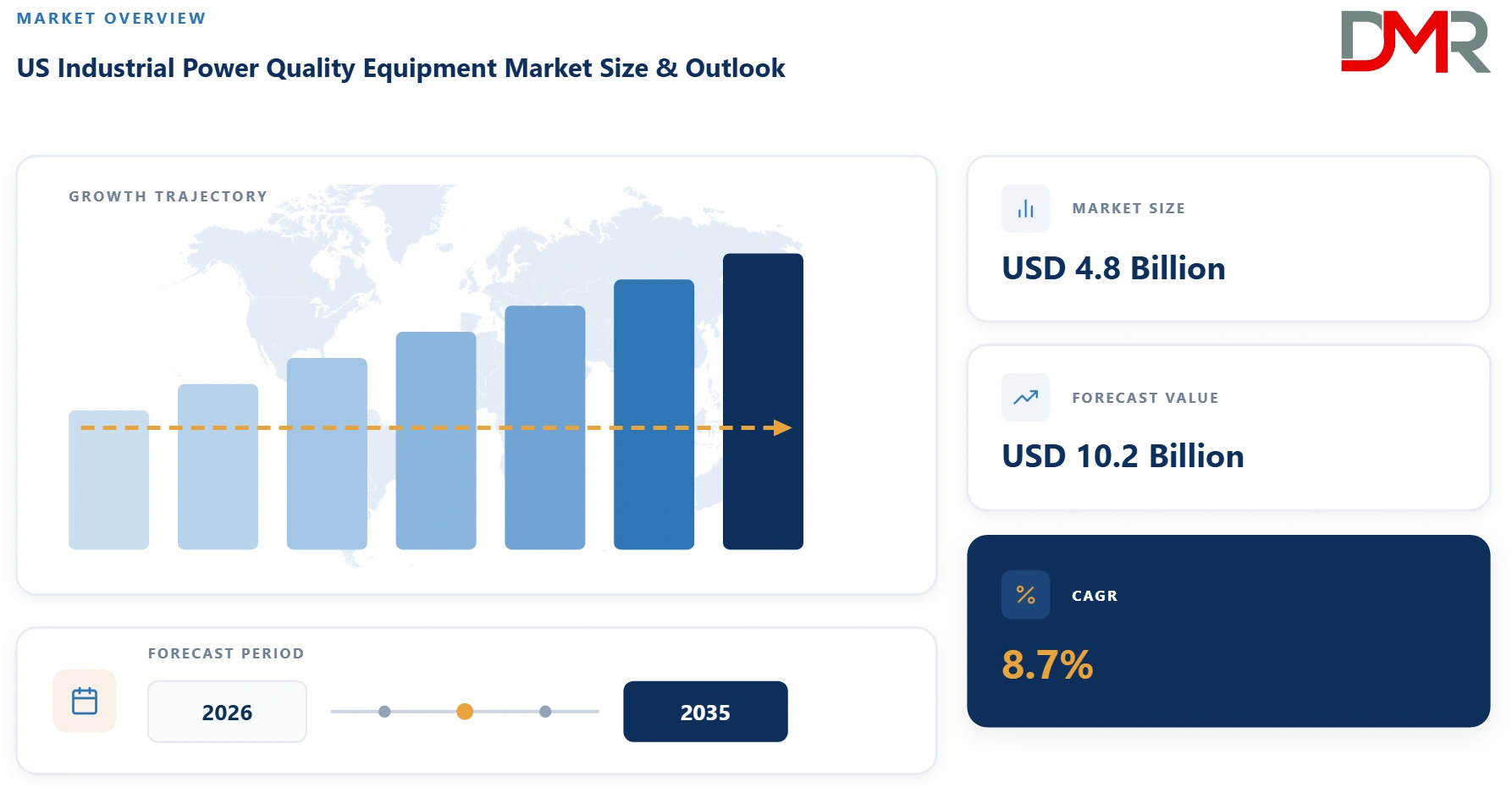
- Market Size (2026): USD 4.8 Bn
- Forecast Value (2035): USD 10.2 Bn
- CAGR (2026-2035): 8.7%
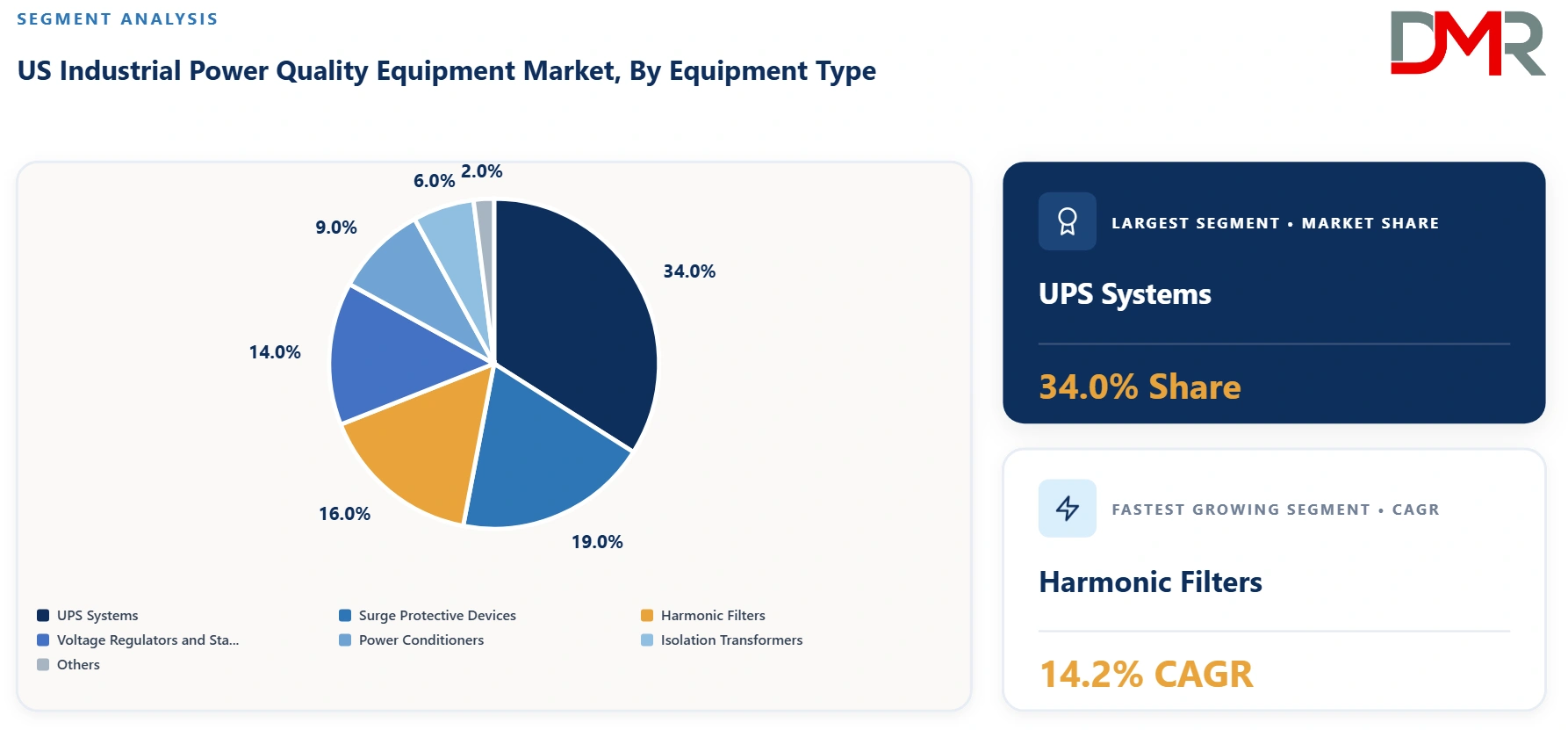
- Leading Equipment Type (2026): UPS Systems, around 34%
- Leading Power Rating (2026): 10 to 200 kVA Systems, close to 38%
- Key Players: Schneider Electric, Eaton, Vertiv and others
What is US Industrial Power Quality Equipment Market and its Market Size?
The US Industrial Power Quality Equipment Market size is estimated to reach USD 4.8 Bn in 2026 and is further anticipated to reach USD 10.2 Bn by 2035, at a CAGR of 8.7%.
ℹ
To learn more about this report –
Download Your Free Sample Report Here
The market covers uninterruptible power supplies, surge protective devices, harmonic filters, voltage regulators and stabilizers, power conditioners, and isolation transformers installed inside American manufacturing plants, oil and gas facilities, utility substations, data centers classed as industrial power users, and healthcare campuses. Every figure in this report reflects demand realized on US soil, purchases, installations and service contracts placed by industrial end users physically operating inside the country, rather than the worldwide revenue booked by equipment makers that happen to be headquartered here.
Industrial power quality equipment protects sensitive loads, variable frequency drives, programmable logic controllers, robotic work cells and server racks, from voltage sags, harmonic distortion, transient spikes and outright outages that would otherwise trip production lines, damage motor windings or corrupt process data. Unlike consumer surge strips, these systems are engineered for continuous duty in dusty, high vibration or temperature extreme plant environments, and are frequently specified as part of a facility's original electrical design rather than bolted on afterward.
Buyers span discrete and process manufacturers, oil and gas operators, mining and metals producers, utilities, data center operators and hospital systems, each purchasing to protect production uptime, satisfy insurance and electrical safety compliance requirements, and avoid the steep cost of an unplanned outage. Facility engineers, plant managers and electrical contractors typically drive the purchase decision, working through system integrators or direct manufacturer sales teams rather than retail channels.
Demand is shifting structurally as variable frequency drives, servo motors and power electronics proliferate across US factory floors, injecting more harmonic distortion into plant feeders than legacy linear loads ever did. At the same time, a wave of semiconductor fabrication, battery and data center construction tied to federal reshoring incentives is pulling in larger, higher capacity power quality installations, while an aging transmission grid raises the frequency of voltage sags reaching industrial feeders.
Use Cases
- Semiconductor Fab Cleanroom Continuity: Wafer fabrication operators install three phase UPS banks and isolation transformers ahead of lithography and etch tools, since a sag lasting only a few cycles can scrap an entire wafer lot, and engineers size battery runtime to bridge generator start delay without interrupting cleanroom airflow.
- Automotive Stamping Plant Sag Ride-Through: Tier one automotive suppliers deploy dynamic voltage restorers ahead of servo press lines, since a sub-second sag can fault a press mid-stroke and scrap tooling, letting the line ride through utility disturbances without a full production stop.
- Oil and Gas Field Harmonic Mitigation: Upstream operators fit active harmonic filters at variable frequency drive-heavy pump stations and compressor skids, correcting the distortion that drive fleets inject into remote feeders and protecting instrumentation from the nuisance tripping that follows.
- Hospital Critical Care Backup Power: Health systems pair UPS banks with isolation transformers ahead of operating suites and imaging equipment, a segment holding close to 12% of 2026 industrial power quality spend, so life safety branch circuits keep running through a utility interruption without a generator transfer gap.
Key Takeaways
- Market Size & Share: The market is valued at approximately USD 4.8 Bn in 2026, with UPS systems still the equipment category carrying the largest share of that spend.
- Equipment Type Analysis: Surge protective devices are gaining ground as facilities retrofit ahead of automation upgrades, expected to represent close to 19% of 2026 revenue behind UPS systems.
- Demand Concentration: Manufacturing and data center or IT infrastructure operators together account for just over half of 2026 industrial power quality demand, with the remainder split across oil and gas, utilities and healthcare buyers.
- Technology Adoption: Predictive maintenance software attached to UPS and switchgear fleets is expanding at nearly double the headline market pace as plant engineers move from scheduled battery swaps to condition based servicing.
- Regulatory Impact: A federal tariff adjustment capping duties on imported electrical grid and metal-intensive industrial equipment at 15% through 2027 is easing cost pressure on transformer and switchgear-heavy power quality installations.
How AI/Gen AI is Transforming the US Industrial Power Quality Equipment Market?
Artificial intelligence in this market is overwhelmingly operational rather than generative. Sensor networks embedded in UPS modules, harmonic filters and switchgear feed continuous voltage, current and temperature readings into machine learning models trained to flag battery degradation, capacitor aging and insulation stress before a failure interrupts production. Computer vision applied to thermal imaging cameras now scans switchgear rooms for hot spots that indicate a loosening connection, catching faults that a quarterly manual inspection would miss.
Adoption is concentrated among larger manufacturers and data center operators that already run centralized building management systems, since the value of predictive analytics compounds with fleet size. System integrators increasingly bundle a monitoring subscription with the hardware sale, turning a one-time equipment purchase into a recurring service relationship and giving vendors a live feed of field performance data to refine future product design.
- Predictive Battery Analytics: Machine learning models trained on internal resistance and temperature trends forecast UPS battery replacement windows within weeks rather than relying on fixed calendar swaps.
- Thermal Imaging Inspection: Computer vision flags overheating breakers, busbars and connections from routine camera sweeps, prioritizing technician visits toward the assets most likely to fail.
- Load Forecasting and Demand Response: Facility-level models forecast harmonic and reactive load swings ahead of new equipment startups, sizing filters and capacitor banks before nuisance tripping occurs.
- Digital Twin Commissioning: Virtual models of a plant's electrical distribution system let engineers simulate sag and harmonic events before installing physical power quality equipment, shortening commissioning cycles.
Key Drivers in the US Industrial Power Quality Equipment Market
Two forces, one tied to construction and one tied to grid condition, are pulling demand in different but reinforcing directions.
- Data Center and Semiconductor Fab Construction Boom: Federal reshoring incentives and AI-driven compute demand are pushing a wave of new semiconductor fabrication plants, battery gigafactories and hyperscale data centers through construction across the country, and every one of these facilities specifies large-capacity UPS, isolation transformers and harmonic mitigation equipment as part of its original electrical design. Data centers and IT infrastructure sites are projected to be the fastest expanding end use segment, growing at a CAGR near 16.8% through 2035 as capacity additions continue to outpace the broader industrial base. Because these projects specify power protection at the megawatt scale rather than the kilovolt-ampere scale, a comparatively small number of construction starts can move segment-level demand meaningfully.
- Aging Grid Infrastructure and Rising Power Disturbance Exposure: Much of the US transmission and distribution network predates modern industrial load profiles, and utilities report a rising frequency of voltage sags, momentary interruptions and harmonic pollution reaching industrial feeders as extreme weather events and grid congestion both increase. Plant managers who once tolerated occasional disturbances are now specifying ride-through equipment after a single sag-triggered production stoppage demonstrates the cost of going without it, converting what used to be a discretionary purchase into a standard line item on new and retrofit electrical projects alike.
Restraints in the US Industrial Power Quality Equipment Market
Two structural brakes temper an otherwise favorable demand backdrop.
- High Upfront Capital Cost and Extended Payback Periods: Large three phase UPS systems, isolation transformers and active harmonic filters carry high per-unit prices, and a mid-size manufacturer weighing a six figure power quality investment against other capital priorities frequently defers the purchase until an outage forces the issue. Financing structures such as power quality as a service, where a vendor retains ownership and bills a monthly fee, are spreading specifically because outright capital cost remains the single most commonly cited objection during the sales cycle, particularly among facilities operating on thin capital budgets.
- Shortage of Skilled Electrical Technicians for Installation and Service: Commissioning and servicing three phase power quality equipment requires licensed electricians with medium voltage experience, a labor pool that has not kept pace with construction demand, and lead times for qualified installation crews now stretch project timelines well beyond the equipment delivery date itself. Vendors have responded by expanding remote diagnostics and factory-trained field service networks, but the underlying technician shortage continues to cap how quickly new capacity can actually be installed and commissioned.
Growth Opportunities in the US Industrial Power Quality Equipment Market
Two pockets of unmet demand stand out against the broader market backdrop.
- Sun Belt Data Center and Semiconductor Corridor Build-Out: Texas, Arizona and Ohio are absorbing a disproportionate share of new semiconductor and data center construction, and local system integrators in these corridors report backlogs for large-capacity UPS and switchgear that outstrip what national vendors can currently staff and service, opening room for regional specialists that can guarantee shorter lead times than a manufacturer's centralized commissioning teams.
- Retrofit and Service Contract Growth Among Mid-Size Manufacturers: A large installed base of aging power quality equipment sits inside mid-size manufacturing plants that lack the in-house electrical engineering staff of a large enterprise, creating an underserved channel for vendors willing to bundle equipment replacement with a multi-year monitoring and maintenance contract rather than selling hardware alone.
Trends in the US Industrial Power Quality Equipment Market
Two shifts in product design and buyer behavior are reshaping how this equipment is specified and sold.
- Modular, Scalable UPS Architectures Replacing Monolithic Systems: Facility engineers increasingly specify modular UPS frames that can be expanded in smaller capacity blocks as a plant grows, rather than committing upfront to a single large monolithic unit sized for peak future load, reducing both initial capital outlay and the risk of stranded capacity.
- Convergence of Power Quality Monitoring with Predictive Analytics Software: Equipment vendors are bundling cloud-connected monitoring dashboards with hardware sales as a default rather than an add-on, shifting the competitive basis from equipment specifications alone toward the quality of the analytics and remote support layered on top.
Research Scope and Analysis
Segment performance is assessed across five axes: equipment type, power rating, end use industry, application and distribution channel, identifying where 2026 revenue concentrates today and which sub-segment is pulling ahead of the market's overall pace.
ℹ
To learn more about this report –
Download Your Free Sample Report Here
By Equipment Type
UPS systems are projected to hold the largest share of 2026 revenue by equipment type, accounting for around 34%, since every industrial and data center site treats battery backed continuity as a baseline requirement rather than an optional add-on, and periodic battery and module refresh cycles keep the installed base turning over. Growth, however, is concentrated in harmonic filters, expanding at a CAGR of 14.2% between 2026 and 2035 as the spread of variable frequency drives, servo motors and other nonlinear loads across factory floors pushes plants that never previously needed active filtration to add it, particularly where utilities have begun enforcing tighter harmonic distortion limits at the point of common coupling.
By Power Rating
The 10 to 200 kVA class is projected to lead 2026 revenue by power rating, holding close to 38%, since this band covers the majority of single production line and departmental installations across discrete manufacturing. The steeper trajectory sits with systems rated above 1 MVA, forecast to expand at a CAGR of 15.6% through 2035 as semiconductor fabs, battery plants and hyperscale data centers specify power protection sized to their own multi-megawatt electrical infrastructure rather than to a single production line, a buyer profile that barely existed in this market a decade ago.
By End Use Industry
Manufacturing is projected to remain the largest end use industry in 2026, accounting for approximately 29% of demand, reflecting the sheer breadth of discrete and process plants operating across the country relative to any single other vertical. Growth, however, is concentrated in data centers and IT infrastructure, expanding at a CAGR of 16.8% between 2026 and 2035 as capacity additions tied to AI compute demand continue at a pace no other industrial vertical is currently matching, pulling this segment's share of total demand steadily upward over the forecast period.
By Application
Backup power and continuity applications are expected to lead 2026 demand, holding around 33%, since maintaining production through a utility interruption remains the primary reason most facilities specify power quality equipment in the first place. The faster growing application is harmonic mitigation, forecast at a CAGR of 13.9% through 2035, pulled by the same proliferation of variable frequency drives and power electronics that is lifting the harmonic filters equipment segment, as plants retrofit filtration onto feeders that were never originally designed to carry today's nonlinear load mix.
By Distribution Channel
Direct sales are projected to remain the leading distribution channel in 2026, accounting for close to 42%, since large capacity installations tied to fab, data center and utility projects are typically negotiated directly between the manufacturer and the end user's engineering team. Growth, however, is concentrated in online and digital channels, expanding at a CAGR of 18.4% through 2035 off a small base, as smaller capacity units for departmental or edge applications increasingly move through e-commerce platforms that let plant engineers configure and order standard units without a formal quotation cycle.
The US Industrial Power Quality Equipment Market Report is Segmented Based on the Following
By Equipment Type
- UPS Systems
- Surge Protective Devices
- Harmonic Filters
- Voltage Regulators and Stabilizers
- Power Conditioners
- Isolation Transformers
- Others
By Power Rating
- Below 10 kVA
- 10 to 200 kVA
- 200 kVA to 1 MVA
- Above 1 MVA
- Others
By End Use Industry
- Manufacturing
- Data Centers and IT Infrastructure
- Oil and Gas
- Utilities and Power Generation
- Healthcare
- Others
By Application
- Backup Power and Continuity
- Harmonic Mitigation
- Voltage Regulation
- Surge and Transient Protection
- Power Factor Correction
By Distribution Channel
- Direct Sales
- System Integrators and EPCs
- Distributors and Resellers
- Online and Digital Channels
Technology Analysis
Power electronics inside UPS and harmonic filter modules are moving from silicon to wide-bandgap semiconductors, with silicon carbide inverter stages now shipping in premium three phase UPS lines because they cut switching losses and shrink the footprint of large capacity units. Sensor-dense installations are also becoming the norm, with vendors bundling condition monitoring into the base product rather than selling it as a separate accessory. The commercial opening sits with mid-size manufacturers that have historically bought monitoring-free equipment, a segment that vendors are now targeting with lower cost sensor retrofit kits rather than full system replacement. The risk is that wide-bandgap components remain concentrated among a small number of overseas foundries, so any supply disruption there raises component cost for every UPS vendor simultaneously, an exposure that ultimately feeds through to end user pricing and delivery lead times across the market.
Geopolitical Analysis
Trade policy has moved to the center of this market's cost structure since a federal proclamation revised Section 232 tariffs on steel, aluminum and copper in 2026, applying duties to the full customs value of covered derivatives while carving out a temporary 15% transitional rate for metal-intensive industrial and electrical grid equipment through the end of 2027 to support domestic buildout. What is shifting now is a scramble among transformer, switchgear and enclosure manufacturers to document US metal content and secure the lower rate, since these products carry substantial steel and copper mass relative to their value. The commercial opening favors manufacturers with established domestic production, who can absorb the tariff exposure their import-dependent competitors cannot, while the risk is that continued tariff revisions keep component costs and delivery timelines volatile for buyers trying to plan multi-year capital projects around power quality equipment procurement.
Competitive Landscape
The market remains moderately fragmented, with a handful of diversified electrical equipment majors holding the largest share of large-capacity UPS and switchgear-adjacent power quality business, while a long tail of specialists competes on niche equipment types such as harmonic filters, voltage regulators and surge protective devices. Competition centers on lead time, service network density and, increasingly, the sophistication of the monitoring software bundled with hardware, rather than on price alone for large capacity projects where downtime cost dwarfs equipment cost. Distribution partnerships with national electrical wholesalers remain the dominant go-to-market motion for mid-market equipment, while the largest capacity installations tied to data centers and semiconductor fabs are typically sold directly through manufacturer engineering teams working alongside the project's electrical contractor from the design stage onward.
Some of the Prominent Players in the US Industrial Power Quality Equipment Market Are
- Schneider Electric
- Eaton Corporation
- ABB Ltd
- Siemens AG
- Vertiv Holdings Co
- Legrand SA
- Emerson Electric Co.
- Mitsubishi Electric Corporation
- Toshiba International Corporation
- Hitachi Energy Ltd
- Delta Electronics Inc.
- Socomec Group
- Riello UPS (RPS Group)
- Piller Power Systems
- AEG Power Solutions
- Fuji Electric Co., Ltd.
- Rittal Corporation
- Kohler Co. (Kohler Power Systems)
- Cummins Inc.
- Caterpillar Inc. (Electric Power Division)
- Generac Power Systems Inc.
- CyberPower Systems (USA) Inc.
- EnerSys
- Mirus International Inc.
- Staco Energy Products Co.
- Powerside
- Falcon Electric Inc.
- SolaHD (Bel Fuse Inc.)
- Powersmiths International Corp.
- Littelfuse Inc.
- WESCO International Inc.
- Graybar Electric Company Inc.
- Rexel USA Inc.
- Sonepar USA
- Panduit Corp.
- Black Box Corporation
- Leviton Manufacturing Co. Inc.
- Advanced Protection Technologies Inc.
- DITEK Corporation
- Border States Electric
- Other Key Players
Recent Developments
- In June 2026, a federal proclamation revised Section 232 tariffs on steel, aluminum and copper derivatives, setting a temporary 15% transitional rate on metal-intensive industrial and electrical grid equipment through the end of 2027, directly easing input cost pressure on transformer and switchgear-heavy power quality equipment.
- In March 2026, Vertiv introduced the PowerUPS 6000 Industrial uninterruptible power supply, engineered specifically for commercial and industrial environments including manufacturing, oil and gas, and food and beverage facilities exposed to electrical instability and airborne contaminants.
- In March 2026, Vertiv announced four new or expanding manufacturing facilities across the Americas to add production capacity for power management and infrastructure equipment amid rising demand from industrial and data center customers.
- In January and April 2026, Eaton implemented successive price increases across its electrical and power product lines, citing allocation pressure and extended lead times across the power equipment supply chain driven by surging demand tied to AI infrastructure construction.
- In November 2025, Schneider Electric opened a new medium voltage manufacturing facility in Mt. Juliet, Tennessee, ramping up domestic production of air-insulated and gas-insulated switchgear as part of a broader domestic investment plan spanning multiple states.
Report Details
| Report Characteristics |
| Market Size (2026) |
USD 4.8 Bn |
| Forecast Value (2035) |
USD 10.2 Bn |
| CAGR (2026–2035) |
8.7% |
| Historical Data |
2021 – 2025 |
| Forecast Data |
2026 – 2035 |
| Base Year |
2025 |
| Segments Covered |
By Equipment Type, By Power Rating, By End Use Industry, By Application, and By Distribution Channel |
| Regional Coverage |
The US |
Frequently Asked Questions
How big is the US Industrial Power Quality Equipment Market?
▾ The market is estimated at USD 4.8 Bn in 2026. It is projected to reach USD 10.2 Bn by 2035, as manufacturing, data center and semiconductor buyers continue hardening electrical infrastructure against sags, harmonics and outages across US industrial facilities.
What is the growth rate of the US Industrial Power Quality Equipment Market?
▾ The market is projected to expand at a CAGR of 8.7% between 2026 and 2035, ahead of the broader industrial equipment base, as construction tied to data centers, semiconductor fabs and battery plants pulls in larger and more frequent power quality installations.
What is driving demand in the US Industrial Power Quality Equipment Market?
▾ Demand is driven chiefly by a wave of data center, semiconductor and battery plant construction that specifies large capacity power protection by design, combined with an aging transmission grid that is raising the frequency of voltage sags and harmonic disturbances reaching industrial feeders nationwide.
Who are the key players in the US Industrial Power Quality Equipment Market?
▾ Key players include Schneider Electric, Eaton Corporation, ABB Ltd, Vertiv Holdings Co, Siemens AG, Emerson Electric Co. and Generac Power Systems Inc., alongside specialists such as CyberPower Systems and Staco Energy Products competing on niche equipment types and service coverage.
Which equipment type leads the US Industrial Power Quality Equipment Market?
▾ UPS systems lead the market, accounting for around 34% of 2026 revenue, since nearly every industrial and data center facility treats battery backed continuity as a baseline requirement rather than an optional purchase during electrical design.
Which end use industry is expanding fastest?
▾ Data centers and IT infrastructure sites are the fastest expanding end use industry, forecast to grow at a CAGR near 16.8% through 2035 as capacity additions tied to AI compute demand continue to outpace construction across every other industrial vertical.
What role is artificial intelligence playing in the US Industrial Power Quality Equipment Market?
▾ Artificial intelligence in the US Industrial Power Quality Equipment Market is used mainly for predictive battery analytics and thermal imaging inspection, letting facility engineers flag failing UPS modules and loosening switchgear connections before an unplanned outage interrupts production.