Market Overview
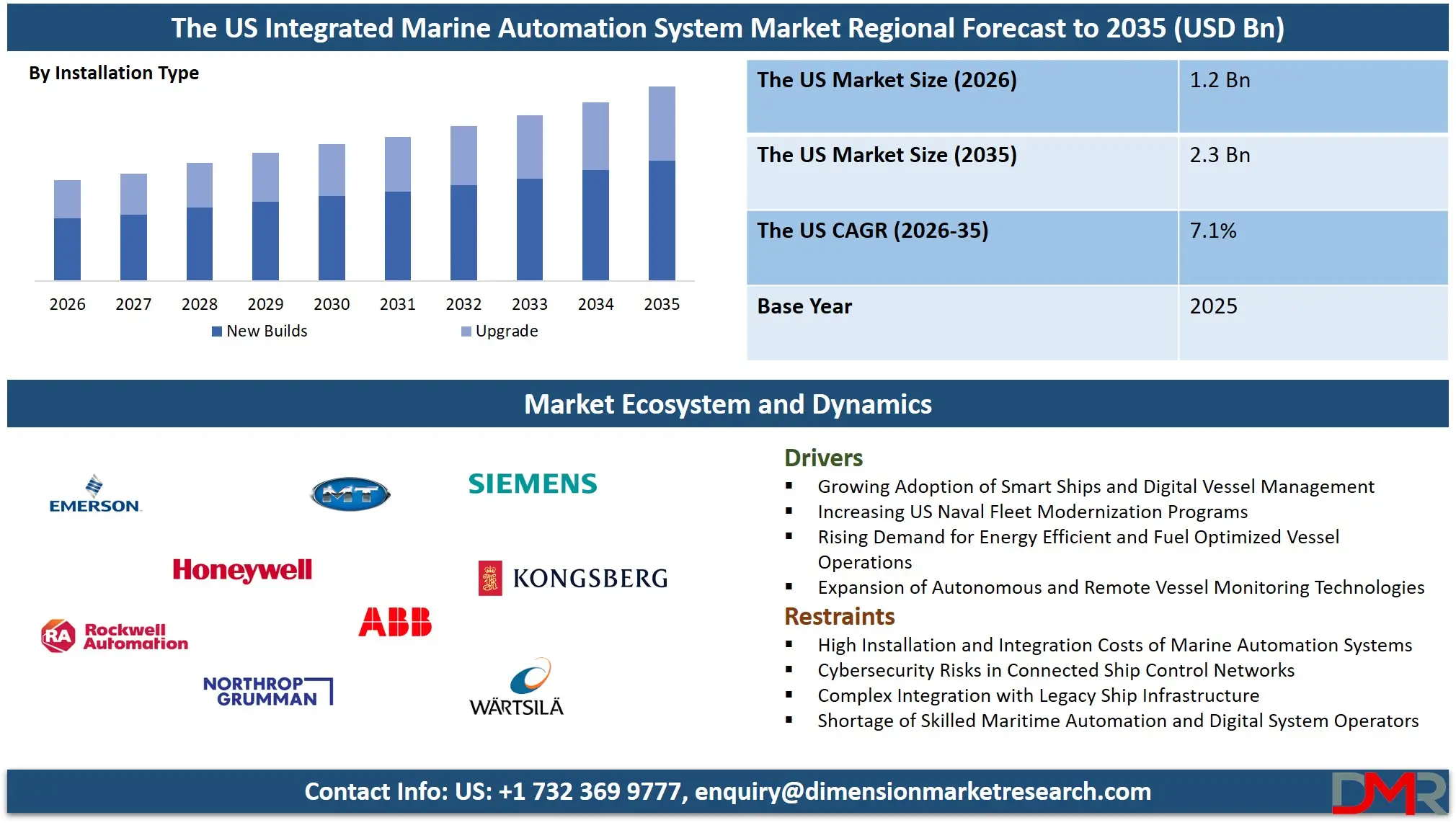
The US Integrated Marine Automation System Market size is projected to reach USD 1.2 billion in 2026 and is anticipated to grow to USD 2.3 billion by 2035, registering a CAGR of 7.1% during the forecast period. Market growth is driven by rising adoption of ship automation technologies, vessel control systems, digital ship management platforms, and advanced marine monitoring solutions across commercial shipping and naval fleets.
ℹ
To learn more about this report –
Download Your Free Sample Report Here
An integrated marine automation system is a centralized digital control and monitoring framework used on modern vessels to manage multiple shipboard operations through interconnected hardware and software platforms. It combines various subsystems such as propulsion control, power management, navigation monitoring, cargo handling, alarm management, and safety supervision into a unified interface that allows operators to oversee vessel performance from a control room or bridge console. These systems rely on advanced sensors, programmable logic controllers, data communication networks, and human-machine interfaces to automate routine ship functions and support real-time decision making. By synchronizing mechanical and electrical processes across the vessel, integrated marine automation systems improve operational efficiency, enhance crew safety, reduce human error, and enable predictive maintenance for critical marine equipment.
The US integrated marine automation system market represents the ecosystem of technologies, suppliers, and service providers that design and deploy automated ship control solutions across commercial shipping, naval fleets, offshore vessels, and research ships operating in the United States. Increasing investments in smart ship technology, digital ship management platforms, and advanced maritime control systems are driving the adoption of automated vessel monitoring and intelligent power distribution solutions. The presence of a strong naval infrastructure and a technologically advanced maritime industry is also encouraging the integration of real-time diagnostics, remote vessel monitoring, and data-driven maintenance capabilities within marine automation platforms.
ℹ
To learn more about this report –
Download Your Free Sample Report Here
In addition, the market is influenced by the growing need for energy-efficient vessel operations, compliance with maritime safety regulations, and the modernization of aging fleet infrastructure. Shipowners and operators in the United States are increasingly deploying integrated bridge systems, engine room automation, and digital vessel management solutions to optimize fuel consumption, improve navigation accuracy, and ensure continuous monitoring of shipboard machinery. As the maritime industry moves toward autonomous shipping concepts and connected vessel ecosystems, the demand for advanced marine control architecture and intelligent ship automation solutions is expected to expand steadily across commercial and defense maritime sectors.
The US Integrated Marine Automation System Market: Key Takeaways
- Market Growth Outlook: The US Integrated Marine Automation System Market is projected to grow from USD 1.2 billion in 2026 to USD 2.3 billion by 2035, reflecting strong demand for smart ship technologies and automated vessel management across commercial and defense maritime sectors.
- Hardware Dominance in Components: Hardware accounts for the largest share of the component segment with around 64.0% market share in 2026, driven by extensive deployment of sensors, PLCs, control panels, and communication modules in ship automation infrastructure.
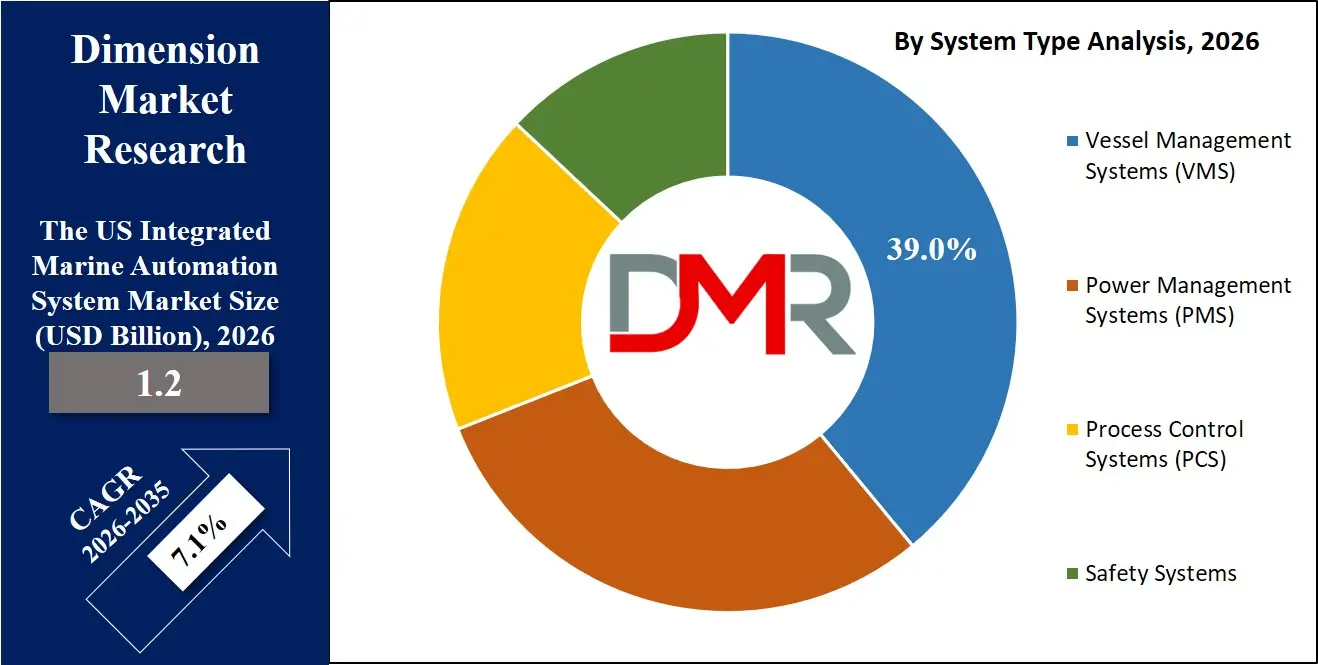
- Vessel Management Systems Leadership: Vessel Management Systems lead the system type segment with approximately 39.0% share in 2026, as ship operators increasingly adopt centralized monitoring platforms for propulsion, navigation, and onboard equipment control.
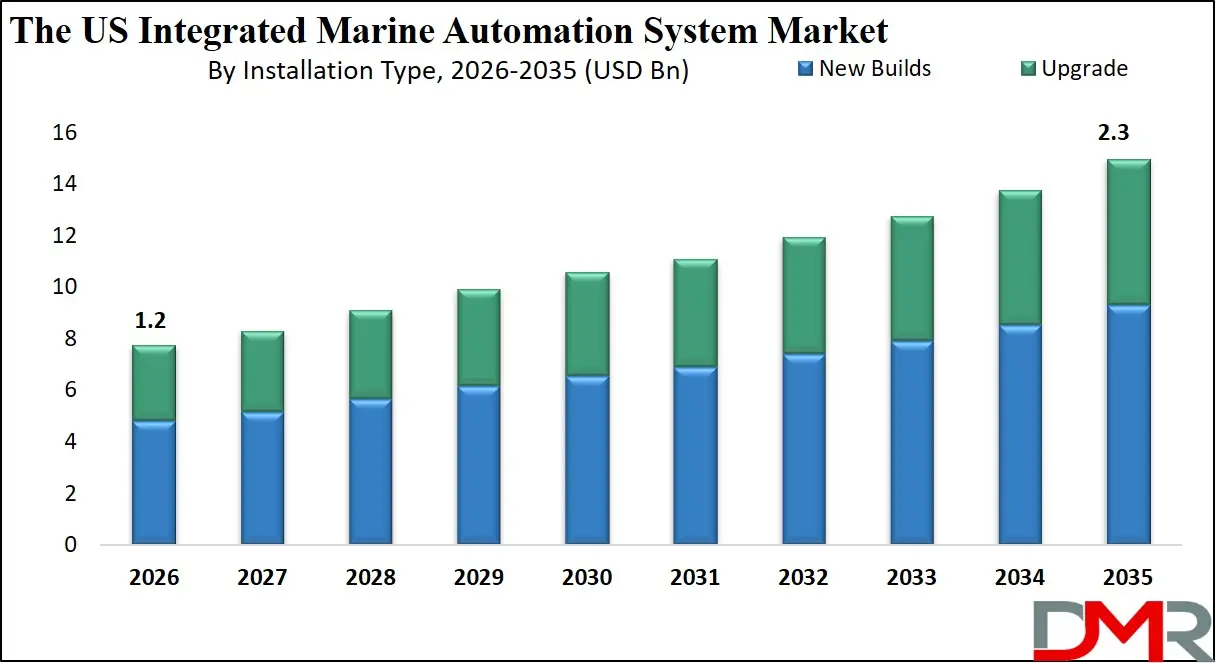
- New Build Installations Lead Adoption: New vessel construction represents the largest installation segment with about 62.0% market share in 2026, as shipbuilders integrate automation systems directly during vessel design and construction.
- Commercial Shipping as the Largest End User: Commercial shipping dominates the end user segment with around 76.0% share in 2026, supported by the large number of cargo, tanker, and container vessels adopting integrated automation to improve fuel efficiency and operational monitoring.
The US Integrated Marine Automation System Market: Use Cases
- Commercial Vessel Operations: Integrated marine automation systems help commercial vessels manage propulsion control, engine room automation, and vessel monitoring from a centralized platform, improving fuel efficiency and voyage management.
- Naval and Defense Ship Automation: US naval ships use marine automation systems to control power management, propulsion systems, and safety monitoring, enhancing operational reliability and situational awareness.
- Offshore Support Vessel Management: Offshore vessels deploy integrated ship control systems to manage dynamic positioning, equipment monitoring, and power distribution during offshore energy operations.
- Smart Vessel Monitoring: Automation platforms enable real time vessel diagnostics and predictive maintenance through advanced sensors and digital ship management systems, reducing equipment downtime.
Impact of US-Iran Conflict in the US Integrated Marine Automation System Market
- Rising demand for advanced navigation and vessel monitoring systems: Geopolitical tensions and electronic interference incidents in major shipping corridors have increased the need for resilient navigation technologies. This encourages the adoption of integrated vessel monitoring platforms, advanced navigation control systems, and automated marine communication infrastructure to ensure safe vessel operations.
- Increased focus on cybersecurity in ship automation systems: Modern ships rely heavily on digital control networks and automated navigation systems. Conflict related cyber threats, signal jamming, and spoofing risks are pushing maritime operators to invest in secure marine automation architecture, protected communication systems, and cyber resilient ship control platforms.
- Growth in US naval fleet modernization programs: Heightened regional tensions often lead to increased defense spending and naval capability upgrades. This drives demand for advanced integrated ship automation systems, intelligent power management solutions, and automated monitoring technologies across US naval vessels.
- Acceleration of autonomous and remotely operated vessel technologies: Security risks in sensitive maritime zones are encouraging the development of unmanned surface vessels and remotely operated ship monitoring systems. These technologies depend on advanced marine automation infrastructure, AI enabled navigation support, and integrated control systems.
- Increased emphasis on maritime safety and real time vessel monitoring: Rising threats to commercial vessels operating in strategic trade routes encourage shipping companies to deploy integrated bridge systems, alarm monitoring platforms, and predictive maintenance tools to ensure continuous monitoring of ship operations and improved maritime safety.
The US Integrated Marine Automation System Market: Stats & Facts
- U.S. Maritime Administration (MARAD)
- The U.S. flagged fleet included 188 commercial vessels as of April 2025.
- The container carrying capacity of the U.S. flagged fleet reached 265,799 TEUs in 2025.
- The liquid cargo carrying capacity of the U.S. flagged fleet reached 4,945,754 barrels in 2025.
- The United States maintained about 189 vessels in the U.S. international fleet in 2025.
- The Ready Reserve Force maintained by the U.S. government consists of 108 vessels supporting strategic sealift operations.
- The Maritime Security Program supports about 60 commercially active vessels available for national defense needs.
- The U.S. fleet included around 177 oceangoing self-propelled ships above 1,000 gross tons in 2023.
- Of these vessels, 153 ships were considered militarily useful in 2023.
- Approximately 93 vessels were Jones Act eligible ships in 2023.
- The U.S. maritime workforce includes around 200,000 licensed mariners supporting maritime operations.
- U.S. Coast Guard (USCG)
- The U.S. flag fleet included 17,765 vessels subject to inspection in 2024.
- The U.S. Coast Guard conducted 21,187 vessel inspections in 2024.
- A total of 1,806 reportable marine casualties were recorded in 2024.
- Marine casualty incidents declined by about 1 percent compared with 2023.
- The number of vessel deficiencies issued during inspections increased by about 2 percent in 2024 compared with 2023.
- The United States recorded 40 vessel detentions under flag state control in 2024.
- National Oceanic and Atmospheric Administration (NOAA)
- U.S. waterways transport about 2.3 billion tons of freight annually.
- Waterborne international trade handled through U.S. ports is valued at about USD 2.3 trillion annually.
- The United States transportation system includes around 25,000 miles of navigable waterways.
- There were approximately 44,800 U.S. flagged vessels operating in domestic waterways.
- The number of U.S. vessels operating domestically increased by about 10.5 percent since 2010.
- U.S. ports handled about 1.6 billion tons of imports and exports annually.
- The United States has 208 commercial ports handling more than 250,000 tons of cargo annually.
- Maritime trade through U.S. ports supports around 13 million jobs nationwide.
- Port related trade activity is associated with about USD 1.9 trillion worth of imports annually.
The US Integrated Marine Automation System Market: Market Dynamics
Driving Factors in the US Integrated Marine Automation System Market
Increasing Adoption of Smart Ship and Digital Vessel Technologies
The growing adoption of smart ship technology across the United States maritime sector is a major driver for the integrated marine automation system market. Ship operators are increasingly deploying vessel monitoring systems, integrated bridge systems, and engine room automation platforms to enhance operational efficiency and safety. These automation technologies enable real time data monitoring, centralized ship control, and improved navigation management. As commercial shipping companies and naval fleets continue to modernize their vessels with advanced marine control systems and intelligent ship management software, the demand for integrated automation platforms is steadily increasing.
Expansion of Naval Fleet Modernization Programs
Ongoing naval fleet modernization initiatives in the United States are accelerating the deployment of advanced marine automation systems. Defense vessels require highly reliable propulsion control systems, automated power management solutions, and integrated alarm monitoring platforms to support complex maritime missions. By integrating sensor networks, control modules, and digital diagnostics tools, naval ships can achieve enhanced system coordination and operational reliability. These modernization programs are encouraging the adoption of next generation ship automation architecture and advanced marine monitoring technologies.
Restraints in the US Integrated Marine Automation System Market
High Installation and System Integration Costs
The deployment of integrated marine automation systems requires significant capital investment due to the complexity of automation hardware, marine control software, and communication infrastructure. Integrating propulsion control modules, power management units, and vessel monitoring platforms into existing ship infrastructure can be technically challenging and costly. Smaller vessel operators and regional shipping companies may face financial constraints when adopting advanced ship automation solutions, which can limit market penetration across certain maritime segments.
Cybersecurity Risks in Connected Ship Systems
As vessels increasingly rely on digital ship management platforms and network connected automation systems, cybersecurity risks have become a growing concern in the maritime industry. Integrated marine automation platforms exchange large volumes of operational data through onboard networks and remote monitoring systems. This connectivity exposes critical ship control infrastructure to potential cyber threats that could affect navigation systems, power management controls, or vessel communication networks. Addressing these cybersecurity challenges requires continuous investment in secure maritime control architectures.
Opportunities in the US Integrated Marine Automation System Market
Growth of Autonomous and Semi-Autonomous Vessels
The development of autonomous and semi-autonomous vessels presents a strong opportunity for integrated marine automation systems in the United States. Autonomous shipping concepts rely heavily on advanced sensor integration, intelligent control software, and automated vessel management platforms. Marine automation systems play a critical role in enabling remote vessel monitoring, automated navigation assistance, and predictive maintenance capabilities. As maritime companies explore unmanned vessel technologies and smart fleet management solutions, demand for advanced ship automation infrastructure is expected to increase.
Rising Demand for Energy Efficient Marine Operations
Energy efficiency has become a key focus area for ship operators seeking to reduce fuel consumption and operational costs. Integrated marine automation systems enable optimized propulsion control, intelligent power distribution, and automated energy management across shipboard systems. Through real time vessel performance analytics and digital monitoring platforms, operators can improve fuel efficiency and reduce emissions. The push toward sustainable shipping practices and efficient marine operations is creating new opportunities for advanced ship control and automation technologies.
Trends in the US Integrated Marine Automation System Market
Integration of Data Analytics and Remote Monitoring Platforms
A growing trend in the US integrated marine automation system market is the integration of data analytics and remote vessel monitoring capabilities. Modern ship automation platforms are increasingly connected with cloud based monitoring systems that allow operators to track vessel performance, engine conditions, and equipment health from onshore control centers. These digital maritime solutions support predictive maintenance strategies, enhance fleet management efficiency, and enable real time operational insights across multiple vessels.
Development of Integrated Ship Control Ecosystems
Another emerging trend is the shift toward fully integrated ship control ecosystems that combine propulsion systems, navigation equipment, cargo management tools, and safety monitoring platforms within a unified automation framework. Shipbuilders and technology providers are focusing on creating interoperable marine automation architectures that simplify vessel operations and improve crew productivity. The adoption of integrated vessel management systems, intelligent alarm monitoring, and advanced marine communication networks is transforming how modern ships are operated and maintained.
The US Integrated Marine Automation System Market: Research Scope and Analysis
By Component Analysis
Hardware is anticipated to dominate the component segment of the US Integrated Marine Automation System market, accounting for about 64.0% of the total market share in 2026. The dominance of hardware components is primarily driven by the extensive use of physical automation equipment installed across vessels to support real time monitoring and control of shipboard operations. Key hardware elements include sensors, programmable logic controllers, control panels, communication modules, alarm management units, and human machine interface displays that enable centralized vessel monitoring and system coordination. These components form the backbone of marine automation infrastructure by collecting operational data from propulsion systems, power management units, navigation equipment, and onboard machinery. Increasing investments in advanced ship control architecture, integrated bridge systems, and engine room automation across commercial vessels and naval fleets in the United States continue to support the strong demand for marine automation hardware.
Software also plays a critical role in this market segment by enabling intelligent control, data processing, and system integration across various shipboard automation functions. Marine automation software platforms support vessel management systems, power monitoring applications, predictive maintenance analytics, and digital ship control interfaces that allow operators to supervise multiple onboard systems through a unified dashboard. These solutions facilitate real time data visualization, automated alarm handling, remote diagnostics, and operational optimization. As maritime operators increasingly adopt smart ship technologies and digital fleet management platforms, demand for advanced marine automation software is growing to support data driven decision making, system interoperability, and efficient vessel performance management.
By System Type Analysis
Vessel Management Systems are anticipated to dominate the system type segment of the US Integrated Marine Automation System market, capturing around 39.0% of the total market share in 2026. The dominance of vessel management systems is attributed to their ability to provide centralized monitoring and control of multiple shipboard operations through a unified digital platform. These systems integrate navigation data, propulsion control, machinery performance, alarm monitoring, and onboard equipment status into a single interface that allows ship operators to oversee vessel performance in real time. By combining sensor networks, communication modules, and advanced control software, vessel management systems support efficient ship operations, improved voyage planning, and enhanced operational safety. In the United States maritime sector, increasing adoption of smart ship technologies, automated bridge systems, and digital vessel monitoring solutions across commercial fleets and naval vessels is driving the demand for advanced vessel management platforms.
ℹ
To learn more about this report –
Download Your Free Sample Report Here
Power Management Systems also represent an important component within the system type segment as they are responsible for regulating and optimizing electrical power distribution across various shipboard systems. These systems monitor power generation units, energy loads, and electrical networks to ensure balanced energy consumption and reliable power supply during vessel operations. Power management platforms integrate generator control, load sharing functions, and automated fault detection mechanisms to prevent power failures and maintain stable ship operations. With the growing focus on energy efficient vessel performance, hybrid propulsion technologies, and electrification of marine equipment, ship operators in the United States are increasingly adopting advanced power monitoring and control solutions to optimize fuel usage, reduce energy losses, and maintain continuous power availability for critical onboard systems.
By Installation Type Analysis
New builds are anticipated to dominate the installation type segment of the US Integrated Marine Automation System market, capturing around 62.0% of the total market share in 2026. This dominance is largely driven by the increasing construction of technologically advanced vessels that incorporate integrated marine automation systems from the design stage. Shipbuilders and maritime operators are integrating vessel management systems, engine room automation, integrated bridge systems, and power monitoring platforms directly into newly built ships to improve operational efficiency and digital connectivity. Installing automation infrastructure during the initial shipbuilding phase allows better system integration, optimized network architecture, and seamless coordination between propulsion control, navigation systems, and onboard machinery. The growing demand for smart ships, energy efficient vessel operations, and modern naval fleet development in the United States is further encouraging the adoption of advanced marine automation solutions in new vessel projects.
Upgrades also represent an important part of the installation type segment as many existing vessels require modernization to keep pace with evolving maritime technology and safety regulations. Older ships are increasingly being retrofitted with updated automation hardware, digital vessel monitoring platforms, and advanced control software to enhance system reliability and operational performance. Through upgrade installations, ship operators can integrate modern sensor networks, alarm management systems, and predictive maintenance tools into existing ship infrastructure without constructing new vessels. This approach helps extend vessel lifespan, improve fuel efficiency, and enable better monitoring of propulsion systems, power distribution units, and onboard equipment within the evolving digital maritime ecosystem.
By Automation Level Analysis
Partial automation is anticipated to dominate the automation level segment of the US Integrated Marine Automation System market, capturing around 72.0% of the total market share in 2026. This dominance is mainly due to the widespread use of semi-automated ship control technologies that support crew assisted vessel operations while improving monitoring and system efficiency. In partially automated ships, critical functions such as propulsion monitoring, engine room automation, alarm management, and vessel performance tracking are controlled through integrated marine control systems, while final operational decisions remain with onboard crew members. These automation platforms use sensors, programmable logic controllers, and digital vessel monitoring software to provide real time operational insights and automated alerts. The adoption of partial automation allows shipping companies and naval operators in the United States to enhance safety, reduce human error, and improve operational efficiency without fully eliminating manual oversight in complex maritime environments.
Remotely operated systems are also gaining attention within this market segment as maritime operators explore advanced ship control technologies and remote vessel management capabilities. Remotely operated automation systems enable shore based control centers or remote operators to monitor and manage certain shipboard functions through secure communication networks and digital control platforms. These systems integrate remote diagnostics, sensor data transmission, and automated control modules to support vessel navigation assistance, equipment monitoring, and operational supervision from off board locations. Although still developing compared to partial automation, remotely operated marine automation solutions are becoming increasingly relevant as the maritime industry moves toward connected vessel ecosystems, smart fleet management, and future autonomous shipping concepts.
By End-User Analysis
Commercial shipping is anticipated to dominate the end user segment of the US Integrated Marine Automation System market, capturing around 76.0% of the total market share in 2026. This dominance is primarily driven by the large number of commercial vessels operating across cargo transport, container shipping, bulk carriers, tankers, and passenger ships in the United States maritime sector. Shipping companies are increasingly adopting integrated marine automation systems to improve vessel efficiency, reduce operational costs, and ensure compliance with maritime safety and environmental standards. These systems enable centralized monitoring of propulsion systems, fuel consumption, navigation performance, and onboard machinery through digital vessel management platforms. By integrating engine room automation, ship control systems, and real time vessel monitoring technologies, commercial ship operators can enhance voyage optimization, minimize equipment downtime, and maintain continuous operational oversight across large fleets.
The defense segment also represents an important part of the market as naval vessels require highly reliable automation systems to support complex maritime operations and mission readiness. Integrated marine automation solutions in defense ships help manage propulsion control, power distribution, alarm monitoring, and safety systems through secure and centralized control platforms. These technologies allow naval operators to monitor shipboard equipment, manage onboard energy systems, and coordinate multiple operational functions with improved accuracy and reliability. With ongoing naval fleet modernization programs and the growing use of advanced sensor networks, digital command systems, and automated ship monitoring platforms, the demand for integrated marine automation systems in the US defense maritime sector continues to expand.
The US Integrated Marine Automation System Market Report is segmented on the basis of the following:
By Component
- Hardware
- Software
- Services
By System Type
- Vessel Management Systems (VMS)
- Power Management Systems (PMS)
- Process Control Systems (PCS)
- Safety Systems
By Installation Type
By Automation Level
- Partial Automation
- Remotely-Operated
- Fully Autonomous
By End-User
- Commercial Shipping
- Defense
- Others
Impact of Artificial Intelligence in the US Integrated Marine Automation System Market
Artificial intelligence is transforming the US Integrated Marine Automation System market by enabling more intelligent and data driven vessel operations. AI powered analytics integrated with marine automation platforms allow ship operators to process large volumes of operational data collected from sensors, propulsion systems, and onboard machinery. Through machine learning algorithms and predictive analytics, AI can detect performance anomalies, forecast equipment failures, and optimize maintenance schedules. This improves vessel reliability, reduces unexpected downtime, and enhances operational efficiency across commercial shipping fleets. AI enabled vessel monitoring systems also support real time decision making by providing automated alerts, operational insights, and performance recommendations through digital ship management interfaces.
In addition, artificial intelligence is supporting the development of advanced autonomous and remotely managed vessel technologies within the US maritime industry. AI driven control systems can assist in navigation planning, route optimization, fuel efficiency management, and dynamic power distribution across shipboard systems. When integrated with marine automation infrastructure, AI enables smarter coordination between propulsion control, navigation equipment, and safety monitoring platforms. These capabilities are helping ship operators move toward intelligent vessel ecosystems where automation systems can continuously learn from operational data and improve ship performance. As investment in smart shipping and digital maritime infrastructure grows in the United States, AI integration is expected to play a key role in enhancing the functionality and efficiency of integrated marine automation systems.
The US Integrated Marine Automation System Market: Competitive Landscape
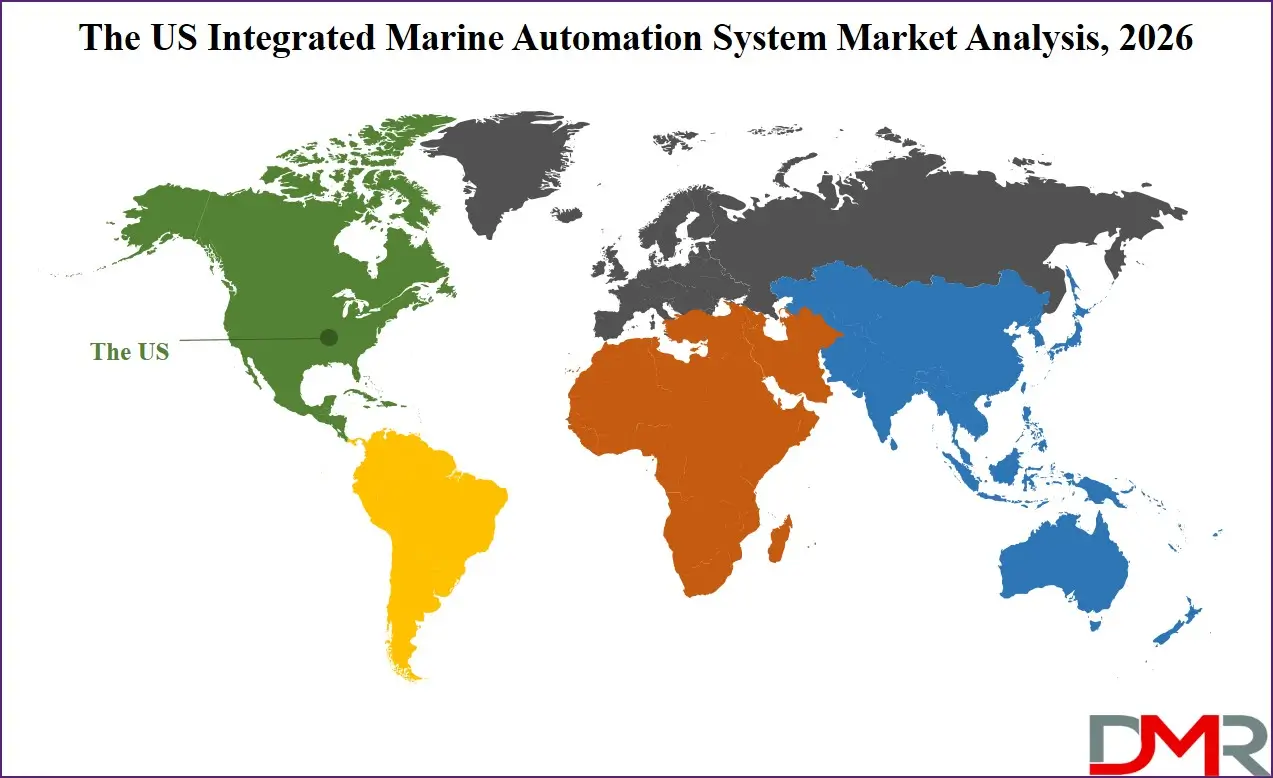
The competitive landscape of the US Integrated Marine Automation System market is characterized by moderate to high competition with a mix of established automation technology providers, defense system integrators, and specialized marine control solution developers. Market participants compete primarily through technological innovation, integrated vessel management platforms, and advanced marine monitoring solutions designed to improve operational efficiency, fuel optimization, and real time ship performance analytics.
ℹ
To learn more about this report –
Download Your Free Sample Report Here
Companies are increasingly investing in research and development to integrate artificial intelligence, Internet of Things connectivity, and cloud based vessel monitoring, and predictive maintenance capabilities into marine automation platforms. Strategic collaborations with shipbuilders, naval contractors, and offshore operators are also common as vendors aim to expand their solution portfolios and strengthen their presence in commercial shipping and defense vessel segments. The market also experiences growing competition from niche automation providers that offer modular retrofit solutions, cybersecurity features, and remote vessel monitoring services tailored for modern smart ship ecosystems.
Some of the prominent players in the US Integrated Marine Automation System Market are:
- Emerson Electric Co.
- Honeywell International Inc.
- Rockwell Automation, Inc.
- Northrop Grumman Corporation
- Marine Technologies LLC
- ABB Ltd.
- Siemens AG
- Kongsberg Gruppen ASA
- Wärtsilä Corporation
- Thales Group
- Rolls‑Royce Holdings plc
- Praxis Automation Technology B.V.
- API Marine ApS
- Consilium AB
- Jason Marine Group
- Tokyo Keiki Inc.
- Schneider Electric SE
- Danelec Marine
- Ulstein Group ASA
- L3Harris Technologies, Inc.
- Other Key Players
Recent Developments in the US Integrated Marine Automation System Market
- October 2025: Helsing announced the acquisition of underwater drone manufacturer Blue Ocean to strengthen its maritime autonomous systems portfolio and accelerate development of AI powered naval surveillance and underwater robotics technologies.
- September 2025: Sea Machines Robotics launched new SMLink APIs integrated with its SM300 marine autonomy system, enabling third-party command and control software to connect with autonomous vessel functions and real time telemetry for advanced marine automation and remote vessel management.
- September 2025: Sea‑Flux raised about USD 2.71 million in funding led by Punakaiki Fund to expand its vessel compliance, maintenance, and maritime management software used for digital ship operations and fleet automation.
Report Details
| Report Characteristics |
| Market Size (2026) |
USD 1.2 Bn |
| Forecast Value (2035) |
USD 2.3 Bn |
| CAGR (2026–2035) |
7.1% |
| Historical Data |
2021 – 2025 |
| Forecast Data |
2027 – 2035 |
| Base Year |
2025 |
| Estimate Year |
2026 |
| Report Coverage |
Market Revenue Estimation, Market Dynamics, Competitive Landscape, Growth Factors and etc. |
| Segments Covered |
By Component (Hardware, Software, Services), By System Type (Vessel Management Systems, Power Management Systems, Process Control Systems, Safety Systems), By Installation Type (New Builds, Upgrade), By Automation Level (Partial Automation, Remotely-Operated, Fully Autonomous), and By End-User (Commercial Shipping, Defense, Others) |
| Country Coverage |
The US |
| Prominent Players |
Emerson Electric Co., Honeywell International Inc., Rockwell Automation, Inc., Northrop Grumman Corporation, Marine Technologies LLC, ABB Ltd., Siemens AG, Kongsberg Gruppen ASA, Wärtsilä Corporation, Thales Group, Rolls-Royce Holdings plc, Praxis Automation Technology B.V., API Marine ApS, Consilium AB, Jason Marine Group, Tokyo Keiki Inc., Schneider Electric SE, Danelec Marine, Ulstein Group ASA, L3Harris Technologies, Inc., and Other Key Players |
| Purchase Options |
We have three licenses to opt for: Single User License (Limited to 1 user), Multi-User License (Up to 5 Users) and Corporate Use License (Unlimited User) along with free report customization equivalent to 0 analyst working days, 3 analysts working days and 5 analysts working days respectively. |
Frequently Asked Questions
How big is the US Integrated Marine Automation System Market?
▾ The US Integrated Marine Automation System Market size is estimated to have a value of USD 1.2 billion in 2026 and is expected to reach USD 2.3 billion by the end of 2035.
What is the growth rate in the US Integrated Marine Automation System Market in 2026?
▾ The market is growing at a CAGR of 7.1% over the forecasted period of 2026.
Who are the key players in the US Integrated Marine Automation System Market?
▾ Some of the major key players in the US Integrated Marine Automation System Market are Emerson Electric Co., Honeywell International Inc., Rockwell Automation, Inc., Northrop Grumman Corporation, Marine Technologies LLC, ABB Ltd., Siemens AG, Kongsberg Gruppen ASA, Wärtsilä Corporation, Thales Group, and many others.