US Lab Automation Market Snapshot
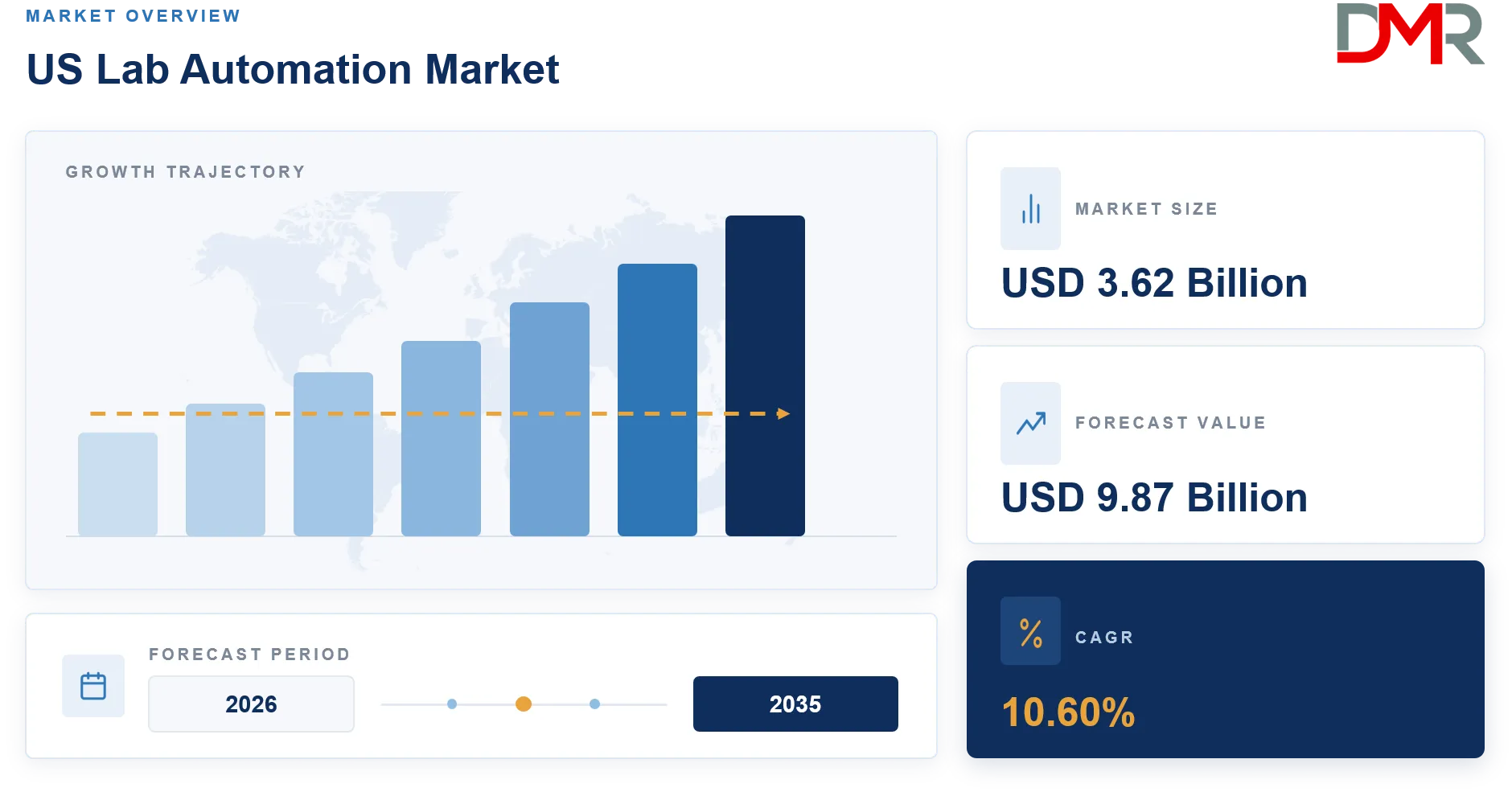
- Market Value: US Lab Automation Market is valued at USD 3.62 billion in 2026 and is projected to reach USD 9.87 billion by 2035.
- CAGR: US Lab Automation Market is expected to grow at a CAGR of 10.6% from 2026 to 2035.
- By Product Analysis: Automated Liquid Handling Systems led the product segment with a 22.4% share in 2026.
- By Application Segment Analysis: Genomics led the application segment with a 24.8% share in 2026.
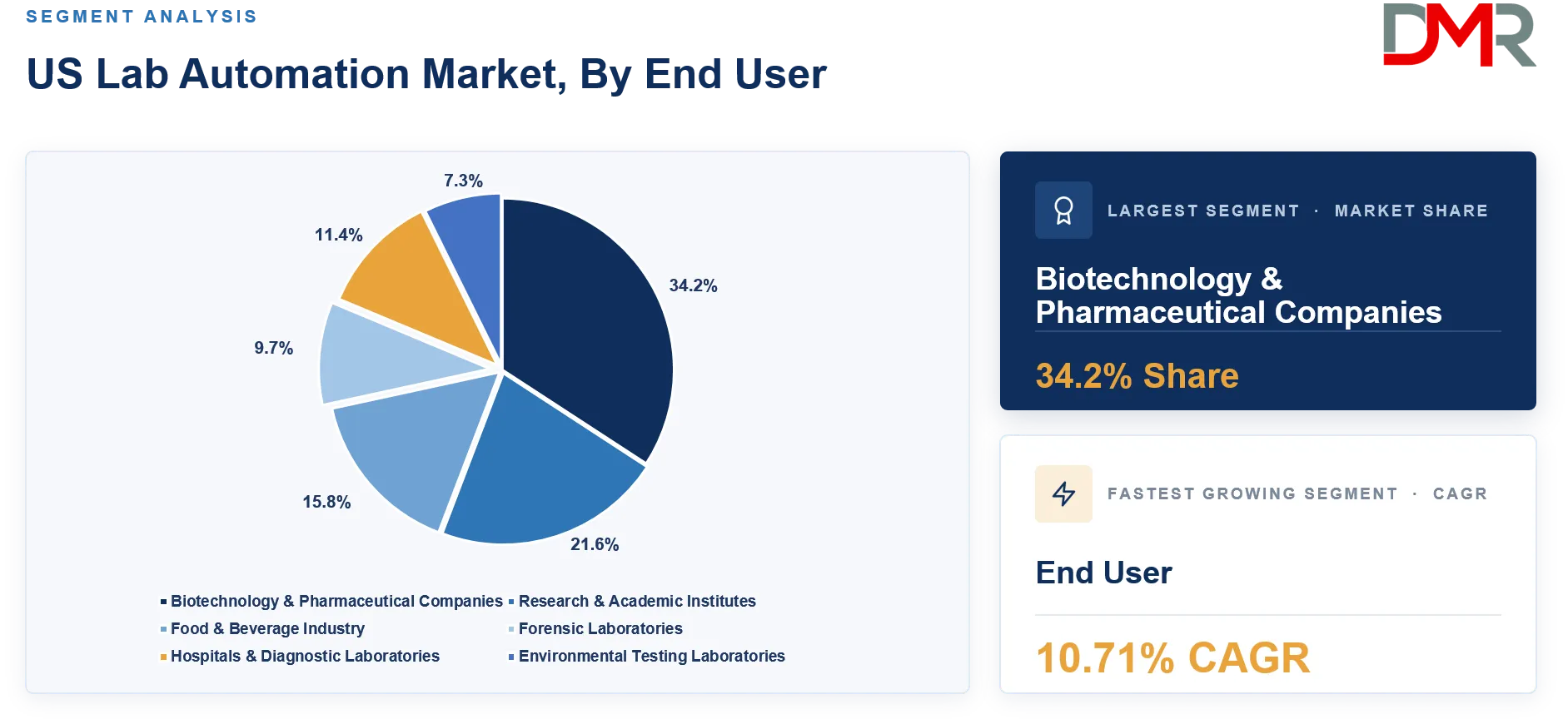
- By End-User Industry Segment Analysis: Biotechnology & Pharmaceutical Companies held a 34.2% share in 2026.
- Major Players: Thermo Fisher Scientific, Danaher Corporation, Agilent Technologies, Hamilton Company, and Others.
What is the US Lab Automation Market and its Market Size?
The US Lab Automation Market size is projected to be valued at USD 3.62 billion in 2026 and is expected to reach USD 9.87 billion by 2035, expanding at a CAGR of 10.6% during the forecast period. Laboratory automation covers instruments, robotic systems, liquid handlers, sample preparation platforms, automated storage systems, workstations, informatics, and control software that reduce manual laboratory work.
ℹ
To learn more about this report –
Download Your Free Sample Report Here
Demand in the US is connected to biotechnology R&D, pharmaceutical discovery, genomics, molecular diagnostics, proteomics, high-throughput screening, clinical testing, and academic research. Buyers increasingly evaluate automation not only for throughput, but also for reproducibility, data integrity, operator utilization, sample traceability, and the ability to standardize complex workflows across multiple laboratories.
Use Cases
- Genomics and NGS Workflows: Automated liquid handlers perform DNA and RNA extraction, normalization, reagent dispensing, library preparation, target enrichment, plate handling, and PCR setup. These systems help genomics laboratories process larger sample batches while reducing pipetting variability and operator-dependent errors.
- Drug Discovery: Pharmaceutical and biotechnology companies use robotic workstations for compound management, assay preparation, serial dilution, ADME screening, cell-based assays, high-throughput screening, and plate movement. Automation allows discovery teams to increase experiment volume while maintaining consistent handling conditions.
- Clinical Diagnostics: Hospitals and diagnostic laboratories automate accessioning, sample preparation, immunoassays, specimen routing, archiving, plate reading, and pre-analytical processes. Workflow integration can shorten manual handling time and support more predictable turnaround for high-volume testing environments.
- Biopharmaceutical Development: Automated workstations are increasingly applied to protein analysis, cell culture support, formulation screening, bioassays, analytical development, and quality workflows. Standardized sample preparation is especially valuable where laboratories must compare results across development stages and multiple operators.
- Research Laboratory Operations: Academic institutes, core facilities, CROs, environmental laboratories, and forensic laboratories use modular automation for repetitive sample preparation, reagent dispensing, microplate handling, storage, retrieval, and data capture. Smaller benchtop systems are widening adoption among laboratories that cannot justify full laboratory automation.
How AI/Gen AI is Transforming the US Lab Automation Market?
Artificial intelligence is moving laboratory automation from fixed task execution toward adaptive workflow management. In US pharmaceutical, biotechnology, genomics, and diagnostic laboratories, intelligent software can prioritize samples, flag abnormal instrument behavior, optimize scheduling, support image interpretation, and identify workflow bottlenecks before they affect throughput. Machine learning can also assist with predictive maintenance by using instrument logs, error frequencies, liquid handling performance, and runtime data to indicate when servicing may be needed. The value is strongest when intelligent software is connected with robotic platforms, laboratory information management systems, plate readers, storage systems, and analytical instruments rather than deployed as a standalone application.
Generative systems are also creating new interfaces between scientists and automated laboratory infrastructure. Researchers can use natural-language tools to draft protocols, convert experimental requirements into workflow steps, summarize instrument outputs, document deviations, and support method development. In regulated or quality-sensitive environments, adoption depends on human review, validated workflows, access controls, audit trails, and clear data governance. The commercial opportunity therefore extends beyond algorithms to orchestration software, laboratory informatics, validated integrations, and automation platforms capable of sharing structured data across instruments. NIH programs supporting machine learning tools for genomic translational research also show how computational methods are becoming more closely linked with laboratory and genomics workflows in the US.
Key Drivers in the US Lab Automation Market
Rising Genomics and High-Throughput Testing Workloads
Growth in sequencing, molecular biology, precision medicine, and translational research is increasing the number of samples and processing steps handled by US laboratories. Genomics workflows require repeated pipetting, normalization, extraction, library preparation, target enrichment, and plate handling, making them highly suitable for automation. Commercial platforms such as Agilent Bravo NGS and Hamilton NGS STAR are designed specifically for automated sequencing preparation. These workflow demands support recurring investment in liquid handling systems, robotic workstations, software, and integrated sample preparation platforms.
Pressure to Improve Laboratory Productivity and Reproducibility
US laboratories are under pressure to process more work without increasing skilled labor at the same rate. The Bureau of Labor Statistics projects about 20,800 openings for clinical laboratory technologists and technicians annually from 2025 to 2035, much of it related to workforce replacement. Automation helps laboratories redirect staff from repetitive pipetting and specimen handling toward higher-value analytical tasks. It also supports consistent liquid transfer, standardized protocols, traceable sample movement, and reproducible processing across operators, which strengthens the business case for automated systems.
Restraints in the US Lab Automation Market
High Capital Cost and Workflow Integration Complexity
Advanced robotic workcells, automated storage systems, integrated liquid handling platforms, and laboratory software can require substantial capital spending beyond the purchase price. Laboratories may also need new benches, environmental controls, accessories, validation, middleware, consumables, staff training, and service contracts. Integration becomes more difficult when laboratories operate instruments from multiple suppliers or depend on legacy LIMS and custom protocols. Small laboratories may therefore favor modular or benchtop automation because it lowers deployment risk and allows automation to be introduced one workflow at a time.
Validation and Regulatory Requirements
Clinical and regulated laboratories cannot automate workflows solely on the basis of speed. Automated processes must preserve analytical performance, traceability, quality controls, cybersecurity, documentation, and appropriate oversight. The US regulatory environment surrounding laboratory-developed tests has also changed materially. A federal district court vacated the FDA's 2024 LDT rule on March 31, 2025, and the agency formally restored the earlier regulatory text on September 19, 2025. This creates a different compliance landscape from the one laboratories anticipated under the original phaseout framework and keeps validation strategy an important purchasing consideration.
Growth Opportunities in the US Lab Automation Market
Expansion of Modular and Benchtop Automation
One of the largest opportunities lies below the fully automated laboratory level. Many academic laboratories, biotechnology startups, translational research groups, and specialized diagnostic facilities need greater throughput but lack the space or capital for large robotic cells. Compact liquid handlers and modular workstations can automate selected steps while preserving existing instruments and methods. A University of Delaware genomics case study reported that benchtop liquid handling reduced hands-on time and improved throughput and reproducibility, illustrating why smaller automation platforms can expand the addressable market beyond major pharmaceutical laboratories.
Connected Laboratory Software and Workflow Orchestration
Hardware growth is creating a parallel opportunity in software that connects instruments, schedules robotic tasks, tracks samples, records metadata, and transfers results to LIMS or other laboratory systems. Laboratories increasingly want interoperable automation rather than isolated instruments. Suppliers that provide application programming interfaces, protocol libraries, orchestration layers, remote monitoring, and structured audit trails can capture value beyond equipment sales. This also creates opportunities for recurring software revenue, integration services, workflow consulting, cybersecurity, and validated digital infrastructure across pharmaceutical and diagnostic laboratories.
Trends in the US Lab Automation Market
Application-Specific Automation is Replacing One-Size-Fits-All Systems
US laboratories are increasingly purchasing automation configured around defined workflows such as NGS library preparation, proteomics sample preparation, metabolomics, cell assays, ELISA, or compound screening. Vendors are responding with preconfigured protocols, dedicated accessories, thermal modules, magnetic separation, shaking, sealing, and plate handling. Agilent, for example, positions its liquid handling portfolio around application-specific genomics, protein, and metabolomics workflows and offers more than 60 deck accessories. This reduces method-development effort and can shorten the path from installation to routine laboratory use.
Open and Interoperable Automation Platforms
Another important US lab automation trend is the shift toward systems that can integrate third-party laboratory devices and support changing protocols. Buyers increasingly prefer platforms that can connect pipetting, incubation, centrifugation, plate reading, thermal cycling, storage, and data software without locking every step to one supplier. Open configurations improve asset utilization and allow laboratories to update individual components as research priorities change. This trend is strengthening competition around software compatibility, device drivers, workflow orchestration, standardized data exchange, and the ability to automate both established assays and newly developed methods.
Research Scope and Analysis
The US Lab Automation Market assessment evaluates equipment, software, robotic systems, workflow integration, laboratory applications, end-user adoption, demand patterns, competitive positioning, and technology development across the United States. The analysis considers purchasing behavior among pharmaceutical companies, biotechnology firms, hospitals, diagnostic laboratories, academic institutes, forensic facilities, food testing laboratories, and environmental testing organizations.
ℹ
To learn more about this report –
Download Your Free Sample Report Here
By Product;
Automated Liquid Handling Systems dominated the product category with a 22.4% share in 2026. Their leadership reflects the central role of pipetting, reagent transfer, dilution, normalization, plate filling, and sample preparation across genomics, screening, diagnostics, proteomics, and drug discovery. Liquid handling automation can be deployed as a compact benchtop instrument or integrated into larger robotic cells, giving vendors access to laboratories with very different budgets and throughput requirements. Systems increasingly combine pipetting heads with thermal control, magnetic bead processing, shaking, barcode handling, plate movement, and workflow software. The segment is also benefiting from NGS library preparation and high-throughput assay demand, where reproducibility and walkaway processing are commercially important. Agilent notes that automated liquid handling can increase throughput while reducing manual preparation and operator variability.
By Application;
Genomics led the application segment with a 24.8% share in 2026. Sequencing workflows contain multiple repetitive stages that are difficult to scale manually, including extraction, normalization, reagent addition, amplification setup, library preparation, target enrichment, cleanup, and microplate processing. As sample volumes increase, manual pipetting can become a throughput constraint and a source of variability. Automation suppliers are therefore developing dedicated NGS platforms with preconfigured protocols and integrated thermal or plate handling modules. Continued US investment in genomic medicine, translational research, population studies, and precision oncology provides a durable demand base. NHGRI funding activity in genomic data science and translational programs also supports a research ecosystem in which laboratory automation and computational workflows increasingly converge.
By End User;
Biotechnology & Pharmaceutical Companies held the largest end-user share at 34.2% in 2026. These organizations operate laboratory-intensive pipelines spanning target identification, assay development, screening, medicinal chemistry, ADME testing, genomics, biologics research, analytical development, and quality workflows. Many of these processes involve high sample volumes and repetitive liquid handling, making automation economically attractive when it increases instrument utilization or reduces hands-on labor. Pharmaceutical and biotech companies also have stronger capital budgets than many academic laboratories and frequently operate multiple automation platforms across discovery sites. Their requirements are moving toward flexible systems that can support new assay formats, connect with informatics tools, and maintain data consistency across increasingly complex development programs.
The US Lab Automation Market Report is segmented on the basis of the following:
By Product
- Software
- Automated Nucleic Acid Purification Systems
- Robotic Systems
- Microplate Readers
- Automated Storage & Retrieval Systems
- Automated ELISA Systems
- Automated Liquid Handling Systems
- Off-the-Shelf Automated Work Cells
- Automated Workstations
- Other Lab Automation Equipment
By Application
- Genomics
- Drug Discovery
- Compound Management
- Weighing & Dissolution
- ADME Screening
- High-throughput Screening
- Microbiology
- Diagnostics
- Sample Distribution & Archiving
- Immunoassays
- Pre-analytics/Sample Preparation
- Proteomics
- Other Applications
By End User
- Food & Beverage Industry
- Research & Academic Institutes
- Biotechnology & Pharmaceutical Companies
- Forensic Laboratories
- Hospitals & Diagnostic Laboratories
- Environmental Testing Laboratories
Competitive Landscape
The US Lab Automation Market is competitive across instruments, robotics, liquid handling, software, diagnostics, and integrated workflows. Large diversified suppliers such as Thermo Fisher Scientific, Danaher Corporation, Agilent Technologies, Becton Dickinson, Abbott, Siemens Healthineers, and Roche can combine automation with broader analytical or diagnostic portfolios. Specialist companies such as Hamilton, Tecan, Opentrons, Hudson Robotics, Formulatrix, SPT Labtech, Gilson, and Automata compete through workflow flexibility, robotics, compact platforms, open integration, and application-specific systems.
Competitive differentiation is moving beyond pipetting accuracy toward walkaway time, protocol libraries, software usability, interoperability, service coverage, validation support, consumable ecosystems, and total cost of ownership. Vendors are also targeting different automation tiers, from affordable benchtop instruments for research groups to integrated robotic cells for high-throughput pharmaceutical laboratories. Commercial success increasingly depends on solving a complete workflow rather than selling an isolated device, particularly in genomics, drug discovery, molecular diagnostics, and sample preparation.
Some of the prominent players in the US Lab Automation Industry are:
- Thermo Fisher Scientific
- Danaher Corporation
- Agilent Technologies
- Hamilton Company
- Tecan Group
- Revvity
- Becton Dickinson and Company
- Abbott Laboratories
- Siemens Healthineers
- Roche Diagnostics
- Bio-Rad Laboratories
- QIAGEN
- Eppendorf
- Opentrons Labworks
- Hudson Robotics
- Brooks Automation
- Gilson
- Formulatrix
- SPT Labtech
- Automata
- Others
Technology Analysis
The US Lab Automation Market is advancing toward integrated, software-controlled laboratories that combine automated liquid handling, robotics, microplate readers, sample storage, nucleic acid purification, and data management within connected workflows. Automated liquid handlers remain central because they support genomics, drug discovery, diagnostics, proteomics, and high-throughput screening, while newer platforms add barcode tracking, thermal control, magnetic bead processing, plate transport, and remote monitoring. Interoperability is becoming a major purchasing factor as laboratories seek systems that can connect third-party instruments, LIMS platforms, and analytical software without creating isolated data environments.
Artificial intelligence and machine learning are also being applied to workflow scheduling, image analysis, predictive maintenance, protocol optimization, and exception detection. This technology shift is increasing demand for flexible robotic workcells, modular automation, open software interfaces, and scalable platforms that allow US laboratories to expand throughput without replacing their entire installed infrastructure.
Regulatory Landscape
The regulatory environment for the US Lab Automation Market is shaped by CLIA requirements, FDA oversight of applicable in vitro diagnostic devices, quality management expectations, validation practices, data integrity, and laboratory-specific accreditation standards. Under CLIA, clinical laboratories performing human diagnostic testing must maintain appropriate certification and comply with requirements tied to test complexity, personnel, quality systems, and analytical performance. FDA also recognizes CLSI AUTO04-A, a standard covering operational requirements and information elements for clinical laboratory automation systems.
The laboratory-developed test environment changed significantly after a federal district court vacated the FDA's May 2024 LDT final rule on March 31, 2025. FDA subsequently restored the earlier wording of 21 CFR 809.3 on September 19, 2025. As a result, laboratories and automation suppliers must evaluate regulatory obligations according to the specific device, assay, intended use, laboratory setting, validation requirements, and applicable CLIA and FDA provisions rather than relying on the vacated phaseout framework.
Recent Developments
- March 2026: Thermo Fisher Scientific completed its $8.875 billion acquisition of Clario Holdings, a leading clinical trial endpoint data solutions provider, strengthening its Laboratory Products and Biopharma Services segment and expanding AI-enabled lab automation capabilities for pharma and biotech customers in the US market.
- January 2026: Thermo Fisher Scientific announced a strategic collaboration with NVIDIA to build autonomous laboratory infrastructure, integrating NVIDIA's AI computing platform (DGX Spark, NeMo, BioNeMo) with Thermo Fisher's scientific instruments to enable AI-driven, scalable lab automation workflows for high-throughput US research labs.
- October 2025: BD (Becton, Dickinson and Company) and Opentrons Labworks announced a multi-year collaboration to integrate robotic liquid-handling capabilities into BD's single-cell multiomics instruments, automating NGS library preparation and cell capture steps to accelerate disease research and drug development workflows in US laboratories.
Report Details
| Report Characteristics |
| Market Size (2026) |
USD 3.62 Bn |
| Forecast Value (2035) |
USD 9.87 Bn |
| CAGR (2026–2035) |
10.6% |
| Historical Data |
2021 – 2025 |
| Forecast Data |
2027 – 2035 |
| Base Year |
2025 |
| Estimate Year |
2026 |
| Segments Covered |
By Product (Software, Automated Nucleic Acid Purification Systems, Robotic Systems, Microplate Readers, Automated Storage & Retrieval Systems, Automated ELISA Systems, Automated Liquid Handling Systems, Off-the-Shelf Automated Work Cells, Automated Workstations, and Other Lab Automation Equipment), By Application (Genomics, Drug Discovery {Compound Management, Weighing & Dissolution, ADME Screening, and High-throughput Screening}, Microbiology, Diagnostics {Sample Distribution & Archiving, Immunoassays, and Pre-analytics/Sample Preparation}, Proteomics, and Other Applications), By End User (Food & Beverage Industry, Research & Academic Institutes, Biotechnology & Pharmaceutical Companies, Forensic Laboratories, Hospitals & Diagnostic Laboratories, and Environmental Testing Laboratories) |
| Regional Coverage |
United States |
Frequently Asked Questions
What is the current size of the US Lab Automation Market?
▾ The US Lab Automation Market size is valued at USD 3.62 billion in 2026 and is forecast to reach USD 9.87 billion by 2035.
What is the growth rate of the US Lab Automation Market during?
▾ The US Lab Automation Market is expected to grow at a CAGR of 10.6% during the forecast period from 2026 to 2035.
What factors are driving the growth of the US Lab Automation Market?
▾ Growth in the US Lab Automation Market is driven by genomics, drug discovery, diagnostics, and laboratory robotics.
What are the major challenges restraining the US Lab Automation Market?
▾ High capital costs, complex integration, and validation requirements restrain growth in the US Lab Automation Market.
Which segment holds the largest share of the US Lab Automation Market?
▾ Automated Liquid Handling Systems led the US Lab Automation Market product segment with a 22.4% share in 2026.
Who are the leading companies in the global US Lab Automation Market?
▾ Thermo Fisher Scientific, Danaher Corporation, Agilent Technologies, Hamilton Company, Tecan Group, Revvity, Becton Dickinson and Company, Abbott Laboratories, Siemens Healthineers, Roche Diagnostics, Bio-Rad Laboratories, QIAGEN, Eppendorf, Opentrons Labworks, Hudson Robotics, Brooks Automation, Gilson, Formulatrix, SPT Labtech, and Automata are leading companies in the US Lab Automation Market.
How is AI influencing the US Lab Automation Market?
▾ AI is influencing the US Lab Automation Market through workflow optimization, predictive maintenance, and data analysis.
What are the future opportunities and trends in the US Lab Automation Market?
▾ Modular robotics, connected labs, genomics, and interoperable software offer future US Lab Automation Market growth.