Market Overview
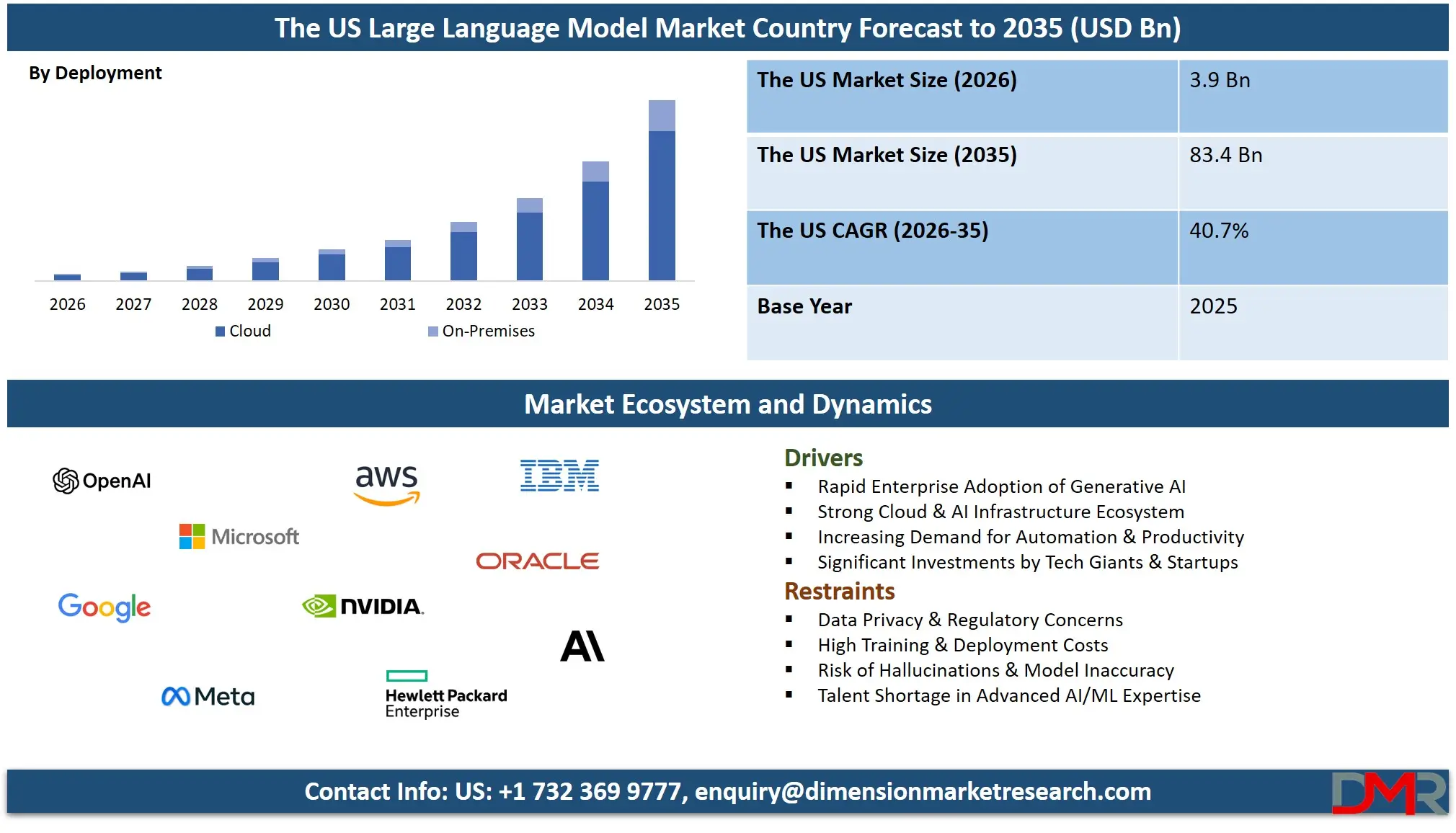
The US large language model market size is projected to reach USD 3.9 billion in 2026 and grow at a CAGR of 40.7%, driven by generative AI adoption, NLP advancements, and enterprise AI solutions, reaching USD 83.4 billion by 2035.
ℹ
To learn more about this report –
Download Your Free Sample Report Here
A large language model is an advanced artificial intelligence system that is trained to comprehend context and respond to given situations with human-like responses. Large language models are based on deep learning and natural language processing techniques.
Large language models are primarily used to generate human-like content, summarize content, and even create code. The US large language model market is a growing and changing environment of AI platforms, foundation models, and generative AI solutions fueled by robust enterprise adoption, hyperscale cloud infrastructure, and ongoing innovation from top tech players.
ℹ
To learn more about this report –
Download Your Free Sample Report Here
The US Large Language Model Market: Key Takeaways and Other Influencing Factors
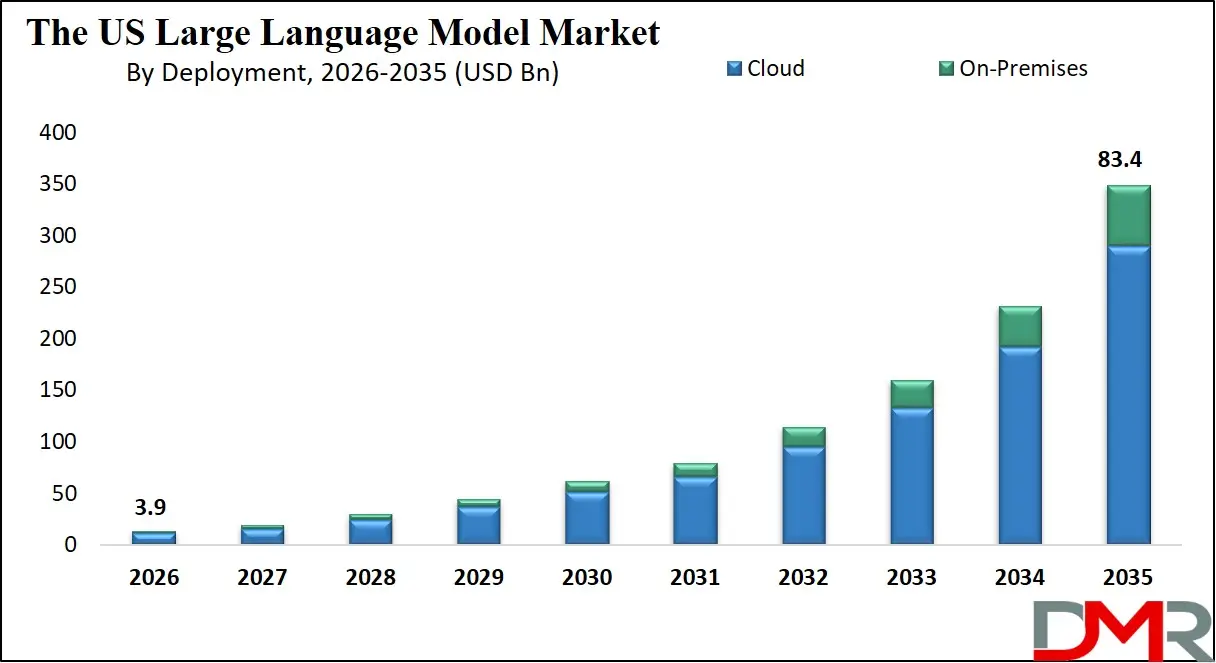
- Strong Market Expansion with High Growth Rate: The US large language model market is projected to grow from USD 3.9 billion in 2026 to USD 83.4 billion by 2035, reflecting a strong CAGR of 40.7%, driven by rapid generative AI adoption and enterprise scale deployment.
- Dominance of Cloud and Scalable AI Infrastructure: Cloud deployment leads with 83.0% market share in 2026, highlighting the growing reliance on scalable AI infrastructure, GPU acceleration, and API driven LLM integration across enterprises.
- Enterprise-Led Application Growth: Chatbots and virtual assistants account for 27.0% share, while financial services lead end user adoption with 22.0%, indicating strong demand for AI driven automation, customer engagement, and decision intelligence.
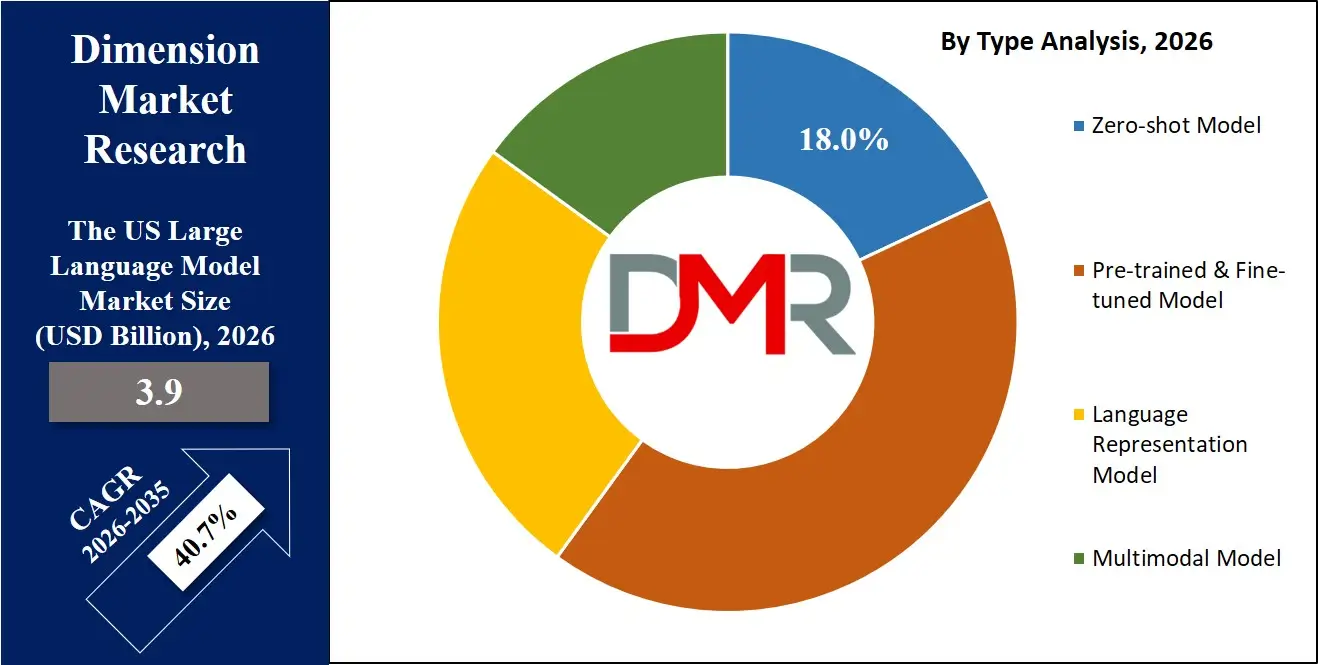
- Rising Preference for Fine-Tuned Models: Pre-trained and fine-tuned models dominate with 42.0% share, reflecting increasing demand for customized, domain specific LLM solutions that enhance accuracy and business relevance.
- US Census Bureau: AI adoption among US firms increased from 3.7% in 2023 to around 7% in 2025, indicating steady enterprise level integration of AI technologies.
- Federal Reserve: Generative AI usage among US adults rose from 44.6% in 2024 to 54.6% in 2025, highlighting accelerating mainstream adoption.
- US Public Sector Data: AI usage among US public sector employees grew from 17% in 2023 to 43% in 2025, reflecting increasing integration of AI tools in daily operations.
The US Large Language Model Market: Use Cases
- AI-Powered Customer Support: Large language models enable AI chatbots and virtual assistants to handle customer queries with real-time responses and contextual understanding, improving efficiency and reducing service costs.
- Automated Content Creation: LLMs support text generation for blogs, ads, and product descriptions, helping businesses scale marketing efforts with AI-driven personalization and SEO optimization.
- Code Generation and Developer Assistance: Generative AI models assist developers in code writing, debugging, and documentation, increasing productivity and accelerating software development cycles.
- Healthcare Data Analysis and Documentation: LLMs streamline clinical documentation, medical transcription, and data analysis, enhancing decision-making and operational efficiency in healthcare systems.
Impact of Iran Conflict on the US Large Language Model Market
The Iran conflict is increasing energy costs and disrupting semiconductor and data center supply chains, raising operational expenses for US large language model development, while geopolitical uncertainty is slowing enterprise AI investments and delaying generative AI adoption. At the same time, demand for AI in defense, cybersecurity, and intelligence is accelerating, and growing risks to digital infrastructure are pushing companies to focus on resilient and secure AI ecosystems.
The US Large Language Model Market: Market Dynamics
Driving Factors in the US Large Language Model Market
Rising Enterprise Adoption of Generative AI
US enterprises are rapidly integrating large language models into their workflows for automation, customer engagement, and decision-making. Growing demand for NLP solutions, AI copilots, and enterprise AI platforms is accelerating adoption across finance, healthcare, and retail sectors.
Expansion of Cloud and AI Infrastructure
The presence of hyperscale cloud providers and advanced GPU infrastructure is enabling scalable deployment of LLMs. Cloud-based AI services, foundation models, and API driven architectures are supporting faster model training and real-time inference capabilities.
Restraints in the US Large Language Model Market
Data Privacy and Regulatory Challenges
Increasing concerns around data security, model transparency, and compliance with evolving AI regulations are limiting adoption. Enterprises are cautious about deploying generative AI due to risks related to sensitive data handling and governance frameworks.
High Computational and Operational Costs
Training and deploying large language models require significant computational power and expensive hardware, increasing the total cost of ownership. This creates barriers for small and mid-sized enterprises in adopting advanced AI solutions.
Opportunities in the US Large Language Model Market
Growth in Industry-Specific AI Solutions
There is strong potential for domain-specific LLMs tailored for healthcare, legal, and financial services. Customized AI models with industry datasets enable better accuracy, compliance, and specialized use case adoption.
Increasing Demand for Multimodal AI Models
The shift toward multimodal AI integrating text, image, and voice processing is creating new growth avenues. Enterprises are adopting advanced generative AI systems to deliver richer user experiences and cross-platform applications.
Trends in the US Large Language Model Market
Emergence of AI Copilots and Assistive Tools
AI copilots are becoming mainstream across productivity tools, coding environments, and business applications. These LLM-powered assistants enhance efficiency through real-time suggestions, automation, and contextual insights.
Focus on Responsible and Explainable AI
Organizations are prioritizing ethical AI practices, explainability, and bias reduction in model development. The adoption of responsible AI frameworks is shaping trust, governance, and long-term scalability of large language model solutions.
The US Large Language Model Market: Research Scope and Analysis
By Type Analysis
Pre-trained and fine-tuned models are anticipated to dominate the type segment, capturing 42.0% of the total market share in 2026, primarily due to their flexibility, cost efficiency, and strong performance across enterprise use cases such as chatbots, content generation, and code development. These models leverage large-scale pretraining combined with domain-specific fine-tuning, enabling businesses to deploy customized generative AI solutions with improved accuracy and contextual relevance.
ℹ
To learn more about this report –
Download Your Free Sample Report Here
In comparison, language representation models play a critical role in understanding text semantics, contextual embeddings, and linguistic patterns, supporting applications like sentiment analysis, search optimization, and natural language understanding, thereby forming a foundational layer within the broader large language model ecosystem.
By Deployment Analysis
Cloud deployment is anticipated to dominate the segment, capturing 83.0% of the total market share in 2026, driven by scalability, cost efficiency, and easy access to advanced AI infrastructure such as GPUs and APIs for real-time inference. Enterprises prefer cloud-based LLM platforms for faster deployment, continuous updates, and integration with existing digital ecosystems, supporting generative AI and NLP applications at scale. In contrast, on-premises deployment is adopted by organizations with strict data security, privacy, and regulatory requirements, offering greater control over sensitive data and model customization, though it involves higher upfront costs and infrastructure complexity compared to cloud solutions.
By Application Analysis
Chatbots and virtual assistants are anticipated to dominate the application segment, capturing 27.0% of the total market share in 2026, driven by rising demand for AI-powered customer support, conversational AI, and automated query resolution across industries. These solutions leverage natural language processing and generative AI to deliver real-time, personalized interactions, improving customer experience and operational efficiency. At the same time, text generation is a key application within this segment, enabling automated content creation for marketing, documentation, and communication, with LLMs supporting high-quality, context-aware outputs that enhance productivity and streamline digital content workflows.
By End User Analysis
Financial services are anticipated to dominate the end-user segment, capturing 22.0% of the total market share in 2026, driven by increasing adoption of large language models for fraud detection, risk assessment, algorithmic trading, and AI-powered customer support. Banks and financial institutions leverage generative AI and NLP for data analysis, regulatory compliance, and personalized financial services, improving decision-making and operational efficiency. In comparison, retail and e-commerce are rapidly growing segments where LLMs are used for product recommendations, customer engagement, demand forecasting, and automated content creation, enabling businesses to enhance user experience and optimize digital commerce strategies.
The US Large Language Model Market Report is segmented on the basis of the following:
By Type
- Zero-shot Model
- Pre-trained & Fine-tuned Model
- Language Representation Model
- Multimodal Model
By Deployment
By Application
- Chatbots & Virtual Assistant
- Sentiment Analysis
- Language Translation
- Text Generation
- Content Rewriting & Summarization
- Content Personalization
- Code Generation
- Others
By End User
- Retail & E-commerce
- Financial Services
- Media & Entertainment
- Healthcare
- Legal Services
- Gaming
- Others (IT & ITES, Education)
Impact of Artificial Intelligence in the US Large Language Model Market
Artificial intelligence is accelerating the US large language model market by advancing natural language processing, generative AI, and deep learning capabilities. Improved AI infrastructure, such as cloud computing and GPUs, enables faster model training and scalable deployment. AI-driven use cases like chatbots, content generation, and code development are boosting automation and productivity. Additionally, rising investments in AI innovation and data-driven personalization are strengthening market growth and enterprise adoption.
The US Large Language Model Market: Competitive Landscape
The US large language model market is highly competitive, driven by rapid innovation in generative AI, natural language processing, and foundation models, with players competing on model performance, scalability, and enterprise integration capabilities across cloud platforms.
ℹ
To learn more about this report –
Download Your Free Sample Report Here
The market is shaped by strategic partnerships, continuous model training, and expanding AI infrastructure to improve accuracy and efficiency, while advancements in multimodal AI, pricing strategies, and a growing focus on responsible and secure AI deployment further intensify competition.
Some of the prominent players in the US Large Language Model Market are:
- OpenAI
- Microsoft
- Google
- Meta
- Amazon Web Services
- NVIDIA
- IBM
- Oracle
- Hewlett Packard Enterprise
- Anthropic
- Cohere
- Hugging Face
- Databricks
- Palantir Technologies
- C3 AI
- DataRobot
- Scale AI
- AI21 Labs
- Snowflake
- Adobe
- Other Key Players
Recent Developments in the US Large Language Model Market
- March 2026: OpenAI introduced GPT 5.4 with improved performance and advanced multimodal and coding capabilities, expanding large language model use cases across enterprises.
- February 2026: Anthropic launched Claude Sonnet 4.6 with enhanced reasoning, coding, and long context capabilities, strengthening enterprise AI and generative AI applications.
- December 2025: Anthropic acquired Bun to improve performance, speed, and stability of its AI coding and large language model ecosystem.
Report Details
| Report Characteristics |
| Market Size (2026) |
USD 3.9 Bn |
| Forecast Value (2035) |
USD 83.4 Bn |
| CAGR (2026–2035) |
40.7% |
| Historical Data |
2021 – 2025 |
| Forecast Data |
2027 – 2035 |
| Base Year |
2025 |
| Estimate Year |
2026 |
| Report Coverage |
Market Revenue Estimation, Market Dynamics, Competitive Landscape, Growth Factors and etc. |
| Segments Covered |
By Type (Zero-shot Model, Pre-trained & Fine-tuned Model, Language Representation Model, and Multimodal Model), By Deployment (Cloud and On-Premises), By Application (Chatbots & Virtual Assistant, Sentiment Analysis, Language Translation, Text Generation, Content Rewriting & Summarization, Content Personalization, Code Generation, and Others), By End User (Retail & E-commerce, Financial Services, Media & Entertainment, Healthcare, Legal Services, Gaming, and Others) |
| Country Coverage |
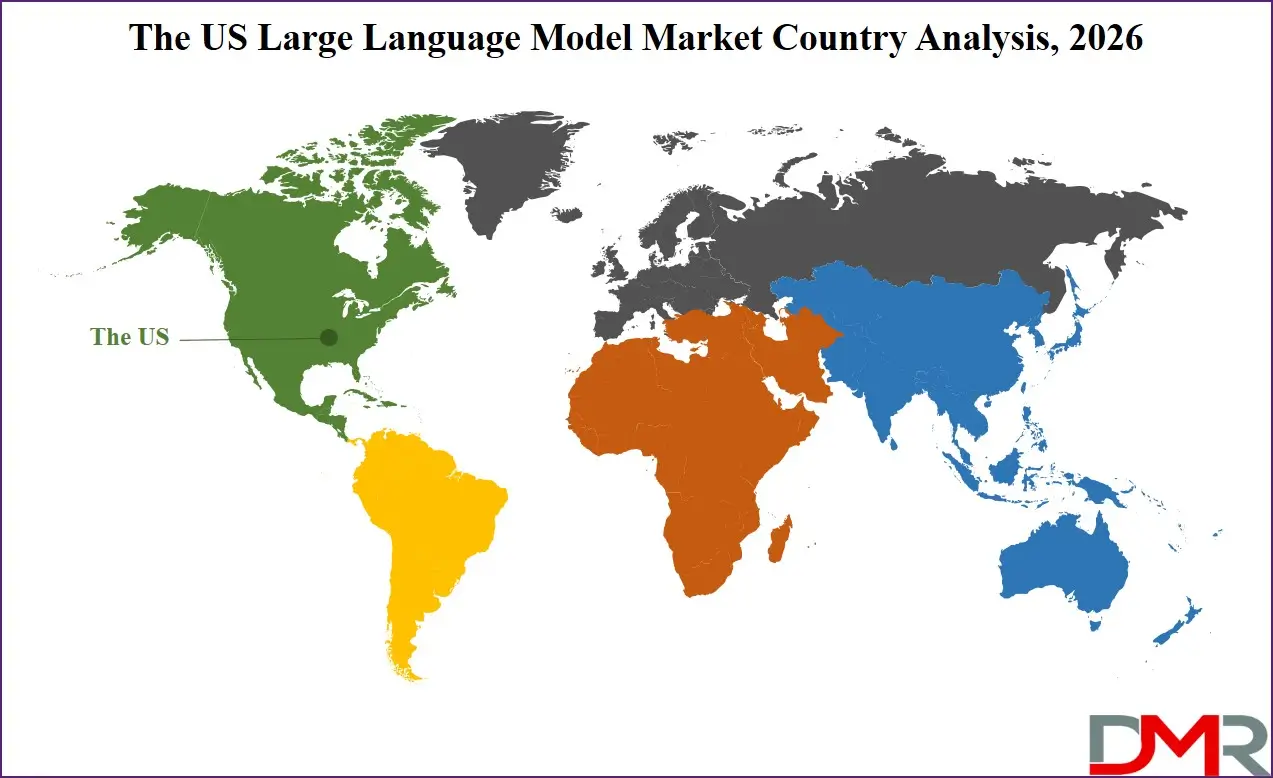
The US |
| Prominent Players |
OpenAI, Microsoft, Google, Meta, Amazon Web Services, NVIDIA, IBM, Oracle, Hewlett Packard Enterprise, Anthropic, Cohere, Hugging Face, Databricks, Palantir Technologies, C3 AI, DataRobot, Scale AI, AI21 Labs, Snowflake, Adobe, and Other Key Players |
| Purchase Options |
We have three licenses to opt for: Single User License (Limited to 1 user), Multi-User License (Up to 5 Users) and Corporate Use License (Unlimited User) along with free report customization equivalent to 0 analyst working days, 3 analysts working days and 5 analysts working days respectively. |
Frequently Asked Questions
How big is the US Large Language Model Market?
▾ The US Large Language Model Market size is estimated to have a value of USD 3.9 billion in 2026 and is expected to reach USD 83.4 billion by the end of 2035.
What is the growth rate in the US Large Language Model Market in 2026?
▾ The market is growing at a CAGR of 40.7% over the forecasted period of 2026.
Who are the key players in the US Large Language Model Market?
▾ Some of the major key players in the US Large Language Model Market are OpenAI, Microsoft, Google, Meta, Amazon Web Services, NVIDIA, IBM, Oracle, Hewlett Packard Enterprise, Anthropic, Cohere, Hugging Face, Databricks, Palantir Technologies, and many others.