Market Overview
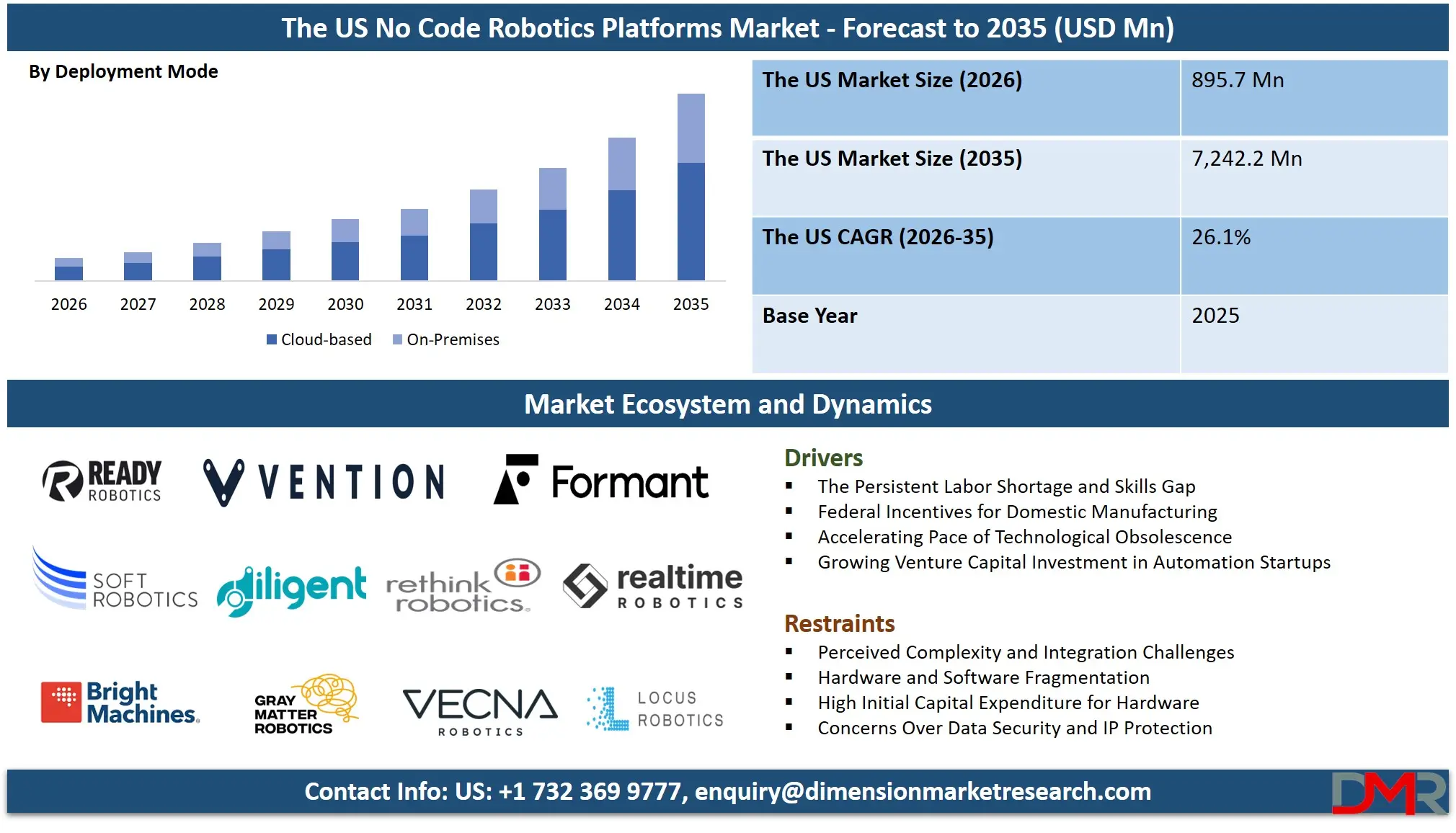
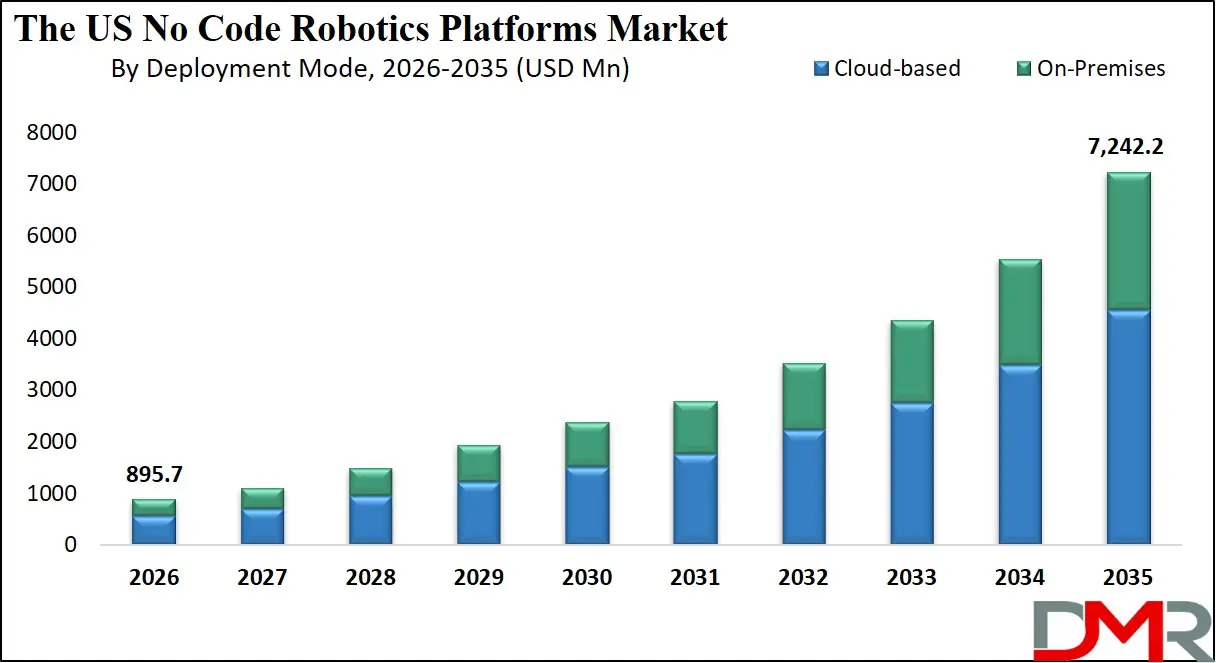
The US No Code Robotics Platforms Market is projected to reach USD 895.7 million in 2026 and is expected to grow at a CAGR of 26.1% from 2026 to 2035, reaching approximately USD 7,242.2 million by 2035. The market growth is driven by a severe shortage of robotics engineers, the increasing need for agile automation in small and medium-sized enterprises (SMEs), and the democratization of robotics through intuitive, drag-and-drop software interfaces. Additionally, advancements in cloud robotics, simulation environments, and artificial intelligence are accelerating the deployment of automation solutions that do not require traditional coding expertise. These innovations are enabling businesses across various sectors to automate complex tasks, reduce operational costs, and improve production flexibility without the overhead of specialized programming teams.
ℹ
To learn more about this report –
Download Your Free Sample Report Here
The American business landscape presents unique characteristics that amplify the adoption of no-code robotics. A highly competitive manufacturing sector grappling with persistent labor shortages, a burgeoning small business ecosystem that requires automation but lacks in-house technical talent, and a cultural shift towards "citizen developers," operations managers and domain experts who can now build and deploy robotic workflows without writing a single line of code. The push for reshoring manufacturing capabilities has further intensified the need for automation solutions that can be deployed rapidly and managed by existing staff.
Regulatory and economic momentum has created a perfect storm for adoption. While not as prescriptive as automotive safety mandates, the U.S. government's focus on strengthening domestic supply chains through the CHIPS and Science Act and the Inflation Reduction Act includes substantial incentives for manufacturers to invest in advanced automation. These policies are implicitly encouraging the adoption of flexible automation technologies that can be reconfigured quickly to adapt to changing production needs. Simultaneously, the rising federal minimum wage and competitive labor market are compelling businesses to explore automation as a means to fill repetitive, physically demanding roles, making no-code platforms an attractive alternative to costly and time-consuming traditional robotics integration.
ℹ
To learn more about this report –
Download Your Free Sample Report Here
The competitive landscape is characterized by a mix of innovative startups and established industrial automation giants. Pure-play no-code platform providers like Vention, Ready Robotics, and Formant are challenging traditional industrial robotics companies such as FANUC, Yaskawa, and Universal Robots, which are now developing their own no-code or low-code interfaces. Major cloud providers like Amazon Web Services (AWS) and Microsoft Azure are also entering the fray with their own robotics and IoT platforms, integrating no-code principles to simplify the connection and management of robotic fleets.
The US No Code Robotics Platforms Market: Key Takeaways
- Exponential Growth Trajectory: The U.S. market is projected to surge from USD 895.7 million in 2026 to USD 7,242.2 million by 2035, driven by the convergence of a dire labor shortage, a cultural shift towards citizen development, and federal incentives for domestic manufacturing automation.
- Democratization of Automation: No-code platforms are dismantling the traditional barrier of specialized programming skills. Operations managers, line supervisors, and process engineers can now design, deploy, and maintain robotic systems, fundamentally altering the economics and accessibility of industrial automation.
- The SME Automation Frontier: Beyond large-scale automotive and electronics manufacturing, small and medium-sized enterprises represent a massive, underserved growth opportunity. No-code platforms are the key to unlocking this segment, offering affordable, modular, and easy-to-deploy automation that can be managed by existing staff.
- AI-Driven Workflow Automation: The market is moving from simple, pre-programmed sequences to AI-powered adaptive workflows. U.S. platform developers are leading the charge in integrating computer vision and machine learning models that allow robots to handle variability, learn from operator demonstrations, and optimize their own performance over time.
- Cloud Robotics and Fleet Management: The shift towards cloud-connected platforms allows for centralized fleet management, over-the-air updates, and data-driven optimization. This capability enables businesses to manage geographically dispersed robotic assets from a single dashboard, providing unprecedented visibility and control.
Impact of the Iran conflict on the US No Code Robotics Platforms Market
- Heightened Focus on Supply Chain Resilience: The conflict underscored the fragility of global supply chains, accelerating the U.S. push for domestic manufacturing. No-code robotics platforms are a key enabler of this reshoring, allowing manufacturers to quickly stand-up automated production lines with a workforce that is not reliant on scarce programming specialists.
- Increased Demand for Rapid Re-tooling: Geopolitical instability necessitates manufacturing agility. No-code platforms enable companies to rapidly reconfigure robotic work cells for new products or components without lengthy software overhauls, providing a critical competitive advantage in a volatile global market.
- Competition for Hardware Components: While the software side is booming, the conflict has contributed to volatility in the supply chain for physical robotic components such as actuators, sensors, and controllers. This has led platform providers to diversify their hardware partnerships and, in some cases, develop more robust supply chains to ensure platform reliability.
- Accelerated Development of Simulation Capabilities: With physical hardware potentially delayed, there is a growing emphasis on high-fidelity simulation environments within no-code platforms. These tools allow businesses to design, test, and validate robotic work cells virtually, de-risking investments and ensuring faster implementation once hardware arrives.
The US No Code Robotics Platforms Market: Use Cases
- Dynamic Machine Tending in Job Shops: In small manufacturing facilities, no-code platforms allow operators to quickly reprogram a robotic arm to tend to a CNC machine for a new job run. Using a simple tablet interface, a machinist can set waypoints and gripping parameters without a programmer, enabling high-mix, low-volume production.
- Automated Quality Inspection with Vision: Citizen developers can use no-code platforms to integrate a camera with a robotic arm. They can program a workflow where the robot picks a part, presents it to the camera, and uses a pre-trained, no-code vision model to inspect for defects, automatically sorting good parts from bad.
- Flexible Palletizing for Warehousing: In e-commerce fulfillment centers, no-code platforms empower warehouse supervisors to reconfigure palletizing patterns for boxes of varying sizes and shapes. They can create and modify palletizing routines on the fly, optimizing for truck space or product stability without waiting for a software update.
- Rapid Deployment of Mobile Manipulators: For research labs or internal logistics, no-code platforms are used to program autonomous mobile robots (AMRs) equipped with robotic arms. A lab manager can map the facility and program the robot to retrieve supplies from a storage room and deliver them to a specific workstation, all through a visual, drag-and-drop interface.
- Collaborative Welding for Small Fabricators: Small fabrication shops are using no-code platforms to program collaborative welding robots. A welder, not a programmer, can guide the robot through the weld path, saving the sequence, and then have the robot repeat it for high-volume components, freeing the welder for more complex custom jobs.
The US No Code Robotics Platforms Market: Stats & Facts
Bureau of Labor Statistics (BLS) – The US
- There were approximately 560,000 job openings for manufacturing workers in the U.S. in 2023, a persistent labor gap.
- The number of industrial machinery mechanics and maintenance workers is projected to grow by 12% from 2022 to 2032.
- An estimated 2.1 million manufacturing jobs could go unfilled by 2030 due to the skills gap, costing the economy over USD 1 trillion.
- The average age of a skilled CNC machinist in the U.S. is over 45, leading to a wave of retirements and a loss of institutional knowledge.
Association for Advancing Automation (A3) – The US
- North American robot orders reached a record high of over 44,000 units in 2022, valued at nearly USD 2.4 billion.
- Non-automotive sectors, such as life sciences, food and beverage, and consumer goods, accounted for over 50% of robot orders for the first time in 2022.
- The average payback period for a robotic automation project has shrunk to under two years, driven by lower costs and easier programming.
- Over 60% of companies cite a lack of in-house programming expertise as a primary barrier to automation adoption.
International Federation of Robotics (IFR)
- The US is one of the top three markets for industrial robots globally.
- The global average robot density in manufacturing hit a record of 151 robots per 10,000 employees in 2021.
- The U.S. robot density is projected to increase significantly as reshoring and labor shortages drive automation investments.
U.S. Department of Commerce
- The CHIPS and Science Act includes USD 52 billion in funding to boost domestic semiconductor manufacturing, a sector with high automation potential.
- The Inflation Reduction Act provides tax credits for domestic clean energy manufacturing, encouraging investment in automated production facilities.
The US No Code Robotics Platforms Market: Market Dynamic
Driving Factors in the US No Code Robotics Platforms Market
The Persistent Labor Shortage and Skills Gap
The most significant catalyst for the U.S. market is the acute shortage of skilled labor, particularly in manufacturing, logistics, and warehousing. The difficulty in finding and retaining workers for repetitive, physically demanding, or highly technical roles is pushing businesses to seek automation solutions. No-code platforms directly address this by allowing existing employees, who understand the production process, to become the automation builders, circumventing the need to hire scarce and expensive robotics programmers.
Federal Incentives for Domestic Manufacturing
The U.S. government is actively encouraging the reshoring of critical supply chains through legislation like the CHIPS and Science Act and the Defense Production Act. These policies provide substantial financial incentives for companies to build new factories and modernize existing ones. To meet the productivity and cost targets of these new facilities, companies are increasingly turning to advanced, flexible automation, with no-code platforms serving as a key enabler for rapid deployment and scalability.
Restraints in the US No Code Robotics Platforms Market
Perceived Complexity and Integration Challenges
Despite the "no-code" promise, integrating robotics into a production line still involves physical challenges, including safety compliance (e.g., OSHA standards for machine guarding), end-of-arm tooling selection, and integration with existing enterprise resource planning (ERP) or manufacturing execution systems (MES). This perception of complexity, along with the upfront capital expenditure for hardware, can be a barrier for smaller companies or those with risk-averse management teams.
Hardware and Software Fragmentation
The market is characterized by a fragmented ecosystem of hardware (robotic arms, mobile robots, sensors) and software platforms. While no-code platforms aim to provide a unified interface, ensuring seamless compatibility and plug-and-play functionality across different brands and generations of hardware remains a significant challenge. This can lead to unforeseen integration costs and technical hurdles that dampen the promise of simplicity.
Opportunities in the US No Code Robotics Platforms Market
The Untapped SME Market
The vast majority of American manufacturers are small and medium-sized enterprises (SMEs). This segment has historically been underserved by traditional automation vendors due to high costs, complexity, and long integration times. No-code robotics platforms, with their lower total cost of ownership, intuitive interfaces, and modular components, are uniquely positioned to unlock this massive market, allowing SMEs to compete more effectively on cost and agility.
AI-Powered Task Learning and Generalization
The next frontier for no-code platforms is moving beyond manual demonstration to AI-driven task learning. Platforms are emerging that allow users to simply show a robot what to do, or even describe the task in natural language, and the AI will generate the executable program. This includes the ability to handle unstructured environments and variable objects, transforming no-code from a tool for simple pick-and-place to a platform for complex, adaptive automation.
Trends in the US No Code Robotics Platforms Market
Cloud-Based Fleet Management and Simulation
The industry is rapidly moving away from siloed, on-premise robot controllers. The dominant trend is the adoption of cloud-based platforms that provide a single interface for programming, simulation, deployment, and monitoring of an entire robotic fleet. This allows for central management of automation assets across multiple facilities, real-time performance analytics, and the ability to push software updates and new capabilities to all robots simultaneously, mirroring the software-defined vehicle trend in the automotive sector.
Rising Adoption of Telehealth and Virtual Consultations
A significant cultural trend is the emergence of the "citizen developer," a line operator, maintenance technician, or process engineer who takes on the role of automation builder. No-code platforms are designed for these users, with intuitive visual programming interfaces that mirror workflow diagrams. This shift is transforming the role of the plant floor worker from a manual operator to a high-skilled automation manager, increasing job satisfaction and creating new career pathways in manufacturing.
The US No Code Robotics Platforms Market: Research Scope and Analysis
By Component Analysis
In the United States no-code robotics platforms market, workflow automation services are currently projected to dominate adoption. Among these, the ability to program complete sequences, from part pickup and machine tending to quality inspection and palletizing, is the most significant driver. This is due to the immediate need for businesses to automate entire processes, not just individual tasks, to address labor shortages and improve throughput. As end-users seek to maximize their return on investment, the demand for platforms that can orchestrate complex, multi-step operations is surging.
However, the fastest-growing segment is pre-media concept and design. This service encompasses the initial planning and simulation of robotic work cells. Before any hardware is purchased or installed, businesses are increasingly using no-code platforms to simulate production flows, test cycle times, and identify potential bottlenecks. This "digital twin" approach de-risks investments, shortens deployment timelines, and allows for iterative design with input from non-technical stakeholders, making it an essential first step in the automation journey.
Artwork and reprographics in the context of no-code robotics refers to the user interface and experience design for programming. As platforms become more sophisticated, the ability to customize the visual programming environment, create branded or role-specific dashboards, and develop intuitive "teach pendants" on tablets is becoming critical for user adoption. Color management and proofing is an analogous service for ensuring the visual clarity and accuracy of sensor feedback and vision system overlays, which is crucial for quality assurance tasks. Plate/tooling supply translates to the provision and integration of compatible end-of-arm tooling, sensors, and hardware components, a critical service for ensuring physical compatibility with the no-code software environment.
By Deployment Mode Analysis
The technological landscape of no-code robotics deployment in the United States is increasingly dominated by cloud-based solutions. Cloud deployment offers significant advantages in terms of scalability, remote access, centralized fleet management, and over-the-air updates. Organizations can manage robots across multiple facilities from a single dashboard, access simulation environments without local hardware constraints, and leverage cloud-based AI models for advanced capabilities like computer vision and predictive analytics. The ability to collaborate across teams and locations through shared cloud workspaces further accelerates development and troubleshooting.
On-premises deployment remains relevant for organizations with strict data security requirements, limited internet connectivity, or legacy infrastructure that cannot easily integrate with cloud services. Industries such as defense, aerospace, and certain segments of pharmaceuticals often prefer on-premises solutions to maintain full control over sensitive operational data. However, the gap between cloud and on-premises capabilities is widening as cloud providers continue to invest heavily in security certifications and hybrid deployment models that offer the best of both worlds.
By Application Analysis
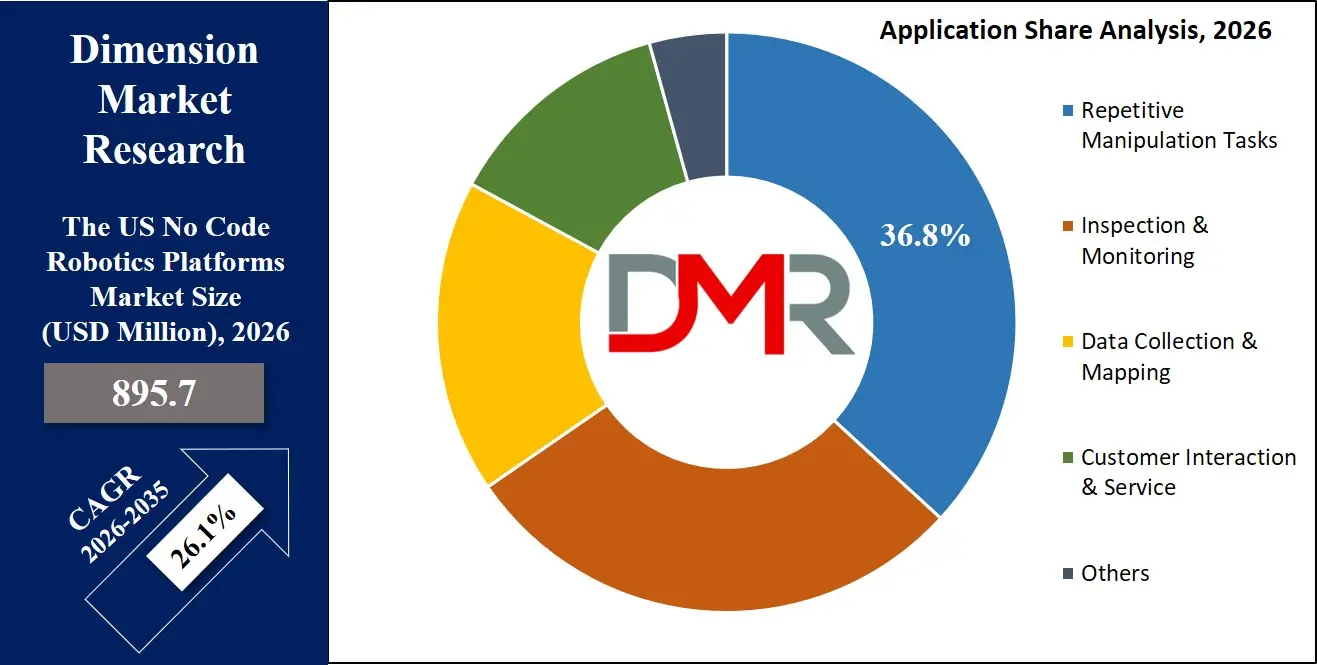
In the U.S. no-code robotics platforms market, repetitive manipulation tasks currently represent the largest segment by adoption. This includes applications such as machine tending, pick-and-place, sorting, and assembly operations, which form the backbone of industrial automation. Manufacturers across industries are deploying no-code platforms to automate these high-volume, labor-intensive processes, driven by the need to improve throughput and address persistent labor shortages. The ability for operators to configure and modify workflows through intuitive, no-code interfaces significantly reduces deployment time and reliance on specialized programming expertise, making this segment highly dominant across manufacturing environments.
ℹ
To learn more about this report –
Download Your Free Sample Report Here
Inspection and monitoring applications constitute another major segment and remain a critical area of adoption. Manufacturers are increasingly leveraging no-code platforms to program robots for visual quality control, thermal imaging inspections, and structural monitoring. The ability for quality engineers to quickly reconfigure inspection parameters without programming expertise is a key advantage, particularly in industries with frequent product changeovers such as consumer electronics and automotive components.
Data collection and mapping is emerging as the fastest-growing application segment. No-code platforms are increasingly used to program autonomous mobile robots (AMRs) and drones for facility mapping, inventory tracking, and environmental data gathering. These applications benefit from the integration of computer vision and sensor fusion capabilities within no-code environments, enabling users to create sophisticated data collection workflows without specialized expertise.
Customer interaction and service applications, while currently smaller in scale, are gaining traction in sectors such as retail, hospitality, and healthcare. No-code platforms enable businesses to program service robots for customer greeting, information delivery, and basic assistance functions. The “others” category includes emerging applications such as collaborative research, educational robotics, and specialized tasks in agriculture and construction.
By Enterprise Size Analysis
Large enterprises currently represent the largest segment in the U.S. no-code robotics platforms market. These organizations have the capital resources to invest in automation, complex operational environments that benefit from standardization, and dedicated teams that can leverage no-code platforms to scale automation across multiple facilities. Large enterprises often deploy no-code platforms as part of broader digital transformation initiatives, using them to unify automation programming across disparate robot brands and models.
However, small and medium enterprises (SMEs) represent the fastest-growing segment. Historically underserved by traditional automation vendors due to high costs and complexity, SMEs are now embracing no-code platforms as an accessible entry point to robotics. The lower total cost of ownership, reduced need for specialized programming staff, and modular, scalable nature of no-code solutions align perfectly with SME requirements. For many small manufacturers, the ability to have a machine operator or shop floor supervisor program a robot represents a fundamental shift in the economics of automation.
By End User Analysis
The industrial sector remains the largest end user of no-code robotics platforms in the United States. This segment includes manufacturing, warehousing, logistics, and construction applications where robots perform tasks ranging from assembly and material handling to quality inspection and packaging. Industrial users are drawn to no-code platforms for their ability to reduce deployment time, enable rapid reconfiguration for changing production lines, and empower frontline workers to take ownership of automation.
The commercial sector is emerging as the fastest-growing end user segment. This encompasses retail operations, hospitality, healthcare facilities, and office environments where robots are deployed for tasks such as cleaning, delivery, customer assistance, and security patrols. Commercial users often lack the dedicated engineering resources found in industrial settings, making no-code platforms particularly attractive for enabling non-technical staff to deploy and manage robotic solutions.
The educational sector represents a growing but distinct end user category. Universities, technical colleges, and vocational training programs are increasingly adopting no-code robotics platforms to teach automation concepts without requiring students to master traditional programming languages first. These platforms enable faster experimentation, broader accessibility, and alignment with industry trends towards citizen development. The "others" category includes government agencies, research institutions, and non-profit organizations deploying robots for specialized applications such as environmental monitoring, disaster response, and public safety.
The US No Code Robotics Platforms Market Report is segmented on the basis of the following:
By Component
- Platform
- Visual Workflow
- Form-based
- Others
- Services
- Professional Services
- Managed Services
By Deployment Mode
By Application
- Inspection & Monitoring
- Customer Interaction & Service
- Data Collection & Mapping
- Repetitive Manipulation Tasks
- Others
By Enterprise Size
- Small & Medium Enterprises
- Large Enterprises
By End User
- Industrial
- Commercial
- Educational
- Others
Impact of Artificial Intelligence in the US No Code Robotics Platforms Market
- Intuitive Skill Acquisition: AI enables robots to learn tasks through demonstration. An operator can manually guide the robot through a motion, and AI algorithms (like reinforcement learning) generalize this into a robust program, eliminating the need for line-by-line coding.
- Generative AI for Workflow Creation: Large language models (LLMs) are being integrated into no-code platforms, allowing users to describe a desired task in plain English. The AI then generates the corresponding workflow logic, robot motion, and sensor triggers, making automation accessible to an even broader audience.
- Adaptive Vision Systems: AI-powered computer vision is embedded within no-code platforms, allowing them to handle variability in object placement, lighting, and part geometry without requiring a programmer to write complex vision scripts. This enables robust bin picking and quality inspection.
- Predictive Analytics and Self-Optimization: AI analyzes data from connected robotic fleets to predict maintenance needs, identify cycle time inefficiencies, and even suggest adjustments to robot paths to improve speed or reduce energy consumption, all managed through the no-code dashboard.
- Natural Language Data Querying: Fleet managers can use natural language to ask questions like, "Show me which robot cells had the most downtime last week," and the AI will query the data, generate a report, and even suggest a workflow to address the issue.
The US No Code Robotics Platforms Market: Competitive Landscape
The U.S. no-code robotics platforms market is a dynamic and rapidly evolving landscape characterized by a blend of agile, venture-backed startups and established industrial automation giants. Pure-play platform innovators such as Vention, Ready Robotics, and Formant are at the forefront, offering end-to-end solutions that prioritize ease of use, cloud connectivity, and rapid deployment. These companies are competing against the traditional leaders in industrial robotics, including FANUC, Yaskawa, KUKA, and Universal Robots, who are increasingly integrating no-code or low-code programming environments into their proprietary teach pendants and software suites.
ℹ
To learn more about this report –
Download Your Free Sample Report Here
Alongside these, a new class of technology companies is emerging that focus on specific layers of the stack. Covariant is developing AI foundation models for robotics, enabling no-code platforms to handle greater variability. Veo Robotics provides safety-focused no-code interfaces for high-payload industrial robots. Major cloud and enterprise software providers, including Amazon Web Services (AWS) with its AWS IoT RoboRunner, Microsoft with Azure Percept, and NVIDIA with its Isaac platform, are also playing a critical role by providing the underlying cloud infrastructure, simulation tools, and AI frameworks that power these no-code solutions.
Some of the prominent players in the US No Code Robotics Platforms Market are:
- Ready Robotics, Inc.
- Vention Inc.
- Formant Inc.
- Hahn Group GmbH (Rethink Robotics GmbH)
- Realtime Robotics, Inc.
- Bright Machines, Inc.
- GrayMatter Robotics, Inc.
- Vecna Robotics, Inc.
- Locus Robotics Corp.
- 6 River Systems, LLC
- Zebra Technologies Corporation (Fetch Robotics, Inc.)
- Seegrid Corporation
- Savioke, Inc.
- Soft Robotics Inc.
- Standard Bots, Inc.
- Diligent Robotics Inc.
- Agility Robotics, Inc.
- Hyundai Motor Company (Boston Dynamics, Inc.)
- Rockwell Automation, Inc.
- NVIDIA Corporation
- Other Key Players
Recent Developments in the US No Code Robotics Platforms Market
- November 2025: Locus Robotics Corp. announced a partnership with MSK Pharma Group to deploy its warehouse automation platform across logistics centers. The implementation includes its LocusONE platform and autonomous mobile robots to enhance order picking, improve throughput, and support compliant pharmaceutical logistics operations.
- June 2025: Rockwell Automation, Inc. announced new AI-powered industrial automation capabilities at its annual event, expanding digital twin and software-defined automation solutions to simplify system design and deployment.
- March 2025: NVIDIA Corporation announced Isaac GR00T N1, the world’s first open humanoid robot foundation model, along with new simulation frameworks to accelerate robot development and enable generalized robotic reasoning.
- March 2025: Vecna Robotics, Inc. announced it would showcase its CaseFlow robotic case picking solution, designed to automate warehouse workflows and improve operational efficiency.
- March 2025: Bright Machines, Inc. announced the launch of its Bright Designer tool, a software-driven engineering solution developed in collaboration with NVIDIA and Microsoft to accelerate product design and enable more automated, software-defined manufacturing workflows.
Report Details
| Report Characteristics |
| Market Size (2026) |
USD 895.7 Mn |
| Forecast Value (2035) |
USD 7,242.2 Mn |
| CAGR (2026–2035) |
26.1% |
| Historical Data |
2021 – 2025 |
| Forecast Data |
2027 – 2035 |
| Base Year |
2025 |
| Estimate Year |
2026 |
| Report Coverage |
Market Revenue Estimation, Market Dynamics, Competitive Landscape, Growth Factors and etc. |
| Segments Covered |
By Component (Platform and Services), By Deployment Mode (Cloud-based and On-Premises), By Application (Inspection & Monitoring, Customer Interaction & Service, Data Collection & Mapping, Repetitive Manipulation Tasks, and Others), By Enterprise Size (Small & Medium Enterprises and Large Enterprises), By End-User (Industrial, Commercial, Educational, and Others) |
| Country Coverage |
The US |
| Prominent Players |
READY Robotics, Inc., Vention Inc., Formant Inc., Hahn Group GmbH (Rethink Robotics GmbH), Realtime Robotics, Inc., Bright Machines, Inc., GrayMatter Robotics, Inc., Vecna Robotics, Inc., Locus Robotics Corp., 6 River Systems, LLC, Zebra Technologies Corporation (Fetch Robotics, Inc.), Seegrid Corporation, Savioke, Inc., Soft Robotics Inc., Standard Bots, Inc., Diligent Robotics Inc., Agility Robotics, Inc., Hyundai Motor Company (Boston Dynamics, Inc.), Rockwell Automation, Inc., NVIDIA Corporation, and Other Key Players |
| Purchase Options |
We have three licenses to opt for: Single User License (Limited to 1 user), Multi-User License (Up to 5 Users) and Corporate Use License (Unlimited User) along with free report customization equivalent to 0 analyst working days, 3 analysts working days and 5 analysts working days respectively. |
Frequently Asked Questions
How big is the US No Code Robotics Platforms Market?
▾ The US No Code Robotics Platforms Market is valued at USD 895.7 million in 2026 and is projected to reach USD 7,242.2 million by the end of 2035.
What is the growth rate for the US No Code Robotics Platforms Market?
▾ The market is growing at a robust compound annual growth rate (CAGR) of 26.1% over the forecast period of 2026 to 2035.
Who are the key players in the US No Code Robotics Platforms Market?
▾ Some of the major key players in the US No Code Robotics Platforms Market are Ready Robotics, Inc., Vention Inc., Formant Inc., Hahn Group GmbH (Rethink Robotics GmbH), Realtime Robotics, Inc., Bright Machines, Inc.., and many others.