US Nucleic Acid Therapeutics Market Snapshot
- Market Size, 2026: USD 5.4 billion
- Market Size, 2035: USD 18.2 billion
- 2026–2035 CAGR: 14.4%
- Leading Therapeutic Modality, 2026: Antisense Oligonucleotides (ASOs), 37.0%
- Leading Delivery Technology, 2026: Lipid Nanoparticle (LNP)-Based Delivery, 34.0%
- Leading Therapeutic Area, 2026: Oncology, 29.0%
- Fastest-Growing Segment: siRNA therapeutics, 17.8% CAGR
What is the US Nucleic Acid Therapeutics and its Market Size?
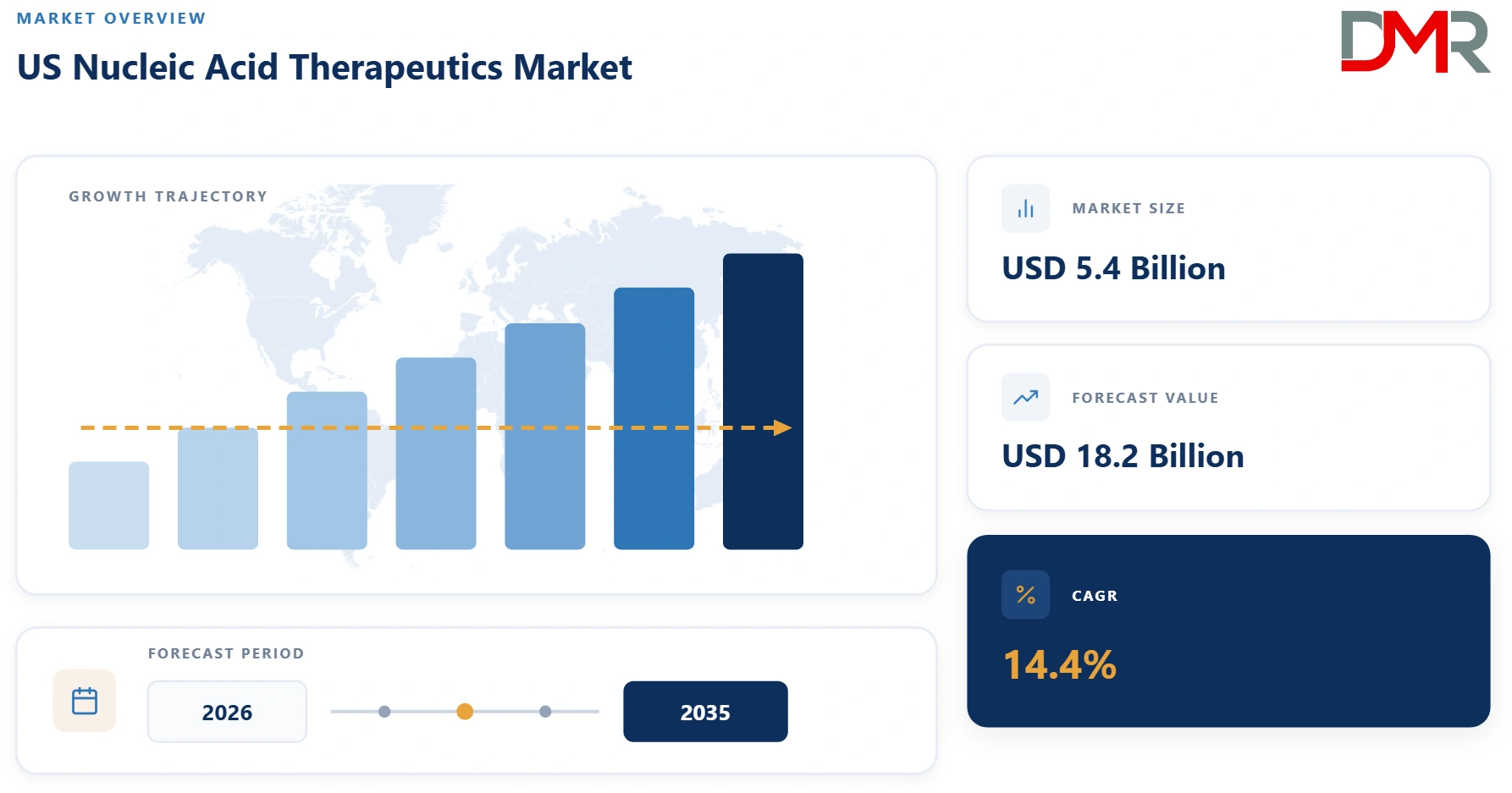
The U.S. nucleic acid therapeutics market is estimated at USD 5.4 billion in 2026 and is projected to reach approximately USD 18.2 billion by 2035, representing a 14.4% CAGR.
ℹ
To learn more about this report –
Download Your Free Sample Report Here
The US nucleic acid therapeutics market comprises medicines that use DNA- or RNA-based molecules to modify gene expression, silence disease-associated genes, replace or introduce genetic information, or otherwise regulate cellular processes. It encompasses antisense oligonucleotides (ASOs), small interfering RNA (siRNA), messenger RNA (mRNA) therapeutics, microRNA therapies, aptamers, DNA-based therapeutics and emerging nucleic-acid modalities. Unlike conventional small molecules that primarily bind proteins, these therapies intervene upstream at the genetic or transcript level. Their principal value proposition is the ability to address previously difficult or inaccessible biological targets with high molecular specificity.
Use Cases
- Gene silencing: Suppresses disease-causing RNA transcripts to reduce production of harmful proteins.
- Splicing modulation: Corrects abnormal pre-mRNA processing associated with inherited neurological and genetic diseases.
- Protein replacement: Uses mRNA to instruct cells to produce therapeutically useful proteins.
- Cancer treatment: Targets oncogenic pathways, immune responses, tumor antigens and disease-driving genetic mechanisms.
- Rare-disease treatment: Enables highly targeted intervention against mutations or abnormal gene-expression pathways.
- Cardiometabolic management: Silences hepatic targets involved in cholesterol, triglyceride, blood-pressure and metabolic regulation.
Key Takeaways
- Market Size: U.S. nucleic acid therapeutics revenue is estimated at $5.4 billion in 2026, rising to $18.2 billion by 2035.
- Growth: The market is expected to expand at approximately 14.4% CAGR during 2026–2035.
- Drivers: FDA approvals, precision medicine, genetic-disease prevalence, improved delivery and increasing pharmaceutical investment are central growth catalysts.
- Dominant Modality: ASOs retain the largest share because of commercial maturity and broad neurological/genetic applications.
- Fastest Growth: siRNA is expected to outpace mature modalities as GalNAc conjugation, longer dosing intervals and cardiometabolic applications expand.
- Strategic Direction: The industry is shifting from rare-disease proof-of-concept toward scalable chronic-disease and tissue-targeted applications.
How AI, LNPs and Advanced Delivery Technologies are Transforming the US Nucleic Acid Therapeutics Market?
Artificial intelligence is increasingly being applied to nucleic-acid sequence design, target identification, molecular optimization, patient stratification and biomarker discovery. AI can evaluate large biological datasets to identify optimal RNA sequences and predict molecular behavior, potentially shortening discovery cycles. In June 2026, Alnylam announced a strategic AI collaboration with Inceptive valued at up to $2 billion, combining its RNAi expertise and proprietary data with foundation-model capabilities.
Advanced delivery technologies are equally important. LNPs, GalNAc conjugates, ligand-mediated delivery and chemically modified oligonucleotides improve stability, cellular uptake, tissue specificity and dosing durability. The competitive frontier is consequently moving from merely designing a therapeutic sequence toward solving tissue-specific delivery, repeat-dose tolerability and manufacturing scalability.
Key Drivers in the US Nucleic Acid Therapeutics Market
Growing Adoption of Precision and Genetic Medicine
The increasing use of precision medicine is a major driver of the US Nucleic Acid Therapeutics Market. ASOs, siRNA, mRNA and other nucleic-acid modalities can directly regulate gene expression or protein production, allowing developers to address disease mechanisms that are difficult to target with conventional therapies. The growing identification of genetic mutations and disease biomarkers is expanding opportunities for highly targeted treatments, particularly across neurological, neuromuscular, metabolic and rare diseases.
Advances in RNA Delivery and Therapeutic Chemistry
Rapid improvements in delivery technologies and oligonucleotide chemistry are strengthening the US Nucleic Acid Therapeutics Market. Lipid nanoparticles, GalNAc conjugates and other ligand-based delivery systems have improved cellular uptake, stability, tissue targeting and dosing convenience. These developments are helping nucleic-acid therapeutics move beyond early rare-disease applications toward chronic metabolic, cardiovascular and neurological conditions. Better chemical modification can also reduce degradation and improve therapeutic durability, while advances in manufacturing are supporting greater commercial scalability.
Restraints in the US Nucleic Acid Therapeutics Market
Delivery Limitations and Manufacturing Complexity
Delivery remains one of the most important constraints in the US Nucleic Acid Therapeutics Market. Although liver targeting has become relatively advanced, efficiently transporting nucleic-acid molecules into tissues such as the brain, skeletal muscle, lungs and solid tumors remains challenging. Large molecular size, instability, cellular uptake limitations and potential off-target effects can restrict therapeutic performance. Manufacturing is also more complex than conventional small-molecule production because developers must manage highly controlled synthesis, purification, formulation and analytical processes.
Safety, Reimbursement and Commercialization Risks
Safety and reimbursement considerations can limit adoption across the US Nucleic Acid Therapeutics Market. Some nucleic-acid therapies require repeated administration, creating concerns regarding immunogenicity, tolerability, off-target activity and long-term safety. Developers must generate extensive clinical and manufacturing evidence before achieving broad regulatory acceptance. Commercialization can also be challenging when therapies target small patient populations or compete against established treatments.
Growth Opportunities in the US Nucleic Acid Therapeutics Market
Expansion into Extrahepatic Delivery
Extrahepatic delivery represents a significant opportunity for the US Nucleic Acid Therapeutics Market. Much of the industry's delivery success has historically focused on the liver, but advances in nanoparticles, ligand-conjugated systems, polymers and other delivery technologies are creating possibilities for targeting the central nervous system, skeletal muscle, lungs and tumors. Successful tissue-specific delivery could substantially increase the number of diseases addressable by RNA therapeutics. Neurological and neuromuscular disorders are particularly attractive because many remain underserved by conventional medicines.
Growth in Chronic and Cardiometabolic Applications
Expansion into large chronic diseases provides another major opportunity for the US Nucleic Acid Therapeutics Market. RNA interference and antisense technologies can potentially provide prolonged suppression of disease-associated proteins, reducing dosing frequency compared with conventional therapies. This creates opportunities across dyslipidemia, hypertriglyceridemia, cardiovascular disease, metabolic disorders and other chronic conditions. The development of longer-acting formulations and subcutaneous delivery could further improve patient convenience and adherence.
Trends in the US Nucleic Acid Therapeutics Market
Shift Toward Long-Acting and Convenient Therapies
The US Nucleic Acid Therapeutics Market is increasingly shifting toward therapies that provide prolonged therapeutic activity with less frequent administration. Improvements in molecular chemistry, conjugation technologies and delivery systems are enabling longer target suppression and more convenient dosing. Subcutaneous formulations are particularly attractive because they can reduce dependence on infusion centers and potentially support outpatient or home-based treatment.
Increasing Focus on Programmable and AI-Enabled Therapeutics
The US Nucleic Acid Therapeutics Market is moving toward more programmable therapeutic platforms supported by computational biology and artificial intelligence. AI can assist with target identification, sequence optimization, molecular screening and prediction of therapeutic properties, potentially accelerating candidate selection. At the same time, advances in delivery technologies are enabling greater spatial and temporal control over nucleic-acid activity.
Research Scope and Analysis
The U.S. market is segmented by Therapeutic Modality, Delivery Technology, Route of Administration and Therapeutic Area. Estimates reflect revenue from commercially available and forecast nucleic-acid therapeutics, including approved medicines and emerging modalities expected to contribute materially during the forecast period.
ℹ
To learn more about this report –
Download Your Free Sample Report Here
By Therapeutic Modality Analysis
Antisense Oligonucleotides (ASOs) represent the dominant modality in 2026, accounting for approximately 37.0% of U.S. market revenue, supported by commercial maturity, established regulatory precedent and strong applications in neurological, neuromuscular and genetic disorders. Ionis remains particularly influential in this segment, with an expanding independently commercialized portfolio and multiple late-stage programs. siRNA represents the second-largest segment at approximately 30.0% and is also the fastest-growing modality, at an estimated 17.8% CAGR, driven by highly efficient gene silencing, GalNAc delivery and expansion into cardiometabolic diseases. mRNA therapeutics account for approximately 18.0%, supported by validated LNP manufacturing and increasing interest beyond vaccines. MicroRNA, aptamer, DNA-based and other nucleic-acid therapies collectively represent the remaining approximately 15%, with microRNA and next-generation gene-regulatory approaches providing significant long-term optionality. The FDA's experience with approved RNA medicines has helped establish a regulatory foundation for the category.
By Delivery Technology Analysis
Lipid Nanoparticle (LNP)-Based Delivery is estimated to lead the U.S. market with approximately 34.0% share in 2026, reflecting its established role in mRNA delivery and growing application across next-generation RNA medicines. Its scalability, modular formulation capabilities and ability to protect nucleic-acid payloads support continued adoption, although manufacturing complexity and tolerability remain limitations. Ligand-conjugated delivery is the second-largest segment at approximately 28.0%, with GalNAc-siRNA systems driving commercial penetration into liver diseases and offering convenient subcutaneous administration. It is also the fastest-growing delivery segment at approximately 18.5% CAGR, as developers seek potent, durable and less complex alternatives to nanoparticle formulations. Polymer-based delivery represents roughly 14%, liposomes about 10%, viral-vector systems about 8%, and other delivery technologies approximately 6%. The long-term competitive race is expected to center on extrahepatic delivery, particularly CNS and tumor targeting..
By Route of Administration Analysis
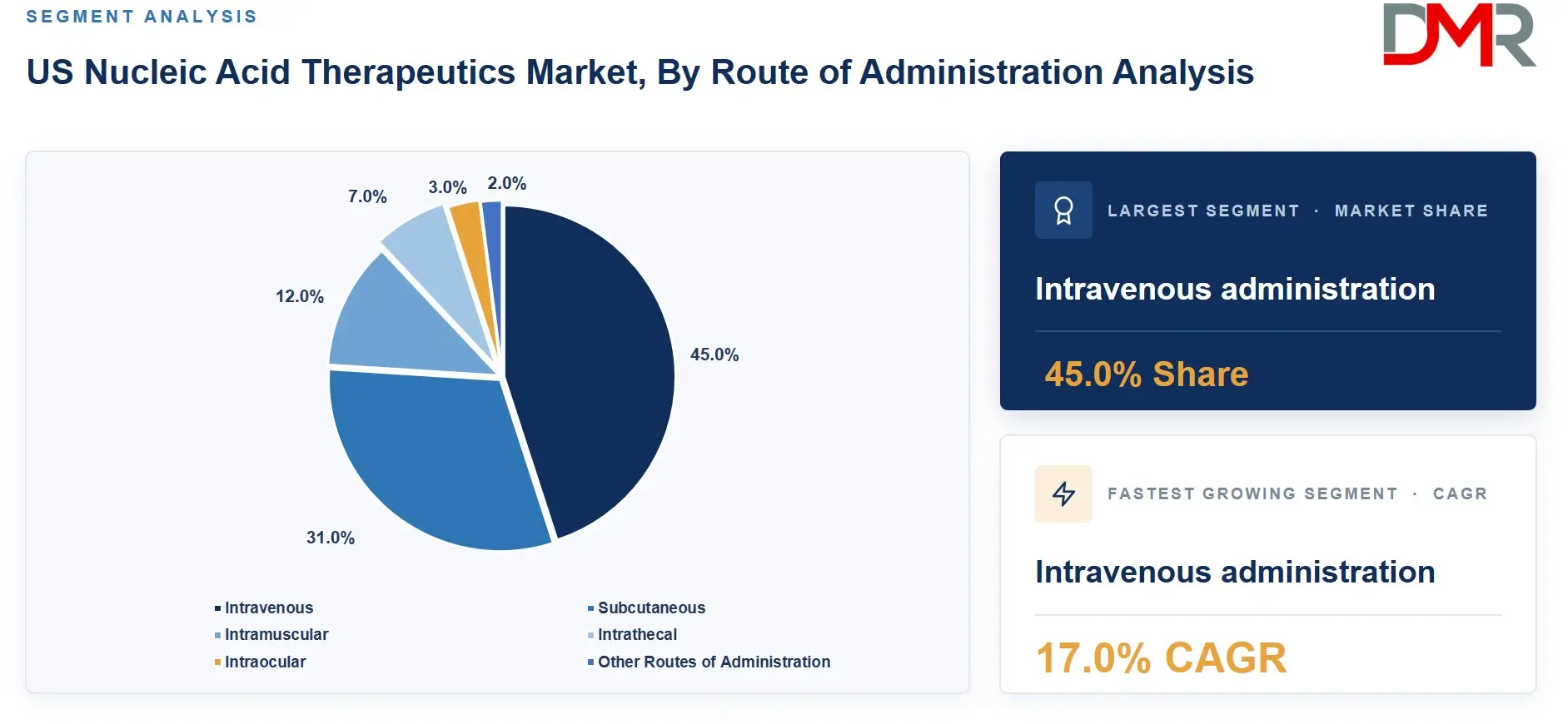
Intravenous administration is estimated to represent approximately 45.0% of 2026 revenue, retaining leadership because many established LNP formulations and infusion-based nucleic-acid products use systemic IV delivery. Hospital and specialty-care infrastructure also supports administration of high-value rare-disease therapies. Subcutaneous administration represents approximately 31.0%, making it the second-largest route and the fastest-growing route at approximately 17.0% CAGR, because conjugated siRNA and ASO therapies can increasingly be administered outside infusion centers and at longer intervals. Intramuscular administration accounts for approximately 12%, supported heavily by mRNA products, while intrathecal delivery represents around 7%, particularly important for neurological ASOs. Intraocular and other routes collectively contribute approximately 5%. Over the forecast period, commercial preference is expected to shift toward routes enabling self-administration, reduced healthcare-resource utilization and extended dosing intervals.
By Therapeutic Area Analysis
Oncology is estimated to constitute approximately 29.0% of the U.S. market in 2026, making it the largest therapeutic-area segment because of extensive RNA-target discovery, personalized medicine initiatives and substantial unmet need across solid and hematologic malignancies. Neurological and neuromuscular disorders represent approximately 24.0%, while metabolic and genetic disorders account for approximately 20.0%. The neurological segment is expected to record the fastest growth at approximately 16.5% CAGR, supported by increasing validation of RNA modulation in diseases such as Huntington's disease, ALS, Angelman syndrome and rare leukodystrophies. Cardiovascular diseases represent around 10%, infectious diseases 7%, ophthalmic disorders 4%, rare diseases 4% and other therapeutic areas 2%. Importantly, the categories overlap clinically: rare genetic diseases can simultaneously be classified as neurological or metabolic, so these shares should be interpreted according to the primary commercial indication.
The US Nucleic Acid Therapeutics Market Report is segmented on the basis of the following:
By Therapeutic Modality
- Antisense Oligonucleotides (ASOs)
- Small Interfering RNA (siRNA)
- Messenger RNA (mRNA) Therapeutics
- MicroRNA-Based Therapeutics
- Aptamer-Based Therapeutics
- DNA-Based Therapeutics
- Other Nucleic Acid Therapeutics
By Delivery Technology
- Lipid Nanoparticle (LNP)-Based Delivery
- Ligand-Conjugated Delivery
- Polymer-Based Delivery
- Liposome-Based Delivery
- Viral Vector-Based Delivery
- Other Delivery Technologies
By Route of Administration
- Intravenous
- Subcutaneous
- Intramuscular
- Intrathecal
- Intraocular
- Other Routes of Administration
By Therapeutic Area
- Oncology
- Neurological & Neuromuscular Disorders
- Metabolic & Genetic Disorders
- Cardiovascular Diseases
- Infectious Diseases
- Ophthalmic Disorders
- Rare Diseases
- Other Therapeutic Areas
Regulatory Landscape
The U.S. regulatory environment is becoming more supportive of nucleic-acid therapeutics as FDA experience accumulates across ASOs, siRNAs, mRNA products and gene-based medicines. Priority Review, Fast Track, Breakthrough Therapy and Orphan Drug pathways can accelerate development for high-unmet-need indications. FDA orphan-designation records show continued activity in emerging RNA technologies, including RNA-editing ASO programs. However, regulators continue to emphasize sequence specificity, off-target effects, immunogenicity, long-term safety, manufacturing controls and clinically meaningful biomarkers. The main opportunity is a clearer regulatory precedent; the key risk is that increasingly complex delivery systems may create new safety and CMC requirements.
Technology Analysis
The competitive technology frontier is shifting from RNA sequence design toward delivery, durability and tissue specificity. GalNAc has established a highly effective liver-targeting paradigm, while LNPs provide scalable intracellular delivery for mRNA and other nucleic acids. The next major opportunity is extrahepatic targeting, including CNS, muscle and tumors. AI is becoming an enabling technology for sequence optimization and candidate prioritization; Alnylam's 2026 agreement with Inceptive, valued at up to $2 billion, demonstrates the strategic importance being assigned to AI-enabled RNA discovery. Technology leaders that combine proprietary targets, delivery systems, manufacturing know-how and clinical datasets are likely to gain disproportionate competitive advantage..
Competitive Landscape
The U.S. nucleic acid therapeutics market is moderately concentrated but increasingly competitive, with established leaders in ASO and RNAi complemented by pharmaceutical companies, mRNA specialists and emerging platform biotechnology companies. Major players compete through proprietary chemistry, delivery platforms, differentiated targets, clinical partnerships, licensing, acquisitions and geographic expansion. Ionis Pharmaceuticals has a leading ASO position, while Alnylam Pharmaceuticals is a major RNAi commercial leader. Arrowhead Pharmaceuticals is expanding its RNAi pipeline, particularly in cardiometabolic and CNS applications. Moderna and other mRNA-focused companies contribute to the broader nucleic-acid ecosystem. Key differentiators include delivery efficiency, dosing frequency, safety, target specificity, clinical efficacy, manufacturing scalability and reimbursement economics.
Some of the prominent players in the US Nucleic Acid Therapeutics Market are:
- Pfizer Inc.
- Moderna Inc.
- BioNTech SE
- Alnylam Pharmaceuticals
- Ionis Pharmaceuticals
- Sarepta Therapeutics
- Arrowhead Pharmaceuticals
- Regeneron Pharmaceuticals
- Biogen
- Novartis
- Roche
- AstraZeneca
- Sanofi
- Astellas Pharma
- Novo Nordisk
- Eli Lilly and Company
- Merck & Co.
- Johnson & Johnson
- Gilead Sciences
- Vertex Pharmaceuticals
- Beam Therapeutics
- Arcturus Therapeutics
- Arbutus Biopharma
- Silence Therapeutics
- Wave Life Sciences
- Avidity Biosciences
- Stoke Therapeutics
- Regulus Therapeutics
- ReCode Therapeutics
- Intellia Therapeutics
- Verve Therapeutics
- Sangamo Therapeutics
- Editas Medicine
- CRISPR Therapeutics
- Prime Medicine
- Tome Biosciences
- Capstan Therapeutics
- Copernicus Therapeutics
- Other Key Players
Recent Developments
- In August 2026, Arrowhead Pharmaceuticals acquired an FDA Rare Pediatric Disease Priority Review Voucher for use with its planned supplemental application for plozasiran in severe hypertriglyceridemia, potentially accelerating the U.S. regulatory review process.
- In July 2026, Arrowhead Pharmaceuticals reported positive Phase 3 SHASTA-3 and SHASTA-4 topline results for plozasiran, demonstrating approximately 79% and 81% median triglyceride reductions, respectively, along with significant reductions in acute pancreatitis events.
- In July 2026, Alnylam Pharmaceuticals reported $1.172 billion in global net product revenue for Q2 2026, including approximately $1.03 billion from TTR products, highlighting the growing commercial scale of RNAi therapeutics.
- In June 2026, Alnylam Pharmaceuticals and Inceptive announced an AI collaboration valued at up to $2 billion, combining Alnylam's RNAi expertise and proprietary data with Inceptive's foundation-model technology to accelerate RNA therapeutic discovery.
- In March 2026, Ionis Pharmaceuticals announced that the FDA accepted the New Drug Application for zilganersen for Priority Review, with a September 22, 2026 PDUFA target date, potentially expanding RNA-targeted treatment options for patients with Alexander disease.
Report Details
| Report Characteristics |
| Market Size (2026) |
USD 5.4 Bn |
| Forecast Value (2035) |
USD 18.2 Bn |
| CAGR (2026–2035) |
14.4% |
| Historical Data |
2021 – 2025 |
| Forecast Data |
2026 – 2035 |
| Base Year |
2025 |
| Segments Covered |
By Therapeutic Modality, By Delivery Technology, By Route Of Administration, By Therapeutic Area |
| Country Coverage |
The US |
Frequently Asked Questions
What is the US Nucleic Acid Therapeutics Market size?
▾ The US Nucleic Acid Therapeutics Market is estimated at USD 5.4 billion in 2026 and is projected to reach approximately USD 18.2 billion by 2035.
What CAGR is expected for the US Nucleic Acid Therapeutics Market?
▾ The US Nucleic Acid Therapeutics Market is projected to grow at approximately 14.4% CAGR from 2026 to 2035, driven by therapeutic innovation and delivery advances.
What are the key growth drivers of the US Nucleic Acid Therapeutics Market?
▾ The major drivers of the US Nucleic Acid Therapeutics Market include precision medicine, genetic-disease treatment, RNA-target validation, improved delivery technologies and increasing pharmaceutical investment.
Which therapeutic modality dominates the US Nucleic Acid Therapeutics Market?
▾ Antisense oligonucleotides (ASOs) dominate the US Nucleic Acid Therapeutics Market, accounting for an estimated 37.0% share in 2026 due to commercial maturity and broad clinical applications.
Which is the fastest-growing segment in the US Nucleic Acid Therapeutics Market?
▾ Small interfering RNA (siRNA) is expected to be the fastest-growing segment of the US Nucleic Acid Therapeutics Market, with an estimated 17.8% CAGR through 2035.
What are the major trends in the US Nucleic Acid Therapeutics Market?
▾ Major trends shaping the US Nucleic Acid Therapeutics Market include longer-acting therapies, extrahepatic delivery, AI-enabled RNA design, personalized medicine and expansion into cardiometabolic diseases.
Who are the key players in the US Nucleic Acid Therapeutics Market?
▾ Key players in the US Nucleic Acid Therapeutics Market include Ionis Pharmaceuticals, Alnylam Pharmaceuticals, Arrowhead Pharmaceuticals, Sarepta Therapeutics, Moderna and other biotechnology companies.
How is the US Nucleic Acid Therapeutics Market segmented?
▾ The US Nucleic Acid Therapeutics Market is segmented by therapeutic modality, delivery technology, route of administration and therapeutic area, enabling detailed assessment of market opportunities.