Market Overview
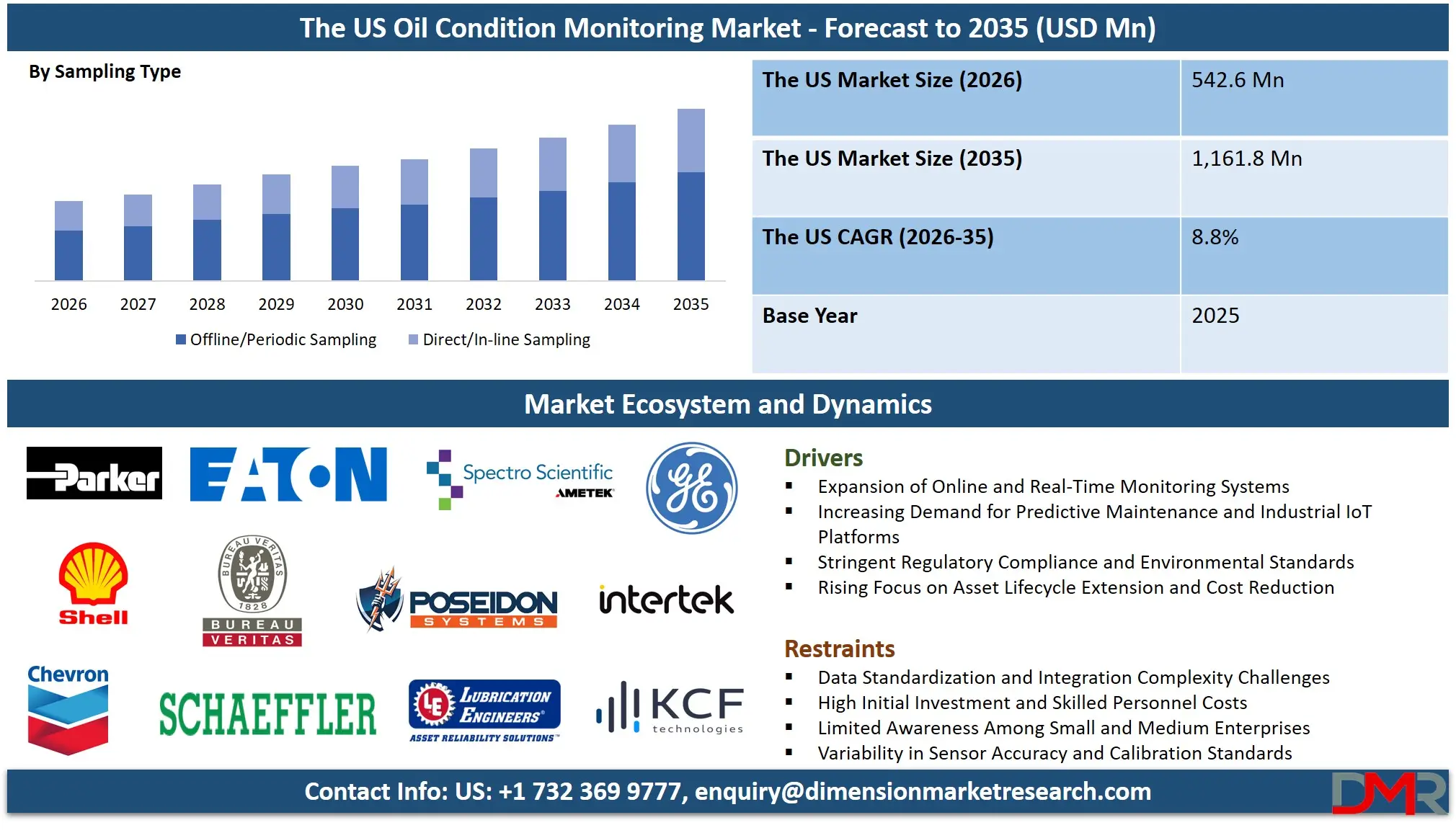
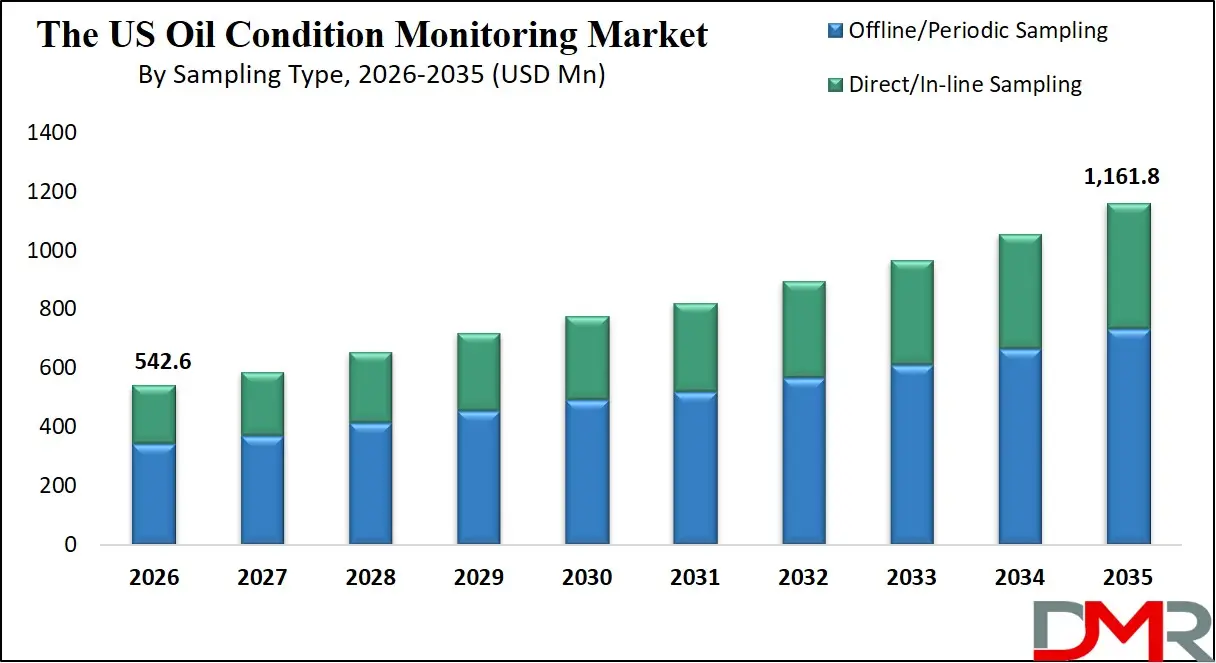
The US Oil Condition Monitoring Market size is expected to reach USD 542.6 million in 2026 and is anticipated to expand at a CAGR of 8.8%, reaching approximately USD 1,161.8 million by 2035.
ℹ
To learn more about this report –
Download Your Free Sample Report Here
Oil condition monitoring is a methodical approach to the investigation of the physical, chemical and contamination characteristics of the lubricants and industrial oils in order to determine the health of the machinery, anticipate failures and streamline the maintenance procedures. These systems are increasingly being used in transportation, energy and power generation, industrial manufacturing, mining and construction and oil and gas.
The oil condition monitoring market in the US is evolving to be more automated and real-time fluid analysis not only in large industrial plants, but also in fleet management and remote equipment monitoring in response to the growing pressure of operational efficiency, the high demand of predictive maintenance solutions, more frequent use of condition-based monitoring, and the embedding of digital analytics which would bring real-time equipment health data and more effective use of maintenance decision-making.
ℹ
To learn more about this report –
Download Your Free Sample Report Here
The US Oil Condition Monitoring Market: Key Takeaways and Other Influencing Factors
- Steady Market Expansion with Moderate Growth Rate: The market is projected to reach USD 542.6 million in 2026 and expand significantly to USD 1,161.8 million by 2035, showing a high pace owing to the digital transformation of industries and the integration of IoT in maintenance delivery.
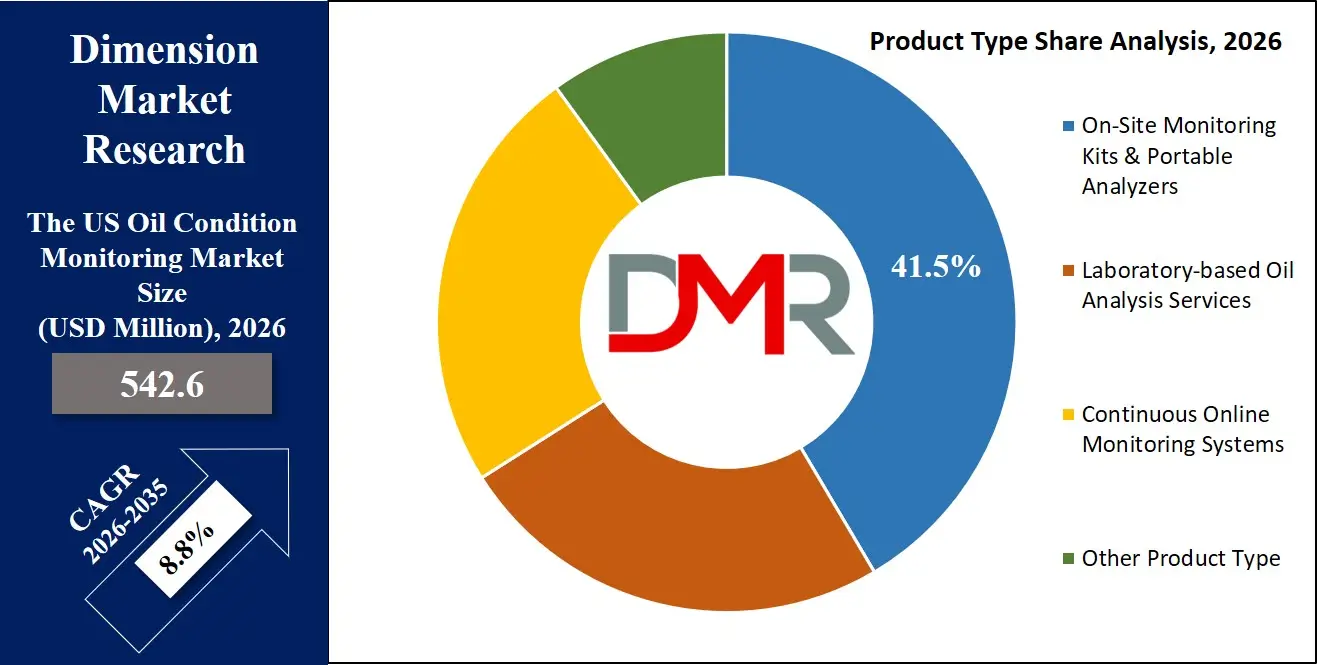
- Dominance within Product Segment: On-site monitoring kits and portable analyzers dominate with 41.5% share in 2026 as a result of an increased utilization of comprehensive spectrometric analysis, ferrography, and additive depletion testing among US industrial operators.
- Energy & Power Generation Leading End User Adoption: Energy and power generation will dominate with 34.8% market share in 2026 and is enhanced by mass deployment of continuous online monitoring systems and integrated digital maintenance infrastructure in wind turbines, gas turbines and traditional power plants.
- Wear & Contamination Monitoring Driving Measurement Type Growth: Wear & contamination monitoring holds 34.1% share, fueled by increasing machinery failure risks and demand for real-time particle counting and ferrous density measurement solutions.
- US Bureau of Labor Statistics – Maintenance Spending Trends: Around 55% of unplanned downtime in US manufacturing is attributed to lubricant-related failures, highlighting strong predictive maintenance adoption trends.
- US Department of Energy – Industrial Asset Utilization: 62% of large US industrial facilities currently use a type of oil analysis with higher use of power generation standing at 78% versus mining.
- Frost & Sullivan – Condition Monitoring Stability: Condition monitoring usage remained around 48% of heavy industries during 2021–2023, indicating sustained reliance on proactive maintenance strategies.
Impact of the Iran conflict on the US Oil Condition Monitoring Market
The escalation of Iranian conflict is disrupting the global supply chains which influence the output of oil condition monitoring systems in the US in terms of availability of sensor components and data controllers, rising energy prices are raising the cost of transporting and manufacturing systems which in turn raise the cost of the system, and scarcity of electronic parts and industrial-grade materials may affect volumes of production, cybersecurity and operational risks are making differences to the US automation and reliability companies.
The US Oil Condition Monitoring Market: Use Cases
- Wind Turbine Gearbox and Bearing Monitoring: Online oil condition sensors are wear debris sensors and real-time ferrous density sensors measuring the health of the gearbox to allow early intervention and minimize unplanned downtime.
- Fleet and Heavy Vehicle Predictive Maintenance: Telematics platforms integrate oil analysis for viscosity, soot, and fuel dilution, supporting optimized drain intervals and reduced engine wear.
- Hydraulic System Contamination in Industry: The sensor-based contamination systems measure the content of water, the number of particles and the oxidation rate to assist in early warning, quicker corrective measures, and enhanced system dependability.
- Lubricant Life Extension and Additive Optimization: Oil analysis tools enhance lubricant life through TAN/TBN tracking and additive depletion insights while enabling personalized drain scheduling for better asset outcomes.
The US Oil Condition Monitoring Market: Market Dynamics
Driving Factors in the US Oil Condition Monitoring Market
Expansion of Online and Real-Time Monitoring Systems
The growing adoption of continuous online monitoring systems supported by inductive sensors and real-time fluid analytics is driving market growth. The increasing prevalence of unplanned downtime and demand for predictive maintenance are accelerating the use of connected sensors and IoT-based maintenance solutions in the US market.
Increasing Demand for Predictive Maintenance and Industrial IoT Platforms
The transition to Industry 4.0 and condition-based maintenance is increasing the merging of spectrometric analysis and automated alarming devices. Intelligent dashboards and data-driven insights are helping industrial operators to achieve better asset engagement and maintenance efficiency.
Restraints in the US Oil Condition Monitoring Market
Data Standardization and Integration Complexity Challenges
Diverse sensor protocols and concerns around cross-platform data integration limit the adoption of unified condition monitoring systems. Compliance with interoperability frameworks and secure data management increases complexity and slows implementation across industrial organizations.
High Initial Investment and Skilled Personnel Costs
The deployment of advanced online sensors and laboratory-grade analyzers requires significant capital investment. Integration with existing CMMS and ERP systems and lack of trained tribologists act as barriers for small and mid-sized operators in the US market.
Opportunities in the US Oil Condition Monitoring Market
Growth in Predictive and AI-Driven Lubrication Analytics
AI enables remaining useful life prediction through advanced algorithms and equipment-specific wear pattern insights. The increasing focus on reliability-centered maintenance and outcome-based contracts is creating new opportunities for condition monitoring platforms in improving long-term asset health outcomes.
Advancement of Remote Monitoring and Decentralized Infrastructure Support
The rising demand for remote equipment monitoring and unmanned facility support is opening new avenues for portable oil analysis kits and IoT-enabled sensors. Smart sampling devices and cloud-based maintenance models are supporting operational continuity and reducing site visits in the US market.
Trends in the US Oil Condition Monitoring Market
AI Integration with Wear Debris and Ferrous Sensors
The integration of artificial intelligence with inductive wear debris sensors and ferrographic analyzers has brought revolutionary changes in remote equipment health services. Real-time analysis of particle shape and concentration has improved preventive measures and early detection of failure conditions.
Cloud-Based Oil Analysis and Digital Twin Integration
Spectrometric data and the usage of cloud analytics platforms have increased among condition monitoring applications. Digital oil dashboards are providing better maintenance insights through automated trend analysis and anomaly detection systems.
The US Oil Condition Monitoring Market: Research Scope and Analysis
By Product Type Analysis
On-site monitoring kits and portable analyzers are expected to have the largest market share of the product type segment, with 41.5% of the total market share in 2026, as the rapid field testing, real-time viscosity checks, contamination detection, and real-time diagnostic capabilities gain prevalence in the U.S. market to augment maintenance decisions and operational reliability.
ℹ
To learn more about this report –
Download Your Free Sample Report Here
The growing popularity of portable spectrometers, handheld analyzers, and in-site diagnostic devices further enhance demand in power generation, transportation, and industrial markets. In the meantime, laboratory-based oil analysis services own a large portion since they contribute to complete spectrometric testing, ferrography, additive depletion analysis, and TAN/TBN profiling, enabling maintenance teams to maximize long-term asset performance, maintain accuracy, and continuity in operations as condition monitoring programs are scaled.
By Sampling Type Analysis
Offline/periodic sampling is anticipated to dominate the sampling type segment, capturing 68.0% of the total market share in 2026 due to the widespread adoption of scheduled oil sampling protocols, laboratory submission workflows, and trend analysis for fleet-wide maintenance programs in the US market. The rising use of standardized sampling valves and sample bottles enables consistent data collection and historical comparison across maintenance cycles. Direct/in-line sampling also holds a significant share as real-time sensors support continuous fluid monitoring, instantaneous contamination detection, and automated alerts, improving diagnostic accuracy and enabling immediate corrective action across critical rotating equipment.
By Measurement Type Analysis
Wear & contamination monitoring is anticipated to dominate the measurement type segment, capturing 34.0% of the total market share in 2026 due to the increasing adoption of wear debris analysis, particle counting, and ferrous density measurement for early failure detection and proactive maintenance in the US market. The rising use of online particle counters and magnetic chip detectors enables real-time wear trend tracking and reduced catastrophic failures. Fluid contamination analysis also holds a significant share as water content, fuel dilution, and soot & insolubles measurement support lubricant health assessment and extended drain intervals across diesel engines and hydraulic systems. Chemical property analysis including TAN, TBN, oxidation, nitration, additive depletion, and spectrometric analysis further strengthens laboratory-based condition monitoring programs.
By Industry Vertical Analysis
Energy & power generation is anticipated to dominate the industry vertical segment, capturing 35.0% of the total market share in 2026, driven by large-scale adoption of continuous online monitoring systems, wear debris sensors, and integrated predictive maintenance infrastructure across wind turbines, gas turbines, hydraulic plants, and conventional power stations in the US market. These facilities leverage advanced oil analysis and real-time condition data to improve asset availability, maintenance planning, and operational efficiency. Transportation also holds a significant share with the rising demand for fleet oil analysis, engine wear monitoring, and extended drain optimization, where portable analyzers and laboratory-based testing support preventive maintenance, reduced downtime, and lower total cost of ownership.
The US Oil Condition Monitoring Market Report is segmented on the basis of the following:
By Product Type
- On-Site Monitoring Kits & Portable Analyzers
- Laboratory-based Oil Analysis Services
- Continuous Online Monitoring Systems
- Other Product Type
By Sampling Type
- Offline/Periodic Sampling
- Direct/In-line Sampling
By Measurement Type
- Physical Properties
- Viscosity
- Density
- Temperature
- Wear & Contamination Monitoring
- Wear Debris Analysis
- Particle Counting
- Ferrous Density Measurement
- Fluid Contamination Analysis
- Water Content
- Fuel Dilution
- Soot & Insolubles
- Chemical Property Analysis
- Total Acid Number (TAN)
- Total Base Number (TBN)
- Oxidation & Nitration
- Additive Depletion
- Spectrometric Analysis
- Other Measurement Parameters
By Industry Vertical
- Transportation
- Automotive (Passenger & Commercial Vehicles)
- Aviation
- Marine
- Railways
- Energy & Power Generation
- Conventional Power (Coal, Gas, Nuclear)
- Renewable Energy (Wind Turbines, Hydropower)
- Industrial Manufacturing
- Heavy Machinery
- Process Industries
- Food & Beverage Equipment
- Mining & Construction Equipment
- Oil & Gas (Upstream, Midstream, Downstream)
- Other Industry Verticals
Impact of Artificial Intelligence in the US Oil Condition Monitoring Market
Artificial intelligence is transforming the US oil condition monitoring market by improving failure prediction through predictive analytics and real-time sensor insights. It enables faster diagnosis with AI-driven wear debris classification and automated spectrometric analysis. Remote equipment monitoring is enhanced through continuous tracking and early anomaly detection for rotating machinery.
Oil analysis programs benefit from natural language processing and automated report generation. AI also supports personalized maintenance scheduling and better asset engagement. Additionally, it improves operational efficiency by automating data interpretation and reducing unplanned downtime costs.
The US Oil Condition Monitoring Market: Competitive Landscape
The US oil condition monitoring market is highly competitive with the presence of established fluid analysis laboratories, sensor manufacturers, and emerging IIoT startups driving innovation.
ℹ
To learn more about this report –
Download Your Free Sample Report Here
Companies are focusing on advanced spectroscopy, online sensor integration, and strategic partnerships to strengthen their market position and expand service offerings. Continuous investments in AI capabilities, data interoperability, and sensor miniaturization are shaping the competitive dynamics in the US market.
Some of the prominent players in the US Oil Condition Monitoring Market are:
- Parker-Hannifin Corporation
- Eaton Corporation plc
- General Electric Company (GE Vernova)
- Chevron Corporation
- Shell plc
- BP p.l.c.
- SGS SA
- Bureau Veritas SA
- Intertek Group plc
- Spectro Scientific, Inc.
- TE Connectivity plc
- Poseidon Systems, LLC
- SKF AB
- ifm electronic gmbh
- Schaeffler AG
- KCF Technologies, Inc.
- ALS Limited
- TestOil, Inc.
- WearCheck International (Pty) Ltd
- Lubrication Engineers, Inc.
- Other Key Players
Recent Developments in the US Oil Condition Monitoring Market
- March 2026: SKF AB announced the acquisition of a condition monitoring technology company (G-Tech) to strengthen its diagnostics and predictive maintenance portfolio, directly enhancing its oil condition monitoring and asset health capabilities.
- November 2025: Parker-Hannifin Corporation announced the acquisition of Filtration Group Corporation, significantly expanding its filtration and aftermarket capabilities, which directly strengthens its fluid condition monitoring and oil analysis ecosystem.
- October 2024: Spectro Scientific, Inc. continued innovation in portable oil analysis instruments, emphasizing field-based diagnostics and real-time fluid condition testing for military, industrial, and oil & gas applications in the U.S.
Report Details
| Report Characteristics |
| Market Size (2026) |
USD 542.6 Mn |
| Forecast Value (2035) |
USD 1,161.8 Mn |
| CAGR (2026–2035) |
8.8% |
| Historical Data |
2021 – 2025 |
| Forecast Data |
2027 – 2035 |
| Base Year |
2025 |
| Estimate Year |
2026 |
| Report Coverage |
Market Revenue Estimation, Market Dynamics, Competitive Landscape, Growth Factors, etc. |
| Segments Covered |
By Product Type (On-Site Monitoring Kits & Portable Analyzers, Laboratory-based Oil Analysis Services, Continuous Online Monitoring Systems, Other Product Types), By Sampling Type (Offline/Periodic Sampling, Direct/In-line Sampling), By Measurement Type (Physical Properties, Wear & Contamination Monitoring, Fluid Contamination Analysis, Chemical Property Analysis, Other Measurement Parameters), By Industry Vertical (Transportation, Energy & Power Generation, Industrial Manufacturing, Mining & Construction Equipment, Oil & Gas, Other Industry Verticals) |
| Country Coverage |
The US |
| Prominent Players |
Parker-Hannifin Corporation, Eaton Corporation plc, General Electric Company (GE Vernova), Chevron Corporation, Shell plc, BP p.l.c., SGS SA, Bureau Veritas SA, Intertek Group plc, Spectro Scientific, Inc., TE Connectivity plc, Poseidon Systems, LLC, SKF AB, ifm electronic gmbh, Schaeffler AG, KCF Technologies, Inc., ALS Limited, TestOil, Inc., WearCheck International (Pty) Ltd, Lubrication Engineers, Inc., and Other Key Players |
| Purchase Options |
We have three licenses to opt for: Single User License (Limited to 1 user), Multi-User License (Up to 5 Users) and Corporate Use License (Unlimited User) along with free report customization equivalent to 0 analyst working days, 3 analysts working days and 5 analysts working days respectively. |
Frequently Asked Questions
How big is the US Oil Condition Monitoring Market?
▾ The US Oil Condition Monitoring Market is valued at USD 542.6 million in 2026 and is projected to reach USD 1,161.8 million by the end of 2035.
What is the growth rate for the US Oil Condition Monitoring Market?
▾ The market is growing at a robust compound annual growth rate (CAGR) of 8.8% over the forecast period of 2026 to 2035.
Who are the key players in the US Oil Condition Monitoring Market?
▾ Some of the major key players in the US Oil Condition Monitoring Market are Parker-Hannifin Corporation, General Electric Company (GE Vernova), SKF AB, Intertek Group plc, Bureau Veritas SA, Spectro Scientific, Inc., and many others.