Market Overview
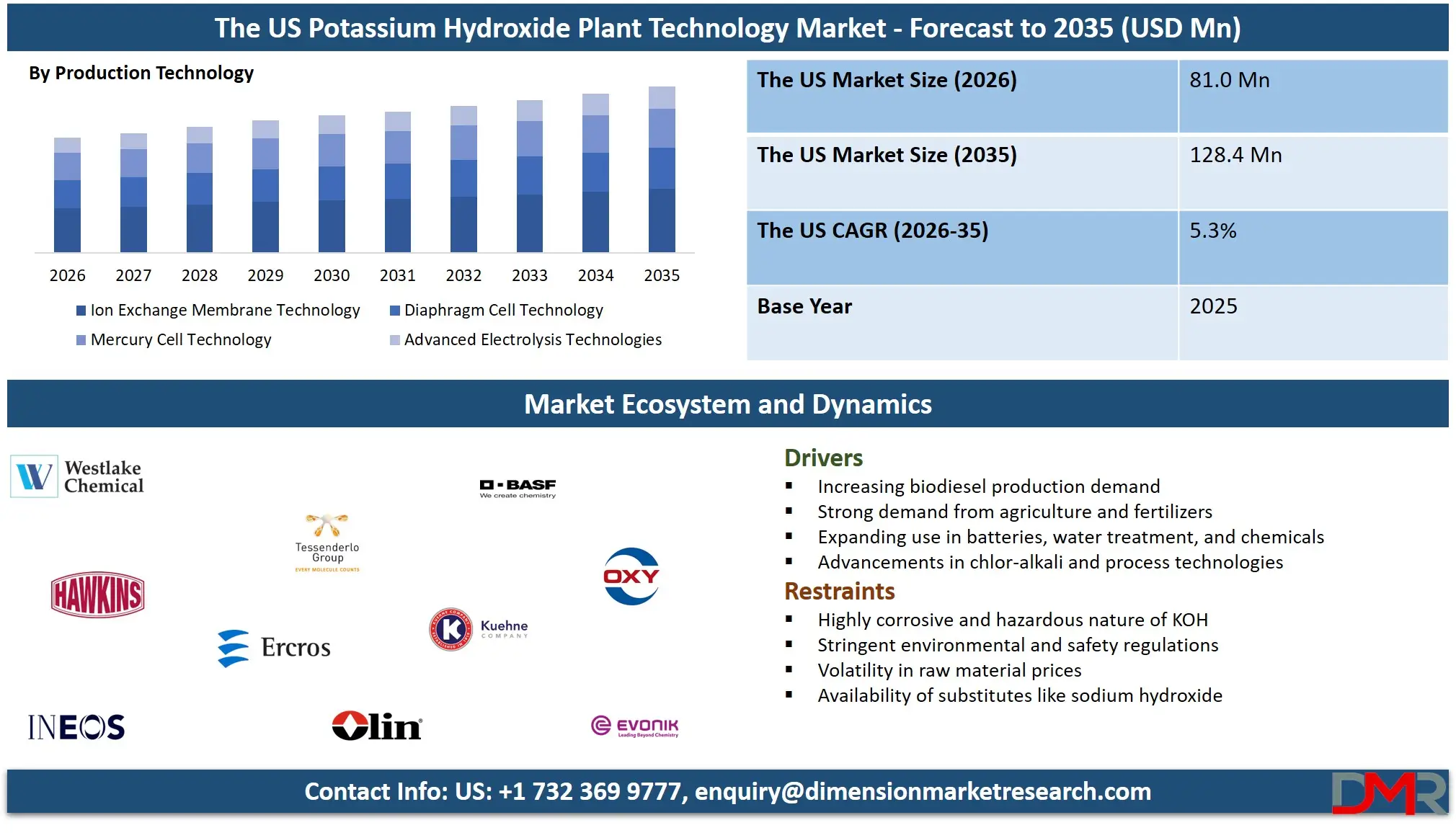
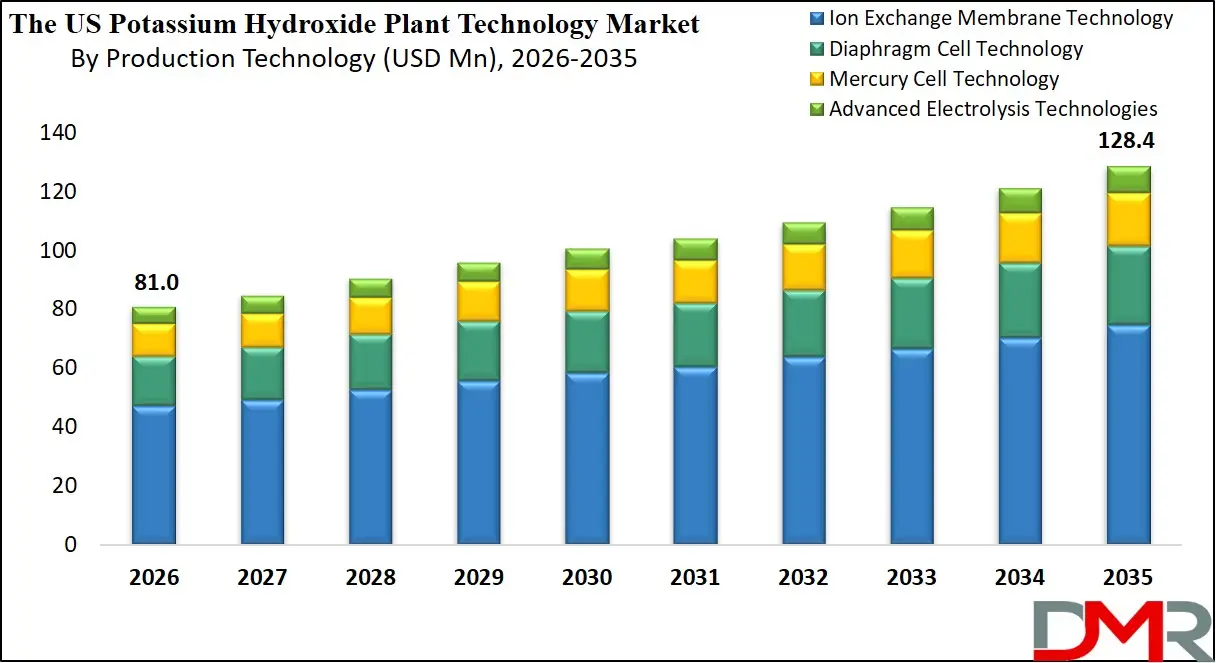
The US Potassium Hydroxide Plant Technology Market size is projected to reach USD 81.0 million in 2026 and grow at a compound annual growth rate of 5.3% to reach a value of USD 128.4 million in 2035.
ℹ
To learn more about this report –
Download Your Free Sample Report Here
Potassium hydroxide manufacturing technology denotes the various methodologies and equipment employed for the manufacture of potassium hydroxide (KOH). Potassium hydroxide manufacturing technology involves the use of membrane cell electrolysis, diaphragm cell electrolysis, and other forms of improved electrolysis techniques that boost performance and minimize the negative environmental effects.
Potassium hydroxide manufacturing technology is essential in various industries such as the chemical manufacturing industry, agriculture sector, and energy storage industry. Rising demand for chemicals with superior purity levels and environmental objectives and developments in electrochemical technology are propelling innovations.
ℹ
To learn more about this report –
Download Your Free Sample Report Here
The US Potassium Hydroxide Plant Technology Market: Key Takeaways & Influencing Factors
- Market Growth: The US Potassium Hydroxide Plant Technology Market size is expected to grow by USD 43.6 million, at a CAGR of 5.3%, during the forecasted period of 2027 to 2035.
- By Production Technology: The ion exchange membrane technology segment is anticipated to get the majority share of the US Potassium Hydroxide Plant Technology market in 2026.
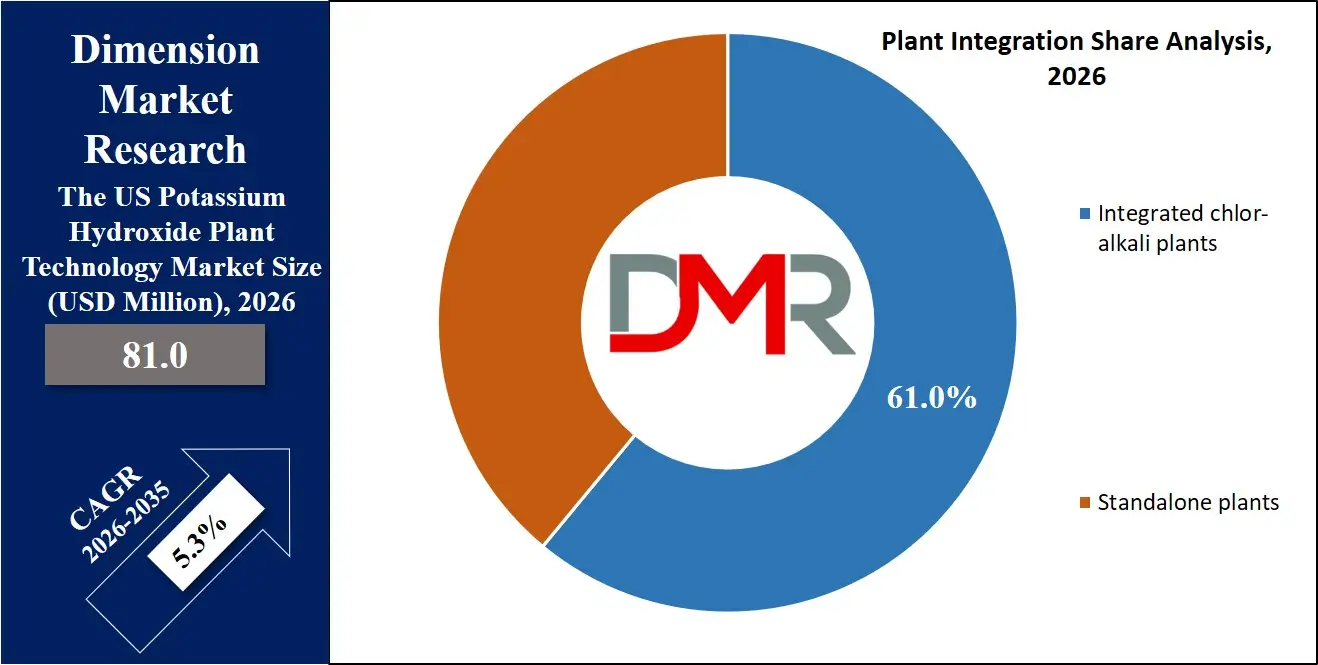
- By Plant Integration: The integrated chlor-alkali plants segment is expected to get the largest revenue share in 2026 in the US Potassium Hydroxide Plant Technology market.
- Use Cases: Some of the use cases of Potassium Hydroxide Plant Technology include agricultural applications, energy storage systems, and more.
- The U.S. Department of Energy reported in 2025 that advanced electrolysis technologies can improve energy efficiency in chemical production by up to 20% compared to conventional systems.
- The U.S. Geological Survey stated in 2024 that domestic potash consumption exceeded 6.5 million metric tons, supporting strong raw material availability for potassium hydroxide production.
- Environmental Protection Agency noted in 2026 that chlor-alkali plants adopting membrane cell technology reduced mercury emissions by over 95% compared to legacy systems.
- The U.S. Census Bureau indicated in 2025 that chemical manufacturing shipments grew by approximately 4.2% year-over-year, reflecting steady downstream demand for potassium derivatives.
The US Potassium Hydroxide Plant Technology Market: Use Cases:
- Industrial Chemical Manufacturing: Potassium hydroxide is widely used in producing soaps, detergents, and specialty chemicals. Advanced plant technologies ensure consistent quality and high output, supporting large-scale industrial operations with reduced waste and improved process efficiency.
- Agriculture Applications: It is utilized in fertilizers and soil treatment solutions to regulate pH levels. Modern production technologies enable cost-effective supply to meet the growing agricultural demand for enhanced crop yield and sustainable farming inputs.
- Energy Storage Systems: KOH serves as an electrolyte in alkaline batteries and emerging energy storage technologies. Advanced electrolysis plants help deliver high-purity grades required for efficient battery performance and longevity.
- Food & Pharmaceutical Processing: High-purity potassium hydroxide is used in food processing and pharmaceutical formulations. Specialized plant technologies ensure compliance with strict regulatory standards and contamination-free production.
Market Dynamic
Driving Factors in the US Potassium Hydroxide Plant Technology Market
Rising Demand for High-Purity Chemicals
The rise in the demand for potassium hydroxide due to its purity in the electronic industry, pharmaceuticals, and batteries is a significant factor for development. There is a need for industries to maintain a certain level of quality and purity, thus forcing them to use new techniques such as zero-gap electrolysis.
Technological Advancements in Electrolysis Systems
Ongoing innovations in electrolysis technology, such as oxygen depolarized cathodes and hybrid membranes, increase efficiency and decrease energy use. This increases competitiveness and minimizes the cost of production. Energy efficiency is now becoming a key factor for success, and therefore firms are fast moving to improve their old technology.
Restraints in the US Potassium Hydroxide Plant Technology Market
High Capital Investment Requirements
There is significant capital outlay involved in setting up or upgrading potassium hydroxide manufacturing plants, especially those that employ sophisticated electrolytic processes. Small-scale and medium-scale producers frequently suffer from capital shortages, which prevent them from embracing state-of-the-art equipment.
Regulatory and Environmental Compliance Challenges
Environmental laws that dictate how pollution should be managed through emissions controls, waste management, and proper chemical usage add more intricacies to the process. The need to be constantly updated about environmental policies and the constant use of pollution control equipment require more resources and time.
Opportunities in the US Potassium Hydroxide Plant Technology Market
Expansion in Energy Storage and Battery Applications
Renewable energy and the development of battery storage systems are booming trends. Potassium hydroxide is used in alkaline batteries, and technological innovation in plants will meet the demands that come up with the growing trend toward energy solutions. New profit sources will be available for companies producing highly pure substances.
Adoption of Sustainable and Green Technologies
There has been an increasing trend towards eco-friendly manufacturing techniques such as low carbon electrolysis. Governments have initiated several policies that can encourage organizations to invest in sustainable practices, which provide a good prospect for future growth.
Trends in the US Potassium Hydroxide Plant Technology Market
Shift Toward Membrane-Based Technologies
The use of membrane cell technology is gaining popularity since it is more efficient and has less impact on the environment. Mercury and diaphragm plants have been phasing out for some time now, as organizations try to adhere to environmental laws.
Digitalization and Process Automation
Integrating digital monitoring systems and automation in the functioning of plants helps improve efficiency and minimize downtime. The use of real-time analytics and predictive maintenance helps optimize resource utilization and costs, thereby converting conventional manufacturing to intelligent manufacturing.
Impact of Artificial Intelligence on the US Potassium Hydroxide Plant Technology Market
AI technology has made plants more efficient by offering predictive maintenance, optimization, and real-time monitoring of electrolysis processes. AI algorithms aid in reducing energy usage and increasing production consistency. The machine learning system will detect inefficiencies within the operations and recommend remedial steps to minimize downtime. AI will also ensure the quality control process by identifying any impurities or inconsistencies. Moreover, automation, driven by AI technology, ensures safer and cheaper operations.
Impact of Iran War on the US Potassium Hydroxide Plant Technology Market
Geopolitical events like the Iranian war have an effect on energy prices and transportation logistics, thus affecting the cost of manufacturing potassium hydroxide. Oil and gas price volatility affect the electricity charges that are important for the electrolysis process. Downtime in raw material supplies and machinery may cause delays in factory expansion plans. It also creates an incentive for homegrown production and technology in the American market.
Research Scope and Analysis
By Production Technology Analysis
The ion exchange membrane is predicted to be the leading market technology, having a market share of around 58% in 2026. This is attributed to the higher energy efficiency levels, lower environmental impacts, and higher purity in products that can be produced using this method. The fact that ion exchange membranes do not release any dangerous pollutants into the environment makes them more preferable compared to other methods of manufacturing. On the other hand, new electrolysis techniques like zero-gap electrolysis are anticipated to be the most promising segment due to lower energy usage.
By Plant Capacity Analysis
Larger plants, those with an output of more than 200 TPD, are expected to account for nearly 52% of the market share by 2026, owing to their advantages of large-scale production and higher capacity to fulfill industrial needs. Larger plants enjoy lower cost structures for each unit of production and are favored by leading chemical producers. On the other hand, smaller plants are growing at the fastest rate because of rising demands for small-scale production.
By Product Grade Analysis
The industrial grade potassium hydroxide is projected to dominate in terms of market share at about 49% in 2026, based on its applications in various end uses, such as chemical production, cleaning agents, and agriculture sector. The stable requirement of the product in various industries makes it feasible to produce the compound in higher quantities. Conversely, the highest growing application segment is that of high purity / electronic grade, as it is increasingly required in semiconductors and battery manufacturing.
By Plant Integration Analysis
ℹ
To learn more about this report –
Download Your Free Sample Report Here
The integrated chlor-alkali plants are going to continue being the most common at 61% due to the efficiency and economies of scale they have. Integration allows manufacturers to make use of all their resources and avoid waste. The non-integrated plants are growing in popularity due to their flexibility and low costs of starting up, which makes them suitable for startups or specific applications.
By End-Use Industry Analysis
It is estimated that chemicals will hold about 46% of the market share in 2026, owing to its wide usage of potassium hydroxide in many chemical reactions. This will ensure that there is continuous demand for it. The second largest growth rate is shown by energy and batteries due to the increase in applications of renewable energy storage. Growing concerns about energy conservation have resulted in the growing demand for potassium hydroxide in batteries.
The US Potassium Hydroxide Plant Technology Market Report is segmented on the basis of the following:
By Production Technology
- Ion Exchange Membrane Technology
- Cation Exchange Membrane (CEM)
- Anion Exchange Membrane (AEM)
- Hybrid Membrane Systems
- Diaphragm Cell Technology
- Asbestos Diaphragm
- Non-Asbestos Diaphragm
- Mercury Cell Technology
- Advanced Electrolysis Technologies
- Zero-gap Electrolysis
- Oxygen Depolarized Cathode (ODC)
By Plant Capacity
- Small Scale (<50 TPD)
- Medium Scale (50–200 TPD)
- Large Scale (>200 TPD)
By Product Grade
- Industrial Grade
- High Purity / Electronic Grade
- Food & Pharmaceutical Grade
By Plant Integration
- Standalone Plants
- Integrated Chlor-Alkali Plants
By End-Use Industry
- Chemicals
- Agriculture
- Energy & Batteries
- Food & Pharmaceuticals
- Electronics & Semiconductors
Competitive Landscape
The US Potassium Hydroxide Plant Technology Market is marked by stiff competition that is brought about by innovations and efficiency levels rather than by capacity additions alone. Businesses are concentrating their efforts on modernizing plants with electrolysis processes while engaging in significant R&D to improve efficiency and minimize emissions. It is difficult for new businesses to enter this market due to entry barriers such as capital-intensive projects.
ℹ
To learn more about this report –
Download Your Free Sample Report Here
Some of the prominent players in the US Potassium Hydroxide Plant Technology are:
- Occidental Chemical Corporation (OxyChem)
- Olin Corporation
- Westlake Corporation
- INEOS Group
- ERCO Worldwide
- Tessenderlo Group
- Hawkins Inc.
- Kuehne Company
- Hydrite Chemical Co.
- California Chemical Company
- American Elements
- Evonik Industries
- BASF SE
- Albemarle Corporation
- Arkema Group
- Ashland Inc.
- Cabot Corporation
- Univar Solutions
- ICC Chemical Corporation
- Brenntag North America
- Other Key Players
Recent Developments
- In November 2025, Freudenberg Sealing Technologies has also launched its latest LCM vulcanizing extrusion line with the use of a salt bath at temperatures ranging from about 200 degrees centigrade in a closed loop recycle system. The company’s LCM extrusion line has a length of 36 meters, out of which 19 meters is the salt bath line, which ensures that the profiles are continuously vulcanized in an oxygen-free environment with uniform heat distribution.
- In September 2025, an award worth USD 1 million has been provided by the U.S. Department of Energy, Argonne National Laboratory ReCell Center to the American Battery Technology Company for promoting the use of their lithium hydroxide technology in industrial scale operations. This collaboration will help in developing domestic critical minerals manufacturing process and long-term system modeling of their electrochemical systems. With the aid of imaging techniques available at Argonne’s Advanced Photon Source, the partnership seeks to assess the efficiency and durability of their systems.
Report Details
| Report Characteristics |
| Market Size (2026) |
USD 81.0 Mn |
| Forecast Value (2035) |
USD 128.4 Mn |
| CAGR (2026–2035) |
5.3% |
| Historical Data |
2021 – 2025 |
| Forecast Data |
2027 – 2035 |
| Base Year |
2025 |
| Estimate Year |
2026 |
| Report Coverage |
Market Revenue Estimation, Market Dynamics, Competitive Landscape, Growth Factors and etc. |
| Segments Covered |
By Production Technology (Ion Exchange Membrane Technology, Diaphragm Cell Technology, Mercury Cell Technology, Advanced Electrolysis Technologies), By Plant Capacity (Small Scale (<50 TPD), Medium Scale (50–200 TPD), Large Scale (>200 TPD)), By Product Grade (Industrial Grade, High Purity / Electronic Grade, Food & Pharmaceutical Grade), By Plant Integration (Standalone Plants, Integrated Chlor-Alkali Plants), By End-Use Industry (Chemicals, Agriculture, Energy & Batteries, Food & Pharmaceuticals, Electronics & Semiconductors) |
| Country Coverage |
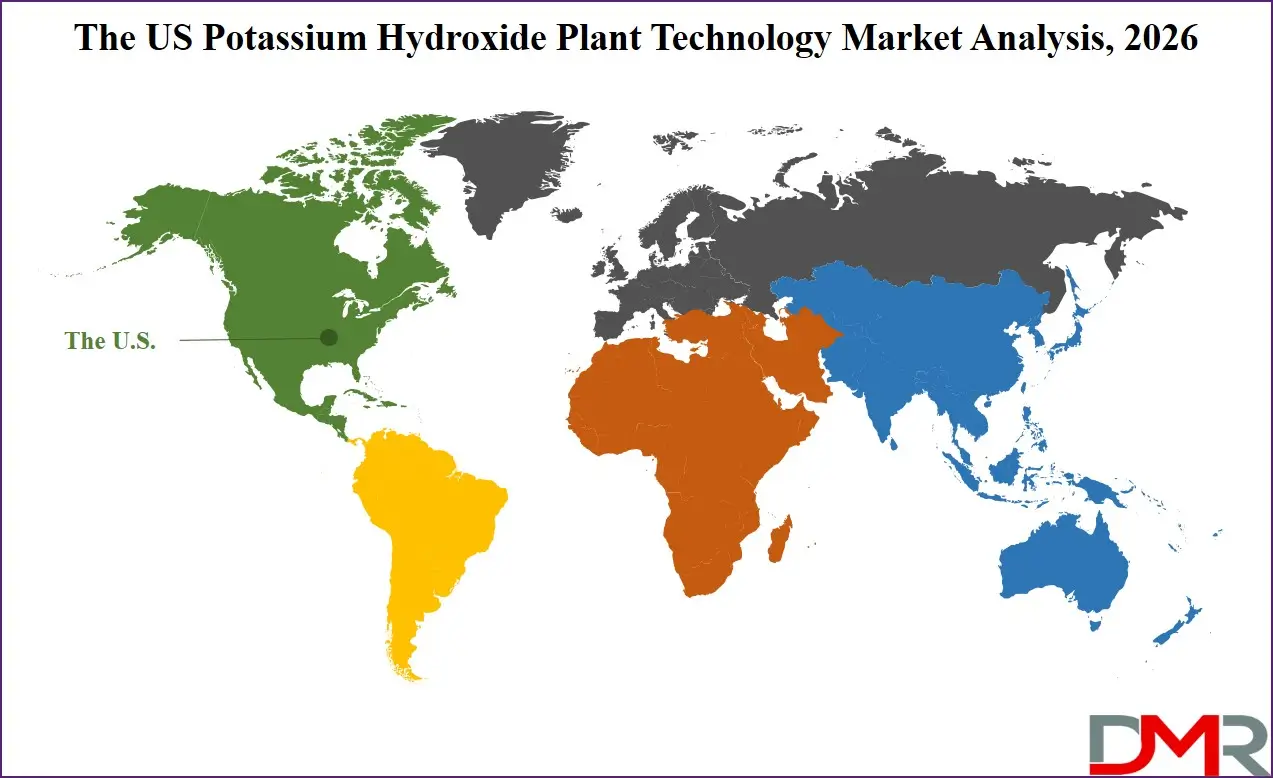
The US |
| Prominent Players |
Occidental Chemical Corporation (OxyChem), Olin Corporation, Westlake Corporation, INEOS Group, ERCO Worldwide, Tessenderlo Group, Hawkins Inc., Kuehne Company, Hydrite Chemical Co., California Chemical Company, American Elements, Evonik Industries, BASF SE, Albemarle Corporation, Arkema Group, Ashland Inc., Cabot Corporation, Univar Solutions, ICC Chemical Corporation, Brenntag North America, and Other Key Players |
| Purchase Options |
We have three licenses to opt for: Single User License (Limited to 1 user), Multi-User License (Up to 5 Users) and Corporate Use License (Unlimited User) along with free report customization equivalent to 0 analyst working days, 3 analysts working days and 5 analysts working days respectively. |
Frequently Asked Questions
How big is the US Potassium Hydroxide Plant Technology Market?
▾ The US Potassium Hydroxide Plant Technology Market size is expected to reach USD 81.0 million by 2026 and is projected to reach USD 128.4 million by the end of 2035.
Who are the key players in the US Potassium Hydroxide Plant Technology Market?
▾ Some of the major key players in the US Potassium Hydroxide Plant Technology Market include BASF, Oxychem, Olin, and others.
What is the growth rate in the US Potassium Hydroxide Plant Technology Market?
▾ The market is growing at a CAGR of 5.3 percent over the forecasted period.