Market Overview
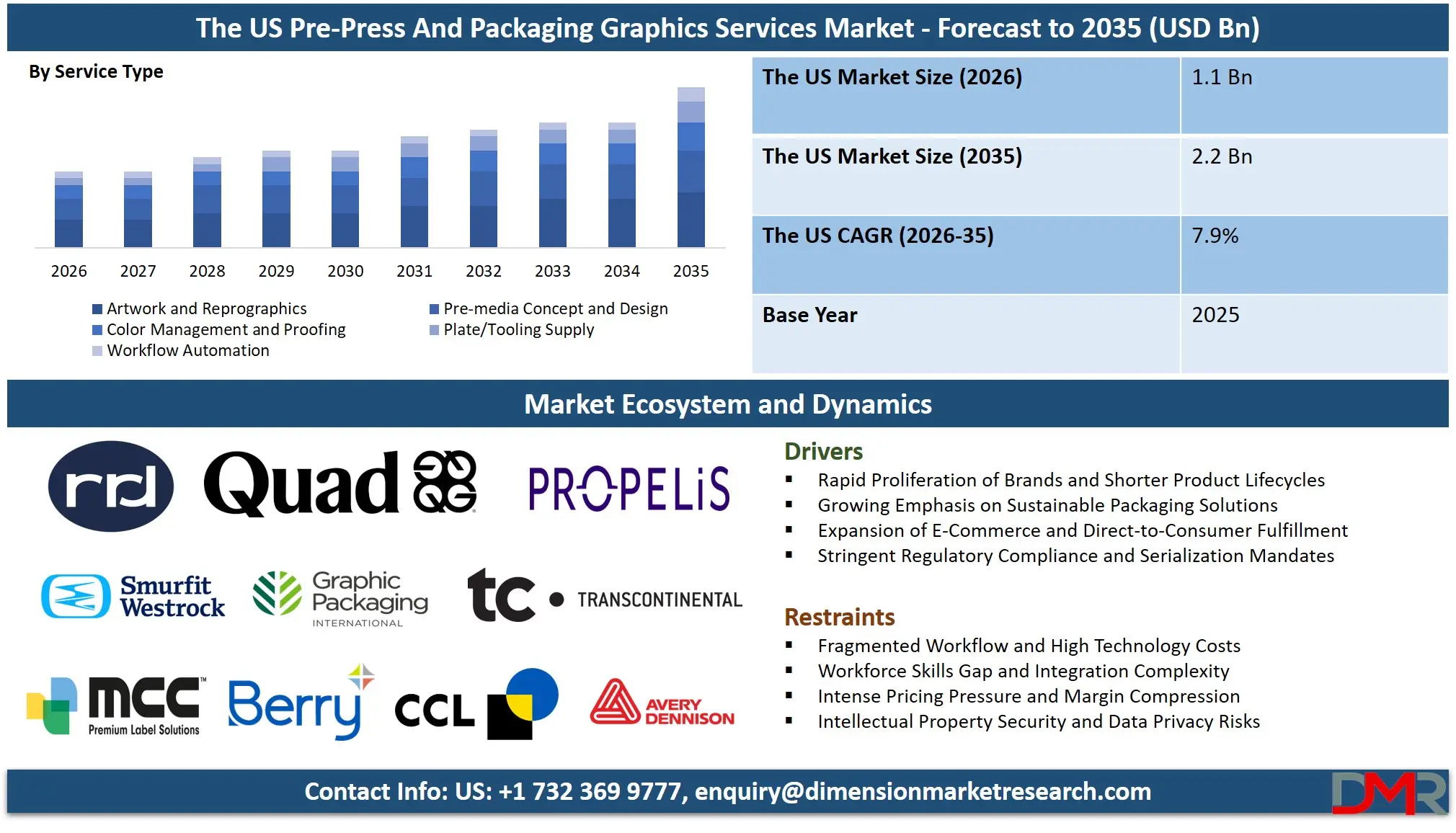
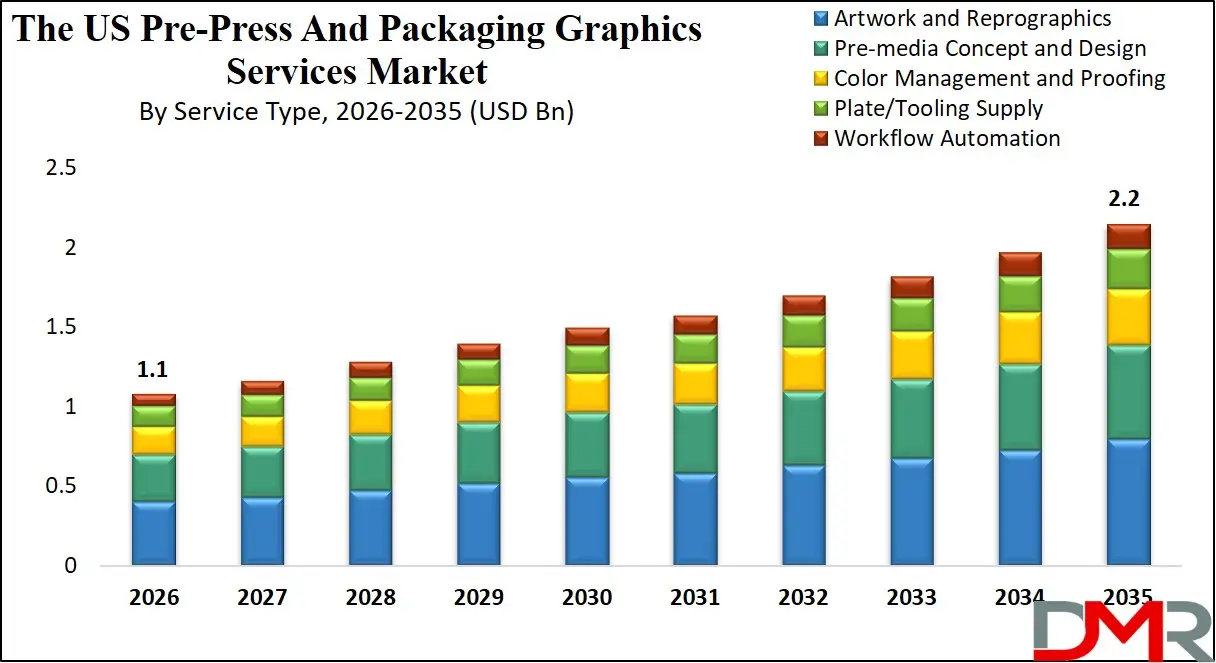
The US Pre-Press And Packaging Graphics Services Market is projected to reach USD 1.1 billion in 2026 and is expected to grow at a CAGR of 7.9% from 2026 to 2035, reaching approximately USD 2.2 billion by 2035.
ℹ
To learn more about this report –
Download Your Free Sample Report Here
The market growth is driven by the increasing complexity of brand management, rising demand for faster time-to-market for consumer packaged goods, and the accelerating shift towards sustainable and digitally printed packaging across the US. Additionally, advancements in cloud-based workflow automation, artificial intelligence-driven color management, and high-definition flexographic plate technologies are accelerating the efficiency and precision of pre-press operations, enabling printers and converters to reduce waste, minimize errors, and support the growing demand for personalized and short-run packaging.
The American packaging landscape presents unique characteristics that amplify the adoption of advanced pre-press services. The world's largest consumer market with over 330 million residents demanding visually appealing and informative packaging; a brand ecosystem that increasingly relies on packaging for product differentiation, consumer engagement, and sustainability storytelling; and a graphics industry undergoing its most significant digital transformation since the advent of desktop publishing, with pre-media houses, reprographic specialists, and integrated print service providers competing fiercely on technological capability and workflow integration.
Regulatory momentum has reached an inflection point. The introduction of extended producer responsibility (EPR) laws in key states, alongside updated Food and Drug Administration (FDA) requirements for food contact materials, represents the most consequential packaging legislation in decades, requiring enhanced material traceability, streamlined compliance documentation, and modernized artwork management systems. This regulatory landscape establishes a non-negotiable operational floor, compelling every packaging graphics service provider in America to integrate advanced color consistency, material compliance, and digital asset management capabilities as standard practice. Simultaneously, the growing focus on supply chain transparency and anti-counterfeiting measures is accelerating the adoption of serialization and track-and-trace features into packaging graphics workflows, enabling the next generation of brand protection and consumer engagement.
ℹ
To learn more about this report –
Download Your Free Sample Report Here
The competitive landscape reflects this dynamism. Traditional pre-press giants, including Matthews International, Quad, and SGK (a Matthews International company), compete alongside specialized reprographic houses and digital print innovators, while technology platforms like Esko, Hybrid Software, and Enfocus push the boundaries of automated workflow solutions. Packaging converters themselves are increasingly investing in in-house pre-press capabilities, with major players like WestRock, Amcor, and Sonoco representing strategic integration of digital asset management and platemaking infrastructure.
The US Pre-Press And Packaging Graphics Services Market: Key Takeaways
- Sustained Growth Trajectory: The US market is projected to surge from USD 1.1 billion in 2026 to USD 2.2 billion by 2035, driven by a potent mix of brand proliferation, sustainability-driven packaging redesigns, and the rapid digitalization of traditional pre-press operations.
- E-Commerce-Led Packaging Innovation: The explosion of direct-to-consumer and e-commerce retail is the single most powerful force driving demand for flexible, durable, and visually impactful packaging, requiring pre-press services to adapt designs for a 'box-in-the-mail' experience rather than solely for the retail shelf.
- The Sustainability and Regulatory Frontier: Beyond core design, the massive US consumer goods and food sectors represent a high-growth opportunity. Brand owners are rapidly adopting specialized pre-press solutions not just for visual appeal, but for tangible material compliance, substrate optimization for recyclability, and the reduction of ink and material waste through advanced color management and proofing.
- AI-Powered Workflow Automation: The market is shifting from manual, error-prone pre-press processes to predictive, automated workflows. US companies are leading the development of AI that automates artwork checking, optimizes color separations, predicts print defects, and manages digital asset libraries by analyzing historical production data and real-time press conditions.
- Infrastructure Integration with Digital Asset Management: Investments in cloud-based platforms are accelerating the deployment of centralized digital asset management (DAM) and workflow automation systems. This integration with smart factory technologies allows brand owners and converters to achieve "touchless" pre-press processing, addressing bottlenecks like artwork version control, last-minute changes, and approval delays.
Impact of the Iran conflict on the US Pre-Press And Packaging Graphics Services Market
- Exposed Critical Supply Chain Vulnerabilities: The conflict highlighted the US reliance on global supply chains for key packaging inputs, including specialized inks, photopolymer plates, and aluminum for tooling. This will drive up costs for raw materials and accelerate efforts to develop domestic sourcing and alternative material strategies.
- Accelerated Digital Workflow Security Innovation: Battlefield validation of AI-powered threat detection and advanced cybersecurity measures will directly accelerate the development of commercial applications for digital asset management, particularly for protecting high-value brand assets and sensitive pharmaceutical artwork from intellectual property theft and cyber intrusion.
- Increased Competition for Graphics Technology Talent: A surge in US defense spending on advanced manufacturing, digital security, and materials science will create a war for the same limited pool of experienced graphics technologists, color scientists, and workflow automation developers needed to manage complex pre-press operations.
- Shift in National Infrastructure Priorities: While not halting commercial packaging progress, increased federal focus and funding on defense manufacturing could represent an opportunity cost, potentially slowing investment in complementary areas like training programs for print technicians and the modernization of legacy pre-press equipment in smaller shops.
The US Pre-Press And Packaging Graphics Services Market: Use Cases
- Pharmaceutical Serialization and Brand Protection: With regulations like the Drug Supply Chain Security Act (DSCSA) mandating item-level traceability, specialized pre-press services are now engineered to integrate unique identifiers, tamper-evident features, and anti-counterfeiting elements into packaging designs, utilizing secure digital workflows and variable data printing capabilities.
- E-Commerce-Ready Packaging Design: For direct-to-consumer brands, advanced pre-media services combine structural packaging design with graphics, creating packaging that minimizes void fill, maximizes unboxing experiences, and maintains brand integrity across a variety of e-commerce fulfillment center operations, with integrated digital proofing ensuring color consistency across different print technologies.
- Sustainable Packaging Substrate Conversion: Leveraging advanced color management and proofing expertise, brand owners rely on pre-press specialists to transition packaging from conventional multi-material laminates to mono-material, recyclable structures, managing the inherent color and printability variations of new sustainable substrates to maintain brand equity.
- Short-Run and Personalized Packaging Coordination: Workflow automation and digital platemaking solutions are evolving into comprehensive platforms that use AI-driven imposition and ganging to economically produce short-run, personalized, or seasonal packaging. This allows brands to launch regional promotions, test new markets, or create customized packaging for loyalty programs without prohibitive setup costs.
- Global Artwork Management for Brand Consistency: Multinational food and beverage companies are integrating pre-press data with global digital asset management platforms. This allows for automated artwork adaptation for different languages, regulatory markets, and local print partners, triggering automated reprographics workflows and ensuring consistent brand appearance across hundreds of SKUs and print sites worldwide.
The US Pre-Press And Packaging Graphics Services Market: Stats & Facts
Printing Industries of America (PIA) – The US
- The US printing and packaging industry employs over 700,000 people across more than 25,000 establishments.
- Pre-press and prep media services account for an estimated 8-10% of total packaging production costs.
- More than USD 180 billion worth of printed packaging is produced annually in the US.
- Digitally printed packaging is projected to grow at over 15% CAGR, significantly outpacing conventional print.
- In 2025, industry data reported that over 50% of packaging converters had invested in new workflow automation software.
- By 2029, cloud-based digital asset management platforms are projected to handle over 60% of artwork version control for major brands.
- Packaging waste reduction goals are driving a 20% increase in demand for pre-press services focused on substrate optimization.
- Around 70% of all pre-press errors are attributed to late-stage artwork changes, driving adoption of automated proofing tools.
International Association of Printing House Craftsmen – Global Industry
- Digital pre-press workflows can reduce time-to-market for new packaging by up to 40%.
- The global market for flexographic platemaking is estimated to be worth over USD 2.5 billion.
- Automation in pre-press could unlock over USD 1.2 billion in value through reduced waste and improved efficiency.
- Brand-related packaging redesign cycles have increased by over 25% year-over-year since 2022.
- High-quality color management requires compliance with ISO 12647-2 printing standards.
The US Department of Commerce – International Trade Administration
- The US exported over USD 10 billion in printing and packaging-related equipment and materials annually.
- Top export markets for US-printed packaging include Canada, Mexico, and Japan.
- Trade agreements have aimed to streamline the flow of printed materials and packaging across North American borders.
The US Customs and Border Protection (CBP)
- Automated commercial environment (ACE) systems process millions of entries for imported printed packaging materials and pre-press consumables.
- Advance cargo information requirements now mandate electronic data submission for time-sensitive materials like photopolymer plates, ensuring just-in-time delivery for print runs.
The US Pre-Press And Packaging Graphics Services Market: Market Dynamic
Driving Factors in the US Pre-Press And Packaging Graphics Services Market
Rapid Proliferation of Brands and Shorter Product Lifecycles
A major growth driver in the US pre-press and packaging graphics market is the sustained expansion of consumer brands, combined with increasing expectations for faster product launches. Time-to-market of 6-12 months for new products is compressing, significantly boosting reliance on efficient pre-press services. Additionally, large retail platforms influence packaging strategies by setting strict delivery and branding benchmarks. In response, pre-press providers are enhancing their capabilities through integrated digital asset management, automated artwork approval, and streamlined color management to efficiently manage rising volumes of new and revised packaging designs.
Growing Emphasis on Sustainable Packaging Solutions
Pre-press services are increasingly being used as a strategic tool for achieving sustainability goals in the US. What was once a secondary consideration is now a primary driver for material selection, ink reduction, and design optimization. Lessons learned from material shortages have strengthened corporate focus on resource efficiency, leading to greater willingness to invest in advanced pre-press technologies like virtual proofing and automated imposition to minimize waste. This shift is accelerating the adoption of tools for substrate analysis, eco-friendly plate technologies, and optimized color separations, enabling more sustainable and cost-effective packaging production.
Restraints in the US Pre-Press And Packaging Graphics Services Market
Fragmented Workflow and High Technology Costs
Despite improvements in cloud-based collaboration, the pre-press workflow remains inherently fragmented, especially involving multiple brand owners, agencies, and print providers. This fragmentation leads to significant inefficiencies, version control errors, and approval delays. As a result, businesses, particularly small to mid-sized converters, face challenges in integrating automated pre-press systems. The issue is more pronounced for complex projects like flexible packaging or custom rigid boxes, where multiple stakeholders and disparate file formats can impact project timelines and quality.
Workforce Skills Gap and Integration Complexity
The increasing sophistication of pre-press software and workflow automation is placing growing pressure on the availability of skilled graphic technicians and color scientists across the US. Even minor skill gaps at a design or pre-press house can lead to production delays and increased costs. Labor shortages in specialized areas like reprographics, color management, and platemaking further contribute to inefficiencies. Additionally, the lack of standardized file formats, color profiles, and digital asset management protocols across different brand owners and print sites adds complexity, requiring pre-press specialists to adapt to a wide range of client requirements and increasing the need for buffer time in project schedules.
Opportunities in the US Pre-Press And Packaging Graphics Services Market
Expansion of Personalized and Variable Data Packaging
The US consumer goods sector presents a significant growth opportunity for pre-press service providers. The increasing demand for personalized packaging for direct mail, e-commerce, and loyalty programs is driving the need for advanced variable data printing (VDP) and workflow automation solutions. With the rise of digital printing, enabling cost-effective customization, ensuring the integrity of thousands of unique SKUs has become critical. The emergence of new marketing strategies, such as "packaging-as-a-medium," which treats packaging as a dynamic communication channel, further elevates the importance of specialized variable data capabilities. Failure to manage this complexity can result in misprints and brand inconsistency, making reliable VDP workflows a key competitive differentiator.
Adoption of AI-Driven Artwork Management and Quality Control
The integration of artificial intelligence into pre-press operations is transforming the packaging graphics landscape in the US. Advanced platforms now leverage machine learning to analyze artwork files, automate pre-flight checks, predict color output, and flag potential compliance issues proactively. These systems enable pre-press providers to move beyond basic file preparation toward predictive quality assurance. By identifying potential printing or regulatory issues in the design phase, companies can take corrective actions, reducing waste and improving overall efficiency. Enhanced visibility platforms are also enabling more accurate production timeline predictions and proactive exception handling.
Trends in the US Pre-Press And Packaging Graphics Services Market
Shift Toward Cloud-Based Digital Asset Management
The industry is undergoing a significant transition from local file servers to cloud-based digital asset management (DAM) platforms that allow centralized storage, version control, and real-time collaboration. Modern pre-press solutions integrate brand guidelines, artwork files, and production data into centralized digital systems, enabling faster and more transparent approval processes. This shift toward digitalization enhances operational efficiency, reduces administrative overhead, and improves customer experience through instant access to current artwork and streamlined proofing workflows.
Rising Adoption of Automation and AI in Workflow
Automation is becoming a key focus area in the US pre-press and packaging graphics market, with increasing adoption of automated pre-flight, proofing, and platemaking technologies. Companies are incorporating automation strategies, including rule-based workflow engines and AI-assisted error detection, to meet productivity goals and customer demands for shorter lead times. Industry initiatives aligned with the broader "Industry 4.0" movement are accelerating the transition toward connected, data-driven pre-press operations. Major converters are also investing in integrated, end-to-end workflow platforms, supporting the broader shift toward the smart factory.
The US Pre-Press And Packaging Graphics Services Market: Research Scope and Analysis
By Service Type Analysis
In the US pre-press and packaging graphics market, Pre-media Concept and Design services currently represent the foundational segment. Among these, structural design and graphic concept creation are the most significant categories due to the sheer volume of new product launches and brand refresh projects moving through creative and marketing pipelines. As e-commerce and sustainability drive demand for innovative packaging, concept and design remain the starting point of the packaging value chain.
However, the fastest-growing segment is Artwork and Reprographics. These services require specialized skills for file preparation, color separation, and proofing that differentiate them from initial concept work. Pre-press houses are developing dedicated reprographics divisions as a requirement for serving high-volume consumer goods sectors such as food and beverage. Beyond simple file preparation, next-generation reprographics capabilities are evolving to include automated pre-flight, brand asset management, and version control for hundreds of SKUs using cloud-based platforms, which can provide end-to-end workflow visibility for brand owners and converters.
Color Management and Proofing is also a widely used service, increasingly requiring digital proofing and remote approval solutions to speed time-to-market. These services help ensure brand color consistency across different print technologies and substrates.
Another important service category is Plate/Tooling Supply, which includes the production of flexographic plates, gravure cylinders, and digital printing masters. This segment requires strict quality control, specialized imaging equipment, and certified materials to ensure print fidelity and pressroom efficiency. Advanced handling protocols such as automated plate exposure and washout systems are gaining importance in high-volume packaging segments, improving consistency and operational speed. Overall, service innovation in the pre-press market is increasingly focused on combining workflow speed, error reduction, and end-to-end digital integration.
By Printing Technology Analysis
The technology landscape of pre-press services in the US is built primarily on Flexography, which represents the majority of volume and revenue for most packaging applications. Flexographic printing connects consumer goods companies with high-speed production of labels, flexible packaging, and corrugated containers, forming the foundation of the high-volume packaging supply chain.
A key emerging trend is the rapid growth of Digital Printing, an advanced production method connecting brand owners with opportunities for short runs, versioning, and personalization. Unlike traditional long-run technologies, digital print offers minimal setup costs, fast turnaround, and variable data capabilities, improving agility for time-sensitive promotional packaging and e-commerce applications. This additional capability improves the responsiveness of brand owners serving dynamic consumer markets.
The next major technology category is Offset Lithography, particularly for folding cartons and high-end labels requiring superior image quality. Offset printing combines consistent color reproduction with broad substrate versatility to serve premium packaging requirements. Leading print service providers are investing heavily in hybrid presses and automated color control systems to process this growing volume. The industry's competitive focus is increasingly shifting from pure print speed to overall workflow integration and quality consistency.
One emerging approach is the hybrid press strategy, which synchronizes conventional printing units with digital inkjet modules to enable cost-effective personalization on long runs. In contrast, trade shops prefer integrated workflow strategies, using automated pre-press to manage files across multiple printing platforms for efficiency.
Another important technology trend is the maturation of Flexography with advanced plate technologies, including flat-top dots and high-definition screening, which allow flexo to compete with gravure and offset in print quality for high-end applications. Additionally, block plate agreements allow packaging converters to secure consistent pricing and quality from pre-press suppliers for high-demand packaging projects.
By End-user Industry Analysis
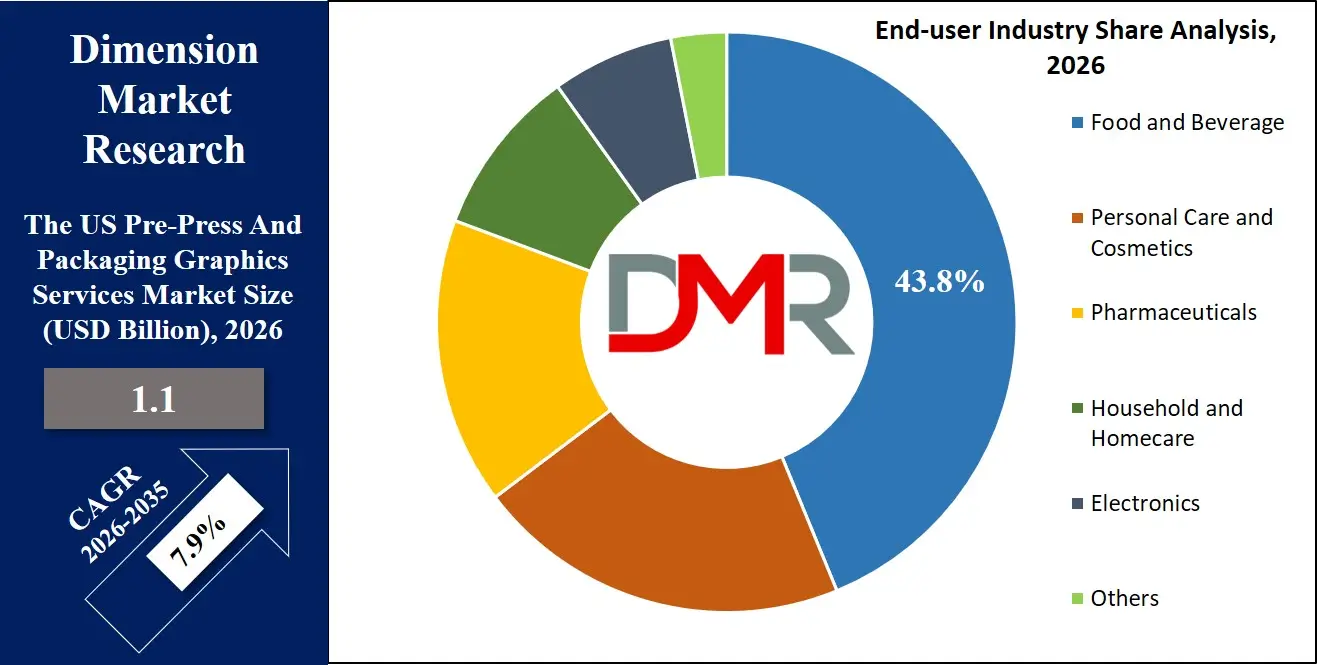
In the US pre-press and packaging graphics market, the Food and Beverage industry represents a primary end-user segment for these services. Major food manufacturers define brand identity standards and collaborate closely with pre-press specialists to integrate packaging graphics into their production networks. Pre-press houses play a critical role in developing specialized color management protocols, regulatory compliance checks, and digital asset libraries for everything from frozen food boxes to beverage labels.
Packaging decisions for food and beverage are heavily influenced by shelf appeal, brand recognition, and regulatory requirements for nutritional labeling. Achieving consistent brand color and imagery from the design file to the retail shelf is an important competitive factor for food brands, encouraging them to adopt increasingly sophisticated pre-press solutions.
ℹ
To learn more about this report –
Download Your Free Sample Report Here
The second major end-user group consists of Pharmaceuticals, including prescription drugs, over-the-counter medications, and medical device packaging. Unlike general consumer goods, pharmaceuticals approach packaging from a patient safety and regulatory compliance perspective. They evaluate pre-press providers based on serialization capabilities, anti-counterfeiting features, and auditable workflow processes. As a result, pharmaceutical companies often actively audit and qualify pre-press partners through formal supplier approval programs.
The Personal Care and Cosmetics sector utilizes pre-press services extensively for high-value, high-impact packaging that drives consumer purchase decisions. Although Household and Homecare, Electronics, and other industries also utilize these services, their packaging profiles differ significantly from food and pharmaceutical applications. Personal care shipments, such as premium cartons and intricate labels, operate under brand-critical frameworks with specialized finishing and embellishment requirements.
Despite smaller individual shipment volumes, these industries influence pre-press innovation by introducing advanced requirements such as custom spot colors, metallic effects, and security printing, which are increasingly being adapted for broader commercial applications.
The US Pre-Press And Packaging Graphics Services Market Report is segmented on the basis of the following:
By Service Type
- Pre-media Concept and Design
- Artwork and Reprographics
- Color Management and Proofing
- Plate/Tooling Supply
- Workflow Automation
By Printing Technology
- Flexography
- Gravure
- Offset Lithography
- Digital Printing
- Screen Printing
- Others
By End-user Industry
- Food and Beverage
- Personal Care and Cosmetics
- Pharmaceuticals
- Household and Homecare
- Electronics
- Others
Impact of Artificial Intelligence in the US Pre-Press And Packaging Graphics Services Market
- Deep Learning for Artwork Pre-flight: AI, particularly machine learning algorithms, is used to automatically detect errors in artwork files, enabling pre-press houses to reduce manual checking, minimize waste, and improve turnaround times across thousands of packaging SKUs.
- Predictive Color Management: AI algorithms analyze substrate characteristics, ink properties, and historical print data to predict optimal color separations, enabling more accurate first-time color matching and reducing press-side adjustments.
- Intelligent Asset Management: AI acts as the "digital librarian" that manages millions of digital assets in real-time, automatically tagging, versioning, and routing artwork files for approval and production without human intervention.
- Edge AI for Platemaking Automation: Advanced imaging and robotics systems perform real-time exposure and processing decisions, allowing pre-press providers to produce plates with greater speed and consistency.
- Fleet Learning (The Digital Twin Model): Pre-press providers use anonymized operational data from their entire network of clients and print sites to continuously train and improve their central workflow models. When one design team encounters a novel pre-press issue, the learning can be applied network-wide to prevent similar problems.
- Customer Experience & Personalization: AI analyzes brand owner behavior, packaging format preferences, and historical approval patterns to personalize workflow recommendations, automate routine status updates, and provide proactive project alerts tailored to individual client requirements.
The US Pre-Press And Packaging Graphics Services Market: Competitive Landscape
The US pre-press and packaging graphics market is a highly dynamic and moderately consolidated competitive landscape characterized by the presence of global pre-media multinationals, integrated packaging converters, digital workflow platforms, and specialized niche service providers. Leading global pre-press specialists such as Matthews International (SGK), Quad, and Multi-Color Corporation maintain strong market positions by supplying integrated, end-to-end artwork management and plate production solutions to major US consumer goods companies and pharmaceutical manufacturers operating in the US. Alongside these specialists, integrated packaging converters are becoming increasingly influential in shaping service expectations. Companies such as WestRock, Amcor, and Sonoco provide the in-house pre-press and platemaking capabilities that power modern, high-volume packaging supply chains.
ℹ
To learn more about this report –
Download Your Free Sample Report Here
In addition, digital workflow platforms such as Esko, Hybrid Software, and Enfocus play a key role in developing the software tools for automation and collaboration. The US also hosts leading software innovators including Artwork Systems and Color-Logic, which are focused on improving workflow efficiency while reducing integration complexity. At the same time, specialty trade shops are pursuing vertical integration strategies through digital printing investments and value-added design services, strengthening their competitive position in the packaging graphics value chain.
Some of the prominent players in the US Pre-Press And Packaging Graphics Services Market are:
- RR Donnelley
- Quad/Graphics Inc.
- Propelis Group
- Sonoco-Trident
- Esko-Graphics
- Smurfit Westrock
- Graphic Packaging International
- Avery Dennison Corporation
- Multi-Color Corporation
- TC Transcontinental Inc.
- CCL Industries Inc.
- Anderson & Vreeland
- Fortis Solutions Group
- Printpack Inc.
- Berry Global Inc.
- International Paper Company
- Amcor plc
- Cimpress Plc
- Labeltronix
- Diamond Packaging
- Other Key Players
Recent Developments in the US Pre-Press And Packaging Graphics Services Market
- March 2026: Smurfit WestRock was named ‘Supplier of the Year’ by Haleon and continued expanding its global footprint, including operational growth initiatives such as expansion in Ecuador, reflecting ongoing strengthening of its packaging solutions network.
- January 2026: Avery Dennison continued advancing retail and packaging innovation initiatives, highlighting the role of RFID and connected product solutions in improving operational efficiency and consumer engagement.
- November 2025: Amcor launched the Lift-Off Winter 2025/26 Challenge, an open innovation program inviting startups to collaborate on developing sustainable packaging solutions across flexible and paper-based packaging formats.
- October 2025: CCL Industries announced continued expansion of its global labeling operations through strategic investments and acquisitions, strengthening its capabilities in pressure-sensitive labels and specialty packaging solutions across key end-use industries.
- August 2025: Graphic Packaging International advanced its portfolio of recyclable and fiber-based packaging solutions, focusing on replacing plastic in food and beverage applications while enhancing sustainability and production efficiency.
Report Details
| Report Characteristics |
| Market Size (2026) |
USD 1.1 Bn |
| Forecast Value (2035) |
USD 2.2 Bn |
| CAGR (2026–2035) |
7.9% |
| Historical Data |
2021 – 2025 |
| Forecast Data |
2027 – 2035 |
| Base Year |
2025 |
| Estimate Year |
2026 |
| Report Coverage |
Market Revenue Estimation, Market Dynamics, Competitive Landscape, Growth Factors and etc. |
| Segments Covered |
By Service Type (Pre-media Concept and Design, Artwork and Reprographics, Color Management and Proofing, Plate/Tooling Supply, and Workflow Automation), By Printing Technology (Flexography, Gravure, Offset Lithography, Digital Printing, Screen Printing, and Others), By End-user Industry (Food and Beverage, Personal Care and Cosmetics, Pharmaceuticals, Household and Homecare, Electronics, and Others) |
| Country Coverage |
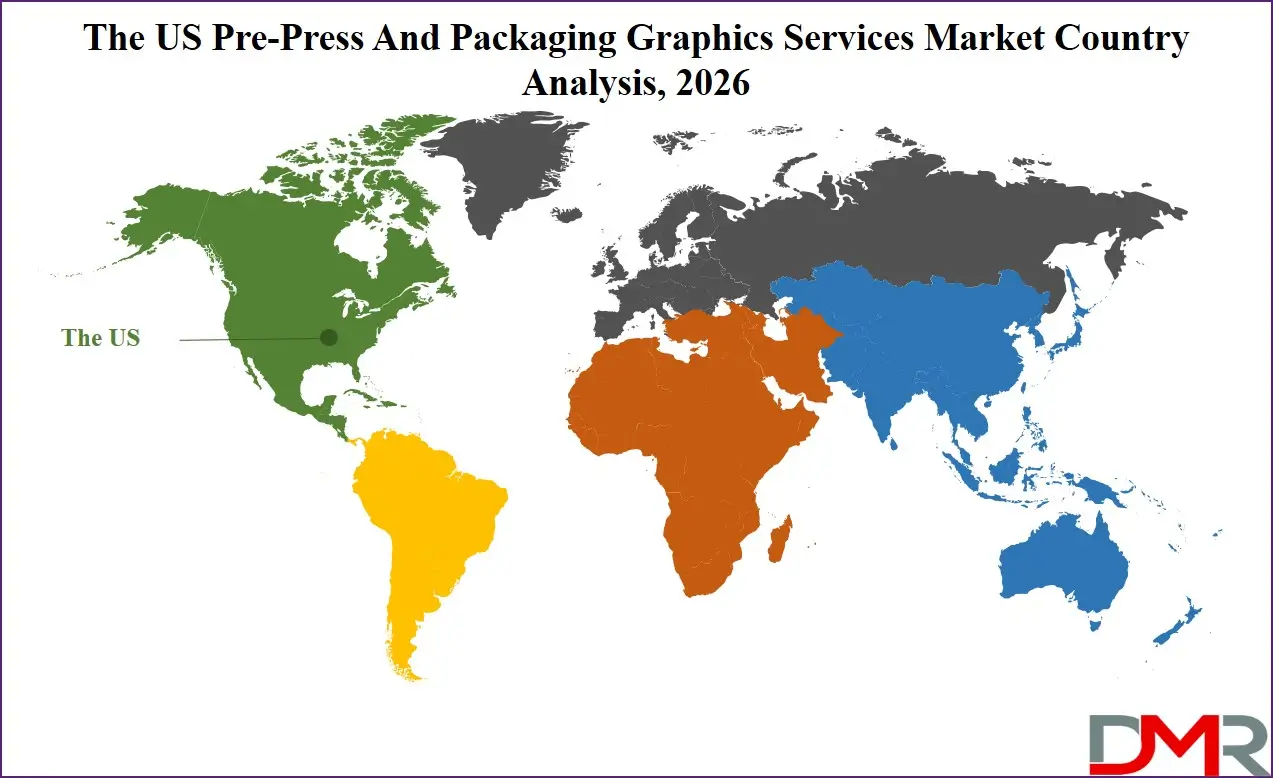
The US |
| Prominent Players |
RR Donnelley, Quad/Graphics Inc., Propelis Group, Sonoco-Trident, Esko-Graphics, Smurfit Westrock, Graphic Packaging International, Avery Dennison Corporation, Multi-Color Corporation, TC Transcontinental Inc., CCL Industries Inc., Anderson & Vreeland, Fortis Solutions Group, Printpack Inc., Berry Global Inc., International Paper Company, Amcor plc, Cimpress Plc, Labeltronix, and Diamond Packaging, and Other Key Players |
| Purchase Options |
We have three licenses to opt for: Single User License (Limited to 1 user), Multi-User License (Up to 5 Users) and Corporate Use License (Unlimited User) along with free report customization equivalent to 0 analyst working days, 3 analysts working days and 5 analysts working days respectively. |
Frequently Asked Questions
How big is the US Pre-Press And Packaging Graphics Services Market?
▾ The US Pre-Press And Packaging Graphics Services Market is valued at USD 1.1 billion in 2026 and is projected to reach USD 2.2 billion by the end of 2035.
What is the growth rate for the US Pre-Press And Packaging Graphics Services Market?
▾ The market is growing at a robust compound annual growth rate (CAGR) of 7.9% over the forecast period of 2026 to 2035.
Who are the key players in the US Pre-Press And Packaging Graphics Services Market?
▾ Some of the major key players in the US Pre-Press And Packaging Graphics Services Market are RR Donnelley, Quad/Graphics Inc., Propelis Group, Sonoco-Trident, Esko-Graphics, Smurfit Westrock, and many others.