US Quality Management Software Market Snapshot
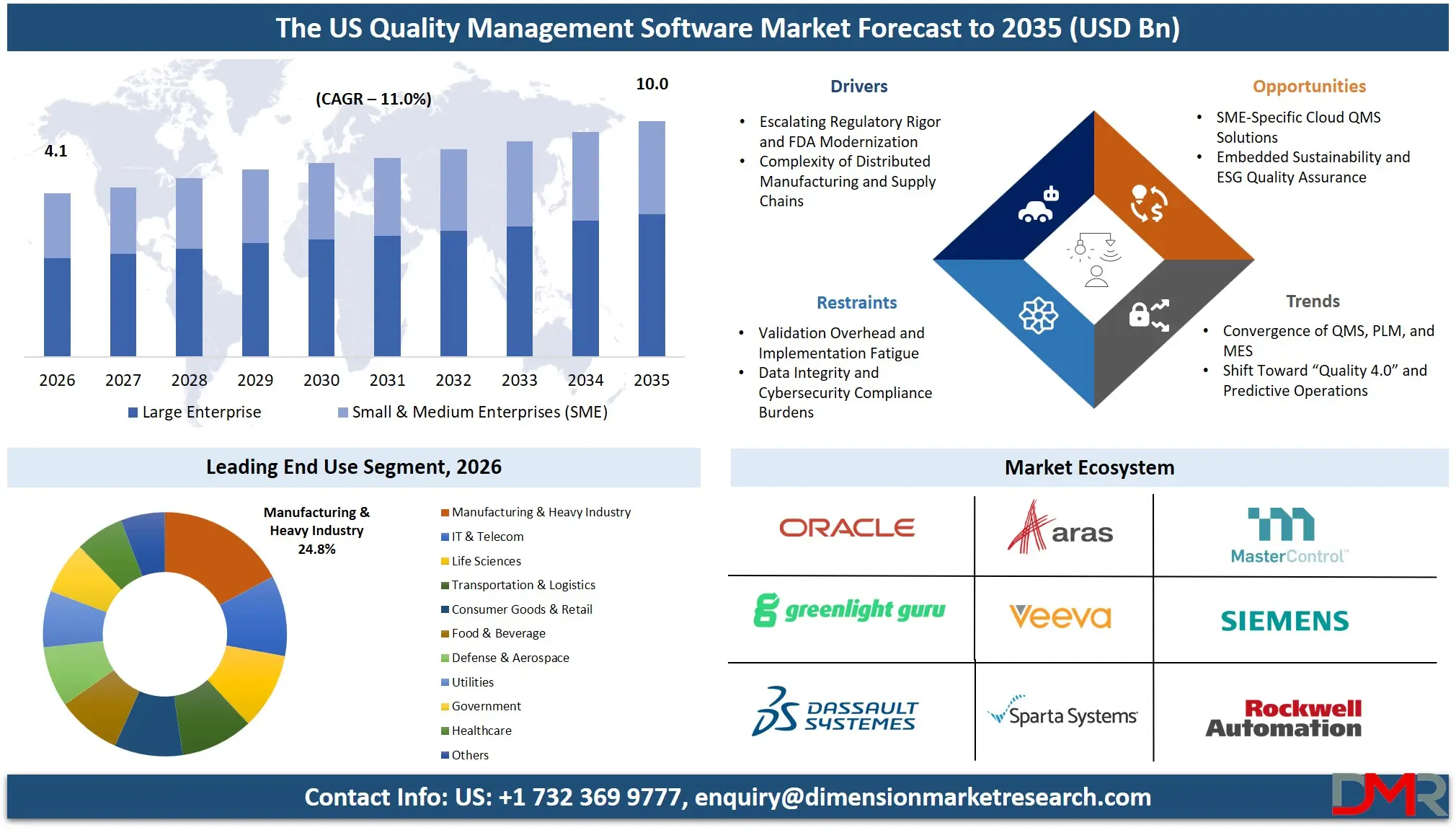
- The US Quality Management Software Market Size in 2026: USD 4.1 Billion
- The US Quality Management Software Market Size in 2035: USD 10.0 Billion
- The US CAGR from 2026 to 2035: 11.0%
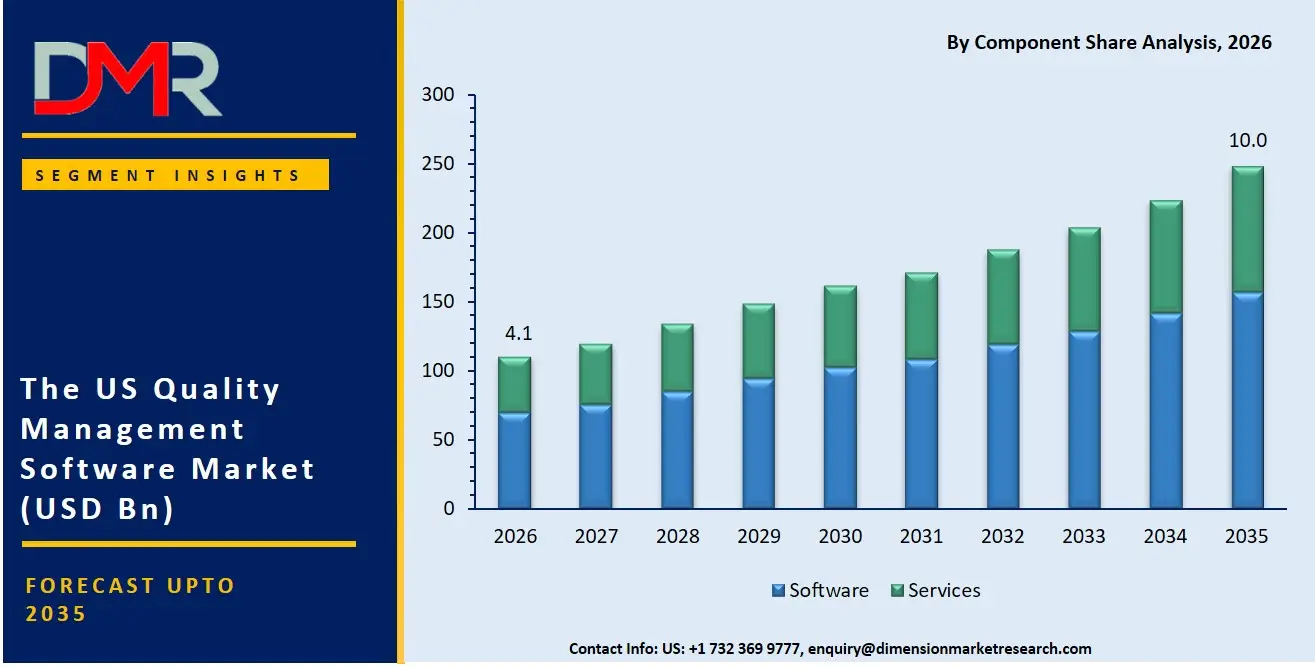
- Software is the leading component segment in 2026: 68.4%
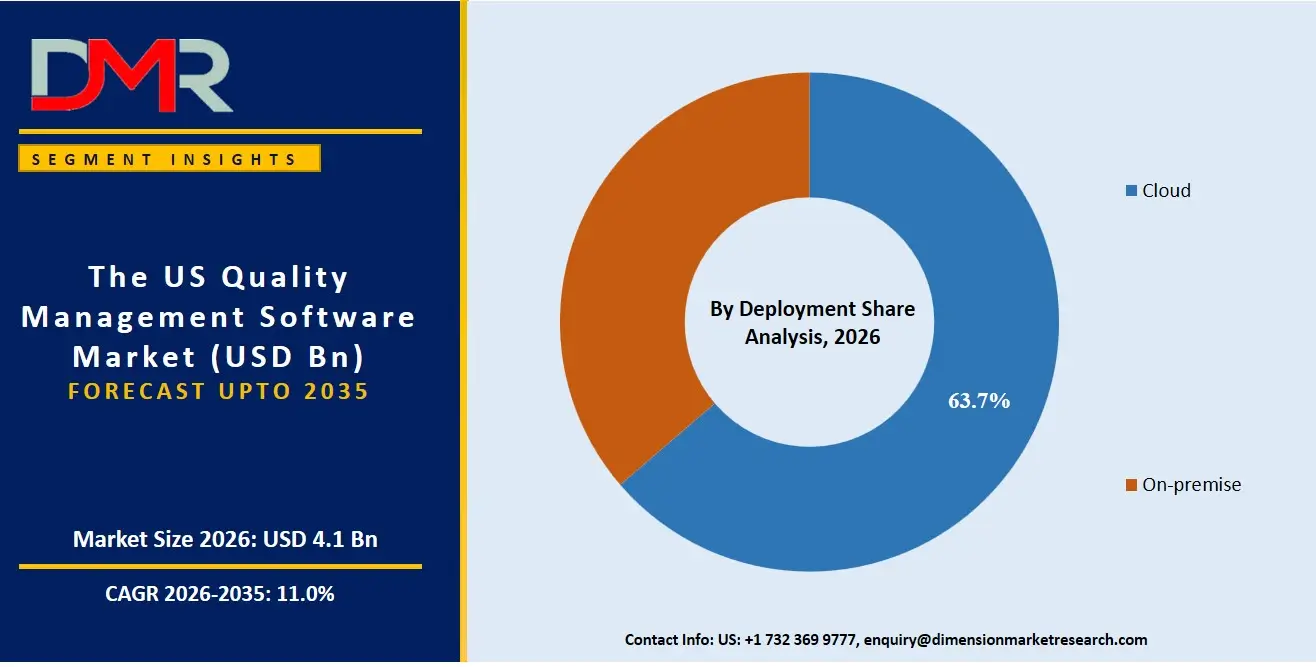
- Cloud is the leading deployment segment in 2026: 63.7%
- Large Enterprise is the leading enterprise size segment in 2026: 67.5%
- Complaint Handling/Management is the leading solution segment in 2026: 16.1%
What is the US Quality Management Software Market and its Market Size?
Quality Management Software (QMS) in the United States is a formalized digital ecosystem that standardizes, automates, and centralizes quality processes, documentation, and compliance evidence across the product and service lifecycle. It provides an authoritative system of record by connecting document control, corrective and preventive actions (CAPA), audit findings, training records, supplier performance data, and customer complaints. Life sciences, manufacturing, healthcare, food and beverage, and defense organizations use QMS to enforce regulatory standards, mitigate operational risk, and drive continuous improvement. The technology supports 21 CFR Part 11 compliance, ISO 9001/13485/AS9100 alignment, hazard analysis, and closed-loop issue resolution, ensuring product safety and organizational accountability.
ℹ
To learn more about this report –
Download Your Free Sample Report Here
The US Quality Management Software Market is projected to be valued at USD 4.1 billion in 2026 and is projected to reach USD 10.0 billion by 2035, expanding at a CAGR of 11.0% during the forecast period. Growth is being fueled by tightening FDA oversight, an increasingly complex global supply base, the shift toward cloud-based quality ecosystems, and the convergence of quality data with enterprise systems like Enterprise Resource Planning (ERP) and Product Lifecycle Management (PLM). Enterprises are investing in connected quality data to manage advanced product quality planning (APQP), supplier corrective actions, employee competency, environmental monitoring, and evolving ESG mandates. Artificial intelligence, predictive quality analytics, and mobile incident reporting are further elevating the strategic role of QMS as the digital backbone of corporate governance in the US.
Use Cases
- Document Control & Regulatory Compliance: US organizations use QMS platforms to manage standard operating procedures, work instructions, and quality manuals with strict version control, e-signatures, and audit trails. A centralized repository eliminates data silos, ensures employees always access current documents, and provides demonstrable evidence of conformance during FDA inspections or ISO surveillance audits.
- CAPA & Non-Conformance Management: QMS software orchestrates the investigation of deviations, out-of-specification results, and customer complaints. Automated workflows route root cause analyses and action plans to relevant departments, track effectiveness checks, and link CAPA records directly to affected quality events.
- Supplier Quality & Risk Management: Enterprises leverage QMS to qualify vendors, monitor supplier scorecards, process production part approval submissions, and manage supply chain corrective actions. By linking supplier ratings with non-conformance data, US manufacturers can proactively mitigate supply chain disruptions and ensure incoming material quality.
- Audit Management & Training: QMS platforms digitize internal and external audit schedules, checklists, and findings management. Simultaneously, they map employee training matrices to document control revisions, automatically triggering retraining when procedures change. This integration ensures a competent, inspection-ready workforce and closes the loop on audit observations.
Key Takeaways
- Market Size: The US Quality Management Software Market is anticipated to be valued at USD 4.1 billion in 2026 and is forecast to reach USD 10.0 billion by 2035, expanding at a CAGR of 11.0%.
- Growth Outlook: Market expansion is underpinned by cloud-native architectures, AI-driven quality intelligence, digital twin integration for process validation, and the harmonization of quality data across health authority submissions, manufacturing execution, and supplier networks.
- Primary Growth Drivers: Heightened FDA scrutiny, complex electromechanical and software-defined products, globalized pharmacovigilance requirements, mass customization in manufacturing, and the need for integrated risk management are accelerating QMS investment.
- By Component Analysis: Software is projected to lead the component segment with a 68.4% share in 2026, propelled by demand for integrated Enterprise QMS platforms that unify quality, ERP, PLM, and manufacturing data. Services are expected to hold the second-largest share of 31.6% and record the highest CAGR of 11.8% as US organizations require implementation, integration, validation, migration, consulting, training, and maintenance support.
- By Deployment Analysis: Cloud is expected to dominate deployment with a 63.7% share in 2026 and register the highest CAGR of 12.1% through 2035, driven by scalability, validated environments, remote accessibility, automated updates, and lower infrastructure requirements. On-premise deployment is projected to hold the second-largest share of 36.3%, supported by security-sensitive and highly customized installations.
- By Enterprise Size Analysis: Large Enterprise is projected to dominate with a 67.5% share in 2026 because multi-site organizations require standardized quality workflows, extensive integration, supplier governance, and enterprise compliance traceability. Small & Medium Enterprises are expected to hold the second-largest share of 32.5% and record the highest CAGR of 12.2% as modular cloud QMS platforms reduce cost and implementation barriers.
- By Solution Analysis: Complaint Handling/Management is anticipated to lead with a 16.1% share in 2026 because it connects customer feedback, product investigations, regulatory reporting, and corrective actions. Document Control is projected to hold the second-largest share of 14.6%, while Supplier Quality Management is expected to record the highest CAGR of 12.5% through 2035.
- By End Use Analysis: Manufacturing & Heavy Industry is projected to lead with a 24.8% share in 2026 due to extensive requirements for inspections, nonconformance control, supplier quality, calibration, CAPA, and operational analytics. Life Sciences is expected to hold the second-largest share of 20.7%, while Healthcare is projected to record the highest CAGR of 12.3% through 2035.
How AI/Gen AI is Transforming the US Quality Management Software Market?
Artificial intelligence is transforming QMS by converting unstructured quality event data into predictive operational intelligence. Machine learning algorithms can classify complaint patterns, predict batch failures, identify duplicate CAPAs, and optimize supplier selection based on historical quality performance. Generative AI assistants allow quality engineers to query standard operating procedures, summarize audit findings, draft technical investigation reports, and translate regulatory requirements into actionable checklists through natural language. Grounded in controlled QMS data, these capabilities accelerate deviation closure while reinforcing data integrity and regulatory defensibility.
The next frontier is agentic AI workflows that orchestrate real-time corrections across manufacturing, supplier portals, and pharmacovigilance databases. AI-assisted triage of incoming complaints, automated change impact assessments, and predictive equipment calibration alerts can dramatically reduce quality cycle times. However, US firms must navigate FDA's evolving guidance on AI/ML in medical device and drug manufacturing software, ensuring algorithmic transparency, model explainability, and rigorous validation. Consequently, QMS providers are embedding governed AI models directly within validated quality platforms to maintain a strict chain of custody on compliance decisions.
Market Dynamics
Key Drivers in The US Quality Management Software Market
Escalating Regulatory Rigor and FDA Modernization
The FDA's shift toward the Quality Management System Regulation (QMSR) harmonized with ISO 13485, coupled with ongoing Computer Software Assurance (CSA) guidance, is compelling device manufacturers to overhaul traditional validation and documentation approaches. Life sciences firms require centralized, automated QMS platforms to manage design controls, risk files, and post-market surveillance in real time. This regulatory modernization, combined with unannounced inspections and increased enforcement in food safety (FSMA), makes a robust, traceable digital quality system indispensable for market access and brand protection.
Complexity of Distributed Manufacturing and Supply Chains
US enterprises are managing globally dispersed suppliers and contract manufacturing organizations, making visibility into external quality processes a critical operational imperative. A modern QMS connects supplier audits directly to incoming inspection results and consumer complaint spikes. Automated supplier corrective action requests (SCARs) and real-time performance dashboards allow quality leaders to enforce standards across organizational boundaries, ensuring raw materials and outsourced services meet precise specifications before they impact production or patient safety.
Restraints in The US Quality Management Software Market
Validation Overhead and Implementation Fatigue
Transitioning from paper-based or siloed legacy systems to an enterprise QMS requires intensive process mapping, data migration, and regulatory validation (CSV/CSA). In FDA-regulated environments, every workflow configuration must be documented and tested, demanding significant cross-functional commitment. Without disciplined change management, projects can stall, leading to "validation debt" where the software is active but the compliance documentation is incomplete. This burden is a substantial barrier for small and medium-sized enterprises (SMEs) with limited quality assurance and IT headcount.
Growth Opportunities in The US Quality Management Software Market
SME-Specific Cloud QMS Solutions
A major white space exists for pre-configured, affordable cloud QMS solutions tailored to the unique needs of US SMEs in the medical device, food, and cannabis sectors. These businesses require "out-of-the-box" compliance with FDA predicate rules, ISO standards, and retailer audit requirements without the complexity of large-scale platforms. Vendors offering modular, subscription-based pricing with industry-specific best practice templates can unlock significant volume in this underserved segment, enabling smaller innovators to scale production while maintaining pristine inspection readiness.
Embedded Sustainability and ESG Quality Assurance
US corporations are increasingly linking product quality with environmental, social, and governance reporting. QMS platforms are evolving to track not only defect rates, but also waste generated through scrap and rework, environmental nonconformances, responsible sourcing performance, and social compliance findings across supplier networks. Integrating sustainability scorecards with supplier quality management can help organizations respond to evolving disclosure expectations, customer requirements, retailer standards, and internal sustainability targets. This creates a growth opportunity for QMS vendors that connect operational quality, supplier assurance, environmental performance, corrective action, and corporate reporting within a governed data environment.
Trends in The US Quality Management Software Market
Convergence of QMS, PLM, and MES
US manufacturers are breaking down data silos between engineering design, shop floor execution, and quality assurance. This convergence links the product bill of materials and design history file directly to manufacturing non-conformances and process capability studies. Enterprise QMS platforms with open APIs are connecting to PLM for closed-loop design changes and to MES for in-process inspection triggers. This "digital thread" ensures that as-designed, as-built, and as-inspected records are synchronized, enabling real-time release of products and reducing the cost of poor quality.
Shift Toward "Quality 4.0" and Predictive Operations
The US market is transitioning from reactive paper-based metrics to a connected, predictive Quality 4.0 paradigm. Modern QMS leverages IoT data from manufacturing lines, statistical process control (SPC) algorithms, and machine learning to predict defects before they occur. Role-based mobile dashboards alert operators, engineers, and executives to statistical trends, enabling proactive interventions. This trend positions QMS not just as a compliance archive, but as a strategic productivity tool that directly impacts operational uptime and yield on the factory floor.
Research Scope and Analysis
The US Quality Management Software Market is segmented by Component, Deployment, Enterprise Size, Solution, and End Use. The analysis evaluates standalone and integrated software demand, cloud and on-premise adoption, organizational scale, core compliance and analytical functions, and vertical-specific industry requirements.
ℹ
To learn more about this report –
Download Your Free Sample Report Here
By Component Analysis
Software is projected to dominate the US Quality Management Software Market with a 68.4% share in 2026, supported by increasing demand for centralized quality data, automated compliance workflows, document control, CAPA management, audit readiness, and enterprise quality analytics.
ℹ
To learn more about this report –
Download Your Free Sample Report Here
Integrated Enterprise QMS Platforms represent the principal software category as organizations connect quality processes with enterprise resource planning and product lifecycle management systems. Services are expected to hold the second-largest share of 31.6% and register the highest CAGR of 12.8% through 2035. Service demand is rising because organizations require implementation, system integration, data migration, workflow configuration, employee training, validation, and ongoing maintenance. Complex regulatory requirements and multi-site deployments are strengthening demand for specialized consulting and implementation expertise across regulated US industries.
By Deployment Analysis
Cloud deployment is anticipated to lead the US Quality Management Software Market with a 63.7% share in 2026 and record the highest CAGR of 13.4% through 2035. Its dominance is supported by subscription-based pricing, rapid deployment, remote accessibility, automated updates, scalable infrastructure, and easier collaboration across facilities and supplier networks. Cloud QMS platforms are gaining strong adoption among both large enterprises and smaller organizations seeking centralized document control, CAPA, audit management, and real-time quality reporting. On-premise deployment is projected to account for the second-largest share of 36.3%. It remains relevant among defense, aerospace, pharmaceutical, medical device, and government organizations requiring controlled infrastructure, customized security, data sovereignty, and restricted-network operation. However, higher infrastructure and maintenance costs are gradually limiting on-premise expansion.
By Enterprise Size Analysis
Large Enterprise is expected to dominate the US Quality Management Software Market with a 67.5% share in 2026. Large organizations operate multiple facilities, extensive supplier networks, complex product portfolios, and heavily regulated processes that require enterprise-wide quality governance, compliance traceability, standardized workflows, and integration with enterprise resource planning, manufacturing execution, and product lifecycle management platforms. Small and Medium Enterprises are projected to hold the second-largest share of 32.5% while recording the highest CAGR of 13.6% through 2035. SME adoption is accelerating as cloud subscriptions, modular applications, configurable workflows, and lower implementation costs make advanced QMS capabilities more accessible. Smaller organizations increasingly deploy digital quality systems to replace spreadsheets, support customer audits, manage corrective actions, improve supplier quality, and satisfy certification requirements.
By Solution Analysis
Complaint Handling and Management is projected to dominate the solution segment with a 16.1% share in 2026, reflecting its importance in capturing customer feedback, investigating product issues, maintaining regulatory records, and improving customer satisfaction. Document Control is expected to hold the second-largest share of 14.6%, supported by the need to govern standard operating procedures, policies, specifications, approvals, revisions, and employee access. Supplier Quality Management is forecast to register the highest CAGR of 14.2% through 2035 as US companies strengthen supplier qualification, performance monitoring, incoming quality control, risk assessment, and corrective action processes across increasingly complex supply networks. CAPA, audit management, risk management, calibration, change control, employee training, inspections, and mobile incident reporting will also experience sustained adoption as businesses develop closed-loop digital quality ecosystems.
By End Use Analysis
Manufacturing and Heavy Industry is anticipated to dominate the US Quality Management Software Market with a 24.8% share in 2026. Manufacturers use QMS platforms to manage nonconformances, production inspections, supplier quality, calibration, audits, engineering changes, corrective actions, and compliance across complex manufacturing operations. Life Sciences is projected to capture the second-largest share of 20.7%, driven by stringent requirements covering validated processes, electronic records, document control, training, risk management, and regulatory traceability. Healthcare is expected to register the highest CAGR of 13.9% through 2035 as providers digitize incident reporting, patient safety, accreditation, corrective actions, audits, and compliance workflows. Aerospace and defense, food and beverage, transportation, utilities, information technology, retail, government, and telecommunications will contribute steadily as quality management becomes increasingly integrated with enterprise risk and operational excellence programs.
The US Quality Management Software Market Report is segmented on the basis of the following:
By Component
- Software
- Standalone QMS Software
- Integrated/Enterprise QMS Platforms (ERP/PLM-embedded)
- Services
- Implementation & Integration
- Consulting & Advisory
- Training & Support/Maintenance
By Deployment
By Enterprise Size
- Large Enterprise
- Small & Medium Enterprises (SME)
By Solution
- Complaint Handling/Management
- Document Control
- Non-Conformances/Corrective & Preventive Action (CAPA)
- Employee Training Management
- Quality Inspections (PPAP & FAI)
- Audit Management
- Supplier Quality Management
- Calibration Management
- Change Management
- Mobile Incidents and Event Reporting
- Risk Management
By End Use
- Manufacturing & Heavy Industry
- IT & Telecom
- Life Sciences
- Transportation & Logistics
- Consumer Goods & Retail
- Food & Beverage
- Defense & Aerospace
- Utilities
- Government
- Healthcare
- Others
Competitive Landscape
The US Quality Management Software Market is highly competitive, with major enterprise software vendors vying against specialized pure-play QMS providers. Differentiation is intensifying around pre-built, industry-specific workflows for FDA and ISO compliance, the depth of AI-driven analytics, and the breadth of cloud integrations with manufacturing execution and product lifecycle systems.
Leading platforms compete on fostering a "connected quality" ecosystem where supplier data, shop floor metrics, and customer feedback flow into a single source of truth. Strategic M&A activity remains high as ERP and PLM giants acquire niche QMS innovators to close the loop on product and process data. As the FDA embraces Computer Software Assurance, vendors offering agile, low-code validation toolkits are gaining significant traction against rigid legacy on-premise competitors.
Some of the prominent players in The US Quality Management Software Market are:
- MasterControl
- Veeva Systems
- ComplianceQuest
- Sparta Systems
- SAP
- Oracle
- Siemens
- Dassault Systèmes
- Rockwell Automation
- MetricStream
- Arena Solutions
- AssurX
- Intellect
- Qualio
- Greenlight Guru
- QT9
- ZenQMS
- IQVIA
- Propel
- Omnex
- Intelex
- Cority
- Tulip
- UniPoint
- iBase-t
- ASC Group
- SafetyChain
- EASE
- QCBD
- Harrington Group
- InspectionXpert
- Benchmark Gensuite
- KPA
- Adaptive Compliance Engine
- Pilgrim Quality Solutions
- ETQ (Hexagon)
- Ideagen
- PTC
- TraceGains
- InfinityQS
- Other Key Players
Recent Developments
- In March 2026, MasterControl announced that it had been recognized as a Leader in three independent assessments: the LNS Research 2025 Enterprise Quality Management Software Guidebook, the 2026 Gartner Magic Quadrant for Quality Management System Software, and the Verdantix Green Quadrant for Quality Management Software 2025. The recognition highlighted MasterControl's data-first architecture, automation, artificial intelligence, training management, and configurable quality workflows.
- In October 2025, Veeva published an AI overview based on the opening keynote from its 2025 R&D and Quality Summit. The presentation covered Veeva's broader artificial intelligence direction across its Vault platform and life sciences applications. The summit itself was held in Boston on September 3 and 4, 2025, so the original wording should not imply that the event occurred in October.
- In June 2025, Veeva reported that artificial intelligence was coming to Veeva Quality Cloud and highlighted enhanced collaboration, digital validation, quality control modernization, centralized quality data, and proactive quality management. This was presented as a summit highlights update rather than a separate product-launch announcement.
- In May 2025, MasterControl announced that its Quality Excellence Gov solution had received FedRAMP Moderate authorization. The authorization enables US federal agencies and contractors to adopt the company's cloud-based QMS within an environment aligned with federal cybersecurity requirements.
- In February 2025, MasterControl announced the general availability of its AI-powered Document Summarizer. The tool generates document descriptions, summarizes changes between document versions, supports human review, and helps life sciences quality teams streamline controlled-document workflows.
Report Details
| Report Characteristics |
| Market Size (2026) |
USD 4.1 Bn |
| Forecast Value (2035) |
USD 10.0 Bn |
| CAGR (2026–2035) |
11.0% |
| Historical Data |
2021 – 2025 |
| Forecast Data |
2027 – 2035 |
| Base Year |
2025 |
| Estimate Year |
2026 |
| Segments Covered |
By Component, By Deployment, By Enterprise Size, By Solution, By End Use |
| Country Coverage |
The US |
Frequently Asked Questions
How big is the Quality Management Software Market?
▾ The Quality Management Software Market is valued at USD 13.4 billion in 2026 and is projected to reach USD 34.2 billion by 2035, reflecting strong demand for integrated digital quality and compliance platforms worldwide.
What is the CAGR of the US Quality Management Software Market from 2026 to 2035?
▾ The Quality Management Software Market is expected to expand at a compound annual growth rate of 11.0% from 2026 to 2035, supported by sustained investment in cloud platforms, automation, analytics, and regulatory compliance solutions.
What factors are driving the growth of the US Quality Management Software Market?
▾ Market growth is driven by regulatory compliance requirements, digital transformation, cloud migration, rising product complexity, supplier quality concerns, operational efficiency initiatives, quality analytics, automated workflows, and increasing demand for real-time enterprise visibility and quality traceability.
What are the major trends in the US Quality Management Software Market?
▾ Major trends include cloud-native QMS adoption, artificial intelligence, predictive quality analytics, mobile incident reporting, connected supplier ecosystems, Quality 4.0, low-code configuration, real-time dashboards, integrated risk management, and closed-loop corrective action processes across regulated industries.
Who are the key players in the US Quality Management Software Market?
▾ Key players include SAP, Oracle, IBM, Siemens, MasterControl, ETQ, Veeva Systems, ComplianceQuest, Ideagen, Qualio, Greenlight Guru, AssurX, Honeywell, Dassault Systèmes, Arena Solutions, Intellect, MetricStream, and Rockwell Automation, serving diverse regulated industries worldwide through platforms.
How is the US Quality Management Software Market segmented?
▾ The market is segmented by component into software and services; by deployment into cloud and on-premise; by enterprise size; by solution; and by end use across manufacturing, life sciences, healthcare, aerospace, retail, and government.