Market Overview
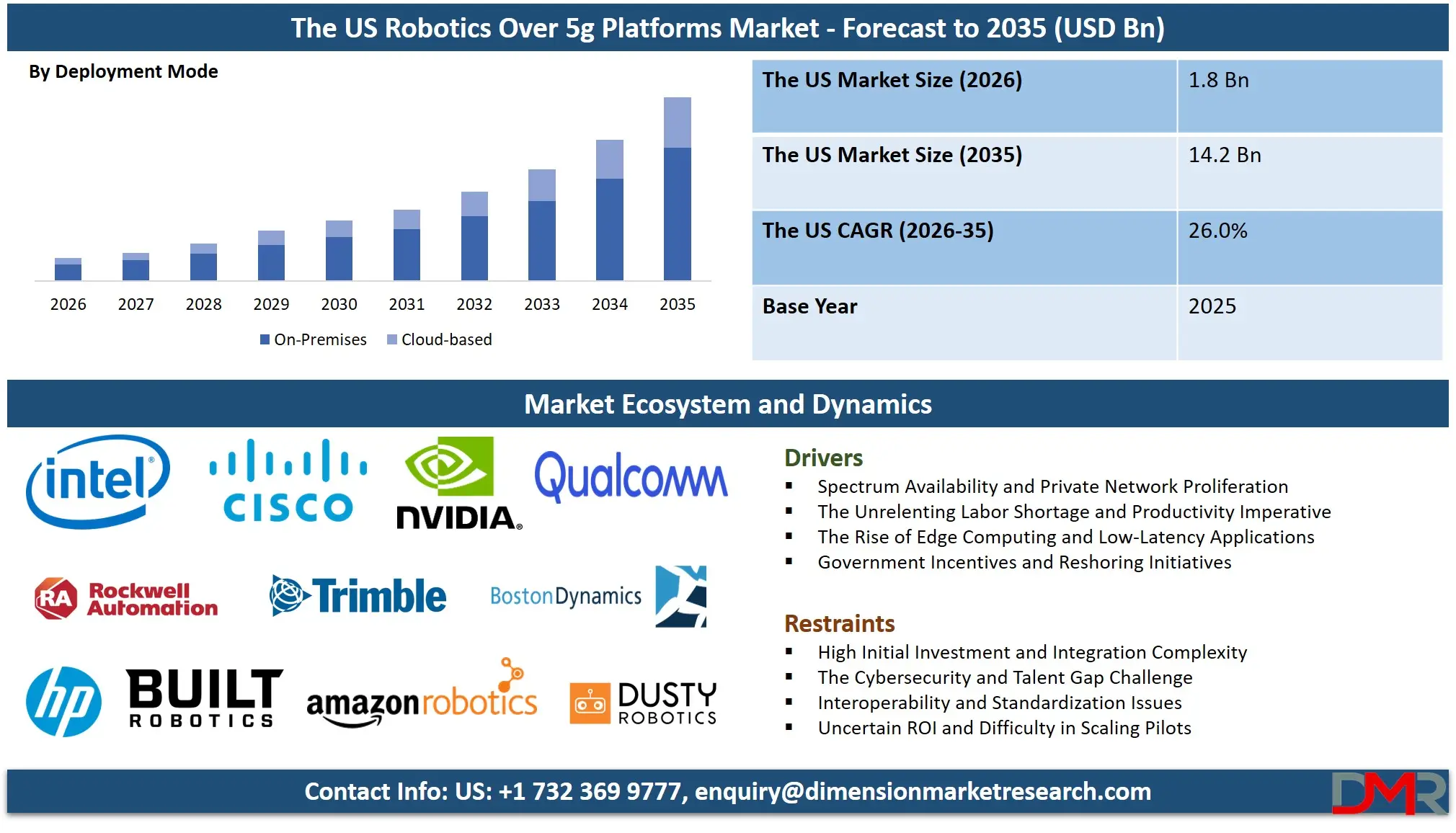
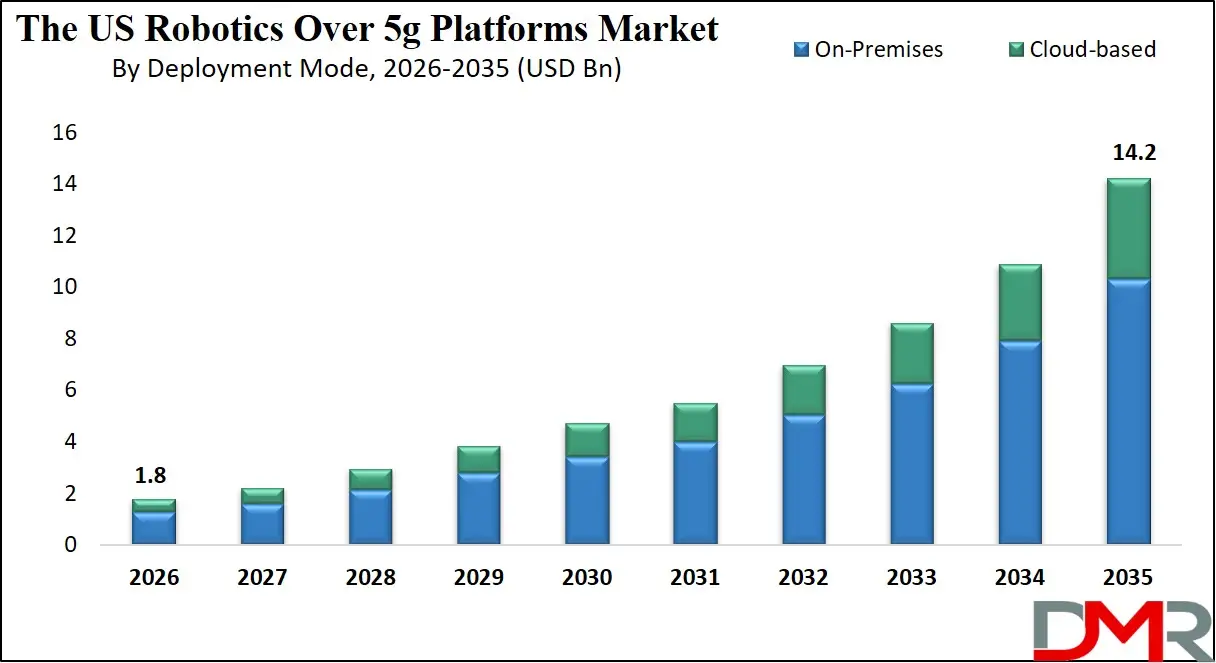
The US Robotics Over 5G Platforms Market is projected to reach USD 1.8 billion in 2026 and is expected to grow at a CAGR of 26.0% from 2026 to 2035, reaching approximately USD 14.2 billion by 2035.
ℹ
To learn more about this report –
Download Your Free Sample Report Here
The market growth is driven by the exponential increase in data generated by industrial robotics, the demand for low-latency teleoperation, and the widespread rollout of private 5G networks across American manufacturing and logistics hubs. Additionally, advancements in edge computing, network slicing, and AI-driven real-time control systems are accelerating the deployment of untethered, high-performance robots that can process complex tasks without onboard supercomputing limitations. These innovations are helping enterprises achieve unprecedented levels of automation, flexibility, and operational efficiency.
The American industrial landscape presents unique characteristics that amplify 5G robotics adoption. The world's most advanced manufacturing sector, with a renewed focus on reshoring and "Factory of the Future" initiatives; a sprawling logistics network handling over 20 billion tons of freight annually, and a labor market facing persistent shortages in skilled trades, warehousing, and manual labor, all creating a powerful economic imperative for robotic automation. The convergence of 5G's ultra-reliable low-latency communication (URLLC) with edge AI is fundamentally altering the ROI calculus for automation, shifting from fixed, caged robots to fleets of autonomous, wirelessly-coordinated machines.
Regulatory momentum has reached an inflection point. The Federal Communications Commission's (FCC) ongoing spectrum auctions, including the 2.5 GHz, 3.5 GHz CBRS band, and the 3.45 GHz band, have unlocked a treasure trove of mid-band spectrum ideally suited for industrial applications. The CBRS band, in particular, has democratized access to private 5G networks, allowing manufacturers and warehouses to build their own dedicated, secure, high-performance wireless infrastructure without relying solely on public carriers. Simultaneously, the National Telecommunications and Information Administration (NTIA) is spearheading the USD 1.5 billion Public Wireless Supply Chain Innovation Fund, aimed at fostering open and interoperable 5G networks, which directly benefits the industrial automation sector by driving down costs and accelerating innovation.
ℹ
To learn more about this report –
Download Your Free Sample Report Here
The competitive landscape reflects this dynamism. Traditional industrial automation giants, including ABB Ltd., Fanuc Corporation, and Yaskawa Electric Corporation, are integrating 5G modules into their next-generation robotic arms and controllers. They compete alongside telecommunications infrastructure leaders like Nokia Corporation and Ericsson, who are pivoting to offer private wireless solutions tailored for Industry 4.0. Semiconductor architects NVIDIA Corporation, Intel Corporation, and Qualcomm Technologies, Inc. provide the high-performance computing platforms and AI acceleration, while a vibrant ecosystem of software startups and system integrators, such as OSARO Inc. and Veo Robotics, are building the orchestration layers that make 5G-connected robotics truly intelligent and adaptable.
The US Robotics Over 5G Platforms Market: Key Takeaways
- Unparalleled Growth Trajectory: The U.S. market is projected to surge from USD 1.8 billion in 2026 to USD 14.2 billion by 2035, driven by a potent mix of private 5G network availability, chronic labor shortages, and the tangible ROI of cloud-connected autonomous fleets.
- Private 5G as the Great Enabler: The FCC's CBRS band initiative is the single most powerful force driving adoption, allowing enterprises to deploy their own secure, high-performance 5G networks, untethering robots from Wi-Fi constraints and enabling real-time coordination.
- The Logistics and Warehousing Frontier: Beyond manufacturing, the massive U.S. warehousing and distribution sector, fueled by e-commerce, represents a high-growth opportunity. Operators are rapidly adopting 5G-connected AMRs not just for efficiency, but for tangible ROI through 24/7 operation, reduced worker injuries, and optimized inventory management.
- AI-Powered Cloud Robotics: The market is shifting from standalone, pre-programmed machines to centrally orchestrated fleets. U.S. companies are leading the development of cloud-based AI that processes data from multiple robots, enabling fleet-wide learning, predictive maintenance, and complex task allocation in real-time.
- Edge Computing Integration: The demand for ultra-low latency is driving the deployment of edge data centers co-located with 5G infrastructure. This integration allows for split-second decision-making for safety-critical applications like high-speed pick-and-place or collaborative human-robot interaction, without relying on a distant cloud.
The US Robotics Over 5G Platforms Market: Use Cases
- Real-Time Teleoperation for Complex Tasks: In hazardous environments or for intricate assembly, 5G's low latency enables operators to control robotic arms with haptic feedback from miles away, allowing for precise intervention without putting humans in harm's way in sectors like mining or nuclear decommissioning.
- Swarm Logistics in Warehousing: In massive fulfillment centers, 5G connects fleets of AMRs, allowing them to communicate directly to avoid collisions, optimize traffic flow in real-time, and dynamically reroute based on incoming orders, creating a synchronized, high-throughput operation.
- Predictive Maintenance via Continuous Data Streaming: 5G's high bandwidth allows industrial robots to continuously stream vibration, temperature, and performance data to the cloud. AI algorithms analyze this data to predict imminent failures, schedule proactive maintenance, and prevent costly production line downtimes.
- Precision Agriculture with Autonomous Tractors: In U.S. heartland farms, 5G-connected autonomous tractors and harvesters use real-time sensor data and AI to optimize planting, spraying, and harvesting, communicating with each other to cover vast fields in coordinated patterns without human intervention.
- Dynamic Safety Zones for Collaborative Robots: 5G and edge computing enable the creation of dynamic, virtual safety perimeters. Using real-time data from overhead sensors and robot-mounted cameras, the system can slow or redirect a robot's path if a human enters a shared workspace, enabling safe and flexible human-robot collaboration.
The US Robotics Over 5G Platforms Market: Stats & Facts
Bureau of Labor Statistics (BLS) – United States
- There were nearly 10 million job openings in the U.S. on the last business day of 2X24, with a significant portion in manufacturing, transportation, and warehousing.
- The manufacturing sector alone faces a skilled labor shortage, with an estimated 2.1 million jobs expected to remain unfilled by 2030.
- Worker productivity in the nonfarm business sector increased by just 0.9% in 2023, highlighting the need for automation to drive future growth.
- The warehousing and storage industry has seen employment grow by over 40% in the last five years, driven by e-commerce.
- Over 500,000 workers in the transportation and material moving occupations quit their jobs monthly in 2024, indicating high turnover and burnout.
- Fatal occupational injuries in the private transportation and warehousing sector reached a record high in 2022, with 635 deaths.
International Federation of Robotics (IFR)
- The US is among the top 5 global markets for industrial robot installations, with over 40,000 units installed annually.
- Robot density in the U.S. manufacturing industry reached 285 robots per 10,000 employees in 2023, up from 255 in 2021.
- The automotive industry remains the largest adopter of robots in the U.S., accounting for roughly one-third of all installations.
- The electrical/electronics industry is the fastest-growing adopter of robotics in the U.S., driven by the CHIPS Act and semiconductor reshoring.
- By 2025, it is projected that over 50% of all new industrial robots sold will be "connected" and capable of integration with industrial IoT platforms.
5G & Connectivity Facts (FCC / CTIA)
- The FCC has made over 1,500 MHz of spectrum available for 5G, including the critical mid-band 3.5 GHz CBRS and 3.45 GHz bands.
- By 2025, it is estimated that there will be over 200 million 5G connections in the U.S.
- Private 5G network deployments in the U.S. are expected to grow at a CAGR of over 40% through 2030, driven by the manufacturing and logistics sectors.
- 5G is designed to support up to 1 million connected devices per square kilometer, essential for dense sensor and robot fleets.
- Network slicing enabled by 5G allows for dedicated, reliable bandwidth for mission-critical robotic communications.
U.S. Department of Energy (DOE) / National Institute of Standards and Technology (NIST)
- The DOE's "Cybersecurity Capability Maturity Model (C2M2)" is being adapted for 5G-enabled industrial control systems to ensure robust security.
- NIST is actively developing guidelines for the integration of 5G and AI in manufacturing as part of its "Smart Manufacturing" program.
The US Robotics Over 5G Platforms Market: Market Dynamic
Driving Factors in the US Robotics Over 5G Platforms Market
Spectrum Availability and Private Network Proliferation
The primary catalyst for the U.S. market is the FCC's forward-thinking spectrum policy, particularly the Citizens Broadband Radio Service (CBRS). This has democratized access to high-quality, mid-band spectrum, allowing factories, ports, and warehouses to deploy their own private, secure 5G networks. This bypasses the cost, complexity, and potential congestion of public networks, creating a guaranteed performance floor for mission-critical robotic applications. The "factory of the future" is being built on a foundation of private wireless.
The Unrelenting Labor Shortage and Productivity Imperative
In the U.S. market, chronic labor shortages across manufacturing, logistics, and agriculture have shifted automation from a "nice-to-have" to a "must-have" for business continuity. 5G-connected robots offer a solution not just by replacing manual labor, but by augmenting the existing workforce, enabling them to be more productive and less prone to injury. The economic imperative to do more with less is accelerating the adoption of autonomous mobile robots and collaborative robots that can operate alongside humans seamlessly.
Restraints in the US Robotics Over 5G Platforms Market
High Initial Investment and Integration Complexity
While 5G and robotics offer long-term ROI, the upfront capital expenditure is significant. This includes the cost of 5G modules and sensors, the robots themselves, the private network infrastructure (or carrier service fees), and the software for orchestration. This creates an adoption barrier for small and medium-sized enterprises (SMEs), potentially creating a two-tiered automation landscape where only large corporations can afford the most advanced, flexible systems. The economic divide in automation is a growing concern, as smaller players struggle to compete on efficiency.
The Cybersecurity and Talent Gap Challenge
The convergence of IT (information technology) and OT (operational technology) through 5G introduces new and complex cybersecurity vulnerabilities. A robot fleet, once air-gapped, is now a potential entry point for ransomware or sabotage. This requires a new breed of cybersecurity expertise that understands both industrial control systems and 5G network architectures. A shortage of these trained professionals can lead to improper security postures, longer deployment times, and higher insurance costs, potentially affecting long-term system trust. This complexity is compounded by the need to secure the entire supply chain, from the robot's operating system to the 5G radio access network. Insurers are still grappling with how to underwrite cyber-risk in automated industrial environments.
Opportunities in the US Robotics Over 5G Platforms Market
The Massive Warehousing and Logistics Frontier
The U.S. warehousing and logistics industry, a backbone of the e-commerce economy, presents a massive growth opportunity. Operators are under immense pressure to fulfill orders faster and handle labor churn. Deploying fleets of 5G-connected Autonomous Mobile Robots (AMRs) for goods-to-person picking, sorting, and inventory transport offers a clear return on investment through increased throughput and 24/7 operational capability. The opportunity is staggering: the U.S. has over 20,000 warehouses, and the vast majority have yet to deploy advanced robotics. With industrial real estate at a premium, automation is the key to maximizing throughput per square foot.
Robot-as-a-Service (RaaS) and Outcome-Based Models
The next frontier is lowering the barrier to entry through flexible consumption models. U.S. software and robotics companies are increasingly offering Robot-as-a-Service (RaaS) models, where customers pay a monthly subscription fee rather than a massive upfront capital cost. This allows even SMEs to access cutting-edge 5G-connected automation. These models include deployment, maintenance, and managed services, aligning the vendor's incentives with the customer's operational success. Startups and established players are moving beyond selling robots to selling outcomes, such as "picks per hour" in a warehouse, creating a powerful new value proposition.
Trends in the US Robotics Over 5G Platforms Market
Cloud Robotics and Centralized Orchestration
The industry is rapidly moving away from robots as standalone, pre-programmed silos. The dominant trend is cloud robotics, where the compute-intensive tasks of AI model training, fleet coordination, and data aggregation are offloaded to the cloud or edge, leveraging 5G's high bandwidth. This allows for "fleet learning," where one robot's experience (e.g., navigating a new obstacle) is shared with and improves the performance of every robot in the fleet. This trend enables the use of simpler, cheaper, and more energy-efficient robots, as the "brains" reside in the cloud. Software platforms for fleet management are becoming the key differentiator, not the robot hardware itself.
The Rise of Edge AI and Ultra-Reliable Low-Latency Communication (URLLC)
While cloud robotics is transformative, it relies on the network. For safety-critical applications requiring split-second decisions like a high-speed robotic arm avoiding a human worker, or a platoon of trucks performing emergency braking, the latency to a central cloud is too high. This is driving the trend of edge AI, where AI inference happens on a local edge server, or even on the robot itself, powered by high-performance systems-on-chips (SoCs). This, combined with 5G's URLLC capabilities, creates a system that is both centrally orchestrated and locally responsive, ensuring both safety and efficiency. The momentum is shifting decisively towards a hybrid architecture where intelligence is distributed across the robot, the edge, and the cloud.
The US Robotics Over 5G Platforms Market: Research Scope and Analysis
By Component Analysis
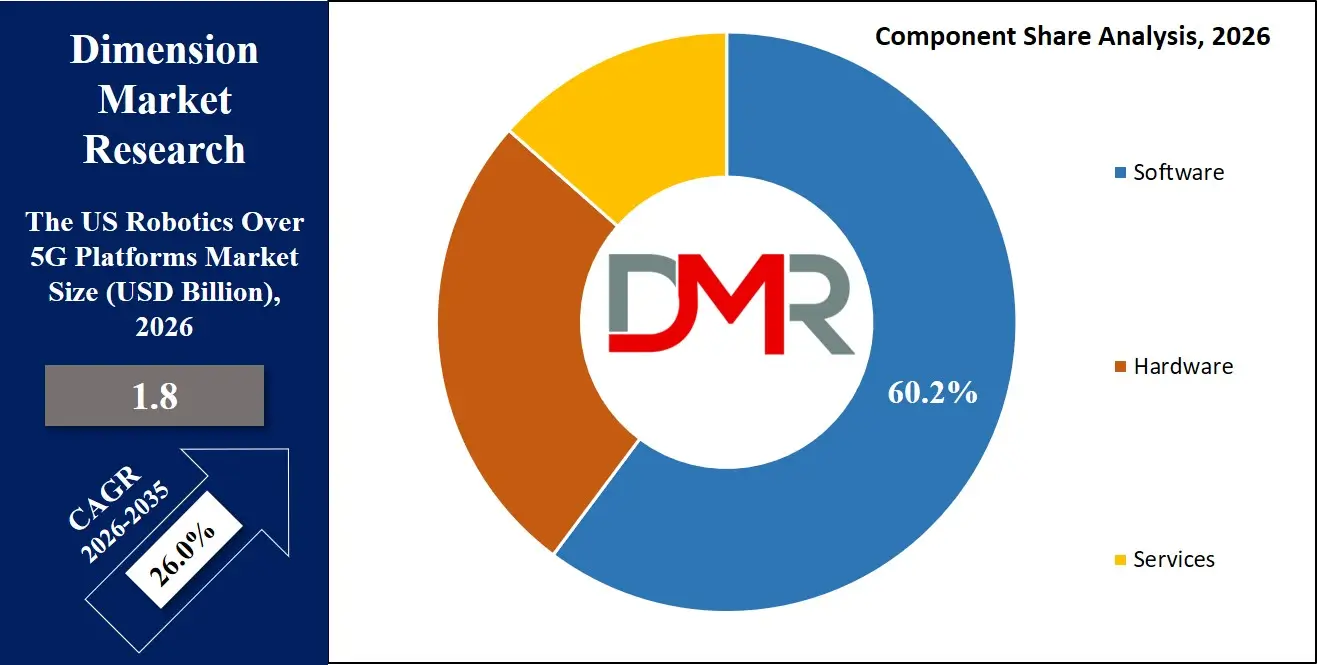
In the US robotics over 5G platforms market, hardware currently accounts for the largest share, forming the core infrastructure of connected robotics systems. Among hardware components, 5G modules act as the key enabler, allowing robots to communicate with low latency and high reliability for real-time operations. Sensors such as cameras, LiDAR, and proximity detectors are essential for perception and navigation, while robotic arms continue to dominate industrial automation and are increasingly being integrated with 5G for flexible, cable-free deployment.
ℹ
To learn more about this report –
Download Your Free Sample Report Here
However, the fastest-growing segment is software, driven by rising demand for intelligent automation. AI & algorithms are central to functions such as object recognition, path planning, and decision-making. Real-time control software, often supported by edge computing, ensures smooth and safe robotic operations, while data processing platforms enable analytics, predictive maintenance, and performance optimization. Enterprises are increasingly viewing software as the key differentiator in robotics deployments.
Services also represent a growing component, including deployment, integration, maintenance, and consulting. As systems become more complex, demand for managed services and Robotics-as-a-Service (RaaS) models is increasing, allowing businesses to outsource system management and focus on core operations.
By Deployment Mode Analysis
The deployment landscape in the US is characterized by a strong preference for on-premises deployment, particularly through private 5G networks utilizing CBRS spectrum. This approach currently dominates core industrial applications, as enterprises require absolute control over security, latency, and data privacy. Manufacturing facilities, warehouses, and logistics hubs cannot tolerate network congestion or downtime, making dedicated on-premises 5G networks the preferred choice for mission-critical robotic operations.
Private 5G deployments also allow enterprises to customize network parameters, ensuring consistent performance for time-sensitive applications such as robotic assembly lines, automated material handling, and real-time quality inspection. As a result, on-premises infrastructure is widely regarded as the gold standard for industrial-grade robotics over 5G platforms.
Nevertheless, cloud-based deployment is emerging as the fastest-growing segment, particularly for applications involving fleet orchestration, large-scale data analytics, and non-real-time control functions. Cloud platforms such as Amazon Web Services, Microsoft Azure, and Google Cloud provide virtually unlimited computational power for training AI models, processing historical data, and enabling centralized management of distributed robot fleets.
A hybrid deployment model is increasingly becoming the industry standard. In this model, robots and edge servers handle real-time control and latency-sensitive operations on-premises, while cloud platforms manage fleet coordination, AI model updates, and long-term analytics. This hybrid approach combines the reliability of local infrastructure with the scalability and cost efficiency of public cloud environments.
By Robot Type Analysis
In the US robotics over 5G platforms market, industrial robots, including traditional robotic arms, welding robots, and assembly-line systems, represent a large and well-established segment. These robots are widely deployed in manufacturing environments where precision, repeatability, and productivity are critical. The integration of 5G enhances their capabilities by enabling real-time monitoring, remote operation, and adaptive control.
However, the fastest-growing segments are Autonomous Mobile Robots (AMRs) and collaborative robots (cobots), reflecting a shift toward flexible and intelligent automation. AMRs, which include autonomous forklifts, tuggers, and goods-to-person robots, are transforming logistics and warehousing by navigating dynamically without fixed infrastructure. Their ability to operate in unstructured environments makes them particularly well-suited to leverage the low latency and high bandwidth of 5G networks.
Collaborative robots are designed to work safely alongside human workers, and 5G connectivity further enhances their functionality by enabling real-time safety monitoring and distributed processing through edge infrastructure. These robots are increasingly adopted in small and medium enterprises due to their flexibility and ease of deployment.
Service robots, including professional cleaning robots, medical delivery robots, and agricultural robots, are also witnessing rapid adoption. These robots operate in complex, unstructured environments and rely heavily on 5G connectivity for navigation, communication, and data exchange. As a result, the diversity of robot types is expanding significantly, driven by the capabilities unlocked by 5G-enabled connectivity.
By End-User Industry Analysis
In the US robotics over 5G platforms market, the manufacturing industry represents the largest end-user segment by revenue, driven by the increasing need to reshore production, enhance productivity, and address skilled labor shortages. Industries such as automotive and electronics manufacturing are at the forefront of adoption, utilizing 5G-connected robots for applications including assembly, painting, welding, and material handling.
The integration of robotics with private 5G networks allows manufacturers to achieve higher levels of automation, flexibility, and real-time visibility across production processes. This capability is particularly important in high-mix, low-volume production environments where adaptability is critical.
However, logistics & warehousing is emerging as the fastest-growing end-user segment, fueled by the rapid expansion of e-commerce. The surge in online shopping has created immense pressure on fulfillment centers to increase speed, accuracy, and throughput. In response, companies are deploying 5G-connected AMRs, robotic picking systems, and automated sorting solutions at scale to handle increasing parcel volumes and meet stringent delivery timelines.
Beyond manufacturing and logistics, other industries such as healthcare, agriculture, and construction are gradually adopting robotics over 5G platforms. These sectors are leveraging connected robotics to improve operational efficiency, enhance safety, and enable new use cases such as remote monitoring and autonomous operations. Overall, the market is witnessing a transition toward highly connected, intelligent, and scalable robotic ecosystems, where 5G acts as the critical enabler of next-generation automation across industries.
The US Robotics Over 5G Platforms Market Report is segmented on the basis of the following:
By Component
- Hardware
- 5G Modules
- Sensors
- Robotic Arms
- Software
- AI & Algorithms
- Real-Time Control
- Data Processing
- Services
- Deployment
- Maintenance
- Consulting
- Professional Services
- Managed Services
By Deployment Mode
By Robot Type
- Industrial Robots
- Service Robots
- Collaborative Robots
- Autonomous Mobile Robots
By End-User Industry
- Manufacturing
- Logistics & Warehousing
- Automotive
- Healthcare
- Energy & Utilities
- Agriculture
- Mining & Construction
- Others
Impact of Artificial Intelligence in the US Robotics Over 5G Platforms Market
- Deep Learning for Perception: AI, particularly convolutional neural networks (CNNs) and vision transformers, is used to process sensor data, enabling robots to recognize and classify objects, people, and obstacles in their environment with ever-increasing accuracy.
- Intelligent Path Planning & Navigation: AI algorithms analyze real-time and historical data to calculate the most efficient, safest paths for AMRs in dynamic environments, adapting to congestion, obstacles, and changing priorities.
- Predictive Maintenance: AI models analyze continuous data streams from robot components (motors, joints, batteries) to predict potential failures before they occur, enabling proactive maintenance and minimizing costly downtime.
- Reinforcement Learning for Manipulation: AI enables robotic arms to learn complex manipulation tasks, such as picking and packing irregularly shaped objects, through trial and error in simulation, accelerating deployment for new use cases.
- Fleet-Wide Learning: Using anonymized operational data from an entire robot fleet, AI models are continuously trained and improved in the cloud. When one robot discovers a more efficient way to navigate a bottleneck, that learning can be disseminated to every robot via an over-the-air (OTA) update.
- Human-Robot Collaboration: AI analyzes human pose and movement to predict intent, allowing collaborative robots to anticipate a worker's next move, adjust their speed, or create a safe buffer zone, ensuring fluid and safe teamwork.
The US Robotics Over 5G Platforms Market: Competitive Landscape
The U.S. robotics over 5G platforms market is a highly dynamic and moderately consolidated competitive landscape characterized by the convergence of traditional industrial automation suppliers, telecommunications infrastructure giants, leading semiconductor and AI technology companies, and innovative software and robotics startups. Long-established players such as ABB Ltd., Fanuc Corporation, Yaskawa Electric Corporation, and KUKA AG maintain strong market positions by supplying robust, reliable industrial robots and are aggressively integrating 5G modules and cloud connectivity into their next-generation offerings. Alongside them, telecom infrastructure leaders Nokia Corporation and Ericsson are becoming increasingly influential, providing the private 5G network solutions (CBRS, 5G core) that form the communication backbone for these systems. Companies such as NVIDIA Corporation with its Isaac robotics platform, Intel Corporation, and Qualcomm Technologies, Inc. provide the high-performance computing hardware and AI software frameworks that power robot intelligence and 5G connectivity.
ℹ
To learn more about this report –
Download Your Free Sample Report Here
In addition, specialized robotics vendors such as Boston Dynamics, Otto Motors, and 6 River Systems (Ocado Group) play a key role in developing advanced AMRs and cobots for logistics and warehousing. The US also hosts leading software innovators including OSARO Inc., Veo Robotics, and Covariant, which are focused on building the AI-powered perception and orchestration software that makes robots adaptable and intelligent. At the same time, cloud hyperscalers like Amazon Web Services (AWS), Microsoft Azure, and Google Cloud are pursuing vertical integration, providing the cloud robotics platforms, AI/ML services, and edge computing infrastructure that enable fleet learning and data analytics.
Some of the prominent players in the US Robotics Over 5G Platforms Market are:
- Intel Corporation
- Cisco Systems, Inc.
- NVIDIA Corporation
- Qualcomm Technologies, Inc.
- Rockwell Automation, Inc.
- HP Inc.
- Trimble Inc.
- Caterpillar Inc.
- Boston Dynamics, Inc.
- Amazon Robotics
- Vecna Robotics, Inc.
- Berkshire Grey, Inc.
- Agility Robotics
- Built Robotics
- Apptronik
- Sarcos Technology and Robotics Corporation
- Autonomous Solutions, Inc.
- Dusty Robotics
- Advanced Construction Robotics
- Ekso Bionics Holdings, Inc.
- Other Key Players
Recent Developments in the US Robotics Over 5G Platforms Market
- March 2026: NVIDIA Corporation supported the deployment of advanced AI-powered "robot brain" systems on U.S. manufacturing lines, enabling robots to perform multi-task operations autonomously and accelerating the adoption of physical AI in industrial automation.
- January 2026: NVIDIA Corporation introduced next-generation robotics AI models (including GR00T and Cosmos) along with edge-to-cloud frameworks to support scalable, real-time robot learning and deployment across industries.
- October 2025: Amazon Robotics expanded the use of AI-trained robotic systems in fulfillment centers, enabling machines to learn from large datasets for improved sorting, picking, and warehouse automation efficiency.
- July 2025: Intel Corporation spun off its RealSense division into an independent company, securing USD 50 million in funding to expand AI-driven computer vision systems widely used in autonomous mobile robots and humanoids.
- January 2026: Boston Dynamics, Inc. unveiled its new electric Atlas humanoid robot for real-world industrial deployment, with planned use cases in automotive manufacturing and logistics operations.
- September 2025: Agility Robotics accelerated commercialization of humanoid robots for warehouse and logistics automation, supported by growing enterprise adoption and integration with advanced AI models for real-world task execution.
Report Details
| Report Characteristics |
| Market Size (2026) |
USD 1.8 Bn |
| Forecast Value (2035) |
USD 14.2 Bn |
| CAGR (2026–2035) |
26.0% |
| Historical Data |
2021 – 2025 |
| Forecast Data |
2027 – 2035 |
| Base Year |
2025 |
| Estimate Year |
2026 |
| Report Coverage |
Market Revenue Estimation, Market Dynamics, Competitive Landscape, Growth Factors and etc. |
| Segments Covered |
By Component (Hardware, Software and Services), By Deployment Mode (On-Premises and Cloud-based), By Robot Type (Industrial Robots, Service Robots, Collaborative Robots and Autonomous Mobile Robots), By End-User Industry (Manufacturing, Logistics & Warehousing, Automotive, Healthcare, Energy & Utilities, Agriculture, Mining & Construction and Others) |
| Country Coverage |
The US |
| Prominent Players |
Intel Corporation, Cisco Systems, Inc., NVIDIA Corporation, Qualcomm Technologies, Inc., Rockwell Automation, Inc., HP Inc., Trimble Inc., Caterpillar Inc., Boston Dynamics, Inc., Amazon Robotics, Vecna Robotics, Inc., Berkshire Grey, Inc., Agility Robotics, Built Robotics, Apptronik, Sarcos Technology and Robotics Corporation, Autonomous Solutions, Inc., Dusty Robotics, Advanced Construction Robotics, Ekso Bionics Holdings, Inc., and Other Key Players |
| Purchase Options |
We have three licenses to opt for: Single User License (Limited to 1 user), Multi-User License (Up to 5 Users) and Corporate Use License (Unlimited User) along with free report customization equivalent to 0 analyst working days, 3 analysts working days and 5 analysts working days respectively. |
Frequently Asked Questions
How big is the US Robotics Over 5G Platforms Market?
▾ The US Robotics Over 5G Platforms Market is valued at USD 1.8 billion in 2026 and is projected to reach USD 14.2 billion by the end of 2035.
What is the growth rate for the US Robotics Over 5G Platforms Market?
▾ The market is growing at a robust compound annual growth rate (CAGR) of 26.0% over the forecast period of 2026 to 2035.
Who are the key players in the US Robotics Over 5G Platforms Market?
▾ Some of the major key players in the US Robotics Over 5G Platforms Market are Intel Corporation, Cisco Systems, Inc., NVIDIA Corporation, Qualcomm Technologies, Inc., Rockwell Automation, Inc., and many others.