Market Overview
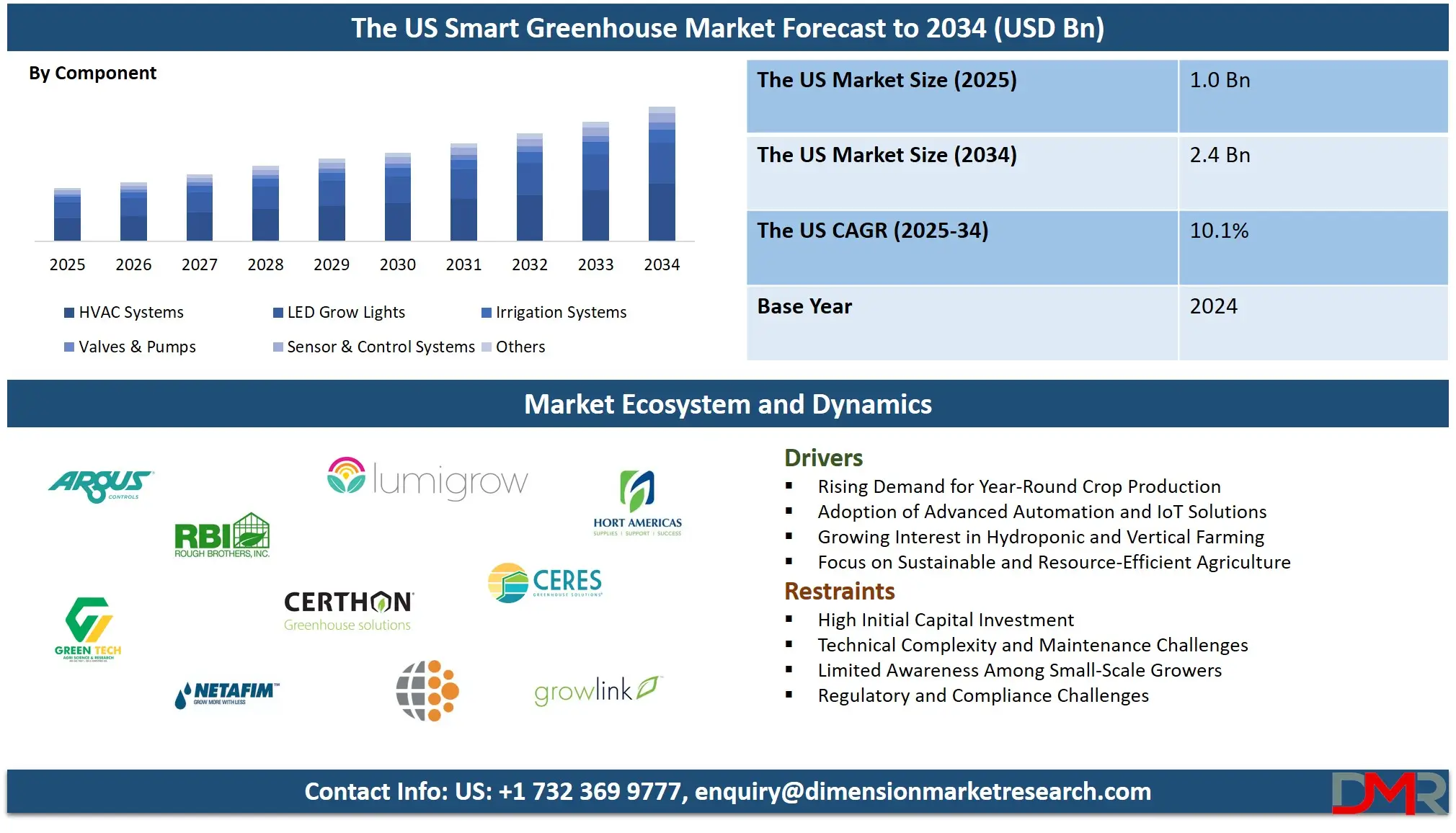
The US smart greenhouse market is projected to grow from USD 1.0 billion in 2025 to USD 2.4 billion by 2034, registering a compound annual growth rate of 10.1%. The expansion is driven by increasing adoption of climate control systems, LED grow lights, automated irrigation, and sensor-based monitoring across commercial growers, research facilities, and urban farms. Rising demand for year-round crop production, efficient resource management, and precision farming solutions is fueling market growth in controlled-environment agriculture.
A smart greenhouse is an advanced agricultural facility designed to optimize crop growth and yield through the integration of technology, automation, and data-driven monitoring. Unlike traditional greenhouses, it utilizes Internet of Things sensors, climate control systems, LED grow lights, and automated irrigation to precisely regulate environmental conditions such as temperature, humidity, light intensity, and nutrient levels.
ℹ
To learn more about this report –
Download Your Free Sample Report Here
By combining software platforms with hardware components, smart greenhouses enable real-time decision-making, efficient resource management, and predictive analysis of crop performance. These systems support sustainable farming practices by minimizing water and energy consumption while enhancing productivity and crop quality. They also provide growers with the ability to monitor operations remotely, reducing manual intervention and improving overall operational efficiency.
The US smart greenhouse market has witnessed significant growth due to rising demand for controlled-environment agriculture and the increasing adoption of advanced agricultural technologies. The market is driven by the need to produce high-quality crops year-round, particularly in urban and semi-urban regions where traditional farming faces space and climate constraints. Key components such as climate control systems, LED grow lights, irrigation technologies, and sensors are widely deployed to enhance automation and optimize plant growth conditions.
Moreover, the integration of software platforms for data analytics, remote monitoring, and predictive crop management is accelerating market expansion by improving decision-making and operational efficiency for commercial growers, research institutes, and retail farms. The market landscape in the United States is shaped by both technological innovation and regulatory support for sustainable agriculture. Investments in research and development, coupled with rising awareness of resource-efficient farming methods, are encouraging the adoption of smart greenhouse solutions across various end-user segments.
ℹ
To learn more about this report –
Download Your Free Sample Report Here
Commercial growers remain the primary adopters due to their focus on maximizing yield and minimizing operational costs, while educational and research institutions leverage these facilities for experimentation and training. Additionally, the growing interest in hydroponic and vertical farming techniques is contributing to the proliferation of smart greenhouses, making them a vital component of modern agriculture in the country.
The US Smart Greenhouse Market: Key Takeaways
- Market Value: The US smart greenhouse market size is expected to reach a value of USD 2.4 billion by 2034 from a base value of USD 1.0 billion in 2025 at a CAGR of 10.1%.
- By Type Segment Analysis: Hydroponic is anticipated to dominate the type segment, capturing 60.0% of the total market share in 2025.
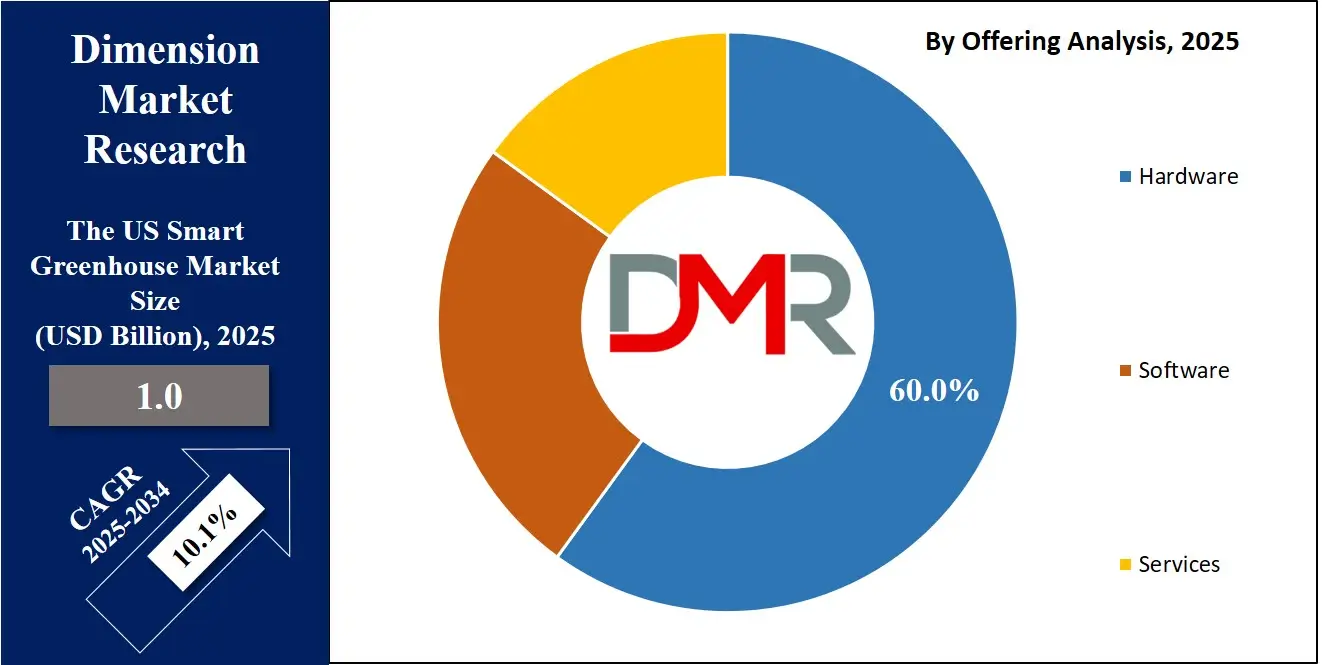
- By Offering Segment Analysis: Hardware is expected to maintain its dominance in the offering segment, capturing 60.0% of the total market share in 2025.
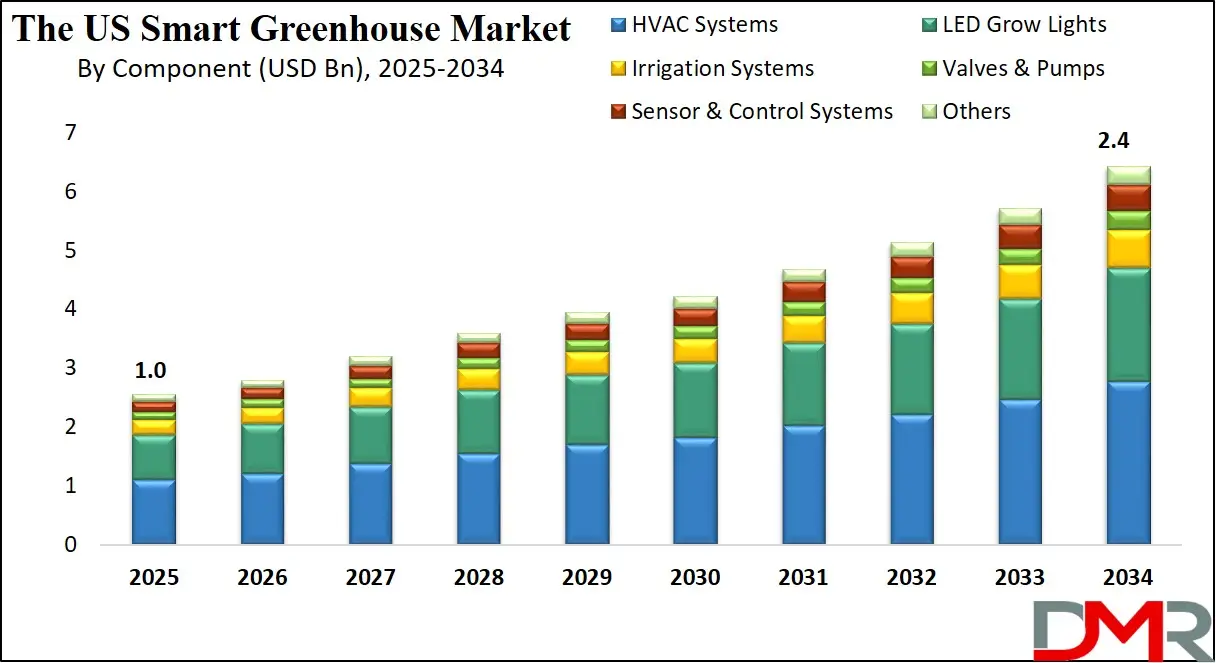
- By Component Segment Analysis: HVAC Systems will account for the maximum share in the component segment, capturing 43.0% of the total market value.
- By End User Segment Analysis: Commercial Growers will dominate the end user segment, capturing 50.0% of the market share in 2025.
- Key Players: Some key players in the US smart greenhouse market are Nexus Corporation, Argus Control Systems Ltd., Rough Brothers, Inc., GreenTech Agro LLC, Netafim Ltd., LumiGrow, Inc., Certhon Group, Terrasphere Systems LLC, Hort Americas, LLC, Ceres Greenhouse Solutions, International Greenhouse Company, Growlink, and Others.
The US Smart Greenhouse Market: Use Cases
- Precision Climate Control: Smart greenhouses use climate control systems and sensors to maintain optimal temperature, humidity, and CO2 levels, enabling year-round crop production and improving yield quality while saving energy.
- Automated Irrigation: IoT-enabled irrigation and nutrient systems monitor soil moisture and nutrient levels, adjusting water and fertilizer supply automatically, reducing waste and lowering operational costs.
- Data-Driven Crop Monitoring: Software platforms collect and analyze environmental and crop data, enabling early detection of pests and diseases and supporting informed decisions for better crop quality and efficiency.
- Hydroponic and Vertical Farming Integration: Smart greenhouses integrate with hydroponic and vertical farming setups, using automated lighting and nutrient systems to maximize space, enhance urban farming, and ensure sustainable high-density cultivation.
Impact of Artificial Intelligence on the US Smart Greenhouse market
Artificial intelligence is transforming the US smart greenhouse market by enabling advanced automation and predictive decision-making for crop management. AI-powered systems analyze data from sensors, climate control units, and irrigation networks to optimize growth conditions, detect early signs of pests or diseases, and adjust resource usage in real time. This integration enhances operational efficiency, reduces labor dependency, and improves crop yield and quality. Additionally, AI-driven analytics support precision agriculture initiatives, allowing commercial growers and research institutions to implement data-backed strategies for sustainable, high-density, and year-round production in controlled-environment agriculture.
The US Smart Greenhouse Market: Stats & Facts
- USDA: In 2022, there were 11,465 farms growing greenhouse vegetables or fresh‑cut herbs. The total greenhouse vegetable area was 133 million square feet and sales reached USD 982 million.
- USDA: The total number of U.S. farms and ranches in 2022 was about 1.9 million, down 7% from 2017, with an average farm size of 463 acres.
- USDA: In 2022, 79% of U.S. farms had Internet access, up from approximately 75% in 2017, indicating growing digital adoption in agriculture.
- USDA: The number of farms and ranches using renewable energy-producing systems increased from 133,176 in 2017 to 153,101 in 2022, reflecting rising interest in sustainable farming practices.
The US Smart Greenhouse Market: Market Dynamics
The US Smart Greenhouse Market: Driving Factors
Rising Demand for Year-Round Crop Production
The US smart greenhouse market is driven by the need to produce high-quality crops throughout the year despite seasonal fluctuations. Controlled-environment agriculture allows growers to regulate temperature, humidity, light, and CO2 levels, ensuring consistent yields for vegetables, herbs, and specialty crops. This reduces dependency on traditional farming cycles and enhances food security while supporting urban and peri-urban farming initiatives.
Adoption of Advanced Automation and IoT Solutions
Increasing integration of Internet of Things sensors, automated irrigation, LED grow lights, and climate control systems is fueling market growth. These technologies enable precision agriculture, reduce manual labor, optimize energy and water usage, and enhance operational efficiency. Commercial growers and research institutions are leveraging smart monitoring and predictive analytics to maximize yield and reduce production costs.
The US Smart Greenhouse Market: Restraints
High Initial Capital Investment
The deployment of smart greenhouses requires significant investment in hardware, software, and sensor networks. Small-scale growers may face financial barriers, limiting adoption despite the long-term benefits of automation, energy efficiency, and controlled-environment agriculture.
Technical Complexity and Maintenance Challenges
Operating advanced greenhouse systems demands technical expertise in IoT, automation, and climate management. Frequent maintenance of sensors, LED lighting, and irrigation systems can be resource-intensive, posing challenges for commercial farms and urban farming operators with limited technical knowledge.
The US Smart Greenhouse Market: Opportunities
Expansion of Hydroponic and Vertical Farming
The growing interest in hydroponic and vertical farming in urban areas presents opportunities for smart greenhouse solutions. These systems maximize space utilization, improve resource efficiency, and support high-density crop production, catering to rising consumer demand for fresh, locally-grown produce.
Integration of Artificial Intelligence and Predictive Analytics
AI and machine learning tools can analyze sensor data to optimize crop growth, forecast yields, and detect potential pest or disease outbreaks. Adoption of AI-driven decision-making offers opportunities for precision agriculture, sustainable resource management, and higher profitability for commercial and research-focused greenhouse operations.
The US Smart Greenhouse Market: Trends
Sustainable and Resource-Efficient Farming Practices
There is an increasing focus on sustainability, with growers adopting energy-efficient LED lighting, water-saving irrigation systems, and renewable energy sources. Controlled-environment agriculture enables reduced water and fertilizer usage, aligning with environmental regulations and green farming initiatives.
Remote Monitoring and Cloud-Based Management
The use of cloud platforms and mobile applications for real-time monitoring of temperature, humidity, and nutrient levels is becoming a standard trend. Remote management allows growers to optimize operations, reduce labor requirements, and maintain crop health from any location, enhancing efficiency and scalability.
The US Smart Greenhouse Market: Research Scope and Analysis
By Type Analysis
In the US smart greenhouse market, hydroponic systems are expected to dominate the type segment, accounting for approximately 60% of the total market share in 2025. Hydroponic cultivation allows plants to grow in nutrient-rich water solutions without the need for soil, providing precise control over nutrient delivery, water usage, and environmental conditions. This method supports higher crop yields, faster growth cycles, and consistent quality, making it particularly attractive to commercial growers and urban farms focused on maximizing productivity. The ability to optimize resource efficiency while producing a wide variety of high-value crops year-round further reinforces the preference for hydroponic systems in controlled-environment agriculture.
Non-hydroponic systems, while less dominant, continue to play a significant role in the market by serving growers who prefer traditional soil-based cultivation with smart monitoring and automation enhancements. These systems combine the benefits of conventional greenhouse farming with advanced technologies such as climate control, LED lighting, and sensor-based irrigation, allowing growers to improve crop health and yield while maintaining familiar soil-based practices. Non-hydroponic solutions are particularly relevant for crops that respond better to natural soil conditions or for growers transitioning gradually from traditional methods to fully automated smart greenhouses.
By Offering Analysis
In the US smart greenhouse market, hardware is expected to maintain its leading position in the offering segment, accounting for approximately 60% of the total market share in 2025. Hardware components include climate control systems, LED grow lights, automated irrigation units, valves, pumps, and sensor networks, all of which are essential for creating optimal growth conditions in controlled-environment agriculture. These physical systems form the backbone of smart greenhouses, enabling precise regulation of temperature, humidity, light, and nutrient supply. The high adoption of advanced hardware is driven by commercial growers and research institutions seeking to maximize crop yield, improve resource efficiency, and implement automated farming practices.
ℹ
To learn more about this report –
Download Your Free Sample Report Here
Software solutions in the smart greenhouse market, while representing a smaller share compared to hardware, play a crucial role in enhancing operational efficiency and decision-making. These platforms collect and analyze data from various sensors and hardware devices, providing real-time insights into crop health, environmental conditions, and resource utilization. Growers use software for remote monitoring, predictive analytics, and automated control of irrigation and lighting systems, allowing for precision agriculture practices. The adoption of software solutions is steadily increasing as growers recognize the value of data-driven management in optimizing productivity, reducing waste, and supporting sustainable farming practices.
By Component Analysis
In the US smart greenhouse market, HVAC systems are expected to account for the largest share in the component segment, representing approximately 43% of the total market value. These systems are essential for maintaining optimal temperature, humidity, and air circulation within controlled-environment agriculture facilities. By regulating climate conditions, HVAC solutions ensure consistent plant growth, prevent crop stress, and reduce the risk of diseases caused by extreme environmental fluctuations. Their high adoption is driven by commercial growers and research institutions aiming to maximize yield, enhance crop quality, and maintain year-round production regardless of external weather conditions.
LED grow lights, while accounting for a slightly smaller share than HVAC systems, play a vital role in the smart greenhouse ecosystem. These lighting solutions provide energy-efficient, customizable light spectra that support photosynthesis, accelerate plant growth, and improve crop quality. LED technology allows growers to simulate optimal sunlight conditions and extend growing hours, which is particularly important in regions with limited natural light. Integration with automated control systems enables precise light management, contributing to energy savings and promoting sustainable practices in modern greenhouse farming.
By End User Analysis
In the US smart greenhouse market, commercial growers are expected to dominate the end-user segment, capturing around 50% of the market share in 2025. These growers focus on large-scale production of vegetables, herbs, and specialty crops, leveraging advanced technologies such as climate control systems, automated irrigation, and sensor-based monitoring to maximize yield and quality. The adoption of smart greenhouse solutions enables them to maintain consistent crop production year-round, optimize resource use, reduce labor costs, and meet the growing demand for fresh, high-quality produce in urban and regional markets.
Research and educational institutes, while accounting for a smaller portion of the market, play a critical role in advancing controlled-environment agriculture. These organizations utilize smart greenhouses for experimental studies, crop trials, and training programs to develop innovative farming techniques and sustainable practices. By integrating automated monitoring systems, LED lighting, and data analytics platforms, research facilities can study plant growth patterns, test new crop varieties, and educate the next generation of agricultural scientists. This segment supports knowledge dissemination and contributes to technological adoption across commercial and community farming initiatives.
The US Smart Greenhouse Market Report is segmented on the basis of the following:
By Type
- Hydroponic
- Non-Hydroponic
By Offering
- Hardware
- Software
- Services
By Component
- HVAC Systems
- LED Grow Lights
- Irrigation Systems
- Valves & Pumps
- Sensor & Control Systems
- Others
By End User
- Commercial Growers
- Research & Educational Institutes
- Retail Gardens
- Others
The US Smart Greenhouse Market: Competitive Landscape
The competitive landscape of the US smart greenhouse market is characterized by intense innovation and technological advancement, with players focusing on developing integrated solutions that combine climate control, automated irrigation, sensor networks, and data analytics platforms. Companies are increasingly investing in research and development to enhance energy efficiency, optimize resource utilization, and improve crop yield and quality.
ℹ
To learn more about this report –
Download Your Free Sample Report Here
Strategic collaborations, product customization, and adoption of AI-driven decision-making tools are common approaches to differentiate offerings and meet the evolving needs of commercial growers, research institutions, and urban farms. Continuous innovation in hardware and software solutions, along with a focus on sustainable and precision agriculture practices, defines the competitive dynamics of the market.
Some of the prominent players in the US Smart Greenhouse market are:
- Nexus Corporation
- Argus Control Systems Ltd.
- Rough Brothers, Inc.
- GreenTech Agro LLC
- Netafim Ltd.
- LumiGrow, Inc.
- Certhon Group
- Terrasphere Systems LLC
- Hort Americas, LLC
- Ceres Greenhouse Solutions
- International Greenhouse Company
- Growlink
- Signify (formerly Philips Lighting)
- Heliospectra AB
- Agra Tech, Inc.
- Logiqs B.V.
- Delta T Solutions
- Autogrow Systems Ltd.
- Sensaphone
- BrightFarms Inc.
- Other Key Players
The US Smart Greenhouse Market: Recent Developments
- November 2025: A European ag‑tech startup specializing in greenhouse automation raised €10 million in Series A funding to accelerate commercial rollout of its “inverted” greenhouse robotics system, where plants move to stationary robots for automated scanning, maintenance, and harvesting, positioning itself for expansion in controlled‑environment agriculture.
- November 2025: A major horticulture‑lighting firm showcased its new high‑power LED module designed specifically for greenhouse cultivation, the upgraded module delivers increased light intensity and energy efficiency, aiming to boost photosynthesis and shorten harvest cycles in controlled‑environment farms.
- July 2025: A greenhouse‑automation startup entered into a strategic collaboration with an established European climate‑control technology provider, combining AI‑driven greenhouse‑management algorithms with precision climate control systems to create an integrated greenhouse automation solution.
- April 2025: A US‑based AI and computer‑vision firm focused on greenhouse automation secured USD 20 million in a Series B funding round, aimed at scaling its AI-driven greenhouse platform across North America and Europe and expanding its engineering and commercial teams.
Report Details
| Report Characteristics |
| Market Size (2025) |
USD 1.0 Bn |
| Forecast Value (2034) |
USD 2.4 Bn |
| CAGR (2025–2034) |
10.1% |
| Historical Data |
2019 – 2024 |
| Forecast Data |
2026 – 2034 |
| Base Year |
2024 |
| Estimate Year |
2025 |
| Report Coverage |
Market Revenue Estimation, Market Dynamics, Competitive Landscape, Growth Factors and etc. |
| Segments Covered |
By Type (Hydroponic, Non-Hydroponic), By Offering (Hardware, Software, Services), By Component (HVAC Systems, LED Grow Lights, Irrigation Systems, Valves & Pumps, Sensor & Control Systems, Others), and By End User (Commercial Growers, Research & Educational Institutes, Retail Gardens, Others) |
| Country Coverage |
The US |
| Prominent Players |
Nexus Corporation, Argus Control Systems Ltd., Rough Brothers, Inc., GreenTech Agro LLC, Netafim Ltd., LumiGrow, Inc., Certhon Group, Terrasphere Systems LLC, Hort Americas, LLC, Ceres Greenhouse Solutions, International Greenhouse Company, Growlink, and Others. |
| Purchase Options |
We have three licenses to opt for: Single User License (Limited to 1 user), Multi-User License (Up to 5 Users) and Corporate Use License (Unlimited User) along with free report customization equivalent to 0 analyst working days, 3 analysts working days and 5 analysts working days respectively. |
Frequently Asked Questions
How big is the US smart greenhouse market?
▾ The US smart greenhouse market size is estimated to have a value of USD 1.0 billion in 2025 and is expected to reach USD 2.4 billion by the end of 2034, with a CAGR of 10.1%.
Who are the key players in the US smart greenhouse market?
▾ Some of the major key players in the US smart greenhouse market are Nexus Corporation, Argus Control Systems Ltd., Rough Brothers, Inc., GreenTech Agro LLC, Netafim Ltd., LumiGrow, Inc., Certhon Group, Terrasphere Systems LLC, Hort Americas, LLC, Ceres Greenhouse Solutions, International Greenhouse Company, Growlink, and Others.