US Smoking Cessation Nicotine De Addiction Market Snapshot
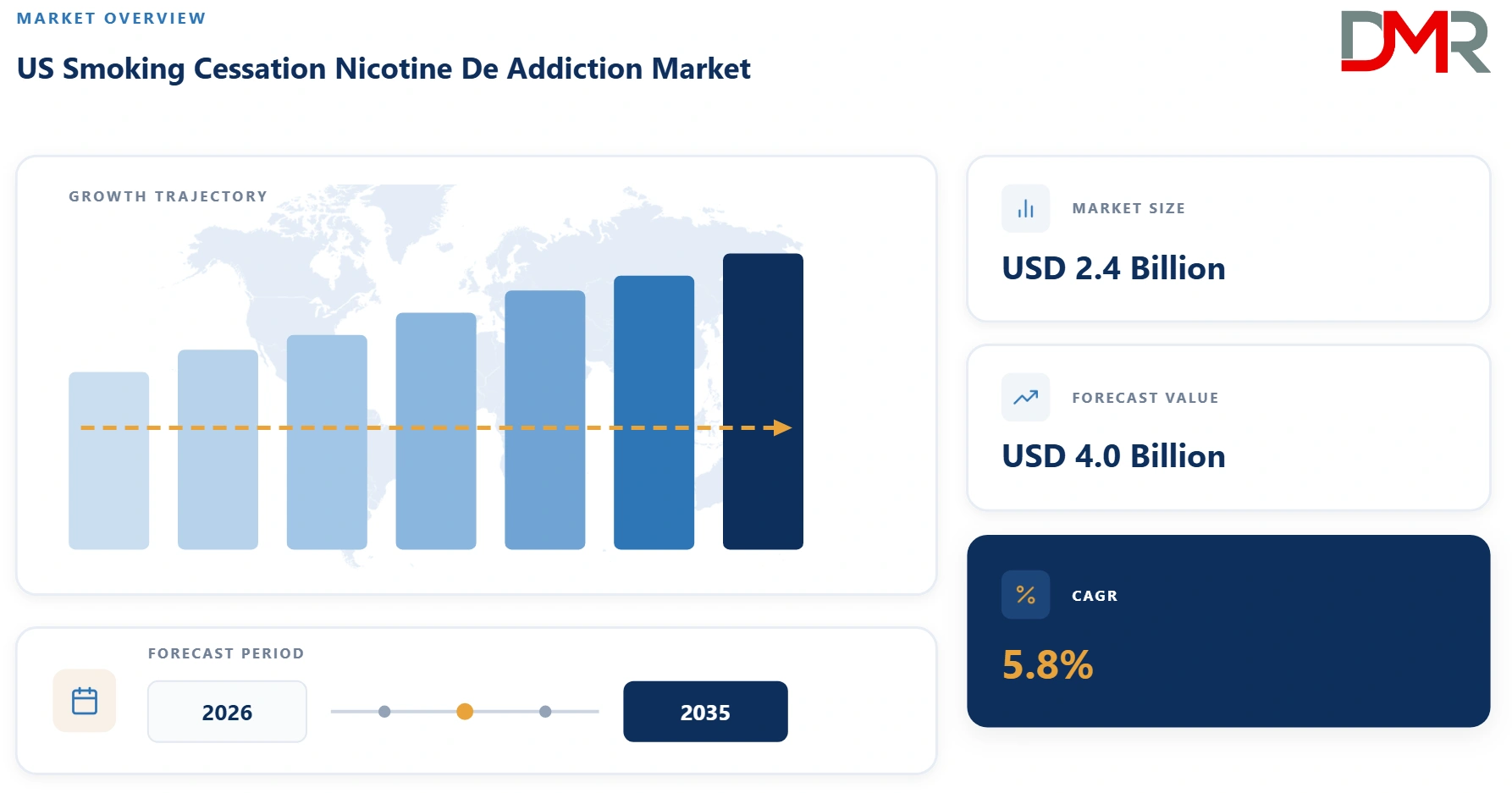
- Market Size, 2026: USD 2.4 billion
- Market Size, 2035: USD 4.0 billion
- CAGR, 2026–2035: 5.8%
- Leading Product Segment, 2026: Nicotine Replacement Therapy, 38%
- Leading Treatment Type, 2026: Pharmacological Treatment, 49%
- Leading Distribution Channel, 2026: Retail Pharmacies, 48%
- Fastest-Growing Segment: Digital & mHealth Assisted Treatment, 12.2% CAGR
What is the US Smoking Cessation Nicotine De Addiction and its Market Size?
The U.S. market is estimated at USD 2.4 billion in 2026, increasing to approximately USD 4.0 billion by 2035, representing a 5.8% CAGR.
ℹ
To learn more about this report –
Download Your Free Sample Report Here
The U.S. smoking cessation nicotine de-addiction market comprises pharmaceutical, over-the-counter, behavioral, digital and support solutions designed to help people stop smoking cigarettes and manage nicotine dependence. Core products include nicotine patches, gums, lozenges, inhalers and sprays; prescription therapies such as varenicline and bupropion; counseling and quitline services; and digital interventions including mobile applications, text-based programs and increasingly AI-enabled behavioral support. FDA-approved cessation medicines and behavioral counseling constitute the evidence-based therapeutic core. CDC identifies seven FDA-approved smoking-cessation medications, while combination medication and counseling can substantially improve cessation outcomes.
Use Cases
- Nicotine Withdrawal Management: Patches, gum and lozenges reduce cravings and withdrawal symptoms during smoking cessation attempts.
- Prescription-Assisted Quitting: Varenicline and bupropion help reduce nicotine cravings and the reinforcing effects of cigarettes.
- Behavioral Cessation Support: Counseling, quitlines and structured programs help smokers manage triggers, stress and relapse.
- Digital Cessation Programs: Mobile applications, texting and web-based programs deliver personalized support between clinical interactions.
- Combination Therapy: Medication combined with behavioral counseling improves treatment intensity and cessation prospects.
- Nicotine Substitution: Nicotine pouches and other smoke-free products provide alternative nicotine delivery, primarily within adjacent harm-reduction markets.
Key Takeaways
- Market Size and Growth: The U.S. market is estimated at USD 2.4 billion in 2026 and USD 4.0 billion by 2035, growing at 5.8% CAGR.
- Key Growth Drivers: Persistent nicotine dependence, large quit-attempt volumes, expanded treatment access, digitalization and renewed pharmaceutical innovation support growth.
- Key Segment Dominance: NRT leads the product category, pharmacological treatment leads by treatment type, and retail pharmacies remain the largest distribution channel.
- Fastest-Growing Segment: Digital and mHealth-assisted treatment is expected to grow at approximately 12.2% annually as consumers seek convenient, personalized and lower-friction support.
- Structural Opportunity: Only 38.3% of adults making recent cessation attempts used medication or counseling in the latest nationally reported CDC data, highlighting substantial unmet treatment demand.
- Competitive Complexity: The market increasingly overlaps with smoke-free nicotine alternatives, but these products should not be conflated with approved cessation therapies.
How AI and Digital Health Are Transforming the U.S. Smoking Cessation Market?
AI, mobile health and connected digital platforms are changing cessation delivery by enabling personalized quit plans, automated behavioral prompts, craving tracking, digital coaching and real-time relapse-risk interventions. Smartphone applications, text messaging and internet-based cessation interventions are already recognized as available behavioral-support modalities, while AI-based interventions are emerging as an adjunctive tool.
Technology lowers delivery costs by automating repetitive counseling functions, extending support outside clinics and allowing programs to serve geographically dispersed populations. Digital platforms can also combine medication reminders, symptom tracking, motivational content and clinician escalation within a single experience.
Key Drivers in the US Smoking Cessation Nicotine De Addiction Market
Large Untreated and Undertreated Cessation Population
The U.S. Smoking Cessation Nicotine De-Addiction Market benefits from a substantial gap between smokers who want to quit and those who use evidence-based cessation support. Smoking cessation is increasingly viewed as an ongoing treatment process because nicotine dependence is chronic and relapse is common. Many smokers make multiple quit attempts before achieving sustained abstinence, creating recurring demand for nicotine replacement therapy, prescription pharmacotherapy, counseling and behavioral support. Healthcare providers, pharmacies, employers and public-health programs are also increasingly integrating cessation interventions into routine care. The availability of over-the-counter products further reduces barriers to treatment, while prescription therapies provide additional options for individuals with stronger nicotine dependence or previous unsuccessful attempts.
Increasing Adoption of Combination and Digital Treatment
The growing use of combination treatment is another important market driver. Combining medication with behavioral counseling can substantially improve the likelihood of successful cessation, while combining long-acting and short-acting nicotine replacement products can provide stronger management of cravings and withdrawal symptoms. Digital technologies are extending this treatment model beyond traditional clinical settings through mobile applications, text messaging, telehealth, online counseling and personalized behavioral programs. These solutions enable continuous engagement, medication reminders, progress monitoring and relapse-prevention support. As healthcare providers, insurers and employers seek scalable cessation programs, integrated treatment models combining pharmacotherapy with digital behavioral assistance are expected to become increasingly important.
Restraints in the US Smoking Cessation Nicotine De Addiction Market
Declining Cigarette Smoking Prevalence
The long-term decline in cigarette smoking represents a structural restraint for the U.S. Smoking Cessation Nicotine De-Addiction Market. As fewer adults smoke combustible cigarettes, the underlying population requiring conventional smoking-cessation treatment gradually becomes smaller. Continued reductions in smoking prevalence are therefore likely to limit volume growth for traditional nicotine replacement products and prescription therapies. At the same time, successful cessation permanently removes consumers from the treatment market, creating a natural limitation on recurring demand. Companies must consequently increase treatment penetration among existing smokers, encourage evidence-based treatment during quit attempts and address nicotine dependence associated with newer tobacco and nicotine products. Market participants are increasingly focusing on treatment adherence, relapse prevention and broader nicotine-dependence management to offset the declining cigarette-smoking population.
Treatment Access, Utilization and Regulatory Complexity
Underutilization of proven cessation treatments remains a major market constraint. Although effective medications and behavioral interventions are available, many smokers attempt to quit without professional assistance or pharmacological support. Barriers include limited awareness, treatment costs, insurance restrictions, lack of healthcare-provider engagement and inconvenience associated with accessing counseling. Regulatory complexity also affects product development and commercialization. Prescription therapies require substantial clinical and regulatory investment, while nicotine pouches and other emerging nicotine products operate under a different regulatory framework and are not FDA-approved smoking-cessation medicines. Changes in tobacco-product regulation, marketing requirements, reimbursement policies and enforcement priorities can therefore influence competitive positioning and investment decisions across the market.
Growth Opportunities in the US Smoking Cessation Nicotine De Addiction Market
Digital and AI-Enabled Smoking Cessation
Digital health represents one of the most attractive growth opportunities in the U.S. Smoking Cessation Nicotine De-Addiction Market. Mobile applications, text-based interventions, telehealth platforms and online counseling can provide support at any time without requiring frequent in-person visits. AI can further personalize cessation programs by analyzing user behavior, identifying periods of elevated craving or relapse risk and adapting messages accordingly. Digital platforms can also integrate medication reminders, quit-date tracking, progress monitoring and behavioral exercises into a single treatment journey. Partnerships with employers, health insurers, pharmacies and healthcare systems can accelerate adoption by embedding digital cessation services into broader wellness and chronic-care programs. Demonstrating measurable quit outcomes and sustained user engagement will be critical to commercial success.
Innovation in Pharmacotherapy and Integrated Treatment
Pharmacological innovation provides another significant opportunity as manufacturers seek alternatives for smokers who do not respond adequately to existing therapies. New non-nicotine medicines could expand treatment choices and stimulate renewed physician and consumer interest in pharmacological cessation. Cytisinicline, for example, represents an emerging therapeutic approach, with its U.S. regulatory pathway continuing after the FDA identified manufacturing and labeling issues rather than clinical efficacy or safety deficiencies. At the same time, opportunities exist to develop integrated treatment packages combining medication, behavioral counseling and digital support. Such models can improve adherence and create differentiated offerings compared with standalone products. Expanding cessation services through pharmacies, primary-care practices and employer-sponsored programs can further increase treatment penetration.
Trends in the US Smoking Cessation Nicotine De Addiction Market
Shift Toward Integrated Cessation Journeys
The U.S. Smoking Cessation Nicotine De-Addiction Market is shifting from standalone products toward integrated treatment journeys. Consumers increasingly have access to combinations of medication, behavioral counseling, digital coaching and ongoing follow-up rather than relying on a single intervention. This approach reflects the chronic and relapsing nature of nicotine dependence and allows providers to address both physiological withdrawal and behavioral triggers. Pharmacies, healthcare systems, insurers and employers are becoming important platforms for delivering coordinated cessation services.
Convergence Between Cessation and Smoke-Free Nicotine Markets
The broader nicotine market is increasingly converging around smoke-free products, creating both opportunities and competitive challenges for traditional cessation therapies. Nicotine pouches, heated tobacco products and other alternatives are gaining attention among adult nicotine users, while regulators continue to evaluate their relative risks and marketing claims. However, these products should remain differentiated from FDA-approved cessation medicines. The growing smoke-free category may compete for consumers who would otherwise use NRT, while also creating opportunities for companies to develop clearer pathways for nicotine reduction, switching and eventual cessation.
Research Scope and Analysis
The market is segmented By Product, By Treatment Type, By Distribution Channel, By End User and By Age Group. Shares below represent estimated 2026 revenue contribution within the defined U.S. smoking-cessation and nicotine-dependence management market.
ℹ
To learn more about this report –
Download Your Free Sample Report Here
By Product Analysis
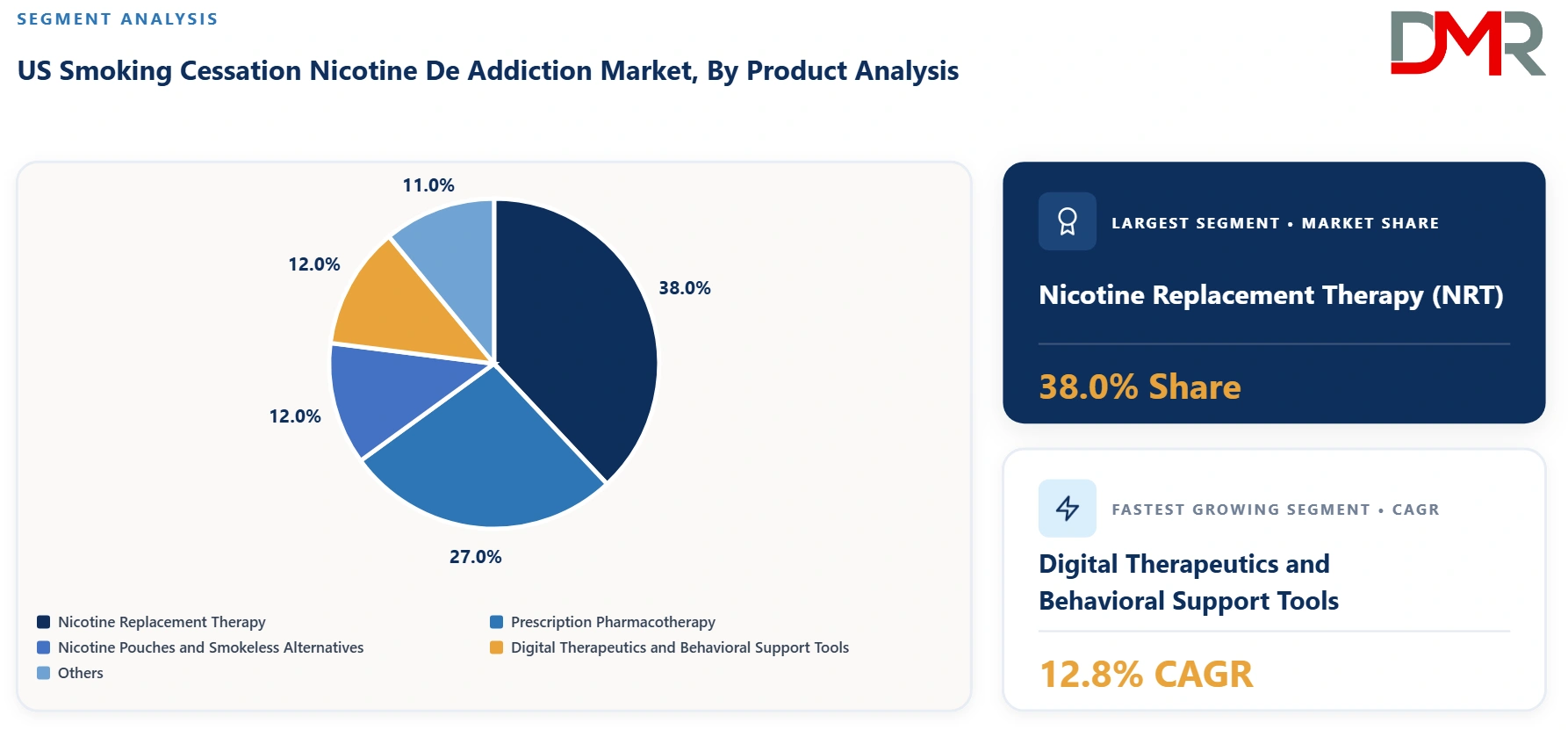
Nicotine Replacement Therapy (NRT) is estimated to dominate the product segment with approximately 38% share in 2026, supported by broad consumer awareness, OTC availability, multiple dosage formats and a long-established clinical evidence base. Patches, gum and lozenges enable consumers to select treatment intensity and administration preferences, while pharmacy and mass-retail availability reduces access friction. Prescription Pharmacotherapy represents the second-largest category at approximately 27%, driven by varenicline and bupropion, with renewed interest in prescription-based cessation as clinicians emphasize evidence-based treatment. The fastest-growing product category is Digital Therapeutics and Behavioral Support Tools, projected at approximately 12.8% CAGR, as smartphone penetration, employer programs, telehealth and AI-enabled personalization increase adoption. Nicotine Pouches and Smokeless Alternatives, estimated at 12%, constitute an adjacent substitution segment rather than an FDA-approved cessation-treatment category. Others, including quitline-supported products and emerging formats, account for approximately 11%. Growth will increasingly depend on treatment combinations rather than individual products.
By Treatment Type Analysis
Pharmacological Treatment is estimated to hold the largest share at 49% in 2026, reflecting the strong utilization of NRT and prescription cessation medications. Medication remains attractive because it directly addresses nicotine withdrawal and cravings, and CDC identifies seven FDA-approved smoking-cessation medications. Combination Therapy is the second-largest category with an estimated 22% share, supported by evidence favoring medication plus counseling and long-acting plus short-acting NRT combinations. The fastest-growing sub-segment is Digital and mHealth Assisted Treatment, estimated to expand at 12.2% CAGR, benefiting from remote access, personalization and low marginal delivery costs. Behavioral Counseling and Support Programs account for approximately 19%, while Others represent 2%. Future treatment models are expected to combine pharmacotherapy, digital engagement and human counseling into continuous treatment pathways.
By Distribution Channel Analysis
Retail Pharmacies are estimated to account for 48% of 2026 revenue, making them the dominant distribution channel due to extensive geographic coverage, established consumer trust and strong OTC NRT availability. Retail pharmacies also provide convenient access to prescription medications and increasingly support pharmacist-led health services. Online Pharmacies and E-commerce are the second-largest channel at approximately 22% and are expected to be the fastest-growing, with an estimated 10.8% CAGR through 2035. E-commerce enables recurring purchases, discreet delivery, digital promotions and direct-to-consumer subscription models. Hospital Pharmacies represent approximately 14%, particularly relevant for patients receiving cessation interventions around cardiovascular, respiratory or surgical care. Government and NGO Cessation Programs account for approximately 12%, supported by quitlines and publicly funded interventions, while Others represent 4%. Channel growth will increasingly involve omnichannel treatment journeys linking online assessment, pharmacy fulfillment and digital follow-up.
By End User Analysis
Adult Individual Smokers represent the dominant end-user category with approximately 57% share in 2026, because most cessation activity occurs through self-directed OTC treatment, primary-care prescribing or direct digital support. Hospital and Clinic Cessation Patients represent the second-largest category at approximately 24%, driven by clinical interventions for patients with smoking-related risk factors and individuals undergoing procedures where cessation improves outcomes. The fastest-growing category is Corporate and Workplace Wellness Programs, expected to grow at approximately 9.7% CAGR, as employers seek cost-effective approaches to improve workforce health and reduce productivity losses associated with smoking. Others, including community and public-sector users, account for 5%. Greater integration between insurers, employers, pharmacies and digital-health providers is expected to shift more cessation activity into structured, population-based programs rather than isolated individual purchases.
By Age Group Analysis
Adults aged 25–54 years dominate the age segmentation with an estimated 62% share in 2026, reflecting the concentration of current smoking and sustained nicotine dependence among working-age adults. CDC's 2024 data show cigarette use was 10.5% among adults aged 25–44 and 13.3% among those aged 45–64. Older Adults aged 55 years and above account for approximately 25%, with demand supported by increasing medical motivation to quit and greater interaction with healthcare providers. Young Adults aged 18–24 years represent approximately 8% but are expected to be the fastest-growing treatment-adoption cohort at roughly 8.9% CAGR, particularly for mobile and behavioral interventions. Others account for approximately 5%. The market opportunity is increasingly segmented by treatment motivation, nicotine dependence severity and product history rather than age alone.
The US Smoking Cessation Nicotine De Addiction Market Report is segmented on the basis of the following:
By Product
- Nicotine Replacement Therapy
- Prescription Pharmacotherapy
- Nicotine Pouches and Smokeless Alternatives
- Digital Therapeutics and Behavioral Support Tools
- Others
By Treatment Type
- Pharmacological Treatment
- Behavioral Counseling and Support Programs
- Combination Therapy
- Digital and mHealth Assisted Treatment
- Others
By Distribution Channel
- Retail Pharmacies
- Hospital Pharmacies
- Online Pharmacies and E-commerce
- Government and NGO Cessation Programs
- Others
By End User
- Adult Individual Smokers
- Hospital and Clinic Cessation Patients
- Corporate and Workplace Wellness Programs
- Others
By Age Group
- Adults (25 to 54 Years)
- Older Adults (55 Years and Above)
- Young Adults (18 to 24 Years)
- Others
Regulatory Landscape
Regulation is a central market determinant because FDA approval governs prescription cessation medicines while tobacco-product authorization governs nicotine pouches and other tobacco-derived alternatives. The U.S. currently has seven FDA-approved cessation medications, including NRT, varenicline and bupropion. Regulatory differentiation creates an important commercial divide between therapeutic products and consumer nicotine alternatives. In 2026, FDA granted modified-risk orders to 20 ZYN products and subsequently authorized 11 ZYN ULTRA products, demonstrating continued regulatory activity around nicotine pouches. The key opportunity is broader treatment innovation, while the principal risk is that regulatory changes, reimbursement requirements, marketing restrictions or product-safety actions could materially alter competitive economics.
Technology Analysis
Technology is shifting cessation from episodic interventions toward continuous, data-driven care. Digital platforms can combine behavioral counseling, medication reminders, craving tracking, quit-date management, text messaging and remote coaching. WHO recognizes text messaging, smartphone applications, AI-based interventions and internet-based interventions as potential cessation-support modalities, although evidence strength varies across technologies. AI can improve personalization by adjusting intervention intensity based on reported cravings, engagement and relapse risk. The largest opportunity is integrating digital tools with pharmacies, employers, health plans and prescription therapies. Risks include limited clinical validation for some AI applications, privacy concerns, user drop-off and inconsistent reimbursement. Competitive advantage will increasingly depend on measurable quit outcomes rather than download volume or engagement alone.
Competitive Landscape
The U.S. market is moderately consolidated in branded NRT and prescription pharmacotherapy but fragmented across digital, counseling and emerging nicotine-substitution solutions. Major participants compete through brand equity, clinical evidence, pharmacy distribution, pricing, consumer convenience and treatment adherence. Leading participants include Haleon/Nicorette, Pfizer/Chantix, Perrigo, Kenvue-related consumer-health channels, Altria/Helix and Philip Morris International/Swedish Match, alongside specialized digital cessation companies and emerging pharmaceutical developers. The market is also experiencing convergence with smoke-free nicotine products, although these products occupy a different regulatory and therapeutic position from approved cessation medicines. Strategic priorities include product innovation, retail expansion, digital partnerships, regulatory approvals and manufacturing scale.
Some of the prominent players in the US Smoking Cessation Nicotine De Addiction Market are:
- Haleon
- Kenvue
- Pfizer
- Perrigo
- GlaxoSmithKline
- Johnson & Johnson
- Philip Morris International
- British American Tobacco
- Altria Group
- Imperial Brands
- NJOY
- Cipla
- Dr. Reddy’s Laboratories
- Zydus Lifesciences
- Novartis
- Merck & Co.
- AstraZeneca
- Takeda Pharmaceutical
- Lupin
- Glenmark Pharmaceuticals
- Amneal Pharmaceuticals
- Viatris
- Sandoz
- Teva Pharmaceuticals
- Hikma Pharmaceuticals
- Sun Pharmaceutical Industries
- Alkalon
- Cambrex
- Qnovia
- 22nd Century Group
- Chrono Therapeutics
- Fertin Pharma
- Enorama Pharma
- Alchem International
- VMR Products
- Smoke Away
- Axcentria Pharmaceuticals
- Chemnovatic
- Japan Tobacco
- Reynolds American
- Other Key Players
Recent Developments
- In August 2026, the U.S. Food and Drug Administration authorized 11 additional ZYN ULTRA nicotine-pouch products, expanding the portfolio of legally marketed nicotine-pouch products and reinforcing the growing role of smoke-free alternatives in the U.S. nicotine market.
- In July 2026, Philip Morris International opened its USD 1.2 billion Aurora, Colorado manufacturing campus, adding U.S. production capacity for ZYN and strengthening domestic supply-chain infrastructure for smoke-free nicotine products.
- In June 2026, Achieve Life Sciences received an FDA complete response on cytisinicline, with the agency citing manufacturing and labeling issues rather than efficacy or safety deficiencies; the company indicated plans for a potential resubmission.
- In June 2026, Philip Morris International announced FDA modified-risk orders for 20 ZYN nicotine pouch products, making them the first nicotine pouches authorized to communicate specified reduced-risk information relative to cigarettes.
- In March 2026, Altria expanded on! PLUS nationwide following FDA authorization and an initial rollout in selected states, increasing competition in the rapidly expanding U.S. oral nicotine-pouch category.
- In February 2026, Pfizer launched a cost-savings program through TrumpRx, offering discounts across more than 30 brands and making branded medicines such as Chantix more accessible through an additional cash-pay channel.
Report Details
| Report Characteristics |
| Market Size (2026) |
USD 2.4 Bn |
| Forecast Value (2035) |
USD 4.0 Bn |
| CAGR (2026–2035) |
5.8% |
| Historical Data |
2021 – 2025 |
| Forecast Data |
2026 – 2035 |
| Base Year |
2025 |
| Segments Covered |
By Product, By Treatment Type, By Distribution Channel, By End User, By Age Group |
| Country Coverage |
US |
Frequently Asked Questions
What is the market size of the U.S. Smoking Cessation Nicotine De-Addiction Market in 2026?
▾ The U.S. Smoking Cessation Nicotine De-Addiction Market is estimated at USD 2.4 billion in 2026.
What will be the size of the U.S. Smoking Cessation Nicotine De-Addiction Market by 2035?
▾ The U.S. Smoking Cessation Nicotine De-Addiction Market is projected to reach approximately USD 4.0 billion by 2035.
What is the CAGR of the U.S. Smoking Cessation Nicotine De-Addiction Market?
▾ The U.S. Smoking Cessation Nicotine De-Addiction Market is expected to grow at a CAGR of approximately 5.8% from 2026 to 2035.
What are the key factors driving the U.S. Smoking Cessation Nicotine De-Addiction Market?
▾ Key drivers include increasing quit attempts, treatment gaps, greater adoption of pharmacotherapy, digital cessation tools, and expanded access through pharmacies and healthcare providers.
Which segment dominates the U.S. Smoking Cessation Nicotine De-Addiction Market?
▾ Nicotine Replacement Therapy is estimated to be the leading product segment, accounting for approximately 38% of the U.S. Smoking Cessation Nicotine De-Addiction Market in 2026.
Which segment is expected to grow fastest in the U.S. Smoking Cessation Nicotine De-Addiction Market?
▾ Digital therapeutics and mHealth-assisted treatment are expected to be the fastest-growing segment, supported by AI, mobile applications, telehealth and personalized behavioral support.
Who are the key players in the U.S. Smoking Cessation Nicotine De-Addiction Market?
▾ Major participants include Haleon, Pfizer, Perrigo, Altria, Philip Morris International, Swedish Match and emerging digital-health and pharmaceutical companies.
How is the U.S. Smoking Cessation Nicotine De-Addiction Market segmented?
▾ The U.S. Smoking Cessation Nicotine De-Addiction Market is segmented by product, treatment type, distribution channel, end user and age group.