US Speech Therapy Market Snapshot
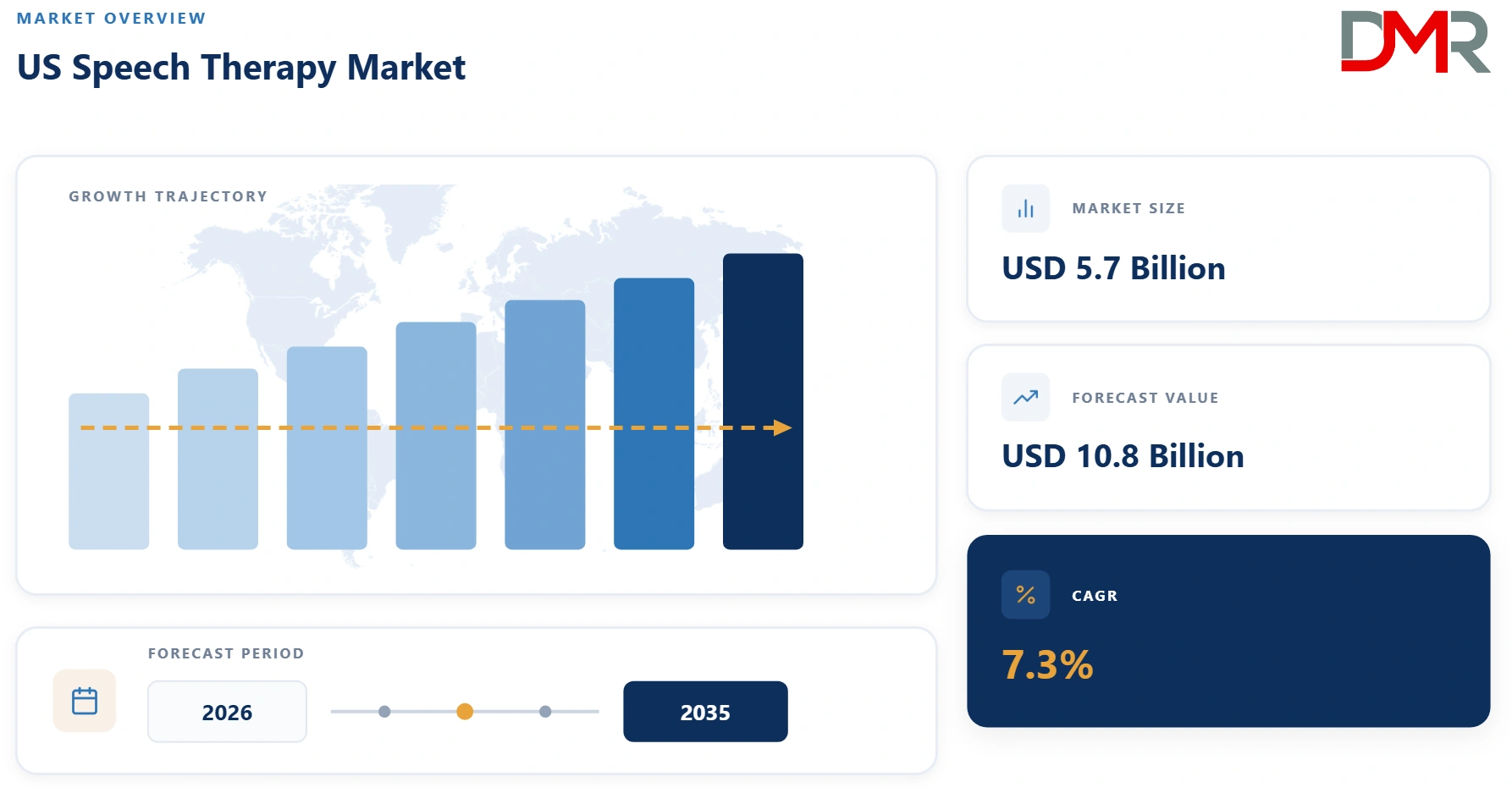
- US Speech Therapy Market Size in 2026: USD 5.7 Billion
- US Speech Therapy Market Size in 2035: USD 10.8 Billion
- US CAGR from 2026 to 2035: 7.3%
- Articulation Therapy is the leading service type segment in 2026: 31.4%
- Speech Disorders is the leading indication segment in 2026: 41.8%
- Pediatric is the leading age group segment in 2026: 52.6%
- Hospitals and Clinics is the leading setting segment in 2026: 34.5%
What is the US Speech Therapy Market and its Market Size?
The US Speech Therapy Market is projected to be valued at USD 5.7 Billion in 2026 and is projected to reach USD 10.8 Billion by 2035, expanding at a CAGR of 7.3% during the forecast period.
ℹ
To learn more about this report –
Download Your Free Sample Report Here
Growth is being propelled by the rising prevalence of speech, language, and communication disorders among children, including autism spectrum disorder and developmental language delays, alongside a growing aging population experiencing stroke-related aphasia, dysarthria, and other neurological communication impairments, and continued expansion of insurance and school-based coverage for speech-language pathology services under early intervention and special education mandates. The rapid expansion of teletherapy and telepractice platforms extending access to underserved rural and suburban communities, growing integration of AI-enabled speech assessment and adaptive therapy personalization tools improving diagnostic accuracy and treatment planning, and continued district-wide adoption of teletherapy contracts replacing fragmented, single-vendor school service arrangements are reshaping the market from a largely clinic- and school-based service category into an increasingly technology-enabled, hybrid care delivery model. Investment is accelerating as providers and platforms expand teletherapy capacity and AI-enabled assessment capability to serve both traditional clinical settings and rapidly growing remote and school-based service channels across the United States.
Use Cases
- Pediatric Speech and Language Intervention for Developmental Delays: Speech-language pathologists in schools and outpatient clinics use articulation and language intervention therapy to support children with developmental language delays, autism spectrum disorder, and speech sound disorders, improving communication skills and academic readiness.
- Post-Stroke and Neurological Rehabilitation for Adults: Hospitals and rehabilitation centers use speech therapy to treat aphasia, dysarthria, and cognitive-communication deficits in stroke and traumatic brain injury patients, supporting functional communication recovery and return to daily activities.
- Teletherapy Delivery for School Districts and Rural Communities: School districts and home healthcare providers use teletherapy platforms to deliver speech-language pathology services to students and patients in areas facing clinician shortages, ensuring compliance with IEP and special education service mandates.
- Swallowing Disorder Management in Hospital and Long-Term Care Settings: Hospitals and skilled nursing facilities use speech-language pathology services to evaluate and treat dysphagia in post-surgical, geriatric, and neurologically impaired patients, reducing aspiration risk and supporting safe oral intake.
Key Takeaways
- Market Size: The US Speech Therapy Market is anticipated to be valued at USD 5.7 Billion in 2026 and is forecast to reach USD 10.8 Billion by 2035, expanding at a CAGR of 7.3%.
- Growth Outlook: Market expansion is sustained by rising prevalence of pediatric and adult communication disorders, rapid teletherapy adoption, and growing integration of AI-enabled speech assessment and personalization tools.
- Primary Growth Drivers: Rising prevalence of speech, language, and neurological communication disorders, rapid teletherapy and telepractice expansion, growing AI-enabled assessment tool adoption, and continued school-based and insurance coverage expansion are accelerating market growth.
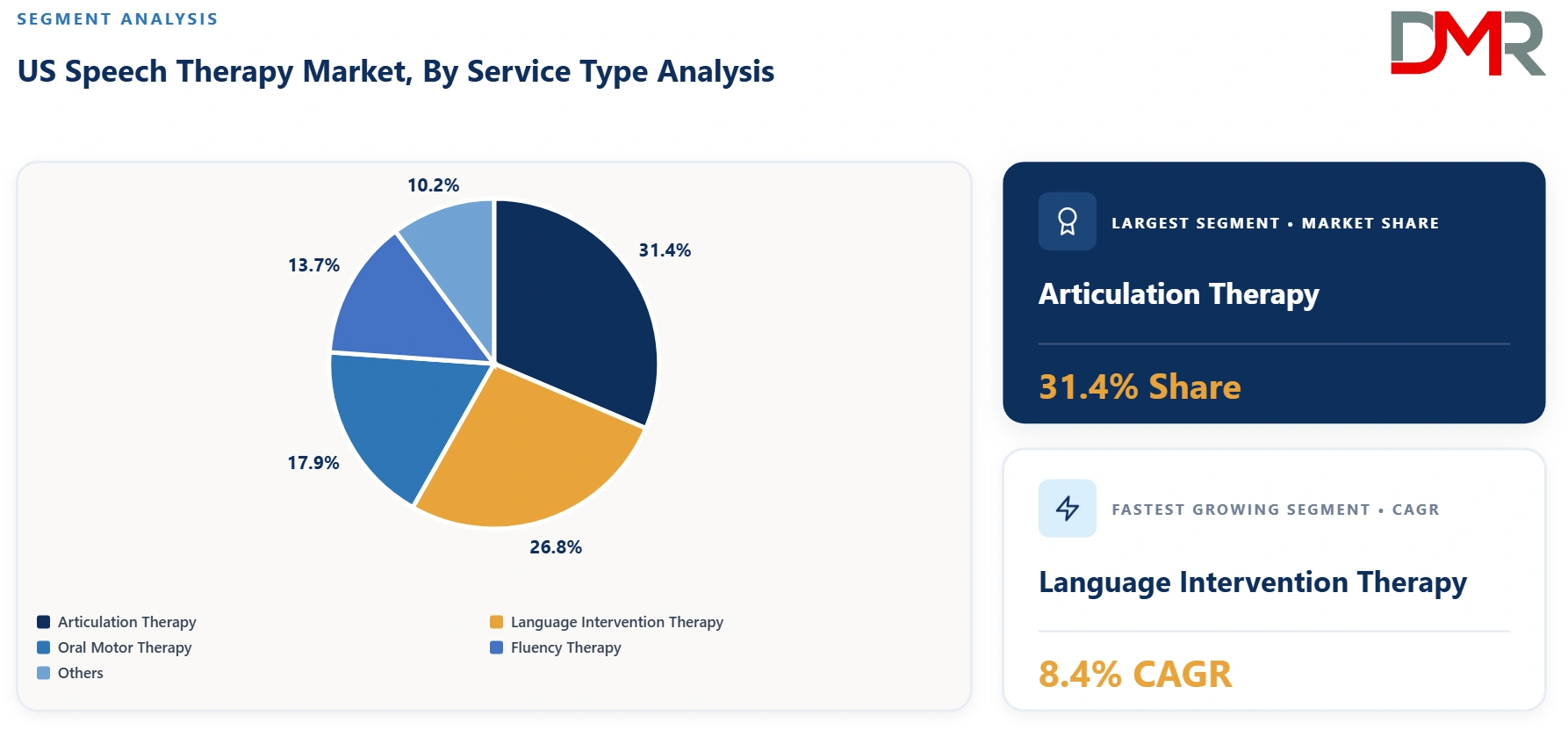
- By Service Type Analysis: Articulation Therapy is projected to lead the service type segment with a 31.4% share in 2026, reflecting its foundational role in addressing the most common pediatric speech sound disorders. Language Intervention Therapy is the fastest-growing service type segment at 8.4% CAGR, driven by rising autism and developmental language delay diagnoses.
- By Indication Analysis: Speech Disorders are expected to dominate with a 41.8% share in 2026, reflecting their widespread prevalence across the pediatric population. Neurological Conditions is the fastest-growing indication segment at 8.9% CAGR, driven by an aging population and rising stroke and traumatic brain injury survivorship.
- By Age Group Analysis: Pediatric is projected to lead with a 52.6% share in 2026, reflecting heightened awareness and early intervention initiatives for developmental communication disorders. Geriatric is the fastest-growing age group segment at 8.6% CAGR, driven by rising stroke incidence and age-related cognitive-communication decline.
- By Setting Analysis: Hospitals and Clinics are poised to lead with a 34.5% share in 2026, reflecting concentrated demand for complex neurological and post-acute speech therapy services. Telehealth Platforms are the fastest-growing setting segment at 9.8% CAGR, driven by expanding teletherapy adoption across schools and home-based care.
Key Drivers in the US Speech Therapy Market
Rising Prevalence of Pediatric and Adult Communication and Neurological Disorders
The prevalence of speech, language, and communication disorders continues to rise across the United States, driven by growing autism spectrum disorder diagnosis rates, developmental language delays, and an aging population experiencing stroke-related aphasia and other neurological communication impairments. This structural rise in diagnosed need directly drives demand for speech-language pathology services across school, clinical, and post-acute care settings, positioning disorder prevalence as a primary structural driver of market expansion.
Rapid Expansion of Teletherapy and Telepractice Service Delivery Models
US school districts, clinics, and home healthcare providers continue to rapidly expand teletherapy and telepractice service delivery, reflecting persistent clinician shortages in rural and underserved areas alongside growing acceptance of remote service delivery following broad telehealth adoption. This continued shift toward district-wide teletherapy contracts is driving sustained demand for teletherapy-capable platforms and licensed speech-language pathologists able to deliver services across state lines under telepractice licensure arrangements.
Restraints in the US Speech Therapy Market
Persistent Shortage of Licensed Speech-Language Pathologists Constraining Service Capacity
The United States continues to face a persistent, well-documented shortage of licensed speech-language pathologists relative to growing clinical and school-based demand, representing a meaningful restraint on the US Speech Therapy Market. Providers and school districts must compete for a limited pool of qualified clinicians, driving up labor costs and extending waitlists for evaluation and treatment, particularly in rural and underserved areas with more limited ability to offer competitive compensation relative to larger, well-resourced urban providers and health systems.
Growth Opportunities in the US Speech Therapy Market
AI-Enabled Speech Assessment and Adaptive Therapy Personalization Tool Development
Growing provider interest in AI-enabled speech assessment tools capable of streamlining evaluation and enabling adaptive, personalized therapy pathways presents a substantial opportunity for platform developers to differentiate through advanced diagnostic and treatment-planning capability integrated within broader teletherapy and clinical documentation platforms. Companies capable of demonstrating improved diagnostic accuracy and treatment personalization can capture premium positioning and stronger provider adoption as AI-enabled speech therapy technology continues maturing.
District-Wide Teletherapy Contract Expansion Across Public Education Systems
Growing school district demand for consolidated, district-wide teletherapy service contracts, replacing fragmented, single-vendor arrangements, presents a substantial opportunity for teletherapy platform providers capable of offering scalable, compliant, and clinician-network-backed service models. Companies developing comprehensive teletherapy ecosystems that address clinician shortages while meeting IEP and special education compliance requirements can capture significant value from continued institutional contract consolidation.
Trends in the US Speech Therapy Market
Growing Adoption of AI-Enabled Speech Assessment and Adaptive Therapy Platforms
US speech therapy providers are increasingly adopting AI-enabled assessment tools capable of streamlining evaluation processes and supporting adaptive, data-driven therapy pathways, reflecting a broader shift toward technology-assisted, outcome-focused care delivery. This trend is shifting clinician roles increasingly toward supervision and outcome validation alongside direct manual session design, improving diagnostic consistency and treatment personalization.
Large-Scale Integration of Teletherapy Into Public Education Systems
US public school districts are increasingly consolidating special education-related teletherapy services into district-wide platform partnerships rather than fragmented, individually contracted vendor arrangements, reflecting growing institutional confidence in remote service delivery and a need to address persistent clinician shortages at scale. This trend is strengthening long-term institutional contracts and consolidating demand among established national teletherapy providers.
Research Scope and Analysis
The US Speech Therapy Market is segmented by service type, indication, age group, and setting, covering articulation, language intervention, oral motor, and fluency therapy services across speech, language, neurological, and swallowing disorder indications and various clinical, educational, and home-based care settings.
ℹ
To learn more about this report –
Download Your Free Sample Report Here
By Service Type Analysis
Articulation Therapy is projected to dominate the US Speech Therapy Market with 31.4% share in 2026, reflecting its foundational and widespread role in addressing the most common pediatric speech sound disorders across school and clinical settings. Language Intervention Therapy is expected to register the highest CAGR of 8.4% during 2026-2035, driven by rising autism spectrum disorder diagnosis rates and growing awareness of developmental language delay.
By Indication Analysis
Speech Disorders are anticipated to dominate the US Speech Therapy Market, accounting for 41.8% share in 2026, supported by their widespread prevalence across the pediatric population and sustained demand for early intervention services. Neurological Conditions are projected to register the highest CAGR as an aging population and rising stroke and traumatic brain injury survivorship drive growing demand for cognitive-communication and dysarthria rehabilitation services.
By Age Group Analysis
Pediatric is projected to lead the US Speech Therapy Market with an estimated 52.6% share in 2026, reflecting heightened awareness of developmental communication disorders and continued expansion of early intervention and special education service mandates. Geriatric is expected to register the fastest CAGR of 8.6% through 2035, driven by rising stroke incidence and age-related cognitive-communication decline requiring rehabilitative speech-language pathology services.
By Setting Analysis
Hospitals and Clinics are projected to lead the US Speech Therapy Market with 34.5% share in 2026, reflecting concentrated demand for complex neurological rehabilitation and post-acute speech therapy services requiring clinical oversight. Telehealth Platforms are expected to register the fastest CAGR of 9.8% through 2035, driven by expanding teletherapy adoption across school districts, home healthcare, and rural and underserved communities.
The US Speech Therapy Market Report is segmented based on the following:
By Service Type
- Articulation Therapy
- Language Intervention Therapy
- Oral Motor Therapy
- Fluency Therapy
- Others
By Indication
- Speech Disorders
- Language Disorders
- Neurological Conditions
- Swallowing Disorders
- Others
By Age Group
- Pediatric
- Adult
- Geriatric
By Setting
- Hospitals and Clinics
- Schools
- Rehabilitation Centers
- Home Healthcare
- Telehealth Platforms
Technology Analysis
Technology development is increasingly shaping competitiveness in the US Speech Therapy Market as providers and platforms invest in AI-enabled speech assessment and diagnostic tools, adaptive therapy personalization engines, and interoperability between teletherapy platforms and electronic health record and school information systems. Growing use of remote monitoring and outcome-tracking analytics is supporting long-term treatment progress validation for both pediatric and adult patients across clinical and school-based settings. Opportunities are expanding for companies developing clinically validated AI assessment tools, comprehensive teletherapy ecosystems addressing clinician shortages at scale, and interoperable data infrastructure supporting care continuity across hospitals, schools, and home-based settings. However, achieving consistent telepractice licensure reciprocity and reimbursement parity across state lines remains an ongoing regulatory and industry coordination challenge.
Investment and White Space Analysis
Investment opportunities in the US Speech Therapy Market are expanding alongside rising prevalence of pediatric and adult communication disorders, rapid teletherapy adoption, and growing institutional demand for AI-enabled assessment tools. Significant white space exists in AI-enabled diagnostic and adaptive therapy tool development, district-wide teletherapy ecosystem expansion, and interoperable data infrastructure supporting confident care continuity across settings. Companies with strong clinician network capability, established relationships with growing school district and health system clients, and robust telepractice compliance infrastructure are positioned to capture premium, longer-duration growth opportunities. However, the persistent shortage of licensed speech-language pathologists, along with the challenge of achieving consistent multi-state telepractice licensure and reimbursement, can constrain smaller providers' ability to compete effectively for larger institutional service contracts.
Competitive Landscape
The US Speech Therapy Market is fragmented and increasingly competitive, comprising large diversified rehabilitation therapy companies with substantial national clinic and hospital-based operations, specialized teletherapy platform providers serving school districts and home-based clients, and emerging AI-focused speech assessment technology innovators. Competition centers on clinician network scale and quality, teletherapy platform capability, AI-enabled assessment and personalization functionality, and established relationships with growing school district, hospital, and health system clients. Large diversified rehabilitation companies benefit from broad service portfolios and substantial clinical staffing resources, while specialized teletherapy providers compete through purpose-built remote service platforms and deep school district compliance expertise. Companies increasingly differentiate through AI-enabled assessment capability and teletherapy ecosystem scale rather than standalone clinic-based service delivery alone.
Some of the prominent players in the US Speech Therapy Market are:
- Select Medical Corporation
- Encompass Health Corporation
- Aveanna Healthcare Holdings Inc.
- BrightSpring Health Services
- BAYADA Home Health Care
- Amedisys, Inc.
- LHC Group, Inc.
- Interim HealthCare Inc.
- FOX Rehabilitation
- Powerback Rehabilitation
- CORA Physical Therapy
- Ivy Rehab Network
- Confluent Health
- ATI Physical Therapy
- Therapy Management Corporation
- Reliant Rehabilitation
- HealthPRO Heritage
- Encore Rehabilitation Services
- EmpowerMe Wellness
- RehabCare
- PresenceLearning, Inc.
- eLuma Online Therapy
- DotCom Therapy, Inc.
- TinyEYE Therapy Services
- Global Teletherapy
- Expressable, Inc.
- Great Speech, Inc.
- Better Speech LLC
- Speechify
- Constant Therapy Health
- Lingraphica
- TalkPath Therapy
- Tactus Therapy Solutions Ltd.
- Virtual Speech Center Inc.
- TherapyWorks
- Chicago Speech Therapy
- Therapy Care Ltd.
- Achieve Beyond Pediatric Therapy & Autism Services
- Soliant Health
- AMN Healthcare Services, Inc.
- Other Key Players
Recent Developments
- August 2026: Ivy Rehab Network rebranded as Ivy Health, unifying its adult and pediatric physical, occupational, speech, and Applied Behavior Analysis therapy operations across more than 800 outpatient locations nationwide under a single corporate identity.
- May 2026: Presence, formerly PresenceLearning, completed a buyout transaction involving Education Modified, extending its national network of live online speech-language pathology and special education-related services for K-12 schools.
- November 2025: The Speech Therapy Center launched a new AI-driven assessment tool designed to streamline the evaluation process for speech disorders, aiming to improve diagnostic accuracy and treatment personalization.
- October 2025: Communication Therapy Services expanded its service offerings by incorporating bilingual therapy options, responding to the diverse linguistic needs of the population it serves across the United States.
Report Details
| Report Characteristics |
| Market Size (2026) |
USD 5.7 Bn |
| Forecast Value (2035) |
USD 10.8 Bn |
| CAGR (2026–2035) |
7.3% |
| Historical Data |
2021 – 2025 |
| Forecast Data |
2026 – 2035 |
| Base Year |
2025 |
| Segments Covered |
By Service Type, By Indication, By Age Group, and By Setting |
| Country Coverage |
The US |
Frequently Asked Questions
How big is the US Speech Therapy Market?
▾ The US Speech Therapy Market is poised to be valued at USD 5.7 Billion in 2026 and is projected to reach USD 10.8 Billion by 2035, reflecting rising prevalence of speech, language, and neurological communication disorders and rapid teletherapy adoption.
What is the CAGR of the US Speech Therapy Market from 2026 to 2035?
▾ The market is projected to expand at a compound annual growth rate (CAGR) of 7.3% between 2026 and 2035, supported by rising disorder prevalence, growing teletherapy adoption, and increasing AI-enabled assessment tool integration.
What factors are driving the growth of the US Speech Therapy Market?
▾ Growth is driven by the rising prevalence of pediatric and adult communication and neurological disorders, rapid expansion of teletherapy and telepractice service delivery, growing AI-enabled assessment tool adoption, and continued school-based and insurance coverage expansion.
What are the major trends in the US Speech Therapy Market?
▾ Major trends include growing adoption of AI-enabled speech assessment and adaptive therapy platforms, large-scale integration of teletherapy into public education systems, and improving interoperability between therapy platforms and electronic health record systems.
Who are the key players in the US Speech Therapy Market?
▾ Key market participants include Genesis Rehab Services, ATI Physical Therapy, Kindred Healthcare, Ivy Health, and Presence, among other national rehabilitation providers and specialized teletherapy platform companies.
How is the US Speech Therapy Market segmented?
▾ The market is segmented by service type, indication, age group, and setting, with demand analysis concentrated across the South, West, Midwest, and Northeast regions of the United States.