US Transformer Oil Regeneration Market Snapshot
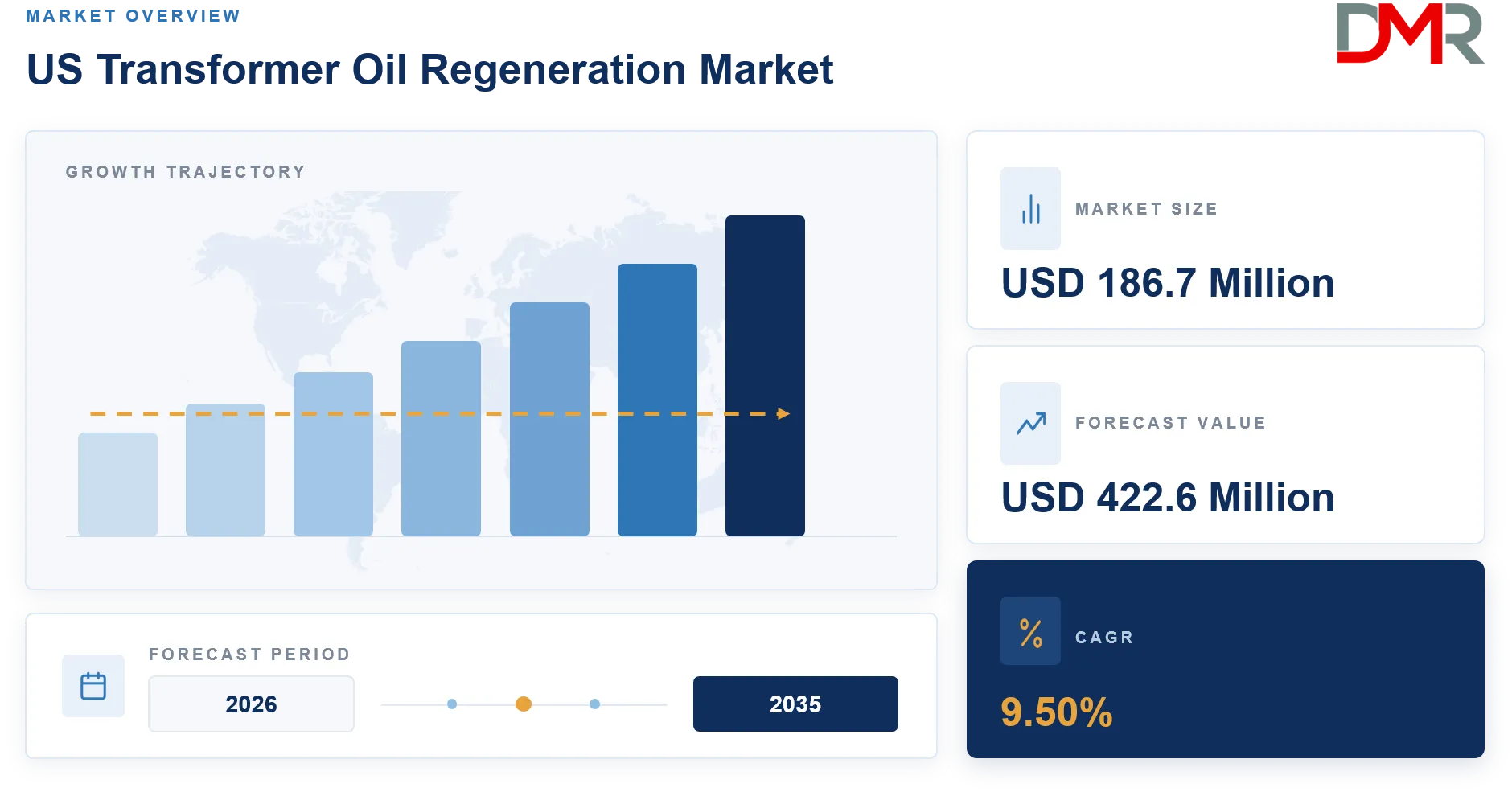
- Market Value: The US Transformer Oil Regeneration Market is valued at USD 186.7 million in 2026 and is projected to reach USD 422.6 million by 2035.
- CAGR: The market is expected to expand at a CAGR of 9.50% from 2026 to 2035.
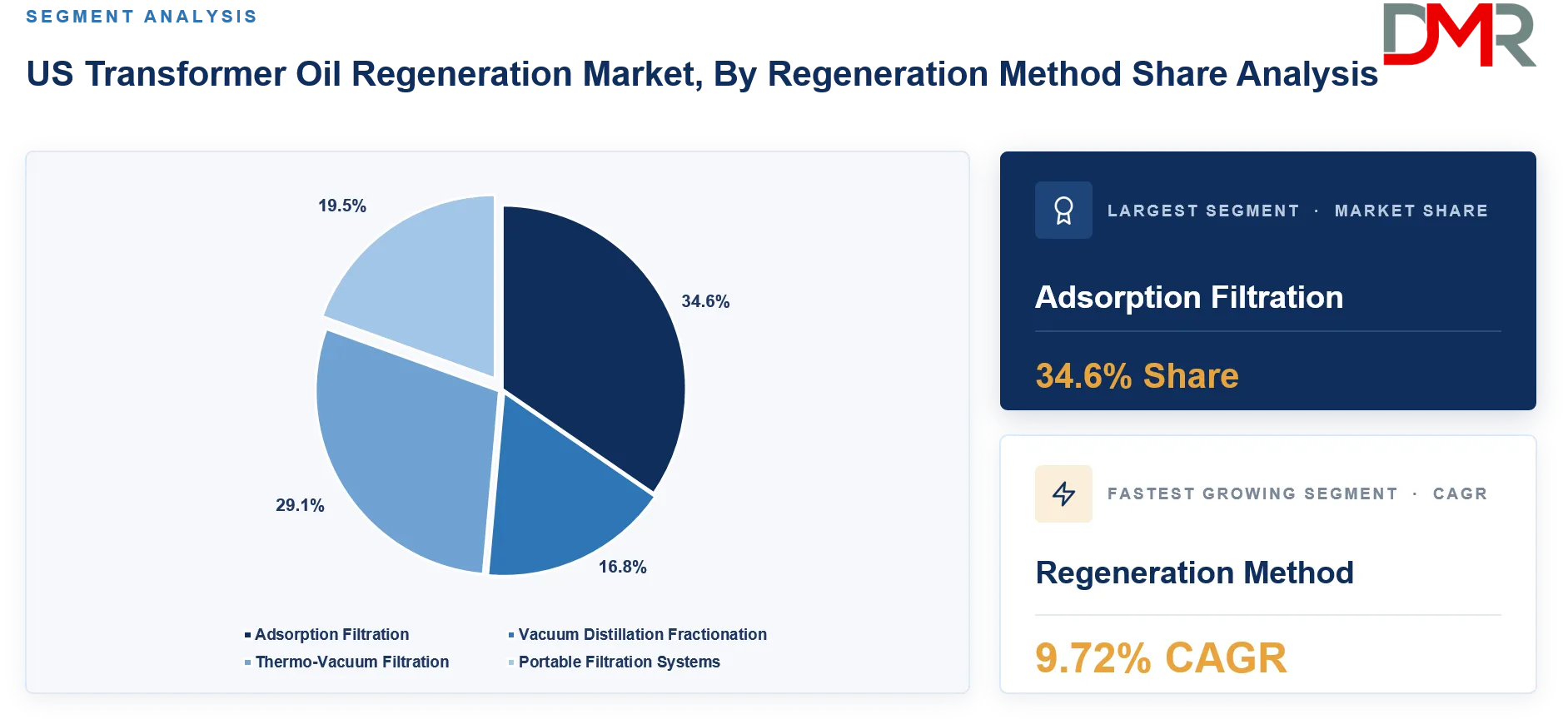
- By Regeneration Method Analysis: Adsorption Filtration led the market with a 34.6% share in 2026.
- By Plant Type Analysis: Stationary Regeneration Plants dominated with a 57.7% share in 2026.
- By Oil Type Treated Analysis: Mineral Naphthenic Oil accounted for a 62.4% share in 2026.
- By Transformer Application Analysis: Power Transformers led the market with a 46.8% share in 2026.
- Major Players: GlobeCore, Siemens Energy, Hitachi Energy, GE Vernova, Pall Corporation and Others.
What is the US Transformer Oil Regeneration Market and its Market Size?
The US Transformer Oil Regeneration Market size is projected to be valued at USD 186.7 million in 2026 and is expected to reach USD 422.6 million by 2035, expanding at a CAGR of 9.50% during the forecast period. Transformer oil regeneration restores aged insulating oil by removing moisture, dissolved gases, sludge, acids, oxidation products, and suspended contaminants that reduce dielectric and cooling performance. Unlike basic filtration, regeneration can combine adsorption, vacuum treatment, dehydration, degassing, and reinhibiting to restore important physical and chemical properties.
ℹ
To learn more about this report –
Download Your Free Sample Report Here
Demand is connected to the aging US transformer fleet, rising grid loads, long transformer replacement lead times, and utility efforts to extend the productive life of high-value electrical assets. DOE estimates that about 55% of in-service US distribution transformers are more than 33 years old, creating a large addressable base for condition monitoring, oil reclamation, and transformer life-extension services.
Use Cases
- Transformer Life Extension: Utilities regenerate oxidized insulating oil to control acidity, moisture, sludge, and dielectric deterioration while keeping otherwise serviceable transformers in operation for longer maintenance cycles.
- Substation Preventive Maintenance: Oil reclamation is integrated with dissolved gas analysis, moisture testing, dielectric breakdown testing, power-factor testing, and visual inspections to support condition-based transformer maintenance.
- Emergency Oil Processing: Mobile regeneration and vacuum treatment systems can be deployed at substations after moisture ingress, repair work, oil contamination, extended storage, or transformer relocation to restore fluid condition before energization.
- High-Voltage Asset Servicing: Power transformers, reactors, and high-voltage equipment require controlled dehydration and degassing because dissolved gases, water, particles, and oxidation products can weaken insulating performance and accelerate aging.
- Oil Reuse and Waste Reduction: Regeneration enables utilities and industrial operators to reuse suitable insulating oil rather than routinely replacing the complete oil volume, reducing virgin oil requirements, transport needs, and used-oil handling volumes.
How AI and Gen AI are Transforming the US Transformer Oil Regeneration Market?
Digital analytics are changing how utilities decide when transformer oil should be filtered, regenerated, replaced, or left in service. Modern asset-management platforms can combine dissolved gas analysis, moisture, acidity, interfacial tension, dielectric strength, loading history, temperature, fault records, and transformer age to identify assets with rapidly deteriorating insulation systems. This shifts oil maintenance from fixed schedules toward condition-based intervention. For regeneration providers, better asset scoring can improve crew scheduling, treatment-volume planning, mobile-unit utilization, and prioritization of transformers where oil reclamation can deliver the greatest lifecycle benefit.
Generative tools are also becoming useful for maintenance documentation, service reports, historical test comparison, work-order preparation, and engineering knowledge retrieval. Their commercial value is strongest when they support qualified engineering decisions rather than replace laboratory testing. Over the forecast period, regeneration equipment is likely to become more connected through PLC controls, sensors, automated data logging, remote alarms, flow monitoring, vacuum monitoring, temperature controls, and digital service records. This supports the transition from standalone oil-treatment equipment toward integrated transformer lifecycle management, especially among utilities operating large fleets across multiple substations.
Key Drivers in the US Transformer Oil Regeneration Market
Aging Transformer Fleet and Replacement Constraints
The aging US transformer base is a central demand driver for oil regeneration. DOE research estimates 60 million to 80 million distribution transformers are installed in the country and about 55% of operating units are more than 33 years old. At the same time, transformer supply constraints have increased the strategic value of maintaining existing assets. DOE reported that distribution transformer lead times increased from roughly three to six months in 2019 to 12 to 30 months in 2023. Regeneration therefore gives utilities another asset-life management option when immediate transformer replacement is costly or difficult.
Rising Grid Capital Investment and Electricity Demand
US grid spending is expanding the installed and serviced transformer base. EIA reported electricity distribution capital investment of USD 50.9 billion in 2023 after an increase of USD 6.5 billion from 2022, while transmission spending reached USD 27.7 billion. Investment is directed toward aging infrastructure replacement, new transformers, substations, resilience, renewable integration, and capacity expansion. Higher utilization of both existing and new liquid-filled transformer assets creates recurring demand for oil testing, filtration, dehydration, degassing, reclamation, and preventive maintenance services.
Restraints in the US Transformer Oil Regeneration Market
Technical Limits of Oil Regeneration
Oil regeneration cannot correct every transformer condition. Serious winding damage, degraded cellulose insulation, major internal faults, structural defects, persistent contamination, severe corrosion, or end-of-life equipment can make repair or replacement more appropriate. Buyers therefore require oil analysis and transformer diagnostics before approving reclamation. This limits regeneration revenue to assets with recoverable fluid and acceptable internal condition. Service providers that combine laboratory analysis, dissolved gas analysis, electrical testing, oil treatment, repair, and engineering assessment are better positioned to address this constraint.
Environmental Handling and PCB Compliance Requirements
Transformer fluid service can involve strict handling procedures when oil contains regulated contaminants or when the historical PCB status of equipment is uncertain. US operators must also comply with applicable used-oil management requirements under 40 CFR Part 279. These obligations increase testing, documentation, transportation, worker training, storage, and disposal requirements for some projects. Specialized providers with PCB analysis, permitted handling processes, tanker logistics, oil recycling capabilities, and documented chain-of-custody practices can gain an advantage where compliance complexity discourages smaller operators.
Growth Opportunities in the US Transformer Oil Regeneration Market
Transformer Refurbishment and Reuse Programs
Transformer shortages are increasing interest in refurbishment, repair, reuse, and life extension. In August 2026, DOE stated that its planned grid supply-chain program could provide up to USD 375 million to strengthen domestic manufacturing of distribution and power transformers and specifically highlighted refurbishment and reuse of existing grid equipment as a supply-chain strategy. Oil regeneration can become an important supporting service because refurbished liquid-filled assets often require oil testing, dehydration, degassing, reclamation, vacuum filling, and final dielectric verification before return to service.
Expansion of Mobile On Site Regeneration
On Site Regeneration Services already account for 51.7% of the market in 2026, and mobile treatment offers further growth potential. Utilities can process oil at the transformer location, reducing oil transportation, tank handling, and extended asset movement. Advanced mobile systems can integrate adsorption, vacuum degassing, dehydration, filtration, reinhibiting, monitoring, and automated controls. This service model is particularly relevant to large power transformers and remote substations where removing the transformer or transporting large oil volumes would add logistics cost and operational complexity.
Trends in the US Transformer Oil Regeneration Market
Shift from Filtration to Full Oil Reclamation
The market is moving beyond particulate filtration toward processes that address chemical aging. Vacuum systems are effective for removing water, dissolved gases, and particles, while adsorption media can additionally target acids, oxidation products, color bodies, and polar contaminants. Suppliers increasingly integrate these processes in a single treatment train. For buyers, this distinction matters because heavily aged oil may require reclamation rather than basic purification. The dominance of Adsorption Filtration, with a 34.6% share in 2026, reflects demand for deeper restoration of aging mineral transformer oil.
Automation and Continuous Process Monitoring
Semi Automatic Units hold 46.2% of the market in 2026 because they balance operator control with process consistency and investment cost. The next stage of development is greater use of PLC-based control, automated temperature regulation, vacuum control, flow measurement, oil-level protection, alarms, data logging, and remote process visibility. Fully automatic systems are especially attractive for high-throughput stationary plants and large mobile service fleets. Enervac, for example, offers regeneration systems with automated control and data-logging options, illustrating the industry's shift toward monitored and repeatable processing.
Research Scope and Analysis
The US Transformer Oil Regeneration Market is segmented based on Regeneration Method, Plant Type, Oil Type Treated, Transformer Application, End User Industry, Automation Level, and Service Model. The study evaluates how treatment technology, transformer fleet characteristics, utility maintenance strategies, oil chemistry, service delivery models, automation, grid investment, and asset-life economics influence demand across these segments.
ℹ
To learn more about this report –
Download Your Free Sample Report Here
By Regeneration Method
Adsorption Filtration dominated the regeneration method segment with a 34.6% share in 2026. Its position is supported by the ability of adsorbent media to remove oxidation compounds and other polar contaminants that conventional particulate filtration cannot adequately address. Fuller’s earth and engineered adsorbent systems are used to lower acidity, improve color and interfacial properties, and restore aged mineral oil when combined with dehydration and degassing. GlobeCore and Enervac both commercialize adsorption-based regeneration configurations, including systems that reactivate the treatment media. This reduces the need for frequent disposal of saturated sorbent and supports high-volume utility applications.
By Plant Type
Stationary Regeneration Plants accounted for 57.7% of the US market in 2026. Their leadership is associated with higher throughput, controlled operating conditions, centralized oil processing, permanent piping and storage infrastructure, laboratory integration, and suitability for organizations handling large fluid volumes. Stationary plants are particularly useful for transformer service centers, oil recyclers, equipment refurbishment operations, and utilities with centralized maintenance facilities. Mobile systems remain strategically important for field projects, but stationary plants can achieve strong utilization when contaminated oil from multiple locations is consolidated for treatment and quality verification.
Additional Leading Segment Findings
Mineral Naphthenic Oil held 62.4% of the Oil Type Treated segment in 2026 due to the large installed base of mineral-oil-filled transformers and established testing and treatment practices. Power Transformers represented 46.8% of Transformer Application revenue because these high-value assets contain substantial oil volumes and carry significant outage consequences. Transmission and Distribution Utilities accounted for 39.5% of end-user revenue because they manage large transformer fleets and structured maintenance programs. Semi Automatic Units held 46.2% by automation level, while On Site Regeneration Services led the service model with 51.7% due to field treatment requirements and the economics of avoiding large-scale oil movement.
The US Transformer Oil Regeneration Market Report is Segmented on the Basis of the Following:
By Regeneration Method
- Vacuum Distillation Fractionation
- Adsorption Filtration
- Thermo-Vacuum Filtration
- Portable Filtration Systems
By Plant Type
- Mobile Regeneration Plants
- Stationary Regeneration Plants
By Oil Type Treated
- Mineral Naphthenic Oil
- Mineral Paraffinic Oil
- Silicone Based Oil
- Bio Based Ester Oil
By Transformer Application
- Power Transformers
- Distribution Transformers
- Instrument Transformers
- Reactors
- Switchgear Units
By End User Industry
- Transmission and Distribution Utilities
- Power Generation Utilities
- Industrial Captive Substations
- Renewables Substations
- Railways and Metros
- Commercial Infrastructure
- Residential Infrastructure
By Automation Level
- Manual Operated Units
- Semi Automatic Units
- Fully Automatic Units
By Service Model
- On Site Regeneration Services
- Off Site Reclamation Services
- In Plant Purification Units
Competitive Landscape
The US Transformer Oil Regeneration Market is moderately fragmented across transformer OEMs, specialized oil-treatment equipment manufacturers, national service organizations, regional field-service companies, and recycling providers. Competition centers on oil-restoration performance, processing capacity, mobile deployment, automation, laboratory support, service response time, safety, environmental handling, and the ability to combine fluid treatment with transformer diagnostics and repair. Siemens Energy, Hitachi Energy, and GE Vernova position regeneration within broader transformer lifecycle and asset-management portfolios.
GlobeCore and Enervac compete strongly through dedicated regeneration, adsorption, vacuum, and mobile processing technologies. RESA Power combines oil reclamation with testing, field maintenance, transformer repair, and a broad US service network, while Emerald Transformer integrates oil processing with transformer repair, recycling, PCB handling, and lifecycle services. Market differentiation is therefore moving toward integrated solutions that can test the oil, diagnose the transformer, perform treatment, verify results, document compliance, and return the asset to service through a single provider.
Some of the prominent players in the US Transformer Oil Regeneration Industry are:
- GlobeCore
- Siemens Energy
- Hitachi Energy
- GE Vernova
- Pall Corporation
- Kleentek
- Environmental Management of KC
- RESA Power
- Power Substation Services
- Enervac International
- ComRent International
- Axiom Oil Purification Systems
- Liquid Process Systems
- MMC International
- Bowe & Gant
- Sabino Electric
- Emerald Transformer
- A-Line E.D.S.
- Voltec Services
- SC Industrial Sales
- Others
Technology Analysis
Technology development in the US Transformer Oil Regeneration Market is shifting from basic filtration toward integrated systems that restore several oil properties in one treatment cycle. Modern plants combine adsorption filtration, vacuum dehydration, degassing, fine-particle removal, heating, inhibitor dosing, and continuous process monitoring. Adsorption systems are important for aged mineral oil because activated media can remove acids, sludge precursors, oxidation products, and polar contaminants that mechanical filtration alone cannot address. Vacuum processing complements regeneration by reducing moisture and dissolved gases that weaken dielectric performance.
Equipment suppliers are also integrating PLC controls, automatic valves, temperature and vacuum sensors, flow meters, alarms, and data logging to improve treatment consistency. Mobile regeneration technology is expanding the commercial scope of on-site services by allowing utilities to process large oil volumes at substations without transporting the transformer. Regenerable adsorbent technology further improves operating economics by allowing treatment media to be reactivated and reused across multiple processing cycles.
Regulatory Landscape
The regulatory landscape for the US Transformer Oil Regeneration Market is shaped by federal and state requirements covering used oil, PCB-containing equipment, hazardous materials, worker safety, transportation, spill management, and environmental protection. The US Environmental Protection Agency regulates used-oil management under 40 CFR Part 279, which establishes requirements affecting storage, labeling, processing, transportation, and recycling activities. Transformer owners and service providers must also evaluate PCB concentrations because electrical equipment and fluids containing regulated PCB levels can fall under Toxic Substances Control Act requirements in 40 CFR Part 761.
These rules make oil sampling, laboratory verification, documentation, containment, and compliant waste handling important parts of regeneration projects. OSHA requirements influence worker protection during high-voltage maintenance and oil-processing operations, while DOT rules can apply when regulated fluids are transported. This framework favors established regeneration providers with documented testing, environmental controls, trained field personnel, traceable oil handling, and compliant disposal capabilities.
Recent Developments
- August 2026: Enervac International shipped Hitachi Energy a custom E575R mobile oil-regeneration system, combining 2,400-GPH degasification, dual vacuum pumps and automated regeneration for field servicing.
- June 2026: Hitachi Energy broke ground on its $457 million South Boston, Virginia, transformer factory, expected to create 825 jobs and nearly double the site workforce.
- February 2026: Siemens Energy committed $1 billion to U.S. manufacturing, including expanded transformer production and servicing in North Carolina and a new Mississippi grid-components factory.
Report Details
| Report Characteristics |
| Market Size (2026) |
USD 186.7 Million |
| Forecast Value (2035) |
USD 422.6 Million |
| CAGR (2026-2035) |
9.50% |
| Historical Data |
2021 - 2025 |
| Forecast Data |
2027 - 2035 |
| Base Year |
2025 |
| Estimate Year |
2026 |
| Segments Covered |
By Regeneration Method (Vacuum Distillation Fractionation, Adsorption Filtration, Thermo-Vacuum Filtration, and Portable Filtration Systems), By Plant Type (Mobile Regeneration Plants and Stationary Regeneration Plants), By Oil Type Treated (Mineral Naphthenic Oil, Mineral Paraffinic Oil, Silicone Based Oil, and Bio Based Ester Oil), By Transformer Application (Power Transformers, Distribution Transformers, Instrument Transformers, Reactors, and Switchgear Units), By End User Industry (Transmission and Distribution Utilities, Power Generation Utilities, Industrial Captive Substations, Renewables Substations, Railways and Metros, Commercial Infrastructure, and Residential Infrastructure), By Automation Level (Manual Operated Units, Semi Automatic Units, and Fully Automatic Units), By Service Model (On Site Regeneration Services, Off Site Reclamation Services, and In Plant Purification Units) |
| Regional Coverage |
United States |
Frequently Asked Questions
What is the current size of the US Transformer Oil Regeneration Market?
▾ The US Transformer Oil Regeneration Market size is valued at USD 186.7 million in 2026 and forecast to reach USD 422.6 million by 2035.
What is the growth rate of the US Transformer Oil Regeneration Market during?
▾ The US Transformer Oil Regeneration Market is expected to grow at a CAGR of 9.50% during the forecast period 2026-2035.
What factors are driving the growth of the US Transformer Oil Regeneration Market?
▾ Aging transformers, grid upgrades, rising power demand, asset life extension, and maintenance needs drive the US Transformer Oil Regeneration Market.
What are the major challenges restraining the US Transformer Oil Regeneration Market?
▾ PCB compliance, oil testing requirements, technical treatment limits, and replacement needs restrain the US Transformer Oil Regeneration Market.
Which segment holds the largest share of the US Transformer Oil Regeneration Market?
▾ Adsorption Filtration holds a 34.6% share of the US Transformer Oil Regeneration Market by regeneration method in 2026.
Who are the leading companies in the US Transformer Oil Regeneration Market?
▾ GlobeCore, Siemens Energy, Hitachi Energy, GE Vernova, Pall Corporation, Kleentek, Environmental Management of KC, RESA Power, Power Substation Services, Enervac International, ComRent International, Axiom Oil Purification Systems, Liquid Process Systems, MMC International, Bowe & Gant, Sabino Electric, Emerald Transformer, A-Line E.D.S., Voltec Services, and SC Industrial Sales are prominent companies in the US Transformer Oil Regeneration Market.
How is AI influencing the US Transformer Oil Regeneration Market?
▾ AI supports oil condition analysis, predictive maintenance, fault detection, service planning, and asset monitoring in the US Transformer Oil Regeneration Market.
What are the future opportunities and trends in the US Transformer Oil Regeneration Market?
▾ Mobile regeneration, automation, predictive maintenance, oil reuse, and grid modernization offer opportunities in the US Transformer Oil Regeneration Market.