Market Overview
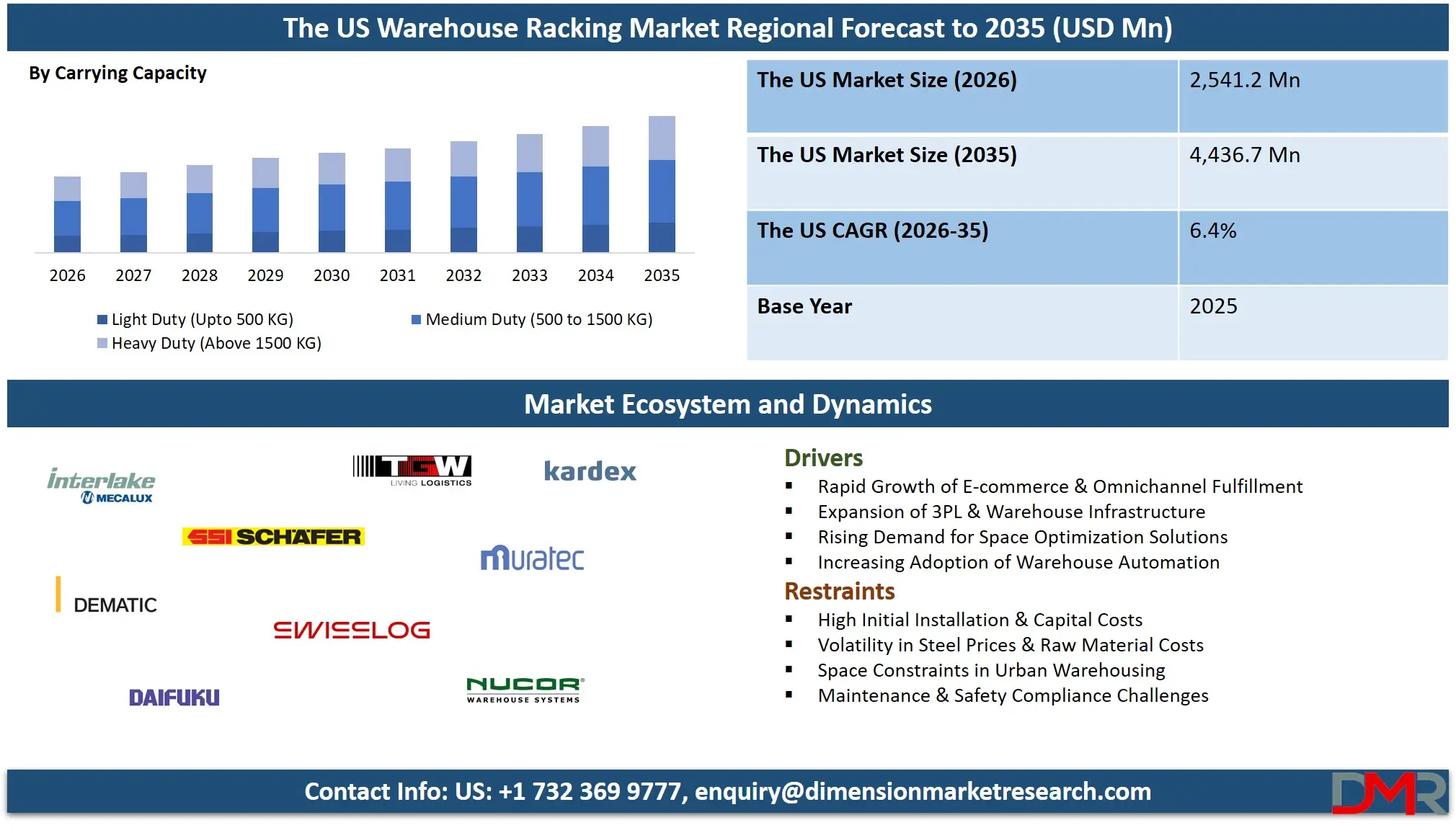
The US warehouse racking market size is estimated to reach USD 2,541.2 million in 2026 and is projected to grow at a CAGR of 6.4%, reaching USD 4,436.7 million by 2035.
ℹ
To learn more about this report –
Download Your Free Sample Report Here
Warehouse racking systems are organized storage solutions used to store and arrange various categories of stock efficiently utilizing the vertical space of warehouses and distribution centers. The specific rack categories, for example pallet racks, cantilever racks, or flow racks, which are capable of supporting a large range of load sizes and types of stock are chosen according to the load/bulk storage needs. Warehouse racking is a fundamental part of material handling improving the accessibility of the product, inventory control and the optimization of storage density. They are usually used in conjunction with sophisticated warehouse or order management software and automated systems to improve the pick process and so reduce labour, or to provide safe handling of all class of goods in different industries such as retail distribution, manufacturing, logistics, food distribution.
The United States warehouse racking industry is one of the most technologically advanced and developed in the overall materials handling sector. The fast-growing e-commerce market, multi-channel retail models, and the growth of large distribution centres across America are driving companies in the United States to invest in advanced storage infrastructure that will ensure maximum efficiency in the usage of warehouse space, while allowing companies to fill orders faster. The increased use of automated storage and retrieval systems is continuing to spur strong demand for palletised storage solutions, thereby strengthening the need for robust and scalable racking systems to support diverse inventory needs in high-volume, high-throughput settings.
ℹ
To learn more about this report –
Download Your Free Sample Report Here
The market is also being affected by an ongoing evolution of warehouses, including new warehouse designs, the implementation of robotics, and the move towards smart logistics ecosystems. The presence of significant 3PLs as well as expanding cold storage facilities also adds to the need for companies to have customized racking systems. The increased focus on safety standards, maximizing load capacity, and streamlining their supply chains will spur companies to modernise their existing racking systems and will ultimately help drive the continued growth of the US warehouse racking industry.
The US Warehouse Racking Market: Key Takeaways
- Strong Market Expansion Through 2035: The market is projected to grow from USD 2,541.2 million in 2026 to USD 4,436.7 million by 2035, reflecting steady long term demand for warehouse storage solutions.
- Stable Growth Rate Indicates Mature Market: A CAGR of 6.4% highlights consistent expansion driven by e-commerce growth, logistics infrastructure, and material handling demand in the US.
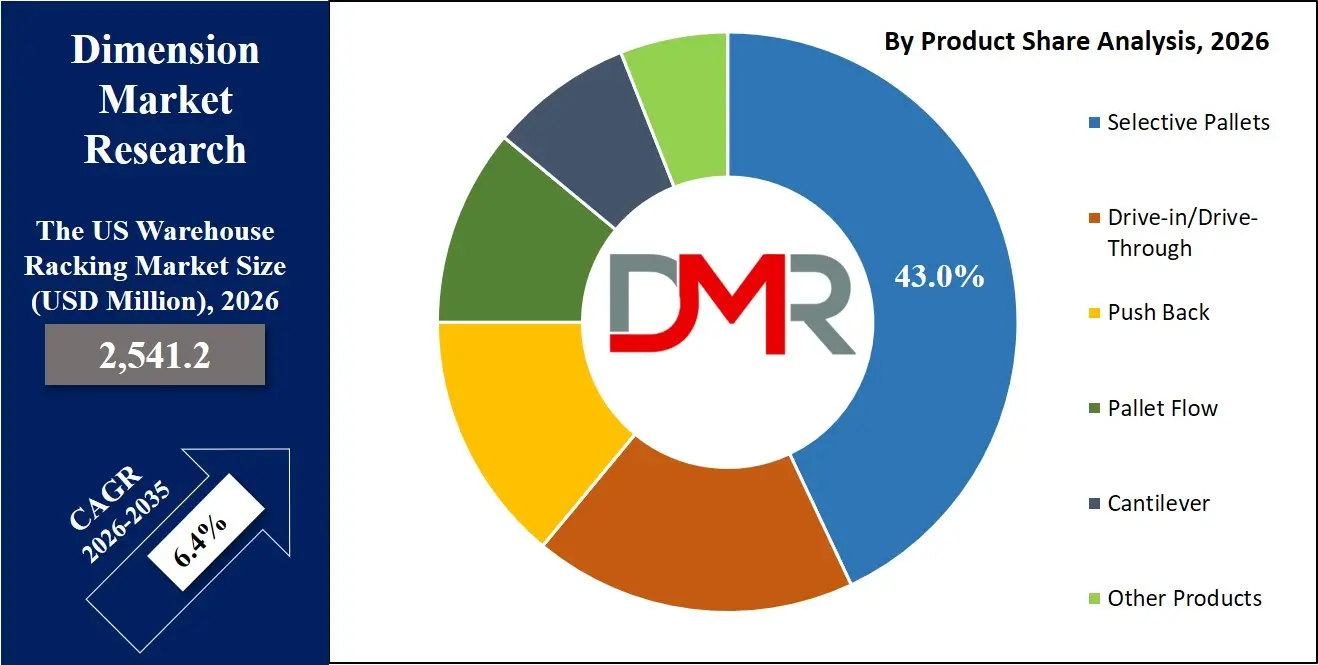
- Selective Pallet Racking Dominates Product Segment: Selective pallet systems account for 43.0% share in 2026, indicating strong preference for flexible and cost efficient storage solutions.
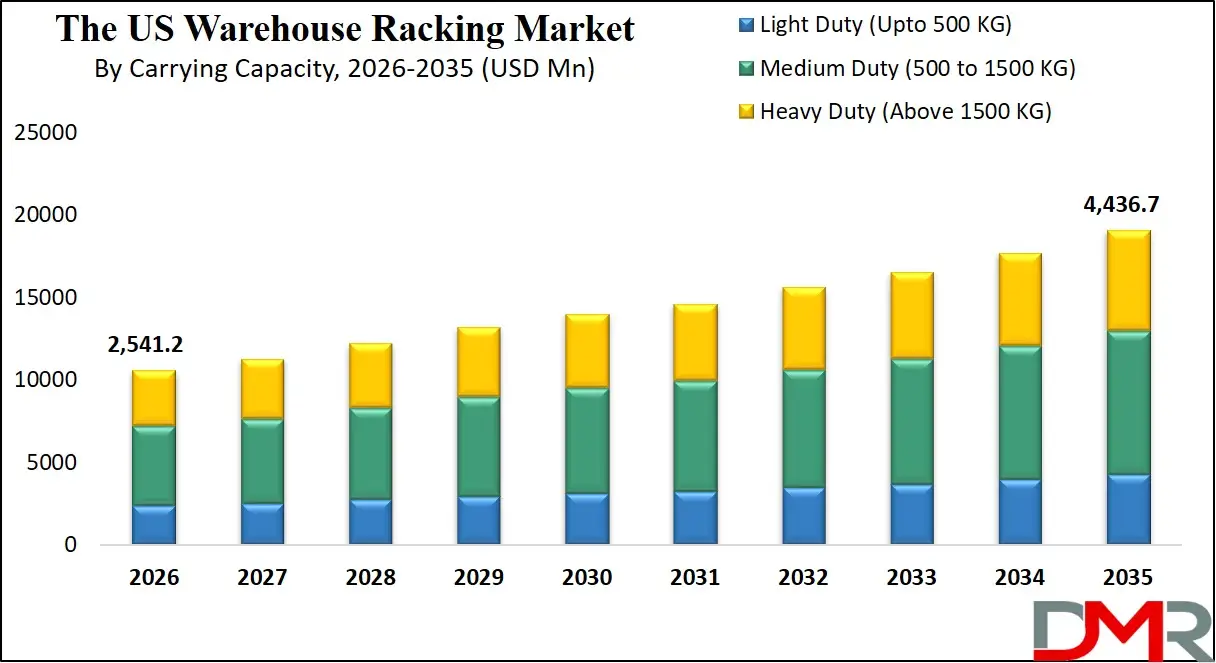
- Medium Duty Racking Leads Capacity Segment: Medium duty systems hold 46.0% market share, driven by widespread use across retail, distribution centers, and general warehousing.
- Retail Sector Drives Application Demand: Retail dominates with 34.0% share, supported by rising e commerce fulfillment and omnichannel distribution networks across the US.
The US Warehouse Racking Market: Use Cases
- Applications in Fulfillment Centres: Pallet racking systems used in fulfillment centres are in high demand, which requires the capability to support fast order picking, effective inventory control, and more warehouse storage throughput.
- Third-Party Storage and Logistics: The storage requirements of third-party warehousing are in need of flexibility and scalability. The companies are seeking racking systems that can accommodate multi-client storage, high-density storage, and efficient material handling operations.
- Food Distribution and Cold Storage: Drive-in racking has found its way in the food distribution and cold storage market due to the high density of storage, efficiency in rotating the inventory, and that of incorporating cool chain into the complete operations.
- Manufacturing and Industrial Use: The heavy-duty racking systems are necessary for bulk storage of material used in manufacturing, and the flow of material between one area and another.
Impact of Iran Conflict on the US Warehouse Racking Market
- Rising Steel and Raw Material Costs: Conflict-driven energy price spikes are increasing steel production costs, directly impacting warehouse racking prices and squeezing manufacturer margins.
- Supply Chain Disruptions and Delays: Disruptions to shipping routes and longer transit times are currently delaying the delivery of material handling equipment and the completion of numerous warehouse infrastructure projects throughout the United States.
- Increased Logistics and Transportation Costs: Higher fuel prices and war risk surcharges are raising freight and installation costs, affecting overall warehouse racking system deployment budgets.
- Short Term Demand Volatility with Inventory Stockpiling: Uncertainty in the supply chain will cause the company to purchase additional steel and more storage systems, and create temporary spikes in demand for warehouse expansion projects.
The US Warehouse Racking Market: Stats & Facts
- U.S. Bureau of Labor Statistics (BLS)
- Warehousing and storage employment reached 1.84 million workers in December 2025.
- Employment stood at 1.83 million in January 2026 (preliminary).
- The transportation and warehousing sector employed 6.6 million workers in June 2024.
- The sector accounted for 5% of total private sector employment in 2024.
- Warehousing and storage employment exceeded 1.25 million workers in 2024.
- Industrial truck and tractor operators accounted for 322,590 jobs in 2024.
- Laborers and material movers represented 437,680 jobs in 2024.
- Stock clerks and order fillers totaled 401,150 workers in 2024.
- Shipping and receiving clerks accounted for 92,970 jobs in 2024.
- Transportation and distribution managers numbered 20,650 in 2024.
- Male workers represented 66% of warehousing workforce in 2023.
- Workers aged 25–54 accounted for 64.1% of workforce in 2023.
- Workers aged 55+ accounted for 23.2% in 2023.
- Workers aged 16–24 accounted for 12.7% in 2023.
- Workplace fatalities in warehousing increased to 32 cases in 2024 from 28 in 2023.
- Injury and illness rate in warehousing was 4.8 cases per 100 workers in 2024.
- Cases involving days away from work were 1.5 per 100 workers in 2024.
- Labor productivity declined by 0.1% in 2024.
- Total factor productivity increased by 1.7% in 2024 after decline in 2023.
- Output growth remained marginal at 0.2% in 2024.
The US Warehouse Racking Market: Market Dynamic
Driving Factors in the US Warehouse Racking Market
Growth of E-commerce and Omnichannel Distribution
The explosive growth of e-commerce and omnichannel retail in the US is a major factor propelling the demand for high end warehouse racking systems. Organizations are equipping their warehouses with pallet racking, high density storage options, and automated storage systems to reduce order cycle times, warehouse footprint, and improve inventory management and tracking. This in turn is pushing for the adoption of scalable material handling infrastructure in fulfillment centers and distribution centers.
Expansion of 3PL and Warehouse Infrastructure
A rising number of third party logistics 3PL companies is creating the need for flexible and modular warehouse storage systems. These companies require adaptable racking configurations that handle a wide variety of inventory, increase load handling capacity, and enable a wide range of supply chain scenarios. Hence the demand for selective pallet racks push back systems and integrated warehouse management systems is rising.
Restraints in the US Warehouse Racking Market
High Costs for Capitalizing and Installing Industrial Racks
Deploying warehouse racking systems requires a large initial capital outlay, which can include constructing, customizing, and integrating the racking system with other automation technologies. Small and medium-sized businesses (SMEs) usually have limited budgets to adopt modern storage solutions, thus capping their potential market share at present.
Raw Materials Price Volatility
High rate fluctuations of steel and metals have a direct impact on the cost of manufacturing racking systems. The uncertainty of fluctuating prices will limit manufacturers' ability to develop pricing strategies and profit margins, and will limit long-term procurement plans for warehouse infrastructure projects, which create long-term uncertainties both for customers and their suppliers.
Opportunities in the US Warehouse Racking Market
Automated Storage Solutions Expanded
The availability of automated solutions offers significant opportunities for businesses to grow by utilizing automation components, including picking robots, conveyor systems, and automated storage facilities. Improvements in operational efficiencies, reduction in labor dependency, and improvements in an organization’s overall management of its inventory will continue to drive businesses to look to the creation of smart warehouses.
Growth of Cold Chain and Specialized Warehousing
There is an increase in demand for refrigerated products being stored in cold chain environments, as well as those products stored within specialized warehousing. This has caused businesses that are currently using custom racking systems to come up with new designs that incorporate a greater density of storage. For example, drive-in/pallet flow rack systems are designed specifically for cold chain applications, enabling businesses to improve their logistics in terms of storage efficiency and enhancing the quality of their product.
Trends in the US Warehouse Racking Market
Shift Toward Smart and Connected Warehousing
The market is witnessing a growing trend toward digital transformation, where warehouse racking systems are integrated with warehouse management systems and IoT enabled tracking tools. This enhances real time inventory monitoring, improves operational accuracy, and supports data driven decision making in logistics operations.
Increasing Focus on Space Optimization and Sustainability
Companies are prioritizing vertical storage solutions and energy efficient warehouse designs to maximize storage capacity while reducing operational costs. Sustainable materials, optimized rack layouts, and efficient material handling practices are becoming key trends in modern warehouse infrastructure development.
The US Warehouse Racking Market: Research Scope and Analysis
By Product Analysis
Selective pallet racking is anticipated to dominate the product segment, capturing around 43.0% of the total market share in 2026. Selective pallet rack systems are the most common form of racking system used within the U.S. since they can also be configured to have access to all the pallets within the rack directly, making them applicable to facilities where selectivity and rapid picking are highly demanded, like e-commerce fulfillment centers or retail distribution centers. The other benefits of selective pallet rack systems that allow them to be the most popular form of rack system are that they can be used with most types of forklifts, can be configured in most any distribution of a warehouse, and can be integrated into a warehouse management system, which allows greater control over inventory, optimum use of space, and operational efficiency.
ℹ
To learn more about this report –
Download Your Free Sample Report Here
On the other hand, the drive-in and drive-through racking systems have their essential role in the storage operation of the high-density storage, where space maximization is the ultimate goal. Drive-in/drive-through racking systems are constructed so as to store huge quantities of a similar product of the same type in the structure by allowing the forklift to move into the racking structure. Such a layout significantly reduces the size of aisle space required, meaning that it will have higher storage capacity. Drive-in /drive-through racking system is best suited to be applied in industries like food and beverage, cold storage, and bulk manufacturing industries where the inventory turnover is relatively low and consequently the pallet selectivity is also low.
By Carrying Capacity Analysis
Medium duty racking systems with a carrying capacity of 500 to 1500 kg are anticipated to dominate the segment, accounting for around 46.0% of the total market share in 2026, driven by their wide applicability across retail, e commerce, and general warehousing operations. These systems offer an optimal balance between load bearing strength and cost efficiency, making them ideal for storing a diverse range of products such as consumer goods, packaged items, and medium weight inventory. Their flexibility, ease of configuration, and compatibility with standard pallet sizes support efficient inventory management, improved picking operations, and better warehouse space utilization, which are critical for high throughput distribution centers in the United States.
Heavy duty racking systems with a carrying capacity above 1500 kg are primarily used in industries that require storage of bulky and high weight materials such as automotive, manufacturing, and industrial equipment. These systems are designed to handle substantial loads with enhanced structural strength and durability, ensuring safety and long term performance in demanding warehouse environments. The increasing demand for bulk storage, raw material handling, and large scale industrial operations is supporting the adoption of heavy duty racking solutions, particularly in facilities focused on maximizing vertical storage capacity and optimizing material handling efficiency.
By Application Analysis
Retail is anticipated to dominate the application segment, capturing around 34.0% of the total market share in 2026, driven by the rapid growth of e commerce, omnichannel retailing, and large scale distribution networks across the United States. Retailers are increasingly investing in advanced warehouse racking systems such as selective pallet racks and high density storage solutions to improve order fulfillment speed, inventory accuracy, and warehouse space utilization. The need for efficient inventory management, fast picking operations, and seamless integration with warehouse management systems is further strengthening the adoption of flexible and scalable storage infrastructure in retail warehouses and fulfillment centers.
The food and beverage segment also represents a significant share of the market, supported by the rising demand for cold storage, perishable goods handling, and efficient supply chain operations. This segment requires specialized warehouse racking systems such as drive in, push back, and pallet flow racks to enable high density storage, proper inventory rotation, and temperature controlled storage environments. Increasing consumption of packaged foods, growth in grocery distribution, and expansion of cold chain logistics are driving the need for durable, hygienic, and space efficient racking solutions in food and beverage warehouses across the US market.
The US Warehouse Racking Market Report is segmented on the basis of the following:
By Product
- Selective Pallets
- Drive-in/Drive-Through
- Push Back
- Pallet Flow
- Cantilever
- Other Products
By Carrying Capacity
- Light Duty (Upto 500 KG)
- Medium Duty (500 to 1500 KG)
- Heavy Duty (Above 1500 KG)
By Application
- Retail
- Food & Beverage
- Automotive
- Packaging
- Manufacturing
- 3PL/Logistics
- Other Applications
Impact of Artificial Intelligence in the US Warehouse Racking Market
Artificial intelligence is transforming the US warehouse racking market by enabling smarter warehouse design, optimized storage allocation, and improved inventory management. AI powered warehouse management systems analyze demand patterns, SKU movement, and storage density to recommend the most efficient racking configurations such as selective pallet, high density, and automated storage systems. This helps businesses maximize warehouse space utilization, reduce picking time, and enhance operational efficiency. Integration of AI with robotics and automated storage and retrieval systems is further improving material handling speed, accuracy, and real time inventory visibility across distribution centers.
In addition, AI is driving predictive maintenance and safety optimization within warehouse racking infrastructure. Advanced analytics and sensor based monitoring allow companies to detect load imbalances, structural stress, and potential failures in racking systems, reducing downtime and ensuring compliance with safety standards. AI driven demand forecasting is also enabling better capacity planning and dynamic storage adjustments, supporting scalable warehouse operations. As companies increasingly adopt smart logistics and data driven decision making, AI is becoming a key enabler in modernizing warehouse storage solutions and enhancing overall supply chain performance in the US market.
The US Warehouse Racking Market: Competitive Landscape
The US warehouse racking market competitive landscape is moderately fragmented, characterized by the presence of both established global solution providers and strong domestic manufacturers competing on product innovation, customization, and service capabilities. Companies are focusing on advanced storage systems, high density racking solutions, and integration with warehouse automation technologies to strengthen their market position.
ℹ
To learn more about this report –
Download Your Free Sample Report Here
Strategic initiatives such as capacity expansion, regional distribution network enhancement, and after sales services are key differentiators, while increasing demand from e commerce, retail, and logistics sectors is intensifying competition. Additionally, players are investing in smart warehouse solutions, automation compatibility, and sustainable materials to gain a competitive edge, as the market continues to evolve with growing emphasis on efficiency, scalability, and optimized supply chain performance.
Some of the prominent players in the US Warehouse Racking Market are:
- Interlake Mecalux
- SSI Schaefer
- Dematic
- Daifuku America
- TGW Logistics Group
- Swisslog
- Kardex
- Murata Machinery USA
- Nucor Warehouse Systems
- Steel King Industries
- Ridg-U-Rak
- Frazier Industrial Company
- Hannibal Industries
- Advance Storage Products
- Unarco Material Handling
- Speedrack Products Group
- AR Racking
- SJF Material Handling
- Elite Storage Solutions
- Rack Builders Inc.
- Other Key Players
Recent Developments in the US Warehouse Racking Market
- March 2026: Marvell Technology announced the acquisition of Celestial AI to strengthen rack level infrastructure and data processing capabilities, indirectly supporting advanced warehouse and data storage systems.
- February 2026: Nippon Rack Industries introduced high performance modular racking systems optimized for automated storage and retrieval systems, enhancing warehouse automation efficiency and storage density.
- October 2025: Dexory raised USD 165 million in funding to expand its AI driven warehouse analytics and robotics solutions across the US and Europe.
Report Details
| Report Characteristics |
| Market Size (2026) |
USD 2,541.2 Mn |
| Forecast Value (2035) |
USD 4,436.7 Mn |
| CAGR (2026–2035) |
6.4% |
| Historical Data |
2021 – 2025 |
| Forecast Data |
2027 – 2035 |
| Base Year |
2025 |
| Estimate Year |
2026 |
| Report Coverage |
Market Revenue Estimation, Market Dynamics, Competitive Landscape, Growth Factors and etc. |
| Segments Covered |
By Product (Selective Pallets, Drive-in/Drive-Through, Push Back, Pallet Flow, Cantilever, Other Products), By Carrying Capacity (Light Duty up to 500 KG, Medium Duty 500 to 1500 KG, Heavy Duty Above 1500 KG), and By Application (Retail, Food & Beverage, Automotive, Packaging, Manufacturing, 3PL/Logistics, Other Applications) |
| Country Coverage |
The US |
| Prominent Players |
Interlake Mecalux, SSI Schaefer, Dematic, Daifuku America, TGW Logistics Group, Swisslog, Kardex, Murata Machinery USA, Nucor Warehouse Systems, Steel King Industries, Ridg-U-Rak, Frazier Industrial Company, Hannibal Industries, Advance Storage Products, Unarco Material Handling, Speedrack Products Group, AR Racking, SJF Material Handling, Elite Storage Solutions, Rack Builders Inc., and Other Key Players |
| Purchase Options |
We have three licenses to opt for: Single User License (Limited to 1 user), Multi-User License (Up to 5 Users) and Corporate Use License (Unlimited User) along with free report customization equivalent to 0 analyst working days, 3 analysts working days and 5 analysts working days respectively. |
Frequently Asked Questions
How big is the US Warehouse Racking Market?
▾ The US Warehouse Racking Market size is estimated to have a value of USD 2,541.2 million in 2026 and is expected to reach USD 4,436.7 million by the end of 2035.
What is the growth rate in the US Warehouse Racking Market in 2026?
▾ The market is growing at a CAGR of 6.4% over the forecasted period of 2026.
Who are the key players in the US Warehouse Racking Market?
▾ Some of the major key players in the US Warehouse Racking Market areInterlake Mecalux, Ridg-U-Rak, Steel King Industries, Frazier Industrial Company, Advance Storage Products, Hannibal Industries, Speedrack Products Group, Nucor Warehouse Systems, SSI Schaefer, Dematic, Daifuku America, Kardex, and many others.