Market Snapshot
- Market Size (2026): USD 6.4 Bn
- Forecast Value (2035): USD 24.0 Bn
- CAGR (2026-2035): 15.8%
- Leading By Component (2026): Hardware, around 44%
- Leading By Application (2026): Mission Critical Voice and Data, close to 34%
- Key Players: AT&T, Motorola Solutions, Verizon and others
What is US Wireless Broadband in Public Safety Market and its Market Size?
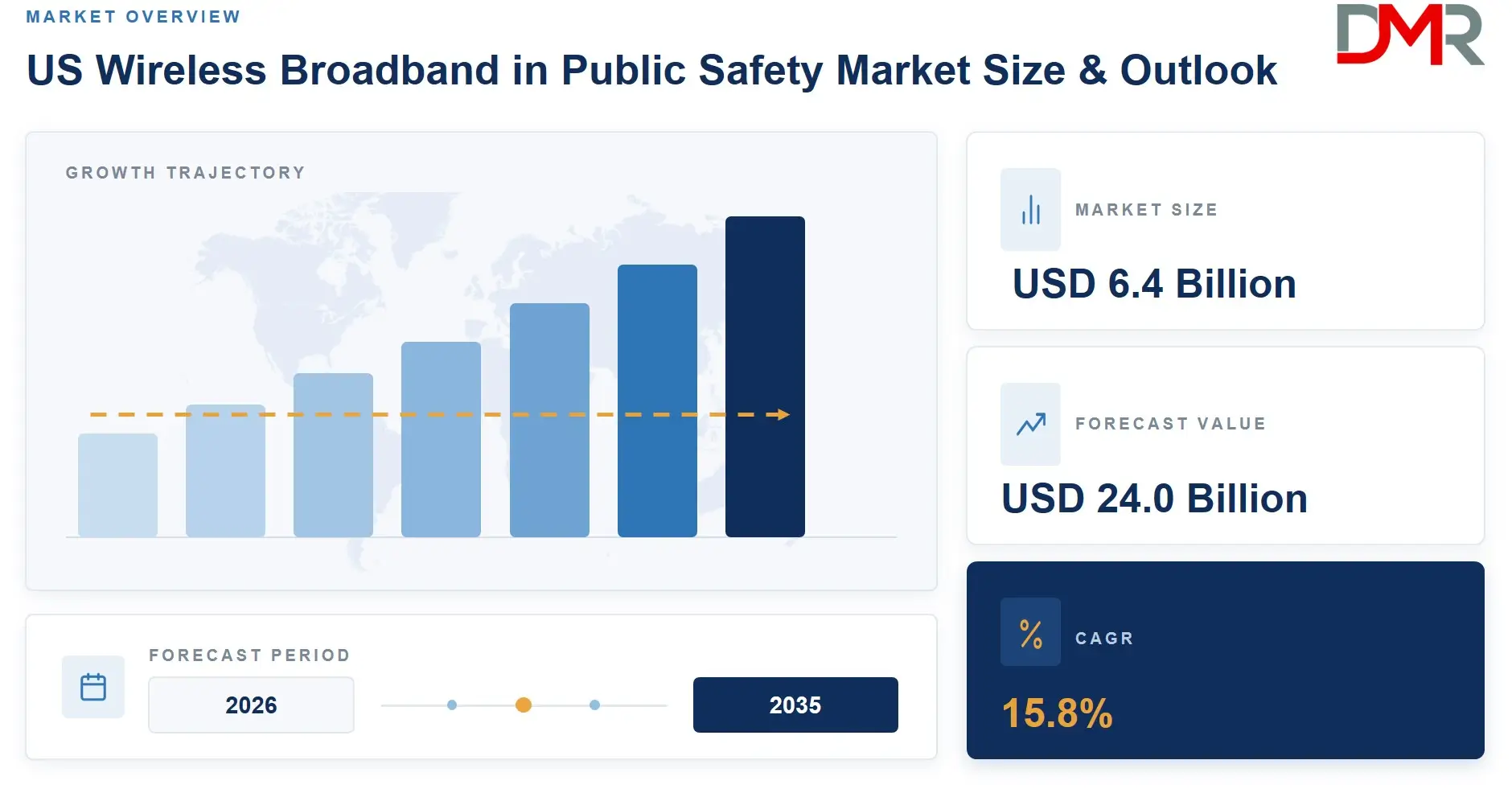
The US Wireless Broadband in Public Safety Market size is estimated to reach USD 6.4 Bn in 2026 and is further anticipated to reach USD 24.0 Bn by 2035, at a CAGR of 15.8%.
ℹ
To learn more about this report –
Download Your Free Sample Report Here
The market covers the connectivity infrastructure, ruggedized devices, dispatch software, and integration services that give American police, fire, emergency medical and emergency management agencies dedicated, high capacity data access for daily and crisis operations. It spans purpose-built public carrier networks, private LTE and 5G deployments on shared and dedicated spectrum, body worn and in-vehicle camera systems, mobile data terminals, and the software tying broadband connectivity into computer aided dispatch and records management. The figures here measure demand realized inside the United States, not the worldwide revenue of vendors headquartered here.
Public safety communications have historically run on land mobile radio networks built for voice, with data treated as an afterthought. That balance has flipped over the past decade as body cameras, real time video, dispatchable location and connected sensors became routine expectations rather than pilot projects. The buildout of a dedicated nationwide broadband network for first responders gave agencies a broadband layer that did not previously exist, and demand has grown fastest wherever commanders need live video or telemetry rather than voice alone.
Buyers span roughly eighteen thousand police departments, more than twenty-nine thousand fire departments, county emergency management offices, and federal homeland security agencies, the large majority of them small departments on constrained municipal budgets. Purchasing is triggered less by routine refresh cycles than by aging land mobile radio nearing end of support, grant funding windows, and interoperability mandates requiring neighboring jurisdictions to share a common data layer during mutual aid response.
What is now shifting is the architecture underneath these deployments. Voice, video and data are converging onto a single broadband connection rather than running on separate radio and cellular devices, dispatch consoles are moving to software defined, cloud hosted platforms, and network operators are beginning to isolate public safety traffic at the network core rather than merely prioritizing it on shared infrastructure, a distinction that matters most during large scale, multi-agency incidents.
Use Cases
- County Sheriff Interoperability: Multi-agency sheriff's offices deploy dedicated broadband to replace radio-only dispatch with shared, real time data links between patrol units, jail transport and regional fusion centers, cutting the gap between a 911 call and an officer viewing floor plans or a suspect photo at the vehicle terminal.
- Wildland Fire Incident Command: Fire agencies extend deployable cell sites and satellite backed broadband to remote wildfire perimeters so commanders can stream drone thermal imagery, track crew locations and push evacuation updates to mutual aid units operating outside normal carrier coverage.
- Transit Police Video Evidence: Transit and campus police departments equip patrol bikes and foot units with body worn cameras tied to private LTE networks, giving supervisors live video during high risk stops and cutting evidentiary footage retrieval for a use of force review from days to hours.
- Federal Border and Port Security: Federal homeland security and port authority teams run ruggedized handhelds and vehicle routers on hardened private networks at ports of entry, letting inspectors query manifest and watchlist databases from the dock and coordinate camera feeds across agencies during peak cargo periods.
Key Takeaways
- Market Size & Share: The market is estimated at USD 6.4 Bn in 2026, rising to USD 24.0 Bn by 2035.
- Component Analysis: Hardware is expected to hold approximately 44% of 2026 revenue, while software is the fastest-expanding component at a CAGR of 21.4% through 2035.
- Demand Concentration: Police departments account for around 38% of 2026 spend, with federal and homeland security agencies the fastest-growing buyer group.
- Application Shift: Mission critical voice and data retains the largest application share, close to 34% in 2026, but IoT and sensor connectivity is scaling fastest.
- Network Evolution: Dedicated public carrier networks still carry roughly 52% of 2026 connections, even as private LTE and 5G deployments expand at the fastest pace of any network type.
- Grant Dependence: A meaningful share of agency purchasing continues to run through federal and state grant cycles rather than standalone agency budgets, which keeps procurement timing uneven across fiscal years.
How AI/Gen AI is Transforming the US Wireless Broadband in Public Safety Market?
Artificial intelligence in this market is arriving mostly as software layered on top of the broadband connection rather than as a change to the network itself. Agencies already streaming body camera and vehicle camera video over dedicated broadband are best positioned to run computer vision and language models against that feed, since the bandwidth and pipeline already exist. The near term impact is concentrated in call handling, video review and documentation, rather than autonomous decision making at the scene.
Genuine adoption still runs behind the marketing around it. Criminal justice information system compliance, chain of custody requirements for video evidence, and limited compute on in-vehicle hardware all slow how quickly models move from pilot to daily use. Where the impact is real, it tends to be operational: fewer non-emergency calls reaching a stretched dispatcher, faster first drafts of incident reports, and earlier flags on video that would otherwise sit unreviewed until a complaint forced someone to watch it.
- Agentic Call Triage: conversational AI agents built on large language models handle non-emergency 911 traffic, freeing dispatchers for calls that need a human decision, an approach now moving from pilot programs into production at metro-area answering points.
- Computer Vision on Body and Vehicle Cameras: models running on edge appliances flag weapons, count crowd density or read license plates from live camera feeds, surfacing alerts to an officer or supervisor without a human reviewing every frame in real time.
- Automated Incident Documentation: language models draft initial incident narratives from dispatch transcripts and camera audio, cutting the paperwork time that surveys consistently identify as a leading source of officer overtime.
- Predictive Resource Allocation: machine learning forecasts call volume and unit availability by shift, zone and weather pattern, helping watch commanders position units before demand spikes rather than reacting after calls start stacking.
Key Drivers in the US Wireless Broadband in Public Safety Market
Two forces are pulling agency budgets toward dedicated broadband faster than routine procurement cycles would otherwise allow.
- Dedicated Network Buildout and Densification: Continued investment in a nationwide, purpose built public safety broadband network, including a physically separate 5G core and thousands of new cell sites planned for first responder coverage, gives agencies a level of network priority and preemption that shared commercial connections cannot match. As build out reaches rural counties that previously had thin or no coverage, departments that had relied on land mobile radio alone gain a broadband option for the first time, and adoption tends to follow coverage almost immediately.
- Video First Evidentiary Standards: Prosecutors, oversight boards and departmental policy increasingly treat body worn and in-car video as the default record of an encounter rather than a supplement to a written report, and that expectation only works if footage uploads reliably and quickly. Departments retrofitting older camera programs, or standing one up for the first time under a state mandate, buy broadband capacity alongside the cameras, since footage that misses a court deadline does not satisfy the policy that required it.
Restraints in the US Wireless Broadband in Public Safety Market
Two brakes slow how fast agencies can move onto dedicated broadband, and neither is a technology problem.
- Budget Constraints at Small Departments: The large majority of US law enforcement and fire agencies employ fewer than twenty-five sworn personnel and operate on municipal budgets not built to absorb recurring per-device network fees on top of existing radio maintenance contracts. Grant funding covers much of the initial hardware purchase but rarely the ongoing subscription and refresh cost, which means small and rural departments adopt broadband unevenly, sometimes years after a comparably sized department in a wealthier county.
- Spectrum Coordination and Interference Management: Private networks increasingly share spectrum, including citizens broadband radio service tiers, with commercial and industrial users, requiring active coordination to avoid interference near stadiums, ports and dense urban corridors where several network types now compete for the same band. Integrating a new broadband layer with legacy land mobile radio systems never designed to interoperate with cellular data also adds engineering cost that a straightforward hardware purchase does not.
Growth Opportunities in the US Wireless Broadband in Public Safety Market
Two areas of white space sit outside where the largest incumbents currently concentrate their attention.
- Rural and Tribal Agency Modernization: Thousands of rural counties and tribal jurisdictions still run exclusively on aging land mobile radio with limited or no cellular data coverage, and deployable, satellite backed connectivity built for wildfire and disaster response is increasingly viable as permanent infrastructure rather than an emergency-only asset. Vendors that package ruggedized devices, satellite backhaul and simplified management consoles for departments with no dedicated information technology staff have a growing addressable base the largest metro-focused integrators have not prioritized.
- Managed Services for Next Generation 911 Integration: Public safety answering points migrating to internet protocol based, next generation 911 call handling need that platform to interoperate with dispatch broadband, video intake and location data, and few county-level information technology teams can run that integration themselves. Managed service providers bundling call handling, broadband connectivity and dispatch software into one subscription are positioned to capture spend that would otherwise go to three separate vendors.
Trends in the US Wireless Broadband in Public Safety Market
Two shifts are changing how agencies buy and use broadband connectivity, independent of the drivers above.
- Convergence of Radio and Broadband Devices: Mission critical push to talk delivered over broadband is starting to replace the dual-device model in which an officer carries a land mobile radio and a separate smartphone, consolidating voice, data and location onto one device and connection. This shift is still early and land mobile radio remains the primary voice system for most agencies, but newer procurement cycles increasingly specify broadband push to talk as a requirement rather than an optional add-on.
- Subscription Based Procurement: Departments are shifting away from capital purchases of devices and network equipment toward monthly, per-seat subscriptions that bundle hardware refresh, software licensing and support into one recurring line item. This smooths budgeting for smaller agencies that cannot absorb a large upfront capital request, and shifts vendor competition toward total cost of ownership and reliability rather than device specification sheets alone.
Research Scope and Analysis
Segment performance is assessed across five axes: component, network type, application, end user and technology. Each axis identifies the sub-segment carrying the largest share of 2026 revenue and the one expanding fastest through 2035, along with the commercial logic behind each position.
ℹ
To learn more about this report –
Download Your Free Sample Report Here
By Component
Hardware is projected to hold the largest share by component in 2026, accounting for around 44% of revenue, because every new deployment carries the cost of ruggedized devices, in-vehicle routers, cameras and network infrastructure that cannot be substituted with a lower-cost alternative, and departments replace this hardware on multi-year cycles tied to warranty and support windows. Growth, however, is concentrated in software, expanding at a CAGR of 21.4% between 2026 and 2035 as dispatch consoles, video management platforms and AI-assisted call handling tools move from on-premise licenses to recurring cloud subscriptions, layered on hardware agencies already own.
By Network Type
Public carrier dedicated networks are expected to carry the largest share of connections in 2026, at approximately 52%, since most agencies reach broadband through a subscription to a purpose-built carrier service rather than building and operating their own radio access network. The steeper trajectory sits with private LTE and 5G networks, forecast to expand at a CAGR of 24.6% through 2035 as larger departments, airports, ports and correctional facilities install dedicated infrastructure on shared or licensed spectrum to guarantee coverage inside a defined perimeter a carrier network cannot economically dedicate to one campus.
By Application
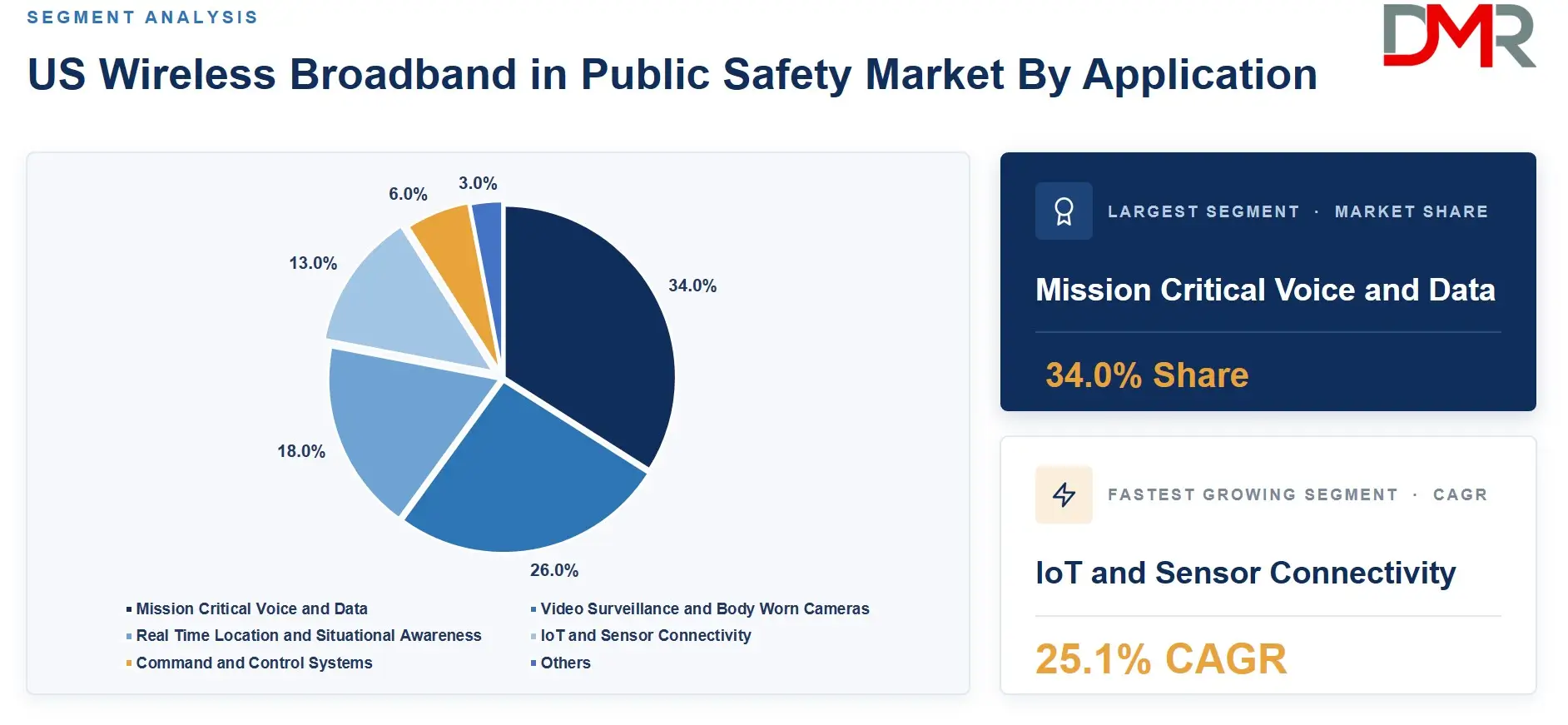
Mission critical voice and data retains the largest application share in 2026, close to 34%, because every deployment still needs a reliable channel for dispatch communication and records queries before any secondary application is added, and this remains the baseline that justifies the broadband subscription in the first place. The fastest growth sits with IoT and sensor connectivity, projected at a CAGR of 25.1% between 2026 and 2035, as departments connect gunshot detection sensors, environmental monitors, license plate readers and wearable biometric devices to the same network that already carries voice and video.
By End User
Police departments account for the largest share of 2026 spend, around 38%, reflecting their larger overall headcount relative to other first-responder disciplines and heavier reliance on real time data during patrol and response. Federal and homeland security agencies post the fastest growth, at a CAGR of 20.3% through 2035, driven by border security modernization, counter-drone programs and expanding interoperable communications requirements across federal components. Fire departments and emergency medical services form the second-largest buyer group, concentrated in vehicle telemetry and incident command connectivity.
By Technology
LTE remains the dominant technology in 2026, holding close to 49% of deployments, because the large majority of currently fielded devices, from mobile data terminals to body cameras, were built and certified against LTE-based public safety networks commercially available for close to a decade. 5G is the fastest-growing technology, forecast at a CAGR of 26.7% through 2035, as network slicing and standalone 5G cores reach general availability and let agencies isolate mission-critical traffic at the network level rather than simply prioritizing it on shared LTE infrastructure.
The US Wireless Broadband in Public Safety Market Report is Segmented Based on the Following
By Component
- Hardware
- Software
- Services
- Others
By Network Type
- Public Carrier Dedicated Networks
- Private LTE and 5G Networks
- Hybrid and Converged Networks
- Others
By Application
- Mission Critical Voice and Data
- Video Surveillance and Body Worn Cameras
- Real Time Location and Situational Awareness
- IoT and Sensor Connectivity
- Command and Control Systems
- Others
By End User
- Police Departments
- Fire Departments and EMS
- Emergency Management Agencies
- Federal and Homeland Security Agencies
- Others
By Technology
- LTE
- 5G
- Land Mobile Radio Integration
- Satellite Backup and NB IoT
- Others
Regulatory Landscape
Federal policy sets the pace of this market more directly than most technology categories, since the network most agencies subscribe to operates under a government contract rather than pure commercial terms. Current policy directs substantial federal funding toward coverage expansion and a dedicated 5G core over the next decade, alongside Federal Communications Commission oversight of the spectrum band reserved for public safety and rules restricting certain foreign-sourced network equipment in federally funded deployments. What is shifting now is tighter integration between the network operator and federal grant programs, opening an opportunity for compliance and integration specialists, while the main risk is that funding renewal stays subject to periodic contract renegotiation, keeping long-range agency planning conditional on political cycles vendors cannot control.
Technology Analysis
The technology base is mid-transition from LTE, which still carries the majority of fielded devices, toward standalone 5G cores that physically separate public safety traffic from commercial subscribers rather than merely prioritizing it on shared infrastructure. What is shifting now is network slicing reaching general availability, letting agencies guarantee bandwidth for camera uploads, mission-critical voice and sensor telemetry at once rather than competing for one pool of capacity. The commercial opening sits with software layered on this new architecture, from computer vision on camera feeds to agentic call triage, since the network can now support workloads it could not reliably carry before. The risk is device fragmentation, as older LTE-only hardware stays in service well past 5G-native arrival.
Competitive Landscape
Competitive intensity concentrates around a small number of carriers and equipment majors that control the physical network layer, while a much larger tier of specialists competes on devices, software and integration built to run on top of that network. AT&T holds a structural advantage as operator of the dedicated nationwide public safety network, and Motorola Solutions holds a comparable position in mission-critical devices, dispatch software and, increasingly, adjacent categories such as counter-drone and video management gained through acquisition. Competition among the remaining tiers centers on total cost of ownership, integration with legacy land mobile radio and speed of support during a live incident rather than price alone, since a network failure during an active response carries consequences a routine business outage does not. Consolidation is active, with device and software specialists frequently acquired by larger platform players rather than competing as standalone vendors long term.
Some of the Prominent Players in the US Wireless Broadband in Public Safety Market Are
- AT&T Inc.
- Verizon Communications Inc.
- T-Mobile US, Inc.
- Motorola Solutions, Inc.
- L3Harris Technologies, Inc.
- General Dynamics Corporation
- Cisco Systems, Inc.
- Nokia Corporation
- Ericsson
- Samsung Electronics Co., Ltd.
- Axon Enterprise, Inc.
- Sonim Technologies, Inc.
- Bittium Corporation
- Getac Technology Corporation
- Zebra Technologies Corporation
- JVCKENWOOD Corporation
- Hytera Communications Corporation
- Tait International Limited
- Codan Limited
- Federal Signal Corporation
- Mutualink, Inc.
- CalAmp Corp.
- Rajant Corporation
- Panasonic Connect Co., Ltd.
- Comtech Telecommunications Corp.
- Inseego Corp.
- Cradlepoint, Inc.
- Persistent Systems, LLC
- Silvus Technologies, Inc.
- Anterix Inc.
- Airbus DS Communications, Inc.
- Carbyne Ltd.
- RapidDeploy, Inc.
- Mark43, Inc.
- CentralSquare Technologies, LLC
- Televate, LLC
- EF Johnson Technologies, Inc.
- Utility Associates, Inc.
- Domo Tactical Communications Ltd.
- Barrett Communications Pty Ltd.
- Other Key Players
Recent Developments
- In August 2026, Motorola Solutions completed its acquisition of D-Fend Solutions, adding counter-drone detection and mitigation technology to its public safety and homeland security portfolio.
- In July 2026, FirstNet and AT&T activated the first nationwide 5G standalone network core built exclusively for public safety, physically separating first-responder traffic from commercial subscribers and adding application-level slicing for camera, radio and dispatch data.
- In April 2026, Motorola Solutions acquired HyperYou, a conversational AI company, bringing agentic call-triage capability into its Command Center software to reduce non-emergency call load on understaffed 911 centers.
- In March 2026, AT&T and the National Telecommunications and Information Administration agreed to redirect roughly USD 2 billion in reduced operating fees and new investment toward additional FirstNet coverage and 5G upgrades.
- In February 2025, T-Mobile launched T-Priority, a dedicated 5G network slice for first responders, and signed an agreement to become the primary public safety network carrier for New York City.
Report Details
| Report Characteristics |
| Market Size (2026) |
USD 6.4 Bn |
| Forecast Value (2035) |
USD 24.0 Bn |
| CAGR (2026-2035) |
15.8% |
| Historical Data |
2021 - 2025 |
| Forecast Data |
2026 - 2035 |
| Base Year |
2025 |
| Segments Covered |
By Component, By Network Type, By Application, By End User and By Technology |
| Regional Coverage |
The US |
Frequently Asked Questions
How big is the US Wireless Broadband in Public Safety Market?
▾ The market is estimated at USD 6.4 Bn in 2026. Demand is driven by continued build-out of dedicated public safety broadband, growing body camera and video evidence programs, and the replacement of aging land mobile radio with converged voice and data networks across US police, fire and emergency management agencies.
What is the growth rate of the US Wireless Broadband in Public Safety Market?
▾ The market is projected to expand at a CAGR of 15.8% between 2026 and 2035, reaching USD 24.0 Bn by the end of the forecast period. Growth is fastest in software, private network infrastructure and applications such as IoT sensor connectivity that extend beyond the traditional voice and dispatch use case.
What is driving demand in the US Wireless Broadband in Public Safety Market?
▾ Demand is driven primarily by continued investment in dedicated nationwide broadband coverage for first responders and by video-first evidentiary standards that require reliable, high-bandwidth uploads from body and vehicle cameras. Aging land mobile radio systems nearing end of support, combined with state and federal grant funding cycles, are pushing agencies to modernize sooner than routine budget planning alone would allow.
Who are the key players in the US Wireless Broadband in Public Safety Market?
▾ Leading participants include AT&T, Motorola Solutions, Verizon Communications, T-Mobile US, L3Harris Technologies and Axon Enterprise, alongside device, software and integration specialists such as Sonim Technologies, Bittium and CalAmp. Competition centers on network reliability, ruggedized device design and integration with legacy land mobile radio systems, with consolidation ongoing as larger platform vendors continue acquiring specialist device and software companies.
Which component segment leads the US Wireless Broadband in Public Safety Market?
▾ Hardware leads the component segmentation, accounting for approximately 44% of 2026 revenue, as every deployment requires ruggedized devices, in-vehicle routers, cameras and network infrastructure that cannot be substituted with a lower-cost alternative. Software is the fastest-growing component, expanding at a CAGR of 21.4% as agencies add cloud-hosted dispatch, video management and analytics platforms on top of existing hardware.