Global Utility Billing Software Market Snapshot
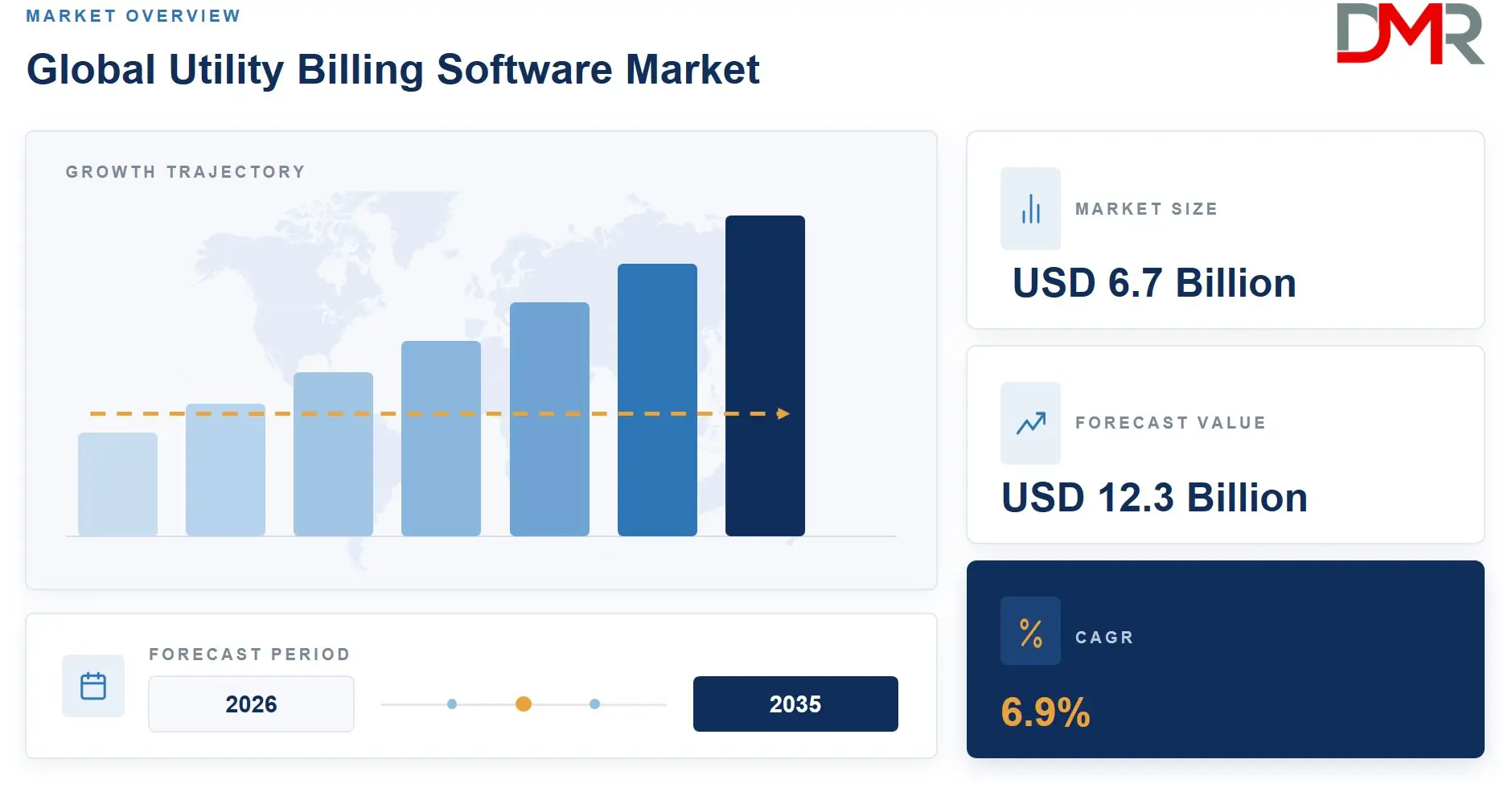
- Market Size in 2026: USD 6.7 billion
- Market Size in 2035: USD 12.3 billion
- Global CAGR, 2026-2035: 6.9%
- Leading Component Segment: Software, 74%
- Leading Deployment Segment: Cloud-Based, 58%
- Leading Utility Type Segment: Electricity, 54%
- Fastest-Growing Segment: Analytics & Reporting, 9.1% CAGR
- Leading Region in 2026: North America, 38%
What is the Global Utility Billing Software and its Market Size?
The global utility billing software market is estimated at USD 6.7 billion in 2026 and is projected to reach approximately USD 12.3 billion by 2035, representing a 6.9% CAGR. The market covers billing and customer-information platforms used by electricity, water, wastewater, gas, and multi-utility providers to manage meter-to-cash processes, customer accounts, tariffs, invoicing, collections, revenue assurance, and digital customer interactions.
ℹ
To learn more about this report –
Download Your Free Sample Report Here
Growth is being driven by replacement of aging billing platforms, smart-meter and advanced-metering infrastructure deployments, cloud migration, increasingly complex tariffs, distributed energy resources, digital payment adoption, and demand for omnichannel customer service. Industry research specifically identifies legacy-system modernization, smart-grid/AMI investment, and cloud-first utility IT architectures as important growth drivers.
Use Cases
- Automated Billing & Invoicing: Calculates consumption, tariffs, taxes, discounts, adjustments, and recurring charges before generating customer bills.
- Smart-Meter Billing: Converts high-frequency AMI consumption data into accurate interval-based bills and exceptions.
- Digital Payments: Supports online payments, mobile wallets, autopay, payment plans, refunds, and automated collections.
- Revenue Assurance: Detects billing anomalies, leakage, unbilled consumption, incorrect tariffs, and potential non-technical losses.
- Customer Self-Service: Enables customers to view bills, monitor usage, update accounts, make payments, and manage service requests.
- Analytics & Reporting: Provides revenue, consumption, delinquency, customer, tariff, and operational intelligence for utility decision-makers.
Key Takeaways
- Market Size: The market is modeled at USD 6.7 billion in 2026, increasing to approximately USD 12.3 billion by 2035.
- Growth Driver: Cloud modernization, AMI deployment, digital payments, and increasingly complex utility tariffs are supporting sustained software investment.
- Segment Dominance: Software accounts for an estimated 74% of 2026 revenue, while electricity utilities represent approximately 54%.
- Fastest Growth: Analytics & Reporting is estimated to grow at approximately 9.1% CAGR, benefiting from AI, AMI data, and revenue-assurance requirements.
- Regional Leadership: North America leads with an estimated 38% share, reflecting high software penetration, mature utility IT budgets, and extensive CIS modernization activity.
- Strategic Direction: Competition is shifting toward cloud-native, API-enabled, AI-enhanced platforms rather than traditional billing-only applications.
How AI, Cloud and Advanced Analytics are Transforming Utility Billing Software
AI and advanced analytics are increasingly being embedded into utility billing platforms for anomaly detection, consumption forecasting, payment-risk scoring, revenue assurance, customer segmentation, and personalized communications. Oracle's utilities platform, for example, incorporates machine-learning-driven insights into customer operations, while its cloud billing platform supports sophisticated rate and usage calculations.
Cloud computing is reducing infrastructure-management requirements and enabling utilities to receive continuous software updates, scale processing around billing cycles, integrate APIs, and support remote operations. Cloud platforms also make functionality such as customer portals, analytics, payment processing, and meter-data services easier to integrate.
Key Drivers in the Global Utility Billing Software Market
Legacy Billing-System Modernization
Aging customer-information and billing environments remain a major replacement opportunity. Utilities often operate highly customized platforms that have accumulated decades of tariff rules, interfaces, customer records, and regulatory configurations. Replacing these systems can improve billing accuracy, processing speed, customer service, and integration with modern digital channels. Research identifies improvement of legacy billing systems and IT infrastructure as a major market driver.
Smart Metering, AMI and Complex Tariffs
The growth of smart meters and distributed energy resources is generating substantially larger volumes of granular consumption data. Utilities need billing platforms capable of processing interval readings, time-of-use rates, demand charges, net metering, dynamic pricing, distributed-generation credits, and increasingly complex customer programs. Oracle's billing platform explicitly supports time-of-use, real-time pricing, net metering, unbundling, proration, and rate comparison.
Restraints in the Global Utility Billing Software Market
Cybersecurity, Privacy and Compliance Requirements
Billing systems hold sensitive customer, payment, financial, and consumption information while increasingly connecting to external payment processors, mobile applications, AMI networks, and cloud environments. Security requirements increase development and implementation costs. Electricity utilities face additional critical-infrastructure obligations; FERC approved further cybersecurity and virtualization-related reliability measures in March 2026.
Growth Opportunities in the Global Utility Billing Software Market
Cloud-Native Billing for Mid-Sized and Municipal Utilities
Small and mid-sized utilities represent an important white space because many lack the internal resources to operate sophisticated enterprise software. SaaS platforms can reduce upfront infrastructure costs and provide standardized upgrades, cybersecurity capabilities, digital payment functionality, and customer portals. Cloud adoption is already identified as a major growth driver for utility billing software.
AI-Based Revenue Assurance and Customer Intelligence
AMI and digital-channel data create opportunities to identify abnormal consumption, potential meter problems, billing errors, payment risk, and revenue leakage. AI can also personalize payment reminders, recommend programs, predict customer inquiries, and explain unusually high bills.
Trends in the Global Utility Billing Software Market
Billing is Becoming a Customer-Experience Platform
Utilities increasingly expect billing software to provide self-service, mobile access, personalized communications, digital payments, usage insights, and proactive notifications. VertexOne's platform, for example, combines CIS and billing with digital engagement, customer self-service, smart-meter insights, and analytics.
Convergence of Billing, DERs and Energy Flexibility
Distributed solar, batteries, EV charging, heat pumps, prosumers, and demand-response programs are increasing billing complexity. SAP's 2026 distributed-energy-resources initiative illustrates the movement toward connecting meters, customers, commercial agreements, and flexibility markets.
Research Scope and Analysis
The market is segmented by Component, Deployment, Utility Type, Billing Type, Application, and End User. The model considers software licenses/subscriptions and associated services across electricity, water and wastewater, gas, and multi-utility providers.
ℹ
To learn more about this report –
Download Your Free Sample Report Here
By Component Analysis
Software is the dominant component, estimated at 74% of 2026 market revenue, supported by recurring SaaS subscriptions, billing engines, CIS platforms, meter-data management, payment management, and revenue-management applications. Services account for approximately 26%, including implementation, integration, consulting, migration, and support. Software remains dominant because utilities increasingly prefer integrated platforms with configurable billing rules and recurring cloud economics. The fastest-growing component is cloud-delivered software, indirectly lifting recurring software revenue at approximately 8.8% CAGR, compared with slower growth in traditional implementation services. The second-largest component, implementation & integration services, represents approximately 15% of total market revenue and remains essential because utility environments contain complex legacy interfaces and regulatory configurations. Vendor strategies increasingly emphasize modular SaaS architectures and integration tooling to shorten deployment periods and reduce long-term customization.
By Deployment Analysis
Cloud-Based deployment leads with an estimated 58% share in 2026, reflecting utilities' increasing preference for managed infrastructure, continuous upgrades, scalability, API connectivity, and lower upfront IT expenditure. On-Premises deployment retains approximately 42%, particularly among large regulated utilities with legacy environments, strict data requirements, or extensive customization. Cloud-based deployment is also the fastest-growing deployment segment at approximately 8.8% CAGR, as utilities increasingly replace infrastructure-heavy systems with SaaS. The second-largest deployment category, on-premises, continues to generate substantial maintenance and modernization revenue because large utilities cannot immediately migrate complex historical platforms. Hybrid migration strategies are therefore expected to remain common through 2030, with utilities progressively moving customer engagement, analytics, and selected billing functions to cloud environments before retiring legacy cores.
By Utility Type Analysis
Electricity utilities represent the dominant utility type, accounting for approximately 54% of 2026 market revenue. Their leadership reflects large customer bases, extensive AMI deployments, dynamic tariffs, distributed energy resources, demand-response programs, and complex regulatory structures. Multi-utility providers are the fastest-growing category at approximately 8.6% CAGR, benefiting from demand for unified platforms covering electricity, gas, water, wastewater, and other municipal services. Water & wastewater is the second-largest category at approximately 22%, supported by aging infrastructure, smart water meters, conservation initiatives, tiered pricing, and municipal digitization. Gas utilities account for roughly 14%, while multi-utility providers represent about 10%. The market increasingly favors systems capable of handling multiple utility products within a single customer account.
By Billing Type Analysis
Postpaid billing remains dominant, with an estimated 72% share in 2026, particularly across mature electricity, gas, and water markets where monthly or quarterly billing remains standard. Prepaid billing, at approximately 28%, is the faster-growing segment at an estimated 8.4% CAGR, driven by emerging markets, smart meters, affordability programs, mobile payments, and demand for tighter credit-risk management. Prepaid systems are particularly relevant to electricity utilities serving low-income or high-risk customer segments, where automated balance management can reduce collection costs. Postpaid remains larger because it is embedded in established utility regulatory and commercial models, but prepaid adoption is expanding as digital wallets, mobile channels, and smart-meter infrastructure make pay-as-you-go services easier to operate.
By Application Analysis
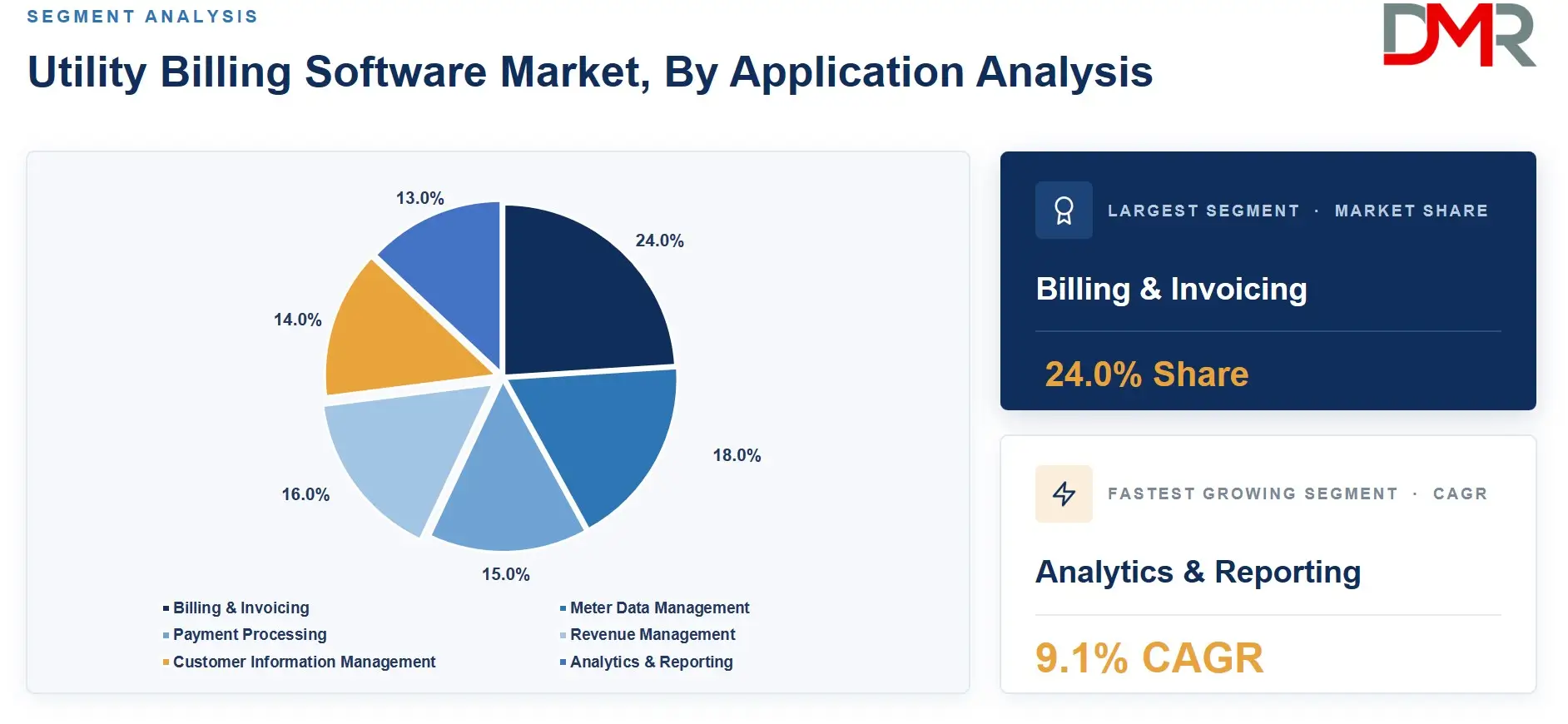
Billing & Invoicing is the largest application, estimated at 24% of 2026 market revenue, because it remains the core function purchased by utilities. Analytics & Reporting is the fastest-growing application at approximately 9.1% CAGR, driven by AMI data, AI-enabled anomaly detection, revenue assurance, forecasting, and regulatory reporting. Meter Data Management represents approximately 18%, Payment Processing 15%, Revenue Management 16%, and Customer Information Management 15%. As utilities modernize, analytics is shifting from a secondary reporting capability to a strategic operating layer. Vendors increasingly connect billing data with consumption, customer, payment, and operational information to generate predictive insights and automate decisions.
By End User Analysis
Electricity utilities are the leading end-user group, accounting for approximately 50% of 2026 market revenue, followed by water utilities at 23%, gas utilities at 15%, and multi-utility providers at 12%. Electricity utilities benefit from the largest addressable customer populations, extensive AMI rollouts, increasing tariff complexity, and the integration of distributed energy resources. Multi-utility providers are the fastest-growing end-user group at approximately 8.7% CAGR, because municipalities increasingly seek unified customer-account and payment platforms. Water utilities also offer significant white-space potential because fragmented municipal technology environments and aging infrastructure create opportunities for cloud billing, digital payments, automated meter reading, and customer self-service.
The Global Utility Billing Software Market Report is segmented on the basis of the following:
By Component
- Software
- Billing & Invoicing
- Customer Information System
- Meter Data Management
- Payment & Collections Management
- Revenue Management
- Services
- Implementation & Integration
- Consulting & Support
By Deployment
By Utility Type
- Electricity
- Water & Wastewater
- Gas
- Multi-Utility
By Billing Type
By Application
- Billing & Invoicing
- Meter Data Management
- Payment Processing
- Revenue Management
- Customer Information Management
- Analytics & Reporting
By End User
- Electricity Utilities
- Water Utilities
- Gas Utilities
- Multi-Utility Providers
Regional Analysis
North America is the Leading Region in the Global Utility Billing Software Market
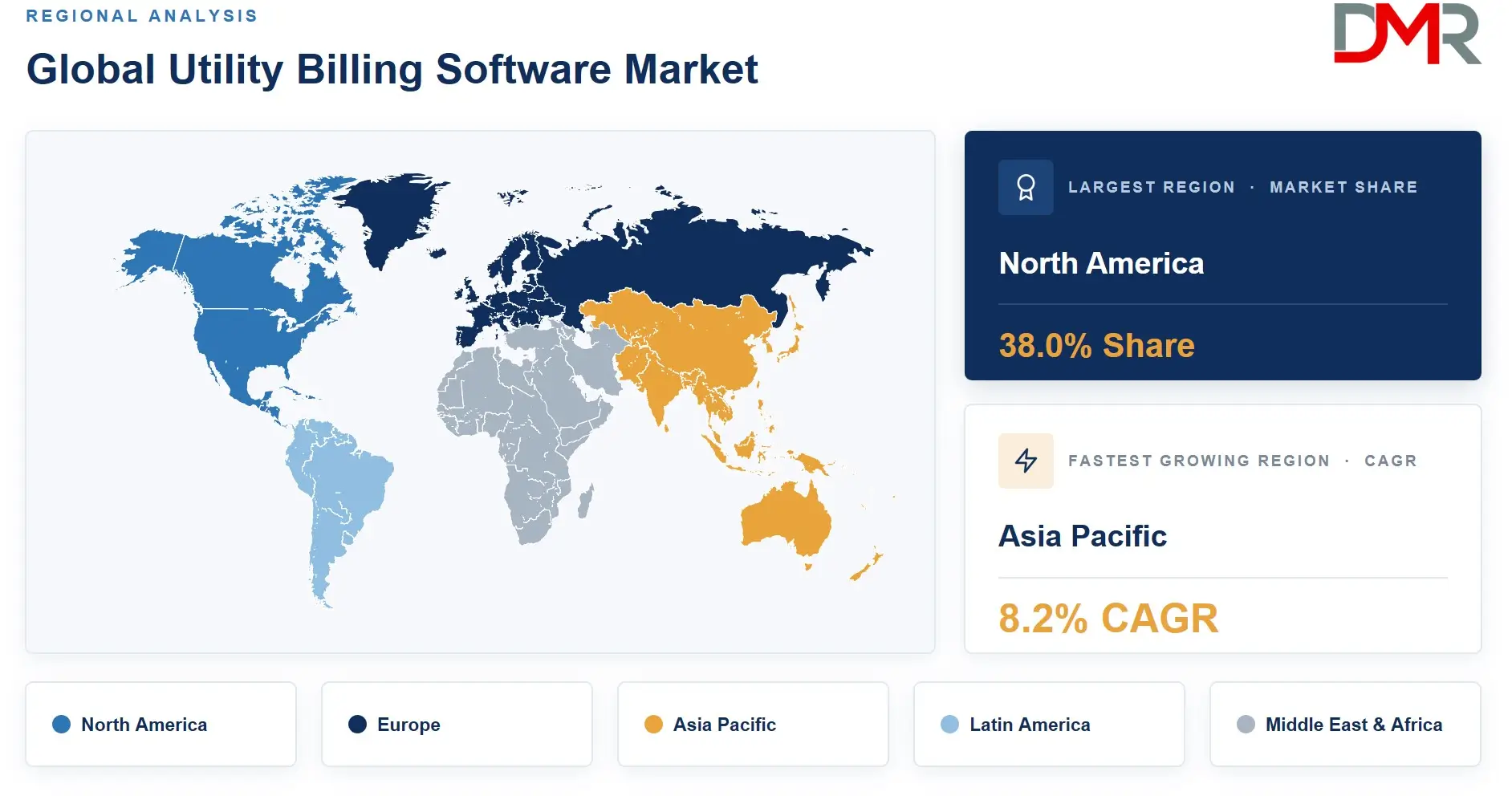
North America is expected to maintain its leading position, accounting for approximately 38% of global market revenue in 2026, or roughly USD 2.5 billion. The region benefits from mature utility IT infrastructure, extensive smart-meter adoption, high digital-payment penetration, established CIS vendors, and substantial spending on cybersecurity and grid modernization. The United States represents the majority of regional demand. Municipal water utilities, investor-owned electricity providers, gas utilities, and competitive energy retailers are all active buyers. Vendors such as Oracle and VertexOne increasingly position cloud-based CIS, billing, customer engagement, and analytics as integrated modernization platforms.
ℹ
To learn more about this report –
Download Your Free Sample Report Here
Asia Pacific is the Fastest-Growing Region in the Global Utility Billing Software Market
Asia-Pacific is projected to be the fastest-growing region, with an estimated 8.2% CAGR through 2035. Growth is supported by smart-meter deployments, utility digitization, urbanization, energy-transition investment, increasing electronic payments, and government-led modernization programs. China, India, Japan, South Korea, Australia, and Southeast Asian markets represent different stages of technology maturity. Large-scale electricity distribution modernization in India is particularly important, while Japan and Australia provide more mature opportunities involving advanced customer analytics, cloud migration, and distributed-energy management.
The Europe Utility Billing Software Market
The European market is estimated at approximately USD 1.8 billion in 2026, reaching about USD 3.2 billion by 2035, representing approximately 6.6% CAGR. Demand is being shaped by smart-meter adoption, renewable-energy integration, dynamic tariffs, consumer-protection requirements, GDPR, cybersecurity obligations, and energy-market liberalization. Cloud modernization and interoperability are particularly important as utilities integrate distributed generation, EV charging, flexibility markets, and customer-facing digital services.
Latin America Utility Billing Software Market
Latin America is estimated at approximately USD 0.40 billion in 2026, reaching USD 0.70 billion by 2035, at approximately 6.5% CAGR. Growth is supported by smart-meter deployment, utility-loss reduction, electronic payments, urbanization, and modernization of electricity and water billing systems. Brazil and Mexico represent the largest opportunities, while prepaid electricity and mobile-payment capabilities provide additional growth potential.
MEA Utility Billing Software Market
The Middle East & Africa market is estimated at approximately USD 0.40 billion in 2026, reaching around USD 0.75 billion by 2035, representing approximately 7.2% CAGR. Smart-city programs, water scarcity, utility digitization, new energy infrastructure, and government-led cloud initiatives support adoption. Gulf states are particularly attractive because large utilities have significant technology budgets and are pursuing customer-experience modernization alongside broader digital-transformation programs.
Major Countries Analysis
United States Utility Billing Software Market
The United States market is estimated at USD 2.25 billion in 2026, reaching approximately USD 3.9 billion by 2035, at roughly 6.3% CAGR. Demand is supported by utility CIS replacement, cloud migration, AMI, competitive retail energy, digital payments, and cybersecurity. FERC's continuing modernization of cybersecurity and critical-infrastructure requirements further raises the importance of secure technology architectures.
Japan Utility Billing Software Market
Japan is estimated at approximately USD 0.40 billion in 2026, reaching USD 0.68 billion by 2035, at approximately 6.1% CAGR. Key drivers include smart-meter maturity, electricity-market restructuring, aging utility infrastructure, renewable integration, demand-response programs, and digital customer engagement. Utilities increasingly require platforms capable of supporting complex tariffs and high reliability.
Saudi Arabia Utility Billing Software Market
Saudi Arabia is estimated at approximately USD 0.12 billion in 2026, reaching about USD 0.25 billion by 2035, representing roughly 8.5% CAGR. Growth is being driven by Vision 2030-related digital transformation, smart-city development, water and electricity modernization, cloud adoption, digital payments, and customer-experience initiatives.
Regulatory Landscape
Utility billing software is affected by overlapping data-protection, payment-security, cybersecurity, utility-market, and critical-infrastructure requirements. In Europe, GDPR governs personal-data processing, while NIS2 increases cybersecurity obligations across covered critical sectors, including energy and certain water-related entities. Payment functionality must generally be designed around PCI DSS v4.0.1 where cardholder data is involved; PCI SSC published v4.0.1 in 2024 and began another industry-feedback cycle in 2026. In the United States, electricity providers operating within the applicable bulk-power framework face NERC CIP requirements overseen by FERC, with 2025-2026 actions strengthening supply-chain, virtualization, and low-impact-system cybersecurity controls. Vendors consequently compete on SOC controls, encryption, auditability, data residency, identity management, disaster recovery, and compliance tooling.
Investment and White Space Analysis
The strongest investment white spaces include cloud-native billing for municipal water utilities, AI-powered revenue assurance, prepaid billing, distributed-energy settlement, utility-payment orchestration, and API-based legacy modernization. Asia-Pacific and selected Middle Eastern markets offer particularly attractive greenfield opportunities because utilities can bypass some legacy infrastructure. In North America and Europe, the opportunity is more frequently replacement and overlay-based: analytics, customer engagement, payments, cybersecurity, and AI can be added without immediately replacing the core CIS. Vendors that provide migration accelerators, configurable tariff engines, prebuilt integrations, and consumption-based pricing should be well positioned to capture underserved mid-market utilities.
By Region
North America
Europe
- Germany
- France
- The U.K.
- Italy
- Spain
- Rest of Europe
Asia-Pacific
- China
- Japan
- India
- Australia
- South Korea
- Rest of APAC
Latin America
- Mexico
- Brazil
- Rest of LATAM
Middle East & Africa
- Saudi Arabia
- The UAE
- South Africa
- Rest of MEA
Competitive Landscape
The global market is moderately consolidated at the enterprise level but fragmented across municipal and specialist utility applications. Large providers such as Oracle and SAP benefit from installed enterprise relationships, broad functionality, and integration capabilities, while specialists such as VertexOne, Hansen Technologies, Harris Computer, Tyler Technologies, Gentrack, and Fluentgrid compete through industry specialization, faster implementation, cloud architectures, customer experience, and lower total cost of ownership. Competitive strategies increasingly include SaaS migration, acquisitions, partnerships, AI development, geographic expansion, and vertical specialization. Industry research identifies Oracle, SAP, Hansen, Harris, VertexOne, Tyler, EnergyCAP, Bynry, Gentrack and Fluentgrid among notable market participants.
Some of the prominent players in the Global Utility Billing Software Market are:
- Oracle
- SAP
- Harris Computer
- Hansen Technologies
- VertexOne
- Itineris
- Salesforce
- Microsoft
- IBM
- Oracle Utilities
- Kraken Technologies
- Open International
- Cayenta
- Fluentgrid
- Gentrack
- CGI
- Utilitec
- Red Clay Consulting
- Ferranti Computer Systems
- Minsait
- Hansen CIS
- Starnik
- NISC
- NorthStar Utilities Solutions
- Cogsdill Tool Products
- LogiSense
- BillingPlatform
- Zuora
- Chargebee
- Aria Systems
- Rev.io
- Stripe
- BillingTree
- SilverBlaze
- PowerPlan
- EnergyCAP
- EnergyIP
- Landis+Gyr
- Itron
- KrakenFlex
- Other Key Players
Recent Developments
- In June 2026, VertexOne announced that Graviti Power selected its cloud-based VXretail CIS/billing and VXexchange EDI solutions, supporting the company's entry into Texas's competitive ERCOT retail-energy market.
- In April 2026, Oracle announced expanded AI capabilities across its utilities portfolio, positioning AI and open technology as tools for reducing costs, improving grid reliability, and enhancing customer experiences.
- In April 2026, Santee Cooper implemented Oracle Utilities Customer Cloud Service, moving its customer platform to the cloud; Oracle reported that nightly billing processes were running approximately three hours faster on average.
- In April 2026, VertexOne appointed Tracey Brown as CEO, signaling an emphasis on operational execution, customer success, and growth as utility digital-transformation demand accelerates.
- In March 2026, SAP highlighted its Distributed Energy Resources platform, connecting meters, markets, customers, and commercial agreements to support energy communities, dynamic pricing, virtual power plants, and demand response.
Report Details
| Report Characteristics |
| Market Size (2026) |
USD 6.7 Bn |
| Forecast Value (2035) |
USD 12.3 Bn |
| CAGR (2026–2035) |
6.9% |
| The US Market Size (2026) |
USD 2.25 |
| Historical Data |
2021 – 2025 |
| Forecast Data |
2026 – 2035 |
| Base Year |
2025 |
| Segments Covered |
By Component, By Deployment, By Utility Type, By Billing Type, By Application, By End User |
| Regional Coverage |
North America – The US and Canada; Europe – Germany, France, The UK, Italy, Spain, Rest of Europe; Asia-Pacific – China, Japan, India, Australia, South Korea, Rest of APAC; Latin America – Mexico, Brazil, Colombia, Argentina, Rest of LATAM; Middle East & Africa – Saudi Arabia, The UAE, South Africa, Rest of MEA |
Frequently Asked Questions
What is the Utility Billing Software Market size in 2026?
▾ The global Utility Billing Software Market is estimated at approximately USD 6.7 billion in 2026, supported by cloud migration, smart-meter adoption, and billing-system modernization.
What will be the Utility Billing Software Market size by 2035?
▾ The global Utility Billing Software Market is projected to reach approximately USD 12.3 billion by 2035, reflecting sustained investment in digital utility infrastructure.
What is the CAGR of the Utility Billing Software Market from 2026 to 2035?
▾ The Utility Billing Software Market is projected to expand at approximately 6.9% CAGR from 2026 to 2035, driven by technology modernization and digital transformation.
What are the key growth drivers of the Utility Billing Software Market?
▾ Major Utility Billing Software Market drivers include legacy-system replacement, cloud adoption, AMI deployment, digital payments, complex tariffs, and demand for improved customer experiences.
What are the major trends shaping the Utility Billing Software Market?
▾ The Utility Billing Software Market is being shaped by AI-powered analytics, cloud-native platforms, smart-meter integration, API-based architectures, automated revenue assurance, and digital customer engagement.
Which region leads the Utility Billing Software Market in 2026?
▾ North America leads the Utility Billing Software Market with an estimated 38% share in 2026, while Asia-Pacific is expected to record the fastest regional growth.
Who are the key players in the Utility Billing Software Market?
▾ Key Utility Billing Software Market participants include Oracle, SAP, VertexOne, Hansen Technologies, Harris Computer, Tyler Technologies, Gentrack, Fluentgrid, EnergyCAP, and Bynry.
How is the Utility Billing Software Market segmented?
▾ The Utility Billing Software Market is segmented by component, deployment, utility type, billing type, application, end user, region, and major countries, covering electricity, water, gas, and multi-utility providers.