Market Overview
The global vegetable oil in beauty and personal care market covers plant-derived lipids formulated into finished cosmetics across skin care, hair care, color cosmetics, fragrance, and bath and body categories. Cold-pressed, expeller-pressed, refined, and virgin grades all sit within scope. Synthetic petrochemical emollients, silicones, and mineral-oil-based ingredients sit outside it. The market connects directly to agricultural commodity chains for palm, coconut, argan, jojoba, sunflower, and castor crops, and sits upstream of finished-goods manufacturers across both mass-market and prestige beauty tiers.
Clean-beauty formulation is the structural force reshaping ingredient sourcing at scale. Brand owners across North America, Europe, and Asia-Pacific now face consumer and retailer pressure to replace petroleum-derived emollients with certified botanical oils. Procurement teams are no longer treating vegetable oils as commodity inputs. Traceability documentation, sustainability certifications, and lifecycle data are now contractual requirements from major beauty conglomerates. Suppliers that cannot provide chain-of-custody records face delisting from preferred-vendor programs regardless of price competitiveness.
The market also benefits from the convergence of skin-health science with beauty formulation. Dermatology-informed product development has placed lipid-rich oils at the center of barrier-repair serums, microbiome-friendly moisturizers, and scalp-treatment systems. Formulators treat functional efficacy as a non-negotiable alongside sensory profile and sustainability credentials. That three-way performance bar narrows the field of qualifying ingredients and creates durable pricing power for oils that meet all three criteria simultaneously.
Key Takeaways
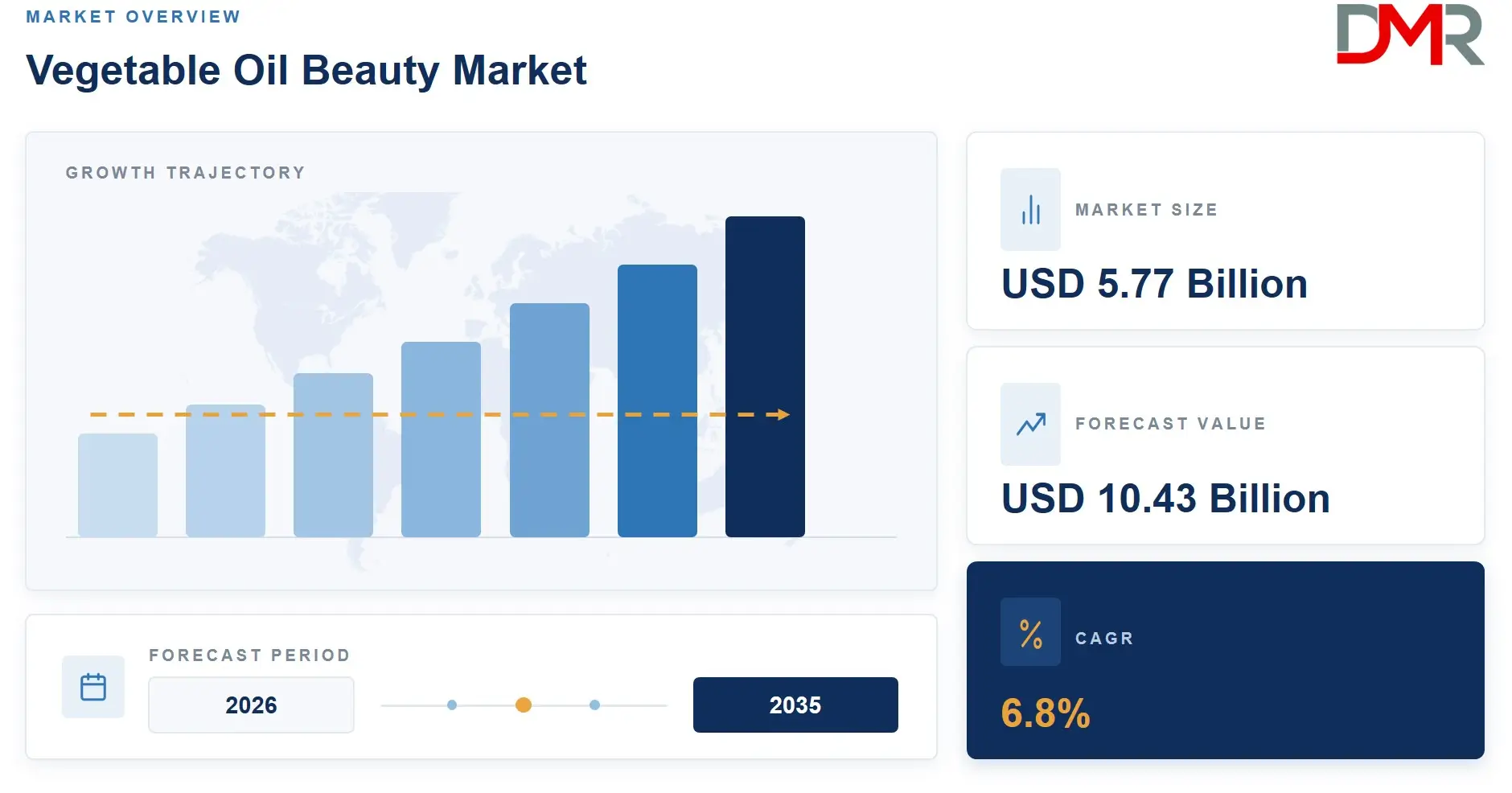
- The market size is USD 5.77 Billion in 2026, and is projected to hit USD 10.43 Billion by 2035 at a CAGR of 6.8%.
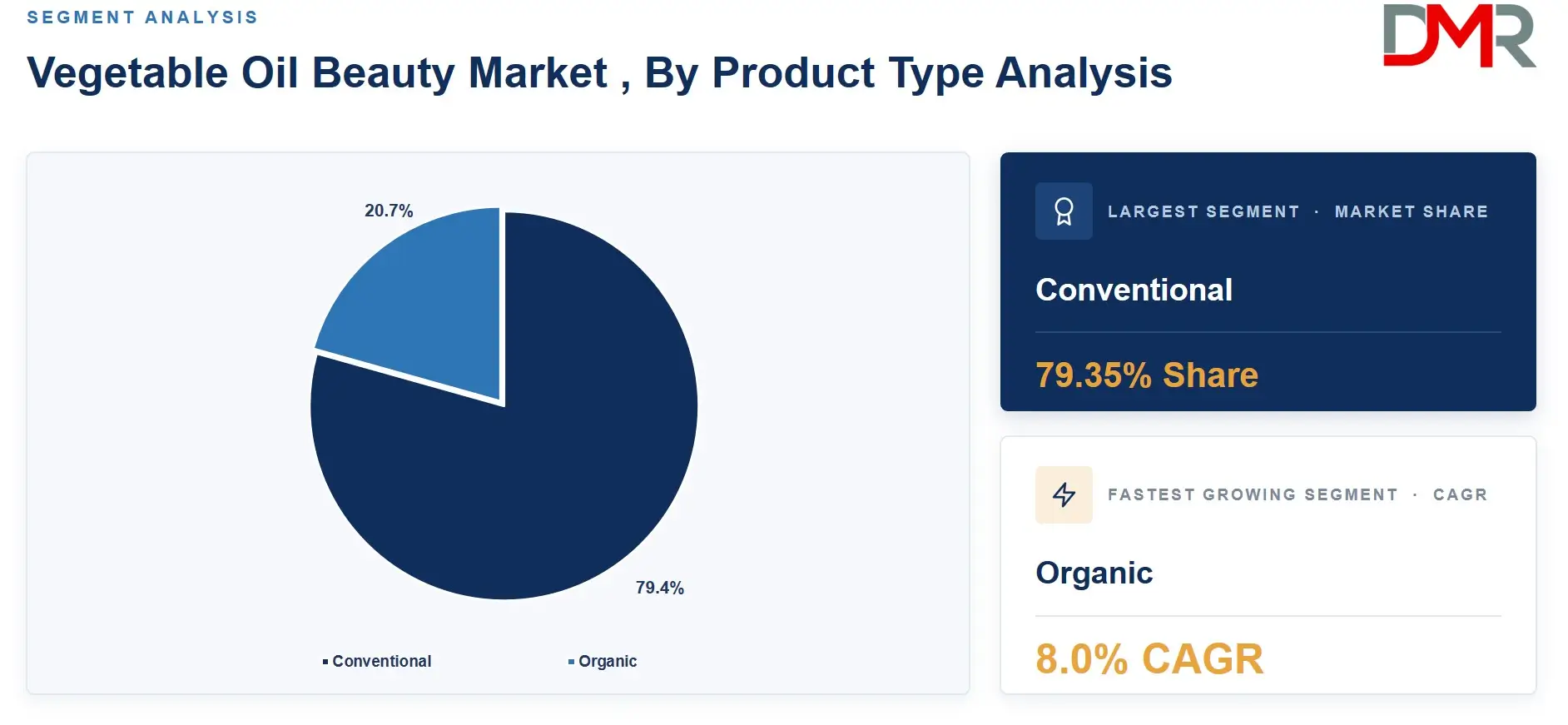
- By Category: Conventional led with a 79.35% share in 2026.
- By Product Type: Coconut Oil led with a 34.12% share in 2026.
- By Application: Skin Care led with a 47.76% share in 2026.
- By Processing Method: Cold-Pressed led as the largest category in 2026.
- By Function: Emollient led as the largest category in 2026.
- By Distribution Channel: E-commerce led as the largest category in 2026.
- By End User: Women led as the largest category in 2026.
- By Product Form: Pure Oils led as the largest category in 2026.
- By Price Range: Mass Market led as the largest category in 2026.
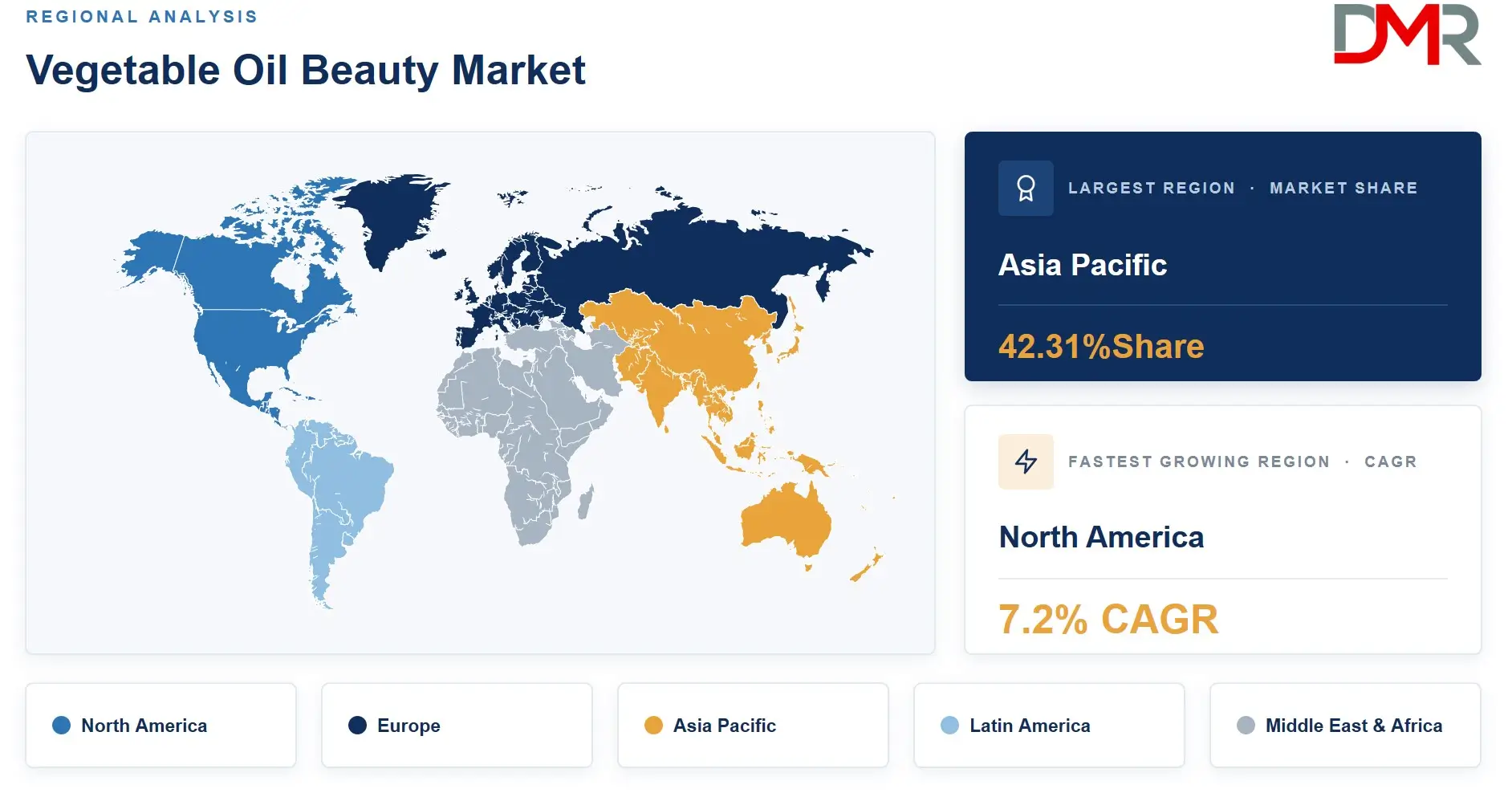
- By Region: Asia-Pacific led with a 42.31% share in 2026.
- Coconut Oil commands the largest product-type share, reflecting its cross-category utility across skin care emollients, hair care conditioning, and color cosmetics bases.
Market Size and Forecast
The Global Vegetable Oil in Beauty and Personal Care Market size is estimated at USD 5.77 Billion in 2026, and is projected to reach USD 10.43 Billion by 2035, exhibiting a CAGR of 6.8% during the forecast period.
Growth during the historic period from 2020 to 2024 was anchored by the accelerating clean-beauty shift across North America and Europe, as brand owners reformulated legacy emollient systems to meet retailer and consumer ingredient standards. Prestige and mass-market channels moved in the same direction at different speeds, with prestige brands leading organic oil adoption and mass-market formulators following as certified-sustainable supply scaled. As reported by Croda's H1 2025 earnings transcript, Beauty Care volume increased 8% in the first half of 2025, confirming that demand from cosmetics customers was outpacing overall personal care industry growth rates at that point in the cycle.
ℹ
To learn more about this report –
Download Your Free Sample Report Here
The 2026 to 2035 forecast rests on three structural assumptions. Plant-derived ingredient mandates from regulatory bodies and retail buyers will continue tightening through the period. Biotech and fermentation pathways will expand the qualifying ingredient set, adding supply-side capacity without relying solely on agricultural crop yields. Premium and prestige channel growth in Asia-Pacific will outpace value tiers, pulling average selling prices higher and supporting revenue expansion above volume growth alone.
Category Analysis
Conventional accounted for 79.35% of Category demand in 2026, the highest of any category.
Conventional vegetable oils retain dominant share because mass-market skincare formulations and haircare and color cosmetics bases require cost-competitive, consistently available lipid inputs at industrial scale. Organic-certified oils cannot yet match conventional supply volumes at price points viable for high-turnover SKUs sold through supermarkets, drugstores, and e-commerce platforms. Brand owners in the mass tier treat conventional oils as the default and reserve organic positioning for hero SKUs where the premium is commercially justified.
Organic oils are capturing share in luxury and prestige skincare and certified-sustainable premium SKUs, where the certification itself functions as a marketing asset. Prestige buyers pay for traceability, third-party verification, and provenance storytelling. Growth in the organic sub-segment is faster than in conventional on a percentage basis, but the absolute volume gap ensures conventional dominance persists well into the forecast period. Vendors serving both tiers simultaneously hold the strongest commercial position, as they can allocate certified stock to premium channels while keeping conventional capacity fully utilized.
Product Type Analysis
Coconut Oil led the Product Type segment with a 34.12% share in 2026.
Coconut Oil's commanding share reflects its formulation versatility across three high-volume application categories. Skincare formulators value its emollient profile and skin-feel properties. Hair care manufacturers rely on its deep conditioning performance. Color cosmetics producers use it as a base for pigment dispersion. No other single vegetable oil spans all three categories at comparable performance and cost levels, which structurally insulates coconut oil's market position from near-term displacement.
ℹ
To learn more about this report –
Download Your Free Sample Report Here
Argan Oil and Jojoba Oil anchor the premium end of the product-type spectrum, commanding higher per-kilogram prices in prestige skincare and hair care where efficacy claims justify the cost. Castor Oil holds a differentiated position across long-wear color cosmetics and therapeutic skincare, where its rheological properties and film-forming characteristics are difficult to replicate with lower-cost alternatives. Oils such as Marula, Sacha Inchi, and Avocado occupy emerging-ingredient status and are gaining formulation visibility in premium launches, but their collective share remains fragmented. Buyers in prestige channels are actively trialing these specialty oils to differentiate product ranges before they enter mainstream availability.
Application Analysis
With a 47.76% share in 2026, Skin Care outpaced all other Application categories.
Skin care's near-majority share signals that formulators have repositioned vegetable oils from optional additives to functional actives in moisturizers, serums, and barrier-repair treatments. Anti-aging formulations in particular have driven adoption, as clinical evidence supporting plant lipids in skin-barrier restoration has expanded. Brands that built product architecture around vegetable oils early now defend share through patent-protected oil blend systems rather than commodity sourcing.
Hair care represents the second-largest application, with coconut oil-based scalp treatments and argan oil-based conditioning systems leading volume. Color cosmetics consumption is growing as brands replace synthetic waxes with plant-based emollient bases, driven by vegan and clean-label commitments at the portfolio level. Fragrance and aromatherapy applications use vegetable oils as clean-label carrier systems and therapeutic aromatherapy blends, a category benefiting from wellness-oriented consumer positioning. Bath and body care rounds out the application mix, with body oils gaining against traditional lotions in several premium channels.
Processing Method Analysis
Cold-Pressed led the Processing Method segment as the largest category in 2026.
Cold-pressed oils command premium positioning across prestige skincare and clean-beauty hair care because the processing method preserves heat-sensitive phytonutrients, fatty-acid profiles, and antioxidants that high-heat extraction destroys. Brand owners treating the process as a label claim have successfully converted cold-pressed status into a price premium that justifies the higher extraction cost. Retailers in Europe and North America now merchandise cold-pressed oils as a distinct shelf tier.
Expeller-pressed and refined grades serve the mass-market and industrial formulation segments, where batch-to-batch consistency and long shelf life outweigh the preservation of micronutrients. Solvent-extracted oils remain cost-competitive but face increasing formulator scrutiny as clean-ingredient standards tighten. Virgin and extra-virgin processing is gaining traction for olive oil applications where provenance and sensory authenticity are central to product positioning.
Function Analysis
Emollient led the Function segment as the largest category in 2026.
Emollient function dominates because skin-feel and occlusive moisture retention remain the primary performance criteria across the largest application categories. Formulators select oils first for emollient performance and then layer secondary functions such as moisturizing agent or skin conditioning agent on top. Oils that deliver emolliency alongside a secondary functional benefit command higher formulation inclusion rates and reduced competition from synthetic alternatives.
Hair conditioning and carrier-oil functions support the hair care and aromatherapy application segments respectively. Cleansing and surfactant bases represent a smaller but growing function category, driven by oil-cleansing method adoption in prestige skin care and the development of sulfate-free haircare systems that use plant lipids as foaming precursors.
Distribution Channel Analysis
E-commerce led the Distribution Channel segment as the largest category in 2026.
E-commerce dominance reflects two converging forces. Direct-to-consumer beauty brands built their entire distribution architecture around online channels, and traditional brands accelerated digital investment after 2020 in ways that permanently shifted category sales online. Pure oils and oil blends are particularly well-suited to online retail because ingredient transparency and certification documentation are easy to display digitally and actively influence purchase decisions for ingredient-aware consumers.
Pharmacies and drugstores serve the mass-market buyer who purchases vegetable oil-formulated skincare and hair care as part of routine health and beauty shopping. Professional salons drive demand for argan and jojoba-based professional hair oils, where performance credibility from salon-channel endorsement supports price premiums in retail settings. Specialty stores serve the prestige and organic buyer segments with curated assortments where cold-pressed and certified-organic credentials are central to the retail proposition.
End User Analysis
Women led the End User segment as the largest category in 2026.
Women account for the largest share of vegetable oil-formulated beauty purchases across skin care, hair care, and color cosmetics, reflecting the historically female-skewed structure of the broader beauty market. Skin barrier repair, anti-aging, and scalp health product lines primarily target female consumers and carry the highest average selling prices across the vegetable oil ingredient set.
Men represent a structurally underpenetrated segment with above-average growth potential. Male grooming brands in beard care, scalp treatment, and post-shave skin conditioning have introduced jojoba, argan, and coconut oil-based formulations at price points above mass but below prestige. Unisex positioning is gaining ground in premium wellness-oriented brands that deliberately avoid gender signaling in product design and marketing.
Product Form Analysis
Pure Oils led the Product Form segment as the largest category in 2026.
Pure oils lead because direct-application products occupy the highest awareness position for ingredient-conscious consumers who understand what they are buying and why. Facial oils, hair oils, and body oils sold as pure or minimally blended products command the strongest brand loyalty and the highest consumer willingness to pay within the vegetable oil beauty category.
Oil blends allow formulators to optimize sensory profile, skin feel, and functional performance in ways that single-oil products cannot, and they carry intellectual property protection that pure oils do not. Creams and lotions with vegetable oil as the active emollient system represent the highest-volume product form by unit count, but they carry lower oil concentration and therefore lower oil content per unit. Serums are the fastest-growing form in prestige skin care, where high oil concentration in a lightweight delivery vehicle addresses consumer demand for clinical-feel performance in botanical formulations.
Price Range Analysis
Mass Market led the Price Range segment as the largest category in 2026.
Mass market dominance is a function of volume rather than value intensity. Coconut oil and sunflower oil-formulated products in drugstore hair care and body care generate the highest unit volumes across the entire market. Mass-tier brand owners optimize for cost of goods and shelf price, which restricts ingredient specification to conventional, refined, and expeller-pressed oils rather than cold-pressed or certified-organic grades.
Premium and luxury tiers carry a disproportionate share of revenue relative to unit volume. A single prestige facial oil priced above USD 80 generates more revenue per unit than dozens of mass-market hair oil SKUs. Mid-range represents the competitive battleground where ingredient quality claims from prestige are combined with mass-market price accessibility, and where the most product launches are concentrated in the current market cycle.
Key Market Segments
By Category
- Conventional
- Mass-market skincare formulations
- Haircare and color cosmetics bases
- Organic
- Luxury and prestige skincare
- Certified-sustainable premium SKUs
By Product Type
- Coconut Oil
- Skincare emollients
- Haircare conditioning
- Color cosmetics base
- Argan Oil
- Castor Oil
- Long-wear color cosmetics
- Therapeutic skincare
- Jojoba Oil
- Olive Oil
- Sunflower Oil
- Palm Oil & Palm Kernel Oil
- Sweet Almond Oil
- Avocado Oil
- Grapeseed Oil
- Rice Bran Oil
- Sesame Oil
- Macadamia Oil
- Shea Oil
- Sacha Inchi Oil
- Marula Oil
By Application
- Skin Care
- Moisturizers and serums
- Barrier repair treatments
- Anti-aging formulations
- Hair Care
- Conditioning agents
- Scalp treatments
- Coconut oil-based treatments
- Argan oil-based treatments
- Color Cosmetics
- Natural substitutes for synthetic waxes
- Plant-based emollient bases
- Fragrance and Aromatherapy
- Therapeutic aromatherapy blends
- Clean-label fragrance carriers
- Bath & Body Care
- Other Applications
By Processing Method
- Cold-Pressed
- Expeller-Pressed
- Solvent-Extracted
- Refined
- Virgin/Extra Virgin
By Function
- Emollient
- Moisturizing Agent
- Skin Conditioning Agent
- Hair Conditioning Agent
- Carrier Oils
- Cleansing & Surfactant Base
By Distribution Channel
- E-commerce
- Pharmacies & Drugstores
- Professional Salons
- Specialty Stores
- Supermarkets & Hypermarkets
By End User
By Product Form
- Pure Oils
- Oil Blends
- Creams & Lotions
- Serums
By Price Range
- Mass Market
- Mid-Range
- Premium
- Luxury
Regional Analysis
Asia-Pacific led the regional segment with a 42.31% share in 2026, representing the largest revenue pool among all geographies.
ℹ
To learn more about this report –
Download Your Free Sample Report Here
Asia-Pacific
Asia-Pacific's leading position reflects two structural advantages operating simultaneously. The region is both a primary producer of coconut oil, palm oil, and rice bran oil, and a rapidly expanding consumer market for premium beauty products. China, India, South Korea, and Japan each represent distinct demand profiles, ranging from K-beauty-influenced multi-step skin care routines in South Korea to Ayurvedic and herbal oil-based formulations in India. Proximity to feedstock supply reduces raw-material logistics costs for regional manufacturers, supporting competitive pricing in domestic markets while enabling export competitiveness in global ingredient supply chains.
Europe
Europe is the most regulation-intensive market for vegetable oil beauty ingredients, and that regulatory pressure has become a commercial advantage for compliant suppliers. As reported by Cosmetics Europe, the continent's cosmetics and personal-care retail sales were valued at €110 billion in 2025, establishing Europe as the world's largest beauty retail market by value. EU Deforestation Regulation and Green Deal supply-chain requirements are accelerating the shift toward certified-sustainable and traceable oils, raising the barrier to entry for suppliers that cannot document provenance. German, French, and Scandinavian brands have moved furthest on clean-ingredient reformulation, making them the most active buyers of certified cold-pressed and organic-grade vegetable oils globally.
North America
North America's market is defined by the e-commerce-led direct-to-consumer channel, where ingredient-transparent clean-beauty brands have built large audiences around plant-derived formulations. US FDA registration data shows the scale of the market infrastructure supporting this channel. Retail consolidation and private-label expansion in mass-market skin care and hair care have created volume opportunities for conventional vegetable oil suppliers who can meet quality and consistency standards at scale. Canada's natural-health-product regulatory framework further reinforces consumer preference for botanical ingredients, supporting above-average penetration of organic and cold-pressed grades relative to market size.
Latin America
Brazil anchors Latin American demand, with a large domestic beauty market that combines mass-market hair care at scale with a growing prestige skin care segment. Brazilian consumers have high per-capita hair care spend, and coconut and argan oil-formulated hair products are mainstream across income tiers. Mexico's proximity to US supply chains and consumer culture creates spillover demand for clean-label formulations that mirror North American trends on a compressed adoption timeline.
Middle East & Africa
GCC markets represent a premium-skewed demand profile, where high per-capita income and a cultural preference for luxury beauty products drive above-average spending on prestige skin care and fragrance. Argan oil carries particular cultural resonance in the region given its Moroccan origin and long history in local beauty practices. Africa's broader market remains underpenetrated relative to its demographic scale, but local production of shea oil, marula oil, and baobab-derived ingredients positions the continent as a future supply-side player as well as a consumption market.
Key Regions and Countries
North America
Europe
- Germany
- France
- The UK
- Spain
- Italy
- Rest of Europe
Asia Pacific
- China
- Japan
- South Korea
- India
- Australia
- Rest of APAC
Latin America
- Brazil
- Mexico
- Rest of Latin America
Middle East & Africa
- GCC
- South Africa
- Rest of MEA
Macroeconomic Impact
Global trade logistics conditions directly affect raw-material availability and cost for vegetable oil beauty ingredient buyers. As estimated by UNCTAD, Suez Canal trade volume fell 42% over two months during the Red Sea disruption, a channel that had handled roughly 12% to 15% of global trade in 2023. Palm oil, coconut oil, and specialty oils moving from Asia-Pacific and the Middle East to European and North American formulators faced extended transit times and freight cost increases during that period. Procurement teams responded by building larger safety stocks and diversifying origin sourcing, both of which raise working-capital costs that eventually filter through to ingredient pricing.
Currency volatility between the US dollar, euro, Malaysian ringgit, and Indonesian rupiah creates persistent margin pressure for ingredient traders and formulators operating across regions. Premium and prestige beauty brands absorb cost increases more readily than mass-market manufacturers, which widens the margin gap between market tiers during periods of commodity-price stress.
Market Dynamics
Driver: Ingredient Transparency Mandates Replace Petrochemical Emollients
Clean-beauty ingredient standards enforced by major retailers across North America and Europe have made petrochemical emollient replacement a procurement priority rather than a voluntary brand choice. Brand owners that fail to reformulate face delisting from specialty and natural-channel retail, where shelf space for conventional synthetic-emollient products is contracting. As reported by USDA/ERS, global vegetable-oil production reached 234.5 million metric tons for MY 2025/26, confirming that supply infrastructure exists at the scale required to support broad-based reformulation without scarcity constraints at the commodity level.
Skin-barrier and scalp-health science has simultaneously elevated the functional credibility of lipid-rich vegetable oils in clinical beauty formulations. Formulators previously used vegetable oils primarily for sensory effect. Peer-reviewed evidence linking specific fatty acid profiles to barrier repair has repositioned them as active ingredients, which justifies higher inclusion rates, higher price points, and more prominent labeling. That shift from auxiliary to active changes the competitive dynamic against synthetic alternatives fundamentally.
Restraint: Agricultural Supply Chains Expose Formulators to Price Volatility
Palm and coconut oil supply chains are exposed to climate disruption, deforestation regulation, and geopolitical trade risk in ways that synthetic emollient supply chains are not. According to USDA/FAS, Malaysian palm-oil production was forecast at 19.85 million metric tons for MY 2026/27, a figure sensitive to rainfall patterns, labor availability, and replanting cycles that cannot be adjusted quickly. A single adverse growing season in Southeast Asia can trigger palm-oil price spikes that cascade through formulations across the entire vegetable oil beauty market.
Oxidative instability adds a formulation-control cost that synthetic emollients do not carry. Vegetable oils with high polyunsaturated fatty acid content degrade faster under heat, light, and oxygen exposure. Manufacturers must invest in antioxidant systems, inert-atmosphere packaging, and accelerated stability testing protocols that increase production cost per unit. Batch-to-batch composition variation from agricultural inputs further complicates quality control for brands that rely on consistent sensory performance across manufacturing runs.
Opportunity: Upcycled, Biotech, and Dermatologist-Validated Oils Create Premium Positioning
Upcycled fruit-seed and food-byproduct oils represent a circular-economy story that prestige beauty brands are actively seeking. Ingredient suppliers processing by-products from food manufacturing into certified beauty-grade oils can command premiums of two to five times commodity oil pricing, while simultaneously reducing waste and meeting sustainability procurement criteria. WTO data projecting world merchandise-trade volume growth of 0.9% in 2025 reflects a slow-growth goods trade environment that places additional pressure on ingredient suppliers to differentiate on value rather than compete on price alone.
Biotech-produced bio-identical oils deliver what agricultural supply chains cannot: consistent molecular profiles, year-round availability independent of crop cycles, and supply security for high-performance formulations. Early commercial volumes are limited, but prestige beauty brands have already signed supply agreements to secure allocation for hero products. That early-adopter positioning creates a credibility moat that will be difficult to replicate once biotech-oil formulations achieve wide consumer recognition.
Porter's Five Forces
Competitive intensity in the vegetable oil beauty ingredient market is moderate overall, with significant variation by oil type and price tier. Barriers to entry are low for commodity-grade conventional oils, where agricultural processing capacity is widely distributed and switching costs for formulators are minimal. Specialty and certified oils face meaningfully higher entry barriers because third-party certification, cold-press processing infrastructure, and traceable supply chains require capital and time to establish. Supplier bargaining power is highest for single-origin specialty oils such as Marula and Sacha Inchi, where geographic concentration of feedstock supply gives producers pricing leverage. Buyer power is strongest among large beauty conglomerates placing multi-year ingredient contracts, where volume and payment certainty extract favorable pricing and priority allocation. Substitutes from synthetic emollients and emerging fermentation-derived ingredients are a credible threat, particularly where clean-beauty regulation does not explicitly prohibit synthetic alternatives. Competitive rivalry among established specialty suppliers is intense on certification, traceability, and technical service rather than price, which partially insulates margins for differentiated players from commodity-market pressure.
AI and Gen AI Impact
Artificial intelligence is reshaping the vegetable oil beauty ingredient market primarily at the formulation and supply-chain intelligence layers. AI-assisted formulation platforms analyze fatty acid composition, sensory interaction data, and stability test results to predict optimal oil blends for specific skin types and product forms, compressing development timelines from months to weeks. Brands using these platforms reach market faster with more precisely validated formulations, creating a competitive gap versus teams still relying on manual trial-and-error formulation cycles.
Generative AI tools are accelerating the translation of scientific efficacy data into consumer-facing claims content, product naming, and marketing copy. Suppliers that provide AI-compatible technical data packages, including structured fatty acid profiles, stability datasets, and sustainability documentation, become preferred partners for brand innovation teams working inside AI-assisted product development workflows. Suppliers that deliver only PDF datasheets risk being deprioritized in AI-powered procurement and formulation systems as the industry standard shifts toward machine-readable ingredient data.
Market Trends
Traceability and Fermentation Redefine Ingredient Standards
EU Deforestation Regulation and Green Deal supply-chain requirements have converted traceability from a marketing differentiator into a market-access requirement. Suppliers without verified chain-of-custody documentation face exclusion from European brand procurement programs regardless of price or performance. Fermentation-derived emollients are entering commercial formulations as high-stability alternatives to conventional botanical oils, offering consistent molecular profiles and supply security that agricultural crops cannot guarantee. Early movers building fermentation capacity alongside conventional oil supply are positioning themselves to serve both the current certified-botanical market and the emerging biotech-emollient tier simultaneously.
Market Competition Overview
The vegetable oil beauty ingredient market is fragmented at the commodity and mid-market tiers, with consolidation concentrated among specialty and certified-sustainable ingredient suppliers. Large diversified chemical and agricultural processing companies hold the strongest positions in conventional oil supply, supported by global sourcing networks and multi-region manufacturing capacity. Specialty suppliers compete on certification portfolios, traceability infrastructure, and technical application support rather than price. As reported by AAK's year-end results, AAK recorded a profit for the period of SEK 948 million in 2025, reflecting the earnings capacity of a specialist supplier operating at the intersection of food and personal care lipid markets.
Competitive differentiation is shifting toward B2B ingredient platform capabilities, where suppliers pair certified oils with lifecycle-impact data and digital documentation for global brand procurement teams. Players without these platform capabilities are being progressively compressed into commodity supply roles, where margin pressure from agricultural price cycles is most acute. No single company holds dominant share across all vegetable oil types and price tiers simultaneously, which creates persistent opportunity for focused specialists to build defensible positions in high-value categories.
Pricing Analysis
Pricing in the vegetable oil beauty ingredient market varies sharply by oil type, certification status, and processing method. Cold-pressed, certified-organic, and single-origin specialty oils command per-kilogram premiums of two to ten times the price of refined conventional equivalents. The World Bank projected palm-oil prices to rise 3% in 2026, following an estimated 6% rise in 2025, a trajectory that lifts the cost floor for formulations that include palm derivatives and pressures mass-market manufacturers with thin ingredient budgets.
Market leaders pass palm and coconut oil cost increases through to buyers more successfully than challengers, because their certified and differentiated products have fewer direct substitutes at equivalent quality levels. Challengers supplying commodity conventional oils face buyer resistance to price increases, as formulators can switch suppliers without changing formulations. Pricing strategy across the market is bifurcating: premium tier suppliers are building price floors around certification and traceability value, while commodity suppliers face structural margin compression from both agricultural cost cycles and substitute-ingredient competition.
Company Profiles
Croda International plc operates as a specialty chemical supplier with Beauty Care as a dedicated growth platform within its personal care business. As reported by Croda's 2025 annual results, the company recorded group sales of £1.6994 billion, up 4.4% on a reported basis, with capital expenditure of £108.2 million. Croda's strategic advantage in the vegetable oil beauty market lies in its ability to combine high-purity specialty ingredient supply with formulation science services, which positions it as a development partner rather than a commodity supplier. That technical service layer creates switching costs among formulator customers that pure-trade ingredient distributors cannot replicate.
BASF SE approaches the vegetable oil beauty ingredient market through its Nutrition and Care segment, which generated Care Chemicals revenue of €4.765 billion in 2025 against total Nutrition and Care sales of €6.509 billion, according to BASF's 2025 annual report. BASF's scale enables simultaneous investment in new production technology, regional manufacturing expansion, and a broad customer base spanning mass-market and prestige beauty. The segment reported €662 million in investments including acquisitions, indicating active portfolio construction. BASF's risk lies in its diversification. Specialty botanical oil suppliers with focused positioning may outmaneuver it in the certified-organic and cold-pressed tiers where ingredient provenance story matters as much as chemistry.
Key Players
- Croda International plc
- BASF SE
- AAK AB
- Avril SCA
- Vantage Specialty Chemicals, Inc.
- Hallstar Beauty
- SOPHIM
- OLVEA Group
- Cargill, Incorporated
- ADM
- All Organic Treasures GmbH
- CREMER OLEO GmbH & Co. KG
- Gustav Heess Oleochemische Erzeugnisse GmbH
- Louis Dreyfus Company
- Henry Lamotte Oils
- Jojoba Desert (A.C.S) Ltd.
- IMCD Group
- AOS Products Pvt. Ltd.
- A.G. Organica Pvt. Ltd.
- Sigma Oil Seeds B.V.
Supply Chain and Value Chain Analysis
The vegetable oil beauty ingredient supply chain runs from agricultural feedstock cultivation through primary extraction, refining or cold-press processing, quality certification, ingredient trading, and finally into formulated beauty product manufacturing and finished-goods distribution. Maximum value is created at the certification and specialty-processing stage, where cold-pressed and certified-organic oils separate from commodity grades in both price and market positioning. As reported by UNCTAD, maritime transport moves more than 80% of globally traded goods, and vegetable oil beauty ingredients are no exception. Bulk shipments of palm, coconut, and sunflower oil move from Asian and African origins to European and North American processing and formulation centers via sea freight, making port congestion and shipping rate volatility direct operational risks for procurement teams.
The biggest bottleneck sits at the certification and traceability verification stage. Certifying body capacity, third-party audit schedules, and documentation management have not scaled at the same rate as brand demand for certified ingredients. Suppliers who have built proprietary traceability platforms and pre-positioned audit documentation can fulfill certified orders faster than competitors still relying on manual certification workflows, creating a service-speed advantage that compounds over time.
Regulatory Landscape
North American regulatory requirements are expanding in scope and specificity. As published by the FDA, there were 16,398 unique active cosmetic-facility registrations and 1,298,361 unique active product listings as of June 30, 2026, reflecting the Modernization of Cosmetics Regulation Act of 2022 implementation requirements that now mandate facility registration and product listing for the first time in the US market's history. Ingredient suppliers selling into US-market formulations must ensure their oils are listed correctly in product filings, creating a documentation requirement that did not exist for much of this market's history.
EU Deforestation Regulation timelines create the most consequential compliance deadline for palm, coconut, and shea oil suppliers in the near term. Operators placing products on the EU market must demonstrate that their vegetable oil feedstocks were not produced on deforested land. Non-compliance risks market exclusion from Europe, the world's largest beauty retail market by value. Suppliers investing in geospatial monitoring, satellite-verified land-use data, and blockchain-based provenance documentation now hold regulatory compliance as a commercial asset, not merely a cost center.
Investment and White Space Analysis
Investment is flowing most heavily toward supply-chain traceability infrastructure, cold-press and specialty extraction capacity, and biotech-derived oil development. Each investment category addresses a different constraint: traceability responds to regulatory demand, specialty extraction responds to prestige brand demand for cold-pressed credential claims, and biotech development responds to supply-security risk from agricultural volatility. The most underserved segments are dermatologist-validated non-comedogenic facial oils for acne-prone and sensitive-skin consumers, and upcycled fruit-seed oils for circular-economy-positioned prestige brands. Both categories carry premium pricing potential but lack the scaled certified supply chains that would allow major brand owners to commit to them at volume.
Africa and South Asia represent the highest growth and lowest competition combination among regional investment opportunities. Local production of shea, marula, and baobab-derived oils in Africa, and sesame, rice bran, and neem oils in South Asia, offers proximity-to-feedstock advantages that reduce raw-material logistics costs substantially. New entrants establishing extraction and certification capacity in these regions before large-scale consolidation begins will capture first-mover supply advantages that compound as European and North American brand demand for traceable, sustainably sourced specialty oils continues to build.
Recent Developments
- 2025 Croda International plc reported full-year group sales of £1.6994 billion, up 4.4% on a reported basis, with capital expenditure of £108.2 million across the business.
- 2025 BASF SE reported Nutrition and Care segment sales of €6.509 billion for 2025, with Care Chemicals contributing €4.765 billion and the segment recording €662 million in investments including acquisitions.
- 2025 AAK AB reported a full-year profit for the period of SEK 948 million in 2025, reflecting continued earnings delivery from its specialty lipid business spanning food and personal care ingredient markets.
- H1 2025 Croda International plc stated Beauty Care volume increased 8% in H1 2025 and reported £60 million of capex at the half-year point. The company was commissioning a new surfactants plant in India at that time.
- 2025 identified new Nutrition and Care production projects in Thailand for alkyl polyglucosides and in Germany for emollients and other personal-care specialties as part of its 2025 investment program.
Report Details
| Report Characteristics |
| Market Value (2026) |
USD 5.77 Billion |
| Forecast Revenue (2035) |
USD 10.43 Billion |
| CAGR (2026–2035) |
6.8% |
| Historical Data |
2020 – 2024 |
| Forecast Data |
2026 – 2035 |
| Base Year |
2025 |
| Estimate Year |
2026 |
| Report Coverage |
Revenue Forecast, Market Dynamics, Competitive Landscape, Recent Developments |
| Segments Covered |
By Category (Conventional, Organic); By Product Type (Coconut Oil, Argan Oil, Castor Oil, Jojoba Oil, Olive Oil, Sunflower Oil, Palm Oil & Palm Kernel Oil, Sweet Almond Oil, Avocado Oil, Grapeseed Oil, Rice Bran Oil, Sesame Oil, Macadamia Oil, Shea Oil, Sacha Inchi Oil, Marula Oil); By Application (Skin Care, Hair Care, Color Cosmetics, Fragrance and Aromatherapy, Bath & Body Care, Other Applications); By Processing Method (Cold-Pressed, Expeller-Pressed, Solvent-Extracted, Refined, Virgin/Extra Virgin); By Function (Emollient, Moisturizing Agent, Skin Conditioning Agent, Hair Conditioning Agent, Carrier Oils, Cleansing & Surfactant Base); By Distribution Channel (E-commerce, Pharmacies & Drugstores, Professional Salons, Specialty Stores, Supermarkets & Hypermarkets); By End User (Women, Men, Unisex); By Product Form (Pure Oils, Oil Blends, Creams & Lotions, Serums); By Price Range (Mass Market, Mid-Range, Premium, Luxury) |
| Regional Coverage |
North America – US, Canada; Europe – Germany, France, UK, Spain, Italy, Rest of Europe; Asia-Pacific – China, Japan, South Korea, India, Australia, Rest of APAC; Latin America – Brazil, Mexico, Rest of Latin America; Middle East & Africa – GCC, South Africa, Rest of MEA |
| Prominent Players |
Croda International plc, BASF SE, AAK AB, Avril SCA, Vantage Specialty Chemicals Inc., Hallstar Beauty, SOPHIM, OLVEA Group, Cargill Incorporated, ADM, All Organic Treasures GmbH, CREMER OLEO GmbH & Co. KG, Gustav Heess Oleochemische Erzeugnisse GmbH, Louis Dreyfus Company, Henry Lamotte Oils, Jojoba Desert (A.C.S) Ltd., IMCD Group, AOS Products Pvt. Ltd., A.G. Organica Pvt. Ltd., Sigma Oil Seeds B.V., and Other Key Players |
| Customization Scope |
Customization for segments and region or country level will be provided. Additional customization can be done based on requirements. |
| Purchase Options |
Three license options: Single User License, Multi-User License (Up to 5 Users), and Corporate Use License (Unlimited Users and Printable PDF) |
Frequently Asked Questions
What is the biggest investment opportunity in the Vegetable Oil in Beauty and Personal Care market?
▾ Upcycled fruit-seed and food-byproduct oils for prestige beauty formulations represent the highest-return white space, as certified circular-economy ingredients command per-kilogram premiums of two to five times commodity oil pricing. Biotech-produced bio-identical oils offer supply security that agricultural crops cannot guarantee, and prestige brands are already securing early allocation through supply agreements. Both categories lack scaled certified supply chains, meaning first-mover suppliers will hold structural advantages as brand demand accelerates.
Who are the top companies in the Vegetable Oil in Beauty and Personal Care market?
▾ Leading companies include Croda International plc, BASF SE, AAK AB, Avril SCA, Vantage Specialty Chemicals, Hallstar Beauty, SOPHIM, OLVEA Group, Cargill Incorporated, and ADM. Croda and BASF operate at the broadest scale, combining specialty ingredient supply with formulation science services across global markets. Specialist suppliers such as SOPHIM and OLVEA compete on certified-organic and cold-pressed credentials where provenance documentation creates commercial differentiation.
Which segment is growing fastest in the Vegetable Oil in Beauty and Personal Care market and why?
▾ The Organic category within the Category segment and the Serum form within Product Form are both growing faster than their respective segment averages, driven by prestige skin care expansion and dermatologist-validated formulation positioning. Skin Care remains the dominant application at 47.76% share, and within it, barrier-repair and anti-aging serums using lipid-rich oils are the highest-growth sub-categories. Brand investment in clinically supported plant-oil formulations continues to pull forward demand from consumers upgrading from conventional moisturizers.
Which region is growing fastest in the Vegetable Oil in Beauty and Personal Care market and why?
▾ Asia-Pacific holds the largest regional share at 42.31% and continues to expand faster than North America and Europe in absolute revenue terms. China's premiumization of skin care, India's integration of Ayurvedic oil traditions into modern beauty formulations, and South Korea's globally influential multi-step skin care culture are all compounding simultaneously. The region's dual role as both feedstock producer and high-growth consumer market compresses cost structures for regional manufacturers in ways that Western competitors cannot replicate.
What is the biggest challenge holding this market back?
▾ Agricultural supply-chain volatility is the most structural constraint on market growth. Palm, coconut, and seed-oil production depends on climate conditions, land-use regulation, and geopolitical trade flows that buyers cannot control. Oxidative instability in high-polyunsaturated oils adds formulation-control costs that compound with raw-material price uncertainty. Mass-market manufacturers operating on thin ingredient budgets face the sharpest squeeze when agricultural commodity prices spike, as they lack the pricing power to pass cost increases through to retail shelf prices without losing volume.