What is the Vertical Farming Market Size?
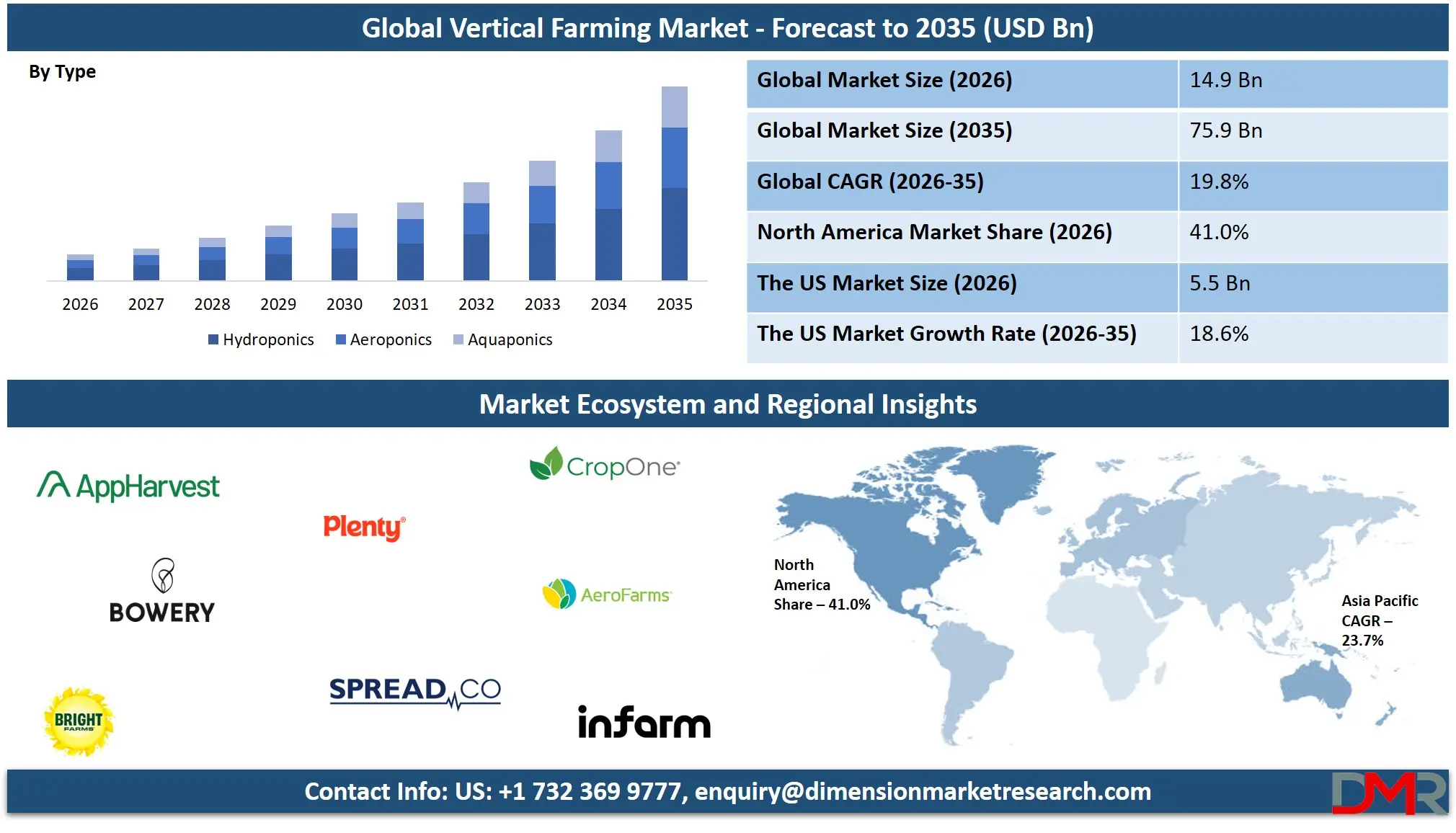
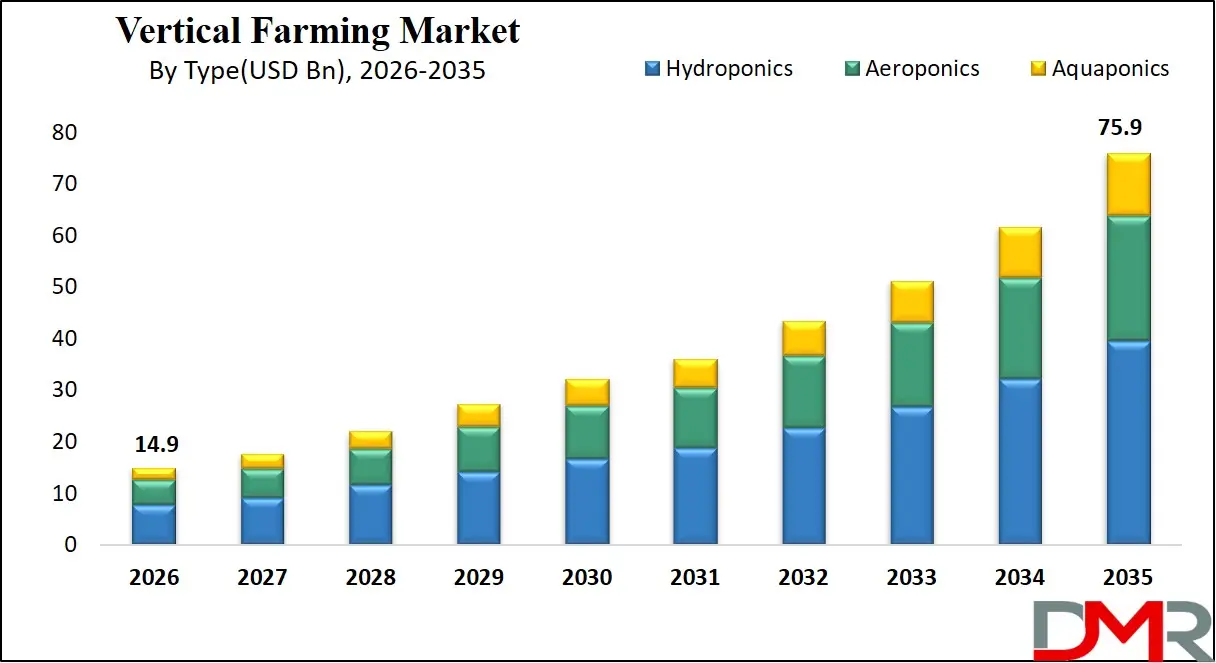
The Vertical Farming Market size is expected to be USD 14.9 billion in 2026 and increase at a compound annual growth rate of 19.8% to USD 75.9 billion in 2035 due to the growing use of renewable energy sources like solar and wind.
ℹ
To learn more about this report –
Download Your Free Sample Report Here
The Vertical Farming market is growing at a fast pace as urbanisation, global warming and food security concerns are driving technology innovations in farming. The market refers to the cultivation of crops in vertically stacked layers, typically in an urban environment, using controlled environment agriculture (CEA) hydroponics, aeroponics, and LED lighting. The need for chemical-free and local farming, and reduction in water consumption are some other factors driving growth in the market. Also, automation, IoT and artificial intelligence in agriculture are also fuelling the growth of the market.
ℹ
To learn more about this report –
Download Your Free Sample Report Here
The US Vertical Farming Market
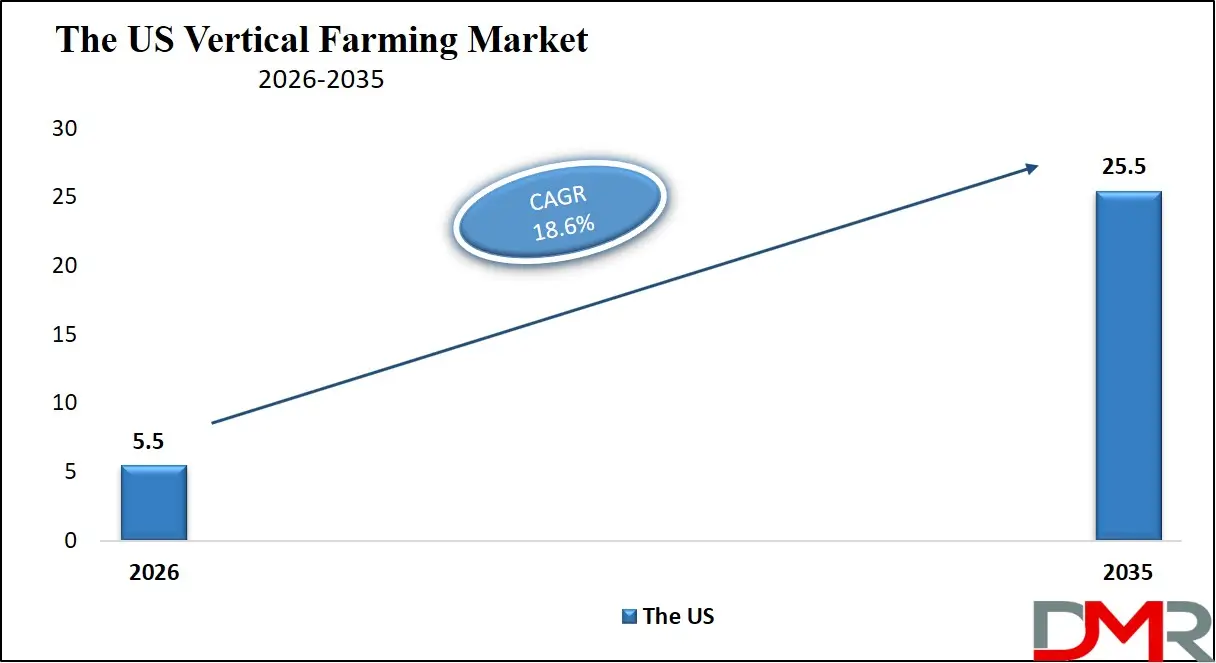
The US Vertical Farming Market size is estimated to be USD 5.5 billion in 2026 and is expected to increase at a CAGR of 18.6% over the forecast period.
ℹ
To learn more about this report –
Download Your Free Sample Report Here
Innovation, investment opportunities, and the growing need for sustainable agricultural practices are driving the vertical farming industry in the US. A growing adoption of vertical farming in urban areas to reduce distribution costs and to ensure access to fresh vegetables. Policies promoting sustainable farming and water conservation also contribute to the industry. Research institutes and partnership between agritech and retailers also boost market share.
Europe Vertical Farming Market
The Europe Vertical Farming Market size is estimated to be USD 3.6 billion in 2026 and at a CAGR of 19.0% over the forecast period.
Very high environmental standards and sustainability goals such as European Green New Deal are the features of the European vertical farming sector. Countries are becoming more interested in the practice of reducing their carbon emissions and achieving food security by using Controlled Environment Agriculture. Energy sustainability and integrating renewable energy in farming is highly promoted in this area. Urban farming is gaining momentum particularly in large cities due to the support of the government. There are substantial R&D investments and good public-private partnerships.
Japan Vertical Farming Market
The market size of Japan Vertical Farming will be USD 745 million in 2026 and at a CAGR of 19.7% in the forecast period.
The vertical farming market in Japan is expanding due to the lack of farmland, high population density and advanced technology. Japan is one of the leading countries in the adoption of technologies to enable indoor farming. Strategies by the government to promote smart farming and food security is a factor contributing to the growth of the market. Growing urban population and demand for quality products are some of the factors that have helped in the growth of the sector. Power costs hinder the growth.
Key Takeaways
- Market Size & Forecast: The Vertical Farming Market size is projected to reach USD 14.9 billion in 2026 and is anticipated to have a value of USD 75.9 billion in 2035.
- Growth Rate & Outlook: The Vertical Farming Market size is set to grow at a compound annual growth rate of 19.8% during the forecast period of 2026 to 2035.
- Primary Growth Drivers: Some of the major growth drivers in the market include Technological Advancements in Controlled Agriculture, Rising Demand for Sustainable and Local Food Production, and more.
- Key Market Trends: Some of the major trends in the market are Adoption of AI and Automation Technologies, Shift Toward Modular and Container-Based Farming, and more.
- By Type: The hydroponics segment is anticipated to get the majority share of the Vertical Farming market in 2026.
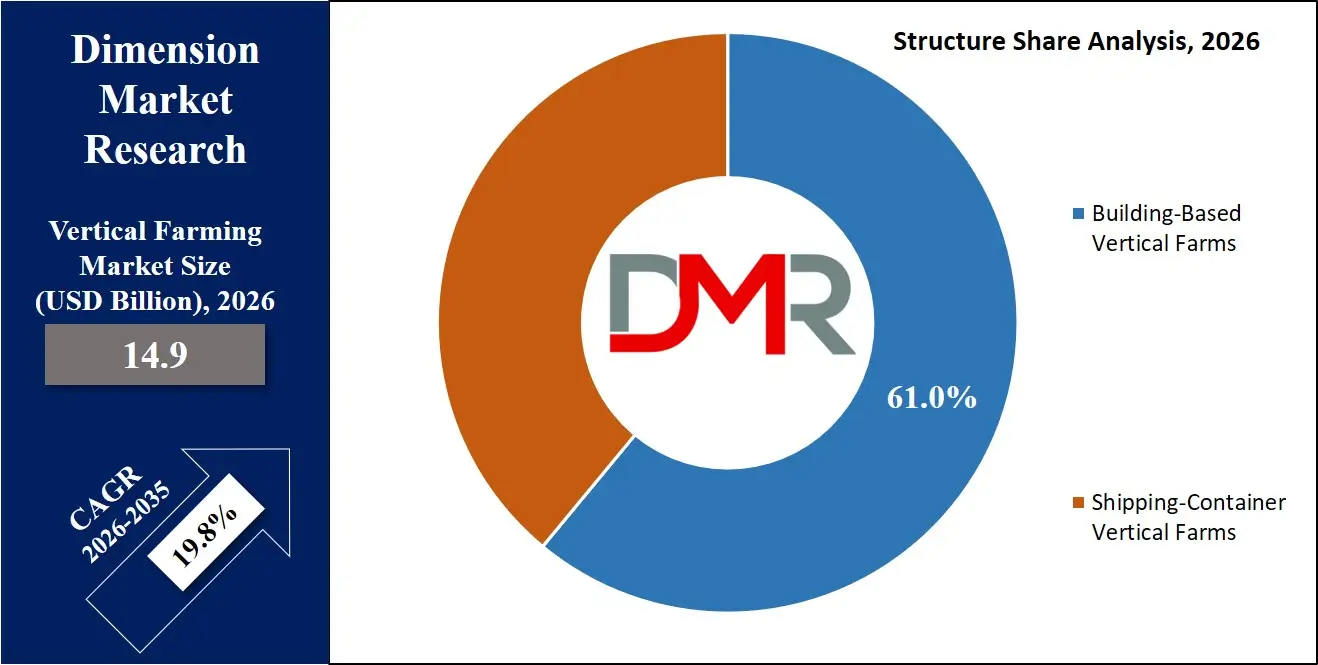
- By Structure: The building-based vertical farms segment is expected to get the largest revenue share in 2026 in the Vertical Farming market.
- By Component: The lighting system segment is expected to get the largest revenue share in 2026 in the Vertical Farming market.
- Regional Leadership: North America is set to lead the Vertical Farming market with an estimated 41.0% share in 2026.
What is the Vertical Farming?
Vertical farming is a new method of agriculture where vegetables and other crops are cultivated in layers or stacks in indoor buildings, greenhouses and containers. The farming uses technologies such as hydroponics, aeroponics, aquaponics, lighting and climate control. The farming method optimises water and land use, while freeing the farm of the need to adapt to the seasons. Vertical farming is an important component of the modern farming system enabling year-round plant cultivation.
Use Cases
- Urban Food Production: Vertical farms enable fresh produce cultivation within cities, reducing transportation costs and ensuring consistent supply. They support local food ecosystems and minimize carbon emissions associated with logistics.
- Climate-Resilient Agriculture: Controlled environments protect crops from extreme weather conditions, enabling stable production regardless of external climate variability. This ensures food security in regions prone to climate disruptions.
- Pharmaceutical and Nutraceutical Crops: Specialized crops for medicines and supplements can be grown with precision, ensuring high purity and controlled quality standards, benefiting healthcare and wellness industries.
- Research and Crop Innovation: Vertical farming systems are used for agricultural research, allowing scientists to experiment with crop genetics, nutrients, and growth conditions to enhance yield and resilience.
How AI Is Transforming the Vertical Farming Market
The use of artificial intelligence has resulted in a revolutionary breakthrough in vertical farming that includes monitoring and control of parameters in crop production. Artificial intelligence technologies leverage data collected from sensors to deliver effective lighting, water and nutrient supply, which in turn lead to high productivity and reduced waste.
In addition, artificial intelligence technologies have predictive capabilities with respect to disease prevention, control of environmental factors, and harvest management. Artificial intelligence also reduces the costs arising from the use of human labor.
Market Dynamic
Driving Factors in the Vertical Farming Market
Technological Advancements in Controlled Agriculture
The growth in the vertical farming industry is being powered by technology. Developments in such areas as LED lighting, automation and Internet of Things (IoT) for monitoring, and artificial intelligence (AI) for data analysis have improved efficiency. Technology allows for greater accuracy in terms of controlling environmental conditions including temperature, humidity, and nutrients in order to optimize resource usage and produce a higher yield.
Rising Demand for Sustainable and Local Food Production
Consumers are increasingly becoming conscious of food safety and sustainability as well as environmental sustainability issues. The solution to this problem lies in vertically farmed food which uses less water, does not require chemical spraying, and requires low energy costs. Urban consumers have an inclination towards fresh and organic food; hence, vertical farming becomes a viable option for them. This is one of the driving forces behind market growth.
Restraints in the Vertical Farming Market
High Initial Capital Investment
Capital expenditure on infrastructure, sophisticated equipment and technology integration is a significant restraint in the vertical farming market. Creating plant growth environments involves substantial costs for lighting, climate control and automation equipment. This can deter smaller and medium-sized operations and hinder the growth of the market, despite potential long-term cost savings.
Energy Consumption and Operational Costs
Vertical farms require high levels of artificial lighting and temperature control, consuming energy. The cost of electricity can affect the bottom line, particularly in areas where energy is costly. While the use of renewable energy sources is growing, it comes at a cost. These operational issues are holding back growth.
Opportunities in the Vertical Farming Market
Expansion in Emerging Urban Markets
Developing markets' rapid urbanisation offers vertical farming opportunities. Increasing population and scarcity of farmland create demand for food security. Emerging market governments are promoting smart agriculture programs, providing a conducive environment for vertical farming investment and growth.
Integration with Renewable Energy Solutions
By connecting with renewable energy sources like solar and wind power, vertical farms can potentially lower costs and improve sustainability. Improvements in energy efficiency technologies can make vertical farming economically feasible. This step is in line with global sustainability targets, encouraging investment and driving growth.
Trends in the Vertical Farming Market
Adoption of AI and Automation Technologies
AI and automation technologies are revolutionizing vertical farming. These technologies allow real-time data monitoring and predictive analysis to make automatic adjustments for optimal crop growth. This development increases efficiency, labor savings and resource efficiency, which makes vertical farming more productive and scalable.
Shift Toward Modular and Container-Based Farming
Container and modular vertical farms are becoming increasingly popular for their adaptability. They can be set up in different settings, such as urban and rural environments. Their small size and simplicity in installation are appealing to startups and small farmers, providing market diversification.
Research Scope and Analysis
Research Scope and Analysis highlights vertical farming market segmentation by type, structure, and component, with hydroponics, building-based farms, and lighting systems leading the market, while aeroponics, container farms, and climate control systems show the fastest growth due to efficiency and scalability.
ℹ
To learn more about this report –
Download Your Free Sample Report Here
By Type Analysis
Hydroponics are the most common types of technologies used in vertical farming and are expected to account for 52% of the market share in 2026. Hydroponic technologies can grow crops without soil using water with dissolved nutrients, and hence, are extremely efficient and sustainable technologies. Hydroponics allow precise control of nutrition, crop life-cycle and high productivity, and therefore, are very attractive for urban farming. Aeroponics is one of the fastest growing technologies. It is gaining traction because it has high water efficiency, and rapid growth development, due to misting of the nutrient solution. The improvements in technologies, cost reduction and research make this farming system more commercially viable. Another emerging grower trend is aquaponics, which is the cultivation of fish and plants.
By Structure Analysis
Vertical farms in buildings dominate the market with an estimated 61% market share in 2026 due to their high production capacity and easy integration into urban areas. These structures are typically intended for densely grown crops and may include automation, robotics, and climate control technologies to boost yields. Their proximity to markets lowers transportation expenses and optimises the supply chain. Container farms are the fastest growing type, due to their modularity, reduced initial investment and versatility. They're portable and can be set up in various settings such as urban, rural and disaster-prone regions. Their versatility and scalability make them attractive for localised and on-demand food production.
By Component Analysis
Lighting systems dominate the market, with a projected share of 38% in 2026, owing to their importance in plant growth, photosynthesis, and yield in indoor farming. LED technology has revolutionised energy usage, light spectrum and yield, making them crucial in vertical farming. The fastest-growing segment is climate control systems, required for maintaining optimal environmental conditions, such as temperature, humidity, and CO₂ concentrations, for plant growth. Sensors and irrigation systems are also crucial, with greater use of IoT devices for real-time monitoring and automation. Smart technologies improve efficiency, minimise labour, and enable informed decision-making in precision farming systems.
The Vertical Farming Market Report is segmented on the basis of the following:
By Type
- Hydroponics
- Aeroponics
- Aquaponics
By Structure
- Building-Based Vertical Farms
- Shipping-Container Vertical Farms
By Component
- Lighting System
- Irrigation and Fertigation System
- Climate Control
- Sensors
- Others (HVAC systems, Shelves and Racks, etc.)
Regional Analysis
Leading Region in the Vertical Farming Market
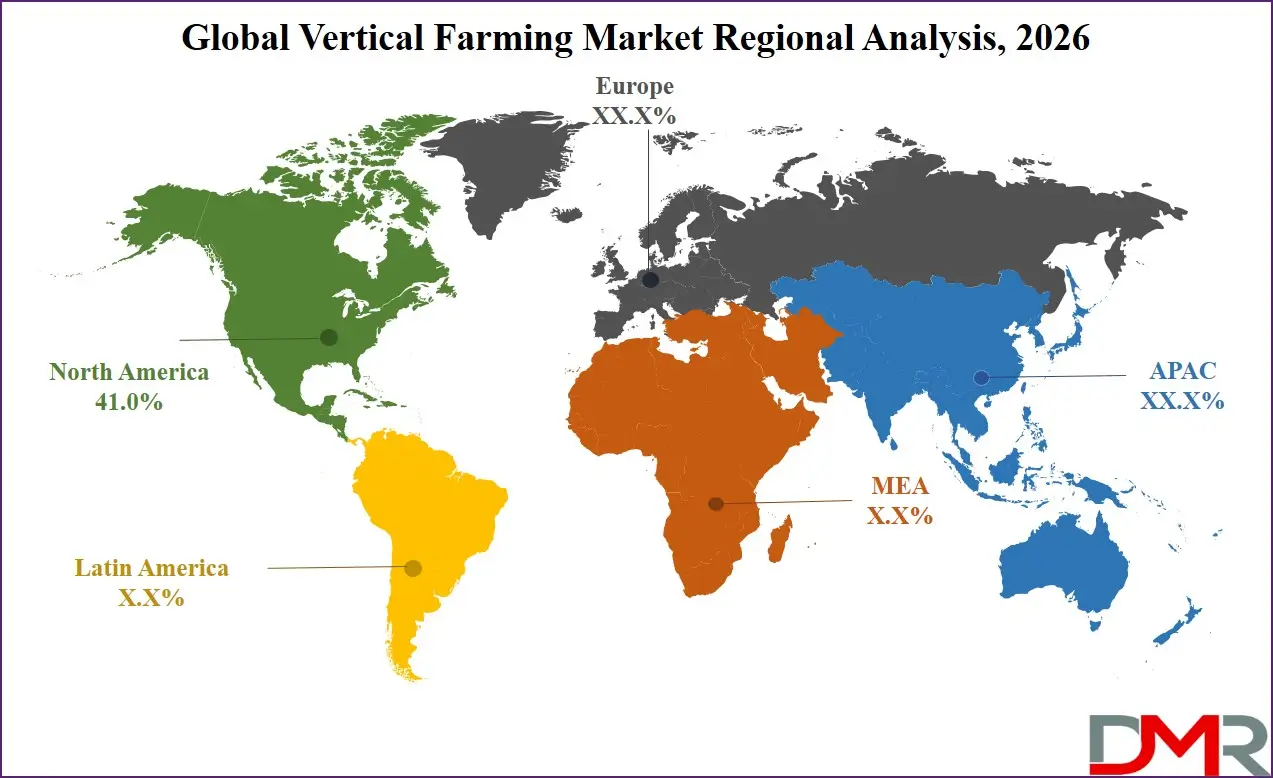
The vertical farming industry is led by North America with an expected 41% market share by 2026. The technological capabilities of the region, combined with venture capital investments, as well as agritech start-up companies support the market growth in the region. There is increased demand in the cities for food products that are locally grown and organic and pesticide-free. Water scarcity and food security policies also help in contributing to the growth in the market. Moreover, innovation is supported by the active start-ups, institutions, as well as collaborations between tech companies and retailers.
ℹ
To learn more about this report –
Download Your Free Sample Report Here
Fastest Growing Region in the Vertical Farming Market
Asia-Pacific has been identified as the fastest-growing region in terms of vertical farms because of rapid urbanization, increasing population, and decline in agricultural lands. Governments of the region have been promoting smart farming techniques and controlled environmental agriculture for ensuring food safety and availability. Rising investment in technologies related to smart farming like automation, artificial intelligence, etc. has been contributing to the growth of the market. In addition, there has been rising demand from consumers for safe and healthy foods that has supported market growth.
By Region
North America
Europe
- Germany
- The U.K.
- France
- Italy
- Russia
- Spain
- Benelux
- Nordic
- Rest of Europe
Asia-Pacific
- China
- Japan
- South Korea
- India
- ANZ
- ASEAN
- Rest of Asia-Pacific
Latin America
- Brazil
- Mexico
- Argentina
- Colombia
- Rest of Latin America
Middle East & Africa
- Saudi Arabia
- UAE
- South Africa
- Israel
- Egypt
- Rest of MEA
Competitive Landscape
The vertical farming industry is characterized by intense competition with fast-paced technological developments and innovations. Efforts are being made to enhance efficiency through automation and use of artificial intelligence and energy management. Market penetration strategies include strategic alliances and collaboration with retailers and research and development activities. High capital costs and technological complexity act as major barriers to entry in the industry.
Some of the prominent players in the global Vertical Farming are:
- AeroFarms
- Plenty
- Bowery Farming
- Infarm
- Crop One Holdings
- BrightFarms
- Gotham Greens
- Spread Co.
- Kalera
- AppHarvest
- Signify (Philips Lighting)
- Heliospectra
- ams-OSRAM
- Everlight Electronics
- Urban Crop Solutions
- Intelligent Growth Solutions (IGS)
- Freight Farms
- American Hydroponics (AmHydro)
- Vertical Farm Systems
- Jones Food Company
- Other Key Players
Recent Developments
- In February 2026, YesHealth Group is expanding its proven vertical farming model in Taiwan through a partnership with Taichung-based Seasons Future Farm Co., Ltd. The collaboration will establish a large indoor vertical farm in Xinshe District, Taichung City, enhancing regional food supply and sustainable agriculture. Built on a 6,000-square-meter site, the facility will offer around 15,000 square meters of cultivation space, featuring 13 racks up to 11 meters tall for high-density, year-round leafy green production.
- In December 2025, Agroz Inc. launched Agroz Robotics in partnership with UBTECH Robotics, marking a strategic move toward fully automated vertical farming. The initiative integrates UBTECH’s humanoid robot Walker S into Agroz’s proprietary Agroz OS to create a unified, AI-driven controlled environment agriculture system. Designed to automate seeding, monitoring, harvesting, and crop optimization, the platform aims to enhance productivity, reduce labor dependence, and deliver more consistent, high-quality crop outputs.
- In May 2025, Aeroponic irrigation firm LettUs Grow partnered with Netherlands-based KG Systems to expand global deployment of its Advanced Aeroponics technology. Announced at Indoor Ag-Con in March 2025, the collaboration combines LettUs Grow’s ultrasonic, clog-resistant aeroponics with KG Systems’ large-scale greenhouse and vertical farming expertise. The system enhances reliability, reduces maintenance, and can increase growth rates and yields of leafy greens and herbs by more than 20% versus traditional hydroponics.
Report Details
| Report Characteristics |
| Market Size (2026) |
USD 14.9 Bn |
| Forecast Value (2035) |
USD 75.9 Bn |
| CAGR (2026–2035) |
19.8% |
| Historical Period |
2021 – 2025 |
| Forecast Period |
2027 – 2035 |
| Base Year |
2025 |
| Estimate Year |
2026 |
| Segments Covered |
By Type, By Structure, By Component |
| Regional Coverage |
North America – The US and Canada; Europe – Germany, The UK, France, Russia, Spain, Italy, Benelux, Nordic, & Rest of Europe; Asia-Pacific – China, Japan, South Korea, India, ANZ, ASEAN, Rest of APAC; Latin America – Brazil, Mexico, Argentina, Colombia, Rest of Latin America; Middle East & Africa – Saudi Arabia, UAE, South Africa, Turkey, Egypt, Israel, & Rest of MEA |
Frequently Asked Questions
How big is the Vertical Farming Market?
▾ The Vertical Farming Market size is expected to reach USD 14.9 billion by 2026 and is projected to reach USD 75.9 billion by the end of 2035.
What is the CAGR of the Vertical Farming Market from 2026 to 2035?
▾ The market is growing at a CAGR of 19.8 percent over the forecasted period.
What factors are driving the growth of the Vertical Farming Market?
▾ Technological Advancements in Controlled Agriculture, Rising Demand for Sustainable and Local Food Production, and more are the factors driving the growth of the Vertical Farming Market.
What are the major trends in the Vertical Farming Market?
▾ Adoption of AI and Automation Technologies, Shift Toward Modular and Container-Based Farming, and more are some of the major trends in the market.
Who are the key players in the Vertical Farming Market?
▾ Some of the key players in the Vertical Farming Market include BrightFarms, Infarm, Plenty and more
How is the Vertical Farming Market segmented?
▾ The Vertical Farming Market is segmented by type, structure, and component.
Which region held the largest share of the Vertical Farming Market in 2026?
▾ North America is set to lead the Vertical Farming market with an estimated 41.0% share in 2026.
Which region is expected to grow the fastest in the Vertical Farming Market?
▾ Asia-Pacific is the fastest-growing region in the Vertical Farming market during the forecast period.