Market Snapshot
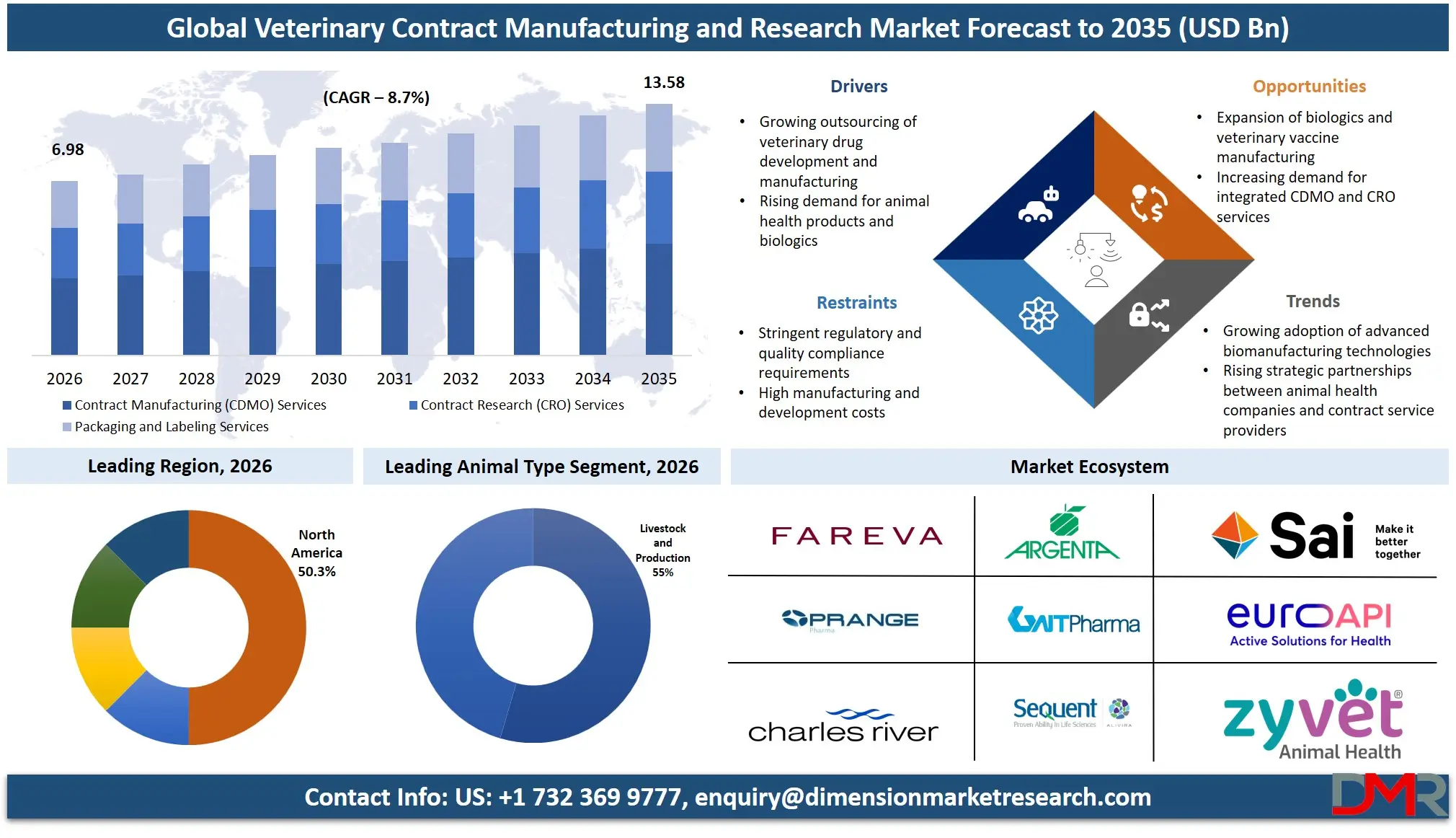
- The Veterinary Contract Manufacturing and Research market size is USD 6.42 Billion in 2025, reached USD 6.98 Billion in 2026, and is projected to hit USD 13.58 Billion by 2035 at a CAGR of 8.7%.
- Contract Manufacturing (CDMO) Services leads the By Service segment with a 54% share in 2026.
- Medicines and Pharmaceuticals leads the By Product Type segment with an 80.0% share in 2026.
- Livestock and Production Animals leads the By Animal Type segment with a 55% share in 2026.
- Multinational Animal Health Companies lead the By End User segment with a 49.7% share in 2026.
- North America dominates the regional landscape with a 50.3% revenue share in 2026.
Market Overview
The Veterinary Contract Manufacturing and Research market covers outsourced manufacturing, research, and packaging services for animal health products. Contract development and manufacturing organization (CDMO) services, contract research organization (CRO) services, and specialized packaging and labeling all fall within scope. Human pharmaceutical manufacturing and companion diagnostics for human use sit outside this market's boundary. The market connects directly to the broader animal health industry, where drug developers and multinational corporations increasingly rely on third-party operators for production and research execution.
ℹ
To learn more about this report –
Download Your Free Sample Report Here
Multinational firms account for 49.7% of total contract production demand. Their pivot to asset-light operations redirects captive capital toward research pipelines and commercial launches rather than facility ownership. This structural shift gives established CDMOs with validated GMP infrastructure and multi-species capabilities durable pricing power over clients who cannot justify in-house facility investment. Vaccines and biologics carry an 8.9% CAGR within the medicines segment, signaling that biologics-capable manufacturers command a premium over standard small-molecule producers.
AI integration into early-stage research and single-use bioprocessing architectures are reshaping how contract research services operate. Real-world evidence streams now accelerate lead optimization in toxicology and bioanalytics, compressing preclinical timelines. For CRO operators, faster cycles translate to higher throughput per scientist and improved client retention, raising revenue per engagement without proportional cost increases. Operators without these capabilities face progressive margin erosion as technically differentiated competitors absorb the highest-value research mandates.
Market Size and Forecast
The Global Veterinary Contract Manufacturing and Research Market size is estimated at USD 6.98 Billion in 2026 from USD 6.42 Billion in 2025, and is projected to reach USD 13.58 Billion by 2035, exhibiting a CAGR of 8.7% during the forecast period.
The 2025 base reflects early enterprise outsourcing concentrated in large multinational animal health firms and established European CDMOs. Alivira Animal Health delivered standalone revenues of INR 14.6 Billion in FY2025, up from INR 13.1 Billion in FY2024, an 11.5% year-on-year increase that confirms outsourcing volume growth in the Indian veterinary supply chain is outpacing general pharmaceutical sector averages. SeQuent Scientific's standalone formulations revenue grew from INR 13.7 Billion in FY2024 to INR 15.5 Billion in FY2025, a 13.1% increase that reflects the same structural momentum at the formulations layer.
The forecast to USD 13.58 Billion by 2035 assumes continued outsourcing adoption by mid-tier animal health companies, sustained biologics pipeline growth, and regulatory pressure that raises compliance costs for in-house manufacturers. Asia Pacific's 9.1% CAGR could accelerate further if India and ASEAN add more GMP-certified export facilities ahead of schedule. Companion animal segment growth at 8.4% CAGR could outpace livestock growth if urban pet ownership rises faster than projected in key markets. Either variable would add USD 1.5 to 2.0 Billion to the 2035 terminal value. On the downside, stricter batch validation enforcement by regulatory bodies could reduce effective market growth to below 7% CAGR in the 2027 to 2030 window if smaller CDMOs face capacity lockdowns on multiple client pipelines simultaneously.
Service Analysis
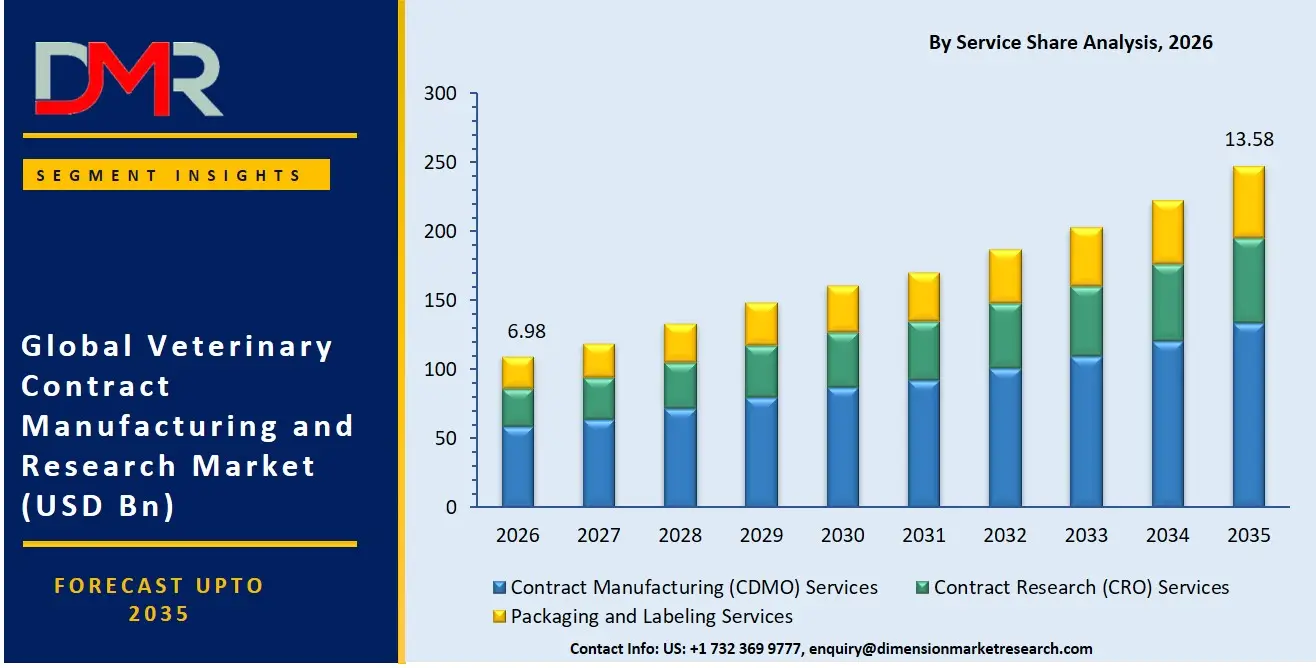
Contract Manufacturing (CDMO) Services led the service segment with a 54% share in 2026.
ℹ
To learn more about this report –
Download Your Free Sample Report Here
Multinational animal health companies have systematically redirected in-house production to certified third-party operators, creating a structural floor for CDMO revenue independent of new product launches. Each product launch by a multinational firm generates a recurring multi-year production contract, giving established CDMOs stable cash flow that supports capacity investment without relying on short-cycle project revenues. Aenova Group's allocation of approximately EUR 100 million over three years to scale sterile technology, cold-chain operations, and quality infrastructure directly reflects the demand confidence driving this investment at the CDMO tier. The installation of an automated sterile isolator fill-and-finish line at its Latina, Italy site, capable of producing 30 to 40 million additional vaccine and biologic units annually, illustrates where the infrastructure capital is concentrating.
Contract Research (CRO) Services holds a 31% share with a 7.4% CAGR. CRO demand is driven by veterinary biotech startups and pharmaceutical companies lacking internal discovery infrastructure, and AI-enhanced preclinical workflows are expanding the fee-per-study premium for operators with specialized toxicology and bioanalytics capability. Packaging and Labeling Services accounts for a 15% share with a 6.8% CAGR. Regulatory compliance mandates in Europe and North America now require specialized blister line formats and region-specific labeling, creating recurring revenue per commercial product and client lock-in because switching packaging vendors mid-launch cycle carries significant regulatory risk.
Contract Research (CRO) Sub-Segment Analysis
Preclinical Research accounted for 34% of CRO sub-segment demand in 2026, the highest of any category.
Every new veterinary drug candidate must pass preclinical evaluation before entering clinical trials. Veterinary biotech startups generate continuous preclinical demand because they lack in-house animal study facilities, making preclinical research the structural entry point for all new product pipelines. CRO operators who build AI capability into preclinical workflows serve more clients per year with the same headcount, directly improving margin without requiring physical capacity expansion.
Discovery Services holds a 28% share with a 7.9% CAGR, the second-highest growth rate in this sub-segment, driven by AI integration into lead optimization loops that compress iterative testing cycles. Clinical Trial Services accounts for a 26% share with a 7.8% CAGR; Clinglobal's December 2024 launch of Clinaxel as a dedicated field trials brand across North America, Europe, and Africa reflects client demand for specialized regional clinical execution that reduces trial timeline variance.
Regulatory Affairs and Consulting holds a 12% share with a 6.9% CAGR, growing more slowly because it is labor-intensive, but tightening GMP compliance requirements make it indispensable for every new product submission. Operators offering integrated regulatory support alongside CRO services reduce client vendor count and increase switching costs, converting what appears to be a slow-growth service into a high-retention revenue stream.
Product Type Analysis
Medicines and Pharmaceuticals dominated the product type segment with an 80.0% share in 2026.
The segment covers every therapeutic category from vaccines to anti-infectives across livestock and companion animals. Its dominance reflects the volume of approved products already in commercial production rather than pipeline potential alone. CDMOs handling medicines revenue benefit from long-term supply agreements that provide multi-year revenue visibility, making this the most predictable revenue base in the market. Vaccines and biologics growing at 8.9% CAGR within this segment confirm that the highest-growth work sits inside the dominant product category.
Medical Devices accounts for a 12.0% share with an 8.2% CAGR, growing faster than the medicines segment overall. Veterinary diagnostic devices and implantable technologies require specialized manufacturing processes distinct from pharmaceutical production, and the higher CAGR signals that device outsourcing is earlier in its adoption curve. Fill-Finish and Specialized Products holds an 8.0% share but carries the highest product-type CAGR at 8.5%, directly serving the biologics and vaccine pipeline where sterile fill-finish is a non-negotiable production requirement. Operators who secure fill-finish capacity now will face lower competitive pressure as biologics pipelines mature through the forecast period.
Animal Type Analysis
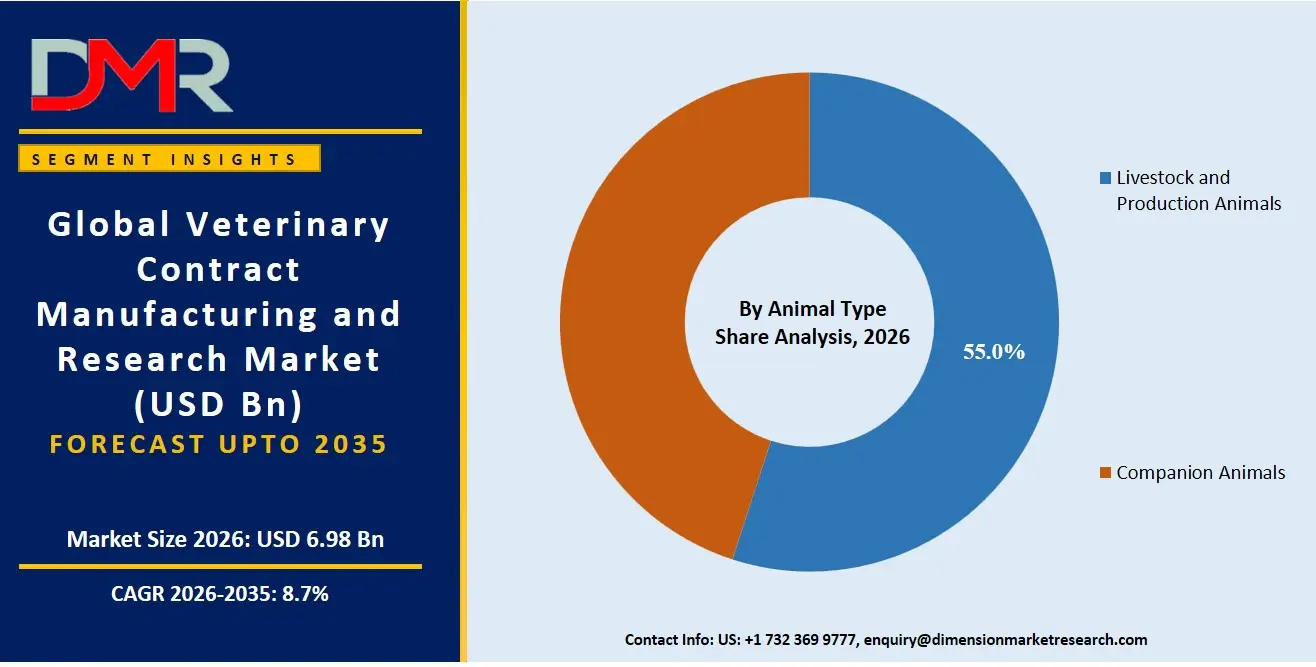
Livestock and Production Animals captured 55% of the animal type segment in 2026, ahead of all rivals.
ℹ
To learn more about this report –
Download Your Free Sample Report Here
Agricultural scale drives this dominance. Global cattle, poultry, and swine populations require preventive medicine programs at volumes no single animal health company can produce internally. Contract manufacturers serving livestock clients operate at industrial batch sizes that generate lower per-unit margins but higher absolute revenue per contract, creating a stable revenue base for CDMOs with validated multi-species production lines.
Companion Animals holds a 45% share but grows faster at an 8.4% CAGR compared to livestock at 7.2%. Urban pet ownership expansion and the humanization of pet healthcare drive prescription volume per animal upward, and companion animal drugs often carry higher price points than livestock medicines because they target smaller patient populations with less price-sensitive owners. CDMOs building companion animal capability alongside livestock lines diversify their revenue mix toward higher-margin product categories without abandoning the volume base that livestock contracts provide.
Livestock Sub-Segment Analysis
Poultry led the livestock sub-segment with a 29% share in 2026.
Global poultry production operates at the largest scale of any livestock category, making prophylactic and therapeutic medicine volumes correspondingly large. Multi-valent avian vaccine development using single-use bioprocessing architectures directly targets this sub-segment, and CDMOs building avian-specific production lines capture recurring institutional contracts from large-scale integrators who cannot tolerate supply disruption.
Cattle accounts for a 27% share with a 7.3% CAGR; beef and dairy production volumes in South America create a regional demand base that European and North American CDMOs increasingly serve through cross-border supply agreements. Swine holds a 23% share with a 7.1% CAGR, heavily vaccine-dependent for respiratory and reproductive disease prevention, making it a direct beneficiary of expanding biologics manufacturing capacity.
Aquaculture accounts for an 11% share but carries an 8.1% CAGR, the highest within the livestock sub-segment. Regulatory frameworks for aquaculture drug approval are less developed in many markets, meaning approvals achieved now create first-mover supply advantages before the segment reaches commercial scale.
End User Analysis
Multinational Animal Health Companies captured 49.7% of end user demand in 2026, the highest of any category.
Their asset-light strategic pivot directly converts internal manufacturing budgets into external contract spending. Each facility divestment by a large animal health firm creates a multi-year supply agreement that transfers to a CDMO, sustaining CDMO revenue even in periods of subdued new product launches. Prange Pharma's acquisition of MSD Animal Health's Aprilia facility in 2026 illustrates how divested corporate assets convert into independent CDMO platforms serving the same multinational client base under new ownership.
Pharmaceutical and Biotechnology Companies account for a 31.3% share with an 8.0% CAGR; EUROAPI's multi-year manufacturing partnership with a global animal health company for companion animal medicines reflects the cross-sector demand these clients bring. Startups and Veterinary Biotech Firms hold a 12.0% share with the highest end-user CAGR at 8.7%, have no proprietary GMP infrastructure, and must outsource every stage of product development and manufacturing. Academic and Research Institutes account for a 7.0% share with a 6.9% CAGR, generating lower commercial volumes but providing CRO operators access to novel compound libraries and early visibility into emerging therapeutic targets before commercial clients bring those targets to scale.
Key Market Segments
By Service
- Contract Manufacturing (CDMO) Services
- Contract Research (CRO) Services
- Preclinical Research
- Discovery Services
- Clinical Trial Services
- Regulatory Affairs and Consulting
- Packaging and Labeling Services
By Product Type
- Medicines and Pharmaceuticals
- Vaccines and Biologics
- Parasiticides
- Anti-Infectives
- Pain Management and Anti-inflammatory
- Others
- Medical Devices
- Fill-Finish and Specialized Products
By Animal Type
- Livestock/Production Animals
- Poultry
- Cattle
- Swine
- Aquaculture
- Others
- Companion Animals
By End User
- Multinational Animal Health Companies
- Pharmaceutical and Biotechnology Companies
- Startups and Veterinary Biotech Firms
- Academic and Research Institutes
Regional Analysis
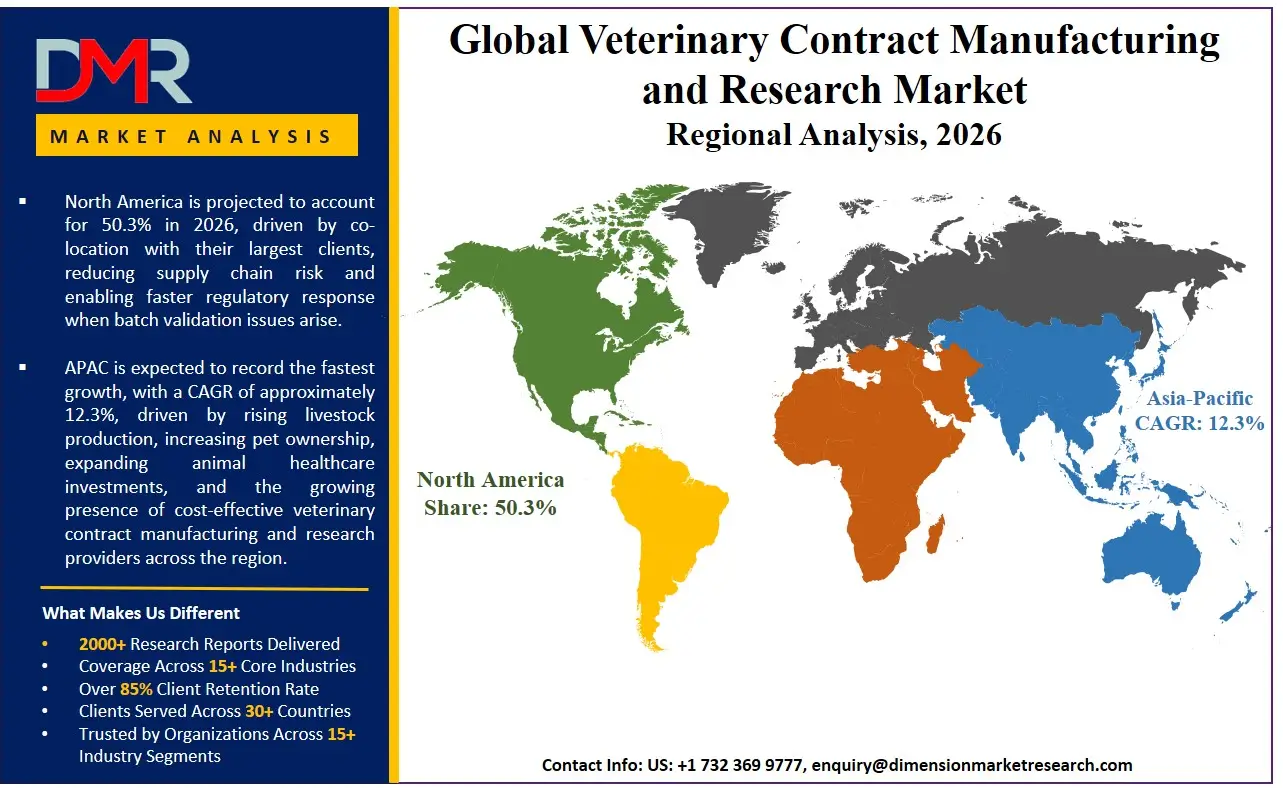
North America held a 50.3% share in 2026, valued at USD 3.23 Billion.
ℹ
To learn more about this report –
Download Your Free Sample Report Here
The United States accounts for 84% of North American revenue at a 7.2% CAGR. The concentration of multinational animal health headquarters, FDA-regulated manufacturing infrastructure, and established GMP audit frameworks keeps production mandates within the region. North American CDMOs benefit from co-location with their largest clients, reducing supply chain risk and enabling faster regulatory response when batch validation issues arise.
Europe holds a 31.1% share with a 7.4% CAGR; Germany leads within the region at a 23% sub-regional share and 7.5% CAGR, and Europe captured a 36.0% share of outsourced veterinary formulations within the SeQuent Scientific distribution network in FY2025. Prange Pharma's Aprilia acquisition and Aenova's multi-site sterile capacity expansion confirm that European operators are consolidating production assets to serve both regional and export demand from fewer, higher-output facilities.
Key Regions and Countries
North America
Europe
- Germany
- France
- The UK
- Spain
- Italy
- Rest of Europe
Asia Pacific
- China
- Japan
- South Korea
- India
- Australia
- Rest of APAC
Latin America
- Brazil
- Mexico
- Rest of Latin America
Middle East & Africa
- GCC
- South Africa
- Rest of MEA
Market Dynamics
Asset-Light Mandates at Multinationals Convert Internal Budgets Into CDMO Revenue
Multinational animal health corporations have systematically divested captive manufacturing assets and channeled capital into R&D, directly feeding contract manufacturing volume. Argenta's acquisition of the TriRx Shawnee facility confirms that purpose-built CDMO operators are absorbing divested assets and converting them into flexible contract production platforms. This is not a gradual preference shift. Each facility divestment by a large animal health firm creates a multi-year supply agreement that sustains CDMO revenue independent of new product launches.
Advanced biologics and sterile fill-finish infrastructure represent the structural differentiator within CDMO competition. Aenova Group allocated approximately EUR 100 million over three years to scale sterile technology, cold-chain operations, and quality infrastructure at its animal health site. Its automated sterile isolator line at Latina, Italy, adds 30 to 40 million additional vaccine and biologic units of annual capacity. Operators who make these investments now will capture the biologics wave before competitors can match their validated production throughput.
Multi-Jurisdictional GMP Compliance Creates Operational Bottlenecks for Contract Operators
Regulatory bodies enforce direct oversight transitions for medicated animal products across multiple jurisdictions simultaneously. Each new market entry requires separate GMP certification, administrative transfer filings, and site audits. For a CDMO operating in North America, Europe, and Asia, this creates a continuous compliance burden that consumes management bandwidth and delays capacity ramp-up during peak demand cycles. Contract validation guidelines for investigational submissions have tightened, with regulatory agencies standardizing manufacturing batch controls supporting original NADAs, ANADAs, and CNADAs.
Any deviation from validated batch parameters triggers re-validation requirements, raising the cost of error for CDMOs handling multiple client pipelines on shared lines. Smaller operators with limited quality assurance teams face the sharpest operational impact. This compliance pressure consolidates contract volume toward larger, better-resourced players, effectively protecting established incumbents whose existing multi-jurisdictional approvals new capital alone cannot replicate.
Strategic Acquisitions and Capacity Expansions Build Independent Manufacturing Hubs
Sai Life Sciences opened its dedicated veterinary API facility at Bidar, India, in September 2025, adding Indian manufacturing depth to the global veterinary supply chain. India's 9.8% CAGR within Asia Pacific reflects the direct result of backward integration and cost-efficient synthesis infrastructure. For global buyers, this creates a lower-cost sourcing alternative to European API suppliers that reshapes procurement negotiations across the entire supply chain. Prange Pharma's acquisition of MSD Animal Health's Aprilia facility in 2026 creates a new independent European CDMO platform without requiring greenfield construction, adding a qualified supplier to a market where options were previously limited.
ZyVet Animal Health launched multiple FDA-approved therapeutic formulas for the domestic veterinary market in 2025. Each new generic approval creates a production contract for a qualified CDMO. Startups and veterinary biotech firms at a 12.0% end-user share with an 8.7% CAGR lack in-house GMP infrastructure and route every new approval directly to contract manufacturers, making this segment the fastest-growing client base in the market and the highest long-term revenue expansion opportunity for full-service operators.
Market Trends
AI, Single-Use Bioprocessing, and Generic Approvals Raise Output Per Operator
AI and real-world evidence streams now integrate into early-stage veterinary research, reducing the time from compound identification to preclinical submission. Single-use bioprocessing architectures replace traditional fixed equipment in multi-valent avian and mammalian vaccine development, eliminating cross-contamination risk and reducing batch turnaround from days to hours. For vaccine CDMOs handling multiple client products on shared lines, this shift removes a structural throughput ceiling that previously limited contract slot availability. Glass Health-equivalent trajectory in veterinary CRO services points toward a near-term standard where operators without AI-assisted preclinical tools will be unable to compete on throughput or turnaround time against digitally capable peers.
Market Competition Overview
The veterinary contract manufacturing and research market is moderately consolidated at the top tier and fragmented in the mid-market. A small number of multi-site, multi-jurisdiction certified operators control the majority of biologics and sterile fill-finish contracts. Compliance costs of GMP certification create a natural ceiling on the number of credible competitors in any given product category. Argenta's January 2025 structural split of its global CRO platform into Americas CRO and Europe CRO standalone divisions reflects the operational reality that North American and European regulatory pathways require dedicated management focus, creating a service advantage that pure-scale competitors without regional specialization cannot easily replicate. AI startups and specialized equipment vendors are also reshaping competitive dynamics by supplying single-use bioprocessing systems that give mid-tier operators access to throughput improvements previously available only to large-format facilities.
Consolidation through acquisition is reshaping the mid-tier at pace. Clinglobal's October 2024 acquisition of OCRvet added European companion animal field trial capability to its existing CRO platform. These transactions follow a clear pattern: operators acquiring specialized assets faster than they can build them organically, compressing the timeline to full-service capability. Operators who retain biotech clients from discovery through commercial launch convert project-based revenue into long-term supply agreements, the most valuable revenue conversion in this market structure. Startups and veterinary biotech firms at an 8.7% CAGR are the fastest-growing client segment, and full-service operators offering integrated CRO-to-CDMO handoffs with flexible batch sizing will capture this growth disproportionately before generalist competitors recognize the structural shift.
Company Profiles
Aenova Group positions itself as a capacity-led European CDMO with a deliberate focus on sterile and biologics manufacturing for the animal health sector. The three-year sterile infrastructure program, combined with the automated isolator fill-and-finish line at Latina adding tens of millions of annual biologic units, locks in biologics clients who require validated sterile capacity that smaller operators cannot provide. A custom-built 800-square-meter microbiology quality control laboratory opened at its production center in September 2025, handling critical containment and analytical scaling for complex sterile formulations. This combination of production capacity and analytical infrastructure creates a compliance architecture that directly supports multi-year enterprise contract retention.
SeQuent Scientific Limited operates through its Alivira Animal Health subsidiary as a vertically integrated veterinary API and formulations manufacturer. A consolidated gross margin of 54.5% in Q3 FY2026 and EBITDA margin of 19.0% in 9MFY2026 confirm that vertical integration in the Indian veterinary supply chain produces financial performance that pure contract operators in Europe or North America rarely achieve. Alivira's 66.0% export revenue share demonstrates that its cost-advantaged production model is already capturing regulated Western market demand at scale, not simply serving domestic Indian buyers.
Key Players
- Aenova Group
- Argenta
- Clinglobal
- SeQuent Scientific Limited
- Prange Pharma GmbH
- Fareva
- Charles River Laboratories
- EUROAPI
- Sai Life Sciences
- GNT Pharma
- ZyVet Animal Health
Supply Chain and Value Chain Analysis
The veterinary contract manufacturing and research supply chain begins with raw material and active pharmaceutical ingredient production. India's backward-integrated model positions domestic chemical synthesis facilities at the base of the global value chain, with API producers supplying formulation manufacturers directly. Vertical integration at this stage reduces input cost volatility for downstream operators. The second layer is formulation manufacturing, where APIs convert into finished dosage forms including tablets, injectables, and biologics. Operators without internal API supply face margin compression when raw material costs rise, a structural vulnerability that vertically integrated players do not share.
Fill-finish and specialized packaging represent the third and fourth layers, carrying the highest technical barrier and regulatory compliance concentration in the chain. A single GMP deviation at the fill-finish stage can halt an entire product batch, making quality system investment at this node non-negotiable for any operator serving biologics clients. Packaging operators with multi-market labeling capability reduce client launch timelines by handling regulatory artwork and compliance verification within a single service agreement. The final layer is distribution and end-user delivery, where multinational corporations at 49.7% of total demand control distribution internally and use CDMOs purely for production, while biotech startups rely on their CDMO and CRO partners for supply chain management through to regulatory submission, giving full-service operators a structural advantage in contract value per engagement.
Regulatory Landscape
The veterinary contract manufacturing and research market operates under multi-jurisdictional GMP frameworks that differ significantly across North America, Europe, and Asia Pacific. In the United States, the FDA enforces oversight of medicated animal products through direct administrative transfer controls linked to original NADAs, ANADAs, and CNADAs. Each regulatory filing type requires standardized manufacturing batch validation, and any change in contract manufacturer triggers a full administrative transfer process before commercial supply can resume. The FDA's batch control standardization for investigational submissions means CDMOs serving multiple clients on shared production lines must maintain separately validated batch records per client product, raising the minimum viable scale for a compliant contract operator.
In Europe, the EMA enforces GMP compliance through site-specific certification that does not automatically transfer across member states. Argenta's FDA and EMA dual-approved Dundee facility represents the gold standard for operators seeking to serve both US and EU clients from a single site. India's veterinary API export infrastructure operates under schedule M GMP standards domestically while targeting WHO-GMP and EU-GMP certifications for export markets. Operators achieving dual certification unlock access to regulated Western markets at a cost base significantly below European and North American competitors, and this regulatory upgrade pathway is the primary mechanism through which Indian CDMOs will gain global market share over the next decade. Regulatory compliance functions simultaneously as a barrier and a moat: every new requirement that raises compliance costs strengthens incumbents' competitive position more than it harms them over a medium-term horizon.
Investment and White Space Analysis
Investment is currently concentrating around sterile fill-finish and biologics manufacturing capacity in Europe. Mid-tier operators willing to build sterile capacity at smaller batch sizes for biotech startup clients represent a distinct white space, as large-format fill-finish lines are sized for multinational volumes that early-stage biotech firms cannot fill. Veterinary biotech startups at a 12.0% end-user share and 8.7% CAGR are the most underserved client segment. Full-service operators offering integrated CRO-to-CDMO handoffs hold a white space advantage because no single dominant provider has yet captured this segment at scale across the full development-to-commercial lifecycle.
Asia Pacific holds only a 12.6% market share but grows at 9.1% CAGR, with investors building GMP-certified formulation and API capacity in India and ASEAN entering a market where demand visibility is high and Western competition is limited by cost structure. Latin America's 18.0% share of outsourced veterinary formulation revenues against a 3.5% overall market share confirms a structural manufacturing gap. Operators building GMP-certified facilities in Brazil or Mexico to serve local cattle and companion animal health demand would face limited domestic competition and strong regional client relationships from the point of commissioning. Aquaculture represents a product-level white space within the livestock segment: its 8.1% CAGR is the highest within livestock sub-segments, yet aquaculture medicine outsourcing remains nascent, and CDMOs engaging with regulatory agencies now to define approval frameworks will establish preferred supplier positions before the segment scales to commercial volume.
Recent Developments
- September 2025 — Aenova Group. Facility expansion. The company completed and opened a custom-built, 800-square-meter microbiology quality control laboratory at its production center to handle critical containment and analytical scaling for complex sterile formulations.
- December 2024 — Clinglobal. Brand launch. Clinglobal established Clinaxel as a dedicated operational brand focused on field clinical trials and veterinary regulatory submissions across North America, Europe, and Africa.
- May 2024 — EUROAPI. Partnership. EUROAPI established a multi-year commercial manufacturing partnership with a top-tier global animal health company to scale raw synthesis and formulation of core companion animal medicines.
- February 2024 — GNT Pharma. Manufacturing agreement. GNT Pharma finalized a commercial manufacturing agreement with Pfizer CentreOne to produce its canine cognitive dysfunction syndrome chewable tablet, GedaCure, at Pfizer's global facilities.
- February 2024 — Argenta. Capacity expansion. Argenta Holdco Limited installed and qualified a high-tech blistering packaging and labeling line at its FDA and EMA-approved facility in Dundee, Scotland, to expand contract packaging capacity for upcoming commercial veterinary drug launches.
Report Details
| Report Characteristics |
| Market Value (2025) |
USD 6.42 Billion |
| Market Value (2026) |
USD 6.98 Billion |
| Forecast Revenue (2035) |
USD 13.58 Billion |
| CAGR (2026–2035) |
8.7% |
| Base Year for Estimation |
2025 |
| Historic Period |
2020 – 2024 |
| Forecast Period |
2026 – 2035 |
| Report Coverage |
Revenue Forecast, Market Dynamics, Competitive Landscape, Recent Developments |
| Segments Covered |
By Service (Contract Manufacturing/CDMO Services, Contract Research/CRO Services, Packaging and Labeling Services), By Product Type (Medicines and Pharmaceuticals, Medical Devices, Fill-Finish and Specialized Products), By Animal Type (Livestock/Production Animals, Companion Animals), By End User (Multinational Animal Health Companies, Pharmaceutical and Biotechnology Companies, Startups and Veterinary Biotech Firms, Academic and Research Institutes) |
| Regional Analysis |
North America – US and Canada; Europe – Germany, France, The UK, Spain, Italy, and Rest of Europe; Asia Pacific – China, Japan, South Korea, India, Australia, and Rest of APAC; Latin America – Brazil, Mexico, and Rest of Latin America; Middle East & Africa – GCC, South Africa, and Rest of MEA |
| Competitive Landscape |
Aenova Group, Argenta, Clinglobal, SeQuent Scientific Limited, Prange Pharma GmbH, Fareva, Charles River Laboratories, EUROAPI, Sai Life Sciences, GNT Pharma, ZyVet Animal Health |
| Customization Scope |
Customization for segments and region or country level will be provided. Additional customization can be done based on requirements. |
| Purchase Options |
Three license options: Single User License, Multi-User License (Up to 5 Users), and Corporate Use License (Unlimited Users and Printable PDF). |
Frequently Asked Questions
What is the biggest investment opportunity in Veterinary Contract Manufacturing and Research Market ?
▾ The clearest investment opportunities lie in sterile fill-finish capacity in Europe, GMP-certified API and formulation infrastructure in India and ASEAN, and integrated CRO-to-CDMO service platforms targeting veterinary biotech startups growing at an 8.7% CAGR. Latin America's 18.0% outsourced formulation share against a 3.5% overall market share signals an underserved local manufacturing gap with strong near-term demand visibility.
Who are the top companies in Veterinary Contract Manufacturing and Research Market ?
▾ Leading operators include Aenova Group, Argenta, Clinglobal, SeQuent Scientific Limited, Prange Pharma GmbH, Fareva, Charles River Laboratories, EUROAPI, Sai Life Sciences, GNT Pharma, and ZyVet Animal Health. These firms compete across manufacturing, research, and packaging service categories with varying degrees of sterile and biologics capability.
Which segment is growing fastest in Veterinary Contract Manufacturing and Research Market and why?
▾ Fill-Finish and Specialized Products carries the highest product-type CAGR at 8.5%, directly serving the biologics and vaccine pipeline where sterile fill-finish is a non-negotiable production requirement. Within the end user segment, Startups and Veterinary Biotech Firms grow fastest at 8.7% CAGR because they lack in-house GMP infrastructure and route every new product approval directly to contract operators.
Which region is growing fastest in Veterinary Contract Manufacturing and Research Market and why?
▾ Asia Pacific grows fastest at a 9.1% CAGR, led by India at 9.8% CAGR within the sub-region. Backward-integrated chemical synthesis, expanding GMP-certified export facilities, and a cost base significantly below European and North American peers give Indian CDMOs a structural advantage in capturing Western market demand over the forecast period.
What is the biggest challenge holding Veterinary Contract Manufacturing and Research Market back ?
▾ Multi-jurisdictional GMP compliance and batch validation tightening represent the primary operational challenge. Regulatory agencies enforcing stricter administrative transfer controls for medicated animal products increase the cost and timeline of supply chain changes, limiting capacity availability during peak demand cycles and raising the minimum viable scale for a compliant contract operator to USD 6.42 Billion market conditions.