Global Video Management System Market Snapshot
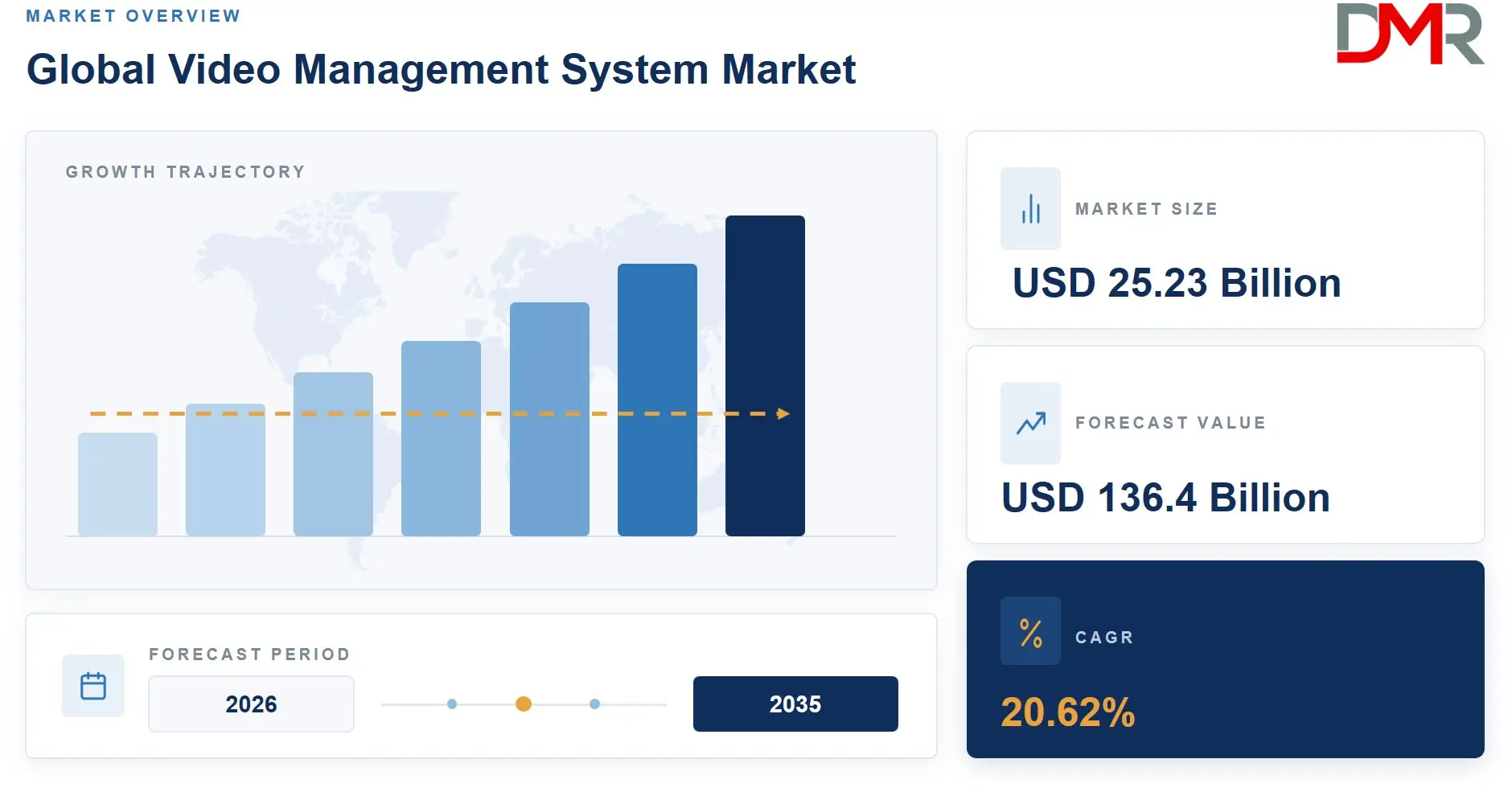
- Market Size, 2026: USD 25.23 billion
- Market Size, 2035: USD 136.4 billion
- Global CAGR, 2026–2035: 20.62%
- Leading Component Segment: Software, 48.5%
- Leading Deployment Segment: On-premises, 68.5%
- Leading Video Source Segment: IP Cameras, 78%
- Fastest-Growing Segment: Cloud-based VMS, 25% CAGR
- Leading Region, 2026: Asia-Pacific, 42%
- Fastest-Growing Region: Middle East & Africa, 23.2% CAGR
- Leading Organization Size: Large Enterprises, 61%
- Leading Application: Security & Surveillance, 35%
- Leading End-Use Industry: Government & Defense, 24%
What is the Global Video Management System and its Market Size?
A Video Management System (VMS) is a software-led platform used to ingest, manage, record, store, retrieve, distribute and increasingly analyze video generated by surveillance cameras and other visual sensors. Modern VMS platforms can integrate IP cameras, legacy analog cameras, access control, alarms, license-plate recognition, video analytics, body-worn cameras, cloud storage and command-center applications.
ℹ
To learn more about this report –
Download Your Free Sample Report Here
The global market is estimated at USD 25.23 billion in 2026 and is modeled to reach approximately USD 136.4 billion by 2035, representing a 20.62% CAGR. The underlying market direction is supported by rapid migration from analog to IP video, rising camera counts, smart-city investment, increasing demand for centralized multi-site monitoring, AI-powered analytics and cloud/VSaaS architectures. Mordor Intelligence identifies IP-based VMS, cloud adoption, SME expansion and retail applications among the fastest-moving areas, while Grand View Research similarly identifies AI-powered analytics, real-time monitoring and smart-city investment as major growth factors.
The market is also shifting from "video recording" to video intelligence. AI-enabled platforms can search thousands of hours of footage, identify people or vehicles, detect anomalies, automate alerts and connect video events to access-control or emergency-response workflows. Recent vendor activity confirms this direction: Milestone has positioned XProtect around AI-native applications and analytics, while Motorola Solutions is expanding AI-powered visual detection across Avigilon's video ecosystem.
Use Cases
- Security & Surveillance: Centralized monitoring of cameras across campuses, facilities, public areas and critical infrastructure.
- Video Analytics: AI-based detection of people, vehicles, behaviors, anomalies and operational events.
- Traffic Monitoring: Management of road cameras, congestion, incidents, license plates and transportation infrastructure.
- Retail Loss Prevention: Investigation of theft, suspicious behavior, customer movement and store-level operational events.
- Industrial Safety: Monitoring restricted areas, worker safety, production environments and process anomalies.
- Emergency Management: Connecting video events with alarms, access control, dispatch and incident-response workflows.
Key Takeaways
- Market Size: The broad global VMS market is estimated at USD 25.23 billion in 2026 and modeled to reach USD 136.4 billion by 2035.
- Growth: A 20.62% CAGR reflects rapid digitization, increasing camera density and migration toward intelligent video operations.
- Key Drivers: Security requirements, smart-city programs, IP-camera migration, AI analytics, multi-site monitoring and cloud adoption.
- Segment Dominance: IP cameras, on-premises deployments, large enterprises and security/surveillance applications remain dominant in 2026.
- Fastest Growth: Cloud/VSaaS, AI-enabled analytics, SME deployments and advanced operational applications are growing faster than traditional VMS.
- Regional Leadership: Asia-Pacific is modeled as the largest regional market, supported by extensive infrastructure, urbanization and smart-city investment.
How AI/Gen AI is Transforming the Video Management System Market?
Artificial intelligence is changing VMS from a recording platform into an operational intelligence layer. AI models can process live camera feeds at the edge or in centralized infrastructure to identify people, vehicles, objects, abnormal activity, crowd conditions, intrusion events and predefined visual scenarios. Motorola Solutions' 2026 Avigilon Visual Alerts, for example, allows users to define site-specific visual events using conversational interfaces, while Milestone's 2026 XProtect developments emphasize AI-native applications and analytics.
The principal benefits are faster investigation, reduced monitoring workload, better incident prioritization and higher value from existing camera infrastructure. AI is also changing competition. Vendors increasingly differentiate through analytics accuracy, search capabilities, edge AI, generative-AI interfaces, integrations and developer platforms rather than simply recording capacity. This favors vendors capable of combining cameras, VMS, analytics, access control, cloud infrastructure and command-center workflows into a unified ecosystem.
Key Drivers in the Global Video Management System Market
Rapid Expansion of IP Surveillance and Camera Infrastructure
The migration from analog CCTV toward IP cameras remains one of the strongest structural drivers. IP-based systems support higher resolutions, network connectivity, remote management, analytics metadata and integration with cloud and enterprise IT infrastructure.
AI, Smart Cities and Video-Based Operational Intelligence
AI is expanding VMS beyond traditional security. Governments and enterprises are using video to monitor traffic, identify safety events, optimize logistics, analyze customer behavior and automate incident response. Smart-city programs are particularly important in Asia-Pacific and the Middle East, where large infrastructure investments generate thousands of connected cameras and sensors.
Restraints in the Global Video Management System Market
Privacy, Data Governance and Regulatory Complexity
Video footage can constitute personal data, while facial recognition and other biometric applications create additional regulatory exposure. Organizations must manage retention periods, user access, consent or lawful basis, cross-border transfers, data minimization and auditability.
Growth Opportunities in the Global Video Management System Market
Cloud, Hybrid and VSaaS Architectures
Cloud VMS represents one of the largest opportunities because it reduces the need for local servers, simplifies multi-site administration and enables subscription-based purchasing. Cloud platforms are particularly attractive to SMEs, retailers, logistics companies and distributed commercial operations.
AI-Powered Video Intelligence
The largest value-creation opportunity is moving from video management to video intelligence as a service. Advanced search, natural-language queries, behavioral detection, automated incident classification and operational analytics can support security and non-security use cases.
Trends in the Global Video Management System Market
Hybrid VMS Becomes the Preferred Transition Architecture
Rather than replacing on-premises VMS overnight, enterprises increasingly combine local recording and edge processing with centralized cloud management. This approach supports low-latency operations while enabling remote administration, centralized analytics and elastic storage.
VMS Platforms Become Open, API-Driven Security Ecosystems
Competition is shifting toward platforms that connect cameras, analytics, access control, sensors, cloud services and third-party applications. ONVIF interoperability remains important, with the organization supporting profiles for video, metadata, edge storage and cloud surveillance.
Research Scope and Analysis
The market is analyzed by component, deployment, organization size, video source, application and end-use industry, with regional analysis covering North America, Europe, Asia-Pacific, Latin America and Middle East & Africa. Market shares below are 2026 modeled estimates based on current published VMS segment patterns and adjusted to the broader scope used in this report. Mordor Intelligence provides useful benchmarks for solutions, IP-based VMS, deployment, enterprise size and end-user segmentation.
ℹ
To learn more about this report –
Download Your Free Sample Report Here
By Component Analysis
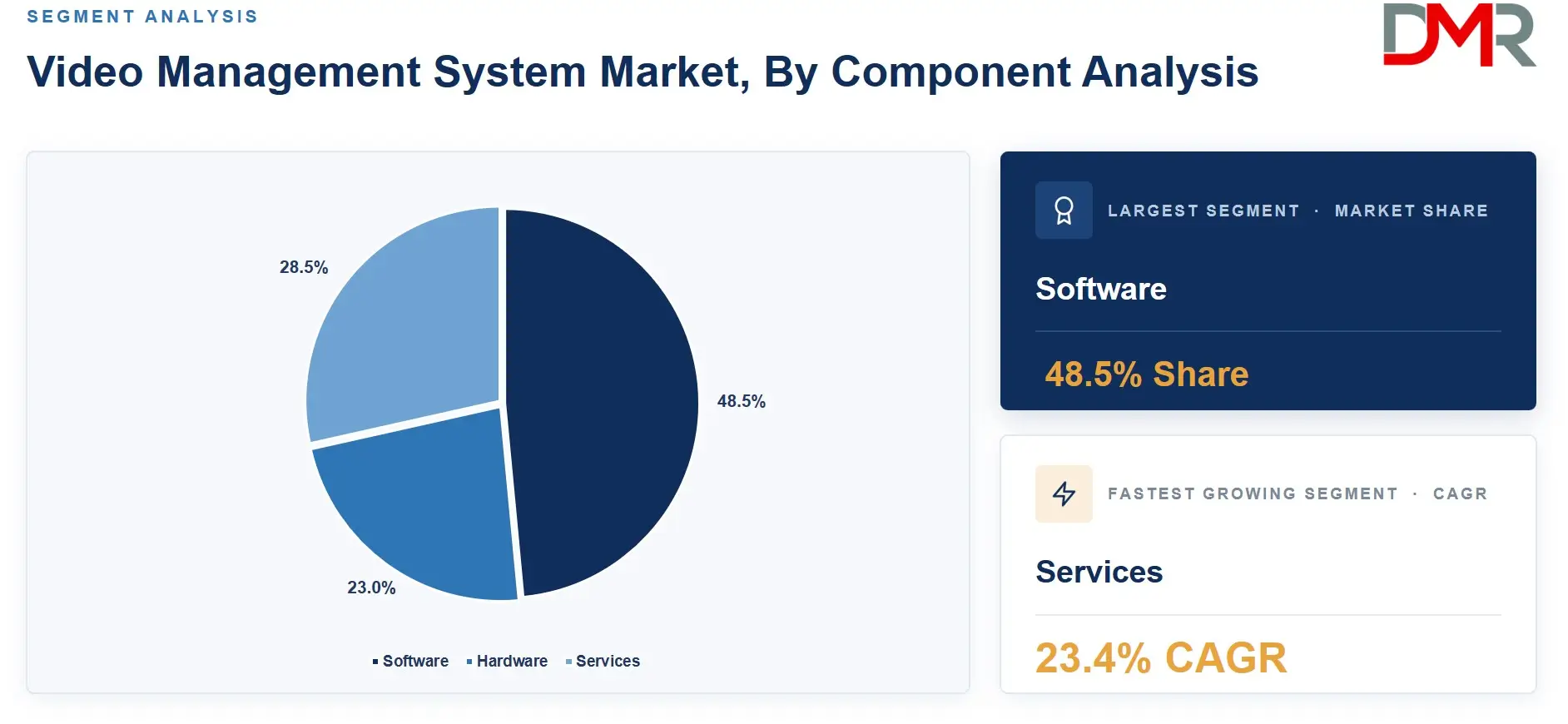
Software is estimated to remain the dominant component at approximately 48.5% share in 2026, reflecting the central role of VMS platforms in recording, device management, user administration, analytics integration and evidence management. Hardware represents approximately 23.0%, including servers, storage and dedicated VMS appliances, while services account for approximately 28.5%, encompassing installation, integration, maintenance and support. Services are expected to be the fastest-growing component at approximately 23.4% CAGR, supported by increasingly complex multi-site deployments and cybersecurity requirements. The second-largest component is services because enterprises increasingly require lifecycle support rather than standalone software.
By Deployment Analysis
On-premises deployment is estimated to hold approximately 68.5% of the 2026 market, supported by large enterprises, government agencies, critical infrastructure and customers with strict requirements for local recording, latency and data control. Cloud-based VMS is the fastest-growing sub-segment at approximately 25% CAGR, driven by subscription models, remote management, rapid deployment and lower initial infrastructure requirements. Hybrid deployment represents approximately 12% and is becoming increasingly important as organizations combine local recording with cloud administration and analytics.
By Organization Size Analysis
Large enterprises are estimated to account for approximately 61% of 2026 revenue, reflecting their larger camera estates, multi-site operations and greater need for centralized security operations. Their requirements include high availability, sophisticated user permissions, integrations and advanced analytics. SMEs represent approximately 39% but are expected to be the fastest-growing segment at around 23% CAGR, primarily because cloud VMS reduces infrastructure and deployment barriers. Retail chains, logistics companies, small manufacturing groups and professional-service businesses are increasingly adopting subscription-based systems.
By Video Source Analysis
IP cameras dominate with an estimated 78% share in 2026, reflecting the continued conversion of surveillance infrastructure from analog to networked video. IP cameras support higher resolutions, distributed intelligence, metadata, remote access and integration with VMS analytics. Analog cameras retain approximately 12%, mainly within legacy installations and cost-sensitive markets. Mobile and body-worn cameras represent approximately 7% but are among the fastest-growing sources at roughly 27% CAGR, particularly in public safety, policing, transportation and field operations. Other sources, including drones, thermal cameras and specialized sensors, represent approximately 3%.
By Application Analysis
Security & Surveillance is estimated to lead with approximately 35% share in 2026, as monitoring and protection remain the fundamental VMS use case across government, commercial and industrial environments. Video Monitoring & Recording follows at approximately 17%, while Video Analytics accounts for about 19% and is expected to be the fastest-growing application at approximately 26% CAGR. Incident & Emergency Management represents 10%, Traffic & Transportation Monitoring 11%, and Access Control & Intrusion Detection approximately 8%. The market is gradually shifting from passive recording toward active intelligence, with analytics increasingly becoming a core VMS capability rather than an optional add-on.
By End Use Industry Analysis
Government & Defense is estimated to lead with approximately 24% share in 2026, supported by public safety, municipal surveillance, transportation infrastructure, border security and critical infrastructure programs. Retail is the second-largest segment at approximately 14%, driven by loss prevention, customer analytics and multi-store monitoring. BFSI represents around 13%, transportation and logistics 11%, manufacturing 10% and healthcare 9%. Healthcare is among the faster-growing sectors because VMS is being integrated with patient safety, restricted-area monitoring and advanced analytics.
The Global Video Management System Market Report is segmented on the basis of the following:
By Component
- Software
- Hardware
- Services
- Installation & Integration
- Maintenance & Support
By Deployment
- On-Premises
- Cloud-Based
- Hybrid
By Organization Size
- Small & Medium-Sized Enterprises
- Large Enterprises
By Video Source
- IP Cameras
- Analog Cameras
- Mobile & Body-Worn Cameras
- Other Video Sources
By Application
- Security & Surveillance
- Video Monitoring & Recording
- Video Analytics
- Incident & Emergency Management
- Access Control & Intrusion Detection
- Traffic & Transportation Monitoring
By End-Use Industry
- Government & Defense
- Banking, Financial Services & Insurance
- Retail
- Healthcare
- Transportation & Logistics
- Manufacturing
- Education
- Hospitality
- Energy & Utilities
- Commercial Buildings
Regional Analysis
Asia Pacific is the Leading Region in the Global Video Management System Market
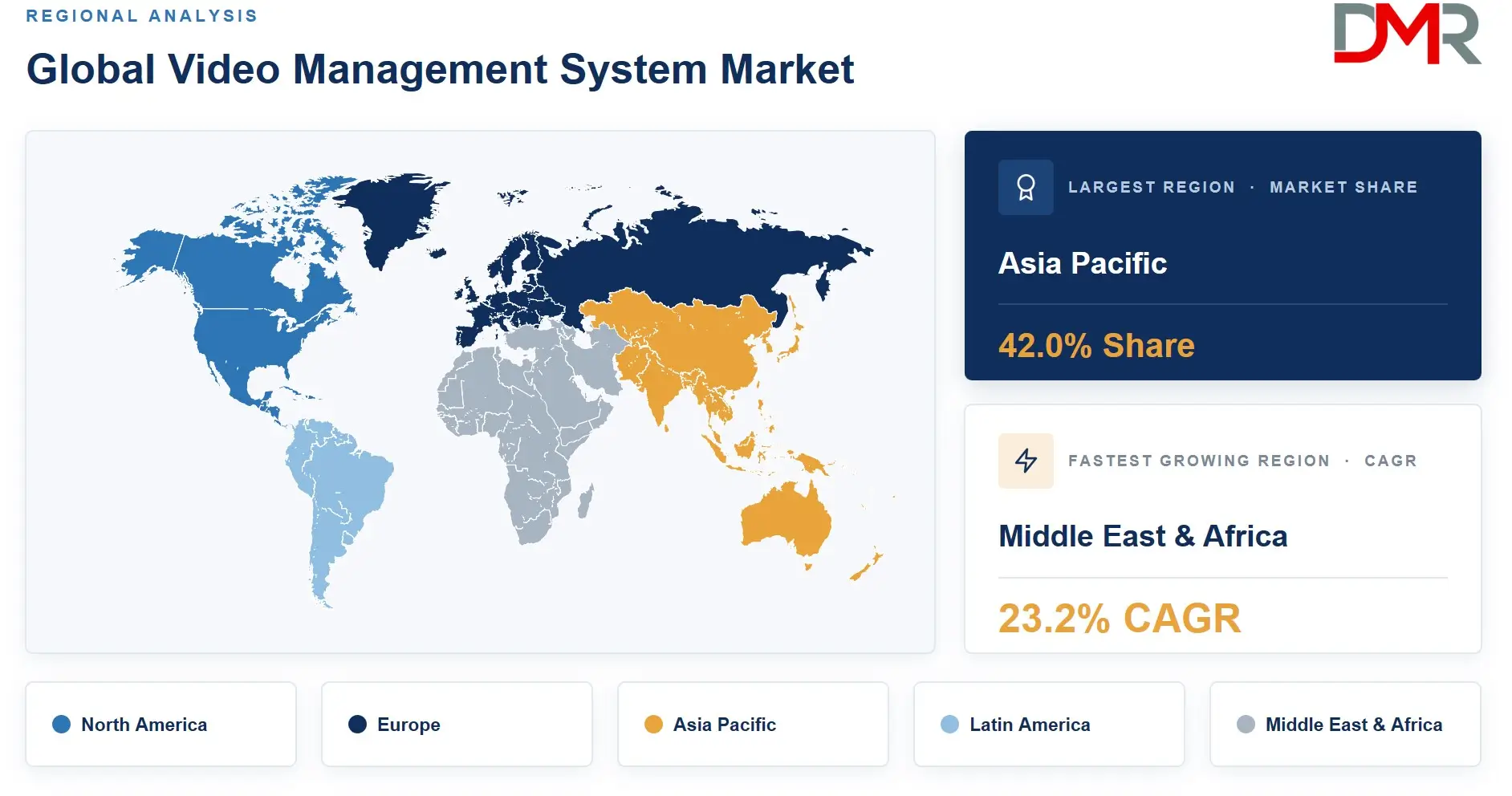
Asia-Pacific is modeled as the leading regional market in 2026, with approximately 42% share, equivalent to about USD 10.6 billion under this report's broad market definition. China remains the largest contributor, while India, Japan, South Korea and Southeast Asia are expanding rapidly. Large-scale transportation modernization, industrial parks, retail expansion and public infrastructure projects generate demand for centralized VMS. APAC's market is also supported by strong regional camera manufacturing ecosystems, which reduce equipment costs and accelerate deployment.
ℹ
To learn more about this report –
Download Your Free Sample Report Here
ME&A is the Fastest-Growing Region in the Global Video Management System Market
Middle East & Africa is projected to be the fastest-growing regional market, with an estimated 23.2% CAGR. Growth is driven by smart-city projects, mega-developments, critical infrastructure, tourism, transportation modernization and government investment in public safety. The region presents particular opportunity for cloud and hybrid VMS providers capable of meeting data-residency, cybersecurity and government procurement requirements. Saudi Arabia is especially important because Vision 2030 is accelerating digital infrastructure and smart-city development.
The Europe Video Management System Market
Europe's VMS market is estimated at approximately USD 4.86 billion in 2026 and is modeled to reach USD 18.5 billion by 2035, corresponding to approximately 18.2% CAGR. Growth is being driven by IP migration, AI analytics, critical-infrastructure cybersecurity, transportation monitoring and hybrid cloud deployments. GDPR adds significant requirements around surveillance data governance, while NIS2 and the EU cybersecurity regulatory environment are raising the importance of secure, auditable infrastructure.
Latin America Video Management System Market
Latin America is modeled at approximately USD 1.0 billion in 2026, with an estimated 19–20% CAGR through 2035. Brazil and Mexico represent the largest individual markets, supported by urban security requirements, retail expansion, banking security, transportation modernization and industrial investment. The region remains an attractive market for cloud VMS because many organizations want centralized multi-site monitoring without extensive local IT infrastructure. Vendor strategies emphasizing local support, camera interoperability and flexible financing are likely to outperform premium hardware-centric models.
MEA Video Management System Market
The MEA market is modeled at approximately USD 1.0 billion in 2026, growing at around 23.2% CAGR. Saudi Arabia, UAE, Israel and South Africa are the principal markets. Government-led smart-city programs, airports, hospitality, logistics, energy infrastructure and major construction projects are supporting demand. Saudi Arabia is particularly attractive because government security spending and private-sector digitization are occurring simultaneously. Local privacy and data-transfer requirements also increase demand for compliant local or hybrid architectures. Saudi Arabia's PDPL applies to personal-data processing and includes specific rules governing transfers outside the Kingdom.
Major Countries Analysis
United States Video Management System Market
The U.S. market is estimated at approximately USD 7.2 billion in 2026, growing to around USD 21.0 billion by 2035, equivalent to an estimated 12.6% CAGR. Demand is supported by enterprise security, retail loss prevention, critical infrastructure, healthcare, transportation and public safety. Cloud VMS and AI analytics are growing particularly quickly. Motorola Solutions reported that its broader video business generated more than USD 2 billion in the prior year and described cloud and body-worn video as faster-growing components of its portfolio.
Japan Video Management System Market
Japan is estimated at approximately USD 1.6 billion in 2026, increasing to about USD 4.7 billion by 2035, representing roughly 12.7% CAGR. Aging infrastructure, disaster preparedness, transportation safety, retail automation and labor shortages are supporting demand for AI-assisted surveillance. Japan's mature technology ecosystem also favors high-quality IP cameras, edge analytics and integrated building-security platforms.
Saudi Arabia Video Management System Market
Saudi Arabia is estimated at approximately USD 0.35 billion in 2026, with potential to reach approximately USD 1.6 billion by 2035, implying a modeled CAGR of about 18%. Government security investment, Vision 2030 projects, hospitality, retail, healthcare and smart-city developments are major demand generators. Saudi market research identifies government security spending, cloud adoption and AI analytics as important growth drivers.
Regulatory Landscape
VMS vendors increasingly compete on compliance as well as functionality. In Europe, GDPR applies to personal data processed through video surveillance, requiring organizations to consider lawful processing, data minimization, access controls, retention and security. The EU AI Act adds another layer for AI-enabled biometric and surveillance applications, with important provisions becoming applicable in August 2026. In India, the Ministry of Electronics and Information Technology published the Digital Personal Data Protection Rules, 2025, alongside an enforcement timeline and Data Protection Board materials. Saudi Arabia's PDPL governs personal-data processing and cross-border transfers, making data governance a material consideration for cloud VMS deployments. At the technical level, ONVIF interoperability standards remain important, with Profile T supporting advanced video streaming and Profile V moving toward standardized cloud surveillance interoperability.
Investment and White Space Analysis
The strongest investment white spaces are AI-native cloud VMS, camera-agnostic VSaaS, verticalized video intelligence, cybersecurity, edge analytics and emerging-market managed services. SMEs remain underserved by complex enterprise VMS products, creating room for low-friction subscription platforms with predictable per-camera pricing. Another opportunity is hybrid migration: enterprises with thousands of legacy cameras need platforms capable of retaining existing hardware while progressively adding cloud management and AI. APAC and MEA offer particularly attractive growth opportunities because infrastructure spending is expanding faster than mature-market replacement cycles. ONVIF's development of Profile V for cloud video interoperability could further reduce vendor lock-in and improve the attractiveness of multi-vendor cloud architectures.
By Region
North America
Europe
- Germany
- France
- The U.K.
- Italy
- Spain
- Rest of Europe
Asia-Pacific
- China
- Japan
- India
- Australia
- South Korea
- Rest of APAC
Latin America
- Mexico
- Brazil
- Rest of LATAM
Middle East & Africa
- Saudi Arabia
- The UAE
- South Africa
- Rest of MEA
Competitive Landscape
The global VMS market is moderately fragmented, with competition between specialized VMS companies, camera manufacturers, physical-security conglomerates and public-safety technology providers. Major vendors include Genetec, Milestone Systems, Motorola Solutions/Avigilon, Axis Communications, Bosch, Honeywell, Johnson Controls, Hikvision, Dahua, Hanwha Vision, Eagle Eye Networks, Verint, IDIS and AxxonSoft. Market participants increasingly compete through AI analytics, interoperability, cloud capabilities, cybersecurity, ecosystem breadth and vertical-specific functionality rather than basic recording alone. The competitive structure is also being reshaped by acquisitions, partnerships and platform consolidation. Larger security companies are acquiring analytics and video companies to build integrated "security operating systems," while specialized vendors are differentiating through open APIs, cloud-native architectures and AI.
Some of the prominent players in the Global Video Management System Market are:
- Motorola Solutions
- Genetec
- Milestone Systems
- Johnson Controls
- Axis Communications
- Honeywell
- Bosch Security and Safety Systems
- Hanwha Vision
- Hikvision
- Dahua Technology
- Avigilon
- Verkada
- Eagle Eye Networks
- Pelco
- March Networks
- Johnson Controls Tyco
- Siemens
- Schneider Electric
- Panasonic Connect
- Sony
- Cisco Systems
- Digital Watchdog
- Salient Systems
- AxxonSoft
- Qognify
- BriefCam
- Agent Vi
- OnSSI
- Digifort
- Network Optix
- Pelco by Schneider Electric
- i-PRO
- Vivotek
- MOBOTIX
- Avigilon Alta
- IDIS
- Arecont Vision
- Speco Technologies
- Exacq Technologies
- March Networks
- Other Key Players
Recent Developments
- July 2026: ONVIF introduced the Profile V Release Candidate, a draft cloud-video interoperability standard designed to connect cameras, encoders and cloud VMS/VSaaS platforms through standardized secure communication, cloud recording and event capabilities.
- April 2026: Milestone released XProtect 2026 R1 and Arcules updates, expanding cloud flexibility, remote management, role-based access controls, Camera-to-Cloud capabilities and forensic search functionality. Milestone lists April 28, 2026 as the XProtect 2026 R1 release date.
- March 2026: Hanwha Vision introduced BLAZE VMS, a hybrid platform combining on-premises performance with cloud federation, centralized management, native AI and multi-site scalability.
- March 2026: Milestone announced major XProtect and BriefCam advances, including a containerized XProtect App Platform and analytics capabilities designed for greater customization, hardware efficiency and generative-AI readiness.
- January 2026: At Intersec Dubai, Motorola Solutions highlighted new AI capabilities for Avigilon, including Visual Alerts designed to identify customizable visual events across large camera networks and enable more proactive security response.
Report Details
| Report Characteristics |
| Market Size (2026) |
USD 25.23 Bn |
| Forecast Value (2035) |
USD 136.4 Bn |
| CAGR (2026–2035) |
20.62% |
| The US Market Size (2026) |
USD 7.2 Bn |
| Historical Data |
2021 – 2025 |
| Forecast Data |
2026 – 2035 |
| Base Year |
2025 |
| Segments Covered |
By Component, By Deployment, By Organization Size, By Video Source, By Application, By End-Use Industry |
| Regional Coverage |
North America – The US and Canada; Europe – Germany, France, The UK, Italy, Spain, Rest of Europe; Asia-Pacific – China, Japan, India, Australia, South Korea, Rest of APAC; Latin America – Mexico, Brazil, Colombia, Argentina, Rest of LATAM; Middle East & Africa – Saudi Arabia, The UAE, South Africa, Rest of MEA |
Frequently Asked Questions
What is the global Video Management System market size in 2026?
▾ The broad VMS market is estimated at USD 25.23 billion in 2026, based on a current 2026 market benchmark.
What will the VMS market be worth in 2035?
▾ Using the 20.62% forecast CAGR, the market is modeled to reach approximately USD 136.4 billion by 2035.
What is driving VMS market growth?
▾ Key drivers include IP-camera migration, AI analytics, smart cities, increasing security requirements, cloud adoption, multi-site monitoring and operational video intelligence.
Which VMS deployment model is currently dominant?
▾ On-premises VMS remains dominant, estimated at about 68.5% in 2026, although cloud and hybrid models are growing substantially faster.
Which region has the largest VMS market?
▾ Asia-Pacific is modeled as the largest region at approximately 42% share, supported by smart-city programs, infrastructure investment and extensive camera deployments.
Which region is growing fastest in Video Management System market ?
▾ Middle East & Africa is modeled as the fastest-growing region at approximately 23.2% CAGR, driven by smart cities, infrastructure and government security investment.
Who are the major VMS market players?
▾ Major players include Genetec, Milestone Systems, Motorola Solutions/Avigilon, Axis, Bosch, Honeywell, Johnson Controls, Hikvision, Dahua, Hanwha Vision and Eagle Eye Networks.
What is the most important emerging VMS trend?
▾ The market is transitioning from video recording toward AI-powered video intelligence, cloud/hybrid management and integration with broader physical-security ecosystems.