What is the Virtual Reality in Aerospace and Defense Market Size in 2026?
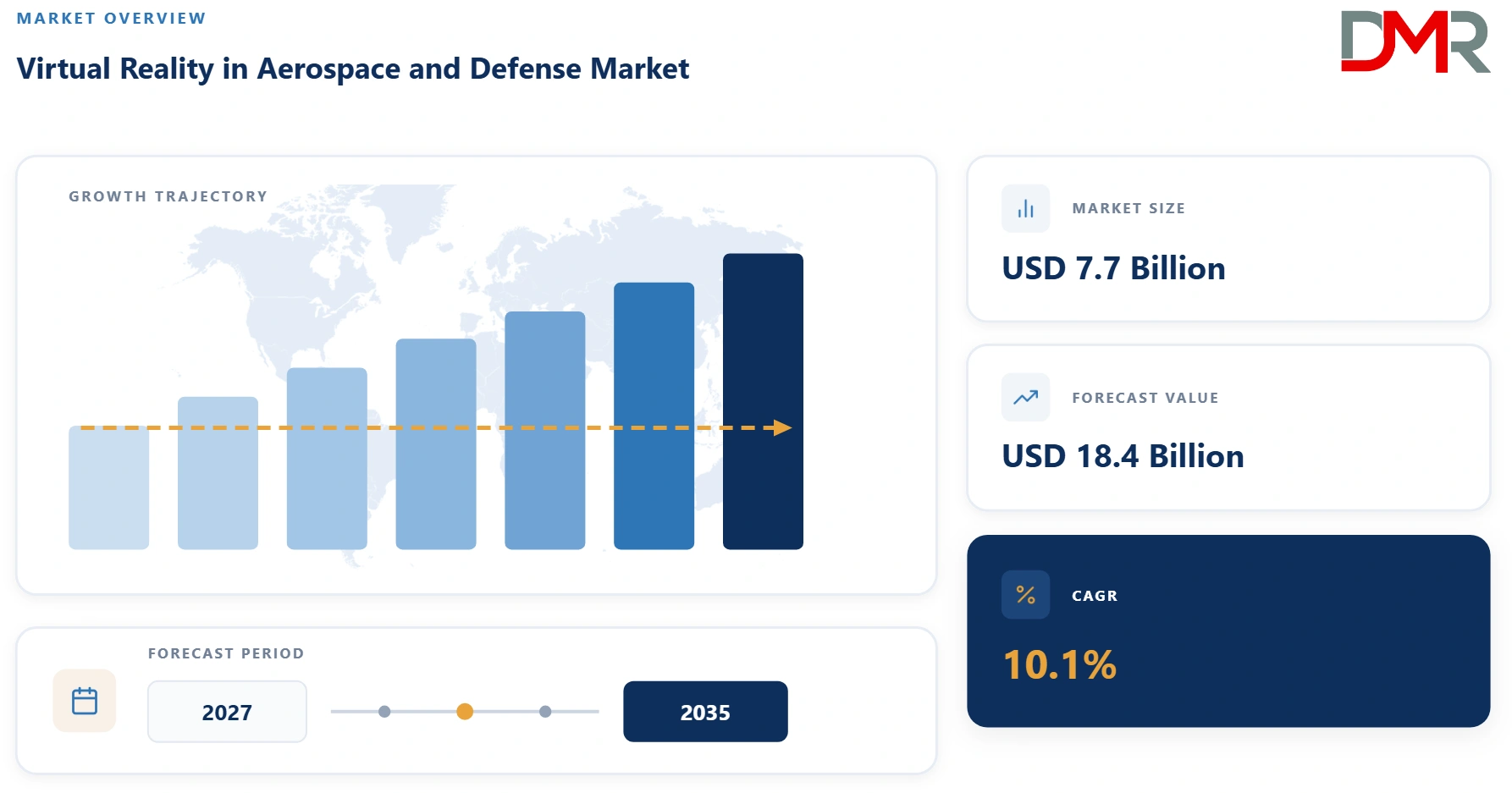
The global virtual reality in aerospace and defense market is valued at USD 7.7 billion in 2026 and is projected to reach USD 18.4 billion by 2035, growing at a CAGR of 10.1% from 2027 to 2035. Growth is driven by rising defense budgets and training modernization, pressure to cut the cost, risk and scarcity of live flight and range training, the spread of VR and mixed reality into maintenance, mission rehearsal and design work, and the integration of artificial intelligence that makes simulated adversaries and instructors adaptive.
ℹ
To learn more about this report –
Download Your Free Sample Report Here
The Virtual Reality in Aerospace and Defense Market measures revenue generated from virtual simulation hardware, software, and services used for aerospace and defense training, planning, maintenance, and engineering applications. It encompasses fully immersive, semi-immersive, and non-immersive virtual environments while excluding the physical platforms and weapons being simulated. Demand originates from armed forces, airlines, helicopter operators, space agencies, aerospace manufacturers, and specialized training and maintenance organizations. The report examines five segmentation categories across five major geographic regions.
The Virtual Reality in Aerospace and Defense market in this report measures the value of immersive simulation hardware, software and services applied to aerospace and defense training, planning and engineering, rather than the platforms and weapons that are simulated. Demand comes from air forces, armies, navies and marine corps, airlines and helicopter operators, space agencies, and the prime contractors, training specialists and maintenance organizations that support them. The report covers five segments across five regions, including major national markets in each.
Virtual Reality in Aerospace and Defense Market Snapshot
Virtual Reality in Aerospace and Defense Market Snapshot, 2027-2035
| Metric |
Value |
| Market Size (2026) |
USD 7.7 Billion |
| Forecast Value (2035) |
USD 18.4 Billion |
| CAGR (2027-2035) |
10.1% |
| Largest Region (2026) |
North America, 40.0% share |
| Fastest-Growing Region (2027-2035) |
Asia Pacific, 12.7% CAGR |
| Leading Component (2026) |
Hardware, 42.0% share |
| Leading Application (2026) |
Pilot Training, 28.5% share |
| Key Players |
Lockheed Martin, Northrop Grumman, RTX, Boeing, General Dynamics, Thales, BAE Systems, Airbus, Leonardo, CAE |
Key Takeaways
- Market growth: The market is valued at USD 7.7 billion in 2026 and is expected to reach USD 18.4 billion by 2035, expanding at a 10.1% CAGR from 2027 to 2035.
- Component leader: Hardware holds a 42.0% share of the market in 2026, led by head-mounted displays, tracking systems, controllers, haptic devices and the high-performance computing that drives them, often in ruggedized or secure editions.
- Fastest Component: Services is set to grow at a 12.0% CAGR through 2035, ahead of the overall market, on content development, integration, instructor support and managed training contracts.
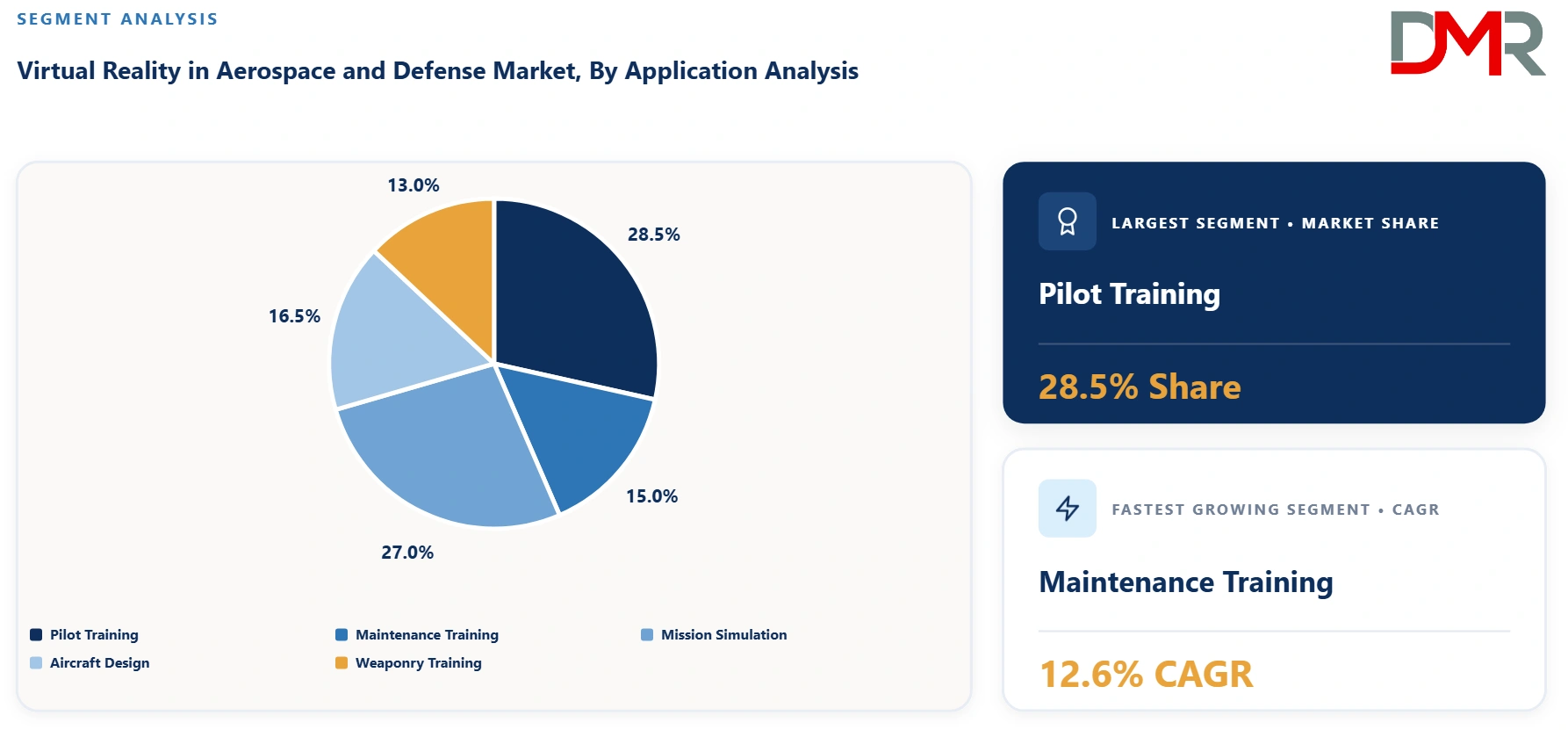
- Application Leader: Pilot Training accounts for 28.5% of 2026 demand, as air forces, airlines and helicopter operators use immersive devices to raise practice time and cut the number of costly flight hours.
- Fastest Application: Maintenance Training is projected to grow at a 12.6% CAGR, supported by virtual maintenance trainers, technician shortages and the limited availability of real aircraft for training.
- Regional Picture: North America leads with a 40.0% share in 2026, while Asia Pacific is the fastest-growing region at a 12.7% CAGR.
What are the Key Use Cases of Virtual Reality in Aerospace and Defense?
- Pilot and Aircrew Training: Immersive cockpit trainers, headset-based procedure trainers and mixed reality devices let pilots and aircrew practice procedures, emergencies and crew coordination with fewer flight hours and fewer aircraft, raising throughput and safety.
- Maintenance and Technician Training: Virtual maintenance trainers let technicians learn engine, avionics and airframe tasks on virtual aircraft, cutting training time and keeping real aircraft in service.
- Mission Rehearsal and Planning: Planners and crews walk through terrain, threat and mission scenarios in VR before operations, improving shared understanding, coordination and decision-making.
- Design, Prototyping and Engineering Review: Engineers inspect full-scale 3D models of cockpits, cabins and systems in VR, find ergonomic and integration problems early, and review designs with teams at different sites.
How are Foundation Models and Agentic AI Transforming the Virtual Reality in Aerospace and Defense Market?
Foundation models and agentic AI are turning virtual reality in aerospace and defense from scripted simulation into adaptive training. Generative models build terrain, scenery, and scenarios from data and doctrine in far less time than manual modelling, while AI agents drive opposing forces, wingmen, and role players that react to what a trainee does instead of repeating a fixed script. In July 2026, for example, the U.S. Marine Corps funded a gunnery trainer prototype whose adversary is driven by agentic AI that builds its behavior from doctrine. Biometric and performance analytics, such as the partnership between Varjo and VRAI announced in April 2026, give instructors data on workload and skill gaps, and language models can act as virtual instructors and debrief assistants. Digital twins connect design, training and maintenance, so one 3D model serves engineers, trainers and technicians. Adoption is rising as buyers want training that adapts to each person and relies less on live instructors and role players. Vendors with deep platform data, secure delivery and regulator-accepted devices gain an edge, though validation, trust in AI behavior and data security remain gating factors.
Virtual Reality in Aerospace and Defense Market Dynamics at a Glance
Drivers, Restraints, Opportunities and Trends in the Virtual Reality in Aerospace and Defense Market
| Type |
Factor |
Impact |
| Driver |
Defense Modernization and Rising Training Budgets |
High |
| Driver |
Cost, Risk and Readiness Pressure on Live Training |
High |
| Restraint |
Security, Accreditation and Data-Rights Burden |
High |
| Restraint |
Human Factors, Hardware Supply and Long Procurement Cycles |
Medium |
| Opportunity |
Regulator-Qualified VR Devices and Maintenance Training |
High |
| Opportunity |
Counter-Drone and Multi-Domain Training |
Medium |
| Trend |
AI-Driven Adversaries and Instructor Analytics |
High |
| Trend |
Mixed Reality, Standalone and Secure Deployable Systems |
High |
What is Driving the Growth of the Virtual Reality in Aerospace and Defense Market?
Defense Modernization and Rising Training Budgets
Governments are raising defense spending and putting more money into readiness, and training is one of the first places where returns show. NATO allies agreed in 2025 to work toward spending 5% of GDP on defense and related security by 2035, while Asia Pacific and Gulf states continue to expand and modernize their forces. New aircraft, unmanned systems and networked platforms arrive faster than ranges, instructors and flight hours can scale, so buyers add simulators, synthetic environments and VR trainers alongside live training. U.S. programs such as the Army's Synthetic Training Environment and the Air Force and Navy Pilot Training Transformation effort show how headset-based devices are being written into programs. This sustains demand for new-build simulators, headset-based devices and upgrades in every major region.
Cost, Risk and Readiness Pressure on Live Training
Flight hours, live ranges, munitions and instructor time are expensive and limited, and accidents or aircraft downtime carry high costs. VR lets trainees repeat dangerous or rare scenarios, such as emergencies, degraded visual environments and complex multi-crew tasks, at a fraction of the cost per hour. Scarcity also drives adoption in operations: in March 2026, Varjo headsets with Fynd Reality software were selected to deliver familiarization, procedural and maintenance training on armored vehicles to Ukrainian forces, funded through Norway's Nansen Program. As more programs show lower cost per trained hour and faster qualification, spending on headsets, software and content grows steadily.
What are the Key Restraints in the Virtual Reality in Aerospace and Defense Market?
Security, Accreditation and Data-Rights Burden
Immersive training systems hold sensitive information on mission plans, platform performance, biometrics and eye tracking, and headsets with cameras, wireless links and cloud services widen the attack surface. Systems used on classified networks need accreditation and often rely on secure or air-gapped headset editions, such as the Varjo XR-4 Secure Edition. Disputes between governments and contractors over rights to simulation models and content, and export controls on high-fidelity visual and flight models, add cost and delay, and they weigh most heavily on smaller suppliers and on new products seeking approval.
Human Factors, Hardware Supply and Long Procurement Cycles
Headsets still raise questions of comfort, simulation sickness and visual fidelity, especially for long sessions and for tasks that need precise cues such as formation flying and weapons employment, so many programs keep full-flight and motion simulators alongside VR. The U.S. Army's IVAS mixed reality headset, which a federal watchdog said cost close to USD 2 billion since 2018 before being shelved, showed what weight, comfort and cyber-sickness problems can do to a program. These shifts push defense buyers toward specialist vendors and longer lifecycle planning. Procurement cycles are long, budgets can shift, and many pilots struggle to scale into programs of record.
What are the Key Opportunities in the Virtual Reality in Aerospace and Defense Market?
Regulator-Qualified VR Devices and Maintenance Training
Qualified VR and mixed reality devices can now earn training credit, which opens civil and military flight training to headset-based systems. Loft Dynamics holds both EASA and FAA qualifications for its VR helicopter device, Leonardo's VxR system is qualified by both authorities, and Reiser's H145 mixed reality simulator received EASA pre-qualification in November 2025. Maintenance training is the next large opening, because virtual maintenance trainers let technicians learn on aircraft that cannot be spared, and the U.S. Air Force has used enterprise contracts to make VR maintenance simulators available to any unit. Vendors able to certify devices, protect data rights and prove lower cost per trained hour can secure long, recurring service revenue.
Counter-Drone and Multi-Domain Training
Drone threats and fast-changing conflicts create demand for training that can be built, updated and fielded in weeks. VR counter-drone simulators, such as the one Varjo and its partners delivered to Ukrainian forces in June 2026 and the pilot started with the Finnish Defence Forces in October 2026, can be updated as threats change. Deployable systems that fit in cases, secure and air-gapped editions, and links to live-virtual-constructive networks let forces train at bases, on ships and at forward sites, and Rheinmetall's plan to integrate Varjo headsets into its deployable land training systems shows primes building these offers. Companies combining immersive hardware, simulation content, performance analytics, and secure delivery platforms can address evolving training requirements across aerospace and defense organizations.
What are the Latest Trends in the Virtual Reality in Aerospace and Defense Market?
AI-Driven Adversaries and Instructor Analytics
Aerospace and defense users are replacing scripted opponents with AI agents that adapt to each crew and are adding analytics that show instructors what drives performance. Generative tools shorten the time needed to build terrain and scenarios, while biometric and eye-tracking data feed debriefs and personalized training paths. Primes, headset makers and analytics specialists are forming alliances to pair deep platform knowledge with immersive technology and data. Expect adaptive scenarios and analytics to anchor premium training tiers and to drive partnerships and consolidation.
Mixed Reality, Standalone and Secure Deployable Systems
Buyers are moving from lab-bound devices toward mixed reality headsets that blend a physical cockpit or weapon with virtual scenes, standalone units with less cabling, and deployable cases that carry compute, tracking and mock weapons. Varjo launched a refreshed XR-4 series for air, land and sea training in October 2025, and in November 2026 Ryan Aerospace announced a T-6 Texan II mixed reality trainer that pairs a full-scale cockpit with the XR-4. Security is part of the design, with secure and air-gapped options and allied-built supply chains becoming selling points. Providers that build security and regulator acceptance into products from the start can turn compliance into a competitive advantage.
Research Scope and Analysis
The report segments the virtual reality in aerospace and defense market by component, technology, immersion level, application and end use across five regions and key countries.
ℹ
To learn more about this report –
Download Your Free Sample Report Here
By Component Analysis
Hardware leads the component segment with a 42.0% share in 2026 because every deployment needs head-mounted displays, tracking systems, controllers, haptic devices and high-performance computing, often in ruggedized or secure editions. Software, covering simulation engines, scenario tools, visual databases and analytics, is the second largest component. Services is the fastest-growing component, expanding at a 12.0% CAGR from 2027 to 2035, as buyers pay for content development, integration, accreditation support, instructors and managed training contracts.
By Technology Analysis
Software Simulation leads the technology segment with a 42.5% share in 2026, supported by demand for flight simulation engines, scenario development platforms, and virtual training environments. 3D Visualization supports engineering design, spatial analysis, and mission planning, while Haptic Feedback enhances physical interaction through tactile and force-feedback technologies. Cloud-Based VR is projected to grow fastest at a CAGR of 13.5% from 2027 to 2035, driven by scalable computing, remote collaboration, and centralized simulation delivery. For market sizing purposes, solutions are classified according to their primary technology and principal commercial functionality to minimize revenue overlap.
By Immersion Level Analysis
Semi-Immersive systems, such as dome, projection and cockpit-based simulators that use VR techniques, hold the largest share at 43.5% in 2026 because air forces and airlines already operate large installed fleets of these devices. Fully Immersive systems that use head-mounted displays grow fastest, expanding at a 12.0% CAGR from 2027 to 2035, as standalone and mixed reality headsets earn regulatory credit and cost less than fixed domes. Non-Immersive desktop and tablet-based virtual trainers remain important for ground school and procedure learning.
By Application Analysis
Pilot Training leads the application segment with a 28.5% share in 2026, supported by increasing demand for cost-effective flight instruction, procedural training, and pilot qualification. Mission Simulation represents another major application, driven by the growing adoption of virtual environments for operational planning, collective training, and coordinated mission rehearsal. Maintenance Training is projected to grow fastest at a CAGR of 12.6% from 2027 to 2035, supported by technician shortages, increasing aircraft complexity, and limited access to operational aircraft for training. Aircraft Design and Weaponry Training contribute to market demand through virtual engineering reviews, equipment familiarization, and simulated training environments.
By End Use Analysis
Civil Aviation leads the end-use segment with a 31.0% share in 2026, supported by the adoption of virtual reality for pilot training, cabin crew instruction, aircraft maintenance, and aviation safety procedures. Military Aviation is projected to grow fastest at a CAGR of 11.9% from 2027 to 2035, driven by military pilot training, aircrew preparation, and aircraft-specific simulation requirements. Defense Operations encompasses land, naval, and non-aviation military training applications, including vehicle crew instruction, tactical exercises, and joint operational planning. Space Exploration includes virtual training for astronauts, spacecraft operations, ground personnel, and space systems engineering. Solutions are classified according to their primary end-use application to avoid double counting.
How is the Virtual Reality in Aerospace and Defense Market Segmented?
By Component
- Hardware
- Software
- Services
By Technology
- Software Simulation
- 3D Visualization
- Haptic Feedback
- Cloud-Based VR
By Immersion Level
- Semi-Immersive
- Fully Immersive
- Non-Immersive
By Application
- Pilot Training
- Maintenance Training
- Mission Simulation
- Aircraft Design
- Weaponry Training
By End Use
- Civil Aviation
- Military Aviation
- Defense Operations
- Space Exploration
Which Region Leads the Virtual Reality in Aerospace and Defense Market?
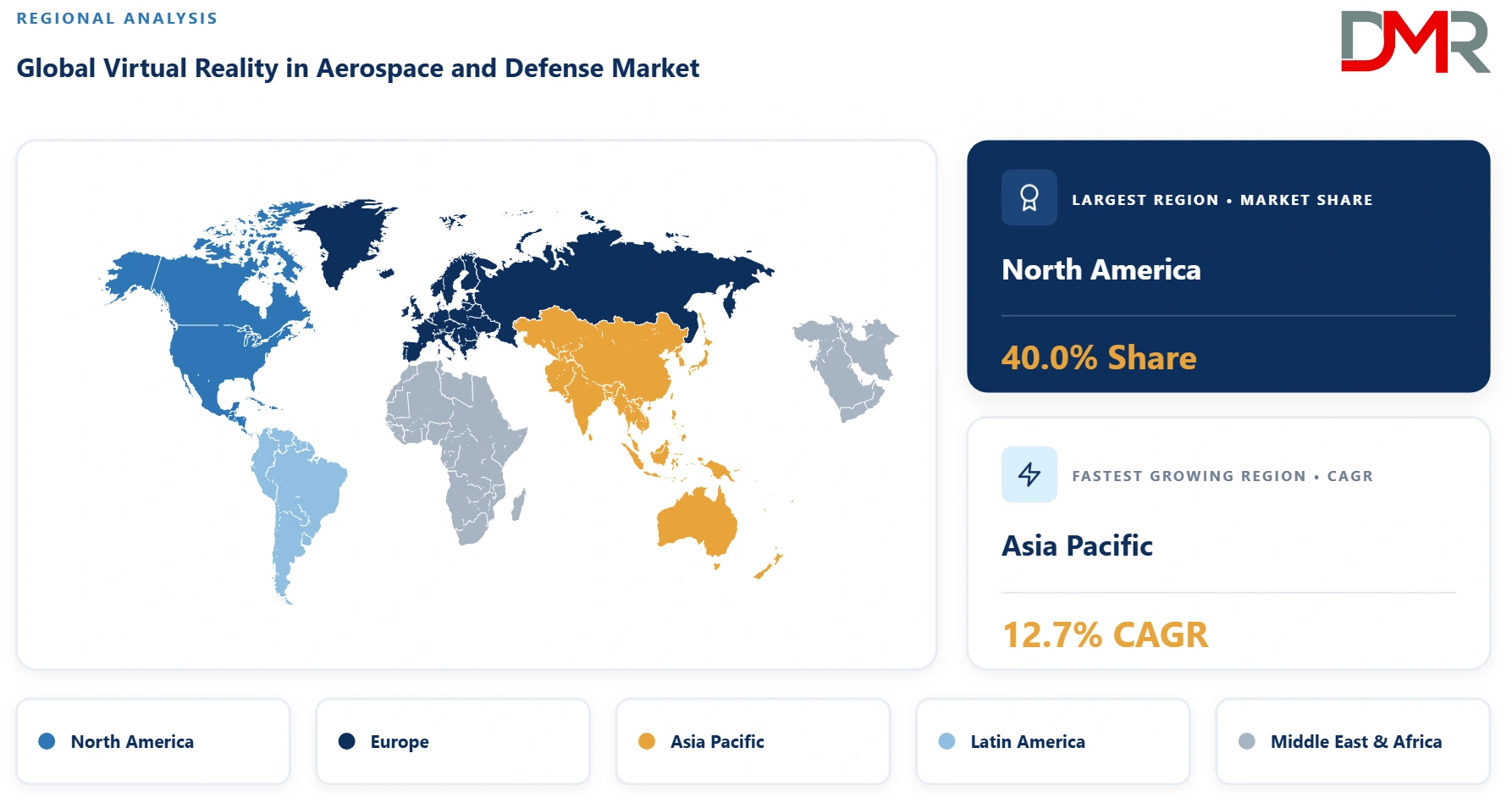
North America leads the virtual reality in the aerospace and defense market with a 40.0% share in 2026, while Asia Pacific is projected to grow at a 12.7% CAGR from 2027 to 2035.
ℹ
To learn more about this report –
Download Your Free Sample Report Here
Region with the Largest Revenue Share
North America accounted for 40.0% of global revenue in 2026, supported by the world's largest defense budget, a deep base of simulation and training contractors, and active programs in pilot, maintenance and infantry training. The United States dominates regional sales, with companies such as Lockheed Martin, Northrop Grumman, RTX and Boeing leading alongside specialist immersive training firms, and the Army, Air Force, Navy and Marine Corps all buying headset-based trainers, often through rapid prototype agreements. Canada adds steady demand through CAE and fleet training programs. Strict cybersecurity and export control rules shape procurement, but large budgets sustain growth. The region should keep the largest share despite slower expansion than Asia Pacific.
Region with the Highest CAGR
Asia Pacific is projected to grow at a 12.7% CAGR from 2027 to 2035, the fastest of any region. China is expanding simulation and training for its air and naval forces, India is building domestic defense electronics and training capacity through state-owned and private firms, and Japan, South Korea and Australia are raising spending and adopting immersive and mixed reality trainers. Australia, for example, awarded CAE its Future Air Mission Training System contract in December 2025 and has moved to buy tactical VR simulators for its Army from local firm Operator XR. Local content policies favor regional suppliers and joint ventures with global primes. Rising budgets, growing fleets and new air and naval programs support adoption through 2035.
Regional Analysis
Europe Virtual Reality in Aerospace and Defense Market
Europe is the second largest market, led by the United Kingdom, Germany, France, Italy and Spain. Higher defense budgets, joint funding through the European Defence Fund and national rearmament programs are lifting demand for simulators, deployable virtual trainers and digital training networks. Thales, BAE Systems, Airbus, Leonardo, Rheinmetall, Saab and CAE hold strong positions, and Finnish headset maker Varjo supplies many programs. Data sovereignty and cybersecurity rules raise compliance costs but favor trusted regional suppliers. Growth is steady, driven by rearmament, cross-border interoperability and the need to train more personnel quickly.
Latin America Virtual Reality in Aerospace and Defense Market
Latin America is a small but developing market, led by Brazil and Mexico, with Chile, Colombia and Argentina contributing smaller volumes. Demand comes from air force and naval training modernization, commercial aviation and helicopter training, and Brazil's aerospace industry, which builds aircraft and trainers that need simulation support. Regional operators increasingly look at qualified VR devices as a lower-cost way to train pilots and technicians. Limited defense budgets, currency volatility and reliance on imported systems slow adoption, yet growth is expected to be moderate from a small base, led by civil aviation and maintenance training.
Middle East & Africa Virtual Reality in Aerospace and Defense Market
Middle East and Africa is a smaller but fast-growing strategic market led by Saudi Arabia, the UAE and South Africa, with Israel and Turkey also important within the rest of the region. Gulf states are investing in modern air forces, local training academies and domestic industry, creating demand for simulators and VR trainers, often through partnerships with global primes. Israel's Elbit Systems is a notable regional supplier of simulation and training. South Africa has an established aerospace and defense base, while many African markets depend on imported platforms and limited budgets. Growth is expected to be among the fastest outside Asia Pacific, from a small base.
By Region
North America
Europe
- Germany
- France
- The U.K.
- Italy
- Spain
- Rest of Europe
Asia-Pacific
- China
- Japan
- India
- Australia
- South Korea
- Rest of APAC
Latin America
- Mexico
- Brazil
- Rest of LATAM
Middle East & Africa
- Saudi Arabia
- The UAE
- South Africa
- Rest of MEA
Regulatory Landscape
Regulation shapes product design, device qualification, data handling, and who can sell to whom. In flight training, EASA and the FAA decide whether a device earns training credit: EASA issued the first certificate for a VR-based flight simulation training device in April 2021 and set up a special conditions process for new technologies such as VR, the FAA qualified its first VR device in July 2024. Military devices follow service-specific accreditation and, in NATO, standardization agreements and open simulation standards that support interoperability. Export controls such as ITAR and the Export Administration Regulations limit transfers of high-fidelity visual, flight model and sensor data. In Europe, GDPR and national data sovereignty rules apply to biometric and eye-tracking data in civil settings, while the EU AI Act excludes systems used exclusively for military and national security purposes. Companies that invest early in device qualification and secure design can turn compliance into a premium advantage.
Investment and White Space Analysis of the Virtual Reality in Aerospace and Defense Market
Capital and contracts are flowing toward companies that tie immersive training to measurable readiness outcomes. In the United States, the Marine Corps' July 2026 award to XR Training for a crew gunnery trainer, the Air Force's May 2026 AFWERX selection of Virtuix for mission planning, and continuing Air Force and Navy purchases of headset-based flight devices show how services use fast prototype agreements to scale small vendors. White space remains in virtual maintenance trainers for aging and new fleets, regulator-qualified headset-based flight devices, counter-drone and multi-domain trainers, AI-driven adversaries and instructor analytics, secure cloud delivery for allied forces, and fast-growing defense markets in India and the Gulf. Risks include budget and program shifts, export control limits, cyber incidents, accreditation cost, headset supply and vendor exits, simulation sickness and data rights disputes. Investors should favor assets with proven training-effectiveness results, secure architectures and recurring service contracts.
Who are the Leading Companies in the Virtual Reality in Aerospace and Defense Market?
The Virtual Reality in Aerospace and Defense Market is moderately fragmented, comprising aerospace and defense contractors, simulation solution providers, immersive hardware manufacturers, and specialized software developers. Companies such as Lockheed Martin, Northrop Grumman, RTX, Boeing, General Dynamics, Thales, BAE Systems, Airbus, and Leonardo integrate virtual simulation capabilities into aerospace and defense training solutions. CAE, Cubic, and Kratos specialize in simulation and training systems, while Varjo, HTC, and Meta provide immersive hardware technologies. Unity, Epic Games, NVIDIA, and Qualcomm support the market through software platforms, graphics processing, and computing technologies. Specialized companies such as Loft Dynamics, HTX Labs, Ryan Aerospace, VirTra, xReality Group, and Virtuix contribute through application-specific virtual training solutions.
- Lockheed Martin Corporation (Bethesda, US): Largest US defense prime, supplying training systems for the F-35 and other platforms and distributed trainers such as the Army's Close Combat Tactical Trainer, and advancing VR initiatives for pilot training and mission preparation.
- Northrop Grumman Corporation (Falls Church, US): Provides live, virtual and constructive training and synthetic environments, holds a USD 801 million U.S. Air Force contract for virtual and distributed training, and integrates VR into its training modules.
- RTX Corporation (Arlington, US): Combines Collins Aerospace, Pratt & Whitney and Raytheon, offering simulation and training systems, virtual maintenance training for engines and avionics, and defense electronics.
- Thales Group (Paris, France): European leader in simulation and training, avionics and secure systems, extending its immersive offers through partnerships such as the June 2026 memorandum of understanding between Thales Australia and Operator XR.
- CAE Inc. (Montreal, Canada): Global training and simulation leader supplying full-mission simulators, virtual maintenance trainers and mixed reality tools to air forces, navies and airlines; it won a recompete in September 2026 to continue U.S. Air Force C-130H aircrew training and has partnered with WB Electronics of Poland on drone operator training.
Some of the prominent players in the Global Virtual Reality in Aerospace and Defense Market are:
- Lockheed Martin Corporation
- Northrop Grumman Corporation
- RTX Corporation
- The Boeing Company
- General Dynamics Corporation
- Thales Group
- BAE Systems plc
- Airbus SE
- Leonardo S.p.A.
- CAE Inc.
- L3Harris Technologies, Inc.
- Elbit Systems Ltd.
- Saab AB
- Rheinmetall AG
- Honeywell International Inc.
- Kongsberg Gruppen ASA
- Hanwha Aerospace Co., Ltd.
- Mitsubishi Heavy Industries, Ltd.
- Textron Inc.
- Kratos Defense & Security Solutions, Inc.
- Cubic Corporation
- Moog Inc.
- Varjo Technologies Oy
- HTC Corporation
- Meta Platforms, Inc.
- Microsoft Corporation
- Anduril Industries, Inc.
- NVIDIA Corporation
- Unity Technologies
- Epic Games, Inc.
- Qualcomm Technologies, Inc.
- Loft Dynamics AG
- HTX Labs, Inc.
- Ryan Aerospace Pty Ltd
- VirTra, Inc.
- xReality Group Limited (Operator XR)
- Virtuix Holdings Inc.
- Bohemia Interactive Simulations
- Bharat Electronics Limited
- EDGE Group PJSC
- Other Key Players
Recent Developments
- In November 2025, Varjo and Rheinmetall announced a partnership to integrate Varjo's mixed reality technology into Rheinmetall's deployable virtual land training systems, to help scale training capacity across NATO.
- In March 2026, Varjo was selected as the XR technology provider for Fynd Reality's immersive training program for the Ukrainian Armed Forces, covering familiarization, procedural and maintenance training on multiple vehicles, delivered through Norway's Nansen Program.
- In April 2026, Varjo and VRAI announced a strategic partnership at ITEC in London to combine secure virtual and mixed reality with biometric performance analytics for military training.
- In May 2026, the U.S. Air Force selected Virtuix for AFWERX SBIR Phase I funding to develop its Virtual Terrain Walk platform for mission planning and leader rehearsals.
- In June 2026, Operator XR and Thales Australia signed a non-binding memorandum of understanding to jointly pursue defense, security and law enforcement training and simulation programs.
Report Scope and Research Methodology
Market definition: Virtual reality in aerospace and defense encompasses hardware, software, and services used to deliver interactive virtual environments for training, mission rehearsal, engineering design, and maintenance. The market includes fully immersive, semi-immersive, and non-immersive virtual training systems, along with mixed reality solutions specifically designed for simulation and training applications. It excludes consumer and gaming VR, operational combat-worn augmented reality devices, conventional training systems without virtual environment capabilities, and the physical aircraft, vehicles, and weapons being simulated.
Methodology: Dimension Market Research utilized published industry data and analyst-based estimation to assess the Virtual Reality in Aerospace and Defense Market. Market estimates and forecasts were developed using industry growth patterns, technology adoption, aerospace and defense expenditure, and demand for immersive training solutions. Component, technology, immersion level, application, end-use, and regional distributions represent analyst estimates based on available industry information and market characteristics.
Report Details
| Report Characteristics |
Details |
| Market Size (2026) |
USD 7.7 Billion |
| Forecast Value (2035) |
USD 18.4 Billion |
| CAGR (2027-2035) |
10.1% |
| Historical Data |
2021–2026 |
| Forecast Data |
2027–2035 |
| Base Year |
2026 |
| Estimate Year |
2027 |
| Segments Covered |
By Component, By Technology, By Immersion Level, By Application, By End Use |
| Regional Coverage |
North America (The US, Canada); Europe (Germany, France, The UK, Italy, Spain, Rest of Europe); Asia Pacific (China, Japan, India, Australia, South Korea, Rest of APAC); Latin America (Mexico, Brazil, Rest of LATAM); Middle East & Africa (Saudi Arabia, The UAE, South Africa, Rest of MEA) |
Frequently Asked Questions
How big is the Virtual Reality in Aerospace and Defense Market in 2026?
▾ The global virtual reality in aerospace and defense market is valued at about USD 7.7 billion in 2026 and is projected to reach USD 18.4 billion by 2035.
What is the growth rate of the Virtual Reality in Aerospace and Defense Market?
▾ The market is expected to grow at a CAGR of 10.1% from 2027 to 2035, driven by defense modernization, cost and risk pressure on live training, regulator-qualified VR devices and AI-driven scenarios.
Which region leads the Virtual Reality in Aerospace and Defense Market?
▾ North America leads with a 40.0% share in 2026, while Asia Pacific is the fastest-growing region at a 12.7% CAGR over 2027 to 2035.
Which component dominates the Virtual Reality in Aerospace and Defense Market?
▾ Hardware dominates the component segment with a 42.0% share in 2026.
Which application is growing fastest in the Virtual Reality in Aerospace and Defense Market?
▾ Maintenance Training is the fastest-growing application at a 12.6% CAGR from 2027 to 2035, as virtual maintenance trainers, technician shortages and limited aircraft availability drive adoption.
Who are the key players in the Virtual Reality in Aerospace and Defense Market?
▾ Key players include Lockheed Martin, Northrop Grumman, RTX, Boeing, General Dynamics, Thales, BAE Systems, Airbus, Leonardo and CAE.
What are the main challenges facing the Virtual Reality in Aerospace and Defense Market?
▾ Main challenges include cybersecurity and accreditation burden, simulation sickness and fidelity limits, headset supply and vendor exits, long procurement cycles and export controls.