Market Overview
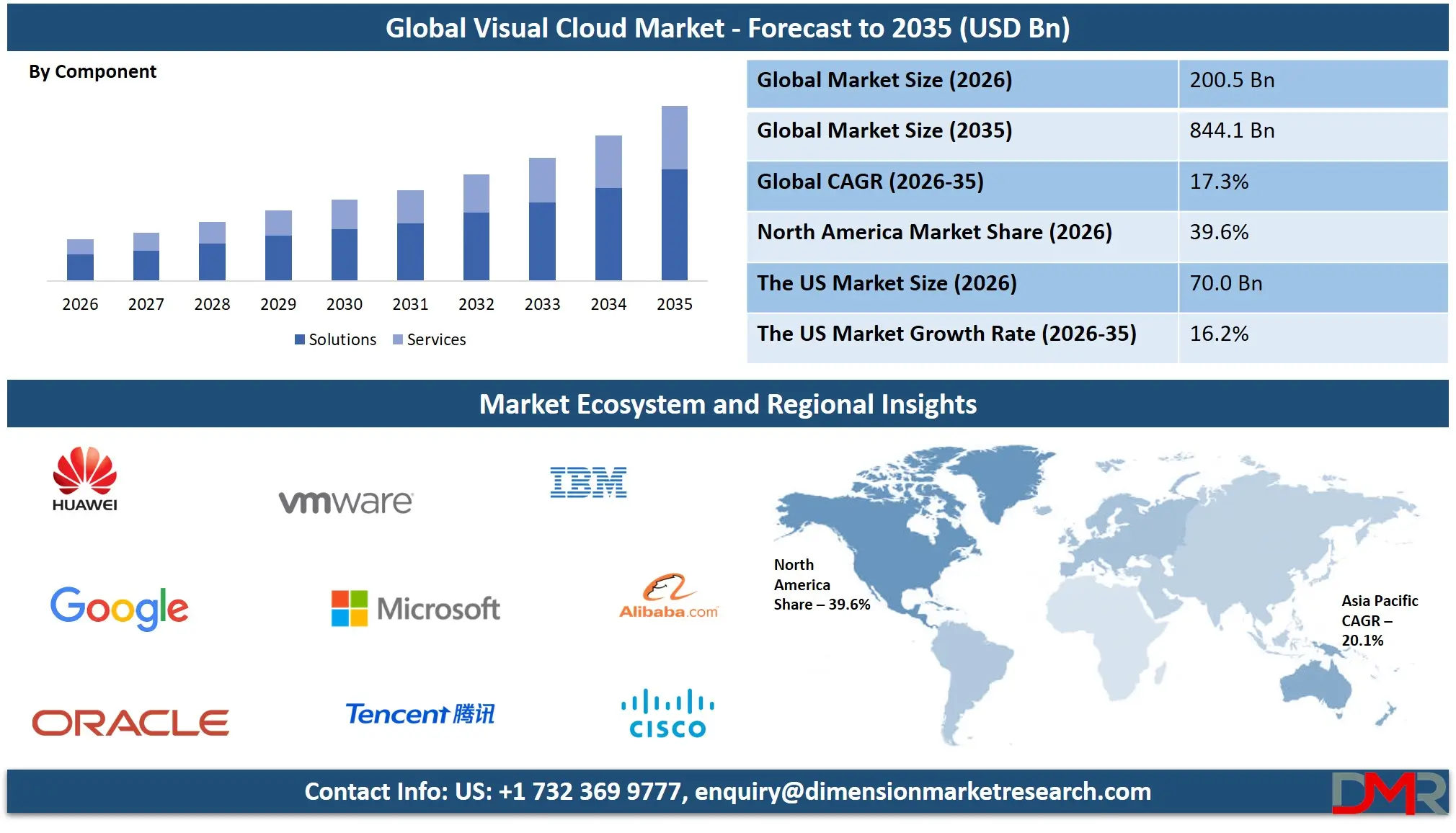
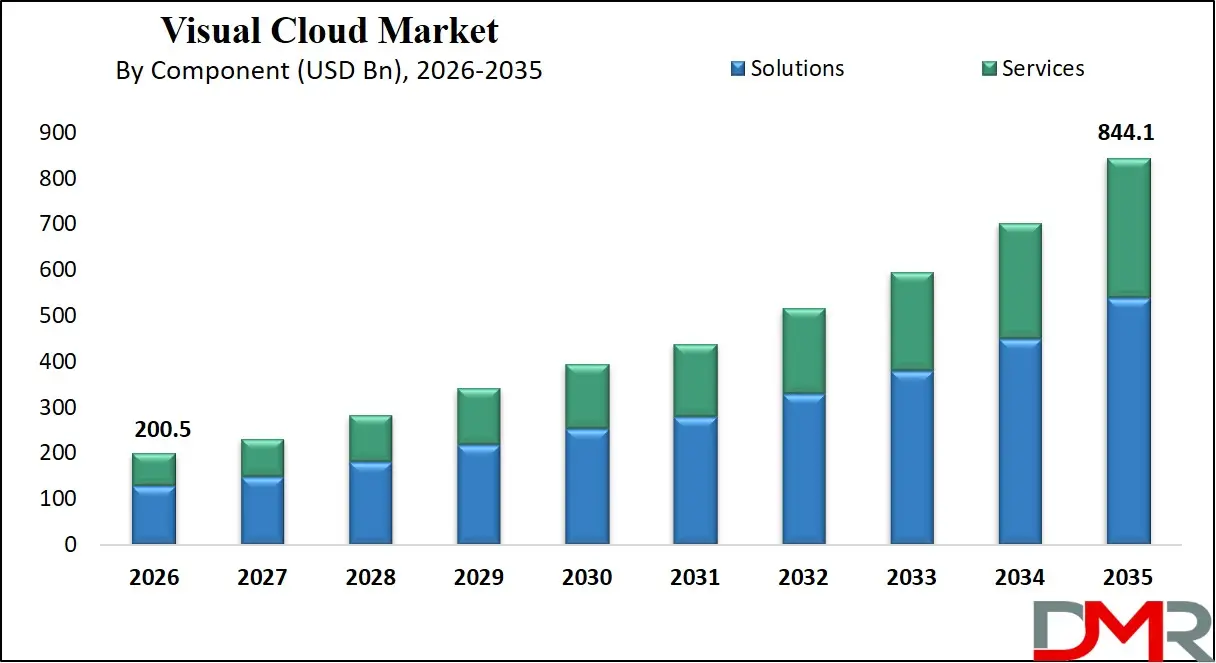
The Global Visual Cloud Market size is projected to reach USD 200.5 billion in 2026 and grow at a compound annual growth rate of 17.3% to reach a value of USD 844.1 billion in 2035.
ℹ
To learn more about this report –
Download Your Free Sample Report Here
Visual Cloud refers to a set of cloud-based technologies designed to process, store, render, and deliver visual content such as videos, images, 3D graphics, and immersive media over internet-based infrastructures. It integrates advanced computing frameworks, distributed cloud architectures, edge computing, and GPU acceleration to support high-performance visual workloads. The ecosystem typically includes video streaming platforms, cloud gaming infrastructures, AR/VR rendering engines, virtual desktops, and remote collaboration systems that rely on scalable cloud resources to ensure seamless visual delivery across devices.
The rapid growth of digital content consumption, immersive media experiences, and cloud-native applications has accelerated the importance of visual cloud technologies across industries. Enterprises are increasingly adopting these solutions to manage complex visual data workloads, reduce hardware dependency, and enable real-time processing capabilities. Innovations in graphics processing units, edge computing, and high-speed connectivity, such as 5G networks are strengthening the ability of cloud platforms to deliver ultra-low latency visual experiences. These capabilities are reshaping sectors including media, gaming, healthcare visualization, remote education, and enterprise collaboration.
ℹ
To learn more about this report –
Download Your Free Sample Report Here
Significant momentum is also emerging from advancements in AI-assisted video analytics, real-time rendering, and scalable cloud infrastructure. Industry participants are investing heavily in cloud data centers optimized for visual computing, enabling faster content delivery and improved streaming quality. Collaborations between cloud service providers, telecom operators, and media platforms are expanding the ecosystem and supporting high-bandwidth applications. As immersive technologies, cloud gaming platforms, and virtual workplaces continue to expand, visual cloud architectures are evolving to support more efficient content processing, interactive services, and globally distributed digital experiences.
The US Visual Cloud Market
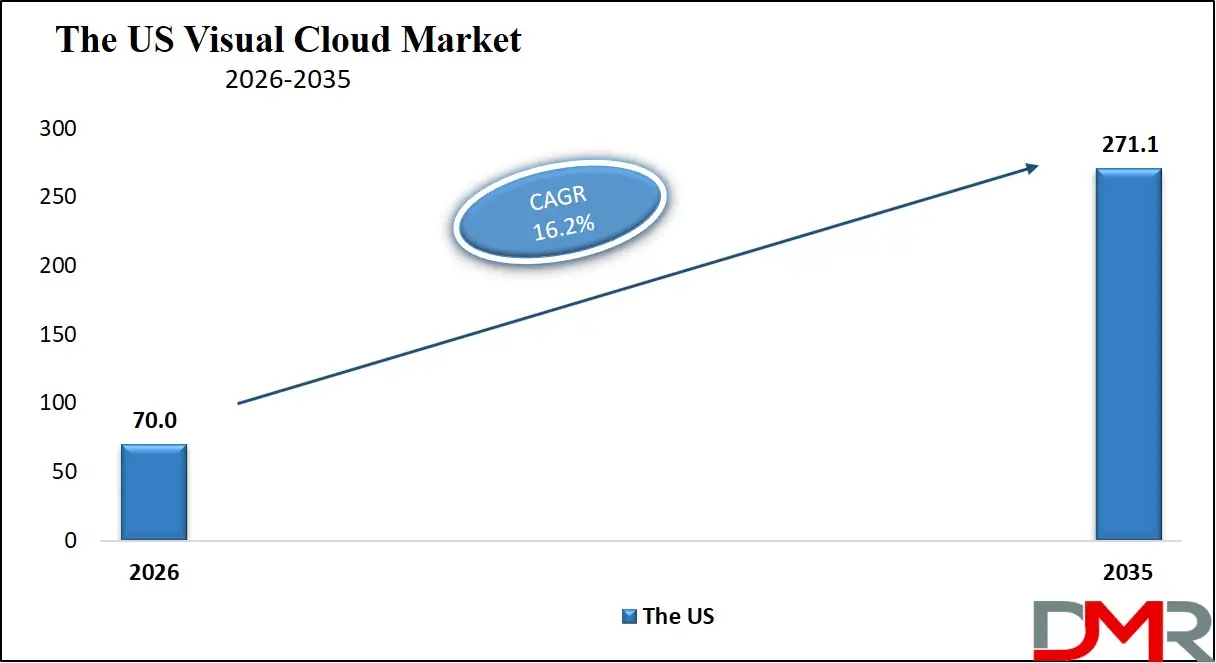
The US Visual Cloud Market size is projected to reach USD 70.0 billion in 2026 at a compound annual growth rate of 16.2% over its forecast period.
ℹ
To learn more about this report –
Download Your Free Sample Report Here
The US represents a highly mature and innovation-driven market for visual cloud technologies, supported by advanced digital infrastructure and widespread cloud adoption. Major technology providers operate large hyperscale data centers optimized for graphics-intensive workloads such as cloud gaming, video streaming, and real-time rendering. Strong demand from media, gaming, and entertainment industries continues to drive infrastructure investments. Government initiatives promoting broadband expansion and 5G deployment further strengthen the ecosystem. Enterprises across healthcare, education, and IT sectors are increasingly adopting virtual desktops, telemedicine visualization, and cloud-based collaboration tools to enhance digital operations.
Europe Visual Cloud Market
Europe Visual Cloud Market size is projected to reach USD 50.1 billion in 2026 at a compound annual growth rate of 16.0% over its forecast period.
Europe's visual cloud market is expanding steadily due to supportive regulatory frameworks, strong data protection policies, and initiatives encouraging digital transformation. Regional policies promoting green computing and sustainable technology are encouraging investments in energy-efficient cloud data centers and advanced computing infrastructure. The region's expanding 5G networks and advanced telecom infrastructure support low-latency streaming, AR/VR applications, and enterprise collaboration platforms. Media production, gaming, and broadcasting industries are increasingly adopting visual cloud technologies to enhance content delivery and workflow efficiency, while enterprises across sectors are leveraging cloud rendering and remote collaboration solutions.
Japan Visual Cloud Market
Japan Visual Cloud Market size is projected to reach USD 10.0 billion in 2026 at a compound annual growth rate of 16.1% over its forecast period.
Japan shows strong adoption of visual cloud technologies due to its advanced technological infrastructure and high-speed connectivity. The country's prominent gaming, animation, and digital media industries create strong demand for cloud-based rendering, video streaming, and immersive AR/VR content delivery platforms. Businesses are increasingly utilizing GPU-accelerated cloud computing to manage complex visual workloads efficiently. Government initiatives supporting digital innovation, smart city development, and advanced telecommunications networks are further strengthening the ecosystem. Additionally, sectors such as healthcare, remote learning, and enterprise collaboration are increasingly adopting visual cloud solutions to improve operational efficiency and digital services.
Visual Cloud Market: Key Takeaways
- Market Growth: The Visual Cloud Market size is expected to grow by USD 612.5 billion, at a CAGR of 17.3%, during the forecasted period of 2027 to 2035.
- By Component: The solutions segment is anticipated to get the majority share of the Visual Cloud market in 2026.
- By Application: The OTT video streaming segment is expected to get the largest revenue share in 2026 in the Visual Cloud market.
- Regional Insight: North America is expected to hold a 39.6% share of revenue in the global Visual Cloud market in 2026.
- Use Cases: Some of the use cases of Visual Cloud include cloud gaming platforms, OTT video streaming, and more.
Visual Cloud Market: Use Cases:
- Cloud Gaming Platforms: Cloud gaming services allow users to stream high-end games directly from cloud servers without requiring powerful local hardware. The visual cloud processes graphics rendering remotely and delivers real-time gameplay streams to devices such as smartphones, PCs, and smart TVs.
- OTT Video Streaming: Visual cloud technologies enable scalable distribution of high-definition and ultra-high-definition video content through streaming platforms. These systems manage encoding, storage, and content delivery networks to provide seamless streaming experiences to millions of users simultaneously.
- AR & VR Content Delivery: Augmented and virtual reality applications rely on visual cloud infrastructure to render complex 3D environments and immersive content. Cloud-based rendering reduces device hardware limitations while enabling real-time interactive experiences for gaming, training simulations, and virtual tourism.
- Virtual Desktop Infrastructure (VDI): Organizations deploy cloud-based virtual desktops to provide remote access to applications and computing environments. Visual cloud processing ensures smooth graphics performance for design software, enterprise tools, and collaborative platforms accessed through remote devices.
- Remote Collaboration & Video Communication: Cloud-based video conferencing and collaboration platforms utilize visual cloud systems to deliver high-quality video streams, screen sharing, and real-time communication capabilities, supporting distributed workforces and hybrid work environments.
- Digital Content Creation & Rendering: Media production studios and animation companies use visual cloud platforms to perform complex rendering tasks, post-production editing, and special effects processing. This enables faster workflows and scalable computing power for large projects.
- Healthcare Imaging & Visualization: Healthcare providers leverage visual cloud technologies to process and share medical imaging data such as CT scans and MRIs. Cloud-based visualization platforms improve collaboration between medical professionals and enhance diagnostic efficiency.
Stats & Facts
- International Telecommunication Union (ITU) reported that global internet penetration reached 67% of the population in 2024, supporting rapid expansion of cloud-based visual services.
- U.S. Federal Communications Commission (FCC) stated in 2024 that over 94% of Americans have access to fixed broadband speeds of at least 100 Mbps, enabling high-quality video streaming and cloud gaming services.
- European Commission announced in 2025 that 5G coverage across EU populated areas exceeded 81%, strengthening infrastructure for immersive cloud-based media services.
- Organisation for Economic Co-operation and Development (OECD) reported in 2024 that over 75% of enterprises in developed economies utilize some form of cloud computing, driving demand for visual cloud capabilities.
- U.S. Census Bureau recorded in 2024 that more than 89% of U.S. households subscribe to at least one video streaming service, increasing data traffic related to visual cloud platforms.
- Japan Ministry of Internal Affairs and Communications reported in 2025 that fiber-optic broadband coverage surpassed 99% of households, enabling high-speed delivery of visual cloud services.
- International Data Corporation (IDC) estimated in 2024 that over 70% of global data center workloads are cloud-based, many supporting media processing and digital content delivery.
- European Telecommunications Network Operators Association (ETNO) stated in 2025 that video streaming accounts for nearly 65% of total internet traffic across Europe.
- National Telecommunications and Information Administration (NTIA) reported in 2024 that more than 80% of U.S. businesses use cloud platforms for collaboration and communication tools.
- United Nations Educational, Scientific and Cultural Organization (UNESCO) stated in 2025 that over 1.6 billion learners globally use digital education platforms, increasing reliance on cloud-based visual communication systems.
- World Economic Forum reported in 2024 that global data traffic generated by video content represents nearly 75% of total internet data flows.
- Statistics Bureau of Japan noted in 2025 that over 92% of households regularly consume online video content, indicating strong demand for advanced visual cloud infrastructure.
Market Dynamic
Driving Factors in the Visual Cloud Market
Expansion of High-Speed Connectivity and 5G Networks
The widespread deployment of high-speed internet infrastructure and 5G networks is one of the most significant forces accelerating visual cloud adoption. High-bandwidth connectivity enables real-time video streaming, cloud gaming, and immersive AR/VR experiences with minimal latency. Telecom providers are continuously upgrading network capabilities to support ultra-high-definition video, interactive digital content, and remote collaboration services. This improved connectivity allows enterprises to shift graphics-intensive workloads from local devices to cloud platforms, reducing hardware limitations. As consumers increasingly rely on mobile devices and connected smart devices for entertainment and communication, demand for scalable visual cloud infrastructure continues to rise.
Rising Demand for Digital Media and Immersive Content
The global surge in digital entertainment, video streaming, and interactive gaming platforms is driving substantial demand for visual cloud technologies. Consumers increasingly expect seamless access to high-definition content across multiple devices, requiring powerful cloud infrastructures capable of processing and delivering large volumes of visual data. Media companies, gaming studios, and content creators are leveraging visual cloud platforms to accelerate production workflows, enhance content quality, and distribute media globally. Additionally, the growing popularity of immersive technologies such as AR, VR, and metaverse-based experiences is increasing reliance on cloud rendering solutions that enable real-time visualization without requiring high-performance local hardware.
Restraints in the Visual Cloud Market
High Infrastructure and Operational Costs
The deployment of visual cloud infrastructure requires significant investments in high-performance data centers, advanced graphics processing units, and high-bandwidth networking systems. Maintaining these facilities also involves substantial operational costs, including energy consumption, cooling requirements, and system maintenance. Smaller organizations and emerging businesses may find it challenging to adopt large-scale visual cloud solutions due to these financial barriers. Additionally, cloud providers must continuously upgrade hardware and infrastructure to meet rising performance expectations, which further increases operational expenditures and affects profit margins within the industry.
Data Security and Privacy Concerns
Visual cloud platforms handle large volumes of sensitive data, including corporate information, proprietary media content, and personal user data. The increasing reliance on cloud-based systems raises concerns related to data breaches, unauthorized access, and cyber threats. Enterprises operating in sectors such as healthcare, finance, and government must comply with strict data protection regulations and security standards, which can complicate cloud adoption. These regulatory and security challenges may slow market expansion, as organizations seek solutions that balance scalability with robust data protection and compliance requirements.
Opportunities in the Visual Cloud Market
Growth of Edge Computing and Distributed Cloud Infrastructure
The integration of edge computing with visual cloud platforms presents significant opportunities for market expansion. Edge nodes positioned closer to end users can process visual data locally before transmitting it to central cloud systems, reducing latency and improving real-time performance. This architecture is particularly beneficial for applications such as cloud gaming, autonomous systems, live broadcasting, and immersive AR/VR environments. As telecom providers expand edge data centers alongside 5G networks, visual cloud services can deliver faster and more responsive experiences, opening new possibilities for industries that require low-latency visual processing.
Increasing Adoption in Enterprise Digital Transformation
Enterprises across industries are accelerating their digital transformation initiatives, creating strong demand for cloud-based visual computing solutions. Organizations are implementing virtual desktops, remote collaboration tools, and cloud-based design platforms to support distributed workforces and global operations. Visual cloud technologies allow companies to scale computing resources dynamically while reducing hardware investments. Industries such as healthcare, education, manufacturing, and retail are increasingly adopting these platforms to improve operational efficiency, enhance customer experiences, and streamline complex workflows that rely heavily on visual data processing.
Trends in the Visual Cloud Market
Integration of Artificial Intelligence in Visual Processing
Artificial intelligence is becoming deeply integrated into visual cloud platforms to improve video analytics, automated content tagging, and real-time rendering capabilities. AI-driven algorithms can analyze video streams, detect objects, and optimize streaming quality based on network conditions. This technology is enhancing applications such as intelligent video surveillance, automated media production, and personalized content delivery. AI-enabled visual processing also helps reduce bandwidth usage and improve performance efficiency, allowing cloud providers to manage increasing volumes of visual data while maintaining high service quality.
Shift Toward Hybrid and Multi-Cloud Architectures
Organizations are increasingly adopting hybrid and multi-cloud strategies to manage visual workloads across different cloud environments. This approach allows enterprises to balance performance, cost efficiency, and data security by distributing workloads between public and private cloud systems. Hybrid architectures are particularly valuable for industries that require strict data governance while still benefiting from scalable computing resources. As enterprises seek more flexible cloud infrastructures, visual cloud providers are developing interoperable platforms that enable seamless integration between multiple cloud environments and on-premise systems.
Impact of Artificial Intelligence in Visual Cloud Market
- AI-Driven Video Compression: AI algorithms optimize video compression techniques to reduce bandwidth usage while maintaining high visual quality, enabling smoother streaming experiences across networks.
- Automated Content Recognition: Machine learning models identify objects, scenes, and facial features within video streams, supporting intelligent video analytics and automated content categorization.
- Real-Time Rendering Optimization: AI improves rendering efficiency by predicting graphical workloads and dynamically allocating computing resources in cloud environments.
- Enhanced Streaming Personalization: AI-powered recommendation systems analyze user preferences to deliver personalized visual content and improve user engagement across streaming platforms.
- Intelligent Network Traffic Management: Artificial intelligence helps manage network congestion by adjusting video bitrates and streaming quality based on real-time connectivity conditions.
- Automated Media Production: AI tools assist in video editing, scene detection, and visual effects generation, accelerating production workflows for digital content creators.
- Security and Fraud Detection: AI algorithms monitor visual cloud platforms to identify suspicious activities, unauthorized access attempts, and cybersecurity threats.
- Improved AR/VR Rendering: Machine learning enhances immersive environments by optimizing 3D rendering processes and improving spatial accuracy for interactive experiences.
- Smart Video Analytics for Enterprises: AI-enabled visual analytics allow businesses to extract insights from surveillance footage, retail analytics, and industrial monitoring systems.
Research Scope and Analysis
By Component Analysis
Solutions are projected to dominate the visual cloud component segment, accounting for 63.8% of the market share in 2026. This segment includes technologies such as cloud gaming platforms, OTT and video streaming systems, AR/VR streaming and cloud rendering, virtual desktop infrastructure (VDI), and cloud-based video conferencing solutions. Increasing demand for digital entertainment, immersive media experiences, and remote collaboration tools is significantly driving the adoption of these solutions. Media companies are investing in scalable streaming infrastructure to support global audiences, while gaming platforms rely on cloud-based rendering for high-performance graphics. Additionally, advancements in GPU acceleration, edge computing, and AI-driven optimization are improving processing speed, lowering latency, and enabling efficient management of complex visual workloads.
The services segment is expected to grow at the fastest rate as organizations increasingly require specialized expertise to implement and maintain visual cloud platforms. This segment includes professional services such as consulting, integration and deployment, along with managed services and ongoing support and maintenance. As companies adopt visual cloud technologies, they often require assistance to integrate these systems with existing IT infrastructures while ensuring optimal performance and reliability. Managed service providers are becoming more important as businesses outsource operational activities such as system monitoring, security management, and performance optimization. The rising complexity of cloud environments and growing demand for scalable digital infrastructure are further accelerating the demand for comprehensive visual cloud service solutions.
By Deployment Mode Analysis
Public cloud deployment is expected to lead the visual cloud market with an estimated 52.6% market share in 2026 due to its scalability, cost efficiency, and global accessibility. Public cloud platforms offer high-performance computing resources, including GPU-powered infrastructure and large-scale data center networks, which are essential for processing visual workloads such as video streaming and cloud gaming. Media companies, streaming services, and collaborative digital platforms rely heavily on public cloud systems to handle large user volumes simultaneously. Additionally, the increasing adoption of cloud-native applications and advancements in cloud-based visual processing are strengthening this segment. Integration of edge computing capabilities with public cloud infrastructure is also improving performance and enabling low-latency visual experiences.
Hybrid cloud deployment is emerging as the fastest-growing model as organizations seek a balance between scalability, performance, and data security. This approach combines the flexibility of public cloud services with the control and security offered by private cloud environments. Industries that handle sensitive data, such as healthcare and financial services, often adopt hybrid cloud strategies to comply with regulatory requirements while still benefiting from scalable computing resources. Hybrid environments allow businesses to store critical information on private infrastructure while utilizing public cloud systems for large-scale visual processing tasks. As enterprises accelerate digital transformation and adopt cloud-based technologies, hybrid cloud models are becoming increasingly attractive for managing complex visual workloads efficiently.
By Application Analysis
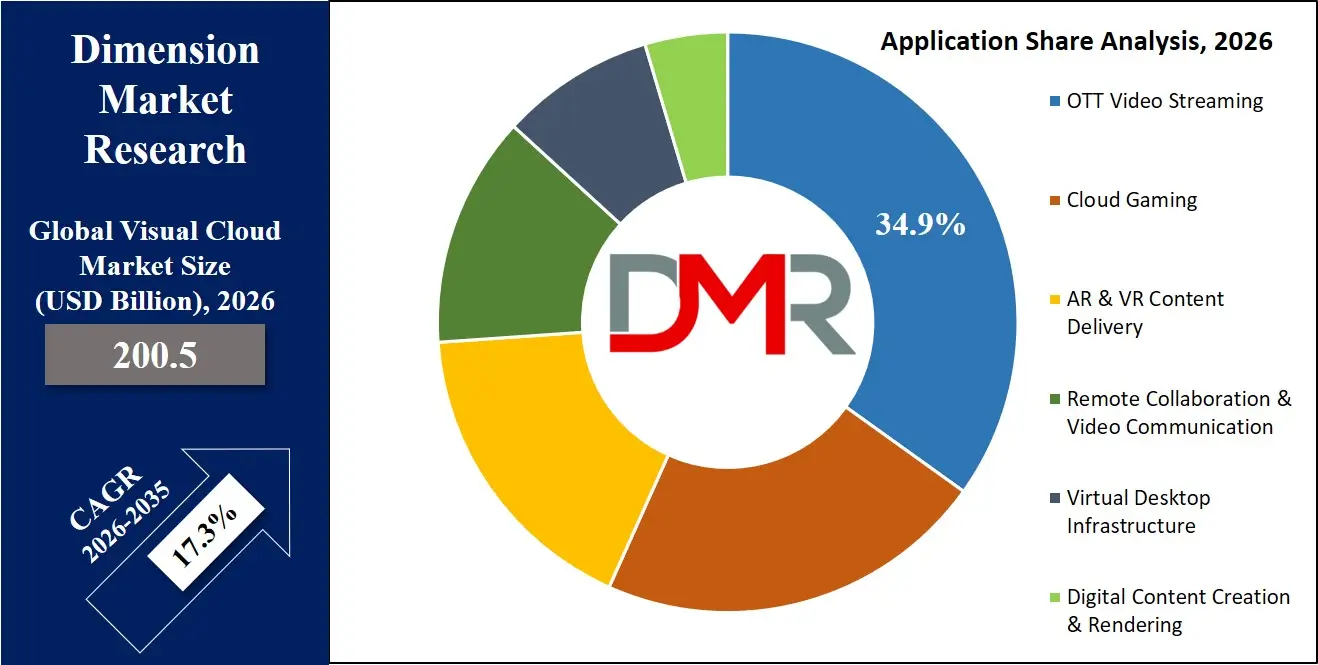
OTT video streaming is anticipated to remain the leading application segment in the visual cloud market, accounting for 34.9% of the market share in 2026. The increasing consumption of digital video content such as movies, television series, live sports, and user-generated videos is driving demand for scalable cloud-based streaming platforms. Visual cloud technologies support efficient video encoding, storage, and distribution through advanced content delivery networks, ensuring seamless viewing experiences across multiple devices. The rising adoption of ultra-high-definition formats like 4K and 8K is further increasing the need for powerful cloud processing systems. Moreover, improvements in adaptive bitrate streaming and AI-based video optimization continue to enhance content quality and streaming performance.
ℹ
To learn more about this report –
Download Your Free Sample Report Here
Cloud gaming is projected to be the fastest-growing application within the visual cloud market as consumer demand for immersive and accessible gaming experiences continues to increase. Unlike traditional gaming, cloud gaming allows users to stream games directly from remote servers, eliminating the need for expensive gaming hardware. Advanced GPU-based cloud infrastructure, along with improvements in edge computing and 5G connectivity, is enabling real-time game rendering with minimal latency. Gaming companies are investing heavily in cloud platforms to expand their services and introduce subscription-based gaming models. As players increasingly seek instant access to high-quality games across multiple devices, cloud gaming is expected to experience strong global adoption.
By End-Use Industry Analysis
The media and entertainment industry is expected to hold the largest share of the visual cloud market, accounting for 31.7% in 2026. This sector heavily relies on visual cloud technologies for content production, video editing, rendering, distribution, and large-scale streaming services. Film studios, broadcasting companies, and streaming platforms require scalable cloud infrastructures to manage vast libraries of digital content and deliver high-quality media to global audiences. Cloud-based rendering solutions also enable faster processing of complex visual effects and animations, improving production efficiency. As global demand for on-demand entertainment continues to rise, media companies are increasing investments in cloud-based visual computing platforms to enhance content delivery and production capabilities.
The healthcare sector is expected to experience the fastest growth in visual cloud adoption due to the increasing need for advanced medical imaging, telemedicine, and remote diagnostics. Healthcare providers are leveraging cloud-based visualization platforms to store, process, and analyze large volumes of imaging data such as CT scans, MRI images, and digital pathology reports. These solutions allow medical professionals to access imaging data remotely and collaborate more effectively with specialists across different locations. Visual cloud technologies also support AI-driven imaging analytics that assist in faster and more accurate diagnoses. As telehealth services expand and healthcare institutions continue their digital transformation, visual cloud platforms are becoming increasingly important in modern medical environments.
The Visual Cloud Market Report is segmented on the basis of the following:
By Component
- Solutions
- Cloud Gaming Platforms
- OTT & Video Streaming Platforms
- AR/VR Streaming & Cloud Rendering
- Virtual Desktop Infrastructure (VDI)
- Cloud-Based Video Conferencing & Collaboration
- Services
- Professional Services
- Consulting
- Integration & Deployment
- Managed Services
- Support & Maintenance
By Deployment Model
- Public Cloud
- Private Cloud
- Hybrid Cloud
By Application
- Cloud Gaming
- OTT Video Streaming
- AR & VR Content Delivery
- Remote Collaboration & Video Communication
- Virtual Desktop Infrastructure
- Digital Content Creation & Rendering
By End-Use Industry
- Media & Entertainment
- Gaming
- IT & Telecommunications
- Healthcare
- Education
- BFSI
- Retail & E-commerce
Regional Analysis
Leading Region in the Visual Cloud Market
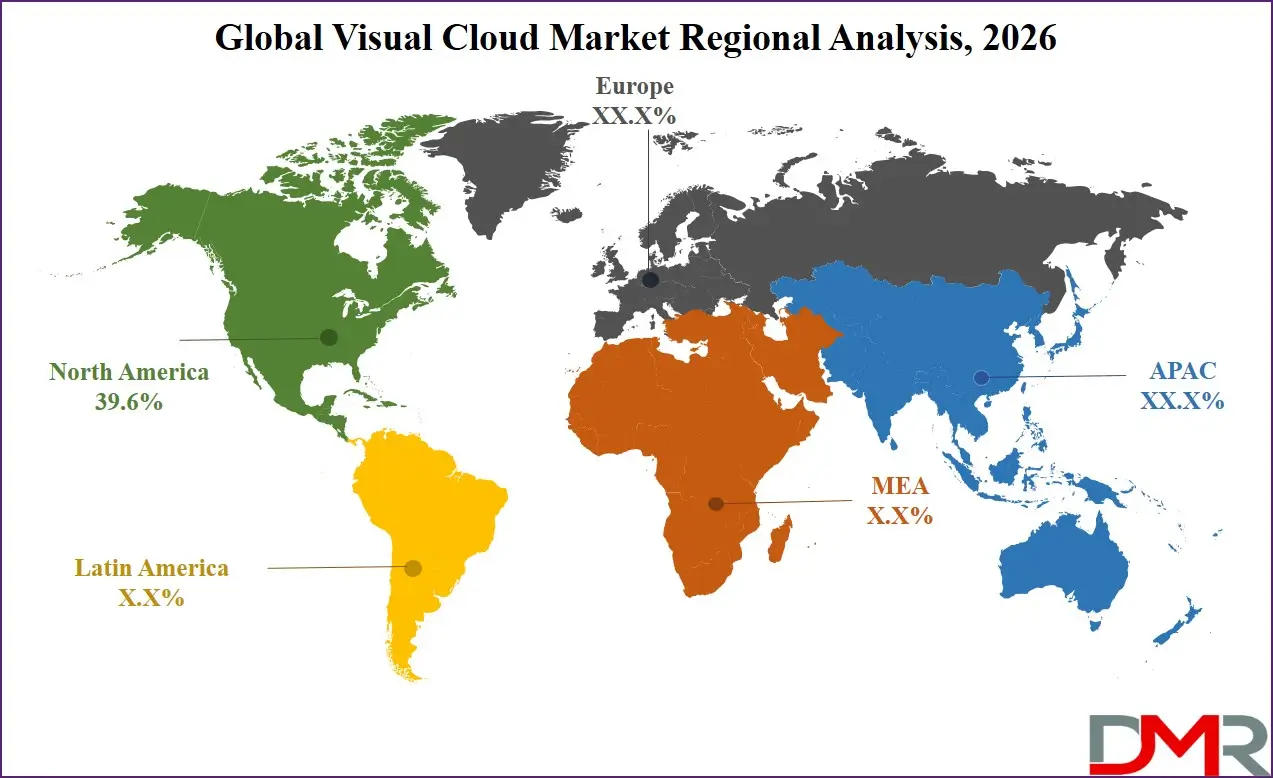
North America is projected to remain the leading region in the visual cloud market, accounting for 39.6% of the global market share in 2026. The region benefits from highly developed digital infrastructure, widespread adoption of cloud computing technologies, and the presence of major cloud service providers and technology innovators.
ℹ
To learn more about this report –
Download Your Free Sample Report Here
Strong consumer demand for OTT streaming services, cloud gaming platforms, and digital collaboration tools is driving significant investments in advanced visual cloud infrastructure. In addition, the region hosts numerous media production companies, gaming studios, and technology startups that rely on high-performance visual computing platforms. Government initiatives supporting broadband expansion and 5G deployment further enhance technological capabilities and accelerate the adoption of visual cloud solutions across industries.
Fastest Growing Region in the Visual Cloud Market
Asia-Pacific is expected to be the fastest-growing region in the visual cloud market due to rapid digital transformation, increasing internet penetration, and rising demand for online entertainment platforms. Countries including China, India, Japan, and South Korea are witnessing strong growth in streaming services, mobile gaming, and digital media consumption. The region's large population and expanding smartphone user base are generating substantial volumes of visual data traffic. Governments across Asia-Pacific are also investing heavily in 5G networks, smart city projects, and digital innovation initiatives that support cloud technologies. Additionally, the growing number of regional content creators, gaming developers, and technology startups is accelerating the adoption of scalable visual cloud infrastructure throughout the region.
By Region
North America
Europe
- Germany
- The U.K.
- France
- Italy
- Russia
- Spain
- Benelux
- Nordic
- Rest of Europe
Asia-Pacific
- China
- Japan
- South Korea
- India
- ANZ
- ASEAN
- Rest of Asia-Pacific
Latin America
- Brazil
- Mexico
- Argentina
- Colombia
- Rest of Latin America
Middle East & Africa
- Saudi Arabia
- UAE
- South Africa
- Israel
- Egypt
- Rest of MEA
Competitive Landscape
The visual cloud market is characterized by intense competition driven by rapid technological innovation and increasing demand for scalable visual computing solutions. Market participants are focusing on expanding cloud infrastructure, improving GPU-based processing capabilities, and integrating advanced technologies such as artificial intelligence and edge computing to enhance service performance. Strategic collaborations with telecom operators, media companies, and gaming developers are helping organizations expand their service ecosystems and strengthen content delivery networks. Continuous investment in research and development is also enabling companies to introduce more efficient video processing technologies and immersive media platforms. Additionally, providers are adopting multi-cloud strategies, global data center expansion, and service differentiation to maintain competitive advantages and address the evolving requirements of enterprises and digital content platforms.
Some of the prominent players in the global Visual Cloud are:
- Amazon Web Services (AWS)
- Microsoft
- Google
- Alibaba
- Tencent
- IBM
- Oracle
- Cisco Systems
- Huawei Cloud
- VMware
- Akamai Technologies
- Salesforce
- Adobe Systems
- Dell Technologies
- Hewlett-Packard Enterprise (HPE)
- Zoom Video Communications
- Avaya
- Poly
- RingCentral
- Rackspace Technology
- SAP SE
- Other Key Players
Recent Developments
- In February 2026, NWN has introduced significant upgrades to its Intelligent Cloud services to support organizations scaling AI adoption. The enhanced offering integrates AI-driven managed services, centralized visibility through the company's Experience Management Platform (EMP), and expert-led cloud modernization. Designed to help enterprises operate efficiently across Amazon Web Services, Microsoft Azure, and hybrid environments, the solution addresses growing challenges such as infrastructure strain, security risks, rising costs, and fragmented tools by delivering continuous operations and improved operational control across complex cloud ecosystems.
- In January 2026, GMI Cloud, a rapidly growing GPU-as-a-Service provider, has introduced GMI Studio, a visual node-based platform designed to simplify AI-driven content workflows. The platform eliminates infrastructure complexity, software dependency issues, and technical barriers that often limit creators and developers. Built to make generative AI more accessible, GMI Studio allows users to combine different AI models, design customized workflows, and deploy scalable content generation pipelines without coding or directly managing GPU infrastructure, enabling teams to create and scale AI-powered content production more efficiently.
Report Details
| Report Characteristics |
| Market Size (2026) |
USD 200.5 Bn |
| Forecast Value (2035) |
USD 844.1 |
| CAGR (2026–2035) |
17.3% |
| The US Market Size (2026) |
USD 70.0 Bn |
| Historical Data |
2021 – 2025 |
| Forecast Data |
2027 – 2035 |
| Base Year |
2025 |
| Estimate Year |
2026 |
| Report Coverage |
Market Revenue Estimation, Market Dynamics, Competitive Landscape, Growth Factors and etc. |
| Segments Covered |
By Component (Solutions, Services), By Deployment Model (Public Cloud, Private Cloud, Hybrid Cloud), By Application (Cloud Gaming, OTT Video Streaming, AR & VR Content Delivery, Remote Collaboration & Video Communication, Virtual Desktop Infrastructure, Digital Content Creation & Rendering), By End-Use Industry (Media & Entertainment, Gaming, IT & Telecommunications, Healthcare, Education, BFSI, Retail & E-commerce) |
| Regional Coverage |
North America – The US and Canada; Europe – Germany, The UK, France, Russia, Spain, Italy, Benelux, Nordic, & Rest of Europe; Asia-Pacific – China, Japan, South Korea, India, ANZ, ASEAN, Rest of APAC; Latin America – Brazil, Mexico, Argentina, Colombia, Rest of Latin America; Middle East & Africa – Saudi Arabia, UAE, South Africa, Turkey, Egypt, Israel, & Rest of MEA |
| Prominent Players |
Amazon Web Services (AWS), Microsoft, Google, Alibaba, Tencent, IBM, Oracle, Cisco Systems, Huawei Cloud, VMware, Akamai Technologies, Salesforce, Adobe Systems, Dell Technologies, Hewlett-Packard Enterprise (HPE), Zoom Video Communications, Avaya, Poly, RingCentral, Rackspace Technology, SAP SE, and Other Key Players |
| Purchase Options |
We have three licenses to opt for: Single User License (Limited to 1 user), Multi-User License (Up to 5 Users) and Corporate Use License (Unlimited User) along with free report customization equivalent to 0 analyst working days, 3 analysts working days and 5 analysts working days respectively. |
Frequently Asked Questions
How big is the Global Visual Cloud Market?
▾ The Global Visual Cloud Market size is expected to reach USD 200.5 billion by 2026 and is projected to reach USD 844.1 billion by the end of 2035.
Which region accounted for the largest Global Visual Cloud Market?
▾ North America is expected to have the largest market share in the Global Visual Cloud Market, with a share of about 39.6% in 2026.
How big is the Visual Cloud Market in the US?
▾ The US Visual Cloud market is expected to reach USD 3.2 billion by 2026.
Who are the key players in the Visual Cloud Market?
▾ Some of the major key players in the Global Visual Cloud Market include IBM, Google, Microsoft, and others.
What is the growth rate in the Global Visual Cloud Market?
▾ The market is growing at a CAGR of 17.3 percent over the forecasted period.