What is the VR Content Creation Service Market Size?
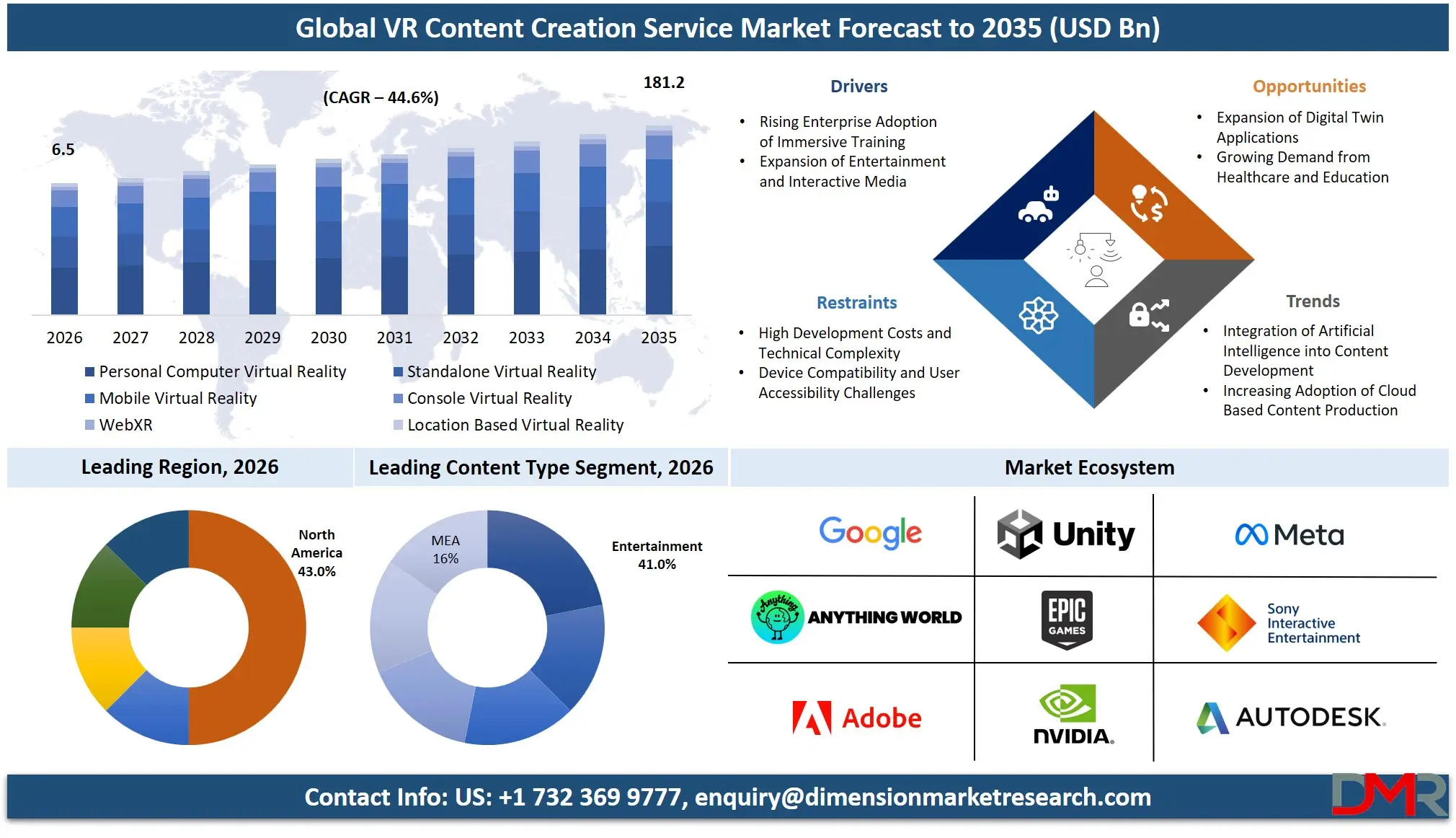
The global VR content creation service market is projected to rise from USD 6.5 billion in 2026 to USD 181.2 billion by 2035, at a 44.6% CAGR. The market includes modeling, animation, simulation, spatial audio, application development, and postproduction. Growth is supported by broadband expansion, improved headsets, cloud rendering, artificial intelligence, and digital experiences.
ℹ
To learn more about this report –
Download Your Free Sample Report Here
The International Telecommunication Union reported that 6 billion people, or 74% of the global population, were online in 2026. Expanding connectivity enables VR delivery across entertainment, education, healthcare, manufacturing, retail, tourism, and training. Businesses use three dimensional assets, digital twins, and simulations to reduce production and training costs. Future growth depends on affordable devices, interoperable platforms, faster networks, and enterprise deployment.
United States VR Content Creation Service Market
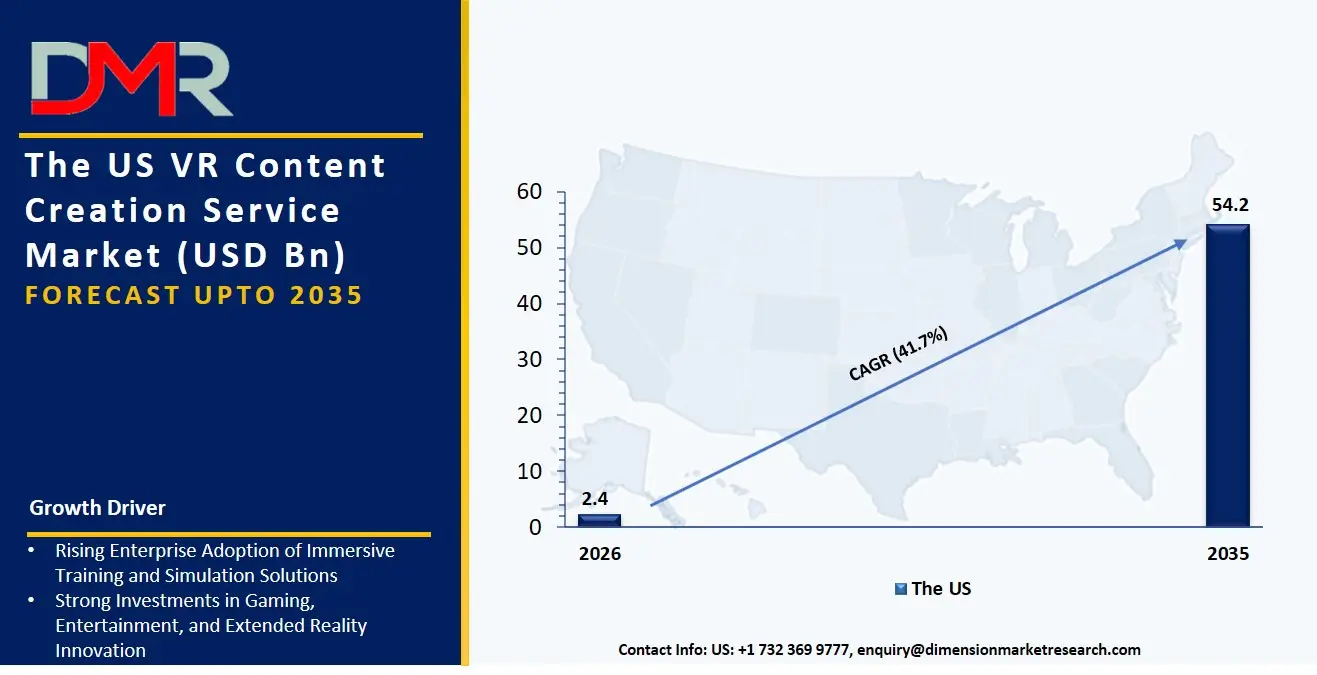
The United States VR content creation service market is projected to grow from USD 2.4 billion in 2026 to USD 54.2 billion by 2035, at a 41.7% CAGR.
ℹ
To learn more about this report –
Download Your Free Sample Report Here
The market serves gaming, media, healthcare, defense, education, industrial training, retail, architecture, and communication. Growth is driven by studios, enterprise digitization, defense simulation, and immersive demand. The Bureau of Economic Analysis reported that American arts and cultural production contributed USD 1.17 trillion in 2023. This creative economy supports animation, visual effects, interactive design, spatial audio, and virtual production.
Healthcare training, digital twins, collaboration, product demonstrations, and location based entertainment create recurring opportunities. Future expansion will favor cloud production, artificial intelligence workflows, standalone headsets, WebXR, and enterprise solutions.
Europe VR Content Creation Service Market
The Europe VR content creation service market is projected to increase from USD 1.4 billion in 2026 to USD 8.6 billion by 2035, at a 21.6% CAGR. The market covers immersive media, industrial visualization, cultural heritage, training, education, healthcare, tourism, and commerce. Growth is supported by creative industries, manufacturing digitization, multilingual demand, and innovation. The European Commission states that around 90% of European companies working in extended reality are small and medium enterprises. This supplier base supports modeling, animation, application development, virtual production, and design. Digital twins, automotive engineering, medical simulation, museums, architecture, and training should generate demand.
Japan VR Content Creation Service Market
The Japan VR content creation service market is projected to expand from USD 302.6 million in 2026 to USD 2.6 billion by 2035, at a 27.5% CAGR. The market combines gaming, animation, electronics, manufacturing, tourism, healthcare, education, and entertainment. Growth is supported by device engineering, automation, digital training, and interactive demand. Japan's Statistics Bureau reported that 85.6% of people aged six or older used the internet in 2024. Smartphone usage reached 74.4%, while internet enabled television usage reached 30.8%, improving accessibility. Automotive visualization, factory simulation, tourism, medical education, virtual events, and character entertainment offer opportunities.
Key Takeaways
- Market Size: The Global VR Content Creation Service Market is projected to expand from USD 6.5 billion in 2026 to USD 181.2 billion by 2035, registering a remarkable 44.6% CAGR, reflecting rapid enterprise adoption of immersive digital content creation services.
- Growth Rate and Outlook: With a 44.6% CAGR through 2035, the market outlook remains highly positive, supported by digital transformation, enterprise metaverse initiatives, cloud based production, immersive training, and increasing investments in interactive three dimensional experiences across industries.
- Primary Growth Drivers: Demand is accelerating because organizations require immersive training, digital twins, virtual collaboration, marketing experiences, and simulation platforms, while advances in graphics engines, artificial intelligence, spatial computing, and high speed connectivity continue improving content quality and production efficiency.
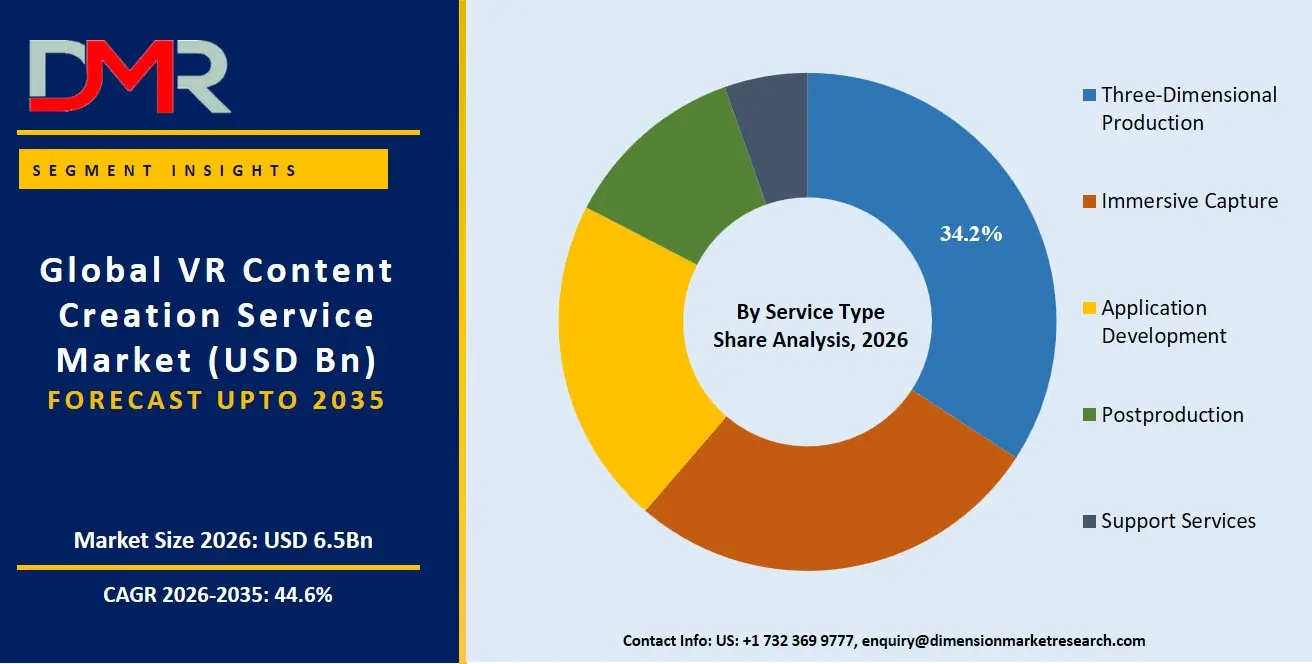
- By Segment One Analysis: Three Dimensional Production accounted for the largest service share at 34.2% in 2026, driven by strong demand for modeling, animation, environment creation, and digital asset development supporting gaming, industrial visualization, healthcare, and enterprise applications.
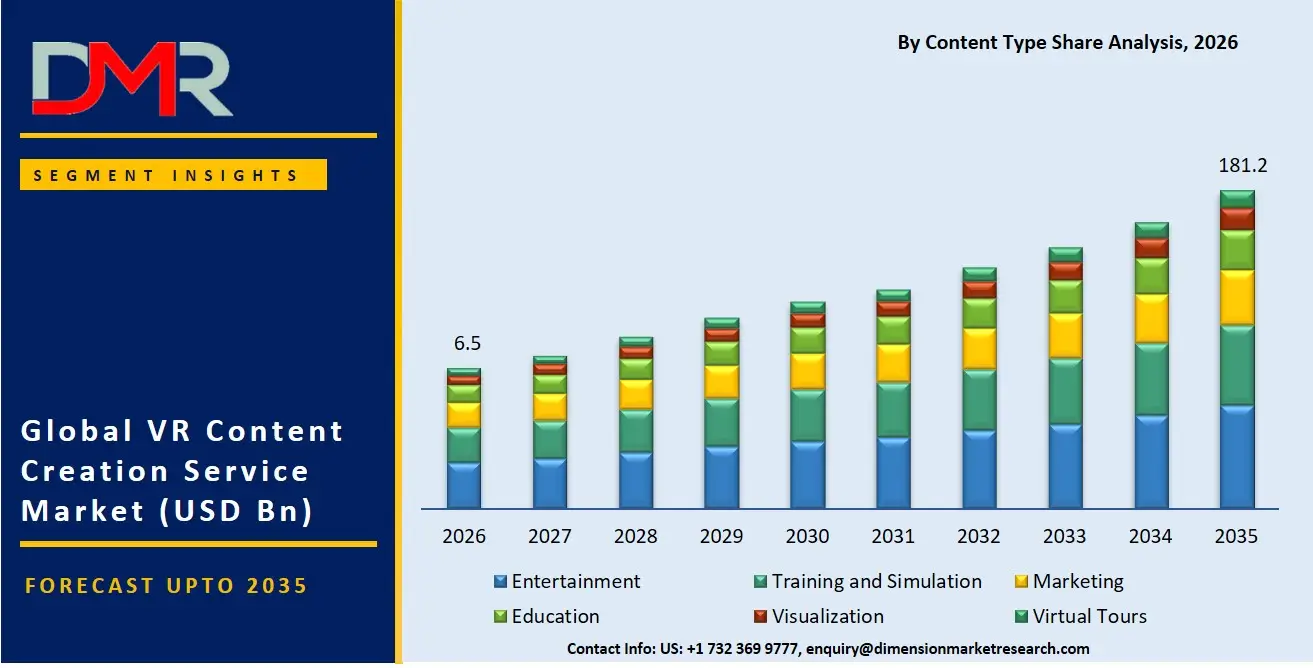
- By Segment Two Analysis: Entertainment dominated content type with a 41.0% market share in 2026, as gaming, virtual events, immersive storytelling, and digital media production increasingly adopted VR experiences to enhance consumer engagement and premium content delivery.
- By Segment Three Analysis: Media and Entertainment represented the leading end use industry with 31.3% market share in 2026, benefiting from growing investment in immersive production, virtual broadcasting, interactive experiences, and next generation digital content creation technologies.
- Regional Leadership: North America held the largest regional share at 43.0% in 2026, while Asia Pacific is expected to register the fastest growth with a 46.3% CAGR, supported by expanding digital infrastructure and immersive technology investments.
What is the Global VR Content Creation Service Market?
The Global VR Content Creation Service Market comprises professional services used to design, develop, optimize, and maintain immersive virtual reality experiences for commercial, industrial, educational, healthcare, entertainment, and government applications. These services include three dimensional modeling, animation, interactive application development, volumetric capture, spatial audio, simulation design, and technical integration delivered through specialized studios and technology providers. According to the United Nations Educational, Scientific and Cultural Organization, the global creative economy generates approximately 3.1% of global GDP and accounts for 6.2% of worldwide employment, creating a strong foundation for immersive digital content industries. As organizations increasingly digitize customer engagement, workforce training, engineering visualization, and remote collaboration, demand for specialized VR content creation services continues to expand across developed and emerging economies.
Use Cases
- Industrial Training and Simulation: Manufacturers and industrial organizations develop immersive safety training, equipment operation modules, and maintenance simulations using VR content creation services.
- Healthcare Education: Hospitals, universities, and medical institutions use VR content to create surgical simulations, anatomy visualization, and clinical training environments.
- Real Estate and Architecture: Developers and architectural firms create interactive property walkthroughs, infrastructure visualization, and design validation experiences before construction begins.
- Media and Entertainment: Studios develop immersive games, virtual concerts, cinematic experiences, and interactive storytelling using advanced VR production services.
How AI is Transforming the VR Content Creation Service Market?
Artificial intelligence is significantly improving the speed, quality, and scalability of VR content creation by automating asset generation, animation, scene optimization, speech processing, and intelligent interaction. AI powered tools such as Adobe Firefly, Autodesk AI capabilities, NVIDIA Omniverse, and Unity AI assist creators in producing realistic three dimensional assets, textures, lighting, and virtual environments with fewer manual workflows. NVIDIA Omniverse enables real time collaboration and physically accurate simulation for industrial digital twins, while Unity AI accelerates coding assistance and content generation for immersive applications. AI based motion capture, speech recognition, and facial animation reduce production time while improving realism. Generative AI also supports multilingual virtual assistants and adaptive learning environments, enabling personalized VR training, healthcare simulations, industrial maintenance, retail visualization, and interactive entertainment across global enterprise deployments.
Market Dynamics
Key Drivers in the Global VR Content Creation Service Market
Rising Enterprise Adoption of Immersive Training
Organizations across manufacturing, healthcare, defense, aviation, and energy increasingly use VR content for employee training, operational simulations, and safety programs. Immersive learning improves knowledge retention while reducing travel expenses, equipment downtime, and training risks. As companies accelerate digital transformation and workforce upskilling initiatives, demand for customized VR environments, interactive simulations, and digital twin applications continues to expand. Government investments in advanced manufacturing, defense modernization, and digital education further encourage adoption, creating sustained opportunities for professional VR content creation service providers across enterprise sectors.
Expansion of Entertainment and Interactive Media
The rapid evolution of gaming, virtual events, sports broadcasting, digital storytelling, and location based entertainment is increasing demand for premium VR experiences. Content creators, media studios, and streaming companies are investing in immersive productions to improve audience engagement and monetization. Growing consumer interest in realistic virtual environments, combined with advances in graphics engines, cloud rendering, and spatial computing, enables developers to deliver higher quality experiences. This expanding ecosystem encourages continuous investment in specialized content development, animation, interactive design, and virtual production services worldwide.
Restraints in the Global VR Content Creation Service Market
High Development Costs and Technical Complexity
Producing professional VR content requires advanced software, specialized hardware, skilled developers, motion capture systems, and extensive testing across multiple devices. Creating realistic three dimensional environments, interactive simulations, and optimized applications often demands significant financial investment and longer production cycles than conventional digital content. Small studios and emerging businesses frequently face budget limitations, making large scale immersive projects difficult to execute. These challenges can slow market penetration, particularly in cost sensitive industries and developing economies where technology budgets remain constrained.
Device Compatibility and User Accessibility Challenges
VR content creators must ensure compatibility across different headsets, operating systems, controllers, and rendering platforms, increasing development complexity and maintenance requirements. Hardware limitations, varying display specifications, and performance optimization needs often require multiple versions of the same application. Consumer adoption also depends on affordable devices, user comfort, and reliable connectivity. Motion sickness, limited battery life, and accessibility concerns continue to influence user acceptance, reducing the speed of widespread deployment for some commercial and consumer applications.
Growth Opportunities in the Global VR Content Creation Service Market
Expansion of Digital Twin Applications
Digital twin adoption is creating significant opportunities for VR content creators across manufacturing, construction, utilities, transportation, and smart infrastructure. Organizations increasingly require immersive digital models for equipment monitoring, facility planning, workforce training, and predictive maintenance. VR content services enable realistic visualization and interaction with complex operational environments, improving decision making and reducing project risks. As industries accelerate industrial automation and connected operations, demand for customized digital twin content and simulation services is expected to increase substantially across global markets.
Growing Demand from Healthcare and Education
Healthcare institutions, universities, and vocational training centers are adopting immersive learning to improve knowledge delivery, clinical practice, and technical education. VR content supports anatomy visualization, surgical simulation, laboratory training, emergency response exercises, and remote learning environments. Increasing investments in digital education and healthcare modernization create long term opportunities for service providers specializing in interactive educational content. The ability to deliver repeatable, scalable, and engaging learning experiences positions VR content creation services as an important component of future workforce development.
Trends in the Global VR Content Creation Service Market
Integration of Artificial Intelligence into Content Development
Artificial intelligence is transforming VR production by accelerating asset creation, animation, coding assistance, environment generation, and quality optimization. Developers increasingly use AI driven tools to automate repetitive tasks, improve rendering efficiency, generate realistic characters, and personalize immersive experiences. This integration reduces production timelines while enabling creators to focus on advanced design and storytelling. As generative AI technologies continue to evolve, they are expected to improve productivity and expand the accessibility of professional VR content development across multiple industries.
Increasing Adoption of Cloud Based Content Production
Cloud technologies are changing how VR content is developed, managed, and deployed by enabling collaborative workflows, remote rendering, centralized asset management, and scalable computing resources. Distributed production teams can simultaneously access shared environments, reducing infrastructure costs and accelerating project delivery. Cloud based development also simplifies software updates, cross platform deployment, and enterprise integration. As organizations increasingly adopt hybrid work models and global development teams, cloud enabled VR content creation services are becoming a preferred production model for complex immersive projects.
Research Scope and Analysis
The VR Content Creation Service Market is driven by rising demand for immersive applications across entertainment, healthcare, education, and enterprise sectors. Growth is supported by advancements in 3D production, cloud deployment, WebXR platforms, and customized application development, while expanding adoption across industries continues to accelerate innovation and long-term market opportunities.
ℹ
To learn more about this report –
Download Your Free Sample Report Here
By Service Type Analysis
Three Dimensional Production is projected to dominate the service type category with a 34.2% market share in 2026, supported by demand for modeling, animation, environment design, simulation assets, and interactive visual development. Application Development is projected to record the highest CAGR of 46.3% through 2031 as enterprises increasingly require customized immersive applications, real time interaction, multiplayer functions, analytics integration, and platform specific deployment. Postproduction is considered the second largest service category, benefiting from growing requirements for rendering, visual effects, spatial audio, stitching, testing, and performance optimization. However, its exact market share was not publicly disclosed. Together, these service categories reflect the rising complexity of virtual reality projects and growing reliance on specialized providers for immersive content production and technical execution worldwide.
By Content Type Analysis
Entertainment is expected to led the content type category with a 41.0% market share in 2026, driven by demand for immersive gaming, virtual events, interactive storytelling, cinematic experiences, and location based entertainment.
ℹ
To learn more about this report –
Download Your Free Sample Report Here
Healthcare Visualization is expected to register the highest CAGR of 46.4% through 2031 as hospitals, medical schools, and training institutions adopt virtual anatomy, surgical simulation, rehabilitation content, and clinical education tools. Training and Simulation represents the second largest content category because enterprises increasingly use immersive environments for safety instruction, workforce development, technical learning, and operational preparedness. Its exact market share was not publicly disclosed. The outlook indicates that consumer entertainment will remain the principal revenue contributor, while healthcare and enterprise learning applications increasingly shape future expansion across global markets.
By Platform Analysis
Personal Computer VR is anticipated to dominate the platform category with a 39.1% market share in 2026, supported by superior graphics performance, processing, premium headsets, and compatibility with complex enterprise and gaming applications. WebXR is projected to achieve the highest CAGR of 45.9% through the forecast period because browser based access reduces installation requirements, improves device flexibility, and supports scalable distribution of immersive content. Standalone VR is regarded as the second largest platform category, benefiting from wireless operation, integrated computing, simplified deployment, and adoption across training, education, healthcare, retail, and entertainment. Its exact market share was not publicly disclosed. Platform development is focused on accessibility, interoperability, cloud rendering, and cross device performance, enabling providers to reach broader target audiences with lower deployment barriers.
By Deployment Analysis
Cloud deployment is expected to dominate the deployment category as studios and enterprises use remote rendering, centralized asset libraries, scalable computing, collaborative workflows, and subscription based production platforms. The exact dominant market share was not publicly disclosed in sources. Hybrid deployment is projected to record the highest growth because organizations seek cloud flexibility while retaining sensitive assets, proprietary simulations, and regulated data within controlled infrastructure. On Premises deployment represents the second largest category, supported by defense, healthcare, manufacturing, and government users requiring security, customization, low latency, and direct infrastructure control. Its exact market share and CAGR were not publicly disclosed. Deployment preferences will increasingly depend on workload complexity, data governance, connectivity, rendering requirements, integration needs, and total ownership costs globally.
By Enterprise Size Analysis
Large enterprises are expected to dominate the enterprise size category due to greater technology budgets, complex training requirements, digital transformation programs, and capacity to commission customized immersive content. The exact dominant market share was not publicly disclosed. Small and Medium Enterprises are projected to register the highest growth as cloud tools, reusable asset libraries, affordable headsets, and outsourced development reduce entry barriers for virtual reality adoption. Medium enterprises represent the second largest customer category, supported by increasing use of immersive marketing, workforce instruction, product visualization, simulation, and customer engagement solutions. Their exact market share and CAGR were not publicly disclosed. Future adoption will be shaped by project affordability, measurable returns, technical skills, platform accessibility, scalability, and industry use cases worldwide.
By End Use Analysis
Media and Entertainment is anticipated to dominate the end use category with a 31.3% market share in 2026, supported by investment in immersive games, virtual production, concerts, interactive films, sports experiences, and location-based attractions. Healthcare is projected to register the highest CAGR of 46.7% through 2031 as providers expand surgical simulation, medical education, rehabilitation, therapy, patient engagement, and clinical visualization applications. Education and Training represent the second largest end use category because schools, universities, corporations, and public agencies adopt experiential learning and skills development environments. Its exact market share was not publicly disclosed. The end use landscape is becoming more diversified as manufacturing, retail, real estate, tourism, defense, automotive, and energy organizations integrate virtual reality into commercial and workforce activities.
The Global VR Content Creation Service Market Report is segmented on the basis of the following:
By Service Type
- Three-Dimensional Production
- Modeling
- Texturing
- Rigging
- Animation
- Environment Design
- Immersive Capture
- Three Hundred Sixty Degree Video
- Three Hundred Sixty Degree Photography
- Volumetric Capture
- Motion Capture
- Photogrammetry
- Application Development
- Interaction Design
- Simulation Development
- Multiplayer Development
- Haptic Integration
- Spatial Tracking
- Postproduction
- Video Stitching
- Visual Effects
- Spatial Audio
- Rendering
- Performance Optimization
- Support Services
- Content Strategy
- Platform Integration
- Quality Testing
- Content Updates
- Technical Support
By Content Type
- Entertainment
- Games
- Films
- Live Events
- Social Experiences
- Training and Simulation
- Technical Training
- Safety Training
- Medical Simulation
- Defense Simulation
- Workforce Training
- Marketing
- Brand Experiences
- Product Demonstrations
- Virtual Showrooms
- Campaign Content
- Education
- Classroom Content
- Laboratory Simulation
- Vocational Learning
- Skill Assessment
- Visualization
- Medical Visualization
- Architectural Visualization
- Product Visualization
- Engineering Visualization
- Digital Twins
- Virtual Tours
- Real Estate Tours
- Tourism Tours
- Museum Tours
- Facility Tours
By Platform
- Personal Computer Virtual Reality
- Standalone Virtual Reality
- Mobile Virtual Reality
- Console Virtual Reality
- WebXR
- Location Based Virtual Reality
By Deployment
By Enterprise Size
- Small Enterprises
- Medium Enterprises
- Large Enterprises
By End Use
- Media and Entertainment
- Gaming
- Healthcare
- Education
- Retail and Electronic Commerce
- Manufacturing
- Automotive
- Aerospace and Defense
- Architecture and Construction
- Real Estate
- Tourism and Hospitality
- Marketing and Advertising
- Government
- Energy and Utilities
Regional Analysis
Leading Region by Market Share
ℹ
To learn more about this report –
Download Your Free Sample Report Here
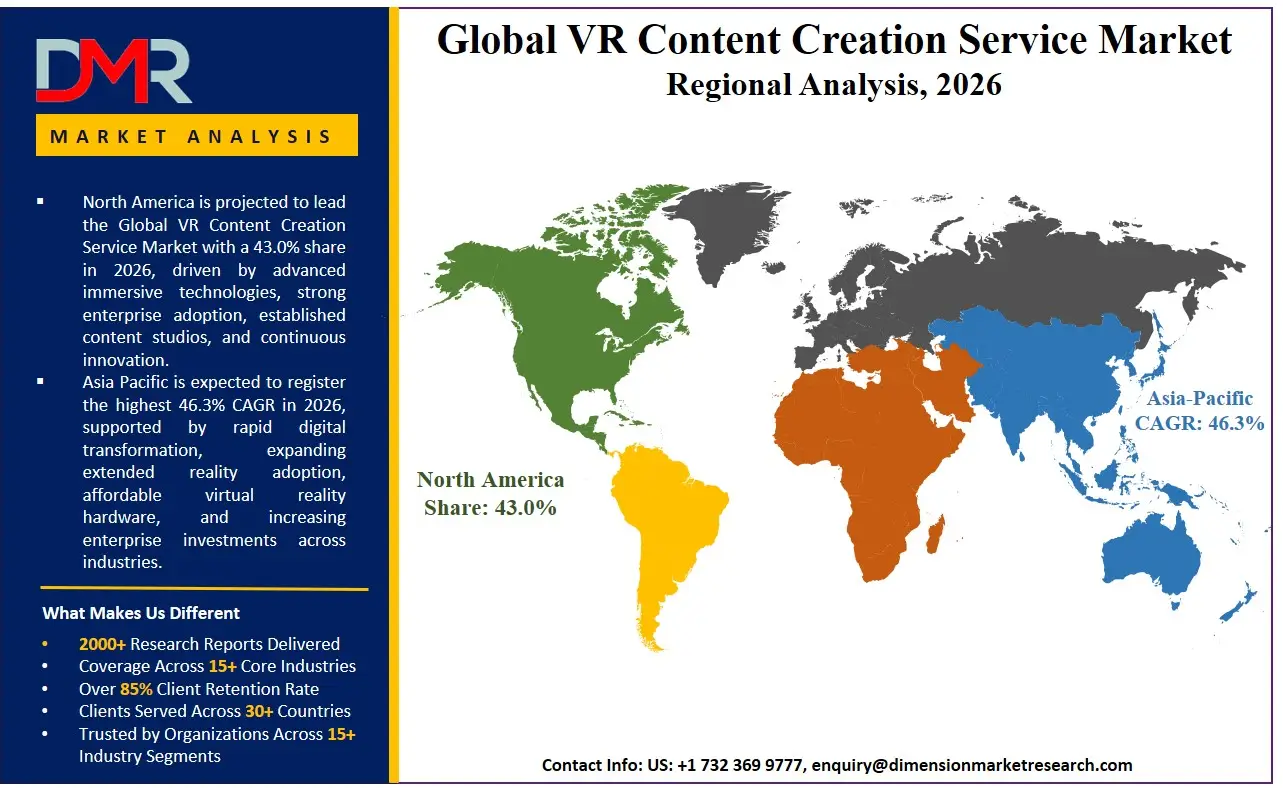
North America is projected to dominate the Global VR Content Creation Service Market with a 43.0% market share in 2026, supported by its mature immersive technology ecosystem, established content studios, and strong enterprise investment in virtual reality solutions. The region benefits from widespread adoption across media and entertainment, gaming, healthcare, defense, manufacturing, education, and retail, where organizations increasingly deploy immersive applications for training, visualization, customer engagement, and product development. The presence of leading technology companies, advanced graphics platforms, cloud infrastructure, and experienced development talent further strengthens regional competitiveness. Continuous investments in artificial intelligence, digital twins, spatial computing, and extended reality innovation continue to accelerate commercial deployment. These factors position North America as the largest revenue contributor and the leading innovation hub for professional VR content creation services.
Fastest-Growing Regional Market
Asia Pacific is expected to register the highest CAGR of 46.3% in this market in 2026, making it the fastest growing regional market for VR content creation services. Growth is fueled by expanding digital infrastructure, increasing investments in immersive technologies, rapid industrial digitalization, and strong demand for interactive applications across gaming, education, healthcare, manufacturing, and retail sectors. Countries including China, Japan, South Korea, India, and Singapore are strengthening their extended reality ecosystems through innovation, technology adoption, and digital transformation initiatives. Rising smartphone penetration, expanding high speed connectivity, affordable VR hardware, and increasing developer communities are encouraging wider commercialization of immersive content. As enterprises continue integrating virtual reality into training, simulation, engineering, and customer engagement, Asia Pacific is expected to remain the primary engine of future market expansion.
By Region
North America
Europe
- Germany
- The U.K.
- France
- Italy
- Russia
- Spain
- Benelux
- Nordic
- Rest of Europe
Asia-Pacific
- China
- Japan
- South Korea
- India
- ANZ
- ASEAN
- Rest of Asia-Pacific
Latin America
- Brazil
- Mexico
- Argentina
- Colombia
- Rest of Latin America
Middle East & Africa
- Saudi Arabia
- UAE
- South Africa
- Israel
- Egypt
- Rest of MEA
Competitive Landscape
The Global VR Content Creation Service Market is moderately fragmented, combining platform vendors, studios, three-dimensional software developers, and immersive training providers. Unity offers its real time development engine for XR applications, while Epic Games provides Unreal Engine and RealityCapture for photorealistic environment production. Adobe supports asset creation through Substance 3D Modeler, Painter, and Sampler, and NVIDIA supplies Omniverse for simulation ready three-dimensional workflows. Meta, Autodesk, Sony, HTC, and Google strengthen the ecosystem through creator platforms, design software, headset environments, and WebXR tools. Competition centers on rendering quality, cross platform deployment, artificial intelligence automation, reusable asset libraries, spatial audio, and enterprise integration. Vendors pursue acquisitions, partnerships, and funding to expand photogrammetry, virtual production, generative content, simulation, and cloud collaboration capabilities across entertainment, healthcare, education, manufacturing, retail, and defense.
Some of the prominent players in the Global VR Content Creation Service Market are:
- Unity Technologies
- Epic Games
- Adobe
- NVIDIA
- Autodesk
- Meta Platforms
- Sony Interactive Entertainment
- HTC
- Google
- Microsoft
- ShapesXR
- Anything World
- Hexa
- Strivr
- Cinesite
- The Mill
- Nexus Studios
- Framestore
- Magnopus
- Virtualware
- Other Key Players
Recent Developments
- March 2026: Roboquest VR Co-op Debut: Developer RyseUp Studios launched its highly anticipated multiplayer Roboquest VR co-op environment, expanding accessibility and introducing refined, highly engaging user interaction behaviors directly into the consumer spatial gaming segment.
- July 2026: EssilorLuxottica Acquires Lynx: Eyewear giant EssilorLuxottica fully acquired French mixed-reality startup Lynx, absorbing its entire spatial software ecosystem, core intellectual property, manufacturing know-how, and engineering team to dominate smart eyewear content.
- January 2026: XREAL Secures Series D: Lightweight spatial computing and headset developer XREAL closed its major Series D expansion financing round, boosting the content platform's lifetime funding milestone to over USD 433 million total.
Report Details
| Report Characteristics |
| Market Size (2026) |
USD 6.5 Bn |
| Forecast Value (2035) |
USD 181.2 Bn |
| CAGR (2026–2035) |
44.6% |
| The US Market Size (2026) |
USD 2.4 Bn |
| Historical Data |
2021 – 2025 |
| Forecast Data |
2027 – 2035 |
| Base Year |
2025 |
| Estimate Year |
2026 |
| Segments Covered |
By Service Type, By Content Type, By Platform, By Deployment, By Enterprise Size, By End Use |
| Regional Coverage |
North America – The US and Canada; Europe – Germany, The UK, France, Russia, Spain, Italy, Benelux, Nordic, & Rest of Europe; Asia-Pacific – China, Japan, South Korea, India, ANZ, ASEAN, Rest of APAC; Latin America – Brazil, Mexico, Argentina, Colombia, Rest of Latin America; Middle East & Africa – Saudi Arabia, UAE, South Africa, Turkey, Egypt, Israel, & Rest of MEA |
Frequently Asked Questions
How big is the Global VR Content Creation Service Market?
▾ The Global VR Content Creation Service Market is valued at USD 6.5 billion in 2026 and projected to reach USD 181.2 billion by 2035, reflecting substantial expansion across immersive applications worldwide.
What is the CAGR of the Global VR Content Creation Service Market from 2026 to 2035?
▾ The Global VR Content Creation Service Market is forecast to register a CAGR of 44.6% from 2026 to 2035, supported by adoption of immersive technologies across enterprise and consumer uses.
What factors are driving the growth of the Global VR Content Creation Service Market?
▾ Market growth is driven by immersive training, virtual production, digital twins, cloud rendering, artificial intelligence, spatial computing, improved headsets, enterprise digitalization, and rising demand for interactive customer and workforce experiences globally.
What are the major trends in the Global VR Content Creation Service Market?
▾ Major trends include generative artificial intelligence, cloud based production, WebXR adoption, digital twins, volumetric capture, spatial audio, real time rendering, cross platform deployment, and expanding enterprise use of immersive simulations globally.
Which region held the largest share of the Global VR Content Creation Service Market in 2026?
▾ North America is expected to retain the largest market position with 43.0% share in 2026, supported by advanced infrastructure, major technology vendors, studios, and strong enterprise adoption.
Which region is expected to grow the fastest in the Global VR Content Creation Service Market?
▾ Asia Pacific is expected to grow fastest, with a projected CAGR of 46.3% with 2026, driven by digital infrastructure expansion, immersive entertainment, industrial simulation, and technology investment across leading economies.
Who are the key players in the Global VR Content Creation Service Market?
▾ Key players include Unity Technologies, Epic Games, Adobe, NVIDIA, Autodesk, Meta Platforms, Sony Interactive Entertainment, HTC, Google, Microsoft, ShapesXR, Anything World, Hexa, Strivr, Framestore, Magnopus, Virtualware, The Mill, and Nexus Studios.
How is the Global VR Content Creation Service Market segmented?
▾ The market is segmented by service type, content type, platform, deployment, enterprise size, end use, and region, covering production, development, entertainment, training, healthcare, media, cloud delivery, and major geographic markets worldwide.