Market Overview
The global waste-to-fiber technologies market covers the full range of systems, processes, and equipment that convert textile and agricultural waste streams into reusable fiber inputs for manufacturing. Mechanical shredding lines, chemical dissolution reactors, enzymatic treatment units, and automated sorting infrastructure all fall within scope. Markets for virgin fiber production, conventional garment manufacturing, and textile retail are outside this boundary.
Canopy Planet data shows Bailu Group's ByluRecel pilot facility launched in 2025 with an initial capacity of 1,000 tonnes per year for recycled viscose staple fiber, with a second filament line of equal capacity under development. Deployments at this scale signal that early-stage pilots are reaching commercial thresholds, pulling forward capital allocation decisions by fiber buyers who need contracted supply before 2027.
Syre signed an MoU with Vietnam's Binh Dinh Province in April 2025 to establish a gigascale textile-to-textile recycling plant, one of the clearest signals that capacity ambitions are shifting from pilot to industrial scale. Brands that delay offtake commitments now face tighter access to certified recycled fiber as production sites lock in anchor customers first.
Key Takeaways
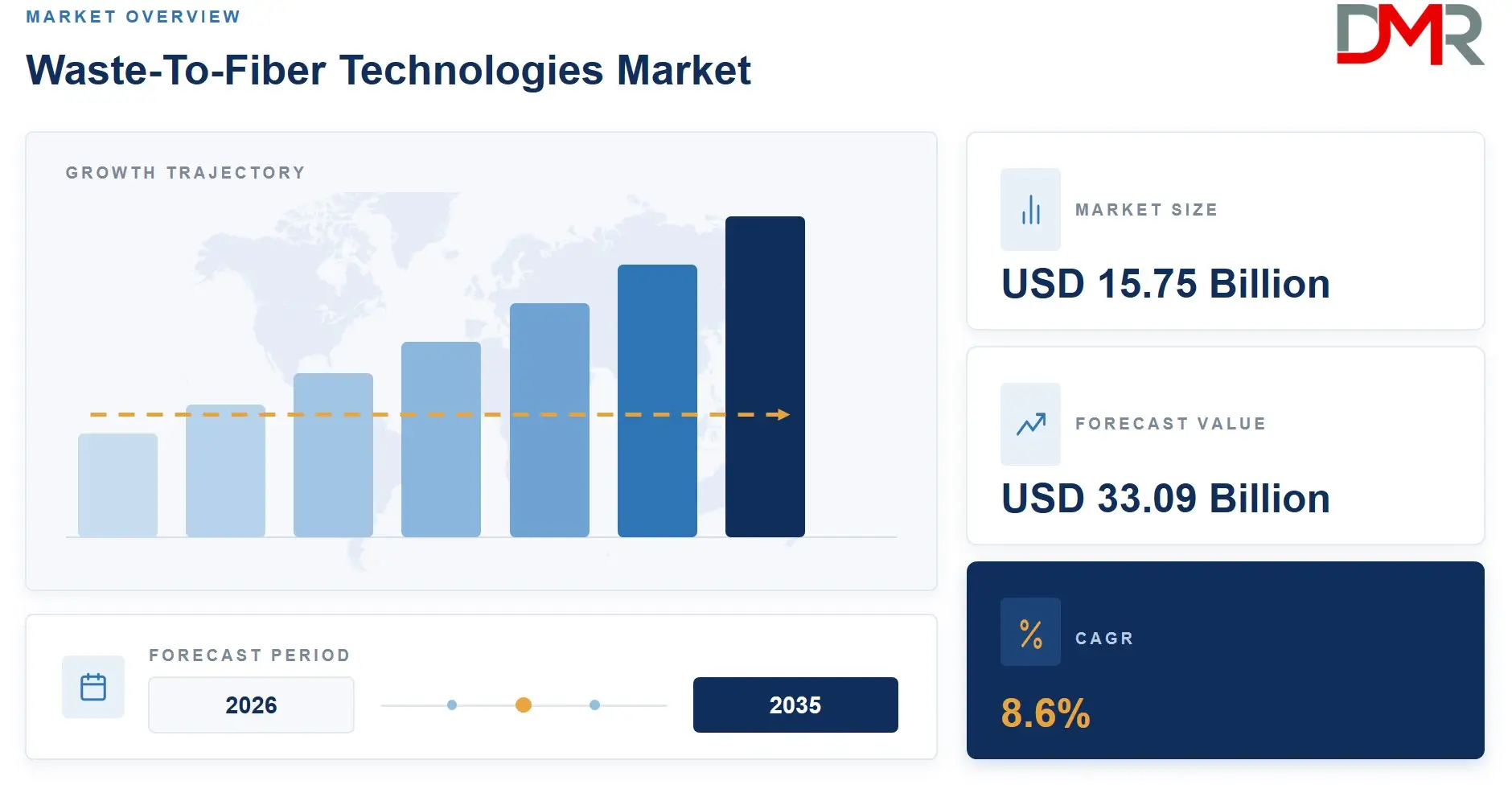
- The market size is USD 15.75 Billion in 2026, and is projected to hit USD 33.09 Billion by 2035 at a CAGR of 8.6%.
- By Waste Source: Pre-consumer (manufacturing scrap) led as the largest category with a 66.8% share in 2025.
- By Input Fiber / Waste Type: Synthetic fibers led with a 54.7% share in 2025.
- By Processing Technology: Mechanical recycling led with a 60.1% share in 2025.
- By Output Product Form: Cotton spinning material led with a 44.1% share in 2025.
- By End-Use Application: Textile & apparel led with a 60.4% share in 2025.
- By Waste Generator: Industrial manufacturing (apparel & footwear) led with a 62.8% share in 2025.
- By Equipment Capacity: Up to 2,000 kg/h led with a 54.3% share in 2025.
- By Region: Asia-Pacific led with a 47.8% share, valued at USD 7.53 Billion, in 2025.
- Post-consumer waste, cellulosic & regenerated fibers, chemical & enzymatic recycling, filling material, automotive interiors, residential/household waste generators, and equipment above 3,000 kg/h are each the fastest-growing sub-segment in their respective categories.
Market Size and Forecast
The Global Waste-To-Fiber Technologies Market size is estimated at USD 15.75 Billion in 2026, and is projected to reach USD 33.09 Billion by 2035, exhibiting a CAGR of 8.6% during the forecast period.
Canopy Planet reported that Bailu Group anticipated producing approximately 600 tonnes of Next Gen fiber from its pilot operation during 2025. Outputs at this scale are modest relative to commercial demand targets, which means the CAGR assumption rests heavily on planned capacity expansions converting from pilot to full commercial throughput before 2028.
ℹ
To learn more about this report –
Download Your Free Sample Report Here
Historical growth from 2020 to 2024 was shaped by brand sustainability pledges that pulled forward recycled fiber procurement commitments. Extended Producer Responsibility legislation in the European Union formalized cost accountability for end-of-life textiles. Both dynamics compress the adoption timeline and support the compound growth assumption embedded in the 2035 forecast.
Processing Technology Analysis
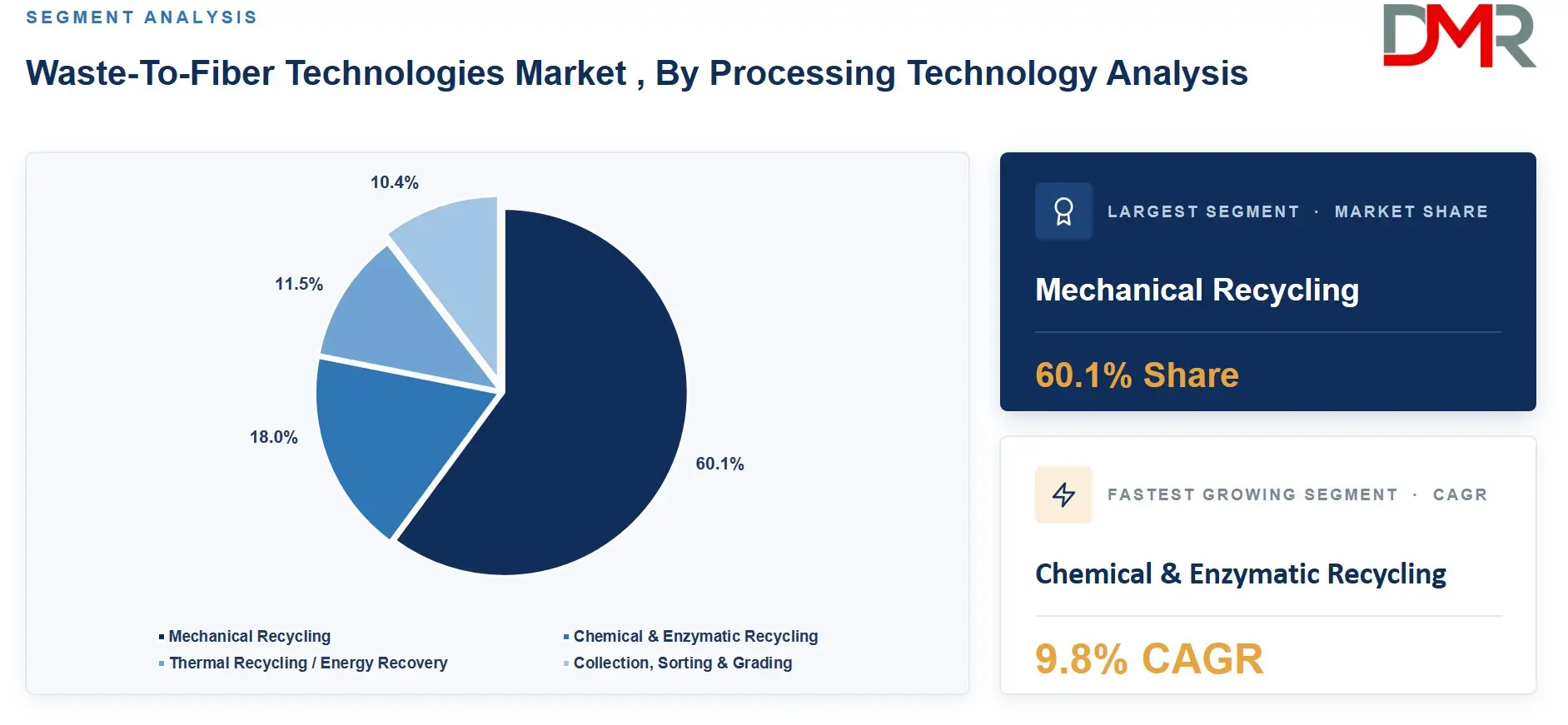
Mechanical recycling accounted for 60.1% of processing technology demand in 2026, the highest of any category.
Mechanical recycling holds its dominant position because capital costs are lower and operational expertise is widely available across Asia and South Asia. Fiber quality from mechanical shredding degrades with each cycle, limiting end-use options to lower-value applications such as insulation and filling. Sciepublish data from 2025 placed mechanical recycling at approximately 43% of total fiber recovery across the three major technology pathways, pointing to a material gap between technology deployment and actual recovery output.
Chemical and enzymatic recycling carries a 9.8% CAGR, the fastest growth of any processing category. Textile World reported planned annual output of up to 10,000 metric tonnes of circular polyester from one facility using advanced chemical recycling methods. Brands targeting virgin-equivalent fiber quality are driving capital toward these platforms, and vendors that establish process IP now will face fewer qualified competitors when scale-up demand peaks after 2027.
ℹ
To learn more about this report –
Download Your Free Sample Report Here
Waste Source Analysis
Pre-consumer (manufacturing scrap) led the waste source segment with a 66.8% share in 2026.
Pre-consumer scrap dominates because factory offcuts arrive clean, uniform, and free of contamination. Sorting costs are minimal, feedstock specifications are predictable, and recyclers can achieve consistent output quality without additional pre-processing investment. Industrial manufacturing facilities in Bangladesh, Vietnam, and India already operate internal recovery loops, making pre-consumer supply the most commercially mature feedstock base in the market today.
Post-consumer waste carries a 9.2% CAGR, the fastest growth of any waste source category. Household and used-garment streams introduce contamination, mixed-fiber content, and collection logistics complexity that pre-consumer supply avoids entirely. Brands and retailers building out take-back schemes are the primary demand signal for post-consumer processing infrastructure, but consistent feedstock quality across geographies remains the central operational challenge that restrains faster scaling.
Input Fiber / Waste Type Analysis
With a 54.7% share in 2026, Synthetic fibers outpaced all other input fiber categories.
Synthetic fiber dominance reflects the composition of global textile output, where polyester has displaced cotton as the primary fiber by volume over the past two decades. Polyester and nylon offcuts from apparel manufacturing are high-volume, geographically concentrated feedstocks that mechanical and chemical recyclers can process at scale. Recycled polyester commands a clear price premium over downcycled alternatives, which strengthens the commercial case for synthetic fiber recovery investment.
Cellulosic and regenerated fibers carry a 9.1% CAGR, making them the fastest-growing input category. Cotton waste processing for viscose and lyocell production is attracting capital from established fiber producers seeking feedstock security. Blended fabrics remain the most technically challenging input stream because polycotton separation at commercial scale has not yet reached cost parity with virgin alternatives, creating a near-term ceiling on growth for recyclers targeting this segment.
Output Product Form Analysis
Cotton spinning material captured 44.1% of the output product form segment in 2026, ahead of all rivals.
Cotton spinning material leads because demand from yarn spinners across South Asia and Southeast Asia is large, established, and price-sensitive enough to absorb mechanically recycled fiber at competitive cost. Filling material carries a 12.4% CAGR, the fastest growth of any output category, driven by automotive interior specifications shifting toward recycled content and home textile brands substituting virgin polyester fill for certified recycled alternatives.
End-Use Application Analysis
Textile & apparel led the end-use application segment as the largest category in 2026, with a 60.4% share.
Apparel brands carry the largest procurement budgets for recycled fiber and face the highest consumer and regulatory scrutiny over sustainability claims. Automotive interiors are the fastest-growing end-use, as vehicle manufacturers embed recycled content requirements into their tier-one supplier specifications. Automotive buyers are more tolerant of price premiums than apparel fast-fashion operators, making them structurally more attractive customers for chemical recycling outputs that carry higher per-kilogram costs.
Waste Generator Analysis
A 62.8% share made Industrial manufacturing (apparel & footwear) the clear leader across waste generator categories in 2026.
Industrial manufacturing generates the most predictable, processable feedstock volumes of any generator category. Residential and household generators carry a 12.4% CAGR, the fastest growth rate of any generator category, as take-back programs and curbside collection schemes expand across Europe and North America. Commercial and institutional generators, covering retail returns and hospitality linen, occupy a middle tier that is operationally underserved and positioned for aggregator-model growth.
Equipment Capacity Analysis
Up to 2,000 kg/h led the equipment capacity segment with a 54.3% share in 2026.
Mid-range equipment at the 2,000 kg/h threshold balances capital cost, operational flexibility, and output volume for commercial-scale recyclers operating in Asian and South Asian markets. Equipment above 3,000 kg/h is the fastest-growing capacity tier, reflecting the shift toward gigascale plants by well-capitalized operators with long-term brand offtake agreements. Smaller lines at up to 1,000 kg/h remain relevant for pilot facilities and regional preprocessing hubs where feedstock aggregation is still maturing.
Key Market Segments
By Waste Source
- Pre-consumer (manufacturing scrap)
- Post-consumer (used garments & household textiles)
- Post-consumer PET bottles
By Input Fiber / Waste Type
- Synthetic fibers
- Natural fibers
- Cellulosic & regenerated fibers
- Viscose / rayon
- Lyocell / modal
- Blended fabrics (polycotton)
By Processing Technology
- Mechanical recycling
- Chemical & enzymatic recycling
- Depolymerization to monomer (polyester)
- Solvent-based cellulose dissolution
- Thermal recycling / energy recovery
- Collection, sorting & grading
By Output Product Form
- Cotton spinning material
- Recycled staple fiber & filament
- Regenerated cellulosic fibers (viscose, lyocell)
- Filling material
- Nonwoven
By End-Use Application
- Textile & apparel
- Home textiles & interiors
- Automotive interiors
- Construction
- Technical textiles & filtration
By Waste Generator
- Industrial manufacturing (apparel & footwear)
- Residential / household
- Commercial & institutional (retail, hospitality)
By Equipment Capacity
- Up to 2,000 kg/h
- Up to 1,000 kg/h
- Up to 3,000 kg/h
- Above 3,000 kg/h
Regional Analysis
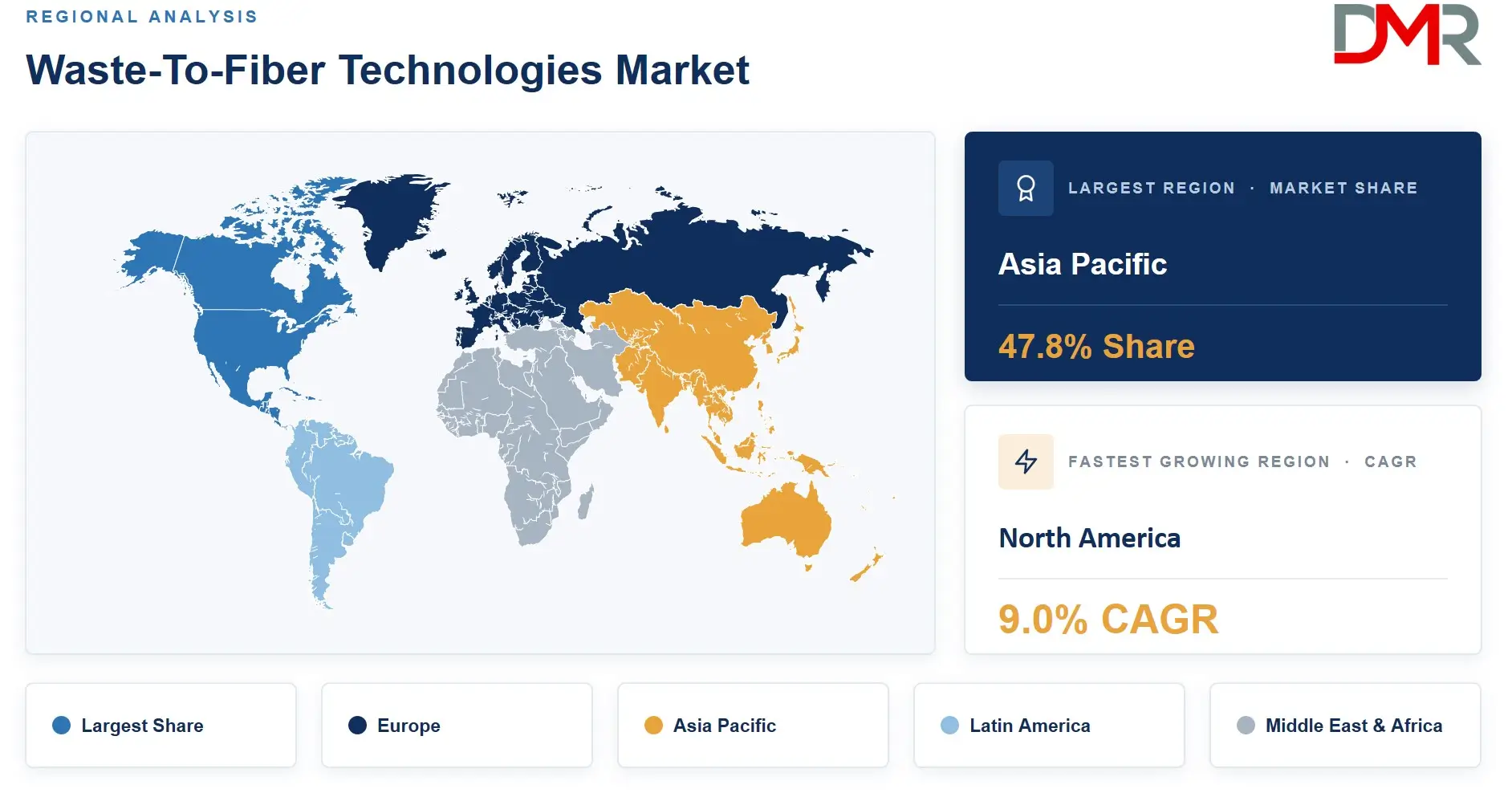
Asia-Pacific led the global waste-to-fiber technologies market with a 47.8% share in 2026, valued at USD 7.53 Billion.
Asia-Pacific
Asia-Pacific leads because the region hosts the largest concentration of apparel and footwear manufacturing, generating the highest volumes of pre-consumer scrap globally. China, India, Bangladesh, and Vietnam operate integrated textile supply chains where waste generators and recycling processors sit in close geographic proximity, reducing feedstock logistics costs that erode margin in other regions. India's Ministry of Textiles reported in 2025 that more than 70% of total textile waste was recovered into recycling, upcycling, downcycling, or reuse streams, and that around 95% of pre-consumer textile waste was captured.
North America
North America holds approximately 24% of global market share and is the fastest-growing region. Recover and Intradeco announced a strategic joint venture in May 2025 to establish recycled cotton fiber production in El Salvador, creating a regional supply base that reduces North American brands' dependence on Asian recycling capacity. Brand-driven procurement mandates and state-level textile disposal regulations are compressing the window for new market entrants without existing offtake agreements.
ℹ
To learn more about this report –
Download Your Free Sample Report Here
Europe
European recyclers operate under the most prescriptive regulatory environment globally. Extended Producer Responsibility mandates and the EU's textile waste framework force apparel producers to internalize end-of-life costs, converting a compliance obligation into a contracted feedstock supply. Processors with chemical recycling capabilities are best positioned in this region because European brand sustainability specifications increasingly require virgin-equivalent fiber quality rather than mechanically downcycled material.
Middle East & Africa
Middle East and Africa carries an 8.15% CAGR, the second-fastest growth rate among all regions. Feedstock availability from growing apparel manufacturing activity in Ethiopia, Morocco, and Egypt is creating early-stage opportunities for sorting and preprocessing infrastructure investment before chemical recycling capacity reaches this geography.
South America
South America remains an early-stage market where feedstock aggregation infrastructure limits commercial-scale recycling deployment. Brazil's growing textile manufacturing base generates pre-consumer waste volumes that are currently exported or landfilled, representing an under-exploited feedstock opportunity for regional processors willing to invest in collection and sorting before recycling conversion.
Key Regions and Countries
North America
Europe
- Germany
- France
- The UK
- Spain
- Italy
- Rest of Europe
Asia Pacific
- China
- Japan
- South Korea
- India
- Australia
- Rest of APAC
Latin America
- Brazil
- Mexico
- Rest of Latin America
Middle East & Africa
- GCC
- South Africa
- Rest of MEA
Macroeconomic Impact
Virgin polyester prices track crude oil closely, and oil price volatility directly affects the cost competitiveness of recycled fiber outputs. When crude falls below USD 70 per barrel, virgin petrochemical fiber undercuts mechanically recycled polyester on price, compressing recycler margins and slowing new investment decisions. Brands with long-term recycled-content procurement targets absorb some of this pressure through contractual floors, but spot-market buyers shift rapidly toward virgin alternatives when the price gap widens.
Agricultural-residue processing faces a distinct macroeconomic input constraint. Research published in PMC in 2025 reported soda-adapted pulping yields of only 30%–40% for canola stalk, rapeseed straw, and sunflower stalk feedstocks, meaning commodity crop price movements translate directly into feedstock cost volatility for cellulosic recycling operations dependent on agricultural byproduct supply.
Market Dynamics
Driver: EPR Mandates and Brand Procurement Targets Lock In Demand
Extended Producer Responsibility legislation across the European Union, and emerging frameworks in Canada and several US states, is converting textile end-of-life cost from an external liability into a line item on apparel producers' balance sheets. Texspace Today reported that Tangshan Sanyou's ReVisco pilot line, operational in 2025, was capable of processing approximately 10,000 tonnes of cotton waste annually, a capacity benchmark that reflects what commercial-scale EPR-linked procurement contracts require to function economically.
A 2025 peer-reviewed review published in PMC reported typical PET mechanical-recycling yields of 70%–90%, depending on feedstock quality and process efficiency. Consistent yields at the upper end of this range are achievable only with clean, sorted pre-consumer feedstock, which is exactly the input stream that EPR mandates and brand circular-fashion procurement programs are designed to generate and channel toward certified recyclers.
Syre and Selenis announced in October 2024 a strategic partnership to establish a textile-to-textile recycling plant in Cedar Creek, North Carolina, with the facility planned to become operational in 2025. Partnerships of this structure, combining recycling technology with polymer production expertise, show how recyclers are building integrated supply chains to meet brand quality specifications that pure mechanical recycling cannot satisfy.
Restraint: Feedstock Contamination and Virgin Price Competition Limit Scale
Multi-fiber blends, elastane content, synthetic dyes, and attached trims create feedstock separation costs that erode the economics of post-consumer textile recycling at commercial scale. India's 2025 government report from the Ministry of Textiles stated that nearly 100% of spinning waste was reintegrated in situ into production, illustrating that the cleanest, most processable waste streams are already captured internally before they reach third-party recyclers.
Virgin petrochemical fiber price advantages persist because oil-linked production costs for polyester remain lower per kilogram than the combined costs of collection, sorting, preprocessing, and recycling for post-consumer textile inputs. Recyclers without contracted offtake agreements face direct spot-market competition from virgin fiber suppliers whenever oil prices drop or feedstock contamination rates rise.
Opportunity: Preprocessing Hubs and Offtake Structures Enable Chemical Recycling Scale
Regional preprocessing hubs for sorting, de-trimming, and bale standardization address the feedstock consistency problem that prevents chemical recycling platforms from operating at full capacity. AMGC project data shows an Australian enzymatic-recycling pilot plant was designed for a processing capacity of 20 tonnes per day, a throughput level that becomes commercially viable only when standardized feedstock bales arrive without requiring plant-level contamination removal.
A 2025 PMC peer-reviewed review confirmed that chemical depolymerization of synthetic fibers can achieve yields of approximately 90% or higher, subject to technology and operating conditions. Yield performance at this level makes chemical recycling cost-competitive with virgin production when feedstock arrives at specification. Brand-recycler offtake agreements that de-risk capacity financing are the commercial mechanism that unlocks this potential.
Ambercycle and REI Co-op announced in October 2025 a three-year offtake agreement for cycora® regenerated polyester, directly demonstrating how structured demand commitments from retail brands fund the molecular-regeneration technology scale-up that ad hoc spot sales cannot support.
Porter's Five Forces
Competitive intensity in the waste-to-fiber technologies market is moderate overall but varies sharply by technology tier. New entrant barriers are high for chemical and enzymatic recycling platforms because process IP, capital requirements exceeding €100 million for industrial-scale plants, and the need for brand offtake agreements before financing closes all screen out undercapitalized operators. Mechanical recycling faces lower barriers, but PMC 2025 research reporting pulping yields above 60% for most examined agricultural residues illustrates that established process knowledge creates a real, if replicable, operational advantage. Supplier power is moderate as feedstock from pre-consumer manufacturing is abundant but feedstock quality from post-consumer streams is variable, giving well-positioned aggregators leverage over recyclers dependent on consistent inputs. Buyer power is high among large global brands, which use multi-supplier sourcing, minimum quality thresholds, and public sustainability commitments to extract pricing discipline from recyclers. Substitution risk from virgin petrochemical fiber is the market's most persistent competitive pressure, as price-sensitive segments shift back to virgin inputs when the recycled premium exceeds buyer tolerance.
AI and Gen AI Impact
AI-enabled near-infrared sorting systems are the most commercially deployed AI application in Waste-To-Fiber Technologies Market . Automated material identification across mixed post-consumer textile streams increases sorting throughput and reduces the manual labor cost that makes post-consumer feedstock processing commercially marginal. Operators deploying AI sorting at scale are already capturing higher feedstock utilization rates than manual-sort competitors, creating a structural cost gap that widens as mixed-fiber input volumes grow.
Generative AI is entering the traceability layer through digital product passport systems that automate end-of-life routing instructions embedded in garment-level product data. Recyclers with systems capable of reading and acting on these digital passports gain first access to sorted, material-identified feedstock streams before competitors relying on manual intake protocols.
Market Trends
Textile-to-Textile Closed Loops Replacing Bottle-to-Fiber Models
Brands are explicitly rejecting bottle-to-fiber recycling as a circularity claim, pushing fiber buyers toward genuine textile-to-textile sourcing. A 2025 Sciepublish review reported a maximum microcrystalline-cellulose yield of 83.4% from hydrolysis of waste cotton under optimized conditions, with crystallinity of 85.2%, a result that validates chemical recycling as capable of producing functional equivalents to virgin cellulosic fiber. Circulose announced in April 2026 a collaboration with China Textile Academy Green Fibre to produce lyocell fibers using CIRCULOSE® recycled pulp, an application that extends the end-market range of textile-to-textile recycled material beyond cotton spinning.
Market Competition Overview
The waste-to-fiber technologies market is fragmented, with mechanical recycling dominated by regional operators across Asia and chemical recycling populated by well-funded startups competing for the same limited pool of brand offtake partners. A 2025 European Commission summary reported that current global textile-to-textile recycling stood at only approximately 1% of discarded textiles. At that penetration level, no single operator controls a dominant share, and competitive advantage today is defined by technology IP, feedstock access agreements, and brand partnership depth rather than market share.
Chemical recycling platforms backed by private equity and corporate venture arms are consolidating technology rights through acquisitions and licensing deals. Mechanical recycling operators in South and Southeast Asia compete primarily on cost and throughput rather than fiber quality, which limits their ability to compete for the premium-specification contracts that European and North American brands increasingly require.
Pricing Analysis
Prices for recycled fiber outputs vary by technology pathway, output quality, and regional market. Mechanically recycled cotton fiber trades at a discount to virgin cotton when fiber length and strength specifications fall below yarn-spinning thresholds. Chemical recycling outputs priced at or near virgin equivalents require clean, consistent feedstock to maintain yields. A 2026 technical article published in Tandfonline reported water retting durations of 12 days for plant stems, and a 5% sodium-hydroxide treatment applied for 2 hours at room temperature to modify agricultural-waste fibers, illustrating the processing time and chemical input costs embedded in natural-fiber recycling economics.
Market leaders price recycled fiber at a premium justified by certified sustainability credentials and brand offtake contract structures. Challengers competing outside offtake agreements sell into spot markets where virgin fiber price movements directly compress their achievable prices, making cost efficiency the only defensible competitive position for operators without long-term brand partnerships.
Company Profiles
Circulose (formerly Renewcell) operates the CIRCULOSE® platform for converting post-consumer textile waste into recycled dissolving pulp used as feedstock for viscose and lyocell production. Altor's acquisition of Renewcell's remaining assets in June 2024 preserved the patented process and positioned the business for industrial-scale restart. The commercial restart of production at the Ortviken plant in Sundsvall, Sweden, announced in February 2026, combined with a new lyocell collaboration with China Textile Academy Green Fibre and brand partnerships with EILEEN FISHER and Marimekko, gives Circulose a multi-market demand base that reduces its dependence on any single fiber buyer or geography.
Recover Textile Systems built its competitive position on mechanically recycled cotton fiber produced at scale across low-cost manufacturing geographies. Recover opened a new manufacturing facility in Vietnam in December 2024, extending its production footprint beyond its existing European and North African operations. The May 2025 joint venture with Intradeco to establish El Salvador production adds a Central American supply node that serves North American brand buyers with shorter logistics chains than Asian-sourced alternatives provide.
Key Players
- Circulose (formerly Renewcell)
- Circ
- Södra (OnceMore)
- Infinited Fiber Company
- Evrnu
- Spinnova
- TreeToTextile
- Lenzing Group
- Birla Cellulose (Aditya Birla Group)
- Sateri
- Ambercycle
- Re&Up
- Reju
- Recover Textile Systems
- Worn Again Technologies
- Andritz AG
- Tomra Systems ASA
- Dell'Orco & Villani
- Laroche
- Saurer Group
Supply Chain and Value Chain Analysis
The value chain runs from waste generation and collection, through sorting and grading, into preprocessing and fiber conversion, then fiber trading and yarn spinning, before reaching garment or technical product manufacturing as the final end-use stage. Maximum value is created at the fiber conversion step, where chemical recycling transforms low-value waste bales into virgin-equivalent fiber that commands a price premium. A 2026 PMC peer-reviewed review reported kenaf dry-fiber productivity in the range of 2.0–4.0 tonnes per hectare, and approximately 2.5 kilograms of pineapple fiber from 100 kilograms of fresh pineapple leaves, showing the yield constraints that define cost structures for agricultural-fiber input streams. Research published in ScienceDirect in 2025 confirmed that crude fiber generally exceeds 70% of agricultural-residue composition, supporting the viability of agricultural byproduct streams as scalable cellulosic feedstock.
The biggest bottleneck sits at the sorting and grading stage. Mixed post-consumer feedstock arriving without material identification data forces manual or semi-automated sorting that adds cost and reduces throughput before any recycling process begins. Operators that invest in AI-enabled near-infrared sorting upstream of conversion remove the single largest margin-erosion point across the entire value chain.
Regulatory Landscape
The European Union's Ecodesign for Sustainable Products Regulation and its textile-specific implementing measures require apparel producers to incorporate recycled content, disclose fiber composition, and comply with Extended Producer Responsibility collection obligations. Member states are required to establish separate textile collection by 2025, a mandate that directly generates the post-consumer feedstock volumes that recyclers need to reach commercial scale. Non-compliance carries financial penalties that make engagement with certified recyclers economically preferable to absorbing regulatory fines.
North America operates through a patchwork of state-level EPR frameworks, with California and New York advancing the most prescriptive textile disposal rules. Voluntary brand-driven commitments are the dominant compliance mechanism in the absence of federal legislation. Middle East and Africa markets operate with minimal sector-specific textile recycling regulation, creating a first-mover advantage for processors establishing collection infrastructure before regulatory requirements formalize.
Investment and White Space Analysis
Capital is flowing toward chemical and enzymatic recycling platforms with contracted brand demand. Circ raised USD 25 million in July 2025, with funds directed toward an industrial-scale textile-to-textile recycling plant capable of processing blended textile waste, exactly the feedstock stream that mechanical recyclers cannot address at acceptable quality levels.
White space exists at the preprocessing and aggregation layer, where no scaled operator has captured the sorting and bale standardization market across Asia and Africa. Regional preprocessing hubs that deliver standardized feedstock to chemical recyclers represent a capital-efficient entry point with asset-lighter economics than full recycling plant construction. South America and the Middle East carry growing feedstock volumes but minimal recycling infrastructure, making these geographies the clearest geographic white spaces for early-mover investment.
Recent Developments
- March 2024: Infinited Fiber Company completed a €40 million development financing round, with Inditex, TTY Management, Youngone, and Goldwin joining existing investors to support scale-up of its Infinna™ textile-fiber technology.
- March 2024: Syre launched publicly as a textile-impact company focused on textile-to-textile recycling, with polyester as its initial focus and a strategy aimed at scaling circular polyester production.
- May 2024: Syre raised USD 100 million in Series A funding, led by TPG Rise Climate, with participation from H&M Group, Giant Ventures, IMAS Foundation, Norrsken VC, and Volvo Cars, to accelerate its textile-to-textile recycling expansion and planned gigascale plants.
- May 2024: Syre integrated Premirr's technology and team following its acquisition of Premirr Plastics, strengthening Syre's polyester textile-to-textile recycling technology platform in North Carolina.
- June 2024: Altor acquired the remaining assets of Renewcell and established Circulose, preserving Renewcell's patented process for converting textile waste into CIRCULOSE® recycled pulp.
- February 2026: Circulose announced the restart of commercial-scale production at its Ortviken plant in Sundsvall, Sweden, with CIRCULOSE® recycled pulp production scheduled to resume in the fourth quarter of 2026.
- February 2026: Reju selected Lacq, France, for an industrial-scale Regeneration Hub to convert post-consumer textile waste into recycled polyester materials.
- April 2026: Reju secured €135 million in Dutch NIKI funding to support its planned industrial-scale textile-to-textile regeneration hub at Chemelot Industrial Park in the Netherlands.
- June 2026: Circulose announced new brand partnerships with EILEEN FISHER, Marimekko, Samsøe Samsøe, and King Louie, expanding its network of brands integrating CIRCULOSE® into collections and sourcing strategies.
Report Details
| Report Characteristics |
| Market Value (2026) |
USD 15.75 Billion |
| Forecast Revenue (2035) |
USD 33.09 Billion |
| CAGR (2026–2035) |
8.6% |
| Base Year for Estimation |
2025 |
| Historic Period |
2020 – 2024 |
| Forecast Period |
2026 – 2035 |
| Report Coverage |
Revenue Forecast, Market Dynamics, Competitive Landscape, Recent Developments |
| Segments Covered |
By Waste Source (Pre-consumer, Post-consumer used garments, Post-consumer PET bottles), By Input Fiber / Waste Type (Synthetic fibers, Natural fibers, Cellulosic & regenerated fibers, Blended fabrics), By Processing Technology (Mechanical recycling, Chemical & enzymatic recycling, Thermal recycling, Collection sorting & grading), By Output Product Form (Cotton spinning material, Recycled staple fiber & filament, Regenerated cellulosic fibers, Filling material, Nonwoven), By End-Use Application (Textile & apparel, Home textiles, Automotive interiors, Construction, Technical textiles & filtration), By Waste Generator (Industrial manufacturing, Residential/household, Commercial & institutional), By Equipment Capacity (Up to 1,000 kg/h, Up to 2,000 kg/h, Up to 3,000 kg/h, Above 3,000 kg/h) |
| Regional Analysis |
North America – US and Canada; Europe – Germany, France, The UK, Spain, Italy, and Rest of Europe; Asia Pacific – China, Japan, South Korea, India, Australia, and Rest of APAC; Latin America – Brazil, Mexico, and Rest of Latin America; Middle East & Africa – GCC, South Africa, and Rest of MEA |
| Competitive Landscape |
Circulose (formerly Renewcell), Circ, Södra (OnceMore), Infinited Fiber Company, Evrnu, Spinnova, TreeToTextile, Lenzing Group, Birla Cellulose (Aditya Birla Group), Sateri, Ambercycle, Re&Up, Reju, Recover Textile Systems, Worn Again Technologies, Andritz AG, Tomra Systems ASA, Dell'Orco & Villani, Laroche, Saurer Group |
| Customization Scope |
Customization for segments and region or country level will be provided. Additional customization can be done based on requirements. |
| Purchase Options |
Three license options: Single User License, Multi-User License (Up to 5 Users), and Corporate Use License (Unlimited Users and Printable PDF) |
Frequently Asked Questions
What is the biggest investment opportunity in the Waste-To-Fiber Technologies market?
▾ Regional preprocessing hubs for sorting, de-trimming, and bale standardization represent the most capital-efficient entry point in the current market. Chemical recycling platforms with contracted brand offtake, such as the €135 million Reju facility at Chemelot, show that structured demand removes the financing risk that has historically blocked industrial-scale investment.
Who are the top companies in the Waste-To-Fiber Technologies market?
▾ Leading players include Circulose (formerly Renewcell), Recover Textile Systems, Circ, Infinited Fiber Company, Ambercycle, Reju, Lenzing Group, Birla Cellulose, Sateri, and Worn Again Technologies. Competition centers on technology IP, feedstock access, and the ability to secure multi-year brand offtake agreements before capacity comes online.
Which segment is growing fastest in the Waste-To-Fiber Technologies market and why?
▾ Chemical and enzymatic recycling is the fastest-growing processing technology segment at a 9.8% CAGR, driven by brands demanding virgin-equivalent fiber quality that mechanical recycling cannot deliver. Post-consumer waste sources, cellulosic and regenerated fiber inputs, filling material outputs, automotive interior end-use, and residential waste generators each carry the fastest CAGR within their respective segment categories.
Which region is growing fastest in the Waste-To-Fiber Technologies market and why?
▾ North America is the fastest-growing region with approximately 24% of global market share in 2025, driven by brand procurement mandates, state-level EPR legislation, and near-shoring investment in recycled fiber production across the US and Central America. The region's growth rate reflects compressed adoption timelines as brands face tightening recycled content disclosure requirements.
What is the biggest challenge holding Waste-To-Fiber Technologies Market back?
▾ Multi-fiber blend contamination and virgin fiber price competition together form the market's primary structural restraint. Global textile-to-textile recycling covered only approximately 1% of discarded textiles as of 2025, per the European Commission, illustrating how far feedstock capture and processing capacity must expand before the market reaches commercial maturity.