Market Overview
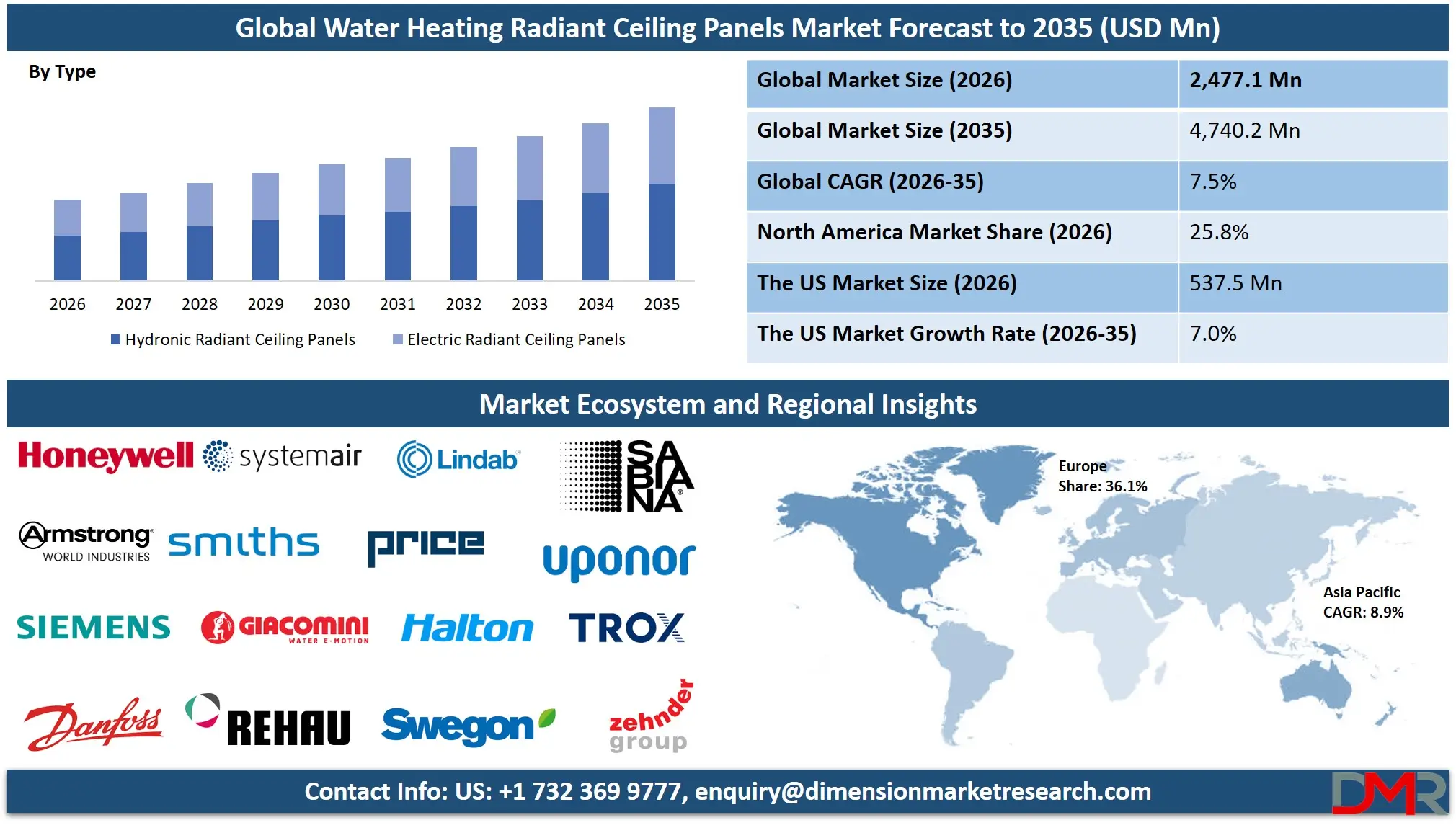
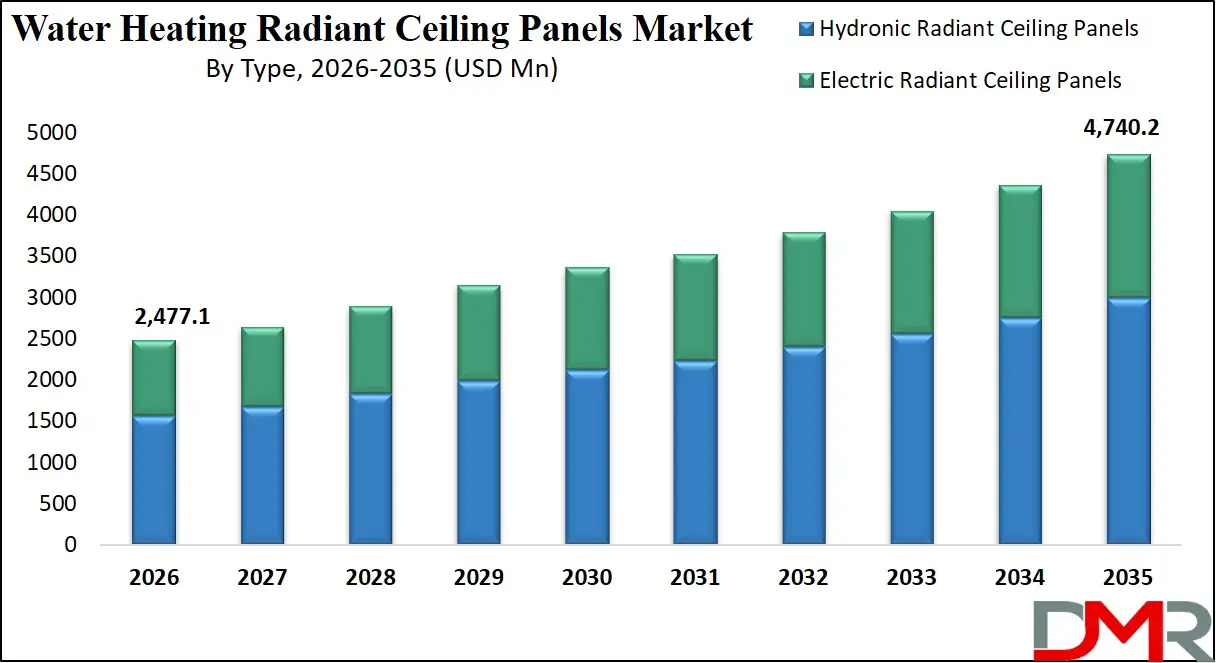
The Global Water Heating Radiant Ceiling Panels Market is set for substantial expansion, reaching an estimated USD 2,477.1 million in 2026 and projected to grow at a strong CAGR of 7.5% from 2026 to 2035, to the market value of USD 4,740.2 million by 2035. This robust growth trajectory is fueled by the accelerating adoption of energy-efficient HVAC solutions, sustainable building technologies, hydronic radiant heating systems, and smart temperature control platforms across industries.
ℹ
To learn more about this report –
Download Your Free Sample Report Here
Rising concerns regarding carbon emissions, escalating energy costs, stringent building energy codes, and growing demand for occupant thermal comfort are compelling organizations to implement advanced radiant heating systems and silent, draft-free indoor climate solutions. The rapid expansion of green building projects, healthcare infrastructure upgrades, educational institution modernization, premium hospitality developments, and high-end corporate offices is significantly increasing demand for reliable water heating radiant ceiling panels.
Additionally, growing regulatory compliance requirements related to Energy Performance of Buildings Directive (EPBD), LEED certification, BREEAM standards, net-zero carbon building mandates, and indoor environmental quality (IEQ) regulations are further accelerating market adoption. Architects, engineers, and building owners are increasingly integrating hydronic radiant ceiling systems, perimeter heating solutions, zone-controlled panels, and AI-driven building management integration to enhance energy efficiency and prevent condensation issues.
Hydronic-based distribution models, modular panel designs, and scalable prefabricated ceiling systems are enabling contractors and facility managers to implement cost-effective and aesthetically versatile heating solutions. As wellness-focused building strategies dominate commercial real estate and energy renovation activities accelerate worldwide, the Water Heating Radiant Ceiling Panels Market is expected to witness sustained double-digit growth through 2035, driven by decarbonization priorities and sustainable construction initiatives.
ℹ
To learn more about this report –
Download Your Free Sample Report Here
Growing government incentives promoting low-temperature heating systems, renewable energy integration (heat pumps, solar thermal), and building electrification further accelerate global adoption. However, barriers such as higher upfront installation costs compared to forced-air systems, longer response times versus convection heating, ceiling height limitations in retrofit projects, and competition from underfloor heating systems remain. Despite these limitations, the convergence of hydronic technology, smart controls, and low-carbon energy sources positions water heating radiant ceiling panels as a central pillar of global sustainable building design through 2035.
The US Water Heating Radiant Ceiling Panels Market
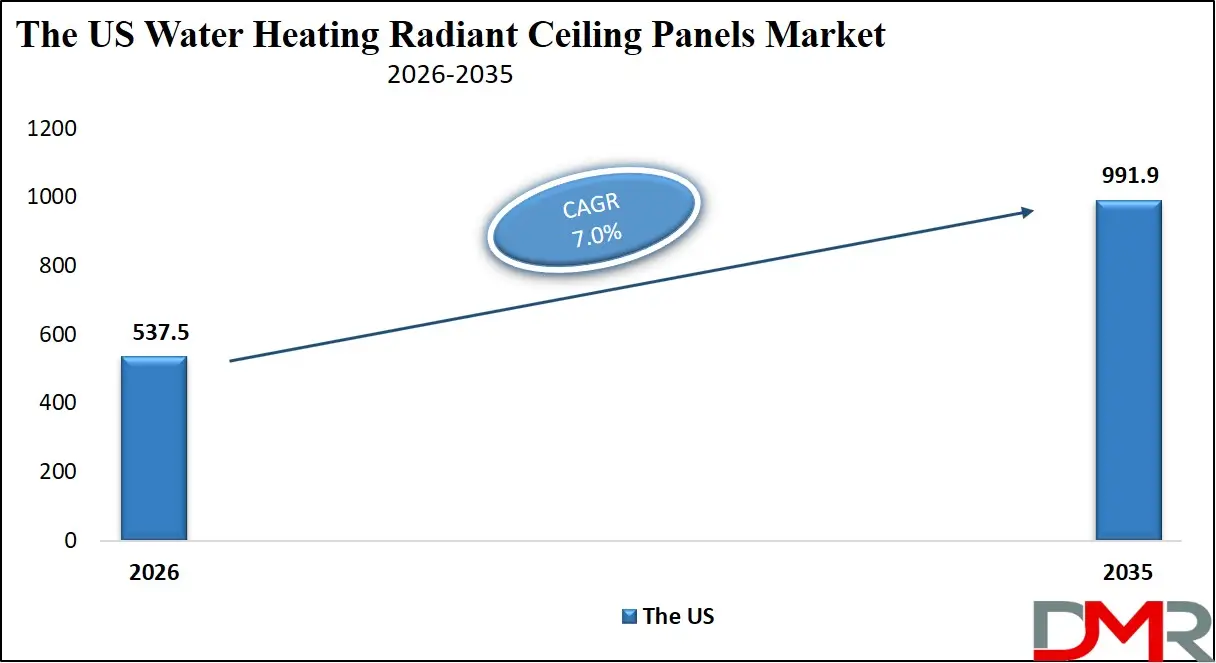
The U.S. Water Heating Radiant Ceiling Panels Market is projected to reach USD 537.5 million in 2026 and grow at a CAGR of 7.0%, reaching USD 991.9 million by 2035. The U.S. leads global adoption due to its mature construction sector, growing emphasis on energy-efficient building retrofits, and strong regulatory push for decarbonization from bodies like the DOE and EPA.
ℹ
To learn more about this report –
Download Your Free Sample Report Here
The proliferation of green building certification programs in healthcare, education, and corporate sectors, coupled with building owners' expectations of silent yet effective heating, fuels demand for premium radiant panel solutions. Major healthcare systems, university campuses, and technology companies such as Kaiser Permanente, Harvard University, and Google are integrating water heating radiant ceiling panels to enhance patient/student comfort while reducing operational carbon footprints.
U.S. regulatory support for building performance standards, alongside frameworks like the Clean Energy Performance Program, encourages investment in hydronic heating technologies. The market is witnessing a shift toward low-temperature panel designs and integration with heat pump systems, reducing reliance on fossil fuel-based heating and improving overall system efficiency. The rise of net-zero energy buildings as a high-profile construction target has further intensified the focus on sophisticated radiant heating and condensation control strategies, positioning the U.S. as a critical innovator in this space.
The Europe Water Heating Radiant Ceiling Panels Market
The Europe Water Heating Radiant Ceiling Panels Market is projected to be valued at approximately USD 894.2 million in 2026 and is projected to reach around USD 1,658.0 million by 2035, growing at a CAGR of about 7.1% from 2026 to 2035. Europe's leadership is anchored by its stringent regulatory environment, particularly the Energy Performance of Buildings Directive (EPBD) and the European Green Deal, which mandate significant reductions in building emissions and promote renewable heating integration.
Countries such as Germany, the U.K., France, and the Nordic region are widely adopting radiant ceiling systems, driven by a high emphasis on energy efficiency and indoor comfort. The U.K.'s Future Homes Standard and the EU's evolving Energy Efficiency Directive further necessitate advanced heating solutions across new construction and deep renovation projects.
Europe's high renovation rates, cross-border building product standardization, and a mature HVAC manufacturing ecosystem drive the demand for seamless, high-performance hydronic panels. Funding and support for decarbonizing public buildings encourage collaboration between panel manufacturers and heat pump suppliers, as well as standardization of installation practices across member states. With a sophisticated building stock and a regulatory landscape that prioritizes energy conservation, Europe remains a highly advanced and essential region for water heating radiant ceiling solutions.
The Japan Water Heating Radiant Ceiling Panels Market
The Japan Water Heating Radiant Ceiling Panels Market is anticipated to be valued at approximately USD 123.9 million in 2026 and is expected to attain nearly USD 218.3 million by 2035, expanding at a CAGR of about 6.5% during the forecast period. Japan's aging population and a government push for "Zero Energy Buildings (ZEBs)" initiative are driving the adoption of energy-efficient and comfortable heating solutions, making radiant ceiling panels a cornerstone of healthy building design.
The Ministry of Land, Infrastructure, Transport and Tourism (MLIT) actively supports the development of high-performance building envelopes, promoting the use of hydronic systems for public and commercial facilities. Japan's leadership in precision manufacturing and high-density urban construction provides a robust foundation for advanced panel designs, including ultra-slim profiles and rapid-response capabilities.
Japan's concept of "Society 5.0", driven by major construction firms and technology groups, integrates smart building technologies into everything from hospitals to office towers. Companies are deploying water heating radiant ceiling panels to combat rising energy costs and ensure thermal comfort in Tokyo's bustling commercial districts and regional healthcare facilities. Japan's cultural emphasis on quality and reliability positions it as a high-growth, precision-focused market for radiant heating solutions.
Global Water Heating Radiant Ceiling Panels Market: Key Takeaways
- Strong Global Market Growth Outlook: The Global Water Heating Radiant Ceiling Panels Market is expected to be valued at USD 2,477.1 million in 2026 and is projected to reach USD 4,740.2 million by 2035, showcasing rapid expansion supported by rising demand for energy-efficient buildings and sustainable heating technologies.
- High CAGR Driven by Decarbonization Adoption: The market is expected to grow at an impressive CAGR of 7.5% from 2026 to 2035, fueled by accelerating green building certifications, heat pump integration, and increasing stringency of building energy codes worldwide.
- Strong Growth Trajectory in the United States: The U.S. Water Heating Radiant Ceiling Panels Market stands at USD 537.5 million in 2026 and is projected to reach USD 991.9 million by 2035, expanding at a CAGR of 7.0% due to high retrofit activity and strong green building technology infrastructure.
- Regional Dominance: Europe is expected to capture approximately 36.1% of the global market share in 2026, supported by stringent regulatory frameworks, a mature hydronic heating ecosystem, and high building renovation rates.
- Rapid Advancement in Panel Technologies: Innovations including ultra-thin panel profiles, fast-response capillary tube mats, integrated acoustic perforations, and smart zoning controls are significantly enhancing efficiency, comfort, and architectural integration of radiant ceiling systems.
- Growing Energy Costs Boost Adoption: Rising global energy prices, coupled with the need for quiet, draft-free environments in healthcare and education, are driving sustained demand for high-performance, low-temperature hydronic radiant panels.
Global Water Heating Radiant Ceiling Panels Market: Use Cases
- Hospital Patient Rooms: Healthcare facilities install radiant ceiling panels to provide silent, draft-free heating essential for patient recovery, while also reducing airborne pathogen movement compared to forced-air systems.
- University Lecture Halls: Educational institutions use radiant panels to maintain comfortable learning environments with minimal noise, ensuring clear acoustics for lectures and presentations.
- Corporate Office Spaces: Companies install suspended radiant ceiling panels to combine heating with acoustic control, creating productive workspaces with high ceiling aesthetics and individual zone temperature control.
- Airport Terminals: Large public transport hubs utilize high-capacity radiant panels to heat vast open spaces efficiently, providing comfortable waiting areas without the drafts associated with large air handling systems.
- Museum and Gallery Preservation: Cultural institutions employ precise hydronic ceiling heating to maintain stable temperature and humidity levels critical for artifact preservation, without visible radiators affecting exhibit aesthetics.
Global Water Heating Radiant Ceiling Panels Market: Stats & Facts
International Energy Agency (IEA)
- Buildings account for around 30% of global final energy consumption.
- Buildings generate approximately 26% of global energy-related CO₂ emissions from operations.
- When construction materials are included, buildings contribute to over one-third of global energy-related emissions.
- Space and water heating represent nearly 50% of total energy use in buildings worldwide.
- Around 40% of households globally require space heating during part of the year.
- Fossil fuels still provide about 63% of global building heating energy demand.
- Natural gas accounts for approximately 42% of global heating energy demand in buildings.
- Electricity represented around 35% of total building energy use in 2022, compared with about 30% in 2010.
- The global buildings sector consumed over 450 exajoules of energy in 2024.
- Residential buildings account for around 70% of building energy demand, while commercial buildings account for about 30%.
- Global space-heating energy demand declined about 4% in 2022 due to mild winter conditions in several regions.
- Energy demand in buildings has increased at around 1% per year during the past decade.
United Nations Environment Programme (UNEP)
- Buildings and construction together account for approximately 32% of global energy demand.
- The sector contributes around 34% of global carbon emissions.
- Operational emissions from buildings reached about 9.8 gigatonnes of CO₂ globally in 2023.
- Embodied emissions from building construction materials reached around 2.9 gigatonnes of CO₂ globally.
U.S. Department of Energy (DOE)
- Radiant heating systems can reduce heating energy consumption by up to 20% compared with conventional forced-air systems.
- Radiant heating systems operate effectively with water temperatures between 30°C and 45°C, improving efficiency.
- Radiant heating systems improve indoor comfort because heat is delivered directly to occupants and surfaces rather than heating air.
European Commission – Energy Performance of Buildings Directive (EPBD)
- Buildings account for about 40% of total energy consumption in the European Union.
- The building sector produces around 36% of energy-related greenhouse gas emissions in the EU.
- The EU aims to achieve zero-emission new buildings by 2030 under revised building efficiency regulations.
- Energy efficiency improvements have reduced heating energy demand in European buildings by about 30% since 2000.
U.S. Energy Information Administration (EIA)
- Space heating represents about 42% of total residential energy consumption in the United States.
- Water heating accounts for around 18% of residential energy use in U.S. homes.
- Commercial buildings in the U.S. use approximately 32% of their total energy for space heating.
Japan Ministry of Economy, Trade and Industry (METI)
- Buildings account for approximately 30% of Japan's total final energy consumption.
- Energy consumption in Japan's commercial buildings increased over 40% between 1990 and 2020 due to growth in floor space and equipment use.
International Renewable Energy Agency (IRENA)
- Improving building heating efficiency could reduce global energy consumption in buildings by up to 25%.
- Renewable heating technologies could cut building sector carbon emissions by nearly 40% by 2050.
Global Water Heating Radiant Ceiling Panels Market: Market Dynamic
Driving Factors in the Global Water Heating Radiant Ceiling Panels Market
Stringent Energy Efficiency Regulations and Decarbonization Goals
The growing global focus on reducing building-related carbon emissions is a major driver for water heating radiant ceiling panels. Regulations like the EPBD in Europe and building performance standards in North America mandate significant energy reductions. Radiant ceiling panels, operating efficiently with low-temperature water from heat pumps or condensing boilers, help building owners meet these strict energy codes. Their ability to integrate with renewable energy sources positions them as a future-proof technology for net-zero carbon buildings, especially in regions with aggressive climate action plans.
Rising Demand for Superior Thermal Comfort and Indoor Environmental Quality
Increasing awareness of the link between indoor environmental quality (IEQ) and occupant health, wellbeing, and productivity is driving adoption. Unlike forced-air systems that create drafts, noise, and temperature stratification, radiant ceiling panels provide silent, uniform, and draft-free heating. This makes them particularly attractive for noise-sensitive environments like hospitals, libraries, and recording studios, and for premium commercial spaces where occupant comfort is a priority. The growing focus on WELL Building Standard certification further amplifies this demand.
Restraints in the Global Water Heating Radiant Ceiling Panels Market
Higher Initial Installation Costs and Perceived Complexity
The upfront capital cost of hydronic radiant ceiling systems remains significantly higher than conventional forced-air or electric resistance heating. This includes costs for piping, manifolds, control systems, and the panels themselves, as well as specialized labor for design and installation. In price-sensitive construction segments, this initial investment barrier can deter adoption, despite long-term operational savings. The perceived complexity of integrating hydronic systems with existing building management systems can also be a deterrent for some facility managers.
Slower Thermal Response Time and Condensation Risks
Radiant ceiling panels have a slower thermal response compared to forced-air systems, requiring careful system design and predictive controls to maintain precise temperature setpoints. In cooling mode, there is also a critical risk of condensation forming on panel surfaces if the panel temperature drops below the room air dew point. This requires sophisticated condensation prevention controls, limiting their application in humid climates or requiring integration with dedicated dehumidification systems, adding complexity and cost.
Opportunities in the Global Water Heating Radiant Ceiling Panels Market
Expansion through Deep Energy Retrofits in Europe and North America
The vast existing building stock in mature markets presents a massive opportunity for deep energy retrofits. Government incentives, carbon taxes, and rising energy prices are making retrofit economics increasingly favorable. Modular, easy-to-install radiant panel systems designed for suspended ceiling grids offer a less disruptive solution for commercial building upgrades. Partnerships with mechanical contractors, energy service companies (ESCOs), and building owners can drive significant market expansion through energy performance contracting models.
Integration with Smart Building Technologies and IoT Controls
The integration of radiant ceiling panels with smart building platforms and IoT-enabled controls creates new value propositions. Predictive algorithms can optimize water temperature and flow based on occupancy patterns, weather forecasts, and real-time room conditions, maximizing energy savings while maintaining comfort. Zone-level control, integration with window contacts, and demand-response capabilities transform static heating systems into dynamic, intelligent assets. This aligns with the broader trend of building digitalization and creates opportunities for value-added services and system optimization.
Trends in the Global Water Heating Radiant Ceiling Panels Market
Multi-functional Panel Designs (Heating, Cooling, Acoustics)
The trend toward multi-functional building Products is gaining significant traction. Manufacturers are developing radiant ceiling panels that integrate acoustic perforations and sound-absorbing backing, combining heating and cooling functions with superior noise control. This is particularly valuable in open-plan offices, educational spaces, and healthcare environments where both thermal and acoustic comfort are priorities. These all-in-one ceiling solutions simplify design, reduce ceiling clutter, and maximize the value of ceiling real estate.
Low-Temperature Systems Optimized for Heat Pumps
As heat pumps become the primary heating technology in new construction and retrofits, the demand for low-temperature emission systems is surging. Water heating radiant ceiling panels, operating efficiently at supply temperatures of 35°C-45°C, are ideally suited for heat pump integration. This trend is driving the development of panels with larger surface areas, improved heat transfer coefficients, and designs specifically optimized for low-temperature operation, ensuring maximum system efficiency and reduced operational costs.
Global Water Heating Radiant Ceiling Panels Market: Research Scope and Analysis
By Type Analysis
Hydronic radiant ceiling panels are projected to dominate the type segment due to their superior energy efficiency, scalability, and compatibility with modern building heating infrastructure. These systems circulate warm water through pipes embedded within ceiling panels, providing uniform radiant heat distribution across indoor spaces. Compared with electric systems, hydronic panels consume less electricity and can integrate with various heat sources such as boilers, district heating networks, geothermal systems, and heat pumps. This flexibility significantly reduces long-term operational costs, especially in large commercial and institutional buildings.
The dominance of hydronic systems is also supported by increasing adoption of energy-efficient building technologies across developed economies, particularly in Europe and North America. Hydronic radiant systems align well with stringent building energy regulations and green building certifications such as LEED and BREEAM. Additionally, they offer improved indoor thermal comfort by minimizing air circulation, reducing dust movement, and maintaining consistent temperatures across large spaces.
Commercial buildings, hospitals, educational facilities, and office complexes widely deploy hydronic ceiling panels because they provide effective heating without occupying floor or wall space. Their compatibility with cooling applications in some configurations further increases demand. As construction industries increasingly focus on low-carbon heating technologies and sustainable building solutions, hydronic radiant ceiling panels continue to dominate this segment and are expected to maintain their leadership position over the coming years.
By Panel Design Analysis
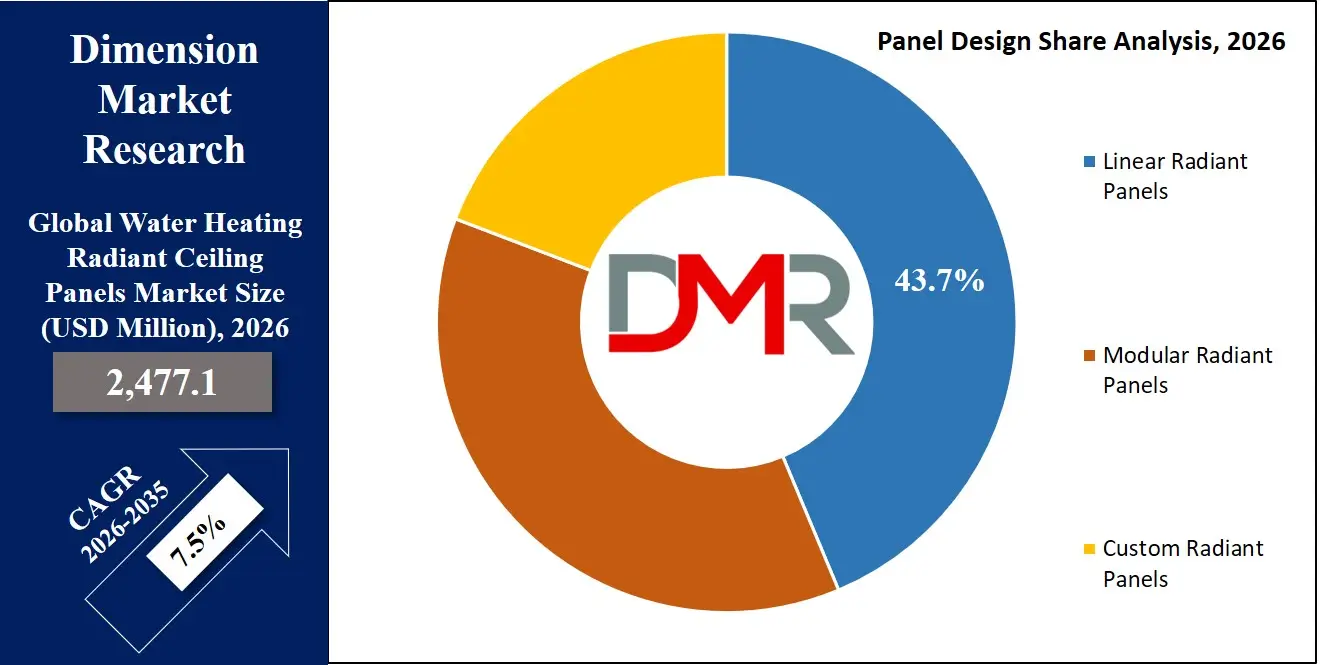
Linear radiant panels are anticipated to dominate the panel design segment because they provide efficient heat distribution while maintaining architectural compatibility with modern ceiling structures. These panels are typically long, narrow units installed in rows across ceilings, allowing designers to create continuous heating coverage across large interior spaces. Their structure allows for easy integration into suspended or modular ceiling systems commonly used in commercial and institutional buildings.
ℹ
To learn more about this report –
Download Your Free Sample Report Here
One key factor driving the dominance of linear radiant panels is their flexibility in installation and scalability in large buildings. They can be installed individually or in multiple arrays, depending on heating requirements, enabling precise control of heat distribution across different zones. This modular configuration allows facility managers to tailor heating capacity to the size and layout of each space without requiring major structural modifications.
Linear panels are particularly common in office buildings, schools, airports, and healthcare facilities, where ceilings often include grid-based suspended systems. Their sleek design allows them to blend seamlessly with lighting fixtures, ventilation components, and acoustic panels, making them attractive for modern architectural designs. In addition, linear panels typically provide higher heat output per unit length compared with some modular systems, improving efficiency in large open areas.
Because of their design versatility, ease of integration, and consistent heating performance, linear radiant panels dominate the panel design segment and continue to be widely specified in commercial construction projects.
By Material Analysis
Aluminum panels are expected to dominate the material segment of the water heating radiant ceiling panels market due to their excellent thermal conductivity, lightweight structure, and corrosion resistance. These properties allow aluminum to efficiently transfer heat from the hydronic piping system to the surrounding indoor environment, improving heating performance and reducing energy consumption.
Compared with steel or gypsum-based panels, aluminum provides faster thermal response, meaning it heats up and cools down quickly when the system is activated or adjusted. This responsiveness improves temperature control within buildings and allows heating systems to operate more efficiently during varying occupancy patterns. As a result, aluminum panels are commonly used in energy-efficient heating designs for commercial buildings and institutional facilities.
Another important advantage of aluminum is its lightweight nature, which simplifies installation and reduces the structural load on suspended ceiling systems. This is particularly beneficial in large commercial buildings where extensive ceiling coverage is required. Aluminum panels are also resistant to corrosion and moisture damage, ensuring longer product life and minimal maintenance requirements.
Architecturally, aluminum panels offer design flexibility because they can be manufactured in different shapes, sizes, and finishes. This allows architects and engineers to integrate radiant heating systems without compromising building aesthetics. Due to their superior heat transfer performance, durability, and installation benefits, aluminum panels remain the most widely used material in the global radiant ceiling panel market.
By Installation Type Analysis
Recessed-mounted radiant ceiling panels are anticipated to dominate the installation type segment because they integrate seamlessly within suspended ceiling structures while maintaining efficient heat distribution. These panels are installed within ceiling grids or cavities, allowing them to remain flush with the ceiling surface and blend with other building components such as lighting fixtures, air vents, and acoustic panels.
The primary advantage of recessed installations is their ability to preserve interior aesthetics while delivering effective heating performance. Architects and building designers prefer recessed systems because they maintain a clean and uncluttered ceiling appearance, which is particularly important in modern office spaces, hospitals, hotels, and educational institutions.
Recessed panels also provide uniform heat coverage because they are distributed evenly across the ceiling grid. This configuration ensures consistent radiant heating throughout the room without creating hot or cold zones. Additionally, recessed installations protect panels from physical damage and reduce maintenance requirements compared with exposed surface-mounted systems.
Another factor contributing to their dominance is compatibility with modular suspended ceiling systems commonly used in commercial construction worldwide. During building design and construction, recessed panels can easily be incorporated into standard ceiling modules, simplifying installation and reducing labor costs.
Due to their architectural integration, consistent heating performance, and widespread compatibility with modern ceiling designs, recessed-mounted radiant ceiling panels dominate this installation segment globally.
By Distribution Channel Analysis
Direct sales dominate the distribution channel segment in the water heating radiant ceiling panels market because these systems are typically specified and purchased as part of large construction or building renovation projects. Radiant ceiling panels are not standard consumer retail products; instead, they are specialized building components that require technical design integration, engineering consultation, and customized installation planning.
Manufacturers commonly sell these systems directly to construction companies, mechanical contractors, HVAC system integrators, and building developers. Direct sales channels allow manufacturers to work closely with project engineers and architects during the design phase to ensure that the radiant heating system is properly integrated into the building's mechanical infrastructure. This collaboration is essential for determining panel layout, piping design, heat load requirements, and system compatibility with boilers or heat pumps.
Another advantage of direct sales is the ability to provide technical support, installation guidance, and after-sales service. Because radiant heating systems are complex mechanical solutions, professional support throughout the project lifecycle is often necessary. Direct engagement between manufacturers and project stakeholders ensures better system performance and reliability.
Large commercial and institutional projects also involve bulk procurement, making direct manufacturer contracts more cost-effective than distributor-based purchasing. For these reasons, technical complexity, project-based purchasing, and customized system design direct sales remain the dominant distribution channel in the global water heating radiant ceiling panels market.
By Application Analysis
Commercial buildings are projected to dominate the application segment of the water heating radiant ceiling panels market because these facilities require efficient and space-saving heating solutions for large indoor environments. Offices, hospitals, schools, airports, retail centers, and government buildings often have expansive interior spaces that demand uniform heating without occupying valuable floor or wall space. Radiant ceiling panels provide an ideal solution by delivering heat from overhead surfaces through radiation rather than relying solely on forced air systems.
One of the major advantages of radiant ceiling panels in commercial buildings is improved energy efficiency. These systems heat people and objects directly rather than heating large volumes of air, which reduces energy losses and lowers operational costs. As energy efficiency becomes a priority for commercial building operators, radiant heating systems are increasingly adopted to meet sustainability targets and building efficiency standards.
Commercial facilities also benefit from the quiet operation of radiant ceiling systems, which operate without large fans or blowers commonly used in conventional HVAC systems. This creates a more comfortable indoor environment, particularly in offices, healthcare facilities, and educational institutions where noise reduction is important.
Additionally, radiant ceiling panels free up wall and floor space that would otherwise be occupied by radiators or heating equipment. This design flexibility allows architects to optimize interior layouts while maintaining consistent thermal comfort. Because of these advantages, commercial buildings represent the dominant application segment in the global market.
The Global Water Heating Radiant Ceiling Panels Market Report is segmented on the basis of the following:
By Type
- Hydronic Radiant Ceiling Panels
- Electric Radiant Ceiling Panels
By Panel Design
- Linear Radiant Panels
- Modular Radiant Panels
- Custom Radiant Panels
By Material
- Aluminum Panels
- Steel Panels
- Gypsum Panels
By Installation Type
- Surface Mounted
- Recessed Mounted
- Suspended Ceiling Mounted
By Distribution Channel
- Direct Sales
- Distributors/Wholesalers
By Application
- Residential
- Commercial
- Industrial
Impact of Artificial Intelligence in the Global Water Heating Radiant Ceiling Panels Market
- AI for Predictive Thermal Comfort Control: AI algorithms analyze occupancy patterns, weather forecasts, and historical building data to predict heating demand and optimize water temperature and flow, maintaining precise comfort while minimizing energy consumption.
- AI-Driven Zoning and Occupancy Optimization: Machine learning models identify usage patterns across building zones, automatically adjusting heating output in unoccupied areas or predicting peak occupancy times to pre-condition spaces efficiently.
- Fault Detection and Diagnostics (FDD): AI-powered systems continuously monitor panel performance, water temperatures, and flow rates to detect anomalies indicative of valve failures, air locks, or circulation pump issues, enabling predictive maintenance.
- Integration with Grid-Interactive Buildings: AI optimizes panel operation based on real-time energy pricing and grid signals, shifting thermal load to periods of low-cost renewable energy or participating in demand response programs.
- Learning from Building Energy Models: AI systems aggregate and anonymize operational data across building portfolios to refine design assumptions, improve commissioning processes, and develop more accurate energy performance models for future projects.
Global Water Heating Radiant Ceiling Panels Market: Regional Analysis
Region with the Largest Revenue Share
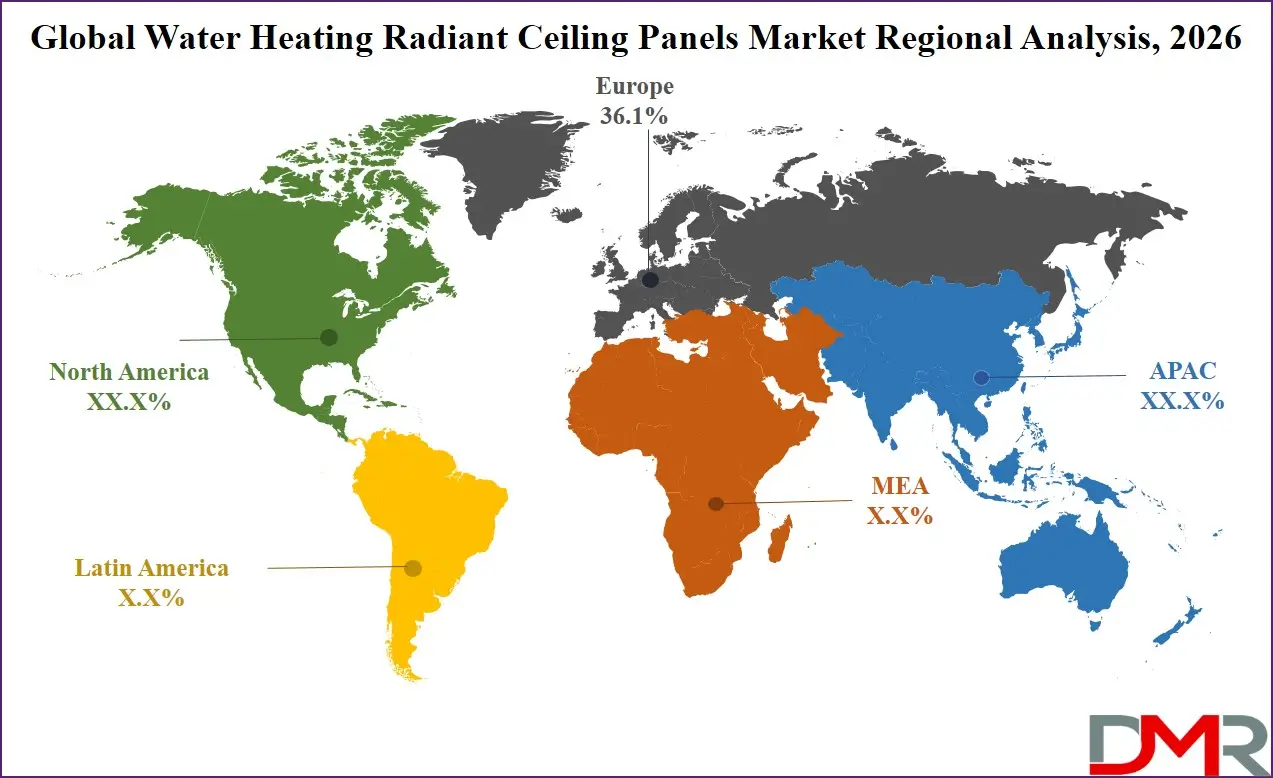
Europe is projected to dominate the regional segment with the highest market share as it is anticipated to hold 36.1% of the total market revenue by the end of 2026, due to stringent energy efficiency regulations, mature hydronic heating infrastructure, and widespread adoption of building renovation programs. The region is home to leading HVAC manufacturers and hydronic system innovators, driving technological advancements in panel design and controls. Strong regulatory frameworks regarding building energy performance and carbon reduction compel building owners to adopt efficient heating technologies. High energy costs and consumer awareness regarding thermal comfort further strengthen demand.
ℹ
To learn more about this report –
Download Your Free Sample Report Here
Germany, the U.K., and the Nordic countries, in particular, account for the largest share within Europe due to their ambitious climate targets and mature renovation markets. Although Asia Pacific is the fastest-growing region, Europe continues to hold the largest revenue share due to early adoption of low-temperature hydronic technologies and strong policy support for building decarbonization.
Region with the Highest CAGR
Asia-Pacific holds the highest CAGR and is poised to achieve rapid market share growth due to its massive urban construction boom, expanding middle class demanding premium buildings, and significant government pushes for green building standards. Countries like China, India, and South Korea are investing heavily in modern healthcare infrastructure and sustainable commercial developments. China's "Healthy China 2030" initiative and India's green building certification programs are creating fertile ground for adoption. The region's cost sensitivity is being addressed through local manufacturing partnerships, simplified panel designs, and collaboration between international manufacturers and regional construction firms. This, combined with an immense volume of new building construction, positions APAC as the fastest-growing market for water heating radiant ceiling panel systems.
By Region
North America
Europe
- Germany
- The U.K.
- France
- Italy
- Russia
- Spain
- Benelux
- Nordic
- Rest of Europe
Asia-Pacific
- China
- Japan
- South Korea
- India
- ANZ
- ASEAN
- Rest of Asia-Pacific
Latin America
- Brazil
- Mexico
- Argentina
- Colombia
- Rest of Latin America
Middle East & Africa
- Saudi Arabia
- UAE
- South Africa
- Israel
- Egypt
- Rest of MEA
Global Water Heating Radiant Ceiling Panels Market: Competitive Landscape
The Global Water Heating Radiant Ceiling Panels Market is moderately consolidated, featuring a mix of established European HVAC manufacturers, specialized hydronic system providers, and building technology integrators. Leading players like Zehnder Group, Uponor, and Rehau leverage their extensive hydronic expertise and distribution networks to offer radiant ceiling solutions as part of comprehensive indoor climate systems. Specialized panel manufacturers such as Sabiana SpA, Frenger Systems, and Merriott Radiators are driving market dynamics with innovative panel designs, acoustic integrations, and customized architectural solutions.
Building technology groups like Siemens and Honeywell play a crucial role in providing advanced controls and BMS integration, while construction material manufacturers such as Armstrong World Industries integrate radiant functionality into ceiling systems. Regional players and fabrication specialists are also active, offering customized solutions for local construction markets and renovation projects.
Some of the prominent players in the Global Water Heating Radiant Ceiling Panels Market are:
- Zehnder Group AG
- Uponor Corporation
- Rehau Group
- Sabiana SpA
- Frenger Systems Ltd.
- Merriott Radiators (Smiths Group)
- Armstrong World Industries, Inc.
- Price Industries Limited
- Swegon Group AB
- TROX GmbH
- Halton Group
- Lindab International AB
- Systemair AB
- Giacomini S.p.A.
- Danfoss A/S
- Siemens AG
- Honeywell International Inc.
- Johnson Controls International plc
- Belimo Holding AG
- IMI Hydronic Engineering
- Other Key Players
Recent Developments in the Global Water Heating Radiant Ceiling Panels Market
- November 2025: Zehnder Group launched its "Comfort Zone Pro" acoustic radiant panel series, integrating high-performance sound absorption with low-temperature hydronic heating, targeting premium office and education markets.
- October 2025: Uponor demonstrated its enhanced smart zoning system at ISH 2026, highlighting room-by-room temperature control with predictive algorithms and seamless heat pump integration for residential and commercial applications.
- September 2025: Sabiana announced a strategic partnership with a top-3 European heat pump manufacturer to co-develop integrated low-temperature systems for the rapidly growing heat pump retrofit market.
- August 2025: Armstrong World Industries completed the acquisition of a specialized acoustic ceiling manufacturer to enhance its radiant panel portfolio's sound absorption capabilities for healthcare and education sectors.
- July 2025: A Horizon Europe grant was awarded to a consortium developing next-generation bio-based materials for radiant panel manufacturing, linking hydronic heating with circular economy goals.
- June 2025: Frenger Systems partnered with a major UK hospital trust to provide its hygienic radiant panel solution for new patient wards, aiming to set new standards for infection control and patient comfort in the region.
Report Details
| Report Characteristics |
| Market Size (2026) |
USD 2,477.1 Mn |
| Forecast Value (2035) |
USD 4,740.2 Mn |
| CAGR (2026–2035) |
7.5% |
| The US Market Size (2026) |
USD 537.5 Mn |
| Historical Data |
2020 – 2025 |
| Forecast Data |
2027 – 2035 |
| Base Year |
2025 |
| Estimate Year |
2026 |
| Report Coverage |
Market Revenue Estimation, Market Dynamics, Competitive Landscape, Growth Factors and etc. |
| Segments Covered |
By Type (Hydronic Radiant Ceiling Panels, Electric Radiant Ceiling Panels), By Panel Design (Linear Radiant Panels, Modular Radiant Panels, Custom Radiant Panels), By Material (Aluminum Panels, Steel Panels, Gypsum Panels), By Installation Type (Surface Mounted, Recessed Mounted, Suspended Ceiling Mounted), By Distribution Channel (Direct Sales, Distributors/Wholesalers), By Application (Residential, Commercial, Industrial) |
| Regional Coverage |
North America – The US and Canada; Europe – Germany, The UK, France, Russia, Spain, Italy, Benelux, Nordic, & Rest of Europe; Asia-Pacific – China, Japan, South Korea, India, ANZ, ASEAN, Rest of APAC; Latin America – Brazil, Mexico, Argentina, Colombia, Rest of Latin America; Middle East & Africa – Saudi Arabia, UAE, South Africa, Turkey, Egypt, Israel, & Rest of MEA |
| Prominent Players |
Zehnder Group AG, Uponor Corporation, Rehau Group, Sabiana SpA, Frenger Systems Ltd., Merriott Radiators (Smiths Group), Armstrong World Industries, Inc., Price Industries Limited, Swegon Group AB, TROX GmbH, Halton Group, Lindab International AB, Systemair AB, Giacomini S.p.A., Danfoss A/S, Siemens AG (Building Products), Honeywell International Inc. (Building Controls), Johnson Controls International plc, Belimo Holding AG, IMI Hydronic Engineering, and Other Key Players |
| Purchase Options |
We have three licenses to opt for: Single User License (Limited to 1 user), Multi-User License (Up to 5 Users) and Corporate Use License (Unlimited User) along with free report customization equivalent to 0 analyst working days, 3 analysts working days and 5 analysts working days respectively. |
Frequently Asked Questions
How big is the Global Water Heating Radiant Ceiling Panels Market?
▾ The Global Water Heating Radiant Ceiling Panels Market size is estimated to have a value of USD 2,477.1 million in 2026 and is expected to reach USD 4,740.2 million by the end of 2035.
What is the growth rate in the Global Water Heating Radiant Ceiling Panels Market?
▾ The market is growing at a CAGR of 7.5 percent over the forecasted period of 2026-2035.
What is the size of the US Water Heating Radiant Ceiling Panels Market?
▾ The US Water Heating Radiant Ceiling Panels Market is projected to be valued at USD 537.5 million in 2026. It is expected to witness subsequent growth as it holds USD 991.9 million in 2035 at a CAGR of 7.0%.
Which region accounted for the largest Global Water Heating Radiant Ceiling Panels Market?
▾ Europe is expected to have the largest market share in the Global Water Heating Radiant Ceiling Panels Market with a share of about 36.1% in 2026.
Who are the key players in the Global Water Heating Radiant Ceiling Panels Market?
▾ Some of the major key players in the Global Water Heating Radiant Ceiling Panels Market are Zehnder Group AG, Uponor Corporation, Sabiana SpA, Frenger Systems Ltd., Armstrong World Industries, and many others.