What is the Waterproofing Chemical Admixture Market Size?
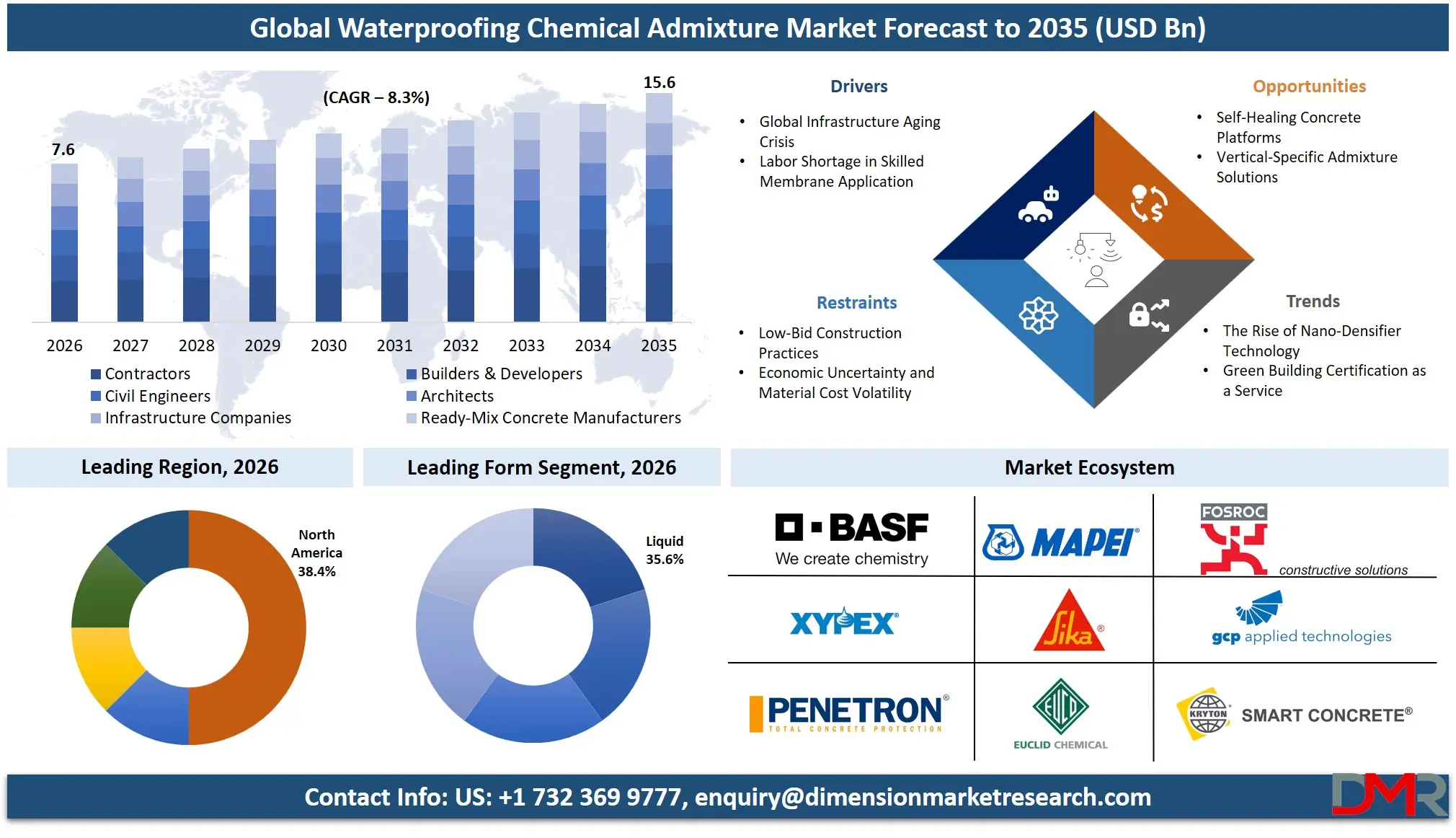
The Global Waterproofing Chemical Admixture Market is expected to reach a value of USD 7.6 billion in 2026, and it is further anticipated to reach USD 15.6 billion by 2035, growing at a CAGR of 8.3% during the forecast period.
ℹ
To learn more about this report –
Download Your Free Sample Report Here
Chemical admixtures that provide waterproofing functionality have witnessed robust growth due to increasing preference among the construction industry for concrete that is both durable and long-lasting as well as resistant to water and chemical corrosion. As opposed to conventional sheet membranes, which are only applied after concrete construction, chemical admixtures are additives that are incorporated into the concrete mix in order to ensure even distribution within the structure. Types of admixtures within this segment include crystalline admixtures, pore blocking admixtures, hydrophobic admixtures, densifier admixtures, capillary admixtures, and flexible admixtures. Growth in this market is fueled by high instances of damage resulting from water exposure as well as stringent guidelines on basement waterproofing. Major end users include contractors, builders, civil engineers, and pre-mixed concrete producers.
ℹ
To learn more about this report –
Download Your Free Sample Report Here
The US Waterproofing Chemical Admixture Market
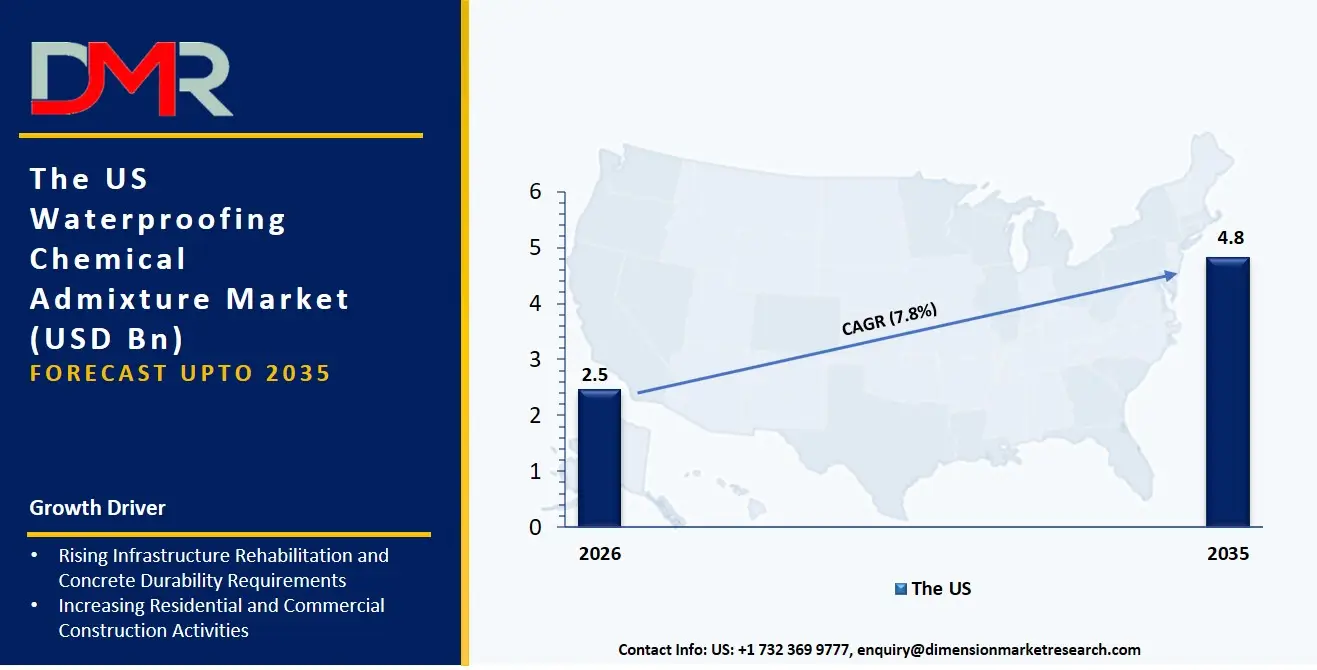
The US Waterproofing Chemical Admixture Market is projected to reach USD 2.5 billion in 2026 at a CAGR of 7.8% over its forecast period, culminating in a value of USD 4.8 billion by 2035. The USA still represents the biggest national market in North America owing to constant investments made into renovation of old infrastructure facilities along with active development of residential basements. It should be noted that the market was characterized by the presence of high demand for waterproofing admixtures of crystalline type as companies, mainly contractors and ready-mix producers, were trying to seal hairline cracks in foundation walls and under-ground slabs. Furthermore, introduction of LEED v4.1 is leading to an emergence of demand for integral waterproofing admixtures to decrease VOC emissions compared to solvent-based surface coatings.
ℹ
To learn more about this report –
Download Your Free Sample Report Here
The Europe Waterproofing Chemical Admixture Market
The Europe Waterproofing Chemical Admixture Market is estimated to be valued at USD 2.1 billion in 2026 and is further anticipated to reach USD 4.1 billion by 2035 at a CAGR of 7.9%. The strict regulations like the EU Construction Products Regulation (CPR) along with the construction of climate-ready infrastructures have a major influence on the European market, thereby necessitating capillary waterproofing admixtures and densifiers for tunnels as well as underground railways. The fast growth of flexible waterproofing admixtures has been observed in the region as the residential and commercial developers of Germany, France, and the Nordic region are now trying to find out admixtures that will be tolerant towards any structural movements but would provide adequate waterproofing for the podium decks and green roofs. Further, the need for rehabilitation of existing water retaining structures like dams and reservoirs is forcing admixture companies to design specific products ensuring potability and chemical resistance.
The Japan Waterproofing Chemical Admixture Market
The Japan Waterproofing Chemical Admixture Market is projected to be valued at USD 0.6 billion in 2026. It is further expected to witness robust growth, holding USD 1.1 billion in 2035 at a CAGR of 7.4%. The uniqueness of the Japanese market lies in the joint effort of the business and government sectors in infrastructure development, which results from regular earthquakes and old tunnel systems constructed as part of post-war rebuilding efforts. The crystalline waterproofing admixtures and the flexible waterproofing admixtures are responsible for a major portion of expenditures as large construction companies waterproof their subway tunnels and mountain tunnels that are under pressure of high water level. Moreover, there exists a considerable requirement of the integral waterproofing admixtures in making up for the deficiency between the shotcrete method and precast concrete system in the construction of high-rise buildings.
Key Takeaways
- Market Size & Forecast: The Global Waterproofing Chemical Admixture market is projected to reach USD 7.6 billion in 2026, expanding to USD 15.6 billion by 2035, thanks to two primary growth factors, namely the renovation of old infrastructure, and the mandatory installation of waterproofing chemicals beneath newly built structures.
- Growth Rate & Outlook: Global market growth is expected at a CAGR of 8.3%, due to a severe shortage of professional membrane applicators and the increasingly complex process of crack injection following construction compared to the application of integral admixtures.
- Primary Growth Drivers: Important factors include the increasing tendency to employ integral admixtures rather than post-applied membranes due to high labor expenses, the employment of capillary waterproofing admixtures due to high remediation costs, and the incorporation of self-healing technology using specialized waterproofing admixtures.
- Key Market Trends: Some main trends in this market include the emergence of concrete self-healing technology, the utilization of nano-silica based waterproofing admixtures to densify concrete, and the development of hydrophobic/water-repellent admixtures owing to mold prevention concerns in occupied buildings.
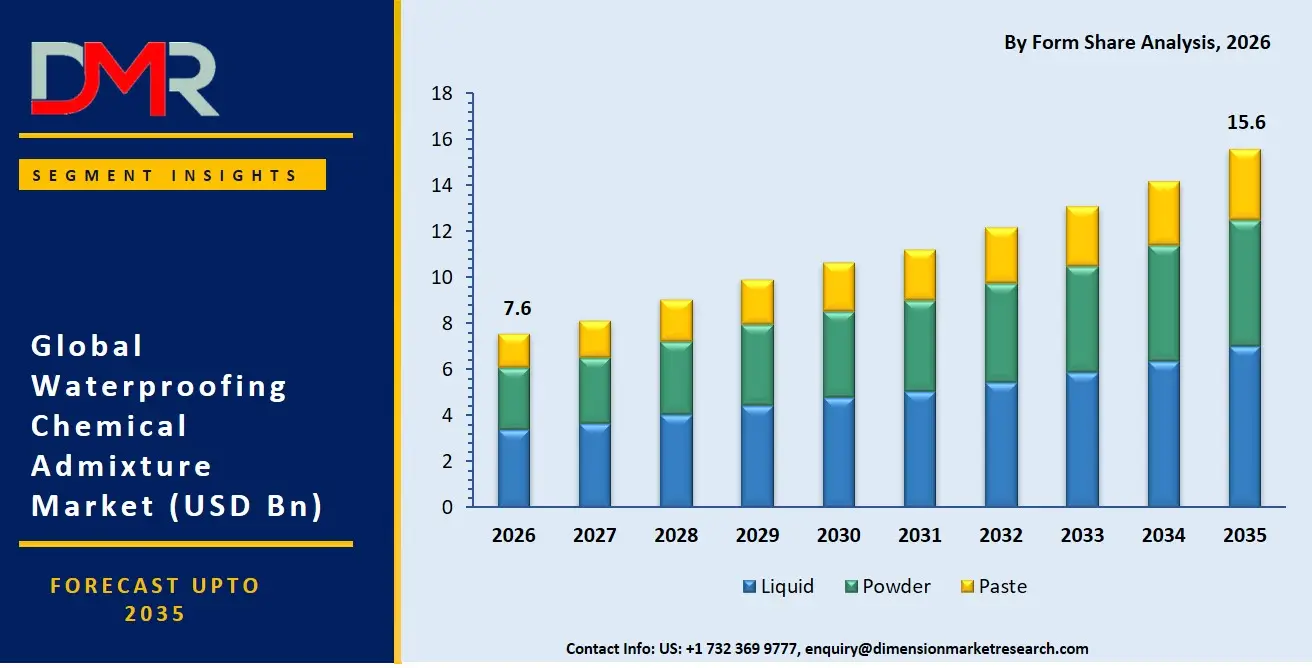
- By Form Analysis: Powder forms will be in greater demand because they are easier to transport, have an extended shelf life, and enable precise dosing in ready-mix plants. However, liquid forms are gaining more traction in precast applications since automated batching systems are becoming the norm. Paste forms will be limited to niche uses in scenarios that require highly viscous products.
- By Application Analysis: The residential buildings category will hold the lead within the application landscape owing to urbanization, housing projects, enhanced awareness about moisture protection, government housing programs, and the need for long-lasting, low-maintenance, and sustainable building materials.
- Regional Leadership: North America is set to capture the highest market share at 38.4% in 2026. The region has a well-established infrastructure renewal environment and is a leader in integral waterproofing of residential basements.
What is the Waterproofing Chemical Admixture?
Waterproofing Chemical Admixtures are chemicals used in the batching process in concrete or mortar that make the material less permeable, water-resistant, or impermeable. The service provided, which is different from waterproof membrane application, focuses on the "how" aspect of providing monolithic, lifetime concrete protection from inside. This includes using crystalline waterproofing admixtures for growing insoluble crystals in the micro-cracks, pore-blocking admixtures for filling the voids, and hydrophobic admixtures for creating water-repellent lining in capillaries. There are also densifiers, which increase concrete density and abrasion resistance, and flexible waterproofing admixtures for accommodating movement of substrates. Considering that 70% of all construction defects are attributed to water seepage, it is important to use waterproofing chemical admixtures to have a dry below-grade envelope, minimized maintenance, and watertight structure for tunnels, pools, and water tanks.
Use Cases
- Basement Waterproofing in Residential High-Rises: Crystalline waterproofing admixtures are used by builders and contractors to seal mat slabs and elevator shafts, as well as hairline cracks that occur due to settlement.
- Potable Water Tank Protection: Waterproofing admixtures approved by NSF/ANSI 61 guidelines are employed by construction firms, providing protection against leakage from millions of liters of drinking water without any chemical migration or epoxy liners.
- Tunnel Lining in Subway Construction: Waterproofing admixtures, when coupled with densifying agents, are applied by civil engineers to the tunnel structures, making sure that no leakage occurs even under the impact of hydrostatic pressure due to groundwater.
- Swimming Pool Concrete Shells: Waterproofing admixtures are utilized by contractors to ensure there is no leakage of water due to cracking and de-bonding of tiles due to thermal stress.
How AI is Transforming the Waterproofing Chemical Admixture Market?
There is a growing influence of AI on the crystalline waterproofing chemical admixture market through the acceleration of formulation chemistry as well as improved on-site quality control. With regard to predictive modeling tools, AI-based solutions can be used to model crystal formations in various humidity levels and crack sizes, thus eliminating the need for conducting extended accelerated tests in laboratories and reducing time-to-market. Furthermore, advanced features for form optimization help to address the issue of aggregate moisture fluctuation, estimate slump losses during transportation, and adjust admixture dose in real-time in order to ensure proper waterproofing results.
Quality control and project specifications revolve increasingly around artificial intelligence technology. Speaking of contractor services, computer vision-based mix verification helps to analyze records of concrete trucks and detect any issues associated with improper admixture dose, misconfigurations, or violation of batching time requirements so that ACI 212.3 (Report on Chemical Admixtures) standards are maintained. Finally, generative AI assistants are assisting civil engineering design teams by creating virtual simulations of water ingress into concrete structures and predicting future crack development.
Market Dynamics
Key Drivers in the Global Waterproofing Chemical Admixture Market
Global Infrastructure Aging Crisis
Organizations worldwide, especially city governments and transit authorities, struggle with the repair of tunnels, bridges, dams, reservoirs, and underground parking facilities that have been around for more than 50 years. The problems associated with these facilities include concrete spalling, corrosion of rebars due to chloride penetration, and leaks. The need for repair work has outpaced the funding available for them, resulting in a shortage of repair products that offer long-lasting solutions. This trend has caused the specification of waterproofing admixtures for their new replacement projects instead of temporary surface treatments.
Labor Shortage in Skilled Membrane Application
Construction companies are finding it difficult to get applicators who can apply either the torch-on or the liquid-applied membrane since the application involves preparation of the substrate, priming, multiple layers of application, and protection boards. The shortage of labor is leading to more companies using integral admixtures that are applied during the manufacturing stage of the concrete at the ready-mix plant.
Restraints in the Global Waterproofing Chemical Admixture Market
Low-Bid Construction Practice
The majority of public works are still tendered on the basis of cheapest bid, and waterproofing admixture products are relatively more costly compared to plain concrete that does not include any admixtures. Engineers usually opt out of the admixtures to stick within the financial limits, at the expense of potential leakage problems. The tradition of value engineering remains a major barrier, in spite of the fact that admixtures provide long-term cost savings. Leakage repair costs post-construction may be between three and five times higher.
Economic Uncertainty and Material Cost Volatility
Instabilities within economic conditions and prices for silicates, polymers, and fatty acids have made ready-mix manufacturers and constructors reluctant about purchasing or specifying premium admixtures. Although water protection is important, procurement officers are expected to provide justification for every cost increase. There is increasing attention to the costs of crystalline admixtures compared to conventional admixtures. Others switch to cheaper pore blockers that provide fast water repellency but cannot heal themselves. Projects focusing on long-term durability will wait for a convincing 20-year return on investment.
Growth Opportunities in the Global Waterproofing Chemical Admixture Market
Self-Healing Concrete Platforms
One of the major areas where growth can be realized is by helping infrastructure owners build self-repairing concrete structures through bacterial or crystallization-based methods. Whereas many agencies have viewed demonstration projects, they are now looking for tested solutions that address their unique soil conditions, water chemistry, and crack widths. Creating such complex systems requires technical expertise in crystallization additives, water/cement ratios, and curing processes. Additive chemical suppliers can assist contractors in designing cost-efficient and independent systems that minimize maintenance costs over a 50-year period.
Vertical-Specific Admixture Solutions
Growth will be driven by the requirement for integration of both chemical technology and application knowledge. The specification requirements for a water treatment facility are different from those of a tunnel, which are different from those of a swimming pool. A supplier of admixtures might wish to consider providing a range of blended products that meet the requirements of water retention systems (drinkable water), underground systems (hydrostatic pressure-resistant), and tunnels/bridges (freeze-thaw resistant).
Trends in the Global Waterproofing Chemical Admixture Market
The Rise of Nano-Densifier Technology
Nano-silica-based densifiers are gaining popularity as a replacement for lithium/sodium silicate-based densifiers. Instead of merely filling pores, densifiers utilizing nano-scale particles act at a molecular level to neutralize free calcium hydroxide and generate further C-S-H (calcium silicate hydrate) the main strengthening compound. Experts from waterproofing chemicals have become available on how to disperse nanoparticles, determine proper dosage for low permeable concrete, and compatibilities with other admixtures.
Green Building Certification as a Service
The environment is gradually becoming a major factor when it comes to concrete selection as people try to certify their buildings using LEED, BREEAM, and Envision. It is important to note that companies are interested in waterproofing techniques that can increase the durability of the structures while at the same time reducing the amount of carbon embedded in them through the removal of the plastic sheets used as the membrane, which is mainly made up of petroleum. This has led to a need for concrete admixtures that can help optimize material composition.
Research Scope and Analysis
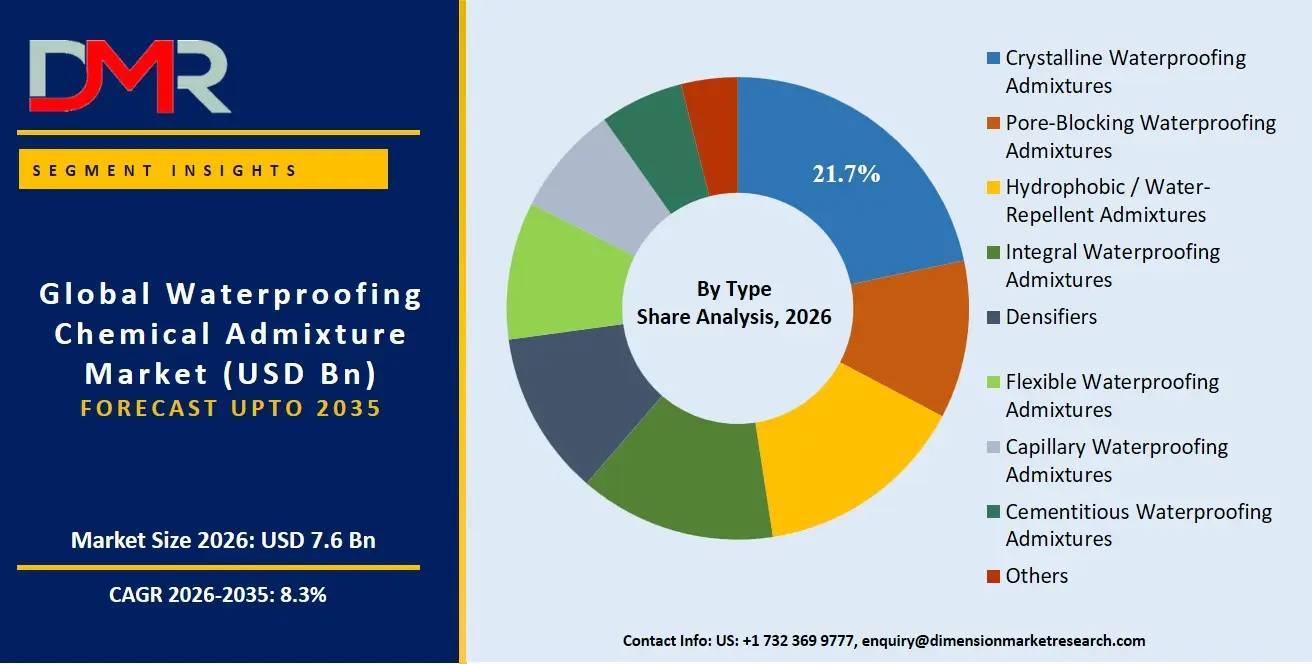
The market is analyzed across type, form, application, and end-user segments. Crystalline waterproofing admixtures lead by performance efficiency, liquid forms dominate for ease of use, residential applications drive demand, while contractors remain the key end-user segment due to material selection authority.
ℹ
To learn more about this report –
Download Your Free Sample Report Here
By Type Analysis
Crystalline waterproofing admixture is poised to leads in the type category because of its outstanding self-sealing property, concrete protection ability, and usage in underground structures and structures holding water. The admixture reacts with water and unreacted cement molecules to create crystals, which fill up the capillaries and micro cracks. Crystalline waterproofing admixtures are preferred in construction work because they offer integrated waterproofing properties without an additional membrane. There is an increasing need for robust and easy-to-maintain construction materials in tunnels, basements, and foundation works, which boosts the market share of crystalline waterproofing admixtures.
By Form Analysis
The liquid waterproofing admixture is anticipated to be the dominant in the form category due to its easy application, ability to mix uniformly, and suitability for use with pre-mixed concrete. Construction contractors and concrete manufacturers find liquid formulations more useful since they readily disperse within the concrete mixture, providing uniform waterproofing performance even in large scale construction. Liquid admixtures ease labor challenges while enhancing batching accuracy during concrete manufacturing and construction processes. The increasing utilization of liquid admixtures in modern concrete manufacture and construction techniques has improved their market dominance further. In addition, advances in flexible, durable and chemically resistant polymers used to formulate the liquid admixtures have boosted their demand.
By Application Analysis
The residential sector has been projected to be the dominant application segment due to the ongoing process of urbanization, development of new housing projects, and awareness among consumers about structural durability and moisture-proofing. Waterproofing chemical admixtures find wide-ranging applications in various parts of residential structures, including foundations, basements, rooftops, bathrooms, and balconies, as a measure against water leakage, mold formation, and deterioration of concrete. Higher disposable incomes in addition to government initiatives aimed at providing affordable housing options have been driving the adoption rate in developing countries. Growing emphasis on durable construction material and lower maintenance costs is another factor responsible for this trend.
By End User Analysis
The contractors are anticipated to dominate the end-users' category because they play a critical role in selecting the materials used, the behavior of the concrete during construction, and the actual implementation of the project regardless of whether it is residential, commercial, or infrastructure. The choice of waterproofing additives is becoming popular among contractors as they try to improve the longevity of the structures, minimize maintenance activities, and meet modern standards of construction. The contractors' dominance in this category is more pronounced in infrastructural projects and skyscrapers because failure to adequately waterproof the building will incur substantial repair expenses.
The Global Waterproofing Chemical Admixture Market Report is segmented on the basis of the following:
By Type
- Crystalline Waterproofing Admixtures
- Pore-Blocking Waterproofing Admixtures
- Hydrophobic / Water-Repellent Admixtures
- Integral Waterproofing Admixtures
- Densifiers
- Flexible Waterproofing Admixtures
- Capillary Waterproofing Admixtures
- Cementitious Waterproofing Admixtures
- Others
By Form
By Application
- Residential Buildings
- Commercial Buildings
- Industrial Infrastructure
- Public Infrastructure
- Underground Structures
- Water Retaining Structures
- Tunnels & Bridges
- Swimming Pools & Water Tanks
- Basements & Foundations
- Roofing & Podiums
- Others
By End User
- Contractors
- Builders & Developers
- Civil Engineers
- Architects
- Infrastructure Companies
- Ready-Mix Concrete Manufacturers
Regional Analysis
Leading Region by Market Share
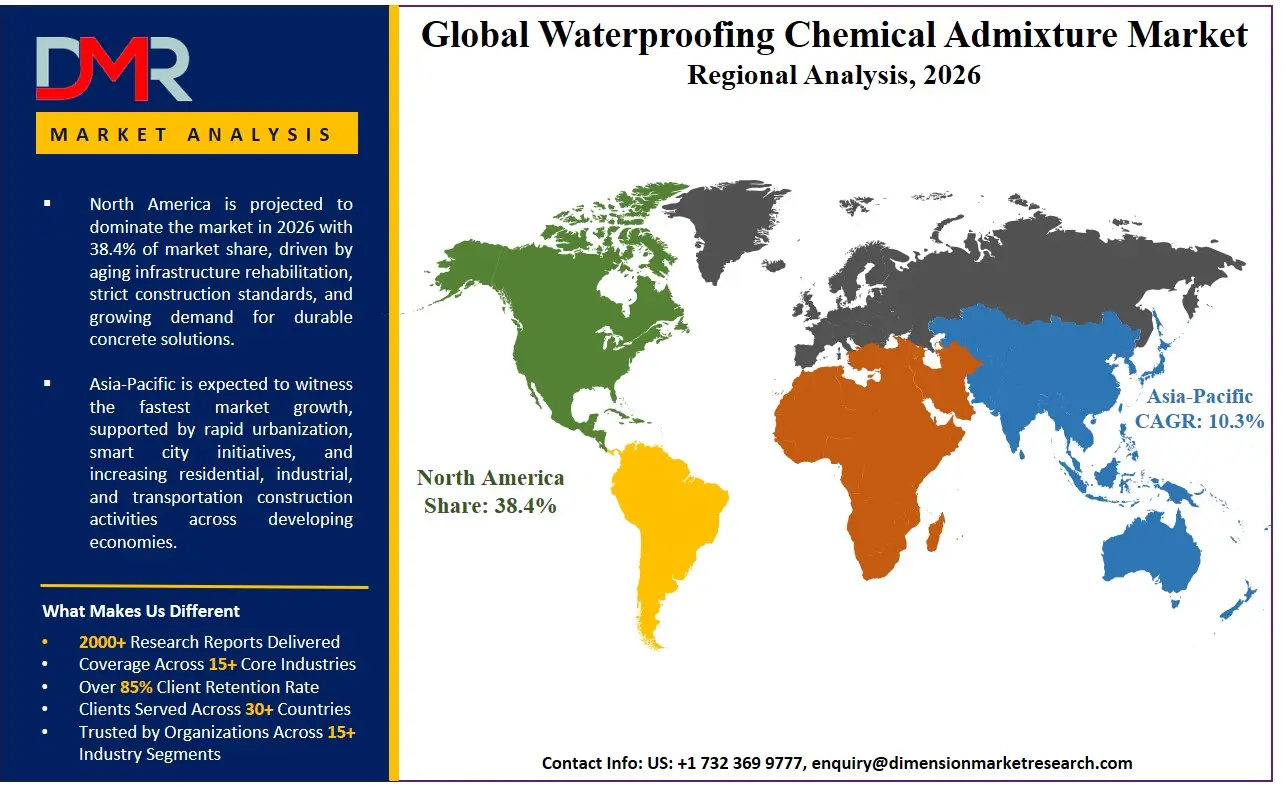
North America is poised to dominate the global waterproofing chemical admixture market, holding 38.4% of the market share by the end of 2026. The US, dominating the continent of North America, enjoys the largest market share owing to large-scale constructions of residential basements in the Midwest and Northeast, in addition to the trillion-dollar investment program for replacing old dams, locks, and tunnels. The region has an already well-developed ecosystem comprising admixture manufacturers, independent test labs (ACI, ASTM), and a large pool of concrete technologists. The investment made towards the underground parking structures of mixed-use properties and repair works in the CSO tunnels will drive demand for crystalline and capillary admixtures. In addition, the favorable insurance risk climate will always penalize any water seepage cases.
ℹ
To learn more about this report –
Download Your Free Sample Report Here
Fastest-Growing Regional Market
The Asia-Pacific region is poised to be the fastest-growing market for waterproofing chemical admixtures due to the massive infrastructure projects that the governments in India, China, and Southeast Asia are undertaking. Fast economic development, increasing urbanization trends, and development of metro rail projects require the governments to replace their traditional membrane-based approaches with the quick and durable integral admixtures. The capillary waterproofing admixtures will be sought after to assist with handling the high water table level in the coastal metropolises. There is also a scarcity of professionals who can apply the membranes. This will prompt the contractors to shift toward ready-mixed waterproofing admixtures.
By Region
North America
Europe
- Germany
- The U.K.
- France
- Italy
- Russia
- Spain
- Benelux
- Nordic
- Rest of Europe
Asia-Pacific
- China
- Japan
- South Korea
- India
- ANZ
- ASEAN
- Rest of Asia-Pacific
Latin America
- Brazil
- Mexico
- Argentina
- Colombia
- Rest of Latin America
Middle East & Africa
- Saudi Arabia
- UAE
- South Africa
- Israel
- Egypt
- Rest of MEA
Competitive Landscape
The competitive landscape in global waterproofing chemical admixtures has now evolved into one that is quite dynamic, with a diverse set of multinationals in specialty chemicals, regional concrete additive firms, and construction material conglomerates. The key lies in forming close technical partnerships with ready-mix suppliers and conducting training programs for contractors. The trend towards market consolidation is gathering pace fast, with conventional construction materials firms buying out admixture specialists having unique crystal-forming or nanodensifying technologies. Unique intellectual property, such as advanced dosing systems and specialized solution boosters (such as certified potable water), is increasingly becoming the cornerstone of competitive advantage over mere water repellents.
Some of the prominent players in the Global Waterproofing Chemical Admixture Market are:
- Sika AG
- BASF SE
- MAPEI S.p.A.
- Fosroc International
- Penetron International
- Xypex Chemical Corporation
- Kryton International
- GCP Applied Technologies
- RPM International Inc.
- Euclid Chemical Company
- Pidilite Industries
- W. R. Grace & Co.
- CICO Technologies Ltd.
- Saint-Gobain
- Wacker Chemie AG
- Evonik Industries AG
- Cementaid International
- KÖSTER BAUCHEMIE AG
- CHRYSO
- Master Builders Solutions
- Other Key Players
Recent Developments
- January 2026: Kryton International unveiled plans for significant expansion of their technical training facility for crystalline waterproofing admixtures as a professional service project that would help contractors in basement structures and water retaining structures attain ACI certification in placement using application development workshops.
- November 2025: BASF SE intensified its partnership with ready-mix concrete companies by implementing a new strategy named Capillary Waterproofing Advisory, which would help civil engineers transition their tunnel lining projects into an integral admixture solution without violating European EN 934-2 regulations.
- October 2025: Sika AG acquired a company based in North America specializing in nano-densifier technology for its densifier and flexible waterproofing admixture solutions for use in industrial floorings, especially for logistics centers that need dust-proof and waterproof slab structures.
Report Details
| Report Characteristics |
| Market Size (2026) |
USD 7.6 Bn |
| Forecast Value (2035) |
USD 15.6 Bn |
| CAGR (2026–2035) |
8.3% |
| The US Market Size (2026) |
USD 2.5 Bn |
| Historical Data |
2021 – 2025 |
| Forecast Data |
2027 – 2035 |
| Base Year |
2025 |
| Estimate Year |
2026 |
| Segments Covered |
By Type, By Form, By Application, and By End User |
| Regional Coverage |
North America – The US and Canada; Europe – Germany, The UK, France, Russia, Spain, Italy, Benelux, Nordic, & Rest of Europe; Asia-Pacific – China, Japan, South Korea, India, ANZ, ASEAN, Rest of APAC; Latin America – Brazil, Mexico, Argentina, Colombia, Rest of Latin America; Middle East & Africa – Saudi Arabia, UAE, South Africa, Turkey, Egypt, Israel, & Rest of MEA |
Frequently Asked Questions
How big is the Global Waterproofing Chemical Admixture Market?
▾ The Global Waterproofing Chemical Admixture market is poised to be valued at USD 7.6 billion in 2026 and is projected to reach USD 15.6 billion by 2035, driven by the universal need for durable, low-permeability concrete in below-grade and water-exposed applications.
What is the CAGR of the Global Waterproofing Chemical Admixture Market from 2026 to 2035?
▾ The market is expected to grow at a CAGR of 8.3% from 2026 to 2035, reflecting accelerating infrastructure renewal, urbanization, and the shift from post-applied membranes to integral solutions.
What factors are driving the growth of the Global Waterproofing Chemical Admixture Market?
▾ Key drivers include the global infrastructure aging crisis, labor shortages in skilled membrane application, rising frequency of extreme rainfall events stressing underground structures, and the demand for self-healing concrete technologies like crystalline admixtures.
Which region held the largest share of the Waterproofing Chemical Admixture Market in 2026?
▾ North America is poised to dominate this market with 38.4% of the market share in 2026, driven by extensive residential basement construction and a mature infrastructure renewal ecosystem.
Which region is expected to grow the fastest?
▾ The Asia-Pacific region is expected to grow the fastest, fueled by rapid urbanization and metro rail construction in India, China, and Southeast Asia, where capillary waterproofing is critical for high-water-table conditions.
What are the major trends?
▾ Major trends include nano-densifier adoption, self-healing concrete platforms, green building certification integration (LEED/BREEAM), and pre-blended vertical-specific admixtures for tunnels vs. water tanks vs. swimming pools.
How is the market segmented?
▾ The market is segmented by Type, Form, Application, and End User.
Who are the key players in Waterproofing Chemical Admixture Market ?
▾ Key players include Sika AG, BASF SE, Kryton International, Xypex Chemical, Penetron, Fosroc, and Mapei—along with regional ready-mix manufacturers offering proprietary waterproof concrete blends.