Market Snapshot
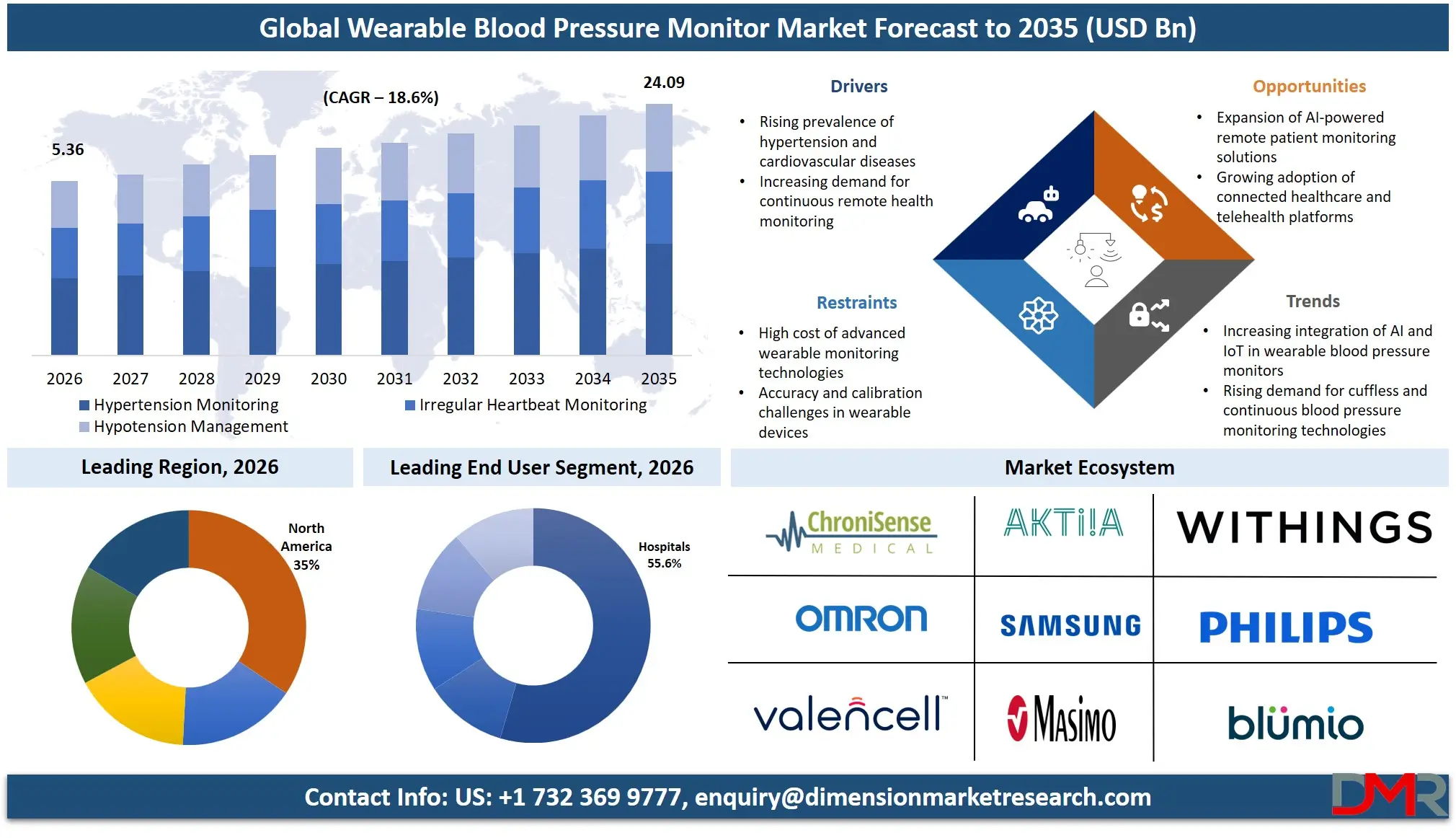
- The market size is USD 4.52 Billion in 2025, reached USD 5.36 Billion in 2026, and is projected to hit USD 24.09 Billion by 2035 at a CAGR of 18.60%.
- Hospitals and Clinics lead the By End User segment with a 55.6% revenue share in 2026.
- Oscillometric Technology commands the By Technology segment with a 71.8% revenue share in 2026.
- Wrist-Worn Blood Pressure Monitors hold a 56.2% volume share in the By Product Category segment in 2026.
- Hypertension Monitoring accounts for a 61.50% revenue share in the By Clinical Application segment in 2026.
- North America leads all regions with a 35.0% revenue share in 2026.
Market Overview
The global wearable blood pressure monitor market covers devices that continuously or periodically measure blood pressure without a traditional inflatable upper-arm cuff during normal daily activity. Products in scope include wrist-worn smartwatches with integrated sensors, patch-based continuous monitoring devices, finger-worn rings, flexible band devices, and arm-worn cuffless wearables. Traditional stationary blood pressure machines used in clinical settings without wearable functionality fall outside Wearable Blood Pressure Monitor Market's scope.
ℹ
To learn more about this report –
Download Your Free Sample Report Here
Approximately 1 billion people worldwide live with hypertension, as noted in Omron corporate filings. That scale of underlying clinical need creates persistent structural pressure on healthcare systems to shift monitoring from periodic clinic visits to continuous passive tracking. Wearable BP devices answer that pressure by moving measurement out of the clinic and into the patient's daily environment. For medical device manufacturers, this means competing on accuracy, regulatory clearance, and user compliance simultaneously rather than on any single dimension.
Wearable Blood Pressure Monitor Market sits at the intersection of consumer electronics and regulated medical devices. Consumer electronics companies bring distribution scale and software ecosystems. Specialized medical device firms bring clinical validation depth and reimbursement access. The two strategies are converging rapidly as FDA OTC clearances lower the prescription barrier and consumer platforms add clinical-grade accuracy ambitions. Vendors that achieved clinical validation before the 2025 to 2026 clearance wave now hold a structural first-mover position that will be difficult to displace once proprietary patient data pools accumulate.
Market Size and Forecast
The Global Wearable Blood Pressure Monitor Market size is estimated at USD 5.36 Billion in 2026 from USD 4.52 Billion in 2025, and is projected to reach USD 24.09 Billion by 2035, exhibiting a CAGR of 18.60% during the forecast period.
Two structural accelerants anchor this forecast. The first is regulatory. FDA OTC clearances for cuffless wrist wearables entering the U.S. market by 2026 directly lower the consumer adoption barrier outside clinical settings. The second is distribution. Samsung's 2026 U.S. market activation of wrist-based BP tracking places the technology in front of tens of millions of existing Galaxy Watch users without requiring a new device purchase decision. Aktiia's prior FDA OTC clearance in 2025 provided the regulatory template Samsung and other entrants used to accelerate their own U.S. filings. Vendors that reached clinical validation before these approvals now hold first-mover positions that compound as user data pools accumulate.
The forecast assumes continued FDA OTC clearance activity, sustained hospital procurement of continuous monitoring devices, and successful commercial scaling by next-generation platform entrants. Downside risk concentrates in accuracy constraints. Clinical studies show that real-world wearable BP devices produce unreliable or unusable readings under active conditions, which delays hospital-grade reimbursement decisions and slows institutional adoption curves beyond what consumer market momentum alone can offset.
End User Analysis
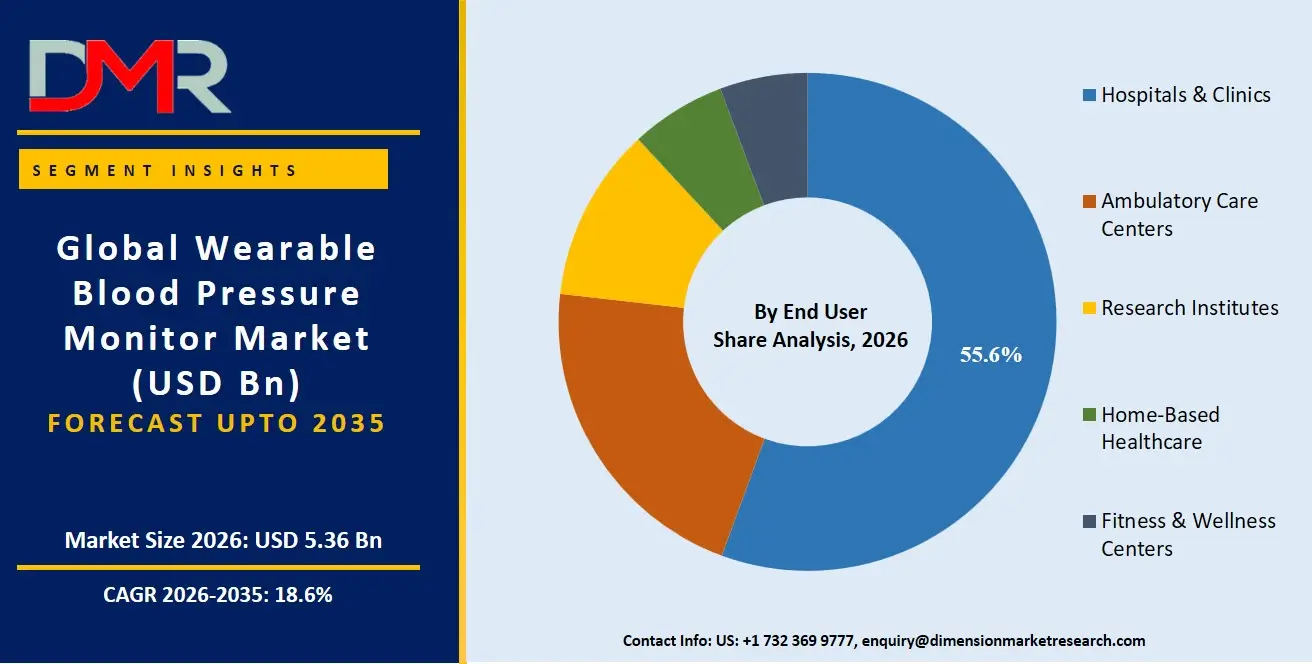
Hospitals and Clinics led the end user segment with a 55.6% share in 2026.
ℹ
To learn more about this report –
Download Your Free Sample Report Here
Hospitals and Clinics hold a 55.6% end user share because continuous hemodynamic data serves direct operational needs in post-operative monitoring, hypertension management protocols, and inpatient cardiovascular assessment. Wearable BP devices reduce nursing workload by replacing manual cuff checks with automated continuous readings. That direct cost and labor reduction justifies procurement budgets within hospital systems in ways that consumer health arguments alone cannot.
Ambulatory Care Centers and Research Institutes represent the next institutional demand tier, driven by outpatient chronic disease management and clinical trial data collection. Home-Based Healthcare is the segment carrying the highest volume growth potential. FDA OTC clearances remove the prescription requirement that previously confined wearable BP devices to clinical settings, allowing hypertension patients to monitor independently without a provider intermediary. Fitness and Wellness Centers occupy the smallest share today but signal a longer-term crossover between consumer health tracking and medical-grade BP measurement as accuracy standards improve.
Technology Analysis
With a 71.8% share in 2026, Oscillometric Technology outpaced all other technology categories.
Oscillometric Technology holds a 71.8% revenue share because ISO 81060-2:2018 accuracy standards were written around oscillometric performance. Any cuffless technology seeking clinical acceptance must show equivalence to oscillometric readings, which entrenches the technology even as competitors invest heavily in alternatives. That validation dependency gives oscillometric devices a structural durability in clinical procurement that newer sensor approaches have not yet displaced.
Optical Sensor Technology, covering both Remote PPG via Camera and Single-Site PPG Waveform Analysis, is the fastest-moving challenger. Machine learning now extracts BP features from single-site PPG without a secondary ECG input, simplifying hardware significantly and reducing the cost and calibration complexity that dual-sensor architectures require.
Pulse Transit Time methods using ECG and PPG fusion remain technically validated but carry that same dual-sensor burden. Arterial Tonometry, Auscultatory Technology, Piezoelectric Technology, and the Volume-Control Method each serve niche applications where specific physiological or form-factor requirements favor them over mainstream alternatives. Commercial momentum sits squarely with optical sensor approaches as consumer device manufacturers scale PPG integration across existing smartwatch platforms.
Product Category Analysis
Wrist-Worn Blood Pressure Monitors captured 56.2% of the product category segment in 2026, ahead of all rivals.
Wrist-Worn Blood Pressure Monitors hold a 56.2% volume share because the existing smartwatch install base that Samsung and Aktiia now activate for BP tracking provides established consumer familiarity, retail distribution, and software ecosystem integration that purpose-built medical devices cannot easily replicate. The wrist format wins on convenience. Patch-based monitors win on clinical data density. Biobeat's chest patch captures BP data every 15 minutes over 24 hours, a data cadence no wrist device currently matches at equivalent accuracy, per CMS regulatory filing from June 2025.
Arm-Worn Wearables, including Upper Arm and Cuff-Based formats, retain relevance in clinical settings where oscillometric accuracy remains non-negotiable. Flexible Band Devices using MXene nanosheets and TPU nanofibers are still in early commercial stages but offer breathable form factors suited to long-duration monitoring where patient comfort drives compliance. Sky Labs' CART BP ring supports a systolic BP range of 70 to 180 mmHg with a 72-hour battery life for uninterrupted multi-day tracking, per Sky Labs 2025 data, occupying a distinct niche for users who cannot tolerate wrist-worn formats. Each product sub-category serves a defined clinical or consumer need. No single format dominates across all use cases simultaneously.
Clinical Application Analysis
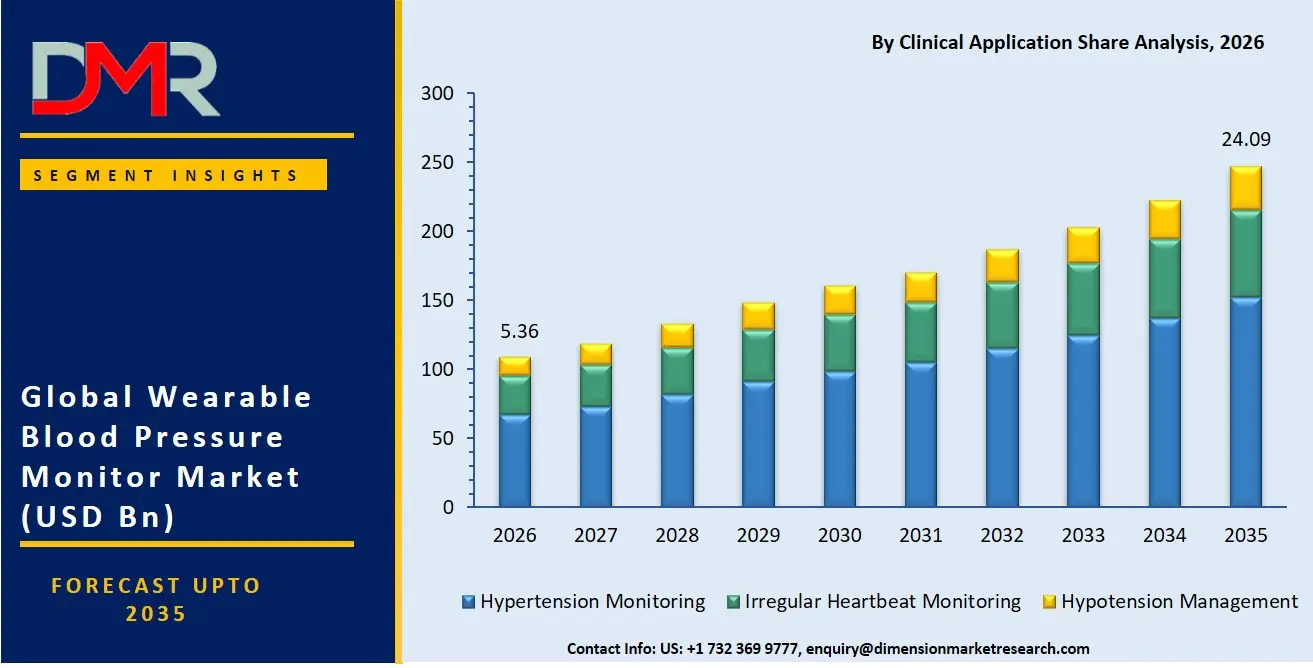
Hypertension Monitoring dominates with 61.50% due to structural global patient volume and 24-hour profiling advantages.
ℹ
To learn more about this report –
Download Your Free Sample Report Here
Hypertension Monitoring commands a 61.50% clinical application share because the underlying patient population is structural rather than cyclical. Continuous wearable monitoring delivers 24-hour BP profiles that single clinic readings cannot provide, which directly improves treatment decisions for uncontrolled or masked hypertension cases where episodic readings miss the diagnostic picture entirely.
Irregular Heartbeat Monitoring is the natural adjacent application. Most wearable BP devices already integrate optical or ECG sensors capable of arrhythmia detection, which means device manufacturers combining BP and cardiac rhythm monitoring in a single platform reduce the number of devices a patient must wear. Hypotension Management serves a smaller but clinically acute population, particularly post-surgical patients and those on antihypertensive regimens where BP drops require immediate clinical response rather than next-appointment follow-up.
Distribution Channel Analysis
A majority of revenue flows through Offline Retail and Clinical Sales channels, anchored by hospital procurement cycles.
Offline Retail and Clinical Sales currently anchor revenue for hospital-grade and prescription-pathway devices. Procurement cycles, clinical validation requirements, and reimbursement codes favor direct sales relationships over consumer e-commerce for these products. That channel suits established incumbents with existing hospital contracts and validated clinical evidence bases.
Online Sales Channels, spanning eCommerce Platforms, Manufacturer Websites, Direct-to-Consumer Sales, Subscription-Based Programs, and Device Bundle Packages, are structurally better suited to the OTC-cleared consumer market that FDA approvals are now opening. Subscription and bundle models convert a one-time device sale into recurring software and data service revenue. Manufacturers that build proprietary platforms alongside hardware will generate higher lifetime customer value than those selling devices alone, a dynamic that rewards early investment in platform architecture over pure hardware margin optimization.
Target Patient Population Analysis
The Geriatric Population leads the target patient population segment as the highest-prevalence hypertension demographic.
Older patients carry the highest prevalence of hypertension, cardiovascular comorbidities, and need for continuous monitoring outside hospital settings. Wearable BP devices address the clinical gap between infrequent outpatient visits and the daily BP variability that geriatric patients experience as a function of age-related vascular changes and polypharmacy interactions.
Pregnancy and Pre-eclampsia Monitoring is the high-growth niche within this segment. Pre-eclampsia onset is unpredictable and clinically dangerous, making continuous ambulatory BP monitoring during pregnancy a compelling use case with measurable outcome improvement potential. Specialized patents filed in 2024 and 2025 target this subgroup specifically, signaling that device manufacturers view it as a near-term regulatory pathway with a clearly defined patient need, a defined clinical endpoint, and faster approval timelines than broad consumer market submissions.
Key Market Segments
By End User
- Hospitals & Clinics
- Ambulatory Care Centers
- Research Institutes
- Home-Based Healthcare
- Fitness & Wellness Centers
By Technology
- Oscillometric Technology
- Optical Sensor Technology
- Remote PPG via Camera
- Single-Site PPG Waveform Analysis
- Arterial Tonometry
- Pulse Transit Time Method
- Pulse Transit Time (ECG + PPG Fusion)
- Auscultatory Technology
- Piezoelectric Technology
- Volume-Control Method
By Product Category
- Wrist-Worn Blood Pressure Monitors
- Patch-Based Blood Pressure Monitors
- Continuous Monitoring Patches
- Disposable Patches
- Arm-Worn Blood Pressure Monitors
- Upper Arm Wearables
- Cuff-Based Wearables
- Flexible Band Devices
- Finger Blood Pressure Monitors
By Distribution Channel
- Offline Retail & Clinical Sales
- Online Sales Channels
- eCommerce Platforms
- Manufacturer Websites
- Direct-to-Consumer Sales
- Subscription-Based Programs
- Device Bundle Packages
By Clinical Application
- Hypertension Monitoring
- Irregular Heartbeat Monitoring
- Hypotension Management
By Target Patient Population
- Geriatric Population
- Pregnancy & Preeclampsia Monitoring
Regional Analysis
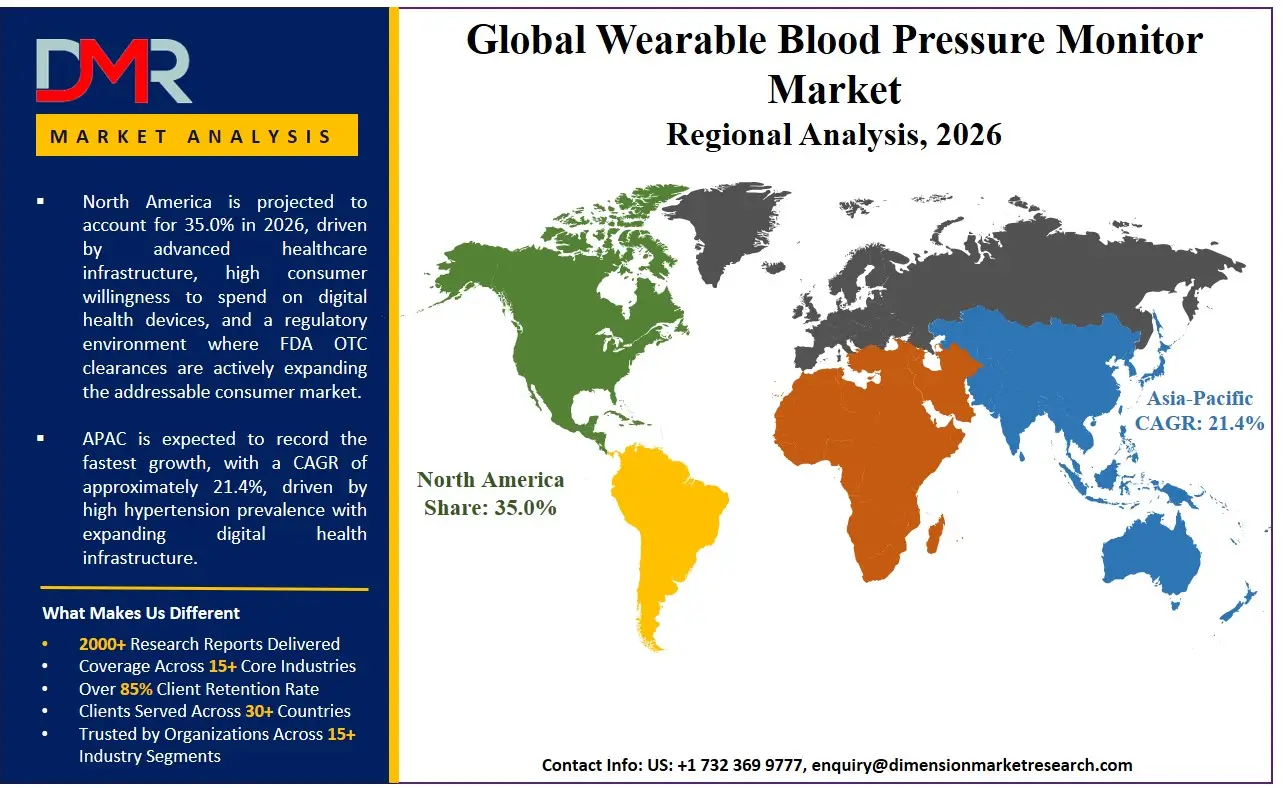
North America held a 35.0% share in 2026, valued at USD 1.58 Billion.
ℹ
To learn more about this report –
Download Your Free Sample Report Here
North America's lead reflects advanced healthcare infrastructure, high consumer willingness to spend on digital health devices, and a regulatory environment where FDA OTC clearances are actively expanding the addressable consumer market. Samsung's March 2026 launch of blood pressure monitoring for Galaxy Watch users in the United States reinforces North America's role as the primary commercialization arena for next-generation wearable BP platforms. No other region has a comparable combination of reimbursement depth, specialist network density, and consumer electronics penetration operating simultaneously.
Europe follows as the second-largest region. CE Class IIa certification pathways that Hilo used to commercially launch its continuous BP wristband in 2026 confirm that European regulatory infrastructure is actively processing consumer-facing wearable BP approvals. Asia Pacific holds strong growth potential. South Korea's Sky Labs holds Ministry of Food and Drug Safety certification and active commercial deployment of its CART BP ring for 24-hour clinical tracking. The region combines high hypertension prevalence with expanding digital health infrastructure. Latin America and Middle East and Africa currently represent smaller revenue bases, but direct-to-cloud telemetry architectures that reduce dependence on local clinical infrastructure lower the cost of serving these markets as global regulatory clearances multiply.
Key Regions and Countries
North America
Europe
- Germany
- France
- The UK
- Spain
- Italy
- Rest of Europe
Asia Pacific
- China
- Japan
- South Korea
- India
- Australia
- Rest of APAC
Latin America
- Brazil
- Mexico
- Rest of Latin America
Middle East & Africa
- GCC
- South Africa
- Rest of MEA
Market Dynamics
FDA Clearances and Consumer Platform Entry Open the Mass Market
Samsung's March 2026 rollout of blood pressure tracking through the Samsung Health app for Galaxy Watch users in the United States is a distribution event, not merely a product launch. Samsung ships wearables at scale to tens of millions of consumers annually. Once BP monitoring reaches that install base, clinical-grade standalone devices face a structurally different competitive environment than they occupied before. Aktiia's prior FDA OTC clearance in 2025 provided the regulatory template that Samsung and other consumer electronics entrants used to accelerate their own U.S. filings, creating a pathway that now benefits the entire category.
Established medical device incumbents are responding by filing continuous BP wearable architecture patents. Philips and Masimo filed continuous BP wearable architecture patents in 2024 and 2025, signaling that large incumbent players view Wearable Blood Pressure Monitor Market as a strategic priority rather than a peripheral opportunity. The 2026 WEARABLE-BP academic trial evaluates 24/7 optical sensors against traditional daytime ambulatory methods. That shift from episodic to continuous clinical validation will define which technologies earn hospital-grade reimbursement and which remain confined to the consumer channel.
Calibration Dependency and Sensor Drift Limit Clinical Uptake
Samsung's Galaxy Watch requires upper-arm cuff recalibration every 28 days to maintain accuracy, per Samsung's own support documentation from May 2026. That dependency on a secondary device directly undermines the core consumer value proposition of a cuffless wearable. Users who skip recalibration produce unreliable readings, creating clinical liability for providers who incorporate that data into treatment decisions. A Biobeat clinical study showed analyzable data for only 61.5% of monitored time, confirming that signal loss under real-world conditions remains a persistent technical failure point, per PMC/NCBI April 2026 data.
ISO 81060-2:2018 standards mandate accuracy within plus or minus 5 mmHg. Aktiia's daytime systolic BP mean difference of 1.2 plus or minus 12.4 mmHg versus a 24-hour ABPM standard, per PMC/NCBI 2024 data, shows that even leading clinical platforms carry measurement variance that exceeds the ISO threshold under certain conditions. Until sensor accuracy stabilizes across patient movement profiles, hospital adoption will remain selective. Payers require consistent real-world accuracy before extending reimbursement to a new monitoring modality, regardless of how strong the consumer market signal appears.
High-Risk Niches and RPM Integration Create Faster Revenue Pathways
Pre-eclampsia monitoring and acute triage assessment are underserved clinical niches where continuous BP tracking offers measurable outcome improvements over traditional intermittent measurement. Specialized patents filed in 2024 and 2025 targeting these high-risk subgroups show that device manufacturers see faster regulatory approvals in defined pathological populations than in broad consumer markets. Entering through these niches allows manufacturers to build clinical evidence before attempting wider OTC clearances. LiveMetric's May 2026 partnership with CCN Health integrated the FDA-cleared LiveOne device, which captures BP every 10 seconds using MEMS nano-sensor technology, into a clinical RPM platform, per disclosed partnership terms.
Direct-to-cloud telemetry through multi-carrier eSIM integration and ultra-low power transfer protocols is reshaping remote patient monitoring architecture. When a wearable BP device connects directly to a provider platform, it generates billable remote patient monitoring encounters. That billing model converts a hardware sale into recurring clinical services revenue, which changes the commercial calculus for both device manufacturers and the health systems that deploy them. RPM reimbursement is the mechanism that bridges consumer device adoption and clinical system procurement in a single commercial framework.
Market Trends
Edge AI and Single-Site PPG Move BP Intelligence Onto the Device
Single-site photoplethysmography is outpacing dual-sensor architectures as machine learning extracts BP features without requiring secondary ECG inputs. Device manufacturers are moving neural network inference directly onto wearable chips, bypassing cloud latency for immediate hemodynamic scoring. The Cardio Watch 287 yielded analyzable vital sign data ranging from 34% to 100% depending on physical activity level, per PMC/NCBI April 2026 data, confirming that on-device intelligence must improve before edge AI delivers consistent clinical-grade output across patient movement profiles. Early movers embedding trained models on-device gain a competitive advantage in clinical triage settings where real-time decisions cannot wait for a cloud round-trip, but only if underlying sensor accuracy holds across the full patient activity spectrum.
Market Competition Overview
The wearable blood pressure monitor market is fragmented, with no single player holding commanding share across all product categories and geographies simultaneously. Consumer electronics giants compete on distribution scale and software ecosystems. Specialized medical device firms compete on clinical validation and regulatory clearances. Both strategies are converging. Samsung's consumer reach now pairs with clinical-grade accuracy ambitions, while Aktiia's clinical pedigree now targets consumer retail through its Hilo rebrand. Hilo's commercial launch of its FDA-cleared and CE Class IIa certified continuous BP monitoring wristband in 2026 confirms that the most advanced pure-play clinical platforms are now pursuing the same consumer channels that consumer electronics firms are entering from the opposite direction.
Competitive dynamics are shifting toward data platform control rather than hardware alone. Aktiia reports a pool of over 20 million optical measurements used to refine its cuffless algorithm, per market data, building an algorithm advantage that hardware investment alone cannot replicate. Prothena recorded full year 2024 R&D expenses of $222.5 million across its neurodegenerative pipeline as a reference benchmark for the capital scale serious clinical platform development requires. Subscription and RPM platform integrations create recurring revenue that changes the competitive calculus from device margin to lifetime patient value. Players entering now without a clear data strategy risk becoming commodity hardware suppliers in a market where the software and analytics layer captures disproportionate commercial value.
Company Profiles
OMRON Corporation built its competitive position on the world's largest blood pressure monitor install base, reaching 20.01 million units sold in FY2019 alone, per Omron's Integrated Report 2020. Blood pressure monitors accounted for 51% of Omron's Healthcare Business revenue in FY2017, per its Annual Report 2017, establishing a clinical brand trust that newer wearable entrants must work against rather than ignore. That legacy provides Omron with an unmatched volume of patient calibration data and a trusted clinical relationship with hospital procurement teams. Omron's pivot toward wearable and continuous tracking devices builds on that foundation, though its oscillometric heritage is most defensible in the clinical channel while the fastest-growing consumer opportunity favors cuffless optical approaches where it does not hold the same incumbency advantage.
Aktiia, now rebranded as Hilo following its oversubscribed Series B in May 2025, represents the most advanced pure-play cuffless BP monitoring platform in commercial deployment. A concordance rate of 79% against ambulatory BP monitoring for nocturnal dipping, validated in a peer-reviewed study of 54 patients per PMC/NCBI 2024 data, gives Hilo a clinical evidence base that consumer electronics entrants have not yet matched at equivalent study rigor. FDA OTC clearance and CE Class IIa certification position it as the clinical benchmark for optical wrist-based BP tracking across both major Western regulatory jurisdictions. The primary risk is scale. Building consumer distribution from a clinical device background requires marketing investment and retail partnerships that differ fundamentally from the B2B clinical sales model that established Hilo's clinical reputation.
Key Players
- Samsung Electronics Co Ltd
- Aktiia
- OMRON Corporation
- Chronisense Medical Ltd
- Koninklijke Philips N.V.
- Masimo Corporation
- Valencell
- Withings
- Blumio
- Leman Micro Devices
Supply Chain and Value Chain Analysis
The wearable BP monitor value chain begins with specialized component suppliers providing photoplethysmography sensors, MEMS nano-sensor arrays, flexible substrate materials including MXene nanosheets and TPU nanofibers, and low-power microprocessors capable of on-device neural network inference. Maximum value concentration sits at two nodes: sensor miniaturization and algorithm development. Both require years of proprietary R&D investment that off-the-shelf component assembly cannot replicate. Device assembly and consumer packaging add margin but are largely commoditized, which is why hardware alone does not generate durable competitive advantage in Wearable Blood Pressure Monitor Market.
The downstream bottleneck is clinical validation and regulatory clearance. A device that passes FDA OTC review or CE Class IIa certification commands a price premium and gains access to hospital procurement and RPM reimbursement pathways that non-cleared devices cannot reach. Sky Labs' Ministry of Food and Drug Safety certification in South Korea and Hilo's dual FDA and CE clearances show how regulatory approval functions as a market access gate rather than a quality stamp. Manufacturers without cleared products are structurally excluded from the clinical and insurance-reimbursed segments, confining them to the lower-margin direct consumer channel where pricing pressure is highest and switching costs are lowest.
Regulatory Landscape
ISO 81060-2:2018 governs blood pressure measurement device accuracy, mandating a mean error within plus or minus 5 mmHg across a validated patient population. Every wearable BP device seeking clinical acceptance must show equivalence to this benchmark. Aktiia validated its initialization cuff on 99 subjects in Zhongshan, China, meeting ANSI/AAMI/ISO 81060-2:2013 accuracy standards, per PMC/NCBI 2023 data, establishing the clinical validation methodology that subsequent FDA OTC applicants have followed. Motion artifacts and PPG sensor drift in 2025 to 2026 product generations remain the primary technical barriers to consistent real-world compliance with these standards.
The FDA OTC clearance pathway has become the strategic regulatory target for consumer-facing wearable BP devices entering the United States. Aktiia's 2025 FDA OTC clearance established the precedent, enabling Samsung's 2026 Galaxy Watch BP feature launch without a prescription requirement. In South Korea, Ministry of Food and Drug Safety certification provides Sky Labs market authorization for clinical BP tracking outside hospitals. CE Class IIa certification governs European market access, a pathway Hilo used to commercially launch its continuous BP wristband in 2026. Each regulatory jurisdiction carries its own accuracy validation, post-market surveillance, and labeling requirements, meaning a multi-region commercial strategy requires parallel regulatory investment rather than sequential filing.
Investment and White Space Analysis
Investment is concentrating in companies that combine clinical validation with consumer distribution ambitions. Biobeat closed a $50 million Series B in December 2025 to expand U.S. commercialization of its continuous ambulatory BP monitoring system. Aktiia raised an oversubscribed $42 million Series B in May 2025, simultaneously rebranding to Hilo to signal its consumer market pivot. Sky Labs secured KRW 11.5 billion, approximately $8 million, in pre-IPO funding in December 2025 for clinical R&D and global expansion of its CART BP ring. The size differential between these rounds reflects a market still rewarding clinical credibility over pure scale, but the Hilo rebrand signals that investors expect consumer volume to follow regulatory clearance in the next commercial cycle.
The clearest white space sits at the intersection of high-risk patient monitoring and remote care reimbursement. Pre-eclampsia and acute triage monitoring are underserved by current consumer devices but carry faster regulatory pathways and higher per-patient reimbursement potential than general hypertension tracking. Acumen Pharmaceuticals held a cash and marketable securities position of $296.6 million as of March 31, 2024, per its May 2024 disclosure, providing a reference point for the capital depth that serious clinical platform advancement requires. Asia Pacific markets beyond South Korea offer high hypertension prevalence with underpenetrated wearable monitoring infrastructure. Direct-to-cloud eSIM architectures reduce the need for local clinical distribution networks, lowering market entry costs for manufacturers already holding multi-region regulatory clearances.
Recent Developments
- 2026: Sky Labs. Commercialization. The company actively commercialized the CART BP ring for continuous 24-hour BP monitoring using PPG sensors, certified by South Korea's Ministry of Food and Drug Safety for clinical use outside hospitals.
- December 2025: Biobeat Technologies. Series B Funding. The company closed a $50 million Series B financing round to expand commercialization of its continuous ambulatory blood pressure monitoring system in the United States.
- May 2025: Aktiia. Series B Funding and Rebrand. The company announced an oversubscribed $42 million Series B and rebranded to Hilo to accelerate its cuffless BP monitoring platform toward consumer markets alongside its clinical positioning.
- December 2025: Sky Labs. Pre-IPO Funding. The company raised KRW 11.5 billion, approximately $8 million, in pre-IPO funding to support clinical R&D and global market expansion of its CART BP ring platform.
Report Details
| Report Characteristics |
| Market Value (2025) |
USD 4.52 Billion |
| Market Value (2026) |
USD 5.36 Billion |
| Forecast Revenue (2035) |
USD 24.09 Billion |
| CAGR (2026–2035) |
18.60% |
| Base Year for Estimation |
2025 |
| Historic Period |
2020 – 2024 |
| Forecast Period |
2026 – 2035 |
| Report Coverage |
Revenue Forecast, Market Dynamics, Competitive Landscape, Recent Developments |
| Segments Covered |
By End User (Hospitals & Clinics, Ambulatory Care Centers, Research Institutes, Home-Based Healthcare, Fitness & Wellness Centers), By Technology (Oscillometric Technology, Optical Sensor Technology, Arterial Tonometry, Pulse Transit Time Method, Auscultatory Technology, Piezoelectric Technology, Volume-Control Method), By Product Category (Wrist-Worn, Patch-Based, Arm-Worn, Flexible Band, Finger Blood Pressure Monitors), By Distribution Channel (Offline Retail & Clinical Sales, Online Sales Channels), By Clinical Application (Hypertension Monitoring, Irregular Heartbeat Monitoring, Hypotension Management), By Target Patient Population (Geriatric Population, Pregnancy & Preeclampsia Monitoring) |
| Regional Analysis |
North America – US and Canada; Europe – Germany, France, The UK, Spain, Italy, and Rest of Europe; Asia-Pacific – China, Japan, South Korea, India, Australia, and Rest of APAC; Latin America – Brazil, Mexico, and Rest of Latin America; Middle East & Africa – GCC, South Africa, and Rest of MEA |
| Competitive Landscape |
Samsung Electronics Co Ltd, Aktiia, OMRON Corporation, Chronisense Medical Ltd, Koninklijke Philips N.V., Masimo Corporation, Valencell, Withings, Blumio, Leman Micro Devices |
| Customization Scope |
Customization for segments and region or country level will be provided. Additional customization can be done based on requirements. |
| Purchase Options |
Three license options: Single User License, Multi-User License (Up to 5 Users), Corporate Use License (Unlimited Users and Printable PDF). |
Frequently Asked Questions
What is the biggest investment opportunity in Wearable Blood Pressure Monitor Market?
▾ High-risk patient monitoring combined with RPM reimbursement integration represents the highest-conviction opportunity. Biobeat raised $50 million and Hilo raised $42 million in 2025 specifically because continuous ambulatory BP monitoring tied to clinical platforms generates recurring revenue that one-time device sales cannot. Pre-eclampsia and acute triage monitoring carry faster regulatory pathways and higher reimbursement potential than general consumer hypertension tracking.
Who are the top companies in Wearable Blood Pressure Monitor Market?
▾ Samsung Electronics, OMRON Corporation, and Hilo (formerly Aktiia) hold the strongest competitive positions across consumer distribution, clinical install base, and regulatory clearance respectively. Masimo, Philips, and Valencell filed continuous BP wearable patents in 2024 and 2025, signaling active entry strategies from established medical device incumbents. Sky Labs and Biobeat represent the most clinically advanced pure-play challengers in continuous monitoring.
Which segment is growing fastest in Wearable Blood Pressure Monitor Market and why?
▾ Home-Based Healthcare within the By End User segment and Online Sales Channels within the By Distribution Channel segment are the fastest-shifting categories. FDA OTC clearances remove the prescription requirement that previously confined wearable BP devices to clinical settings. Subscription and device bundle models within direct-to-consumer online channels convert hardware sales into recurring platform revenue, which is structurally more attractive to manufacturers than single-unit device margins.
Which region is growing fastest in Wearable Blood Pressure Monitor Market and why?
▾ Asia Pacific shows the strongest forward growth trajectory outside North America. South Korea's Sky Labs holds MFDS clinical certification and active commercial deployment. The region combines high hypertension prevalence with expanding digital health infrastructure. Direct-to-cloud eSIM architectures reduce dependence on local clinical networks, lowering market entry costs for globally cleared devices targeting the region's large unmonitored hypertension population.
What is the market size of the Wearable Blood Pressure Monitor Market?
▾ The global Wearable Blood Pressure Monitor Market was valued at USD 4.52 Billion in 2025 and reached USD 5.36 Billion in 2026. The market is projected to reach USD 24.09 Billion by 2035, growing at a CAGR of 18.60% through the forecast period.