What is the Wireless Healthcare Asset Management Market Size?
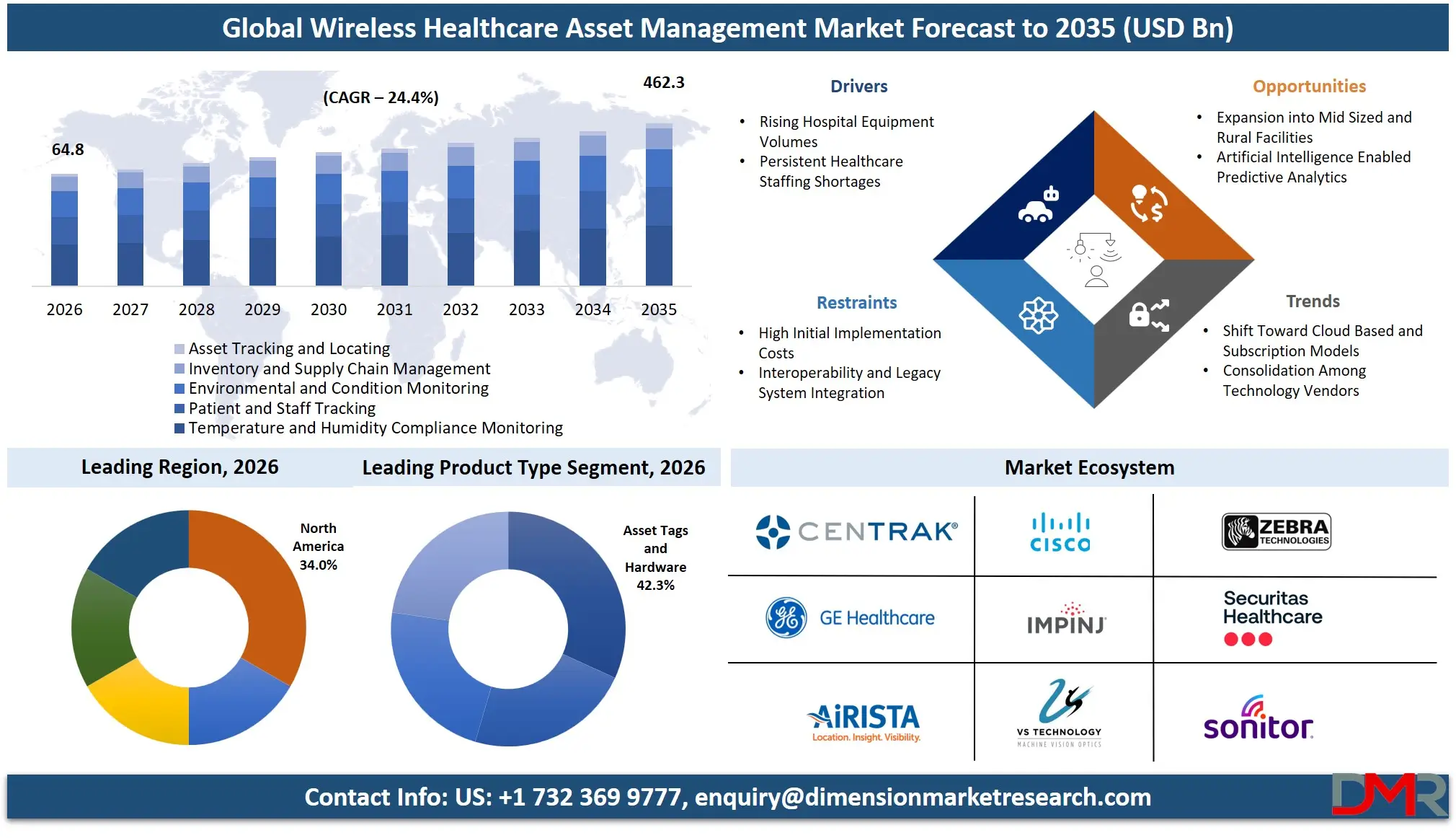
The Global Wireless Healthcare Asset Management Market is projected to be valued at USD 64.8 billion in 2026 and is projected to reach USD 462.3 billion by 2035, advancing at a compound annual growth rate of 24.4%.
ℹ
To learn more about this report –
Download Your Free Sample Report Here
Growth is anchored in the rising complexity of hospital inventories, where mobile devices, infusion pumps and diagnostic tools must be located and maintained in real time. According to World Health Organization data, global health spending reached USD 9.8 trillion in 2022, equal to 9.9% of global gross domestic product, underscoring the scale of infrastructure that hospitals must now track digitally. As facilities modernize under tighter budgets, wireless tagging and sensor networks are becoming a default layer for equipment visibility. Looking ahead, deeper integration of radio frequency identification with hospital information systems, alongside predictive maintenance analytics, is set to widen adoption across mid sized and rural facilities, extending the market's reach well beyond flagship urban hospitals.
The US Wireless Healthcare Asset Management Market
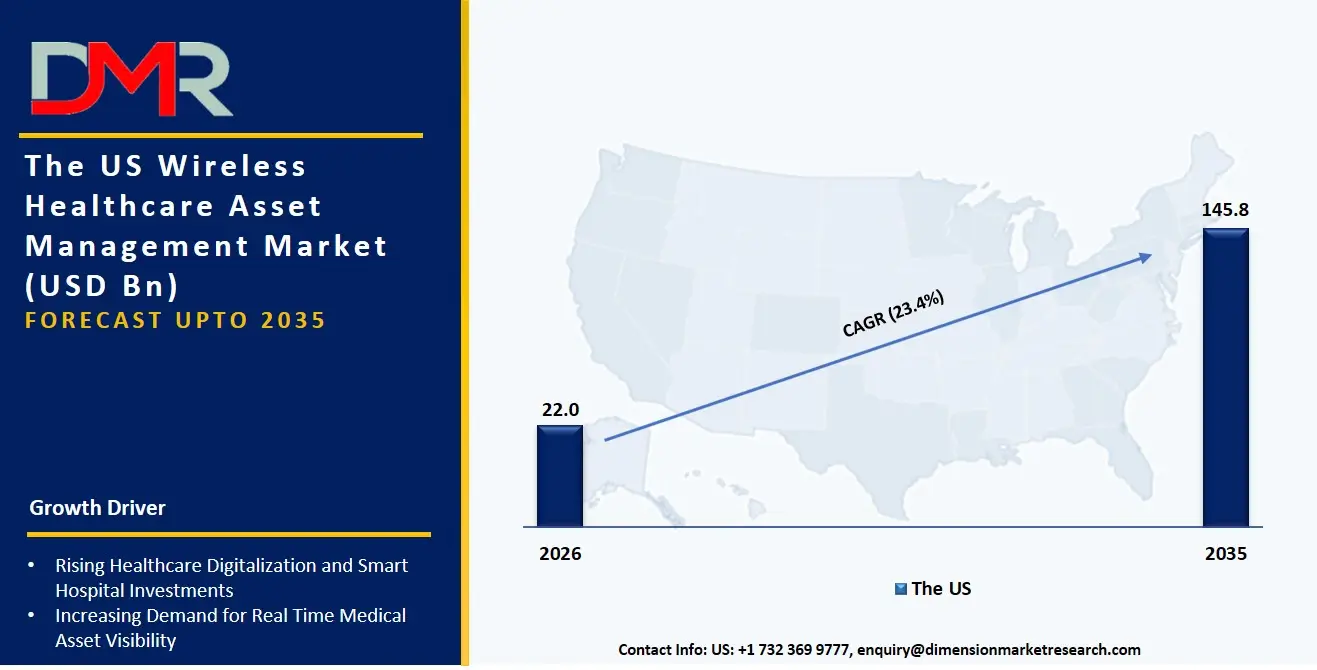
The US Wireless Healthcare Asset Management Market is poised to be valued at USD 22.0 billion in 2026 and is projected to reach USD 145.8 billion by 2035, expanding at a compound annual growth rate of 23.4%.
ℹ
To learn more about this report –
Download Your Free Sample Report Here
The United States remains the largest single national contributor to global healthcare spending, with the Centers for Medicare and Medicaid Services reporting national health expenditure of USD 5.3 trillion in 2024, a rise of 7.2% over the prior year. This scale of spending, concentrated in a dense network of hospitals and outpatient facilities, creates continuous pressure to track costly mobile equipment efficiently. Growth going forward will be shaped by hospital consolidation, ongoing staffing shortages that limit manual inventory checks, and reimbursement models that reward operational efficiency. Wireless asset visibility is increasingly viewed as a prerequisite for meeting compliance and safety mandates across large, multi-site health systems nationwide.
The Europe Wireless Healthcare Asset Management Market
Europe Wireless Healthcare Asset Management Market is valued at USD 16.2 billion in 2026 at a compound annual growth rate of 22.7%. Eurostat reports that current healthcare expenditure across the European Union reached EUR 1,720 billion in 2023, equal to 10.0% of gross domestic product, with Germany and France recording the highest spending ratios. This spending is spread across large public hospital networks facing mounting pressure to modernize aging equipment tracking practices. Regulatory harmonization under European Union medical device rules is pushing hospitals toward traceable, wireless enabled asset registries. Over the coming years, national digitization programs in Germany, France and the United Kingdom, combined with cross border interoperability standards, are expected to accelerate adoption of asset tagging and sensor-based monitoring across public and private healthcare networks.
The Japan Wireless Healthcare Asset Management Market
The Japan Wireless Healthcare Asset Management Market is valued at USD 2.3 billion in growing at a compound annual growth rate of 21.3%. Japan's Ministry of Health, Labour and Welfare reported national medical expenditure of JPY 48.1 trillion in fiscal 2023, a record high driven largely by an aging population, with patients aged 65 and above accounting for roughly 60% of total spending. This demographic pressure is intensifying the need for efficient equipment utilization across hospitals already facing workforce shortages. Government backed digital health initiatives are encouraging wireless infrastructure upgrades in regional hospitals long reliant on manual asset logs. Going forward, integration with Japan's electronic health record modernization efforts is expected to steadily widen adoption beyond major metropolitan hospital networks into smaller regional facilities.
Key Takeaways
- Market Size: The Global Wireless Healthcare Asset Management Market is anticipated to be valued at USD 64.8 billion in 2026 and is projected to reach USD 462.3 billion by 2035, reflecting sustained expansion across hospitals, diagnostic centers and long term care facilities worldwide.
- Growth Rate and Outlook: The market is set to expand at a compound annual growth rate of 24.4% between 2026 and 2035, among the fastest trajectories within connected healthcare technology, driven by continuous digitization of hospital operations.
- Primary Growth Drivers: Growth stems from rising hospital equipment volumes, chronic staffing shortages limiting manual tracking, stricter regulatory compliance requirements, and expanding adoption of Internet of Things enabled sensors across clinical workflows.
- By Product Type Segment Analysis: Asset Tags and Hardware is poised to remains dominant, holding approximately 42.3% share in 2026, as hospitals prioritize foundational tagging before layering analytics onto existing asset registries.
- By Technology Segment Analysis: Wireless Sensors and Real Time Location Systems segment forms the second largest category at roughly 28.6% share, supporting room level tracking of high value mobile equipment across large hospital campuses.
- Regional Leadership: North America leads with an estimated 34.0% share in 2026, supported by dense hospital networks and early technology adoption, while Asia Pacific is forecast to post the fastest regional growth rate.
What is the Wireless Healthcare Asset Management?
Wireless Healthcare Asset Management refers to the use of radio frequency identification, Bluetooth, ultra-wideband and other wireless technologies to locate, monitor and maintain medical equipment, mobile devices and clinical assets across hospitals and healthcare facilities in real time. Rather than relying on manual logbooks or periodic physical audits, healthcare providers deploy wireless tags, sensors and centralized software platforms that continuously report equipment location, usage status and maintenance needs. According to the United States Bureau of Labor Statistics, the healthcare and social assistance sector is projected to be the fastest growing sector in the economy through 2034, adding roughly 2.0 million jobs, a trend that intensifies staffing constraints and makes automated, wireless equipment tracking increasingly essential rather than optional for daily hospital operations.
Use Cases
- Real Time Equipment Location: Nursing staff locate infusion pumps, ventilators and wheelchairs instantly through wireless tags. This eliminates time consuming manual searches across departments. Hospitals report meaningful reductions in equipment search time and rental costs.
- Preventive Maintenance Scheduling: Sensors flag equipment nearing service intervals automatically to biomedical engineering teams. This prevents unexpected breakdowns during procedures. Facilities extend asset lifespan while maintaining continuous regulatory compliance readiness.
- Cold Chain and Environmental Compliance: Wireless sensors continuously monitor temperature and humidity for vaccines, blood products and lab samples. Automated alerts flag deviations before spoilage occurs. This safeguards patient safety and reduces costly product losses.
- Staff and Patient Safety Monitoring: Wearable tags support duress alerts and contact tracing during infection outbreaks. Security teams respond faster to emergencies across large campuses. Hospitals strengthen both workplace safety and infection control protocols.
How AI is Transforming the Wireless Healthcare Asset Management Market?
Artificial intelligence is reshaping wireless healthcare asset management by converting raw location data into predictive operational insight. Rather than simply reporting where equipment sits, AI powered platforms from vendors such as Kontakt.io and Cognosos analyze historical movement patterns to forecast equipment shortages before they disrupt care. Machine learning models flag anomalous usage that may indicate theft, misplacement or impending mechanical failure, enabling biomedical teams to intervene proactively. Hospitals using AI driven analytics have reported measurable reductions in search time and equipment rental spend. Natural language interfaces are also emerging, allowing staff to query asset locations conversationally. As AI models mature, integration with electronic health record systems and staffing platforms is expected to deepen, aligning equipment availability directly with predicted patient volume and procedure schedules across departments.
Market Dynamics
Key Drivers in the Global Wireless Healthcare Asset Management Market
Rising Hospital Equipment Volumes
Modern hospitals manage thousands of mobile devices across departments, from infusion pumps to diagnostic imaging carts. Manual tracking of this scale is increasingly impractical, pushing facilities toward automated wireless registries. As equipment volumes rise alongside patient loads, administrators are prioritizing visibility solutions that reduce rental costs, prevent loss and shorten search times for nursing staff, directly supporting adoption of tagging and sensor infrastructure across both large urban hospitals and expanding regional healthcare networks.
Persistent Healthcare Staffing Shortages
Chronic shortages of nursing and biomedical engineering staff are reducing the capacity for manual equipment audits and inventory checks. Facilities are turning to automated wireless asset management as a direct substitute for labor intensive tracking processes, freeing clinical staff to focus on patient care. This driver is reinforced by workforce projections showing continued strong demand for healthcare labor, which sustains pressure to automate operational tasks including asset visibility and maintenance scheduling.
Restraints in the Global Wireless Healthcare Asset Management Market
High Initial Implementation Costs
Deploying wireless infrastructure, including readers, gateways and enterprise software licenses, requires substantial upfront capital that smaller hospitals and clinics may struggle to justify. Return on investment, while favorable over time, is not always immediate, discouraging budget constrained facilities from adopting comprehensive systems. This restraint is particularly pronounced in rural and lower income regions, where healthcare budgets remain tightly allocated toward direct patient care rather than operational technology investments, slowing broader market penetration.
Interoperability and Legacy System Integration
Many hospitals operate a patchwork of legacy information technology systems that were not designed to integrate with modern wireless asset platforms. Achieving seamless data exchange between asset management software and electronic health record or enterprise resource planning systems often requires custom integration work. This complexity extends implementation timelines, raises project costs and creates hesitancy among administrators evaluating whether new wireless deployments will function reliably within existing hospital technology environments.
Growth Opportunities in the Global Wireless Healthcare Asset Management Market
Expansion into Mid Sized and Rural Facilities
While large urban hospitals have led early adoption, mid sized and rural facilities represent a substantial underserved opportunity. As hardware costs decline and cloud based subscription models reduce upfront investment, smaller facilities can adopt scaled down wireless asset tracking deployments. Vendors offering modular, subscription priced platforms are well positioned to capture this expanding segment, particularly in regions where government digital health initiatives are actively subsidizing hospital technology modernization efforts.
Artificial Intelligence Enabled Predictive Analytics
Layering predictive analytics onto existing wireless tracking infrastructure represents a significant upsell opportunity for vendors. Hospitals that have already deployed basic tagging are natural candidates for software upgrades that forecast maintenance needs, equipment shortages and utilization inefficiencies. This creates a recurring software revenue opportunity beyond initial hardware sales, positioning analytics capable vendors to capture greater lifetime value from existing hospital customer relationships over the coming decade.
Trends in the Global Wireless Healthcare Asset Management Market
Shift Toward Cloud Based and Subscription Models
Vendors are increasingly moving away from large upfront hardware and licensing sales toward cloud hosted, subscription priced platforms. This trend lowers adoption barriers for smaller facilities and creates more predictable recurring revenue for vendors. Cloud deployment also simplifies software updates and multi site management for large hospital systems operating dozens of facilities across different regions under a single centralized asset visibility platform.
Consolidation Among Technology Vendors
The competitive landscape is experiencing notable merger and acquisition activity, as larger technology and security firms acquire specialized real time location system providers to broaden their healthcare portfolios. This consolidation is concentrating advanced capabilities, including analytics and Bluetooth Low Energy hardware, within fewer, larger vendors, while smaller specialized firms continue to compete in analytics driven and artificial intelligence enabled niche segments of the market.
Research Scope and Analysis
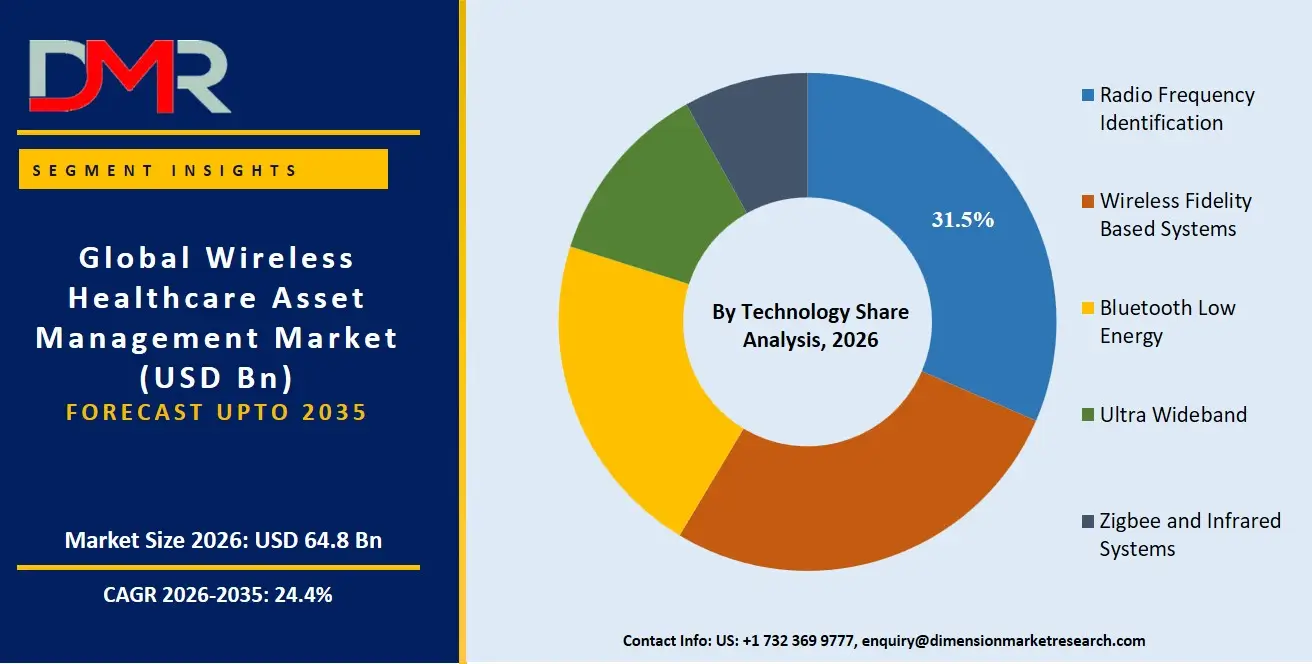
The healthcare asset tracking market is segmented by product type, technology, application, and end user to evaluate adoption patterns and growth opportunities. Asset tags and hardware dominate current deployments, while analytics platforms, Bluetooth Low Energy technology, asset tracking applications, and hospitals continue driving innovation and long-term market expansion.
ℹ
To learn more about this report –
Download Your Free Sample Report Here
By Product Type Analysis
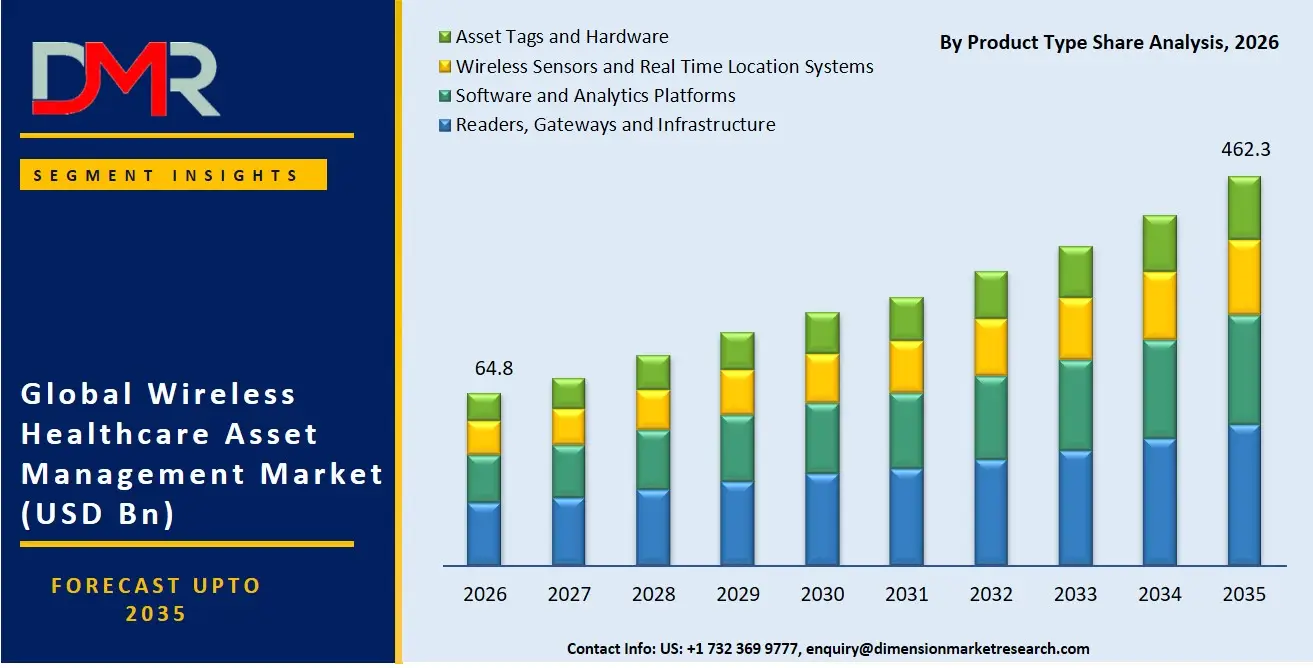
Within the Product Type segmentation, Asset Tags and Hardware is projected to lead with 42.3% share, followed by Wireless Sensors and Real Time Location Systems at 28.6%, while Software and Analytics Platforms post the fastest growth.
ℹ
To learn more about this report –
Download Your Free Sample Report Here
Hospitals typically progress along an adoption curve, beginning with basic tagging, layering sensor based location accuracy, and eventually adding analytics software once sufficient historical location data has accumulated. Readers, Gateways and Infrastructure round out the category as a smaller but essential enabling layer, since every tag and sensor deployment depends on adequately distributed reader coverage throughout hospital corridors, storage rooms and clinical departments to maintain uninterrupted real time visibility.
By Technology Analysis
Radio Frequency Identification is poised to remain the leading technology given its established reliability, low per unit tag cost and broad vendor ecosystem support across hospital procurement channels. Wireless Fidelity based systems benefit from leveraging existing hospital network infrastructure, reducing incremental deployment cost. Bluetooth Low Energy is gaining share rapidly due to low power consumption and compatibility with smartphone based reader infrastructure. Ultra Wideband delivers the highest positional accuracy, making it preferred for high value operating room equipment tracking, while Zigbee and Infrared Systems continue serving legacy deployments and specialized environmental monitoring applications within older hospital facilities.
By Application Analysis
Asset Tracking and Locating is expected to be the leading application, directly addressing the core need to reduce equipment search time and rental expenditure. Inventory and Supply Chain Management follows closely, as hospitals seek tighter control over consumable and reusable medical supplies. Environmental and Condition Monitoring is expanding steadily, driven by cold chain compliance requirements for vaccines and biologics. Patient and Staff Tracking supports both safety and workflow optimization objectives, while Temperature and Humidity Compliance Monitoring is increasingly bundled into broader asset visibility platforms rather than deployed as a standalone application.
By End User Analysis
Hospitals and Multi Specialty Centers is projected to represent the dominant end user category, reflecting their scale, equipment density and complex multi department operations that create the strongest business case for wireless asset visibility. Ambulatory Surgical Centers and Diagnostic and Imaging Centers are adopting more selectively, prioritizing high value imaging and surgical equipment. Long Term Care and Nursing Facilities are emerging adopters, often motivated by staff safety and resident monitoring use cases alongside asset tracking. Pharmaceutical and Biotechnology Companies primarily deploy environmental monitoring applications tied to cold chain compliance for temperature sensitive products.
The Global Wireless Healthcare Asset Management Market Report is segmented on the basis of the following:
By Product Type
- Asset Tags and Hardware
- Active Radio Frequency Identification Tags
- Passive Radio Frequency Identification Tags
- Battery Assisted Passive Tags
- Wireless Sensors and Real Time Location Systems
- Software and Analytics Platforms
- Readers, Gateways and Infrastructure
By Technology
- Radio Frequency Identification
- Wireless Fidelity Based Systems
- Bluetooth Low Energy
- Ultra Wideband
- Zigbee and Infrared Systems
By Application
- Asset Tracking and Locating
- Inventory and Supply Chain Management
- Environmental and Condition Monitoring
- Patient and Staff Tracking
- Temperature and Humidity Compliance Monitoring
By End User
- Hospitals and Multi Specialty Centers
- Ambulatory Surgical Centers
- Diagnostic and Imaging Centers
- Long Term Care and Nursing Facilities
- Pharmaceutical and Biotechnology Companies
Regional Analysis
Leading Region by Market Share
ℹ
To learn more about this report –
Download Your Free Sample Report Here
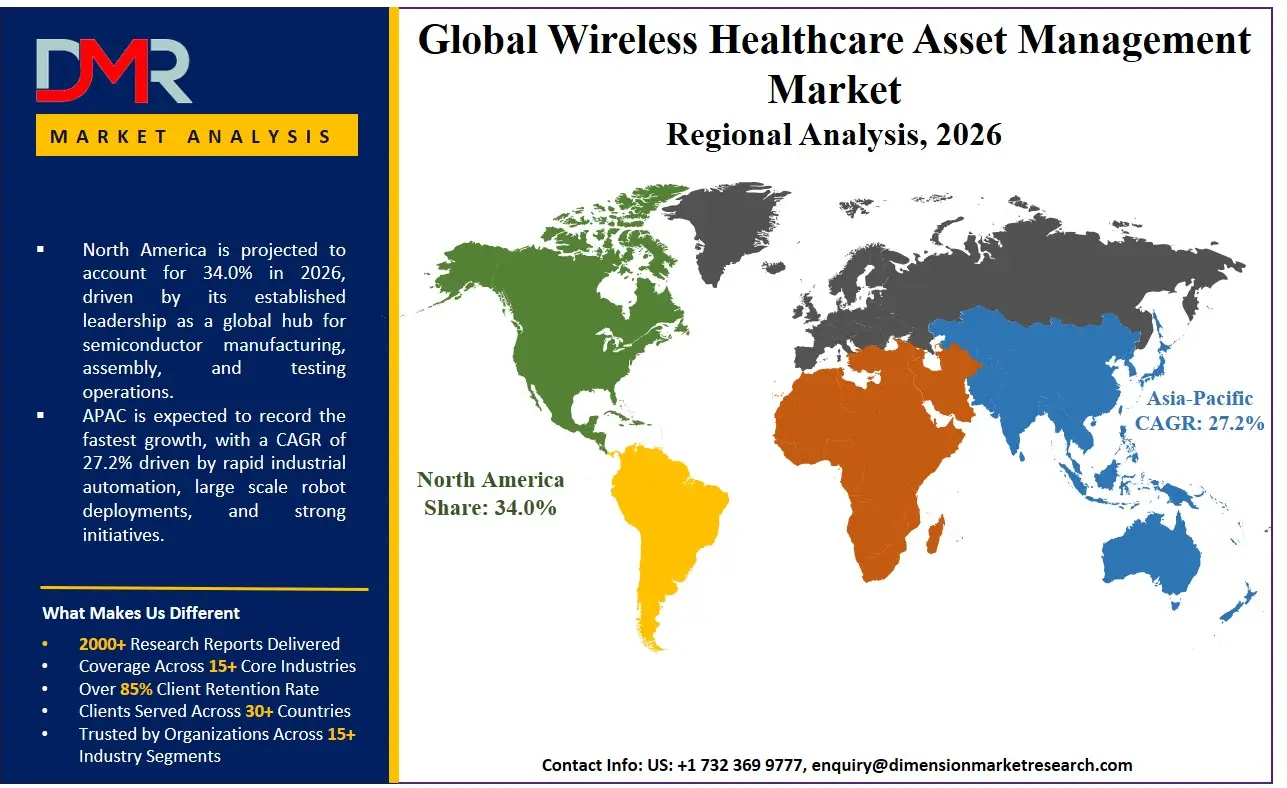
North America is projected to hold the largest regional share of the Global Wireless Healthcare Asset Management Market, estimated at 34.0% of the total market share in 2026. This leadership reflects a dense concentration of large hospital systems, early adoption of radio frequency identification and real time location system technology, and a well established vendor ecosystem including several of the market's leading providers headquartered within the region. The United States in particular benefits from substantial healthcare technology budgets and continuous consolidation among hospital networks, which favors standardized, enterprise wide asset visibility deployments. Regulatory emphasis on patient safety and equipment traceability further reinforces sustained regional demand, with continued expansion expected as mid sized hospital systems and outpatient networks extend adoption beyond flagship academic medical centers into broader community healthcare settings.
Fastest-Growing Regional Market
Asia Pacific is forecast to post the fastest regional compound annual growth rate of 27.2% in the Global Wireless Healthcare Asset Management Market through 2035. Rapid hospital infrastructure expansion across China, India and Southeast Asia, combined with rising healthcare expenditure and growing government emphasis on digital health modernization, is driving accelerated adoption of wireless asset tracking technologies. Many hospitals across the region are building new digital infrastructure from the ground up, allowing them to deploy modern wireless systems without the legacy integration challenges faced by older facilities in mature markets. Japan and South Korea contribute mature demand tied to aging populations and advanced healthcare systems, while China and India represent the region's largest volume growth opportunities as hospital networks expand to serve growing urban populations.
By Region
North America
Europe
- Germany
- The U.K.
- France
- Italy
- Russia
- Spain
- Benelux
- Nordic
- Rest of Europe
Asia-Pacific
- China
- Japan
- South Korea
- India
- ANZ
- ASEAN
- Rest of Asia-Pacific
Latin America
- Brazil
- Mexico
- Argentina
- Colombia
- Rest of Latin America
Middle East & Africa
- Saudi Arabia
- UAE
- South Africa
- Israel
- Egypt
- Rest of MEA
Competitive Landscape
The Global Wireless Healthcare Asset Management Market remains moderately fragmented, with established real time location system providers competing alongside diversified technology conglomerates and emerging artificial intelligence focused startups. Leading vendors including Zebra Technologies, Securitas Healthcare and CenTrak offer comprehensive hardware and software portfolios spanning radio frequency identification tags, Bluetooth Low Energy infrastructure and enterprise analytics platforms. The competitive environment is characterized by ongoing merger and acquisition activity, as larger firms acquire specialized real time location system vendors to broaden healthcare specific capabilities. Simultaneously, artificial intelligence native entrants such as Kontakt.io and Cognosos are gaining traction by emphasizing predictive analytics and rapid deployment over traditional hardware heavy approaches, intensifying competition around software differentiation, interoperability with hospital information systems and total cost of ownership.
Some of the prominent players in the Global Wireless Healthcare Asset Management Market are:
- Zebra Technologies Corporation
- Securitas Healthcare LLC (formerly Stanley Healthcare)
- CenTrak, Inc. (a Halma plc company)
- GE HealthCare Technologies Inc.
- Cisco Systems, Inc.
- IBM Corporation
- Impinj, Inc.
- AiRISTA Flow, Inc.
- Versus Technology, Inc.
- Sonitor Technologies Inc.
- TeleTracking Technologies, Inc.
- Awarepoint Corporation
- Vizzia Technologies (a HID company)
- RF Technologies, Inc.
- Midmark Corporation
- Intelligent InSites, Inc.
- Identec Group
- Verizon Communications Inc.
- Kontakt.io
- Cognosos, Inc.
- Other Key Players
Recent Developments
- August 2025: Zebra Technologies Corporation announced a definitive agreement to acquire Elo Touch Solutions, Inc. for approximately USD 1.3 billion, broadening its frontline and healthcare technology portfolio across self service, patient engagement, and workflow automation touchpoint hardware categories.
- April 2025: SEUIC Technologies Co., Ltd. launched new radio frequency identification products, including an artificial intelligence powered fixed reader built for healthcare and logistics environments, improving read accuracy, data processing speed, and integration with existing hospital inventory management systems.
- March 2025: CenTrak, Inc. launched a fully integrated, plug and play Bluetooth Low Energy real time location system platform designed specifically for hospital deployments, enabling faster installation, simplified scalability, and improved tracking accuracy across multi department healthcare facility environments nationwide.
Report Details
| Report Characteristics |
| Market Size (2026) |
USD 64.8 Bn |
| Forecast Value (2035) |
USD 462.3 Bn |
| CAGR (2026–2035) |
24.4% |
| The US Market Size (2026) |
USD 22.0 Bn |
| Historical Data |
2021 – 2025 |
| Forecast Data |
2027 – 2035 |
| Base Year |
2025 |
| Estimate Year |
2026 |
| Segments Covered |
By Product Type, By Technology, By Application, and By End User |
| Regional Coverage |
North America – The US and Canada; Europe – Germany, The UK, France, Russia, Spain, Italy, Benelux, Nordic, & Rest of Europe; Asia-Pacific – China, Japan, South Korea, India, ANZ, ASEAN, Rest of APAC; Latin America – Brazil, Mexico, Argentina, Colombia, Rest of Latin America; Middle East & Africa – Saudi Arabia, UAE, South Africa, Turkey, Egypt, Israel, & Rest of MEA |
Frequently Asked Questions
How big is the Wireless Healthcare Asset Management Market?
▾ The market is valued at USD 64.8 billion in 2026 and is projected to reach USD 462.3 billion by 2035, based on averaged data from two leading primary market research firms.
What is the CAGR of the Wireless Healthcare Asset Management Market from 2026 to 2035?
▾ The market is projected to expand at a compound annual growth rate of approximately 24.4% between 2026 and 2035, based on averaged primary source data from leading research firms.
What factors are driving the growth of the Wireless Healthcare Asset Management Market?
▾ Growth is driven by rising hospital equipment volumes, persistent healthcare staffing shortages, stricter regulatory compliance requirements, and expanding adoption of Internet of Things enabled sensor networks across departments.
What are the major trends in the Wireless Healthcare Asset Management Market?
▾ Key trends include a shift toward cloud based subscription platforms, growing use of artificial intelligence for predictive analytics, and ongoing consolidation among real time location system technology vendors.
Which region held the largest share of the Wireless Healthcare Asset Management Market in 2026?
▾ North America held the largest regional share, estimated at 34.0% in 2026, supported by dense hospital networks, strong technology budgets, and early adoption of tracking systems.
Which region is expected to grow the fastest in the Wireless Healthcare Asset Management Market?
▾ Asia Pacific is expected to record the fastest regional compound annual growth rate through 2035, driven by rapid hospital infrastructure expansion and rising government healthcare technology investment.
Who are the key players in the Wireless Healthcare Asset Management Market?
▾ Key players include Zebra Technologies, Securitas Healthcare, CenTrak, GE HealthCare, Cisco Systems, Impinj, TeleTracking Technologies, Kontakt.io and Cognosos, among other established and emerging technology providers.
How is the Wireless Healthcare Asset Management Market segmented?
▾ The market is segmented by product type, technology, application, end user and region, spanning asset tags, wireless sensors, software platforms, infrastructure components, and major global healthcare geographies.