Global Wireless Testing for Wi-Fi Market Snapshot
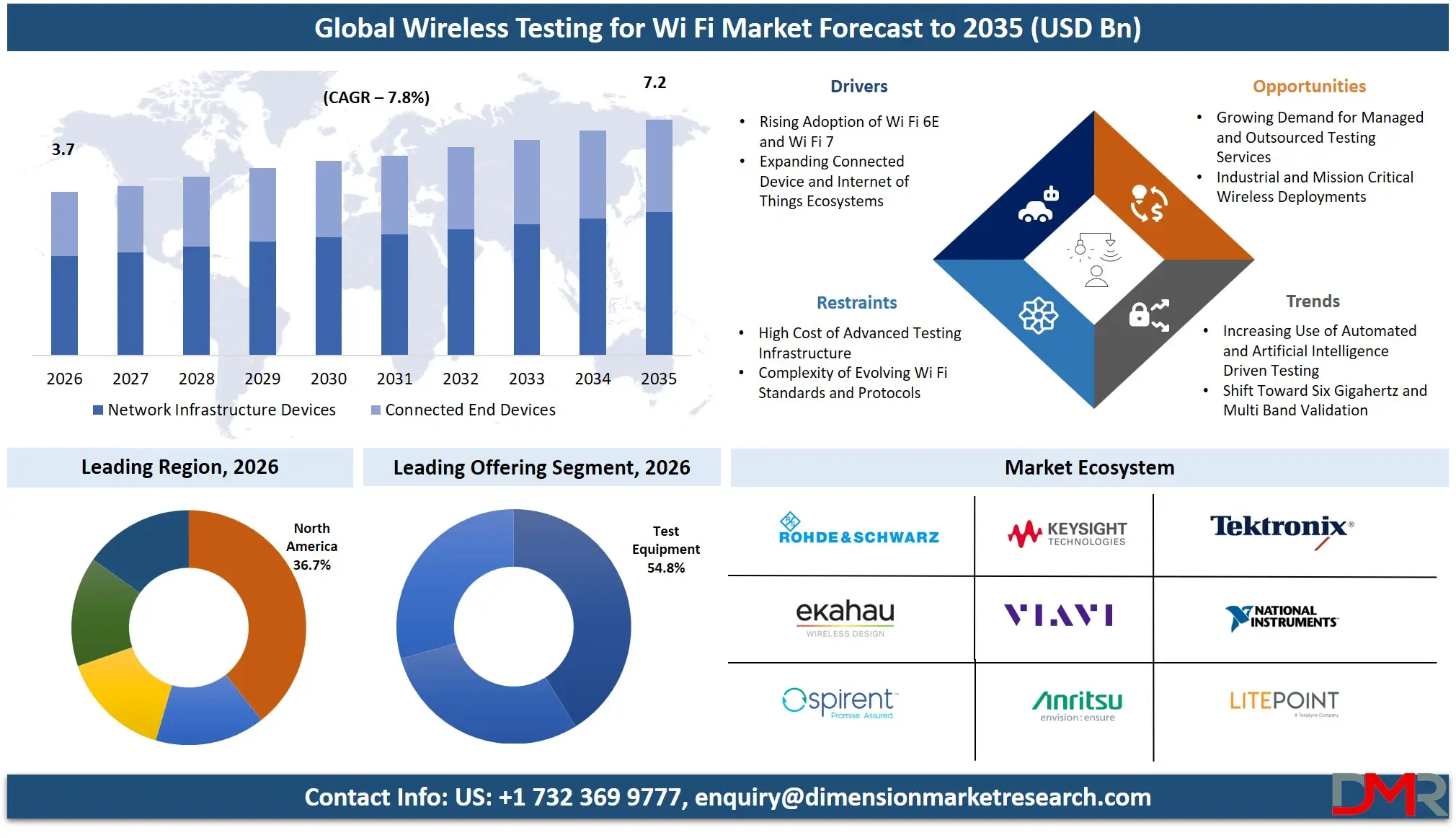
- Global Wireless Testing for Wi-Fi Market Size in 2026: USD 3.7 Billion
- Global Wireless Testing for Wi-Fi Market Size in 2035: USD 7.2 Billion
- Global CAGR from 2026 to 2035: 7.8%
- Test Equipment is the leading offering segment in 2026: 54.8%
- Wi-Fi 6 is the leading Wi-Fi standard segment in 2026: 31.4%
- Network Performance Testing is the leading test type segment in 2026: 29.7%
- Information Technology and Telecommunications is the leading end-use industry segment in 2026: 30.2%
- North America is the leading region in 2026: 36.7%
What is the Global Wireless Testing for Wi-Fi Market and its Market Size?
Wireless testing for Wi-Fi is a specialized engineering discipline that validates the radio frequency performance, network throughput, protocol conformance, interoperability, and security resilience of devices and networks built on the IEEE 802.11 family of standards. It integrates a comprehensive ecosystem of signal generation and analysis hardware, automated software platforms, and expert professional services to measure critical parameters such as error vector magnitude, spectral mask compliance, roaming latency, packet loss, and multi-user connection density across the 2.4 GHz, 5 GHz, and 6 GHz frequency bands. Chipset designers, original equipment manufacturers, network infrastructure vendors, telecommunication operators, automotive suppliers, and medical device companies all depend on rigorous Wi-Fi testing to ensure seamless connectivity, global regulatory compliance, and a robust user experience in increasingly dense and interference-prone radio frequency environments.
ℹ
To learn more about this report –
Download Your Free Sample Report Here
The Global Wireless Testing for Wi-Fi Market is projected to be valued at USD 3.7 billion in 2026 and is projected to reach USD 7.2 billion by 2035, expanding at a CAGR of 7.8% during the forecast period. Growth is being driven by the mainstream adoption of Wi-Fi 7 with its advanced multi-link operation capabilities, the opening and global harmonization of the 6 GHz spectrum, an explosion in connected Internet of Things and industrial wireless device volumes, and the increasing stringency of Wi-Fi Alliance certification and regulatory body compliance mandates. Investment is accelerating as engineering teams move beyond legacy conducted radio frequency checks toward sophisticated over-the-air system-level testing, AI-driven test automation, and real-world field performance benchmarking to validate next-generation wireless experiences.
Use Cases
- Chipset Design Validation and Radio Frequency Characterization: Silicon vendors and device manufacturers use advanced radio frequency test equipment and channel emulators to validate the physical layer performance of new Wi-Fi 7 and Wi-Fi 6E chipsets.
- Enterprise Network Certification and Performance Benchmarking: Telecommunication operators and managed service providers deploy network test equipment and field testing services to validate access point coverage, connection density, and seamless roaming within high-density venues such as stadiums, conference centers, and university campuses.
- Pre-Certification Compliance and Interoperability Assurance: Manufacturers utilize shielded laboratory testing environments and protocol analysis software to demonstrate adherence to global electromagnetic compatibility and electromagnetic interference regulations.
- High-Volume Production Line Quality Assurance: Consumer electronics and Internet of Things device manufacturers integrate fast, automated one-box test equipment directly onto assembly lines.
Key Takeaways
- Market Size: The Global Wireless Testing for Wi-Fi Market is anticipated to be valued at USD 3.7 billion in 2026 and is forecast to reach USD 7.2 billion by 2035, expanding at a CAGR of 7.8%.
- Growth Outlook: Market expansion is supported by Wi-Fi 7 technology commercialization, extensive 6 GHz band utilization, massive Internet of Things and smart home device proliferation, AI-driven test automation adoption, and growing enterprise demand for secure, high-capacity wireless network assurance.
- Primary Growth Drivers: Exploding wireless device density, the immense complexity of tri-band and multi-link operation architectures, strict low-latency performance benchmarks for industrial and gaming applications, and rigorous multi-vendor interoperability validation requirements are accelerating global investment in advanced Wi-Fi testing solutions.
- By Offering Analysis: Test Equipment is projected to lead the offering segment with a dominant 54.8% share in 2026, driven by non-negotiable requirements for spectrum analyzers, network testers, channel emulators, and over-the-air test chambers to characterize physical layer performance.
- By Wi-Fi Standard Analysis: Wi-Fi 6 is expected to dominate the standard segment with a 31.4% share in 2026, supported by its vast installed base across enterprise networks, industrial sites, and consumer devices that generates continuous demand for regression and security validation.
- By Test Type Analysis: Network Performance Testing is anticipated to dominate with a 29.7% share in 2026, as organizations require persistent validation of throughput, latency, jitter, packet loss, and roaming handover efficiency in mission-critical wireless environments.
- By End-Use Industry Analysis: Information Technology and Telecommunications is projected to lead with a 30.2% share in 2026, driven by continuous network modernization, managed Wi-Fi service deployments, and extensive broadband gateway and enterprise access point certification testing.
How AI/Gen AI is Transforming the Wireless Testing for Wi-Fi Market?
Artificial intelligence is fundamentally transforming wireless testing by enabling intelligent anomaly detection and predictive failure analysis across vast spectral datasets. Machine learning algorithms can dynamically classify interference sources in real-time, predict packet error rate degradation under specific channel conditions, and automatically optimize test automation scripts to eliminate redundant regression test cases. Generative AI assistants are being integrated into test management software platforms, allowing radio frequency engineers to create complex multi-device protocol analysis sequences using natural language prompts, significantly reducing manual coding time and human error in setting up over-the-air and conducted test campaigns.
The next frontier of adoption involves agentic AI workflows that orchestrate closed-loop testing environments autonomously. In this paradigm, spectrum analysis software detects a subtle impedance mismatch or spectral re-growth anomaly, instantly instructs a channel emulator to replicate the exact propagation and fading conditions that triggered it, and then correlates the physical layer impairment with a specific protocol-level packet loss signature to perform root-cause analysis. This capability compresses debugging cycles from days to minutes. However, for these AI models to be trusted in automated pass/fail decision-making, they require strict governance on high-integrity training data derived from calibrated vector signal analysis and reference over-the-air measurements to prevent dangerous false positives.
Key Drivers in the Global Wireless Testing For Wi-Fi Market
Rising Adoption of Wi-Fi 6E and Wi-Fi 7
The adoption of Wi-Fi 6E and Wi-Fi 7 is a major driver for the Global Wireless Testing For Wi-Fi Market. These standards introduce wider channels, six gigahertz spectrum access, multi link operation, higher throughput, and lower latency capabilities. Device manufacturers, network operators, and enterprises require advanced testing to verify radio frequency behavior, interoperability, coverage, roaming, and connection stability. Testing solutions help identify performance gaps before products reach the market or networks are deployed. The growing number of high bandwidth applications, including cloud collaboration, online gaming, video streaming, industrial automation, and augmented reality, further increases demand for reliable Wi-Fi validation across diverse devices and operating environments.
Expanding Connected Device and Internet of Things Ecosystems
Rapid growth in connected devices and Internet of Things deployments is strengthening demand for Wi-Fi testing solutions globally. Smartphones, laptops, smart speakers, surveillance cameras, connected appliances, industrial sensors, wearables, and medical devices must operate reliably across increasingly crowded wireless environments. Manufacturers require performance testing to confirm compatibility, signal quality, power efficiency, security, and network resilience. Enterprises also need network assessments to support growing device densities across offices, hospitals, factories, retail locations, and public venues. The increasing use of wireless connectivity in critical operational applications makes testing essential for reducing outages, improving user experience, and maintaining service reliability. This widespread device expansion creates consistent demand for equipment, software, and professional testing services.
Restraints in the Global Wireless Testing For Wi-Fi Market
High Cost of Advanced Testing Infrastructure
The substantial cost of advanced Wi-Fi testing infrastructure can limit adoption, particularly among small enterprises, start ups, and regional service providers. Sophisticated spectrum analyzers, channel emulators, shielded enclosures, over the air systems, and automated test platforms require considerable initial investment. Organizations may also face recurring expenses for calibration, maintenance, software licenses, laboratory upgrades, and skilled personnel. Wi-Fi 6E and Wi-Fi 7 testing often requires more specialized capabilities because of six gigahertz band operation and complex performance requirements. These costs can delay equipment replacement and testing modernization. Budget constrained organizations may rely on basic tools or outsource testing, limiting direct purchases of premium testing platforms.
Growth Opportunities in the Global Wireless Testing For Wi-Fi Market
Growing Demand for Managed and Outsourced Testing Services
Managed and outsourced testing services present a strong growth opportunity because many organizations lack in house laboratory infrastructure and specialized wireless engineering expertise. Device manufacturers, enterprises, service providers, and start ups increasingly seek external support for compliance, certification, field testing, security assessments, and network optimization. Service providers can offer flexible project based engagement models, reducing the capital burden for customers while providing access to sophisticated tools and experienced professionals. Demand is particularly strong among companies launching Wi-Fi enabled products across multiple regions. Outsourced testing also helps accelerate product commercialization and regulatory readiness. As wireless deployments become more complex, managed testing services can deliver recurring revenue opportunities for laboratories, consultants, and technology integration specialists.
Industrial and Mission Critical Wireless Deployments
Industrial and mission critical environments offer important expansion potential for Wi-Fi testing vendors. Manufacturing plants, warehouses, hospitals, airports, utilities, defense facilities, and transportation networks increasingly depend on reliable wireless connectivity for real time operations. These environments require stringent testing for coverage, low latency, roaming, interference resistance, cybersecurity, and device density. A network failure can disrupt automation processes, patient monitoring, logistics coordination, safety systems, or operational communications. Wi-Fi testing providers can develop specialized solutions for industrial wireless devices, connected medical equipment, autonomous systems, and private enterprise networks. The growth of smart factories and digital infrastructure investments creates opportunities for tailored assessment services, continuous monitoring platforms, and high reliability wireless validation solutions.
Trends in the Global Wireless Testing For Wi-Fi Market
Increasing Use of Automated and Artificial Intelligence Driven Testing
Automated testing is becoming an important trend as organizations seek faster, repeatable, and scalable Wi-Fi validation processes. Test automation software can execute predefined scenarios, evaluate network performance, collect diagnostic information, and generate detailed reports with reduced manual intervention. Artificial intelligence enabled analytics can identify unusual network behavior, detect interference patterns, predict potential failures, and recommend optimization actions. These capabilities are valuable for enterprises managing large numbers of access points, endpoints, and distributed locations. Automated platforms also improve product development by enabling continuous testing throughout design and deployment stages. As Wi-Fi networks become more dynamic and complex, demand for intelligent test management, real time analytics, and remote diagnostic capabilities is expected to increase significantly.
Shift Toward Six Gigahertz and Multi Band Validation
The shift toward six gigahertz and multi band testing is reshaping testing requirements across the wireless ecosystem. Wi-Fi 6E and Wi-Fi 7 expand access to additional spectrum, creating demand for tools that can validate channel behavior, signal integrity, interference, range, and device compatibility across two point four, five, and six gigahertz bands. Multi band testing is increasingly necessary for routers, access points, mesh systems, smartphones, and industrial devices designed to operate across diverse network conditions. Vendors are developing more integrated platforms that combine radio frequency, protocol, security, and network performance analysis. This trend supports broader adoption of advanced channel emulators, over the air systems, and spectrum analysis solutions.
Research Scope and Analysis
The Global Wireless Testing for Wi-Fi Market is segmented by offering, Wi-Fi standard, frequency band, test type, test environment, device type, and end use industry. Offerings include equipment, software, and services. The study evaluates standards, bands, testing approaches, infrastructure devices, and adoption across telecommunications, electronics, automotive, healthcare, manufacturing, utilities, retail, government, logistics, and hospitality.
ℹ
To learn more about this report –
Download Your Free Sample Report Here
By Offering Analysis
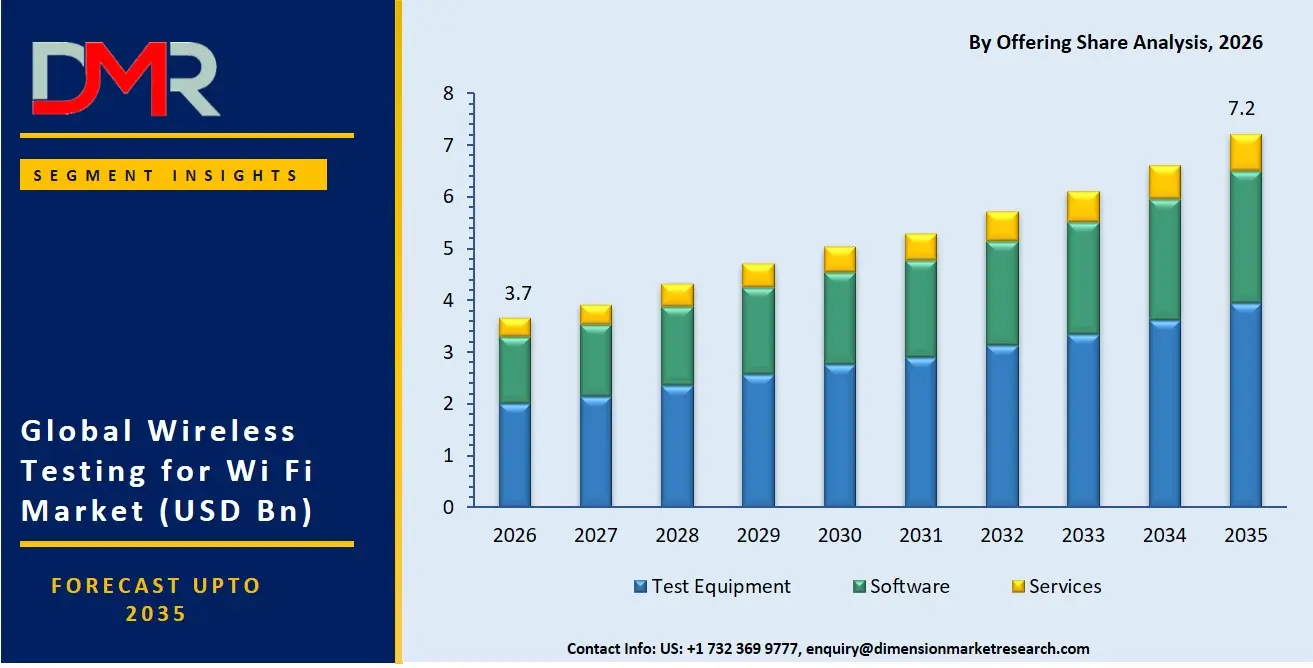
Test Equipment is poised to dominate the Global Wireless Testing for Wi-Fi Market with 54.8% market share in 2026, supported by demand for spectrum analyzers, network testers, channel emulators, and over the air test systems. These solutions are essential for validating Wi-Fi 6E and Wi-Fi 7 performance, coverage, throughput, and interference.
ℹ
To learn more about this report –
Download Your Free Sample Report Here
Software holds the second highest share of 27.6%, as enterprises increasingly adopt automated performance analysis and test management platforms. Services are projected to record the highest CAGR of 8.4% from 2026 to 2035, driven by outsourced compliance testing, field assessments, certification support, network optimization, and managed testing requirements.
By Wi-Fi Standard Analysis
Wi-Fi 6 is anticipated to dominate the market with 31.4% share in 2026, as it remains widely deployed across enterprise networks, consumer devices, industrial sites, and public connectivity infrastructure. Its installed base generates considerable demand for throughput, latency, roaming, security, and interoperability validation. Wi-Fi 5 accounts for the second highest share of 24.8%, owing to its continued presence in legacy residential and commercial networks. Wi-Fi 7 testing is anticipated to expand at the highest CAGR of 12.3% from 2026 to 2035, supported by demand for multi link operation, wider channels, high capacity networking, low latency applications, and six gigahertz band validation.
By Frequency Band Analysis
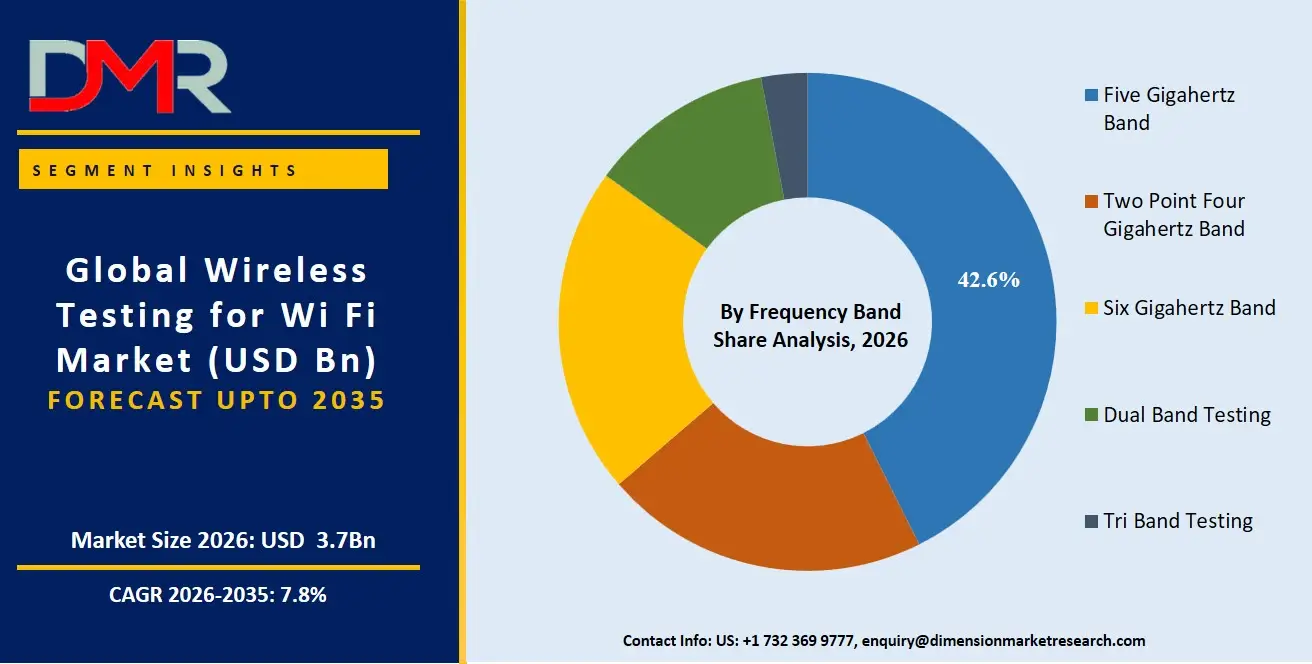
Five Gigahertz Band testing is poised to lead with 42.6% market share in 2026, due to its broad use in enterprise access points, residential routers, wireless controllers, and connected devices. Testing demand is reinforced by congestion management, channel optimization, interference detection, and high throughput performance validation. Two Point Four Gigahertz Band testing represents the second highest share of 28.9%, supported by its use in legacy devices, Internet of Things products, smart home systems, and industrial wireless equipment. Six Gigahertz Band testing is expected to register the highest CAGR of 11.8% from 2026 to 2035, driven by Wi-Fi 6E and Wi-Fi 7 deployments.
By Test Type Analysis
Network Performance Testing is expected to dominate the market with 29.7% share in 2026, as organizations require continuous validation of throughput, latency, jitter, packet loss, roaming, and connection density. This testing is especially important in enterprise campuses, high density venues, smart facilities, and industrial environments. Radio Frequency Performance Testing holds the second highest share of 25.4%, reflecting the need to evaluate transmit power, receiver sensitivity, spectral mask compliance, spurious emissions, and antenna performance. Security Testing is forecast to grow at the highest CAGR of 10.1% from 2026 to 2035, owing to rising concern over authentication weaknesses, encryption vulnerabilities, rogue access points, and expanding connected device ecosystems.
By Test Environment Analysis
Over The Air Testing is projected to lead the market with 34.8% share in 2026, because it measures actual wireless performance across antennas, propagation conditions, device orientation, interference, and real world usage scenarios. It is essential for validating access points, routers, smartphones, wearable devices, and automotive connectivity modules. Shielded Laboratory Testing captures the second highest share of 24.6%, driven by controlled and repeatable compliance, radio frequency, and device certification assessments. Simulated Network Testing is projected to achieve the highest CAGR of 9.7% from 2026 to 2035, supported by digital test automation, virtual network scenarios, multi device evaluation, and earlier detection of performance issues during product development.
By Device Type Analysis
Network Infrastructure Devices is anticipated to dominate with 57.3% market share in 2026, driven by testing requirements for access points, wireless routers, controllers, mesh Wi-Fi nodes, and residential gateways. Vendors and service providers rely on comprehensive validation to ensure coverage, capacity, interoperability, security, and roaming performance before deployment. Connected End Devices account for the second highest share of 42.7%, supported by growing volumes of smartphones, personal computers, smart home products, and Internet of Things devices. Automotive Connectivity Modules are expected to register the highest CAGR of 10.6% from 2026 to 2035, driven by connected vehicle platforms, in vehicle entertainment, telematics, and advanced mobility applications.
By End Use Industry Analysis
Information Technology and Telecommunications is projected to dominates the market with 30.2% share in 2026, supported by continuous network modernization, managed Wi-Fi services, enterprise connectivity, broadband deployments, and communications equipment development. This sector requires extensive performance, security, interoperability, and certification testing across multiple standards and device categories. Consumer Electronics holds the second highest share of 19.8%, due to frequent launches of smartphones, laptops, smart televisions, gaming devices, and smart home products. Healthcare and Life Sciences is anticipated to record the highest CAGR of 9.4% from 2026 to 2035, driven by connected medical devices, telehealth infrastructure, hospital mobility systems, and stringent network reliability requirements.
The Global Wireless Testing for Wi-Fi Market Report is segmented on the basis of the following:
By Offering
- Test Equipment
- Radio Frequency Test Equipment
- Network Test Equipment
- Over The Air Test Systems
- Shielded Test Enclosures
- Channel Emulators
- Antenna Positioning Systems
- Software
- Spectrum Analysis Software
- Protocol Analysis Software
- Test Automation Software
- Network Performance Analytics Software
- Test Management Software
- Services
- Laboratory Testing Services
- Field Testing Services
- Compliance and Certification Services
- Network Assessment Services
- Consulting and Integration Services
- Managed Testing Services
By Wi-Fi Standard
- Wi-Fi 4
- Wi-Fi 5
- Wi-Fi 6
- Wi-Fi 6E
- Wi-Fi 7
- Multigeneration Wi-Fi Testing
By Frequency Band
- Five Gigahertz Band
- Two Point Four Gigahertz Band
- Six Gigahertz Band
- Dual Band Testing
- Tri Band Testing
By Test Type
- Radio Frequency Performance Testing
- Transmit Power Testing
- Receiver Sensitivity Testing
- Error Vector Magnitude Testing
- Spectral Mask Testing
- Spurious Emissions Testing
- Antenna Performance Testing
- Network Performance Testing
- Throughput Testing
- Latency Testing
- Jitter Testing
- Packet Loss Testing
- Connection Density Testing
- Roaming Performance Testing
- Interoperability Testing
- Access Point and Client Device Testing
- Multi Vendor Device Testing
- Mesh Network Testing
- Internet Protocol Version Six Compatibility Testing
- Security Testing
- Authentication Testing
- Encryption Testing
- Rogue Access Point Detection Testing
- Vulnerability Assessment
- Penetration Testing
- Compliance and Certification Testing
- Regulatory Compliance Testing
- Electromagnetic Compatibility Testing
- Electromagnetic Interference Testing
- Wi-Fi Alliance Certification Testing
By Test Environment
- Conducted Testing
- Over The Air Testing
- Shielded Laboratory Testing
- Field Testing
- Simulated Network Testing
By Device Type
- Network Infrastructure Devices
- Access Points
- Wireless Routers
- Wireless Controllers
- Mesh Wi-Fi Nodes
- Residential Gateways
- Connected End Devices
- Smartphones
- Personal Computers
- Smart Home Devices
- Wearable Devices
- Internet of Things Devices
- Industrial Wireless Devices
- Connected Medical Devices
- Automotive Connectivity Modules
By End Use Industry
- Information Technology and Telecommunications
- Consumer Electronics
- Automotive
- Aerospace and Defense
- Healthcare and Life Sciences
- Manufacturing
- Energy and Utilities
- Retail and Ecommerce
- Government and Public Safety
- Transportation and Logistics
- Hospitality and Tourism
Regional Analysis
North America is the Leading Region in the Global Wireless Testing for Wi-Fi Market
ℹ
To learn more about this report –
Download Your Free Sample Report Here
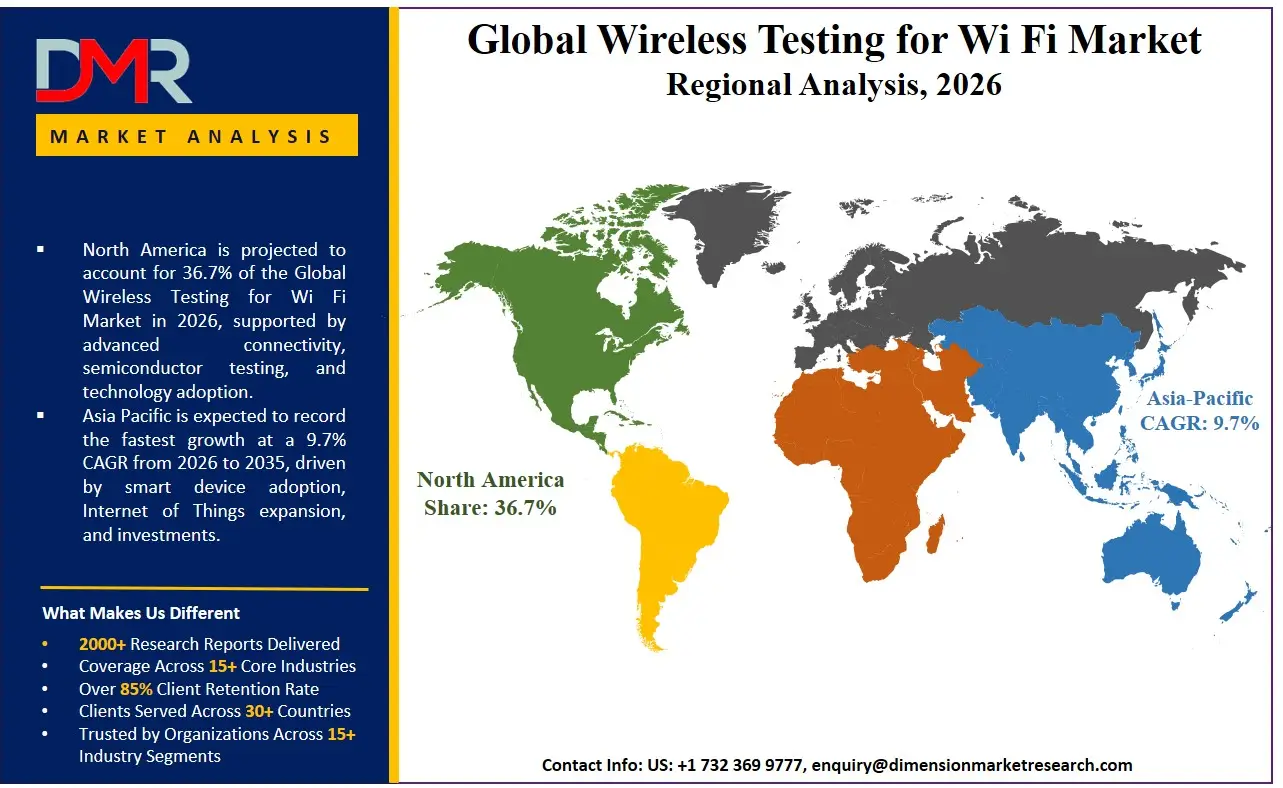
North America is poised to lead the Global Wireless Testing for Wi-Fi Market with an estimated 36.7% revenue share in 2026. The region's dominance is anchored by a dense concentration of semiconductor design firms, wireless infrastructure vendors, and stringent FCC regulatory mandates. Aggressive early adoption of Wi-Fi 7 technology, widespread 6 GHz band activation, and substantial enterprise investment in network performance validation tools further solidify its position as the primary global hub for advanced compliance, security, and interoperability testing across all device categories.
Asia Pacific is the Fastest-Growing Region in the Global Wireless Testing for Wi-Fi Market
Asia Pacific is projected to register the fastest CAGR of 9.7% through 2035, driven by its role as the global epicenter for consumer electronics, smartphone, and Internet of Things device manufacturing. Massive production volumes in China, Taiwan, South Korea, and Vietnam necessitate rapid, automated conducted and over-the-air testing on high-speed assembly lines. Accelerating smart factory deployments, government-led 5G and Wi-Fi 7 infrastructure initiatives, and the expansion of automotive connectivity module production further fuel demand for comprehensive performance, compliance, and field testing services across the region.
The Europe Wireless Testing for Wi-Fi Market
The Europe Wireless Testing for Wi-Fi Market is estimated to be valued at USD 0.85 billion in 2026 and is further anticipated to reach USD 1.60 billion by 2035 at a CAGR of 7.3%. Europe represents the second largest regional market, distinguished by its stringent regulatory framework driven by the Radio Equipment Directive and CE marking requirements that mandate rigorous electromagnetic compatibility and spectrum efficiency validation. The region's powerhouse automotive manufacturing sector, particularly in Germany, is a significant growth engine, requiring specialized testing for automotive connectivity modules that must handle high-speed vehicle-to-everything communication and in-vehicle infotainment streaming.
Latin America Wireless Testing for Wi-Fi Market
The Latin America Wireless Testing for Wi-Fi Market is expanding steadily as the region undergoes significant digital transformation and broadband infrastructure modernization. Brazil and Mexico lead regional adoption, driven by their established consumer electronics manufacturing bases, growing telecommunication service provider investments in Wi-Fi 6 network upgrades, and increasing integration with global supply chains. Multinational original equipment manufacturers are encouraging local suppliers to adopt standardized quality assurance processes, including conducted and over-the-air testing, to meet export requirements. Cloud-managed network performance analytics platforms and managed testing services offer an accessible route for regional operators to optimize high-density urban deployments without massive capital expenditure.
Middle East and Africa Wireless Testing for Wi-Fi Market
The Middle East and Africa Wireless Testing for Wi-Fi Market is developing alongside large-scale smart city projects, economic diversification initiatives, and the expansion of modern telecommunication infrastructure. Saudi Arabia and the United Arab Emirates are the primary investment hubs, deploying extensive Wi-Fi 6E and Wi-Fi 7 networks in mega-event venues, airports, and new urban developments, which necessitates sophisticated network performance validation and security testing. South Africa maintains steady demand within its established financial services and enterprise sectors. The growing adoption of connected medical devices and telehealth platforms in remote areas is spurring initial demand for reliability and interference testing.
Major Countries Analysis
The US Wireless Testing for Wi-Fi Market
ℹ
To learn more about this report –
Download Your Free Sample Report Here
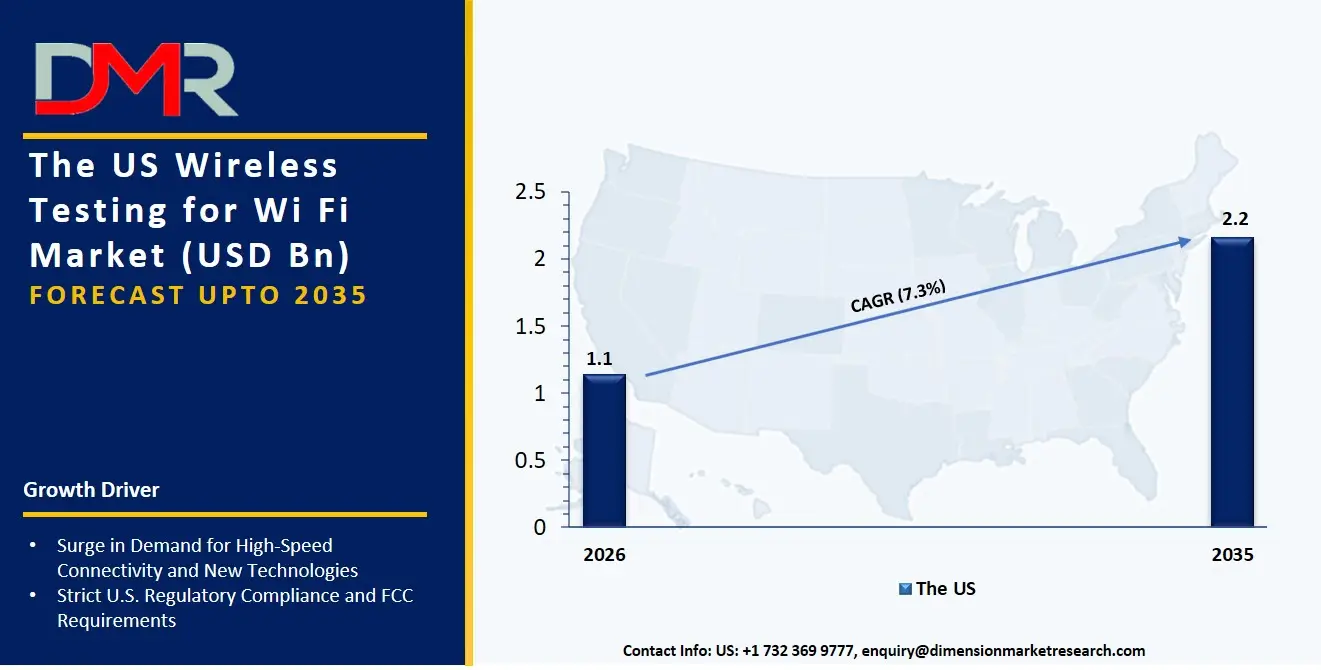
The United States Wireless Testing for Wi-Fi Market is projected to be valued at USD 1.1 billion in 2026 and is expected to reach USD 2.2 billion by 2035, registering a CAGR of approximately 7.5% from 2026 to 2035. This robust trajectory reflects the U.S.'s position as the epicenter of Wi-Fi chipset innovation and enterprise networking deployment. Growth is fueled by intensive research and development spending on Wi-Fi 7 multi-link operation testing, accelerating 6 GHz band adoption requiring automated frequency coordination validation, and surging demand for rigorous WPA3 security protocol and rogue access point detection assessments. The expanding footprint of connected healthcare and smart manufacturing further drives investment in field testing and network assurance platforms to guarantee zero-failure wireless connectivity.
Japan Wireless Testing for Wi-Fi Market
The Japan Wireless Testing for Wi-Fi Market is valued at USD 660.0 million in 2026 and is forecast to reach USD 1,200.0 million by 2035, expanding at a CAGR of approximately 6.8% between 2026 and 2035. Market development is supported by Japan's leading automotive, precision electronics, and industrial robotics industries, which demand meticulous radio frequency performance and interoperability validation for embedded modules. Manufacturers are modernizing test processes to validate Wi-Fi 7 devices for high-density urban environments and factory automation applications. Increasing adoption of over-the-air test systems, channel emulators, and AI-driven automated regression testing tools is expected to sustain steady, quality-focused market expansion throughout the forecast period.
Saudi Arabia Wireless Testing for Wi-Fi Market
The Saudi Arabia Wireless Testing for Wi-Fi Market is estimated at USD 120.0 million in 2026 and is projected to reach USD 310.0 million by 2035, expanding at a CAGR of 11.1%. Growth is directly tied to the Kingdom's Vision 2030 giga-projects, which mandate world-class wireless connectivity across new smart cities, entertainment venues, and transportation hubs. These massive deployments require extensive network performance testing, connection density validation, and security assessments for imported and locally deployed Wi-Fi 6E and Wi-Fi 7 infrastructure. Opportunities are particularly strong for vendors and service providers offering localized consulting and integration services, comprehensive field testing, and managed compliance certification support to validate end-to-end wireless ecosystem performance in extreme environmental conditions.
Regulatory Landscape
The regulatory landscape is a primary catalyst for investment in the Wi-Fi testing market. In the United States, the Federal Communications Commission mandates strict compliance with transmit power limits, spurious emissions thresholds, and the new Automated Frequency Coordination system for 6 GHz band access, driving demand for precise spectral mask and interference testing. The European Union's Radio Equipment Directive enforces comprehensive electromagnetic compatibility and spectrum efficiency standards, requiring thorough conducted and radiated emissions assessments in accredited shielded laboratory testing environments. Wi-Fi Alliance certification, including WPA3 and Wi-Fi CERTIFIED 7 programs, compels manufacturers to invest in extensive interoperability and security protocol validation. These global frameworks collectively transform testing from a discretionary engineering step into a mandatory, legally enforced gateway to market access.
Investment and White Space Analysis
The strongest investment opportunities lie in AI-native test automation software that can reduce regression cycles for complex multi-link operation, modular over-the-air test systems optimized for high-throughput Wi-Fi 7 production lines, and specialized security testing suites targeting the vast consumer Internet of Things device market. Significant white space remains in developing cost-effective, cloud-managed one-box testers for mid-tier smart home and wearable device manufacturers who lack internal radio frequency expertise. Vendors can differentiate through integrated platforms that bridge physical layer signal analysis with deep protocol analytics, and by offering "as-a-service" models that provide flexible lab access. Emerging growth areas include standardized automotive connectivity module testing for high-Doppler environments and dedicated test protocols for connected medical devices requiring absolute network reliability.
By Region
North America
Europe
- Germany
- The U.K.
- France
- Italy
- Russia
- Spain
- Benelux
- Nordic
- Rest of Europe
Asia-Pacific
- China
- Japan
- South Korea
- India
- ANZ
- ASEAN
- Rest of Asia-Pacific
Latin America
- Brazil
- Mexico
- Argentina
- Colombia
- Rest of Latin America
Middle East & Africa
- Saudi Arabia
- UAE
- South Africa
- Israel
- Egypt
- Rest of MEA
Competitive Landscape
The Global Wireless Testing for Wi-Fi Market features a moderately concentrated landscape at the high-end test equipment tier, dominated by established electronic measurement leaders such as Keysight Technologies, Rohde & Schwarz, Anritsu Corporation, and VIAVI Solutions, alongside focused wireless specialists like LitePoint and Spirent Communications. These vendors compete intensely on signal analysis bandwidth, channel emulation fidelity, and protocol analysis depth to support rigorous Wi-Fi 7 and 6 GHz band validation. The competitive field broadens significantly in the software and services segments, where network performance analytics firms like NetAlly and Ekahau, and global compliance bodies like TÜV Rheinland, Intertek, and Bureau Veritas, hold substantial influence. Strategic differentiation increasingly hinges on providing seamless, software-centric platforms that unify laboratory-based radio frequency characterization with real-world field testing insights, supported by AI-driven analytics and flexible managed service engagements to address the full design-to-deployment lifecycle.
Some of the prominent players in the Global Wireless Testing for Wi-Fi Market are:
- Keysight Technologies Inc.
- Rohde and Schwarz GmbH and Co KG
- Anritsu Corporation
- VIAVI Solutions Inc.
- Spirent Communications plc
- Tektronix Inc.
- National Instruments Corporation
- EXFO Inc.
- LitePoint Corporation
- NetAlly LLC
- Ekahau Inc.
- Fluke Networks
- Teledyne LeCroy Inc.
- Fortinet Inc.
- Cisco Systems Inc.
- Juniper Networks Inc.
- Arista Networks Inc.
- Huawei Technologies Co Ltd
- Nokia Corporation
- Ericsson AB
- Samsung Electronics Co Ltd
- Qualcomm Incorporated
- Broadcom Inc.
- Intel Corporation
- MediaTek Inc.
- Airoha Technology Corporation
- Advantest Corporation
- Cohu Inc.
- Teradyne Inc.
- Chroma ATE Inc.
- Boonton Electronics
- Berkeley Nucleonics Corporation
- Wireless Telecom Group Inc.
- Octoscope Inc.
- Allion Labs Inc.
- TÜV Rheinland AG
- Bureau Veritas SA
- Intertek Group plc
- UL Solutions Inc.
- DEKRA SE
- Other Key Players
Recent Developments
- In January 2026, LitePoint announced physical layer validation of Qualcomm Technologies' next generation Wi-Fi 8 platforms using its IQxel MX system. The milestone reflects ongoing progress in advanced Wi-Fi testing and helps prepare chipset and device manufacturers for future wireless performance, reliability, and interoperability requirements.
- In September 2025, LitePoint introduced the IQxel MX platform for Wi-Fi 7 and Wi-Fi 8 validation. The solution provides lifecycle testing capabilities from early research and development characterization through high volume manufacturing, supporting evolving wireless device development and production requirements.
- In August 2025, LitePoint and Advantech announced a collaboration to advance industrial wireless connectivity validation. The partnership uses LitePoint's IQxel MX platform to support automated radio frequency testing of Wi-Fi 7 modules, targeting edge artificial intelligence, autonomous mobile robots, smart manufacturing, and industrial Internet of Things deployments.
- In February 2024, Keysight Technologies launched the E7515W UXM Wireless Connectivity Test Platform for Wi-Fi 7. The platform supports signaling, radio frequency, and throughput testing, including 4x4 MIMO and 320 megahertz bandwidth, helping device developers evaluate Wi-Fi 7 performance and accelerate time to market.
Report Details
| Report Characteristics |
| Market Size (2026) |
USD 3.7 Bn |
| Forecast Value (2035) |
USD 7.2 Bn |
| CAGR (2026–2035) |
7.8% |
| The US Market Size (2026) |
USD 1.1 Bn |
| Historical Data |
2021 – 2025 |
| Forecast Data |
2027 – 2035 |
| Base Year |
2025 |
| Estimate Year |
2026 |
| Segments Covered |
By Offering, By Wi Fi Standard, By Frequency Band, By Test Type, By Test Environment, By Device Type, and By End Use Industry |
| Regional Coverage |
North America – The US and Canada; Europe – Germany, The UK, France, Russia, Spain, Italy, Benelux, Nordic, & Rest of Europe; Asia-Pacific – China, Japan, South Korea, India, ANZ, ASEAN, Rest of APAC; Latin America – Brazil, Mexico, Argentina, Colombia, Rest of Latin America; Middle East & Africa – Saudi Arabia, UAE, South Africa, Turkey, Egypt, Israel, & Rest of MEA |
Frequently Asked Questions
How big is the Global Wireless Testing for Wi-Fi Market?
▾ The Global Wireless Testing for Wi-Fi Market is valued at USD 3.7 billion in 2026 and is projected to reach USD 7.2 billion by 2035, reflecting strong worldwide demand for solutions that validate next-generation wireless performance, compliance, and security.
What is the CAGR of the Global Wireless Testing for Wi-Fi Market from 2026 to 2035?
▾ The market is projected to expand at a compound annual growth rate of 7.8% between 2026 and 2035, supported by sustained investment in Wi-Fi 7 development, 6 GHz band utilization, and automated test automation platforms worldwide.
What factors are driving the growth of the Global Wireless Testing for Wi-Fi Market?
▾ Growth is driven by rising device density and multi-link operation complexity, mandatory compliance and interoperability demands, the proliferation of connected Internet of Things devices, and the increasing need for sophisticated over-the-air and security validation across all device categories.
What are the major trends in the Global Wireless Testing for Wi-Fi Market?
▾ Major trends include a shift to holistic over-the-air system-level testing, the convergence of physical layer signal analysis and protocol analytics, the adoption of AI-native test automation for closed-loop debugging, and the growth of managed testing-as-a-service business models globally.
Which region held the largest share of the Global Wireless Testing for Wi-Fi Market in 2026?
▾ North America is expected to lead the global market with a 36.7% share in 2026, supported by a mature semiconductor ecosystem, aggressive early adoption of Wi-Fi 7, strict FCC regulations, and substantial enterprise investment in wireless network performance and security validation.
Which region is expected to grow the fastest in the Global Wireless Testing for Wi-Fi Market?
▾ Asia Pacific is expected to record the fastest growth at a 9.7% CAGR through 2035, driven by its role as the global manufacturing hub for smartphones and Internet of Things devices, smart factory expansion, and government-led next-generation connectivity infrastructure programs.
Who are the key players in the Global Wireless Testing for Wi-Fi Market?
▾ Key market participants include Keysight Technologies, Rohde & Schwarz, Anritsu, VIAVI Solutions, Spirent Communications, LitePoint, NetAlly, Ekahau, TÜV Rheinland, Intertek, Bureau Veritas, and UL Solutions, serving manufacturers and service providers globally.
How is the Global Wireless Testing for Wi-Fi Market segmented?
▾ The market is segmented by offering, Wi-Fi standard, frequency band, test type, test environment, device type, and end-use industry, with regional analysis covering North America, Europe, Asia Pacific, Latin America, and the Middle East and Africa worldwide markets.