Market Overview
The wound contact layer dressing market covers specialized primary dressings designed to sit directly against wound tissue. Products in this category regulate moisture exchange, minimize trauma at dressing changes, and create a stable healing interface across acute surgical wounds, chronic ulcers, burns, and pressure injuries. The market excludes secondary dressings, wound-closure devices, and negative-pressure wound therapy systems, though contact layer products frequently pair with these adjuncts in clinical protocols.
Diabetes prevalence underpins a substantial portion of long-term demand. As per the CDC, approximately 12% of people with diabetes develop diabetic foot ulcers during their lifetime, a chronic wound category that requires repeated dressing interventions and extended care pathways. Chronic wounds of this type generate recurring product consumption rather than single-episode purchases, making the segment structurally different from the acute-care dressing market in its revenue predictability.
April 2024 marked a structural shift in the competitive landscape when Solventum was separated from 3M as an independent healthcare company, retaining 3M's wound-care portfolio including advanced wound dressings. The separation created a distinct publicly accountable entity whose wound-care strategy, capital allocation, and product pipeline can now be tracked independently by investors and competitors alike.
Key Takeaways
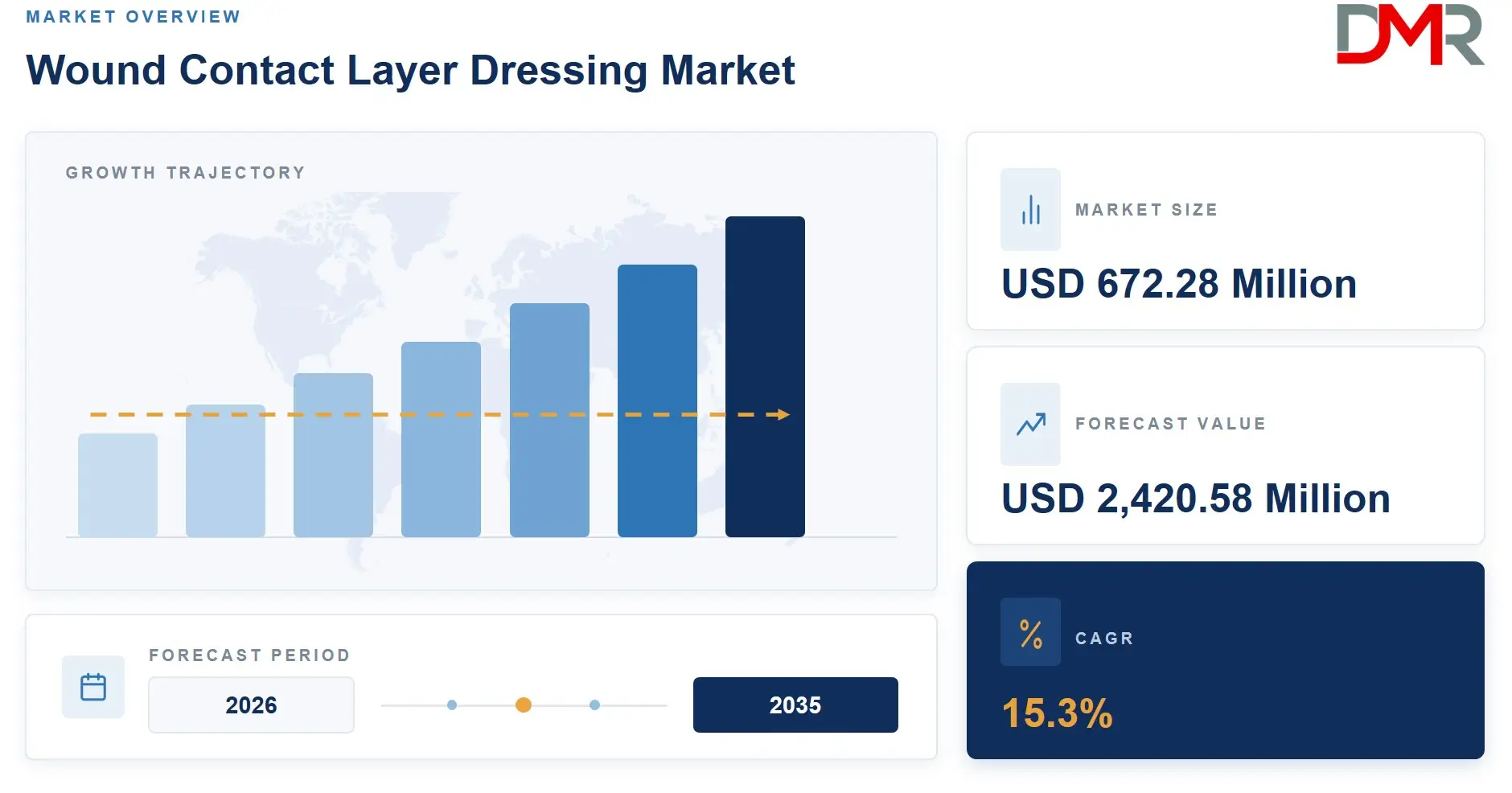
- The market size is USD 672.28 Million in 2026, and is projected to hit USD 2,420.58 Million by 2035 at a CAGR of 15.3%.
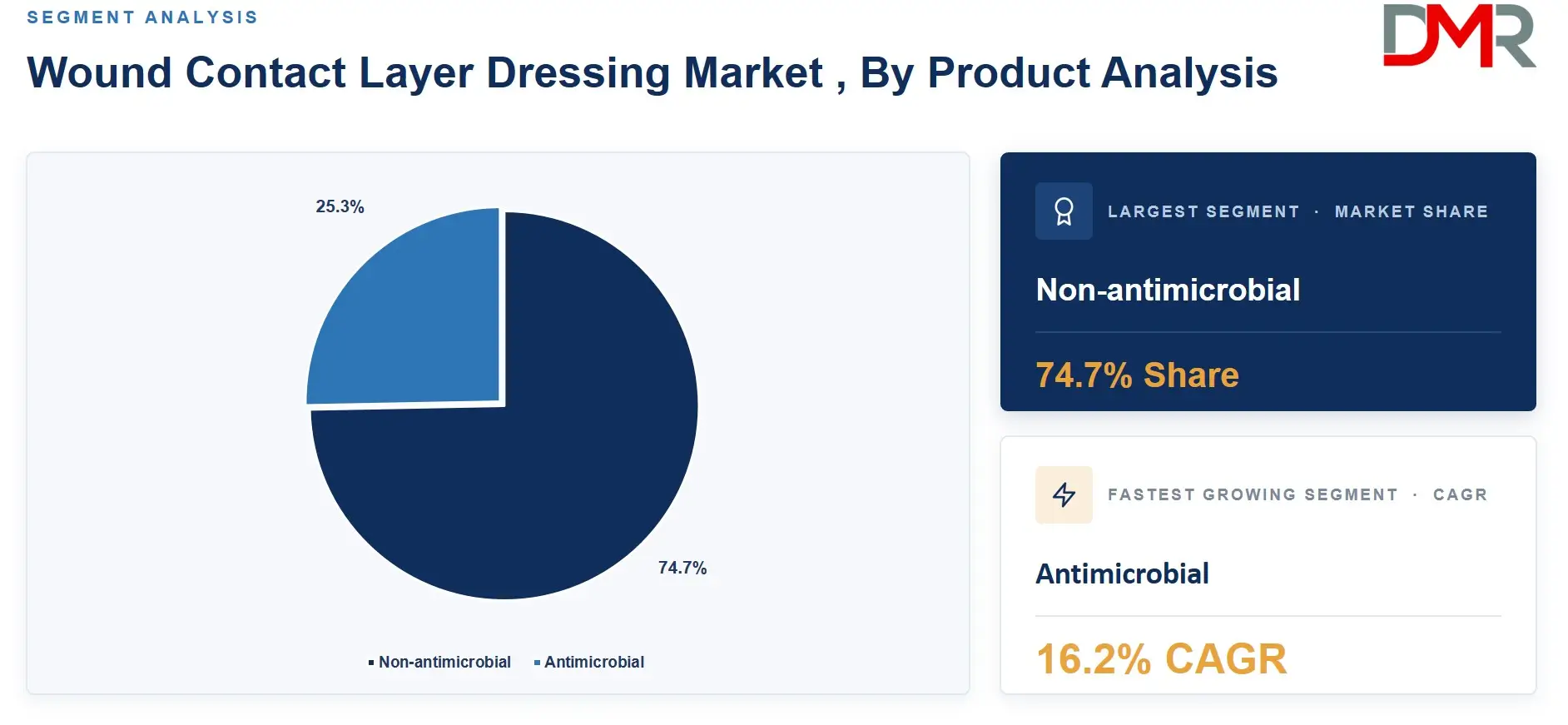
- By Product: Non-antimicrobial led with a 74.7% share in 2025.
- By End-use: Hospitals led with a 45.4% share in 2025.
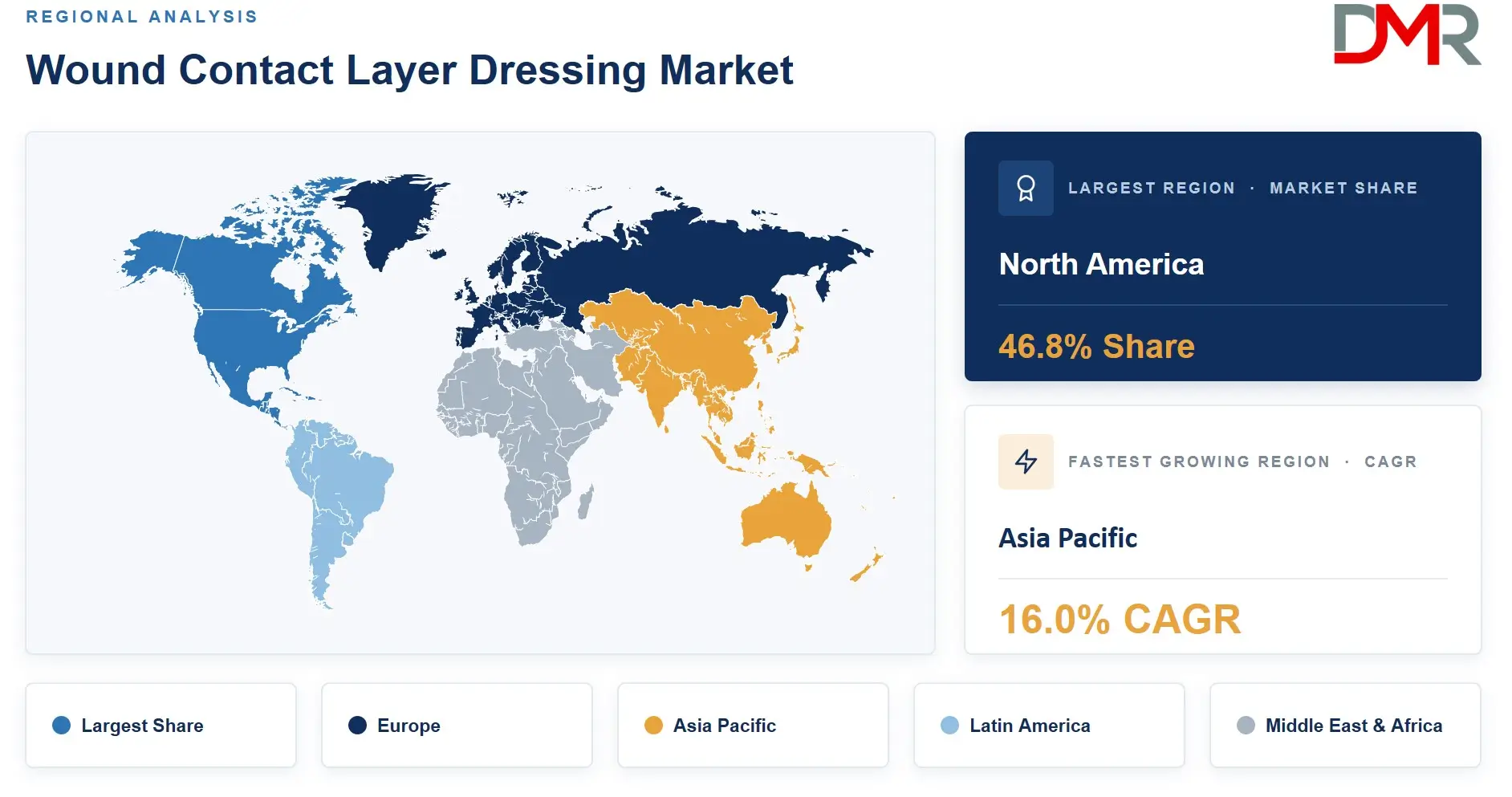
- By Region: North America led with a 46.8% share, valued at USD 272.7 Million, in 2025.
- Asia Pacific is the fastest-growing regional market by CAGR across the forecast period.
- Top Key players: Smith & Nephew (UK), Mölnlycke Health Care (Sweden), Solventum (US), ConvaTec Group (UK), Coloplast Group (Denmark), Cardinal Health (US)
Market Size and Forecast
The Global Wound Contact Layer Dressing Market size is estimated at USD 672.28 Million in 2026, and is projected to reach USD 2,420.58 Million by 2035, exhibiting a CAGR of 15.3% during the forecast period.
Growth through the forecast period rests on two compounding structural factors: an expanding chronic wound population tied to diabetes and aging demographics, and a measurable shift of wound-care episodes from inpatient to outpatient and home settings. Both trends lengthen the duration of dressing use per patient and broaden the addressable market beyond hospital procurement channels. The forecast assumes continued reimbursement support for advanced wound care products in North America and Europe, alongside accelerating hospital infrastructure build-out across Asia Pacific.
ℹ
To learn more about this report –
Download Your Free Sample Report Here
ConvaTec's completion of a UK advanced wound-care manufacturing expansion exceeding £24 million signals that leading vendors are committing fixed capital to production capacity ahead of forecast demand, rather than waiting for demand to materialize. Capacity investment of this scale by an incumbent confirms the upside scenario embedded in the 15.3% CAGR is credible.
Product Analysis
Non-antimicrobial contact layer dressings accounted for 74.7% of product demand in 2026, the highest of any category.
Non-antimicrobial products dominate because the majority of clean surgical wounds and straightforward chronic wounds do not require active antimicrobial intervention at the contact layer. Clinicians reserve antimicrobial variants for infected or high-risk wounds, keeping the non-antimicrobial category as the standard-of-care default across most wound types. Procurement teams in hospital systems favor non-antimicrobial products for formulary efficiency, since a single SKU covers a broad patient population.
ℹ
To learn more about this report –
Download Your Free Sample Report Here
As reported by CMS, 8.3% of all Medicare fee-for-service beneficiaries used home health care in 2020. Home health patients predominantly receive non-antimicrobial dressings in the first instance, with antimicrobial products introduced only when infection indicators arise. Antimicrobial dressings represent the faster-growing sub-segment, driven by rising awareness of wound bioburden and regulatory approvals that expand their clinical indications. Vendors targeting the antimicrobial segment compete on clinical evidence, not price, which structurally supports higher average selling prices in that category.
End-use Analysis
Hospitals captured 45.4% of end-use demand in 2026, ahead of all other care settings.
Hospitals generate the largest volume of wound contact layer consumption because surgical procedures, trauma cases, and acute wound management concentrate within inpatient settings. Procurement decisions in hospitals flow through standardized committee processes, which gives established vendors with clinical evidence and national contracts a durable volume advantage. Price sensitivity in hospital procurement is real but secondary to formulary compliance and staff familiarity with product formats.
Home healthcare, outpatient clinics, and research and manufacturing facilities represent the three remaining end-use categories. Home healthcare is the fastest-growing setting as payers redirect chronic wound management away from expensive inpatient stays. Outpatient clinics serve as the natural bridge between discharge and long-term home care, creating a consistent pull-through channel for mid-tier and premium contact layer products. Research and manufacturing end-use remains a niche but specialized segment, concentrated among a small number of institutions with chronic wound model programs.
Key Market Segments
By Product
- Non-antimicrobial
- Antimicrobial
By End-use
- Hospitals
- Home Healthcare
- Research & Manufacturing
- Outpatients
Regional Analysis
North America led the wound contact layer dressing market with a 46.8% share, valued at USD 272.7 Million, in 2026.
North America
North America's dominant share reflects the intersection of high chronic disease prevalence, a mature reimbursement infrastructure, and concentrated hospital purchasing power. The U.S. market benefits from CMS coverage pathways that reimburse advanced wound dressings across inpatient, outpatient, and home health settings, reducing price sensitivity for premium contact layer products. As data published by the OECD shows, the region's hospital bed density and care utilization patterns differ materially from emerging markets, keeping per-capita dressing consumption well above the global average.
ℹ
To learn more about this report –
Download Your Free Sample Report Here
Europe
Europe operates as the second-largest market, anchored by Germany, France, and the UK, where national health systems maintain structured wound-care procurement pathways. OECD figures confirm an average of 4.2 hospital beds per 1,000 population across member countries in 2023, a baseline that sets the consumption floor for dressings used in inpatient acute care. Europe is also home to several of the largest wound-care manufacturers, creating a domestic supply dynamic that reduces landed cost and supports product availability.
Asia Pacific
Asia Pacific registers the fastest CAGR across the forecast period, driven by hospital infrastructure expansion, rising surgical volumes, and a diabetes burden that is growing faster than in any other region. Korea demonstrates the depth of institutional capacity in the region, with 12.6 hospital beds per 1,000 people against an OECD average of 4.2, as reported by OECD Health at a Glance 2025. That bed density translates directly into wound-care product consumption at a scale that positions the region as the primary volume growth engine through 2035.
Latin America
Latin America presents a growth market constrained by fragmented reimbursement structures and inconsistent hospital procurement standards. Brazil and Mexico anchor regional demand, with wound-care adoption tracking the pace of public health system investment and private hospital network expansion. Price sensitivity is higher here than in North America or Europe, which tilts procurement toward non-antimicrobial and entry-tier contact layer formats.
Middle East and Africa
The Middle East and Africa region is the smallest by current revenue share but carries meaningful longer-term potential as GCC countries accelerate healthcare facility investment. South Africa serves as the primary sub-Saharan anchor market. Surgical site infection rates across low- and middle-income country settings create unmet demand that advanced wound dressings are positioned to address, provided access and reimbursement conditions improve.
Key Regions and Countries
North America
Europe
- Germany
- France
- The UK
- Spain
- Italy
- Rest of Europe
Asia Pacific
- China
- Japan
- South Korea
- India
- Australia
- Rest of APAC
Latin America
- Brazil
- Mexico
- Rest of Latin America
Middle East & Africa
- GCC
- South Africa
- Rest of MEA
Macroeconomic Impact
Container tonnage crossing the Suez Canal fell 82% by mid-February 2024, as reported by UNCTAD, forcing wound-care manufacturers to reroute shipments around the Cape of Good Hope at significantly higher cost and longer transit times. For a product category where sterility and shelf-life govern distribution logistics, route disruptions of this magnitude directly affect inventory planning and landed-cost structures for suppliers serving European and Asian markets from North American or multi-continent production facilities.
World merchandise trade-volume growth was projected to decelerate from 2.8% in 2024 to 2.4% in 2025 and 0.5% in 2026, according to WTO data. The World Bank projected global goods-and-services trade growth declining from 3.4% in 2025 to 2.2% in 2026, alongside GDP growth of 2.6% in 2026. Slowing global trade compresses margins for vendors reliant on cross-border component sourcing, while moderate GDP growth in key markets supports continued public health spending, partially offsetting the procurement headwinds.
Market Dynamics
Driver: Diabetes and Surgical Complication Burden Accelerates Wound Volume
WHO data shows 830 million people were living with diabetes globally in 2022, compared with 200 million in 1990. A chronic wound population of this scale generates sustained, non-cyclical demand for primary dressings across all care settings, from hospital wards to home health programs. Vendors who align product portfolios with diabetic foot ulcer and venous leg ulcer management hold a structural volume advantage over generalist competitors.
Surgical settings contribute a parallel demand source. WHO data confirms complications occur in up to 25% of patients after inpatient operations, while 11% of surgical patients in low- and middle-income countries acquire a surgical site infection. Post-operative wound complications directly extend dressing usage per patient episode. Mölnlycke Health Care committed USD 8 million to Siren, a diabetic foot ulcer management system company, signaling that the leading wound-care vendors now view diabetes-specific technology investment as a core competitive position rather than an adjacency.
Restraint: Reimbursement Complexity Slows Advanced Product Uptake
Reimbursement pathways for wound contact layer dressings vary substantially across payer systems, creating uneven access to premium products between high-income and lower-income markets. In markets where wound-care products require separate line-item approval or face bundled payment structures, clinicians default to lower-cost options regardless of clinical evidence supporting advanced formats. Product innovation therefore outpaces payer adoption, compressing the addressable market for higher-margin antimicrobial and specialty contact layer categories.
The cost burden of wound care also faces institutional pressure in markets rationalizing health expenditure. Hospitals operating under fixed diagnosis-related group payments absorb dressing costs within the procedure tariff, limiting their willingness to pay premium prices for individual product innovations unless cost-per-outcome evidence is overwhelming and well-documented.
Opportunity: Home Health Expansion Opens a New Volume Channel
Approximately 3 million Medicare fee-for-service beneficiaries used home health care in 2021, supported by 11,474 Medicare-certified home health agencies, as reported by CMS. Chronic wound patients discharged into home-care programs require dressing changes at regular intervals for weeks or months, generating a volume stream per patient that rivals inpatient care in total units consumed. Solventum's agreement to acquire Acera Surgical, a regenerative wound-care company expected to generate approximately $90 million in 2025 sales, positions the company to capture home-care wound spending across both traditional and regenerative product categories.
Payer-driven care-site migration is the mechanism. As hospitals discharge wound patients earlier, home health agencies absorb ongoing wound management, and the dressing procurement decision shifts from hospital supply chains to home health agency formularies and individual patient prescriptions. Vendors that build direct relationships with home health agencies and individual dispensing channels gain a durable pull-through advantage that hospital-focused sales forces cannot easily replicate.
Porter's Five Forces
Global innovators filed 3.7 million patent applications in 2024, a 4.9% increase from 2023, as reported by WIPO, signaling that the cost of proprietary product differentiation is rising across medical technology. New entrants face compound barriers in wound contact layer dressings: regulatory clearance requirements in the U.S. and EU, established clinical evidence expectations, and entrenched hospital formulary positions held by incumbents with decades of procurement relationships. Supplier concentration in specialty materials such as silicone wound interfaces, antimicrobial agents, and hydrocolloid matrices gives raw-material suppliers meaningful pricing influence over mid-tier manufacturers.
Buyer bargaining power is strongest in hospital group purchasing organizations and national health system tenders, where volume aggregation forces price concessions. Individual prescribers and home health agencies, by contrast, exert less price pressure, which is why vendors actively cultivate these channels. Substitute risk at the technology level is moderate, as foam secondary dressings or film dressings can replace contact layer formats in some wound types, but no substitute replicates the atraumatic removal characteristic of silicone contact layers for fragile-skin patients. Competitive rivalry is intense among the top six to eight players who compete across all wound types, geographies, and care settings simultaneously.
AI and Gen AI Impact
Artificial intelligence reshapes wound assessment at the point of care, which indirectly determines the contact layer product selected. AI-enabled imaging tools analyze wound dimensions, tissue composition, and healing trajectory, replacing visual clinical judgment with quantified outputs that can be standardized across care settings and clinician experience levels. Consistent wound classification reduces both over-treatment with premium products and under-treatment with inadequate formats, improving both clinical outcomes and procurement efficiency.
Nanordica Medical raised €1.6 million in an equity round in June 2026 to commercialize its Premotiv wound dressing, an antibiotic-free antibacterial product for chronic and infected wounds. Early-stage entrants like Nanordica use non-traditional antibacterial mechanisms that align with antimicrobial stewardship guidelines, a positioning that AI-powered wound management platforms can identify and recommend with greater precision than generalist clinical protocols. Vendors that lag in integrating digital wound assessment tools risk losing prescribing influence as clinicians increasingly follow AI-generated wound-care pathways rather than brand-driven protocols.
Market Trends
Antimicrobial Innovation and Antibiotic-Alternative Technologies Reshape the Product Frontier
Medical-technology patent filings increased 7.1%, as reported by WIPO, confirming that R&D intensity in wound care is accelerating faster than broader innovation benchmarks. ConvaTec's receipt of regulatory approval for ConvaNiox, citing evidence of 60% higher diabetic foot ulcer healing and wound-area reduction three times faster than the comparator, sets a new clinical benchmark for the antimicrobial contact layer sub-segment. Products that can demonstrate measurable healing speed advantages will command premium pricing and accelerate formulary displacement of older antimicrobial formats.
Market Competition Overview
The wound contact layer dressing market is moderately consolidated at the top, with a small group of vertically integrated multinational medical device companies holding the majority of hospital formulary positions and home health distribution contracts. Solventum posted organic sales growth of 2.7% in the third quarter of 2025 on total quarterly sales of $2.1 billion, as reported by the company's investor releases. Scale at this level enables incumbents to fund simultaneous R&D programs, maintain global supply chains, and absorb the cost of regulatory clearances across multiple geographies, all barriers that constrain mid-market competitors.
HARTMANN reported continued advanced wound-care business growth in 2025, driven primarily by atraumatic dressings based on Zetuvit Silicone and Resposorb Silicone product lines, as confirmed in March 2026 company communications. Regional specialists that build depth in a specific wound type or care setting carve defensible positions against the largest players, particularly in markets where national procurement preferences favor domestic or European manufacturers over U.S.-headquartered competitors.
Pricing Analysis
CMS outpatient-hospital public-use data cover estimated hospital-specific charges across 30 ambulatory payment classification groups, as published by CMS, reflecting the complexity of procedure-linked reimbursement frameworks that govern wound-care product pricing in the U.S. market. Pricing for wound contact layer dressings stratifies by product format, antimicrobial functionality, and care setting. Antimicrobial contact layers command price premiums of 30% to 100% over non-antimicrobial equivalents in clinical procurement, though the actual premium realized depends on payer mix and contract structure.
Market leaders sustain premium pricing through clinical evidence, proprietary materials, and formulary lock-in. Challengers compete on cost-per-dressing or cost-per-change efficiency arguments, targeting procurement managers under budget pressure. Home health and outpatient channels show greater price variation than hospital channels, as individual dispensing decisions are less tightly governed by formulary contracts.
Company Profiles
Smith+Nephew reported 2025 group revenue of $6.164 billion, compared with $5.810 billion in 2024, with underlying revenue growth of 5.3%, as confirmed by the company's full-year 2025 results. Advanced Wound Management is the division most directly exposed to the contact layer dressing category, and the division's consistent revenue generation supports continued investment in clinical evidence programs and market access infrastructure across all major geographies. Smith+Nephew's competitive advantage rests on the breadth of its wound-care portfolio, which spans contact layers, foam dressings, and negative-pressure therapy, allowing it to capture the full dressing protocol rather than a single product category.
Mölnlycke Health Care reported 2024 annual sales of EUR 2.064 billion with 7.4% growth from the prior year, as per the company's annual report. Coloplast's acquisition of Kerecis at a valuation of up to USD 1.3 billion enterprise value signals a strategic broadening of the Scandinavian medical device competitive bloc into regenerative wound care, which complements traditional contact layer positioning and widens the clinical footprint across complex wound types. Both companies demonstrate that European wound-care manufacturers are scaling through acquisition as well as organic growth, accelerating the pace of portfolio consolidation in the upper tier of the market.
Key Players
- Smith & Nephew (UK)
- Mölnlycke Health Care (Sweden)
- 3M Company / Solventum (US)
- ConvaTec Group (UK)
- Coloplast Group (Denmark)
- Cardinal Health (US)
- Medline Industries (US)
- Johnson & Johnson / Ethicon (US)
- B. Braun Melsungen (Germany)
- Paul Hartmann (Germany)
- Urgo Medical (France)
- Medtronic (Ireland)
- Integra LifeSciences (US)
- Essity / BSN medical (Sweden)
- Hollister Incorporated (US)
- Avery Dennison (US)
- Winner Medical (China)
- DeRoyal Industries (US)
- DermaRite Industries (US)
- Lohmann & Rauscher (Germany)
Supply Chain and Value Chain Analysis
Global maritime trade grew 2.4% in 2023, while longer shipping routes increased vessel ton-mile demand by 3%, as reported by UNCTAD. For wound contact layer manufacturers sourcing specialty silicones, antimicrobial agents, and non-woven substrates from geographically dispersed suppliers, extended transit routes translate into higher safety-stock requirements and inventory carrying costs.
The value chain in Wound Contact Layer Dressing Market runs from specialty chemical and polymer suppliers through converting and laminating operations, sterile packaging, and distribution to hospitals, home health agencies, and outpatient dispensaries. Maximum value creation occurs at the converting and clinical evidence layer, where proprietary material combinations and wound-healing data differentiate premium brands from commodity alternatives.
Regulatory Landscape
CMS projected Medicare home-health payments to increase 0.8% in aggregate for calendar year 2024 and created separate reimbursement for disposable negative-pressure wound-therapy devices, as confirmed by the CY2024 Home Health Prospective Payment System final rule. Separate payment recognition for wound-care device categories is a structural indicator that CMS is refining its payment architecture to match the complexity of modern wound management. Products that secure distinct reimbursement codes hold a significant market access advantage over those bundled into broader care episode payments.
European wound-care regulation requires CE marking under the EU Medical Device Regulation, which tightened post-market surveillance and clinical evidence obligations relative to the prior directive. Manufacturers operating across both U.S. and EU markets face parallel compliance obligations that raise the cost of product launches and favor large organizations with dedicated regulatory affairs infrastructure over smaller specialist entrants.
Investment and White Space Analysis
Investment concentration in the wound contact layer market favors antimicrobial product development, regenerative wound care, and home health distribution infrastructure. The white space lies in underserved patient populations: low- and middle-income country markets where surgical site infection rates are documented but advanced dressing adoption remains low due to cost and distribution barriers. Vendors willing to develop value-tier antimicrobial contact layers with acceptable clinical performance at a significantly lower price point could open markets that current premium pricing effectively excludes.
Asia Pacific represents the clearest intersection of high growth potential and underpenetrated market share. Hospital bed expansion, rising surgical volumes, and a growing diabetes burden create a demand profile that mirrors North America's historical growth pattern at an earlier stage of adoption. Entry strategies that combine distributor partnerships with local manufacturing or assembly can reduce landed cost to levels competitive with domestic product alternatives in China, India, and Southeast Asia.
Recent Developments
- August 2025 — Smith+Nephew initiated a U.S. launch of ALLEVYN Ag+ SURGICAL; Advanced Wound Management recorded $459 million in revenue in the second quarter of 2025.
- November 2025 — Smith+Nephew reported third-quarter 2025 revenue of $1.501 billion and confirmed the launch of CENTRIO platelet-rich-plasma technology for chronic exuding wounds.
- 2026 — Mölnlycke disclosed an outstanding debt structure of EUR 1.8 billion and USD 400 million alongside its 2026 investor-relations disclosures.
- 2025 — Coloplast outlined DKK 1.4 billion in capital expenditure covering manufacturing-site and machinery investments.
- 2024 — Integra LifeSciences disclosed an October 2024 acquisition transaction and later entered a CHF 59.7 million cross-currency swap agreement equivalent to approximately $75 million.
- 2024 — Medline reported annual production of more than 250 million procedure kits across North America, Australia, Asia, and Europe.
- March 2025 — Solventum established additional cross-currency swaps with an approximate $377 million notional value.
- Q3 2025 — Solventum projected cumulative pre-tax transformation-program costs of approximately $500 million.
- June 2025 — Cardinal Health's Nuclear and Precision Health Solutions business planned to invest more than $150 million over three years to expand its cyclotron network across 11 markets.
- June 2025 — Cardinal Health planned to invest at least $600 million annually in capital expenditure to support organic growth.
- 2024 — Medline reported cumulative solar-energy investment of more than $34 million since 2016.
- January 2025 — Cardinal Health reported Global Medical Products and Distribution segment profit of $18 million in the second quarter of fiscal 2025.
- 2024 — Medline introduced OptiView Transparent Dressing with HydroCore Technology and reported annual production of more than 200 million procedure trays.
- September 2024 — Solventum launched the V.A.C. Peel and Place Dressing, an integrated dressing designed to simplify negative-pressure wound therapy and reduce pain at dressing changes.
- October 2024 — Mölnlycke Health Care acquired PGF Industry Solutions, an Austrian manufacturer of Granudacyn wound-cleansing and moistening solutions, broadening its wound-care portfolio.
- February 2025 — ConvaTec reported continued expansion of its advanced wound-care business, supported by its infection prevention and wound protection technology portfolio.
- March 2025 — ConvaTec showcased its advanced wound-care innovation pipeline at EWMA 2025, including clinical evidence for Aquacel Ag+ Extra and Aquacel Ag Advantage targeting hard-to-heal wounds.
- May 2025 — Mölnlycke launched its 2025 Future Summit through its Wound Care business to bring healthcare professionals together around wound-management innovations.
- March 2026 — Smith+Nephew launched its next-generation ALLEVYN COMPLETE CARE Foam Dressing, incorporating proprietary technologies for wound management and pressure-injury prevention.
- May 2026 — Smith+Nephew announced the launch of ALLEVYN COMPLETE CARE Dressing and RENASYS EDGE at EWMA 2026, expanding its advanced wound-management offering for chronic wounds.
- May 2026 — ConvaTec showcased its latest advanced wound-care innovations at EWMA 2026, including products designed to improve wound healing and manage wound bioburden.
Report Details
| Report Characteristics |
| Market Value (2026) |
USD 672.28 Million |
| Forecast Revenue (2035) |
USD 2,420.58 Million |
| CAGR (2026–2035) |
15.3% |
| Base Year for Estimation |
2025 |
| Historic Period |
2020 – 2024 |
| Forecast Period |
2026 – 2035 |
| Report Coverage |
Revenue Forecast, Market Dynamics, Competitive Landscape, Recent Developments |
| Segments Covered |
By Product (Non-antimicrobial, Antimicrobial); By End-use (Hospitals, Home Healthcare, Research & Manufacturing, Outpatients) |
| Regional Analysis |
North America – US and Canada; Europe – Germany, France, The UK, Spain, Italy, and Rest of Europe; Asia Pacific – China, Japan, South Korea, India, Australia, and Rest of APAC; Latin America – Brazil, Mexico, and Rest of Latin America; Middle East & Africa – GCC, South Africa, and Rest of MEA |
| Competitive Landscape |
Smith & Nephew (UK), Mölnlycke Health Care (Sweden), 3M Company / Solventum (US), ConvaTec Group (UK), Coloplast Group (Denmark), Cardinal Health (US), Medline Industries (US), Johnson & Johnson / Ethicon (US), B. Braun Melsungen (Germany), Paul Hartmann (Germany), Urgo Medical (France), Medtronic (Ireland), Integra LifeSciences (US), Essity / BSN medical (Sweden), Hollister Incorporated (US), Avery Dennison (US), Winner Medical (China), DeRoyal Industries (US), DermaRite Industries (US), Lohmann & Rauscher (Germany) |
| Customization Scope |
Customization for segments and region or country level will be provided. Additional customization can be done based on requirements. |
| Purchase Options |
Three license options: Single User License, Multi-User License (Up to 5 Users), and Corporate Use License (Unlimited Users and Printable PDF) |
Frequently Asked Questions
What is the biggest investment opportunity in the Wound Contact Layer Dressing market?
▾ Home healthcare channel expansion represents the clearest near-term investment opportunity. Approximately 3 million Medicare beneficiaries used home health services in 2021, and care-site migration from hospitals is accelerating, lengthening the dressing usage period per chronic wound patient. Antimicrobial product development for diabetic foot ulcer management offers a parallel high-value entry point.
Who are the top companies in the Wound Contact Layer Dressing market?
▾ Smith+Nephew, Mölnlycke Health Care, Solventum, ConvaTec Group, and Coloplast Group lead the competitive field by revenue scale and portfolio breadth. Smith+Nephew posted 2025 group revenue of $6.164 billion, confirming its position at the top of the market. Medline Industries, Cardinal Health, and B. Braun Melsungen hold strong positions in specific geographies and care settings.
Which segment is growing fastest opportunity in the Wound Contact Layer Dressing market and why?
▾ Antimicrobial contact layer dressings are the fastest-growing product sub-segment, driven by rising clinical awareness of wound bioburden and new regulatory approvals expanding their clinical indications. ConvaTec's ConvaNiox approval, citing evidence of 60% higher diabetic foot ulcer healing versus the comparator, illustrates the differentiation potential that is pulling prescribers toward antimicrobial formats. Home healthcare is the fastest-growing end-use setting, following the payer-driven migration of chronic wound management out of hospitals.
Which region is growing fastest opportunity in the Wound Contact Layer Dressing market and why?
▾ Asia Pacific registers the fastest CAGR across the 2026 to 2035 forecast period. South Korea's hospital bed density of 12.6 per 1,000 people and rapid healthcare infrastructure expansion across China, India, and Southeast Asia create compounding volume demand. A diabetes burden growing faster in Asia Pacific than in any other region adds a chronic wound management dimension that sustains long-cycle dressing consumption.
What is the biggest challenge holding Wound Contact Layer Dressing Market back?
▾ Reimbursement complexity across markets is the primary structural restraint. Payer systems in many countries bundle wound dressing costs into procedure payments rather than reimbursing them separately, which suppresses willingness to adopt premium-priced antimicrobial and specialty contact layer products. Countries lacking defined wound-care reimbursement pathways effectively create a price ceiling that locks out the most clinically advanced product formats regardless of clinical evidence strength.