What is the 5G Network API Monetization Market Size?
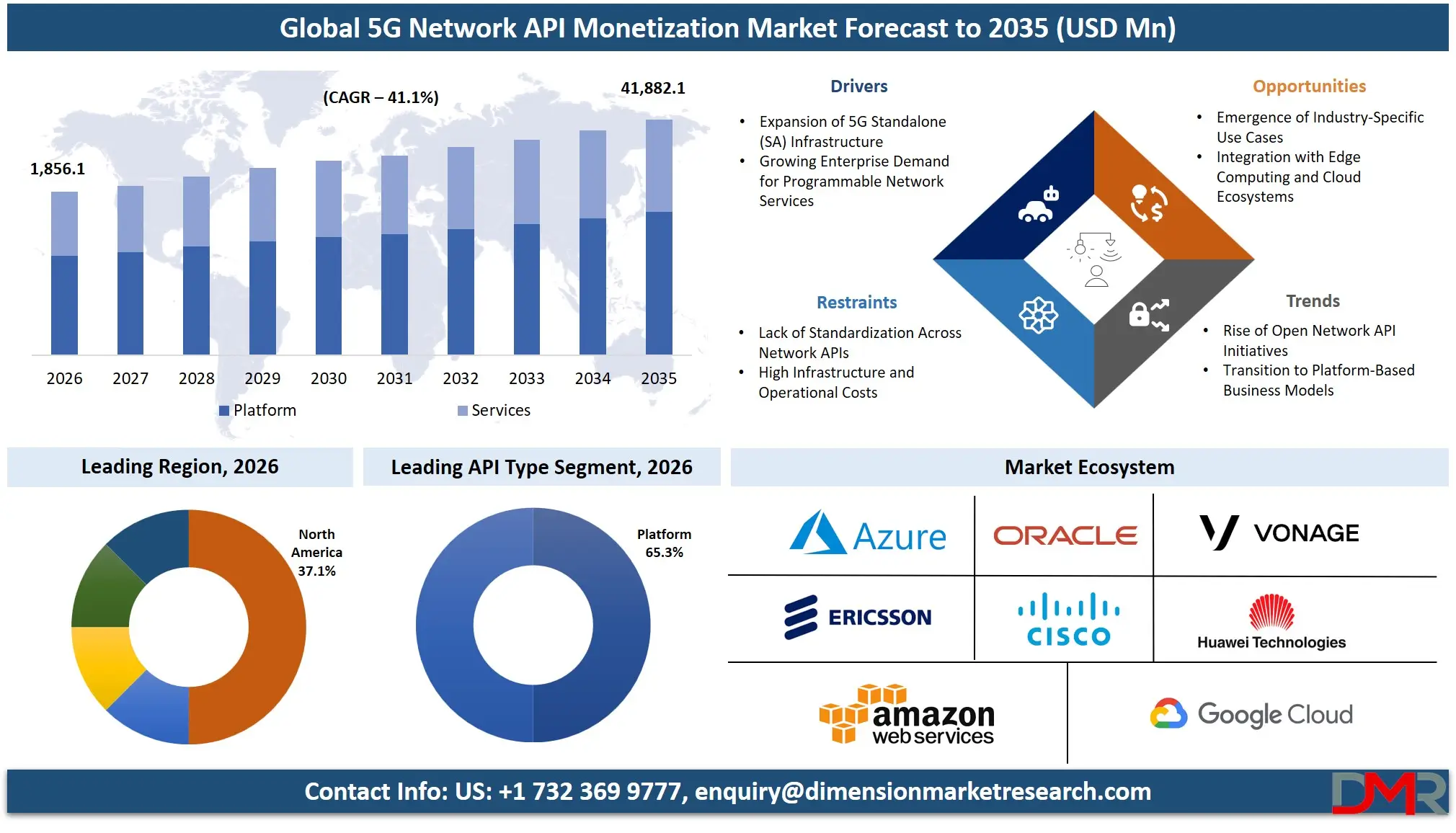
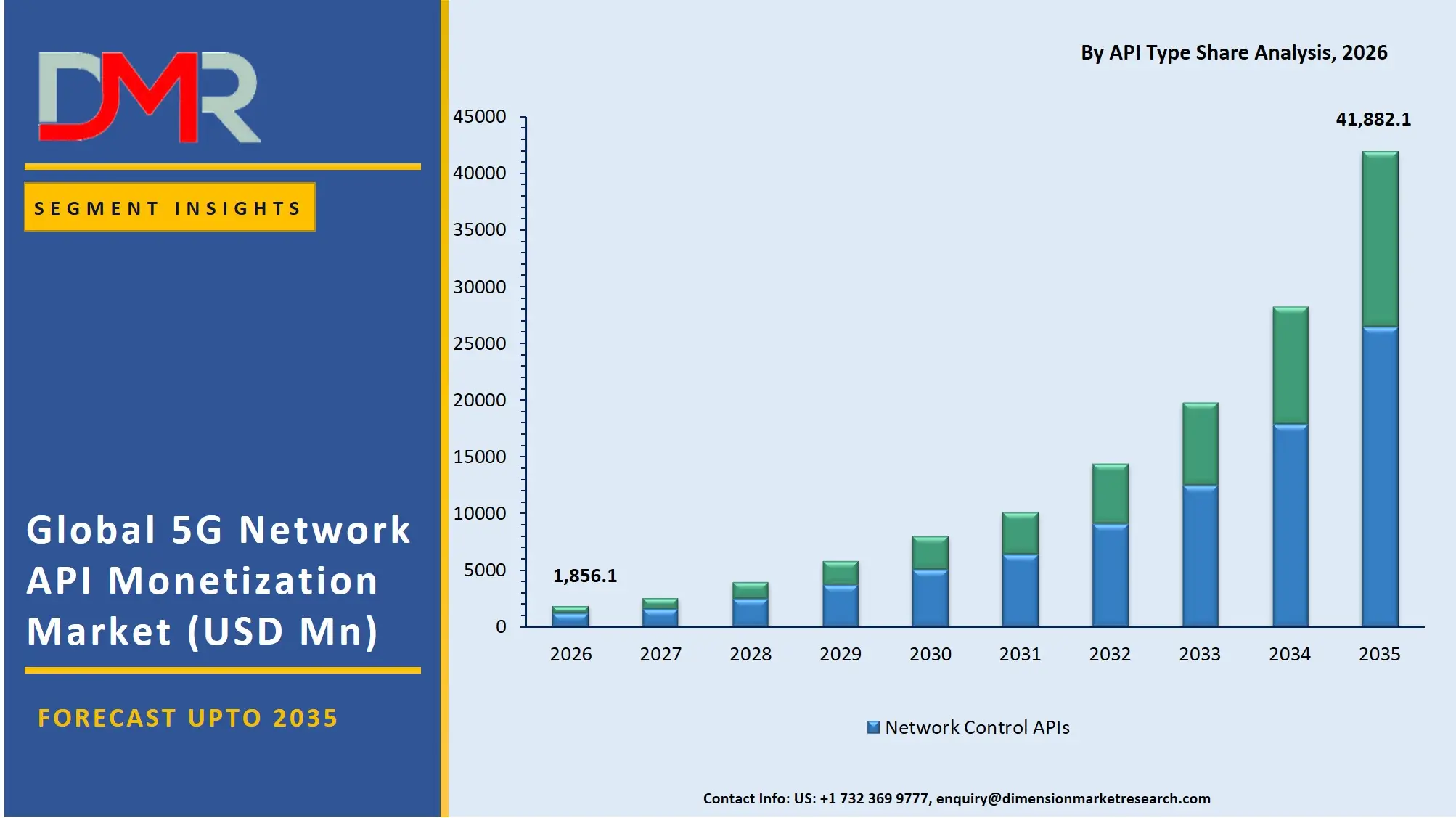
The Global 5G Network API Monetization Market is expected to reach a value of USD 1,856.1 million in 2026, and it is further anticipated to reach USD 41,882.1 million by 2035, growing at a CAGR of 41.4% during the forecast period.
ℹ
To learn more about this report –
Download Your Free Sample Report Here
The 5G network API monetization market has been expanding at a staggering pace as telecom companies move from being connectivity to platform enablers, opening up network functions to external developers and enterprises. The market comprises of platforms and services enabling programmatic access to various 5G network capabilities such as quality-on-demand, location, and edge resources.
The growing need to adopt a programmable network architecture, support low-latency applications, and develop new revenue models beyond connectivity packages is fuelling the need for dedicated API platforms and services. Network operators are the key enablers, with Service Exposure APIs being the most popular ones as they enable value creation from their networks to new ecosystems. The smart cities, industrial automation, healthcare, and autonomous vehicles industries are major players as they require secure, highly reliable, and low-latency programmable network services.
ℹ
To learn more about this report –
Download Your Free Sample Report Here
The US 5G Network API Monetization Market
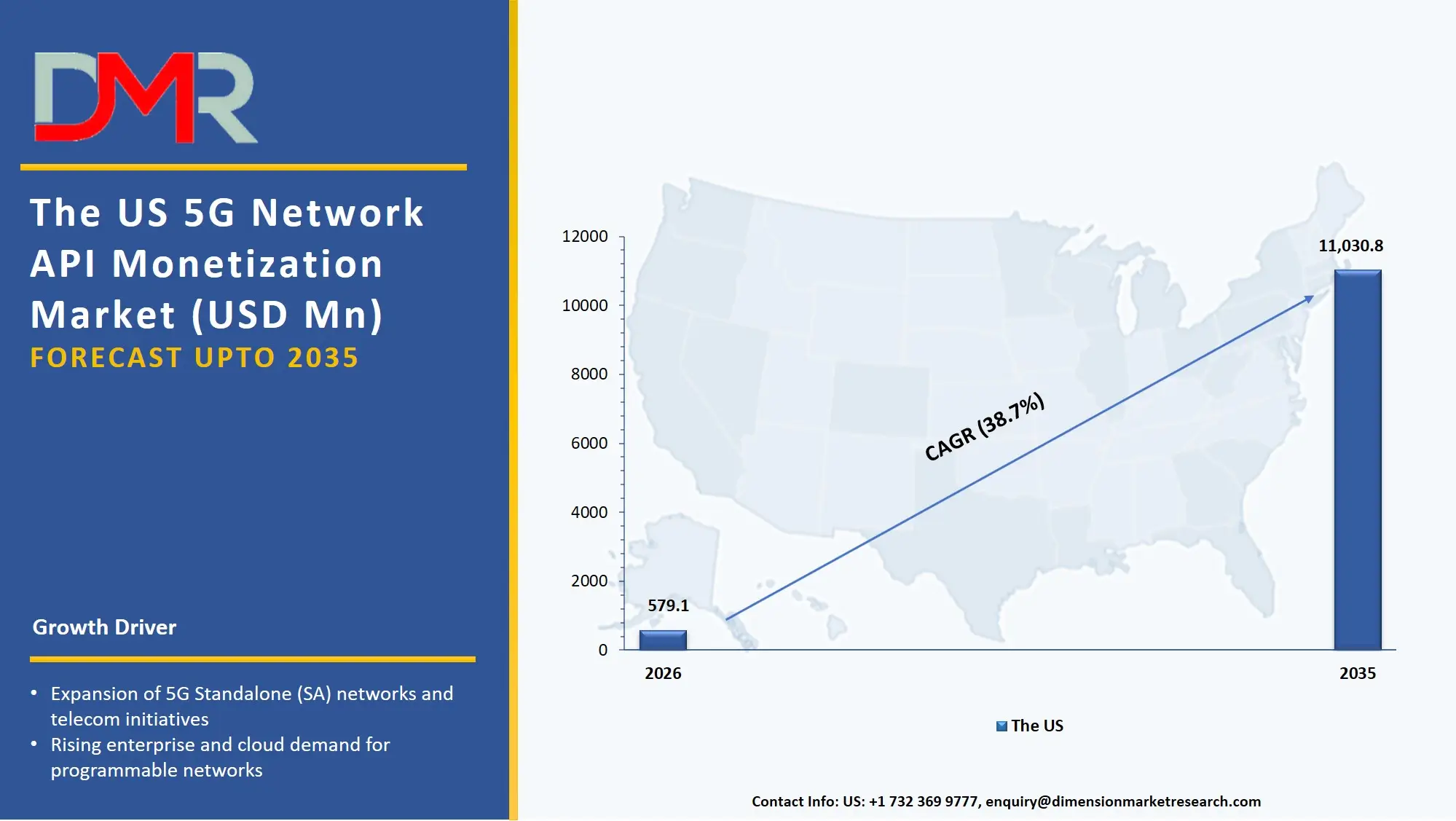
The US 5G Network API Monetization Market is projected to reach USD 579.1 million in 2026 at a compound annual growth rate of 38.7% over its forecast period, culminating in a value of USD 11,030.8 million by 2035.
ℹ
To learn more about this report –
Download Your Free Sample Report Here
The US remains the biggest and most mature market for 5G network API monetization owing to the rapid roll-out of 5G standalone cores by Tier-1 operators and a large and vibrant developer community. The market has been characterised by strong demand for Network Control APIs, where enterprises seek to provision bandwidth and network slicing on demand for immersive gaming and industrial automation applications. Similarly, the deployment of edge computing for autonomous vehicle use cases is generating a similar demand in Service Exposure APIs to control device authentication and low-latency data management on the mobile edge.
The Europe 5G Network API Monetization Market
The Europe 5G Network API Monetization Market is estimated to be valued at USD 535.1 million in 2026 and is further anticipated to reach USD 11,743.1 million by 2035 at a CAGR of 40.5%. The European market is highly influenced by regulatory guidelines such as the GDPR and the forthcoming EU AI Act, which demand the use of secure and sovereign compliant API exposure platforms. The region is also witnessing an increase in the rate of adoption of API deployment in the cloud as Germany and France automotive manufacturers and industries try to balance between the security of operational technology (OT) and 5G-powered analytics. Furthermore, programs like GAIA-X are pushing the platform providers to develop dedicated API services that provide data sovereignty and interoperability for telecom markets in Europe.
The Japan 5G Network API Monetization Market
The Japan 5G Network API Monetization Market is projected to be valued at USD 196.2 million in 2026. It is further expected to witness robust growth, holding USD 4,376.7 million in 2035 at a CAGR of 41.2%. The Japanese market is distinctive in that there is a corporate push to Digital Transformation (DX) to address an ageing workforce and the need for smart city and smart factory automation. A considerable portion of this expenditure involves Network Control APIs and Service Exposure APIs as big conglomerates integrate 5G with critical industrial control systems. There also is a need for localised API wrappers to bridge old industrial protocols with new 5G network functions which is a niche in transaction-based API monetisation and automation.
Key Takeaways
- Market Size & Forecast: The Global 5G Network API Monetization market is projected to reach USD 1,856.1 million in 2026, expanding dramatically to USD 41,882.1 million by 2035, driven by the need for Telecom Operators to generate revenue from 5G standalone core rollouts and the requirement for them to recover investments in spectrum infrastructure.
- Growth Rate & Outlook: Global market growth is expected at a CAGR of 41.4%, driven by the urgent need to evolve from connectivity services to exposing programmable network functions and the growing need for network slicing and edge computing APIs that enable developers.
- Primary Growth Drivers: Major drivers include the growing demand for quality-on-demand connectivity for self-driving cars and automation industries, the need for Telecom Operators to monetise enterprise revenues through Subscription-based and Usage-based business models, and the inclusion of network APIs in enterprise application workflows that require dedicated API platforms.
- Key Market Trends: Key trends include the emergence of industry-specific slices of network functions exposed as APIs, the integration of embedded AI tools into API platforms to forecast and manage network resource allocation, and the shift towards federated API standards as GSMA Open Gateway is adopted globally.
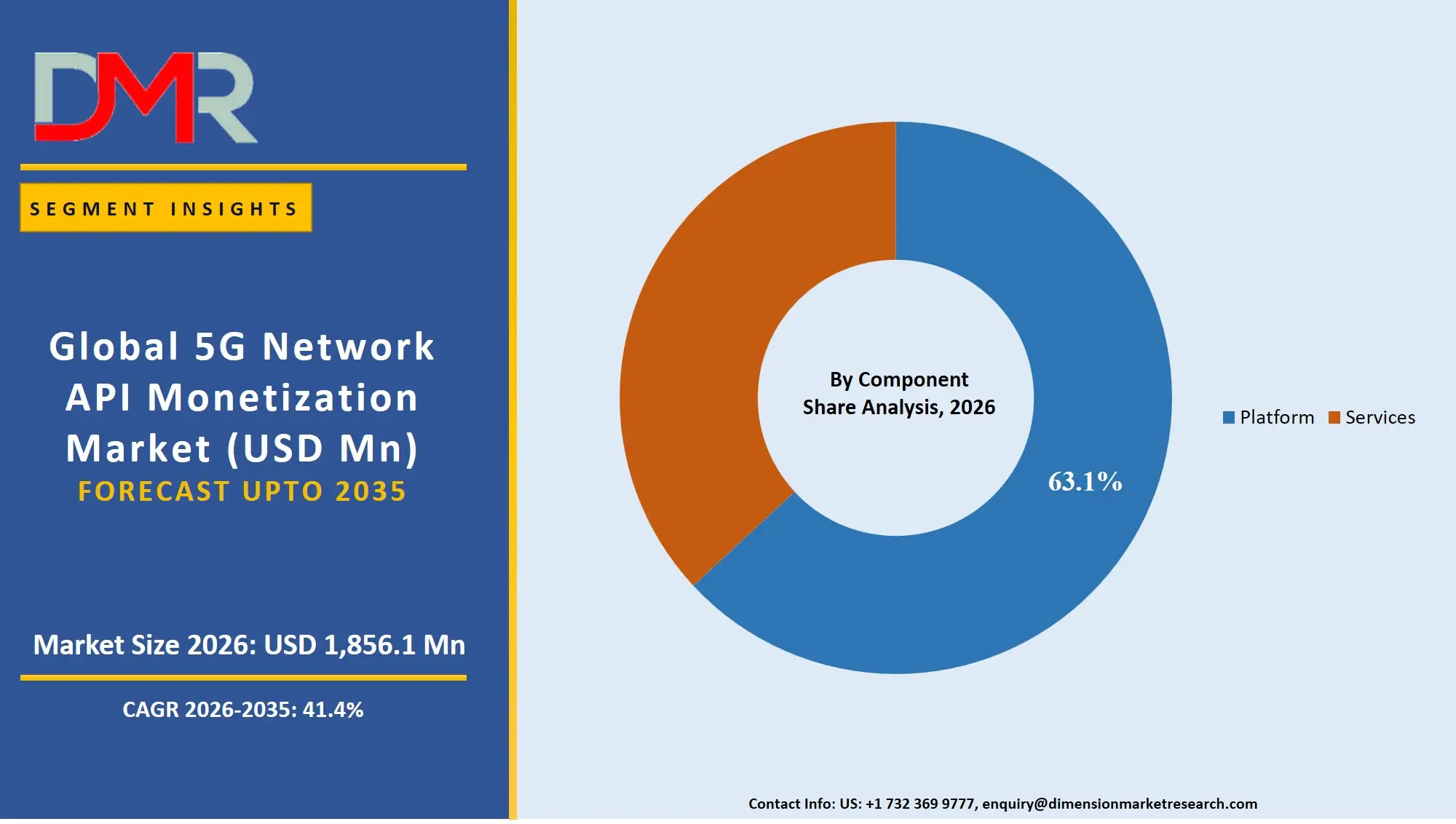
- By Component Analysis: The platform segment is poised to dominate as they are the foundation for API exposure, security, and revenue. CSPs deploy cloud-native platforms that enable network slicing, analytics and integration, while consulting and integration are dependent, with platforms driving revenue.
- By Deployment Mode Analysis: Cloud deployment are projected to lead this segment due to scalability, flexibility, and cost-effective API management. This mode is compatible with 5G standalone networks, offers quick integration, lower deployment costs and facilitates global access, with on-premises deployment restricted to regulated market.
- By API Type Analysis: Service exposure APIs are anticipated to dominate due to their ability to allow external access to network services such as location, quality of service, and billing. They connect telecom with apps, enable monetization, and cater to various industries, compared to less monetizable network control APIs.
- Regional Leadership: North America is poised to dominate this market with 37.1% of the market share in 2026 as it has a strong technology ecosystem of telecom operators and cloud hyperscalers that makes the best of this infrastructure and leads this market.
What is the 5G Network API Monetization?
5G Network API Monetization refers to the platforms and services that allow telecom operators and platform providers to expose unique network capabilities to third-party developers, enterprises, and application providers in a secure, managed and commercial manner. These services, unlike traditional connectivity (the network itself), are related to the how of network programmability. This includes both Platforms for API exposure, security and billing, and Services to help enterprises embed low-latency or bandwidth-on-demand with their applications. With 90% of operators expected to expose network APIs to developers, platforms and services are required to drive scalable developer onboarding, security and revenue management to ensure 5G investments become a reality with new revenue opportunities, rather than technical challenges.
Use Cases
- Dynamic Quality-on-Demand for Autonomous Vehicles: Fleet managers of autonomous vehicles use Network Control APIs to dynamically request in real-time low-latency and high-bandwidth network slices for safe remote operation and telemetry, when the vehicles experience challenging edge cases on the road.
- 5G-Connected Surgery in Healthcare: Hospital networks implement Service Exposure APIs to securely expose location information and device identity of surgical robots, enabling guaranteed bandwidth for telesurgery applications, which are considered critical mobile health and charged on a transactional basis.
- Public Safety in Smart Cities: Government agencies use Network Control APIs to immediately spin up a temporary network slice for first responders during a natural disaster, prioritizing first responder traffic over commercial traffic during a network congestion event.
- High-Fidelity Cloud Gaming: Game developers use Service Exposure APIs and monetization models based on revenue sharing to connect directly with the telecom operator billing system and request low jitter network resource, ensuring high quality mobile gaming.
How AI is Transforming the 5G Network API Monetization Market?
AI is transforming the 5G Network API Monetization market, by facilitating network resource management and improving monetization. For the Platform solution, tools powered by AI could automatically predict network traffic and pre-allocate network resources for APIs, significantly reducing network latency and enabling efficient quality-on-demand experiences. In the monetization function, AI-based features enable the platform to dynamically price according to demand and propose the best monetization model (subscription or transaction-based) to ensure the highest revenue for operators.
AI is also the focus of governance and partner onboarding projects. In terms of platform management, smart security agents are monitoring API traffic to detect suspicious access patterns, misconfiguration and policy violations to ensure the ecosystem complies with international security and data sovereignty standards. Similarly, generative AI assistants are augmenting enterprise application integration by producing example SDK code and network sims for stakeholders to see how the code will work before dedicating development resources.
Market Dynamics
Key Drivers in the Global 5G Network API Monetization Market
Expansion of 5G Standalone (SA) Infrastructure
The rapid deployment of 5G standalone (SA) networks across the United States is a primary driver of the 5G network API monetization market. SA networks support the full cloud-native features, enabling telecommunication providers to offer via API access to advanced network capabilities such as ultra-low latency, network slicing, and quality-on-demand. The leading operators are heavily investing in modernizing their core networks to enable these software-defined interfaces, laying the groundwork for API monetization. This enables enterprises and developers to access network resources, driving innovation in areas such as autonomous driving, smart cities and immersive media. The rollout of SA networks is helping telecom providers shift from being providers of connectivity to providers of platform services, driving API monetization.
Growing Enterprise Demand for Programmable Network Services
Businesses in various sectors are increasingly looking for flexible and real-time network services to enable digital transformation, driving a surge in 5G network API demand. Manufacturing, healthcare, transportation, and finance sectors need low-latency, secure network connectivity seamlessly integrated into their applications and services to support remote monitoring, predictive maintenance, and AI-powered analytics. Network APIs enable businesses to manage network attributes such as bandwidth and latency, to suit the needs of critical applications. This is particularly true with the growth of cloud computing and edge computing, in which applications need to be integrated with the network. In turn, telecom companies are monetizing APIs via partnerships, subscription-based pricing and pay-per-use policies.
Restraints in the Global 5G Network API Monetization Market
Lack of Standardization Across Network APIs
A major challenge facing the US 5G network API monetization market is the absence of a standardised approach among telecommunication operators and platforms. Each service provider may create unique APIs, with different structures, protocols, and integration methods, which hampers efforts to develop scalable and interoperable applications for developers and businesses. This slows down market adoption, as enterprises need to spend more time and effort tailoring applications to various networks. While industry efforts are being made to standardise, this process is slow. Lack of globally accepted standards makes it difficult to integrate with enterprise applications and limits innovation, thereby constraining the monetization of 5G network APIs across various industry segments.
High Infrastructure and Operational Costs
The high capital costs associated with 5G standalone network and API deployment and maintenance serve as barrier to market growth. Telecom providers need to upgrade their existing infrastructure, deploy cloud-native core networks, and establish strong cybersecurity measures for API exposure. Further, the ongoing costs of managing the network, maintaining it and fostering the developer community add to the financial burden. These costs can be overwhelming for smaller telecom companies, stunting their growth. Additionally, the monetization of network APIs is an evolving concept, leading to uncertainty of return on investment. This makes adoption more cautious and slows down the progress to API-based network business models.
Growth Opportunities in the Global 5G Network API Monetization Market
Emergence of Industry-Specific Use Cases
The 5G network API monetization market in the US offers growth opportunities for industry-specific applications that take advantage of network features. Industries like healthcare, automotive, manufacturing and entertainment are embracing 5G-powered solutions that demand fine-tuned network control. APIs enable application developers to control the network to support remote surgery, connected cars, industrial automation and augmented reality (AR). This opportunity for telecom providers is to provide vertical-specific API bundles and services, opening up new revenue opportunities. With the digitalisation of the enterprise, there will be an ever increasing need for specialised network services, making API monetisation an important driver for vertical specific innovation and value creation.
Integration with Edge Computing and Cloud Ecosystems
Leveraging 5G network APIs to integrate with edge computing and cloud ecosystems presents a significant opportunity. Telecommunication companies can leverage low-latency communication complemented with distributed computing to support real-time data analytics and application hosting closer to users. This is especially beneficial for applications that demand real-time responses, including autonomous vehicles, gaming, and smart cities. APIs are essential in managing the interactions between network functions and cloud platforms, allowing for harmonious scalability and agility. Collaborations between telecom providers and cloud service providers are also driving this shift. With the increasing adoption of edge and cloud, API monetization will be an integral part of providing seamless, high-speed digital services.
Trends in the Global 5G Network API Monetization Market
Rise of Open Network API Initiatives
One of the key trends in the US 5G network API monetization market is the increased use of open network API standards to encourage interoperability and ease of development. Industry alliances are promoting network API standardisation by telecommunication operators, allowing developers to create multi-network compatible applications. This openness is creating a more active developer community, driving innovation and making it easier for developers to participate. Open APIs also enable quicker time-to-market for services, as developers can work with standard interfaces instead of developing custom connections. With growing operator adoption of open frameworks, the market is set to see greater involvement of third-party developers, startups, and enterprises, leading to greater adoption and opportunities for monetization.
Transition to Platform-Based Business Models
In the US, telecommunication operators are gradually moving from traditional connectivity-based business models to platform-based business models focusing on API monetization. Rather than simply providing data services, telecom companies are transforming into digital service platforms that offer programmable network capabilities to developers and businesses. This shift allows for innovative pricing structures like pay-as-you-go, subscription-based, and co-innovation revenue-sharing arrangements. Telephone companies are fostering innovation and partnership by establishing developer portals and marketplaces and providing software development kits (SDKs). This development is part of the digital transition in the telecom industry where revenues are being generated through services and applications and not just connectivity, improving the prospects for future growth.
Research Scope and Analysis
The global 5G network API monetization market is segmented by component into platforms and services, by deployment mode into cloud and on-premises, by API type, monetization model, application across industries, and end users including telecom operators, enterprises, and developers.
ℹ
To learn more about this report –
Download Your Free Sample Report Here
By Component Analysis
The platform segment is poised to dominate the component category as it is the foundational infrastructure for API exposure, management, security and monetization. Communications service providers (CSPs) and tech vendors focus on strong API platforms to manage network services, control access by developers, and enable seamless integration with enterprise IT. These platforms enable features like network slicing, quality-on-demand and real-time analytics, which are crucial for 5G applications. With a shift towards a platform business model, operators are investing heavily in cloud-native API platforms. Although segments like consulting and integration are crucial, these are largely tied to the platform, so platforms are the key revenue and strategic segment.
By Deployment Mode Analysis
The cloud deployment mode leads this segment due to scalability, flexibility and cost-effectiveness in managing massive API ecosystems. The cloud-native approach is in line with the design principles of 5G standalone networks, allowing telecom providers to quickly provision, update and scale APIs. Businesses and developers also favour cloud-based APIs as they can easily integrate with other cloud-based services and applications, enabling rapid innovation. Moreover, cloud-based deployment eliminates upfront infrastructure costs, and provides worldwide access. As edge computing and hybrid cloud become more prevalent, cloud-based API monetization platforms are the norm, with on-premises deployments only occurring in highly regulated industries that need to maintain tight control on data.
By API Type Analysis
Service exposure APIs are projected to dominate the API type segment as they directly expose network capabilities to external developers and businesses. These APIs enable applications to access capabilities like location, quality of service, billing and authentication, and are critical to developing business cases. They provide the bridge between telecom networks and external applications, enabling innovations in gaming, healthcare, smart cities, and other sectors. Network control APIs are essential for network operations and optimisation, while service exposure APIs are more lucrative as they make services monetisable. These APIs' support for a variety of apps and ecosystems makes them the most prominent segment for API monetization.
By Monetization Model Analysis
The usage-based monetization model is expected to dominate this segment because of its adaptability to real-time network usage patterns. This enables telecom operators to bill enterprises and developers according to the API consumption metrics, such as the number of API calls made, data transferred or the quality of the service. It is ideal for enterprises with fluctuating usage patterns, as there are no upfront costs and it is cost-effective. This also fosters innovation, as developers can flexibly use the API without upfront investments. Usage-based pricing is the most popular monetization model as it has superior revenue scalability for operators and transparency and flexibility for users, compared to subscription or transaction-based models.
By Application Analysis
The enterprise applications are anticipated to lead this segment since many industries are embracing 5G-driven digital transformation programs. Corporations are using network APIs to improve efficiency, enable real-time data analysis, support technologies like AI, IoT and edge computing. Examples of applications include smart factories, supply chain management, remote monitoring and improved customer engagement. Enterprise applications have a broader reach across industries compared to specific use cases like gaming and autonomous driving, and result in a more sustained demand for API services. The enterprise segment is the biggest revenue and growth driver for the API market as telecom operators are increasingly offering tailored API solutions for enterprises.
By End User Analysis
Telecom operators are expected to dominate the end-user segment as they are the owners and suppliers of 5G network infrastructure and APIs. They are key players in the creation, management and monetization of network APIs by opening up their network resources. They heavily invest in API platforms, partner with cloud providers, and develop developer programs to unlock revenue potential. Although developers and enterprises are the main buyers of these APIs, the supply chain is controlled by telecom operators, setting pricing models, access rules, and quality of services. Their evolution towards a platform business model also enhances their control, putting them in the driver's seat for the growth of 5G network API monetization.
The Global 5G Network API Monetization Market Report is segmented on the basis of the following:
By Component
By Deployment Mode
By API Type
- Network Control APIs
- Service Exposure APIs
By Monetization Model
- Subscription-based
- Usage-based
- Transaction-based
- Revenue-sharing
By Application
- Smart Cities
- Industrial Automation
- Autonomous Vehicles
- Healthcare
- Gaming
- Enterprise Applications
By End User
- Telecom Operators
- Enterprises
- Developers
- Government
Regional Analysis
Leading Region by Market Share
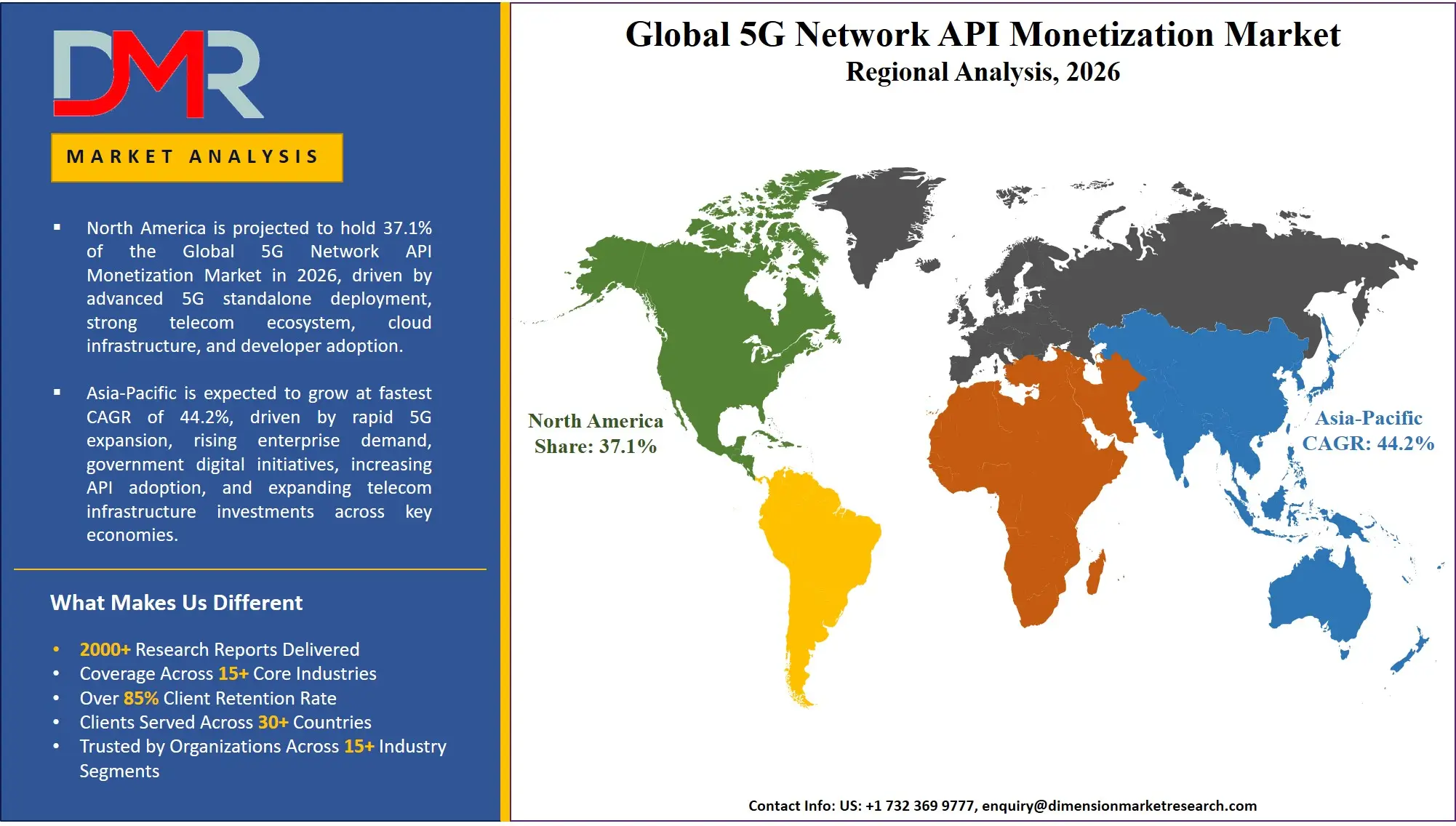
North America is poised to dominate the global 5G network API monetization market as it is projected to hold 37.1% of the market share by the end of 2026. North America is dominated by the United States, which has the largest market share in the 5G network API monetization market owing to the unrivalled presence of cloud hyperscalers, the largest venture capital funded application developer ecosystem, and the ambitious digital transformation programs of Tier-1 telecom operators. The region also has a strong presence of global systems integrators, cutting-edge API platform startups and a large talent pool of network and cloud engineers. Corporate funding for self-driving cars, smart factories powered by artificial intelligence (AI) and mobile augmented reality gaming drives the demand for the Network Control and Service Exposure APIs, as well as settlement improvements. As well, the regulatory environment continues to fund the next generation of neutral-host network providers which require an API-first platform for rapid deployment and partner integration.
ℹ
To learn more about this report –
Download Your Free Sample Report Here
Fastest-Growing Regional Market
The Asia-Pacific region is anticipated to be the fastest-growing 5G network API monetization market because of the government-driven massive 5G and smart city deployment programs in India, China, Japan and South Korea. The rapid economic growth, the emergence of a manufacturing power base and the rapid growth of the digital economy are driving the incumbent telecommunication service providers and government agencies to aggressively roll out programmable network platforms. The demand for Service Exposure API is high to aid these large enterprises to transform into B2B2X platform providers. There is also a dire need for application developers who are proficient in network programming and it is critical to use platform services for onboarding, testing and managed security to bridge the talent gap and accelerate the time-to-market to roll out new 5G applications.
By Region
North America
Europe
- Germany
- The U.K.
- France
- Italy
- Russia
- Spain
- Benelux
- Nordic
- Rest of Europe
Asia-Pacific
- China
- Japan
- South Korea
- India
- ANZ
- ASEAN
- Rest of Asia-Pacific
Latin America
- Brazil
- Mexico
- Argentina
- Colombia
- Rest of Latin America
Middle East & Africa
- Saudi Arabia
- UAE
- South Africa
- Israel
- Egypt
- Rest of MEA
Competitive Landscape
The global 5G network API monetization market is rapidly becoming very competitive with a diverse mix of global telecom software providers, API management vendors, cloud hyperscalers and focused network platform innovators. The market will require deep strategic partnerships with the GSMA's Open Gateway program and telecom operators such as AT&T, Vodafone or China Mobile due to co-selling opportunities and early access to network functions of new 5G standalone cores. Consolidation of the market is advancing at a fast pace with traditional telecom equipment suppliers buying out API management and edge computing startups to survive. Unique intellectual property such as AI-powered network optimization algorithms and industry-specific API templates are becoming more important as a distinguishing factor than mere API gateway or generic billing software solutions.
Some of the prominent players in the Global 5G Network API Monetization Market are:
- Ericsson
- Nokia
- Vonage
- Amazon Web Services
- Google Cloud
- Microsoft Azure
- Cisco Systems
- Huawei Technologies
- ZTE Corporation
- Amdocs
- Twilio
- Infobip
- Sinch
- Oracle
- IBM
- AT&T
- Verizon
- T-Mobile
- Deutsche Telekom
- Vodafone
- Other Key Players
Recent Developments
- January 2026: Nokia announced a significant expansion of its 5G API Innovation Center, allowing Healthcare and Smart Cities customers to develop network-aware applications with a common Service Exposure API platform and developer environment.
- November 2025: Amazon Web Services (AWS) and Vodafone Group announced a joint effort to provide Network Control API Integration for industrial automation and secure migration of mission-critical workloads to private 5G networks.
- October 2025: Vonage bought a European edge computing integration company to boost subscription and revenue-share API models on sovereign cloud, aiming to meet government and smart city data sovereignty demands.
Report Details
| Report Characteristics |
| Market Size (2026) |
USD 1,856.1 Mn |
| Forecast Value (2035) |
USD 41,882.1 Mn |
| CAGR (2026–2035) |
41.4% |
| The US Market Size (2026) |
USD 579.1 Mn |
| Historical Data |
2021 – 2025 |
| Forecast Data |
2027 – 2035 |
| Base Year |
2025 |
| Estimate Year |
2026 |
| Segments Covered |
By Component, By Deployment Mode, By API Type, By Monetization Model, By Application, and By End User |
| Regional Coverage |
North America – The US and Canada; Europe – Germany, The UK, France, Russia, Spain, Italy, Benelux, Nordic, & Rest of Europe; Asia-Pacific – China, Japan, South Korea, India, ANZ, ASEAN, Rest of APAC; Latin America – Brazil, Mexico, Argentina, Colombia, Rest of Latin America; Middle East & Africa – Saudi Arabia, UAE, South Africa, Turkey, Egypt, Israel, & Rest of MEA |
Frequently Asked Questions
How big is the Global 5G Network API Monetization Market?
▾ The Global 5G Network API Monetization market is poised to be valued at USD 1,856.1 million in 2026 and is projected to reach USD 41,882.1 million by 2035, driven by the universal need for telecom operators to generate returns on 5G investments by exposing network capabilities to developers and enterprises.
What is the CAGR of the Global 5G Network API Monetization Market from 2026 to 2035?
▾ The market is expected to grow at a CAGR of 41.4% from 2026 to 2035, reflecting the accelerating complexity of 5G standalone networks and the persistent demand from enterprises for programmable, low-latency connectivity.
What factors are driving the growth of the Global 5G Network API Monetization Market?
▾ Key drivers include the telecom operator imperative to diversify revenue beyond data plans, the need to enable low-latency applications like autonomous vehicles and industrial automation, and the surge in demand for secure, federated API platforms amid evolving operator consortium standards.
Which region held the largest share of the 5G Network API Monetization Market in 2026?
▾ North America is projected to be led this market with 37.1% of market share in 2026, driven by a mature cloud hyperscaler ecosystem and aggressive enterprise investment in integrating 5G network control into autonomous systems and gaming applications.
Which region is expected to grow the fastest in the 5G Network API Monetization Market?
▾ The Asia-Pacific region is expected to grow the fastest, fueled by rapid 5G network expansion in China, Japan, and India, where enabling Service Exposure APIs for smart cities and industrial automation is critical for national digital agendas.
What are the major trends in the Global 5G Network API Monetization Market?
▾ Major trends include the adoption of GSMA’s Open Gateway federated API standards, the rise of AI for dynamic pricing and network optimization, the demand for industry-specific API wrappers, and the focus on complex multi-party settlement within transaction-based and revenue-sharing models.
Who are the key players in the Global 5G Network API Monetization Market?
▾ Key players include telecom network vendors like Ericsson, Nokia, and Huawei, API and cloud platform specialists like Twilio, Infobip, and AWS, as well as telecom software companies like Amdocs and Netcracker, alongside specialized pure-play 5G API platform innovators.
How is the Global 5G Network API Monetization Market segmented?
▾ The market is segmented by Component, Deployment Mode, API Type, Monetization Model, Application, and End User.