What is the A2P Messaging Market Size?
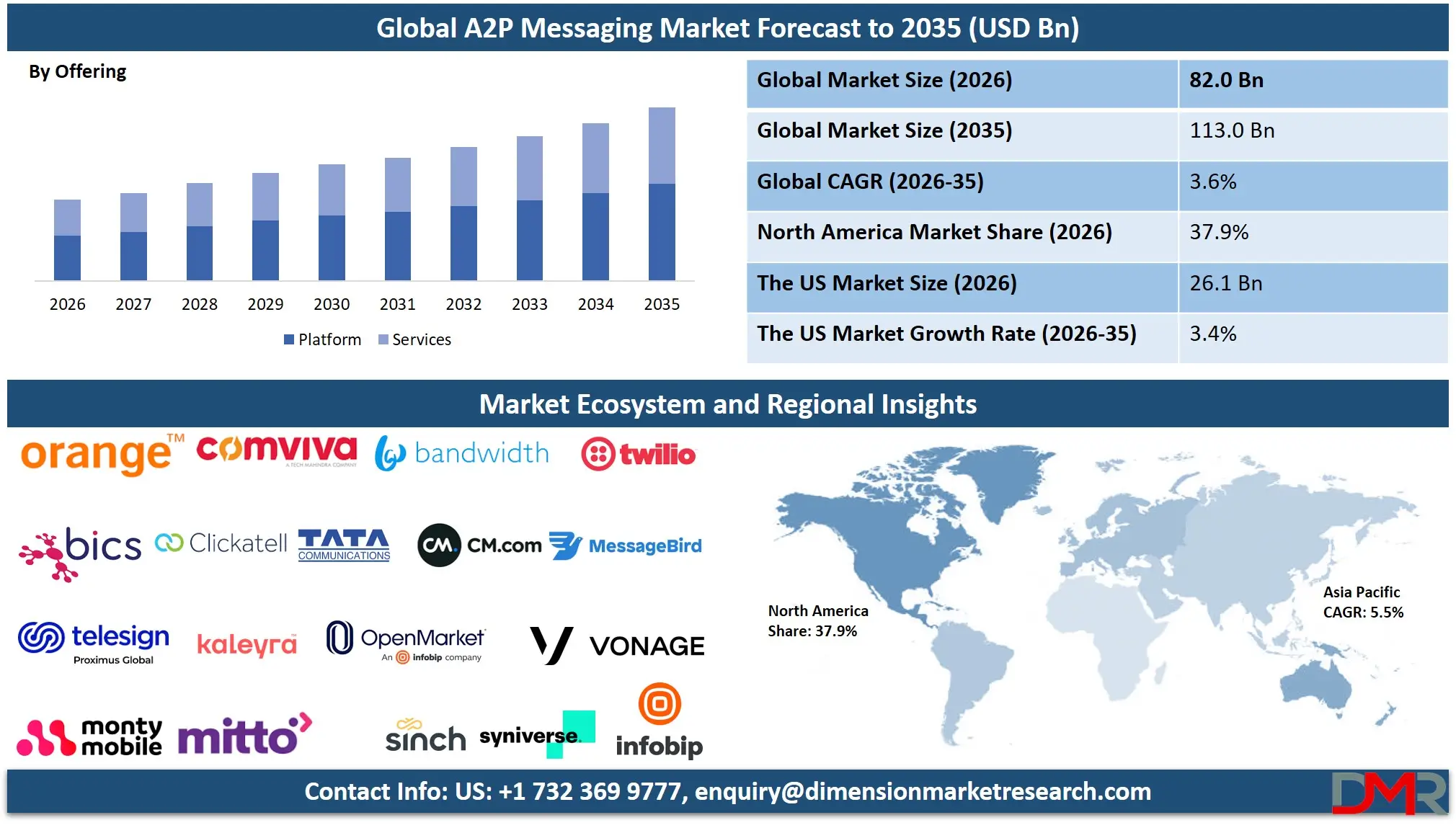
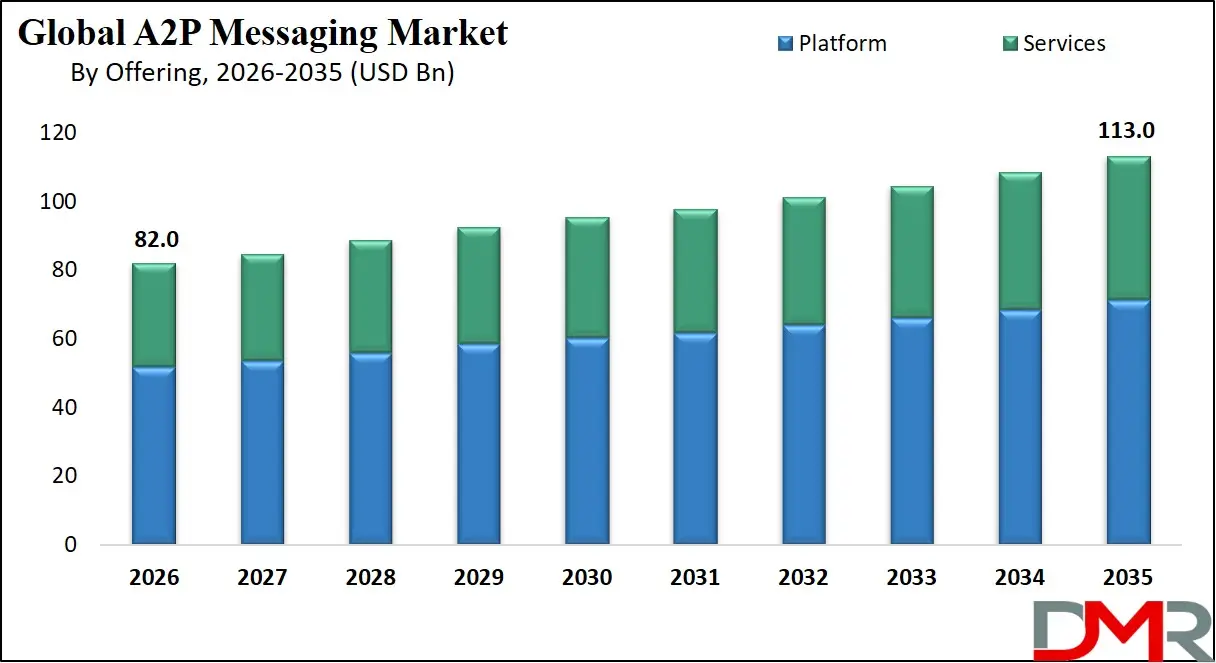
The Global A2P Messaging market is expected to reach a value of USD 82.0 billion in 2026, and it is further anticipated to reach USD 113.0 billion by 2035, growing at a CAGR of 3.6% during the forecast period. Application-to-Person A2P Messaging involves sending SMS, RCS, and OTT messages to the mobile phones of consumers by business applications. The market is fueled by continual need of digital authentication, multi-factor authentication (MFA) and integration of conversational commerce in enterprise workflows. The development of telecom infrastructure to 5G and Rich Communication Services (RCS) is fundamentally changing stagnant notifications into branded customer experience as an interactive experience.
ℹ
To learn more about this report –
Download Your Free Sample Report Here
The largest AI-based routing and fraud prevention innovation centers are located in North America, Western Europe, and high-tech mobile economies in Asia-Pacific.
The market ecosystem includes global CPaaS vendors, mobile network operators (MNOs), SMS aggregators, and firewall vendors that control the integrity of signaling networks. Also, regulatory regimes such as the GDPR in Europe and the TCPA in the U.S. are compelling businesses to use secure, compliant messaging systems, where value is being directed to verified sender platforms and direct-connect carrier models to avoid the inefficiencies of the grey route.
ℹ
To learn more about this report –
Download Your Free Sample Report Here
The US A2P Messaging Market
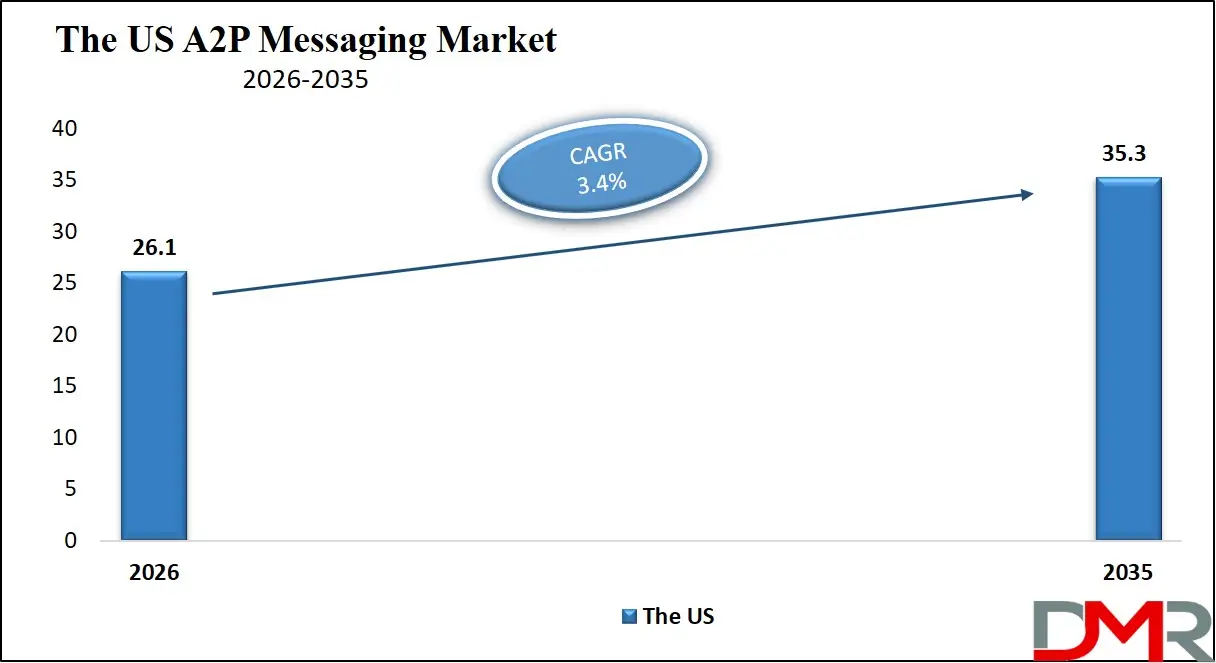
The US A2P Messaging Market is projected to reach USD 26.1 billion in 2026 and is further anticipated to reach USD 35.3 billion by 2035 at a CAGR of 3.4% over the forecast period. The US market remains the largest globally, underpinned by the dominance of SMS for enterprise customer engagement and the surging demand for 10DLC (10-Digit Long Code) compliance.
ℹ
To learn more about this report –
Download Your Free Sample Report Here
With migration of businesses out of unverified P2P long codes to approved A2P routes, the ecosystem is experiencing greater value capture by Tier-1 aggregators and mobile carriers. The use of Verified SMS and RCS by large retail and banking organizations is setting interactive marketing to a new standard, allowing rich carousels and quick- reply functionality in the native messaging inbox, thus increasing the rate of conversion.
The Europe A2P Messaging Market
The Europe A2P Messaging Market is estimated to be valued at USD 18.6 billion in 2026 and is further anticipated to reach USD 25.1 billion by 2035 at a CAGR of 3.4%. The European market is one that has a very high regulatory emphasis on data privacy (GDPR) and a high level of network security. This has enhanced the transition of the grey route traffic to direct and secure operator links and firewall-defended routes. The region is a pioneer in embracing the use of Open Gateway APIs, which enable businesses to implement carrier-grade security and network quality-of-service into messaging processes. Industries like open banking and digital identity are being used to generate high-volume authentication traffic, while the retail market is using RCS to make rich promotional campaigns, such as in the UK, Germany and France.
The Japan A2P Messaging Market
The Japan A2P Messaging Market is projected to be valued at USD 4.2 billion in 2026. It is further expected to witness subsequent growth, holding USD 5.7 billion in 2035 at a CAGR of 3.5%. The A2P messaging market in Japan is distinct because of the domination of domestic OTT services and the special program of the so-called "+Message" (Plus Message) program by the domestic carriers. Whereas SMS is essential in banking alerts and one-time passwords (OTPs), the RCS is influenced by the Japanese cultures and business needs to have a secure and time-stamped delivery. The intersection of messaging and My Number Card digital identity system is forming new, high-value applications of secure government-to-citizen notifications and healthcare appointment management.
Key Takeaways
- Market Size & Forecast: The Global A2P Messaging market is projected to reach USD 82.0 billion by 2026 and expand to USD 113.0 billion by 2035, fueled by the dual drivers of digital identity verification requirements and the commercialization of RCS Business Messaging (RBM).
- Growth Rate & Outlook: The market is projected to grow at a CAGR of 3.6%, as the number of transaction-related alerts in emerging markets and the adoption of MFA (Multi-Factor Authentication) in place of single-factor passwords within enterprise SaaS applications have surged.
- Primary Growth Drivers: The driving forces include global compliance mandates for data security, the expansion of conversational AI Chabot's within messaging threads, and the decommissioning of 2G/3G networks forcing enterprise IoT and alert systems onto LTE/5G messaging protocols.
- Key Market Trends: Integration of AI to make smart routes and reduce delivery latency, consolidation of SMS firewall services to fight Artificially Inflated Traffic (AIT), and merging A2P channels with What Sapp Business API and Telegram to automate customer support are some of the main trends.
- By Offering Analysis: Platforms is poised to dominate the offering segment, fueled by the need to have CPaaS (Communications Platform as a Service) offerings that provide API-based Omni channel orchestration.
- By Deployment Mode Analysis: Cloud-based deployment is expected to dominate based on deployment mode in this market as it ipreferred choice because of the elastic scalability requirements that are inherent to peak-traffic events (e.g., Black Friday alerts) and the ability to gracefully fail.
- By Application Analysis: Authentication Services (MFA/OTP) is projected to be the dominate this segment, as zero-trust security designs become the new organizational norm. Customer Relationship Management (CRM) Services is the fastest-growing category as companies abandon blast promotions and move to two-way conversation support through personalization, using RCS and OTT applications.
- Regional Leadership: North America is poised to dominate this market with 37.9% of the market share in 2026 due to its well-developed technological ecosystem that utilizes this infrastructure to its fullest and makes it a leader in this market.
What is the A2P Messaging?
Application-to-Person (A2P) Messaging is defined as a method of transmitting text or rich media messages between a software application, web service or enterprise system and the device of a mobile subscriber. A2P is automated and scaled unlike Person-to-Person (P2P) texting, and can be used in a variety of use cases, such as two-factor authentication (2FA), appointment notifications, logistics, and marketing notifications. The ecosystem is based on a sophisticated value chain of companies, aggregators, and Mobile Network Operators (MNOs) to direct traffic in a legal and reliable way.
Modern A2P is more than simple SMS to encompass RCS (Rich Communication Services) as well as OTT applications such as WhatsApp as a secure and branded experience which helps companies bridge the gap between corporate infrastructure and consumer mobile interaction touchpoints and helps companies cut on operational costs and improve customer touchpoints.
Use Cases
- Banking & Payment Security: Financial institutions globally utilize A2P SMS for real-time transaction alerts and 3D Secure (3DS) authentication codes, mitigating fraud and complying with PSD2/Open Banking regulations.
- Retail E-commerce Logistics: Major e-commerce platforms rely on A2P messaging for click-to-collect codes, delivery driver tracking links, and abandoned cart recovery promotions, driving last-mile operational efficiency.
- Healthcare Appointment Management: Hospitals and clinics deploy A2P to reduce no-show rates by sending automated appointment reminders and digital intake form links, optimizing clinical resource utilization.
- Travel Itinerary Updates: Airlines and hospitality brands use A2P channels to deliver flight gate changes, check-in links, and booking confirmations instantly, providing critical real-time traveler support.
How AI is Transforming the A2P Messaging Market
Artificial intelligence is transforming enterprise messaging by improving the speed, security, and effectiveness of communication networks. Predictive traffic routing uses AI to continuously evaluate carrier performance, network congestion, and delivery success rates in real time. Based on this analysis, the system automatically reroutes one-time passwords (OTPs) and transactional messages through the fastest available channel, ensuring delivery within milliseconds. This capability is especially important in banking, financial services, and e-commerce, where delays in authentication messages can affect customer experience and transaction security.
AI is also enhancing customer engagement by making enterprise messaging more interactive and intelligent. Sentiment and intent analysis tools examine inbound responses to automated campaigns and identify whether customers are interested, dissatisfied, confused, or ready to purchase. Based on this interpretation, smart autoresponders can instantly escalate issues to support teams, provide tailored information, or move leads further down the sales funnel without human involvement.
Market Dynamics
Key Drivers in the Global A2P Messaging Market
The Unrelenting Demand for Digital Trust (Authentication)
Digital authentication has become one of the most powerful forces of the A2P messaging market with the growing popularity of cloud applications, online banking, e-commerce, and remote work. Multi-factor authentication (MFA) has become an essential tool used nowadays by enterprises to secure user accounts, transactions, and sensitive data against cyberattacks and credential theft. Each only log-in, authorization of payment, or password reset usually results in an A2P SMS one-time password (OTP). As long as security is a critical concern despite the economic conditions, authentication messaging budgets are steadily increasing.
Adoption of RCS and Conversational Commerce
The use of Rich Communication Services (RCS) is reshaping the conventional A2P messaging industry. RCS also allows branded and interactive messages, which include images, buttons, carosels, maps and payment options, as opposed to simple SMS. Companies are now able to interact with customers directly within the messaging inbox, enabling them to purchase tickets, pay bills, select products or confirm appointments without changing applications. Google and mobile operators are taking active action to popularize RCS as a secure alternative to other OTT messaging platforms.
Restraints in the Global A2P Messaging Market
Grey Route Arbitrage and Revenue Leakage
One of the largest problems in the global A2P messaging market is grey route arbitrage. Unauthorized routes, SIM farms, and SIM boxing are some of the methods that many messaging providers employ to send business messages as person-to-person traffic at reduced cost. This enables them to avoid carrier billing systems and save on money at the expense of mobile operators and legitimate service providers who make huge losses. Grey routes may result in delays in messages, unsuccessful delivery, or blockage by carrier firewalls. Moreover, unjustified competition on the pricing front renders it challenging to remain profitable by the compliant CPaaS providers. Grey route activity has still been able to compromise the market trust and stability despite the increased regulation.
The Rise of OTT App Cannibalization
The fast progress of over-the-top (OTT) messaging applications like WhatsApp, Viber, Telegram, and WeChat is diminishing the growth potential of conventional SMS-based A2P messaging. Consumers with easy access to internet and cheap mobile data tend to use these applications in high volume in areas with high internet coverage and low cost of mobile data since they are multimedia and real time chat and reduce cost of communication. A lot of businesses are moving their marketing and customer interaction budgets to OTT channels to enhance their response rates and minimize costs of messaging.
Growth Opportunities in the Global A2P Messaging Market
5G IoT and Network API Exposure
The implementation of 5G networks and network APIs is making significant opportunities in the A2P messaging market. Enterprise can now also access network functions via initiatives like the GSMA Open Gateway and CAMARA project and provide smarter and more secure messaging experiences. As an illustration, companies can activate messages through the location of a customer, the state of their device or the network. This can be used in more advanced applications like silent authentication, real-time delivery status, and connected vehicle notices, or industrial IoT notifications.
Integration with CPaaS and Low-Code Workflows
Business messaging is becoming more accessible to non-technical users with the integration of A2P messaging into CPaaS and low-code automation tools. No-code workflow solutions like Microsoft Power Automate, Salesforce Flow, and others provide marketing, customer service, and operations teams with an opportunity to create messaging campaigns. Companies are able to generate automatic reminders, order alerts, lead nurturing emails, and customized follow-ups using easy drag-and-drop interfaces. This democratization widens usage of A2P messaging by organizations and volume of messages in various industries.
Trends in the Global A2P Messaging Market
The Era of Verified SMS and Branded Calling
A2P messaging is shifting towards verified and branded communication to minimize spam, phishing, and consumer distrust. Google Verified SMS and Apple Branded Messages are technologies that enable companies to show their official logo, brand name, and verification badge in the message interface. This will enable customers to identify legitimate businesses immediately and minimize the possibility of fraud or smishing attacks. Registering sender IDs and authentication are also becoming tougher among mobile operators.
Sustainability in Transactional Messaging
Sustainability is emerging as an important trend in the global A2P messaging market as enterprises seek to reduce their environmental impact. Messaging campaigns with high volumes burn the network resources, cloud computing capabilities and power, as well as electricity when messages are sent repeatedly to inactive or invalid numbers. In order to promote ESG objectives, businesses are starting to audit their message practice and enhance database hygiene. They are eliminating duplicate, old and non-responsive contacts so as to minimize unwarranted message traffic.
Research Scope and Analysis
By Offering Analysis
Platforms is poised to dominate the offering segment since businesses are increasingly adopting Communications Platform-as-a-Service (CPaaS) offerings that consolidate all messaging services into a unified interface. The platforms enable businesses to operate SMS, RCS, and third-party messaging apps like WhatsApp using APIs and dashboards. Services like automated failover routing, analytics, campaign management, and cost optimization are beneficial to organizations. Meanwhile, the services sector is expanding fast due to the high demand of assistance in controlling the international regulations, anti-spam, carrier relations, and optimization of delivery of the messages in different enterprises. Consulting and managed services are particularly useful to the companies that are going international across several countries and have increasingly complicated telecom needs.
By Communication Channel Analysis
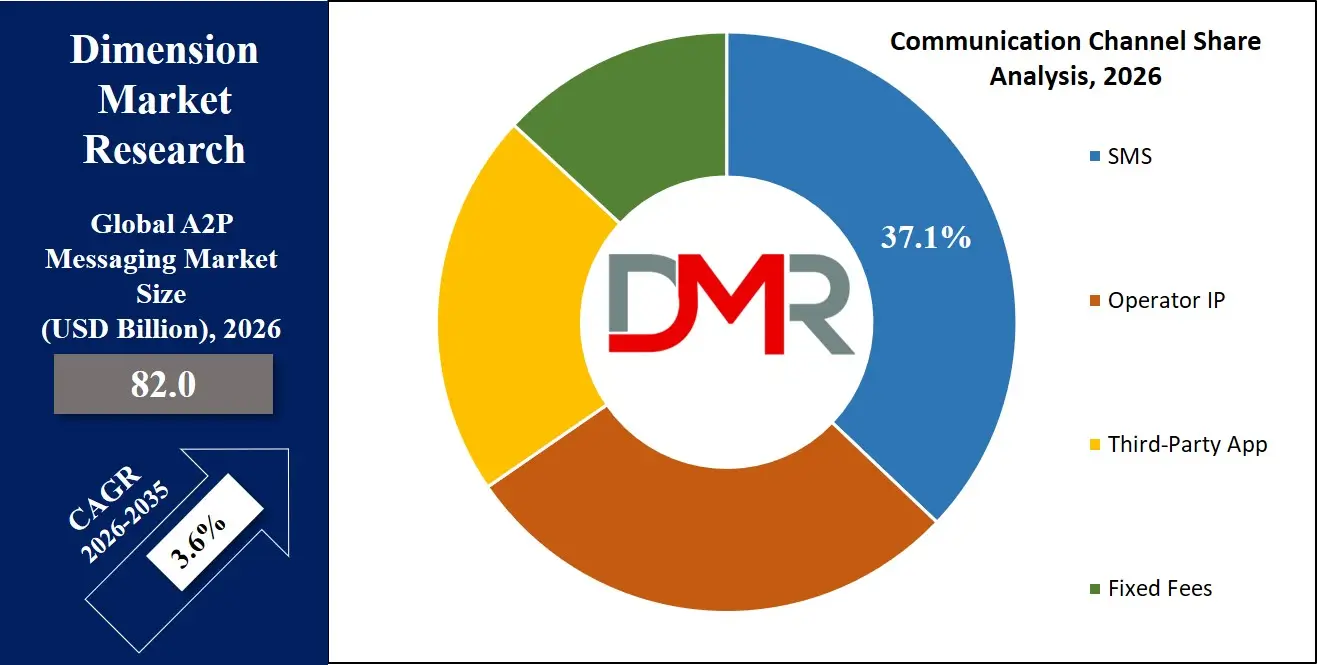
The SMS is poised to dominate the communication channel segment due to its universal nature and compatibility with almost all mobile phones without the need to use the internet or other applications. It remains a necessity in one-time passwords, banking notifications, and emergency messages, particularly when using apps is not possible.
ℹ
To learn more about this report –
Download Your Free Sample Report Here
Third-party messaging applications, though, like WhatsApp, Viber, and WeChat are becoming increasingly popular to publish messages to customers and promote the product. These mediums facilitate multimedia, interactive contents and reduce the cost of messaging during massive campaigns. Operator IP messaging (particularly RCS) is regarded as the future of the industry since it integrates both rich media and branded interactions in the native mobile inbox, though wider adoption remains reliant on carrier support.
By Deployment Mode Analysis
Cloud deployment leads the A2P messaging market since it offers the scalability, flexibility and reliability needed to support such massive volumes of messages across the regions. Cloud-based solutions enable companies to add or subtract messaging capacity swiftly when sales are boosted by the season (e.g. holiday sales), a promotion is going on, or when the bank is experiencing a high volume of business. They also facilitate the low-latency routing with the help of the globally distributed SMS gateways, enhancing the speed of delivery and performance. In comparison, on-premise deployment is only applicable to the most specialized environment with high security and sovereignty needs. On-premise systems are common in central banks, defense organizations, and government agencies, due to their need to have full control over data storage, message generation, and network access through secure physical infrastructure.
By SMS Traffic Analysis
Domestic SMS traffic is expected to account for the largest share of the market because most enterprise messaging is generated within national borders. Domestic routes are widely utilized by businesses to remind customers of their appointments, verify their bank accounts, update them on the delivery of their online purchases, and promote themselves locally. These paths tend to be more stable, cheaper and less complicated to manage since the messaging providers have direct connections with the local carriers. The SMS traffic between countries is, in total volume, less, but much more complex and more likely to be more profitable. It entails several telecommunication companies, cross border laws, fluctuation in exchange rates and geopolitical limitations. The providers are required to employ advanced routing technologies to make sure that the messages are delivered efficiently and at the same time adhere to various national telecom policies and pricing models.
By Application Analysis
Authentication services, such as multi-factor authentication and one-time passwords, claim a larger share of the application segment since they are vital in ensuring protection of online transactions, digital banking, and account access. Businesses rely on prompt and high-quality OTP delivery, as any delays, even minor ones, may result in unsuccessful logins, an abandoned shopping cart, and bad customer experience. This renders authentication messaging the most vital and regular usage instance in the A2P market. Simultaneously, customer relationship management services are emerging as the most rapidly growing type of application. Two-way communication with customers via messaging is becoming more popular among businesses, such as booking appointments, tracking orders, making personalized offers, and customer service. Artificial intelligence-driven chatbots and conversational e-commerce are also fuelling expansion in this segment.
By End User Analysis
The BFSI sector is expected to remain the leading end user in the A2P messaging market because banks, financial institutions, and insurance companies, need to communicate securely and in real time with their customers. They extensively apply A2P messaging to authenticate and send fraud alerts, confirm transactions, and send regulatory messages. Customer authentication and increased cybersecurity concern remains a high demand in this segment. The highest growth rates are registered in retail and e-commerce as companies are more concerned with messaging to update orders, track their delivery, promote the product, and send personal messages to their customers. The popularity of this sector is towards rich Communication Services and third-party messaging applications. Another key vertical is healthcare, where A2P messaging is used to remind patients of appointments, medications, access telehealth, and communicate about public health.
The Global A2P Messaging Market Report is segmented on the basis of the following:
By Offering
By Communication Channel
- SMS
- Operator IP
- Third-Party App
- Fixed Fees
By Deployment Mode
By SMS Traffic
By Application
- Authentication Services
- Pushed Content Services
- Customer Relationship Management (CRM) Services
- Promotional Campaigns / Marketing Services
- Interactive Services
- Others
By End User
- Banking, Financial Services, And Insurance (BFSI)
- Retail & E-commerce
- Healthcare
- Travel & Tourism
- Media & Entertainment
- Government
- Transportation & Logistics
- Others
Regional Analysis
Leading Region by Market Share
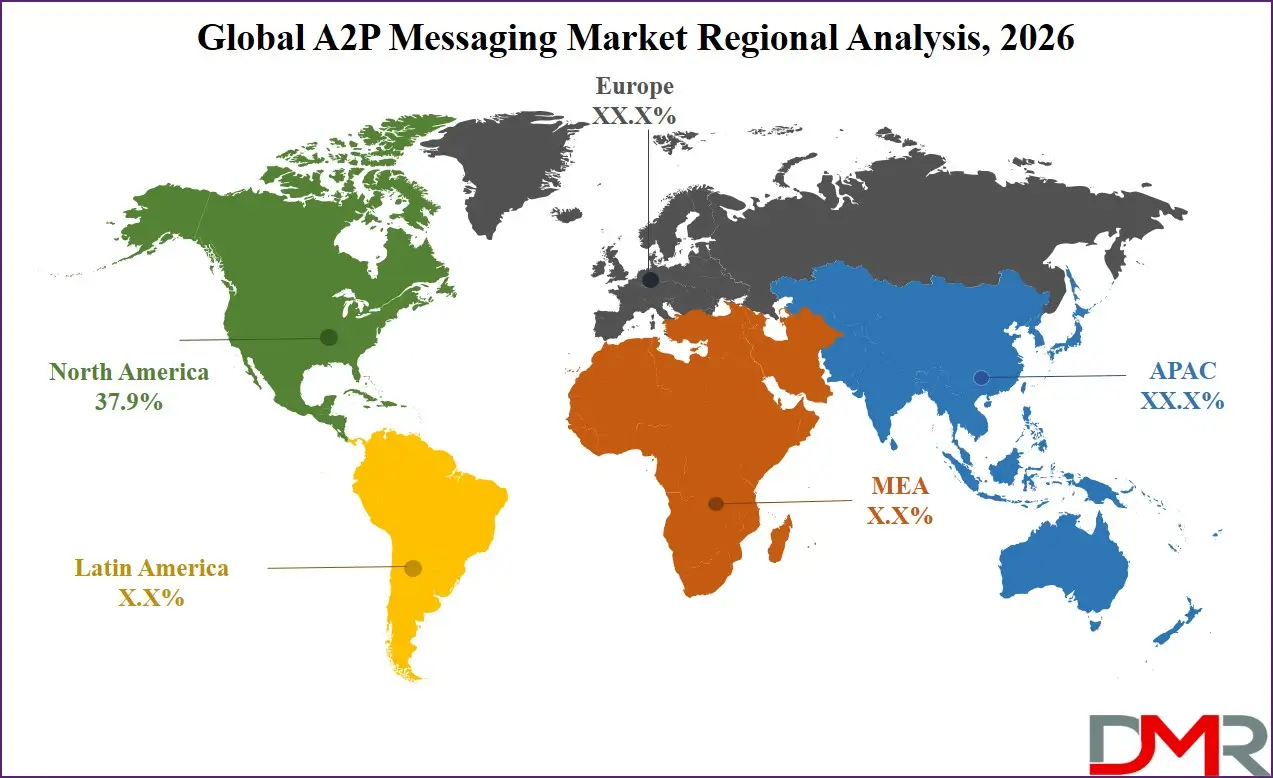
North America is poised to lead the global A2P messaging market as it holds 37.9% of market share by the end of 2026, because of its well-developed telecommunications network, high population of smart phone users, and high demand of authentication messaging. There are high utilization of multi-factor authentication, one-time passwords, banking alerts and e-commerce alerts in the region. Big businesses throughout the region are quickly implementing CPaaS, RCS, and omnichannel communication systems to enhance customer communication and fraud prevention. The presence of strict regulations on the control of spam and business messages, such as 10DLC registration in the United States, also promotes the development of verifiable A2P channels by enterprises. High concentration of major technology and telecommunication companies also contribute to the dominance of the region and the perpetuated investment in enterprise secure messaging services.
ℹ
To learn more about this report –
Download Your Free Sample Report Here
Fastest-Growing Regional Market
The Asia-Pacific market is expected to have the highest growth rate, which can be driven by the high rate of digitalization of Southeast Asian and Indian economies. The spread of mobile-first banking, the emergence of super-app ecosystems, and explosive growth in the e-commerce logistics industry that needs instant OTP verification and updates on delivery demands exponential growth. Whereas North America is experiencing high value per message, APAC is experiencing an explosive volume growth as millions of new consumers board digital platforms. Government programs that encourage digital identity and financial inclusion are also driving the need to have a strong A2P infrastructure to bridge the gap between enterprises and a significant unbanked but mobile-connected population.
By Region
North America
Europe
- Germany
- The U.K.
- France
- Italy
- Russia
- Spain
- Benelux
- Nordic
- Rest of Europe
Asia-Pacific
- China
- Japan
- South Korea
- India
- ANZ
- ASEAN
- Rest of Asia-Pacific
Latin America
- Brazil
- Mexico
- Argentina
- Colombia
- Rest of Latin America
Middle East & Africa
- Saudi Arabia
- UAE
- South Africa
- Israel
- Egypt
- Rest of MEA
Competitive Landscape
The Global A2P Messaging industry is represented as a two-tiered system of global CPaaS providers and regional aggregators that fight against each other with the routing effectiveness and direct operator connectability. Contrasting legacy telecom, software intelligence AI-based algorithms are the key to achieving success as they bypass grey route congestion and block fraudulent traffic in real-time. One of the most notable trends is consolidation, as big cloud providers are purchasing small vendors to gain access to Tier-1 carrier relationships and increase their RCS offerings. Entry barriers are high and they are characterized by the need to have relationships with more than 1,000 international multinational organizations. Vendors that provide strong firewall solutions and analytics dashboards that enable enterprises to have end-to-end visibility of delivery receipts and on investment returns on messaging spend are increasingly taking over market leadership.
Some of the prominent players in the Global A2P Messaging Market are:
- Twilio Inc.
- Sinch AB
- Infobip Ltd.
- Vonage Holdings Corp.
- Tata Communications Limited
- Route Mobile Limited
- MessageBird B.V.
- Syniverse Technologies LLC
- Kaleyra Inc.
- Bandwidth Inc.
- CM.com
- OpenMarket Inc.
- TeleSign Corporation
- Clickatell (Pty) Ltd.
- Plivo Inc.
- Mitto AG
- Monty Mobile SAL
- Comviva Technologies Limited
- BICS SA/NV
- Orange S.A. f
- Other Key Players
Recent Developments
- February 2026: Sinch announced an expanded partnership with a major European airline to migrate legacy SMS check-in alerts to RCS, providing passengers with interactive seat maps and baggage tracking links directly within their native messaging app.
- October 2025: BICS launched an AI-powered "SMS Firewall as a Service" specifically designed for Mobile Virtual Network Operators (MVNOs), enabling smaller carriers to block grey route termination and identify SIM box fraud patterns in real-time.
- July 2025: Infobip acquired a specialized CPaaS provider in Latin America to strengthen its WhatsApp Business API and local carrier routing footprint in Brazil and Mexico, targeting the rapid growth of conversational commerce in the region.
Report Details
| Report Characteristics |
| Market Size (2026) |
USD 82.0 Bn |
| Forecast Value (2035) |
USD 113.0 Bn |
| CAGR (2026–2035) |
3.6% |
| The US Market Size (2026) |
USD 26.1 Bn |
| Historical Data |
2021 – 2025 |
| Forecast Data |
2027 – 2035 |
| Base Year |
2025 |
| Estimate Year |
2026 |
| Segments Covered |
By Offering (Platform, and Services), By Communication Channel (SMS, Operator IP, Third-Party App, and Fixed Fees), By Deployment Mode (Cloud, and On-premise), By SMS Traffic (Domestic, and International), By Application (Authentication Services, Pushed Content Services, Customer Relationship Management (CRM) Services, Promotional Campaigns / Marketing Services, Interactive Services, and Others), By End User (Banking, Financial Services, and Insurance (BFSI), Retail & E-commerce, Healthcare, Travel & Tourism, Media & Entertainment, Government, Transportation & Logistics, and Others) |
| Regional Coverage |
North America – The US and Canada; Europe – Germany, The UK, France, Russia, Spain, Italy, Benelux, Nordic, & Rest of Europe; Asia-Pacific – China, Japan, South Korea, India, ANZ, ASEAN, Rest of APAC; Latin America – Brazil, Mexico, Argentina, Colombia, Rest of Latin America; Middle East & Africa – Saudi Arabia, UAE, South Africa, Turkey, Egypt, Israel, & Rest of MEA |
Frequently Asked Questions
How big is the Global A2P Messaging Market?
▾ The Global A2P Messaging market is poised to be valued at USD 82.0 billion in 2026 and is projected to reach USD 113.0 billion by 2035, driven by digital identity security needs, enterprise automation, and the evolution of rich mobile communication.
What is the CAGR of the Global A2P Messaging Market from 2026 to 2035?
▾ The Global A2P Messaging market is expected to grow at a CAGR of 3.6% from 2026 to 2035, reflecting mature yet steady expansion driven by authentication traffic and new revenue streams from conversational commerce.
What factors are driving the growth of the Global A2P Messaging Market?
▾ Key growth drivers include the universal requirement for Multi-Factor Authentication (MFA) to secure digital identities, the retirement of legacy 2G/3G networks forcing an upgrade path, and the enterprise shift toward RCS for interactive, branded customer experiences.
Which region held the largest share of the A2P Messaging Market in 2026?
▾ North America, and specifically the United States, is expected to hold 37.9% of market share of the global A2P market in 2026 due to high enterprise adoption of 10DLC compliant messaging and a mature CPaaS ecosystem serving large retail and financial sectors.
Which region is expected to grow the fastest in the A2P Messaging Market?
▾ The Asia-Pacific region, is expected to grow fastest due to rapidly increasing smartphone penetration, the digitalization of micro-finance, and the expansion of e-commerce logistics across Southeast Asia and India.
What are the major trends in the Global A2P Messaging Market?
▾ Major trends include the adoption of AI for smart routing and fraud prevention, the expansion of Open Gateway APIs for silent authentication, and the migration of promotional spend from SMS to RCS and WhatsApp Business platforms.
Who are the key players in the Global A2P Messaging Market?
▾ Key players include Twilio, Sinch, Infobip, Vonage, Route Mobile, BICS, Tata Communications, MessageBird, Telesign, and a vast ecosystem of regional aggregators and mobile network operator (MNO) groups.
How is the Global A2P Messaging Market segmented?
▾ The Global A2P Messaging market is segmented across offering (Platform, Services); communication channel (SMS, Operator IP, Third-Party App); deployment (Cloud, On-premise); traffic (Domestic, International); application (Authentication, CRM, Promotional); and end user (BFSI, Retail, Healthcare, and other end users).