Market Overview
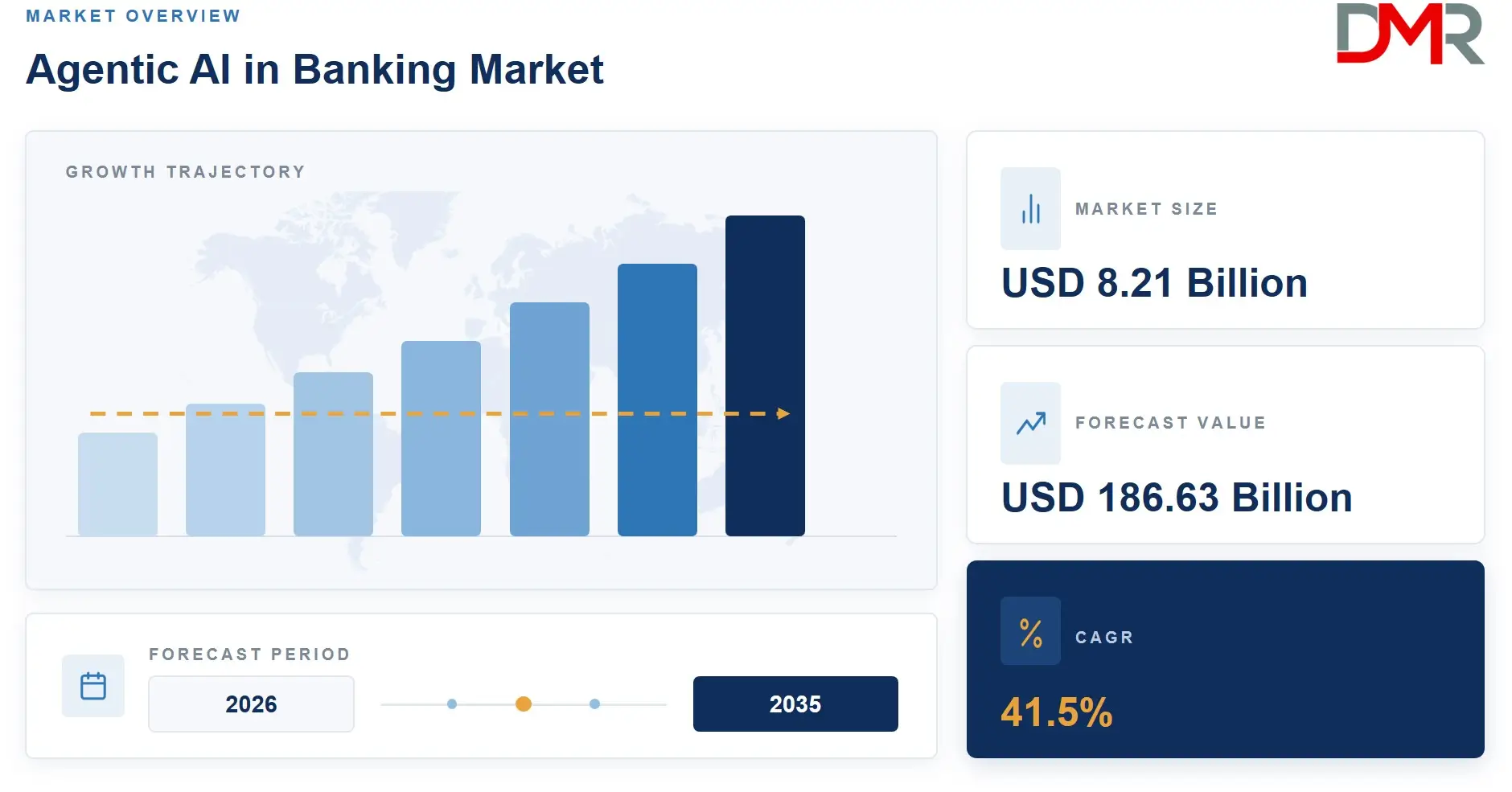
The Global Agentic AI in Banking Market size is estimated at USD 8.21 Billion in 2026, and is projected to reach USD 186.63 Billion by 2035, exhibiting a CAGR of 41.5% during the forecast period. Banks moved past pilot budgets faster than most software categories in financial services history. A 2025 survey of 250 banking executives found that 70% of institutions already use agentic AI in some form, split between 16% with live deployments and 52% running pilots, as reported by MIT Technology Review. That level of active testing at the pilot stage explains why the forecast assumes a steep early ramp rather than a slow multi-year build. Vendors are pricing this shift as infrastructure, not software add-ons. NVIDIA, AWS, and Microsoft compete to become the execution layer beneath thousands of individual banking agents, which pulls the market's center of gravity toward cloud-native, high-margin platform contracts.
AI in Banking as a category is broadening from decision support tools into systems that act without a human in the loop, and agentic architectures represent the sharpest edge of that shift. Coverage in this report excludes generic chatbot deployments and static rule-based automation that lack autonomous decision authority. It includes only systems capable of independent action across fraud detection, compliance, payments, and advisory workflows. TD Bank's 2026 mortgage pre-adjudication agent, which cut processing from 15 hours to under three minutes, illustrates the operational threshold that separates agentic systems from earlier automation.
ℹ
To learn more about this report –
Download Your Free Sample Report Here
Key Takeaways
- The market size is USD 8.21 Billion in 2026, and is projected to hit USD 186.63 Billion by 2035 at a CAGR of 41.5%.
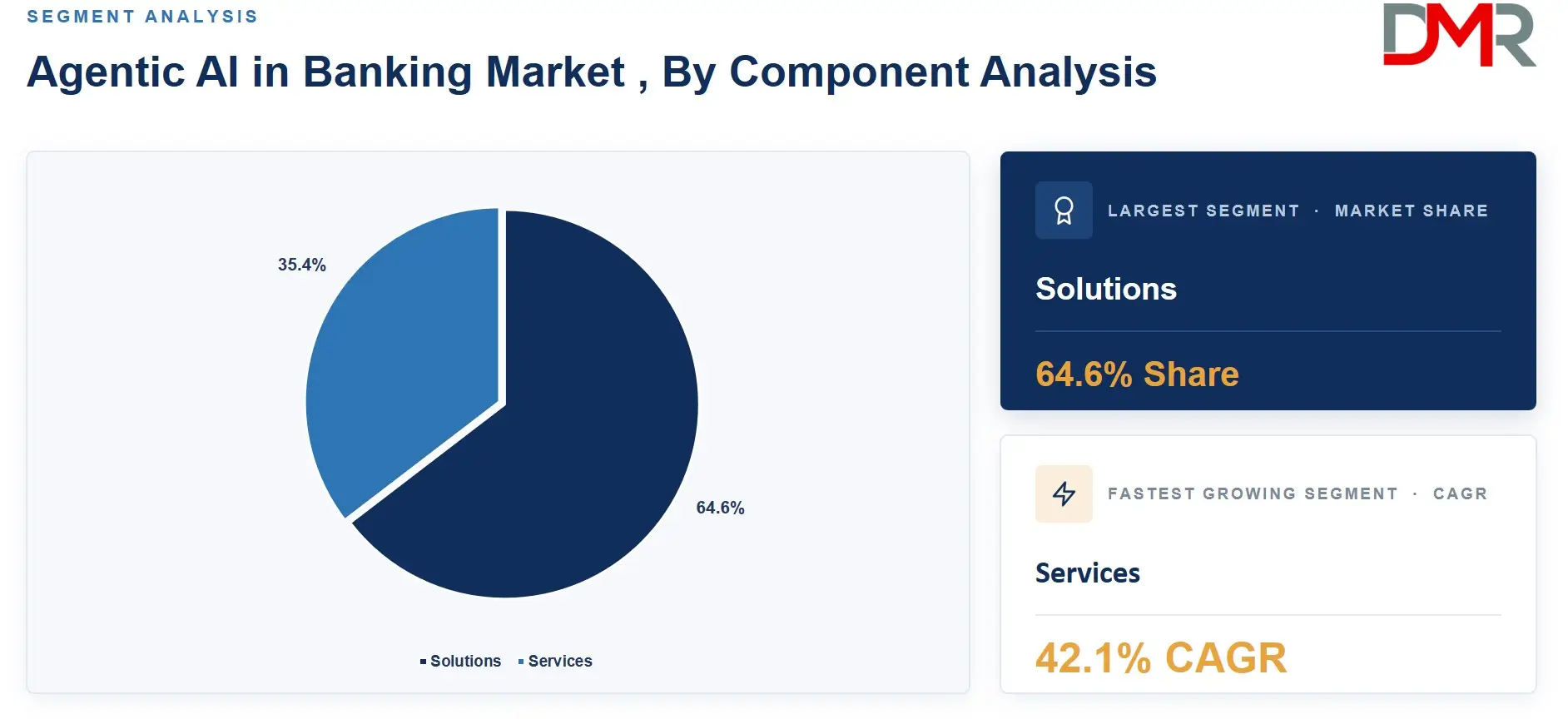
- By Component: Solutions led with a 64.6% share in 2026.
- By Deployment Mode: Cloud-Based led with a 71.2% share in 2026.
- By Agent Type: Risk-Aware Decision Agents led with a 43.5% share in 2026.
- By Agent Architecture: Multi-Agent Systems led with a 58.8% share in 2026.
- By Application: Fraud Detection & Prevention led with a 41.7% share in 2026.
- By Bank Type: Retail Banks led with a 47.5% share in 2026.
- By Organization Size: Large Banks & Financial Institutions led with a 70.2% share in 2026.
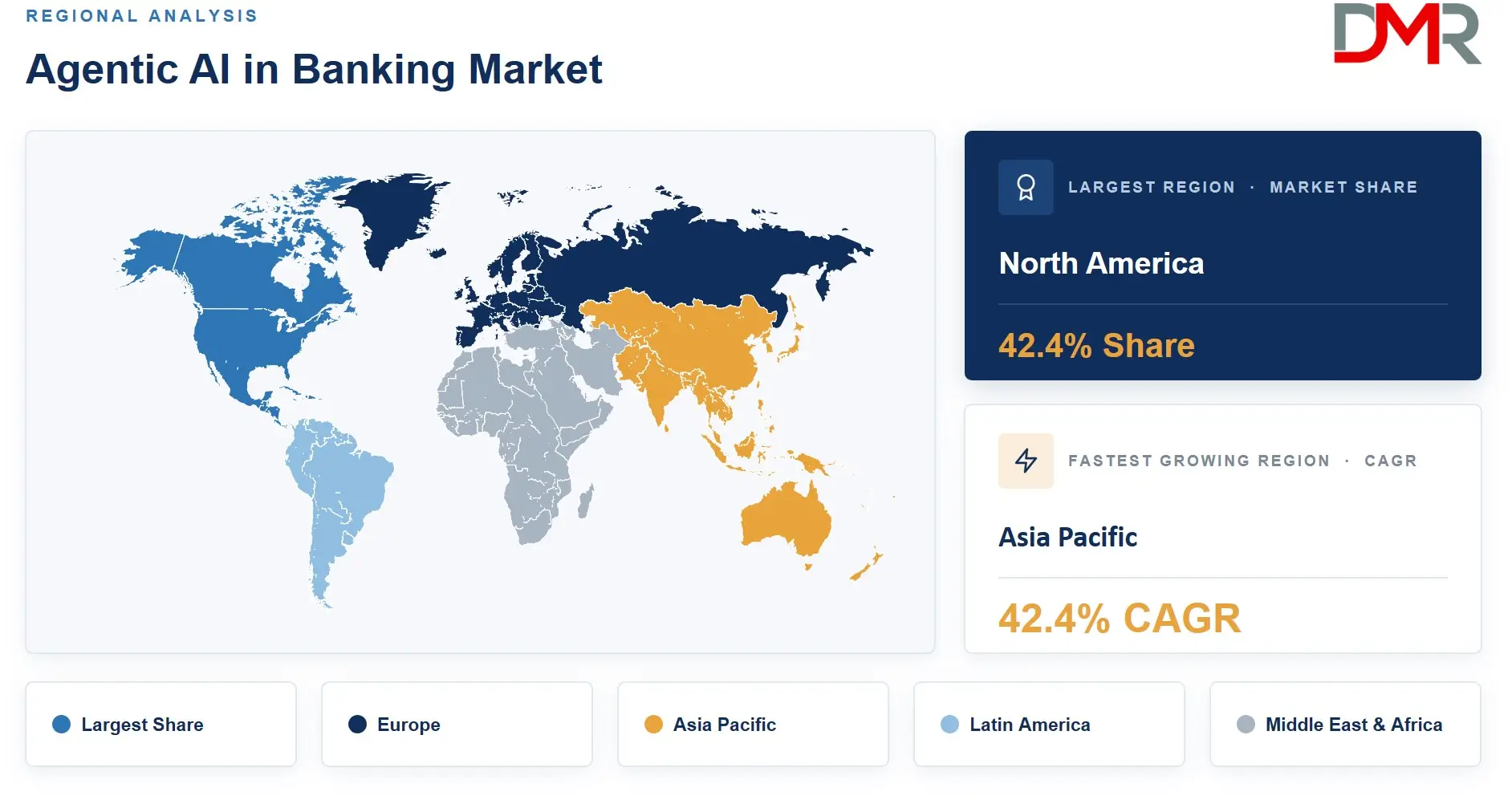
- By Region: North America led with a 42.4% share, valued at USD 2.4 Billion, in 2026.
- Top 5 key players: Amazon Web Services, Inc., NVIDIA Corporation, Microsoft Corporation, IBM Corporation, Salesforce, Inc.
Component Analysis
Solutions captured 64.6% of the component segment in 2026, ahead of all rivals. Banks buy platforms first and services second when the underlying technology still changes month to month. Solutions revenue includes the agent orchestration layers, model infrastructure, and pre-built domain agents that Oracle and Temenos now embed directly into core banking suites. That platform-first spending pattern signals vendors can capture recurring licensing revenue before banks commit to long consulting engagements. Services demand grows alongside deployment complexity rather than ahead of it. Banks running multi-agent systems across fraud, compliance, and payments need integration specialists who understand legacy core banking architecture, and that dependency will push services revenue higher as pilots convert to production. Systems integrators with banking domain expertise stand to gain the most as Tier-1 institutions move from proof-of-concept to enterprise rollout.
ℹ
To learn more about this report –
Download Your Free Sample Report Here
Deployment Mode Analysis
With a 71.2% share in 2026, Cloud-Based deployment outpaced all other deployment mode categories. Cloud-based deployment dominates because agentic systems need elastic compute for real-time inference across thousands of simultaneous banking decisions. AWS, Microsoft, and Google Cloud built their banking strategies around this exact requirement, positioning managed AI infrastructure as the default path to production. Hybrid deployment exists mainly as a bridge for banks unwilling to move core transaction data off-premises. On-premises deployment persists in jurisdictions with strict data residency rules or in banks still running mainframe cores that resist cloud migration. Regulators in some markets will keep on-premises relevant even as cloud adoption accelerates elsewhere.
Agent Type Analysis
Risk-Aware Decision Agents accounted for 43.5% of agent type demand in 2026, the highest of any category. Risk-aware agents lead because banks will not deploy autonomous decision systems without a built-in mechanism for flagging uncertainty. Fraud teams and credit committees need agents that recognize when a case falls outside trained parameters and escalate to a human rather than acting blindly. Payment authorization agents and Know Your Agent compliance agents cover narrower functions but grow from a smaller base. KYA agents exist specifically to verify that other AI agents transacting on a bank's behalf are authorized and traceable, a category that barely existed three years ago and now sits at the center of agent-to-agent commerce debates.
Agent Architecture Analysis
A 58.8% share made Multi-Agent Systems the clear leader across agent architecture categories in 2026. Multi-agent systems win because no single agent can own fraud detection, compliance checks, and customer communication at once inside a regulated bank. Coordinated agent fleets divide these tasks and hand off decisions between specialized agents, mirroring how banks already structure human departments. Single-agent systems remain common in smaller banks running one narrow use case, such as a standalone document-parsing agent. As small and mid-sized banks add use cases, most will graduate toward multi-agent orchestration rather than stacking unconnected single agents.
Application Analysis
Fraud Detection & Prevention accounted for 41.7% of application demand in 2026, the highest of any category. Fraud detection leads application demand because rule-based systems cannot keep pace with attack patterns that change weekly. Capgemini's 2025 research found cards, payments, and fraud detection processes each reached 64% scaled adoption among surveyed banks, the highest scaled-adoption rate of any banking process category. Customer service and AML/KYC compliance form the next largest applications, both benefiting from clear, repeatable decision logic that suits current agent capability. Generative AI in Financial Services overlaps heavily with the customer-facing side of this segment, while treasury and wealth management applications remain smaller today but carry the highest per-transaction value as agents take on autonomous portfolio and liquidity decisions.
Bank Type Analysis
Retail Banks led the bank type segment with a 47.5% share in 2026. Retail banks lead adoption because they process the highest transaction volumes and face the sharpest fraud and compliance exposure per customer relationship. Capgemini's industry breakdown found only 13% of surveyed retail banking organizations had adopted AI agents at the enterprise level in 2025, a gap between category leadership and actual enterprise-wide rollout that points to a long runway still ahead. Digital banks and neobanks move fastest despite smaller balance sheets, since they built core systems on modern APIs that agentic platforms can plug into directly. Commercial, corporate, and investment banks trail because treasury and trade finance workflows involve more counterparties and regulatory checkpoints, slowing agent deployment even where the economic case is strongest.
Organization Size Analysis
Large Banks & Financial Institutions captured 70.2% of the organization size segment in 2026, ahead of all rivals. Large institutions dominate because they can absorb the compliance, model risk, and integration costs that agentic AI demands before it delivers returns. Their existing relationships with AWS, Microsoft, and Oracle also shorten procurement cycles that would stall smaller banks. Small and mid-sized banks depend on vendor-packaged agent products rather than custom builds. As Fiserv and Oracle push pre-configured agent bundles into community and regional banks, this category's share should climb faster than its current base suggests.
Key Market Segments
By Component
By Deployment Mode
- Cloud-Based
- On-Premises
- Hybrid
By Agent Type
- Risk-Aware Decision Agents
- Payment Authorization Agents
- Know Your Agent (KYA) Compliance Agents
By Agent Architecture
- Multi-Agent Systems
- Single-Agent Systems
By Application
- Fraud Detection & Prevention
- Customer Service & Virtual Banking Assistants
- AML/KYC & Regulatory Compliance
- Credit Scoring & Loan Processing
- Risk Management
- Back-Office Process Automation
- Dynamic Payment Authorization
- Autonomous Payment Initiation
- Treasury & Liquidity Management
- Wealth Management & Personalized Advisory
By Bank Type
- Retail Banks
- Commercial Banks
- Digital Banks & Neobanks
- Corporate Banks
- Investment Banks
By Organization Size
- Large Banks & Financial Institutions
- Small & Medium-Sized Banks
Regional Analysis
North America led the regional market with a 42.4% share, valued at USD 2.4 Billion, in 2026. US banks hold the deepest cloud infrastructure contracts with AWS, Microsoft, and Google Cloud, giving them first access to production-grade agent tooling. Tier-1 institutions here also carry the compliance budgets needed to satisfy SR 11-7 model risk guidance while still shipping autonomous agents into live workflows. Canada adds weight to the region through TD Bank's production mortgage agent, a concrete proof point that pulls other North American lenders toward faster rollout timelines. Asia Pacific is the fastest-growing region, and government-backed payment infrastructure explains why. NPCI's 2026 Agentic AI Platform standardizes autonomous multi-agent operations across India's digital banking rails, giving banks a shared foundation instead of forcing each institution to build integration from scratch. Singapore adds momentum through Bank of Singapore's KYC agent, which cut source-of-wealth report preparation from roughly ten days to one hour.
ℹ
To learn more about this report –
Download Your Free Sample Report Here
Key Regions and Countries
North America
Europe
- Germany
- France
- The UK
- Spain
- Italy
- Rest of Europe
Asia Pacific
- China
- Japan
- South Korea
- India
- Australia
- Rest of APAC
Latin America
- Brazil
- Mexico
- Rest of Latin America
Middle East & Africa
- GCC
- South Africa
- Rest of MEA
Macroeconomic Impact
Rate cycles matter less to this market than compliance budgets do. Banks fund agentic AI from cost-reduction lines, not discretionary technology spending, so slower GDP growth pushes CFOs toward automation rather than away from it. Cost-per-transaction pressure only sharpens when margins tighten, and that dynamic protects agentic AI budgets even during a downturn. Currency volatility strengthens the case for treasury and liquidity management agents specifically, since corporate banking clients need faster FX exposure decisions when rates move unpredictably. Regions with tighter capital rules, including parts of Europe under Basel IV, will see slower agent rollout tied directly to regulatory capital planning cycles.
Market Dynamics
Driver: Automation ROI Forces CFO-Level Adoption
Cost-per-transaction reductions exceeding 60% in back-office automation turn agentic AI from an innovation project into a finance department mandate. When a single deployment cuts processing cost by more than half, CFOs stop treating the technology as experimental. Agentic Automation spreads fastest inside banks precisely because the return shows up on the same income statement line executives already track. Regulatory compliance workload adds a second structural driver behind this shift. AML, KYC, DORA, and Basel IV requirements keep expanding faster than compliance headcount, and banks in the 2025 IIF-EY survey confirmed the shift is already underway. Some 23% of 61 surveyed institutions across eight regions had agentic AI in production, while 34% were piloting it, as reported by the Institute of International Finance and EY.
Restraint: Explainability Rules Block Black-Box Models
The EU AI Act and SR 11-7 guidance both demand audit trails that most agentic models cannot yet produce on request. Regulators want to trace exactly why an autonomous agent approved a loan or flagged a transaction, and many agent architectures still operate as opaque decision layers. That gap forces banks to slow deployment in exactly the workflows where autonomy would deliver the most value. Legacy core banking architecture compounds the problem. Mainframe, mid-tier, and cloud systems coexist inside most large banks, and agents cannot execute actions across systems that were never built to expose clean data interfaces. Findings from the 2025 IIF-EY survey show 69% of institutions cite autonomy risk or model drift as a top concern, with 55% pointing to insufficient explainability.
Opportunity: Underserved Segments Open New Agent Categories
SME and micro-credit borrowers carry thin credit files that traditional scoring models reject outright. Autonomous underwriting agents can pull alternative data sources and make faster, better-informed lending decisions than static scorecards ever could, opening a segment banks have underserved for decades. Wealth management presents a parallel opening at the mass-affluent tier. Banks can now deliver portfolio rebalancing and tax-loss harvesting once reserved for private banking clients. SEB's wealth management AI agent already produced a 15% efficiency improvement in 2025 by generating suggested responses and call summaries for advisors, a preview of what scaled deployment could deliver.
Porter's Five Forces
New entrants face a steep barrier because hyperscalers and core banking vendors already control the infrastructure and bank relationships needed to deploy agents at scale, though specialized startups like Kore.ai and Interface.ai still carve out defensible niches in conversational banking. Suppliers, namely AWS, Microsoft, NVIDIA, and Google Cloud, hold considerable leverage since agentic systems depend on their compute and model infrastructure with few substitutes at comparable scale. Buyers, meaning banks themselves, retain negotiating power because large institutions can build proprietary agents in-house rather than buy, and Capgemini's research found 33% of banks were already doing exactly that. Substitutes remain limited since traditional RPA and rule-based automation cannot match the adaptive decision-making agentic systems provide, though that same RPA installed base creates switching friction. Competitive rivalry runs high across enterprise software vendors, cloud providers, and banking-native specialists all racing to embed agents into the same core platforms, keeping pricing and feature competition intense through the forecast period.
AI and Gen AI Impact
Generative AI supplied the language layer that made agentic banking systems conversationally capable, but agentic architecture adds the decision-making and execution layer that generative models alone never had. NVIDIA's 2026 survey of more than 800 financial-services professionals found 42% were using or assessing agentic AI, with 21% already having deployed agents into production. That gap between assessment and deployment marks where early movers separate from the pack. Commerzbank's customer-service agent illustrates the ceiling of current capability, handling more than 30,000 conversations monthly and resolving roughly 75% autonomously in 2026. Laggards still routing these conversations through human-first queues risk losing the cost advantage competitors have already banked.
Market Trends
Agent Marketplaces Reshape Platform Competition
SAP, Salesforce, and Oracle now embed pre-built banking agents directly into core financial platforms, turning agent selection into a marketplace decision rather than a custom build. Open banking data ecosystems feed these agents multi-institution context that single-bank systems never had access to before. Financial regulators across the UK, EU, and Singapore are simultaneously issuing supervisory expectations that will reshape model risk frameworks at Tier-1 banks faster than most vendors currently plan for.
Market Competition Overview
This market remains fragmented at the application layer even as infrastructure consolidates around a handful of cloud providers. Hyperscalers compete on compute and orchestration while banking-native vendors like Temenos and Backbase compete on domain-specific agent design, and neither group has captured a dominant combined share yet. Capgemini's 2025 survey of 1,100 financial-services executives found only 10% of institutions had adopted AI agents at scale, leaving most of the addressable market still open to competitive repositioning. Enterprise software vendors are gaining ground fastest by bundling agents into platforms banks already run, which lowers switching costs compared to standalone agent products. Specialist conversational AI vendors risk losing share to this bundling strategy unless they can prove deeper domain accuracy than generalist platforms offer.
Pricing Analysis
Pricing splits between consumption-based cloud infrastructure fees and per-agent or per-use-case licensing from software vendors. Large banks negotiate enterprise-wide agent bundles that lower per-unit cost, while smaller banks pay higher per-seat or per-agent pricing through vendor-packaged products from Fiserv and FIS. Compliance and audit requirements push implementation costs upward, since explainability tooling and model monitoring add expense beyond the core agent license. Market leaders like Oracle and Salesforce increasingly bundle monitoring into platform pricing, while challengers still charge separately, giving incumbents a pricing advantage during procurement negotiations.
Company Profiles
Oracle Corporation built its banking strategy around composable, agent-native core platforms rather than bolting agents onto legacy cores. In February 2026, Oracle Financial Services launched its Agentic Banking Platform for retail banking, deploying domain agents for product brochure generation, application tracking, and automated credit decisioning. Oracle then expanded into corporate banking in April 2026 with dedicated agents for treasury management and trade finance, positioning itself to capture both retail and corporate banking budgets before rivals finish their retail-only rollouts. Fiserv, Inc. took a different route, focusing on infrastructure that other vendors' agents run on rather than competing head-on with hyperscalers. In August 2026, Fiserv rolled out unified agent infrastructure alongside Experian, designed to deploy, monitor, and audit compliance behavior across multi-agent banking systems. That positioning lets Fiserv profit from agentic adoption regardless of which specific agent vendor a bank chooses.
Key Players
- Amazon Web Services, Inc.
- NVIDIA Corporation
- Microsoft Corporation
- IBM Corporation
- Salesforce, Inc.
- Oracle Corporation
- Palantir Technologies Inc.
- FIS
- Temenos AG
- Kore.ai, Inc.
- Backbase B.V.
- Interface.ai, Inc.
- Kasisto, Inc.
- Glia Technologies, Inc.
- ServiceNow, Inc.
- Fiserv, Inc.
- SAP SE
- Google Cloud (Alphabet Inc.)
- Accenture plc
- Infosys Limited
Regulatory Landscape
The EU AI Act and US SR 11-7 guidance define the two toughest compliance regimes agentic banking systems must satisfy today. Both frameworks demand documented audit trails for autonomous decisions, which forces vendors to build explainability into agent architecture rather than treating it as an afterthought. Financial regulators in the UK, EU, and Singapore are now issuing agentic-specific supervisory expectations, moving beyond generic AI guidance toward rules built for systems that act independently. Banks that build compliant explainability now will clear regulatory review faster than competitors retrofitting it later.
Investment and White Space Analysis
Capital is flowing toward infrastructure and orchestration layers rather than narrow point-solution agents, matching where AWS, Microsoft, and NVIDIA already compete. Underserved segments include SME lending and mass-affluent wealth management, both flagged as opportunities precisely because current tooling cannot serve them profitably yet. Some 48% of financial institutions surveyed by Capgemini were creating dedicated roles to supervise agents in 2025, revealing a white space in agent-governance software that few vendors currently address directly. New entrants with strong compliance tooling, rather than better language models, hold the clearest path into this market.
Recent Developments
- May 2025 Hebbia, a financial document-parsing and analysis company, expanded its agentic data platform by acquiring FlashDocs.
- December 2025 Oracle Financial Services introduced a strategic framework for Banking 4.0, outlining a shift toward composable core platforms built for fleets of autonomous agents.
- April 2026 Oracle Financial Services expanded its Agentic AI Platform into corporate banking, launching domain agents for treasury management and trade finance.
- September 2026 Amazon Pay introduced its Smart Wallet feature at the Global Fintech Fest, letting autonomous agents initiate and authenticate UPI payments on behalf of users.
- September 2026 The National Payments Corporation of India unveiled a dedicated Agentic AI Platform to standardize multi-agent digital banking operations.
Report Scope
| Report Characteristics |
| Market Value (2026) |
USD 8.21 Billion |
| Forecast Revenue (2035) |
USD 186.63 Billion |
| CAGR (2026 to 2035) |
41.5% |
| Base Year for Estimation |
2025 |
| Historic Period |
2020 to 2024 |
| Forecast Period |
2026 to 2035 |
| Report Coverage |
Revenue Forecast, Market Dynamics, Competitive Landscape, Recent Developments |
| Segments Covered |
By Component (Solutions, Services), By Deployment Mode (Cloud-Based, On-Premises, Hybrid), By Agent Type (Risk-Aware Decision Agents, Payment Authorization Agents, Know Your Agent Compliance Agents), By Agent Architecture (Multi-Agent Systems, Single-Agent Systems), By Application (Fraud Detection & Prevention, Customer Service & Virtual Banking Assistants, AML/KYC & Regulatory Compliance, Credit Scoring & Loan Processing, Risk Management, Back-Office Process Automation, Dynamic Payment Authorization, Autonomous Payment Initiation, Treasury & Liquidity Management, Wealth Management & Personalized Advisory), By Bank Type (Retail Banks, Commercial Banks, Digital Banks & Neobanks, Corporate Banks, Investment Banks), By Organization Size (Large Banks & Financial Institutions, Small & Medium-Sized Banks) |
| Regional Analysis |
North America (US and Canada), Europe (Germany, France, The UK, Spain, Italy, and Rest of Europe), Asia Pacific (China, Japan, South Korea, India, Australia, and Rest of APAC), Latin America (Brazil, Mexico, and Rest of Latin America), Middle East & Africa (GCC, South Africa, and Rest of MEA) |
| Competitive Landscape |
Amazon Web Services, NVIDIA, Microsoft, IBM, Salesforce, Oracle, Palantir Technologies, FIS, Temenos, Kore.ai, Backbase, Interface.ai, Kasisto, Glia Technologies, ServiceNow, Fiserv, SAP, Google Cloud, Accenture, Infosys |
| Customization Scope |
Customization for segments and region or country level will be provided. Additional customization can be done based on requirements. |
| Purchase Options |
Three license options: Single User License, Multi-User License (Up to 5 Users), Corporate Use License (Unlimited Users and Printable PDF) |
Frequently Asked Questions
What is the biggest investment opportunity in the Agentic AI in Banking market?
▾ SME and micro-credit underwriting represents the clearest opening, since thin-file borrowers remain underserved by traditional scoring models. Wealth management agents for mass-affluent clients follow closely, offering institutional-quality advisory at a fraction of current cost. Both segments carry a 41.5% market CAGR tailwind behind them.
Who are the top companies in the Agentic AI in Banking market?
▾ Amazon Web Services, NVIDIA, Microsoft, IBM, and Salesforce lead the infrastructure and platform layer. Oracle and Fiserv lead banking-specific agent deployment, each having launched dedicated platforms in 2026.
Which segment is growing fastest in the Agentic AI in Banking market and why?
▾ Fraud Detection & Prevention grows fastest among applications, holding a 41.7% share as of 2026. Attack patterns evolve faster than rule-based systems can update, forcing banks toward adaptive agentic detection.
Which region is growing fastest in the Agentic AI in Banking market and why?
▾ Asia Pacific grows fastest, driven by government-backed infrastructure like NPCI's Agentic AI Platform in India. Shared national payment rails let banks deploy agents without building integration from scratch.
What is the biggest challenge holding in the Agentic AI in Banking market back?
▾ Explainability requirements under the EU AI Act and SR 11-7 guidance slow deployment of black-box agent models. Legacy core banking architecture compounds the problem by blocking clean data access across mainframe and cloud systems.