Market Overview
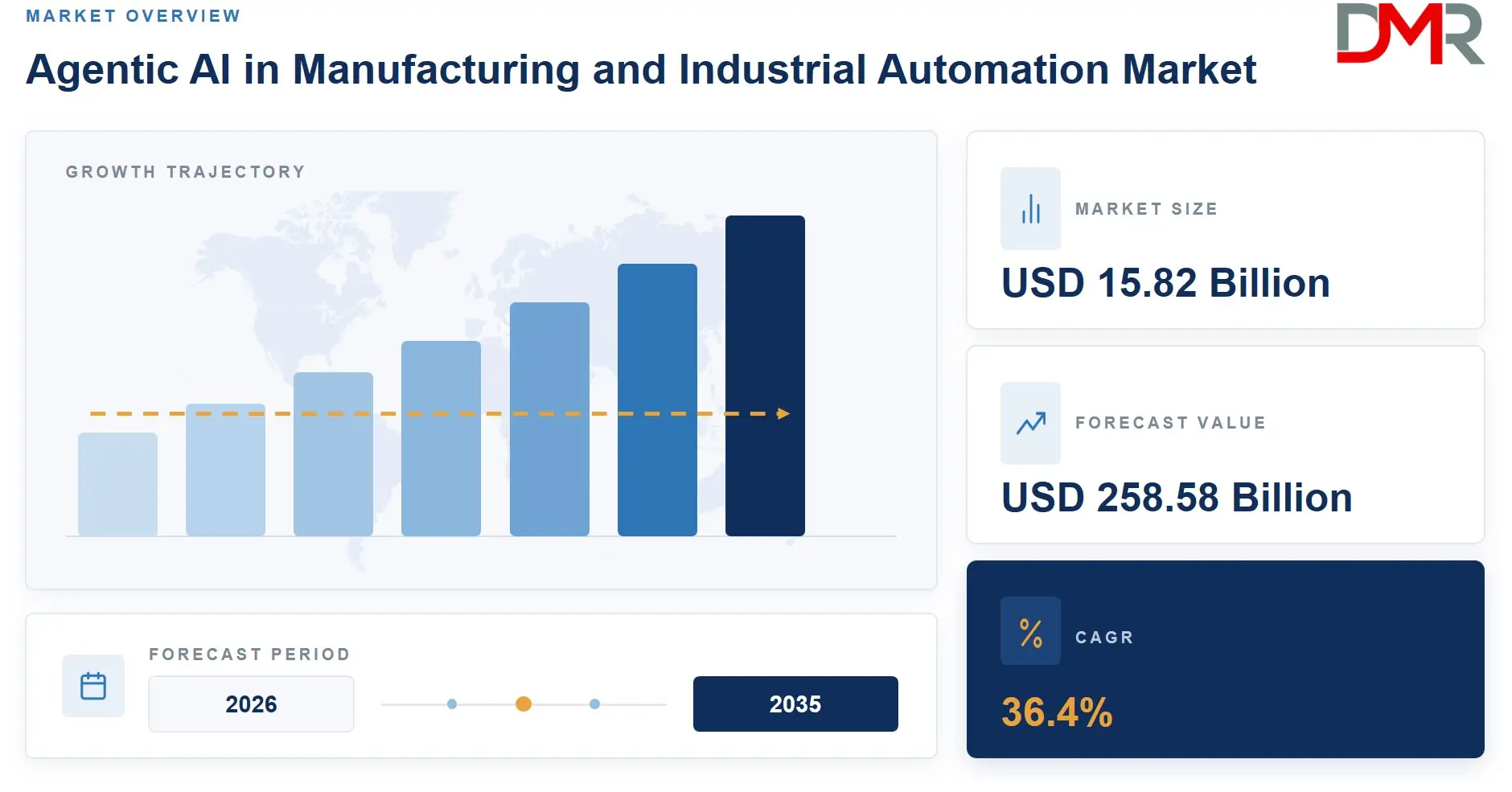
The Global Agentic AI in Manufacturing and Industrial Automation Market size is estimated at USD 15.82 Billion in 2026, and is projected to reach USD 258.58 Billion by 2035, exhibiting a CAGR of 36.4% during the forecast period. Factory operators moved past pilot testing between 2025 and 2026, and adoption data shows why. As reported by a 2025 industry survey, 77% of manufacturers had implemented AI to some extent, with 24% expecting full agentic deployment by 2027, a fourfold jump from prior levels. That pace of conversion from trial to production use explains the steep forecast curve built into this model. Buyers are not testing agentic systems anymore. They are replacing single-purpose automation tools with agents that decide, act, and adjust without waiting for a human operator. Microsoft showcased deep integration of agentic ERP systems for Industrial Automation in September 2026, connecting production, supply chain, and cost data into loops where agents execute operational decisions directly through Dynamics 365. That move signals a shift from AI as an advisory layer to AI as an operating layer inside the plant. Buyers evaluating vendors now ask a different question. They no longer ask whether an agent can recommend an action. They ask whether it can execute one safely without a supervisor in the loop.
This market covers software platforms, edge hardware, and orchestration layers that let AI agents plan, monitor, and act inside manufacturing environments. It excludes standalone industrial robotics hardware that runs fixed programs without autonomous decision logic. Traditional automation vendors sit adjacent to this market, and the boundary between the two categories is narrowing fast as legacy players embed agentic layers into existing control systems.
ℹ
To learn more about this report –
Download Your Free Sample Report Here
Key Takeaways
- The market size is USD 15.82 Billion in 2026, and is projected to hit USD 258.58 Billion by 2035 at a CAGR of 36.4%.
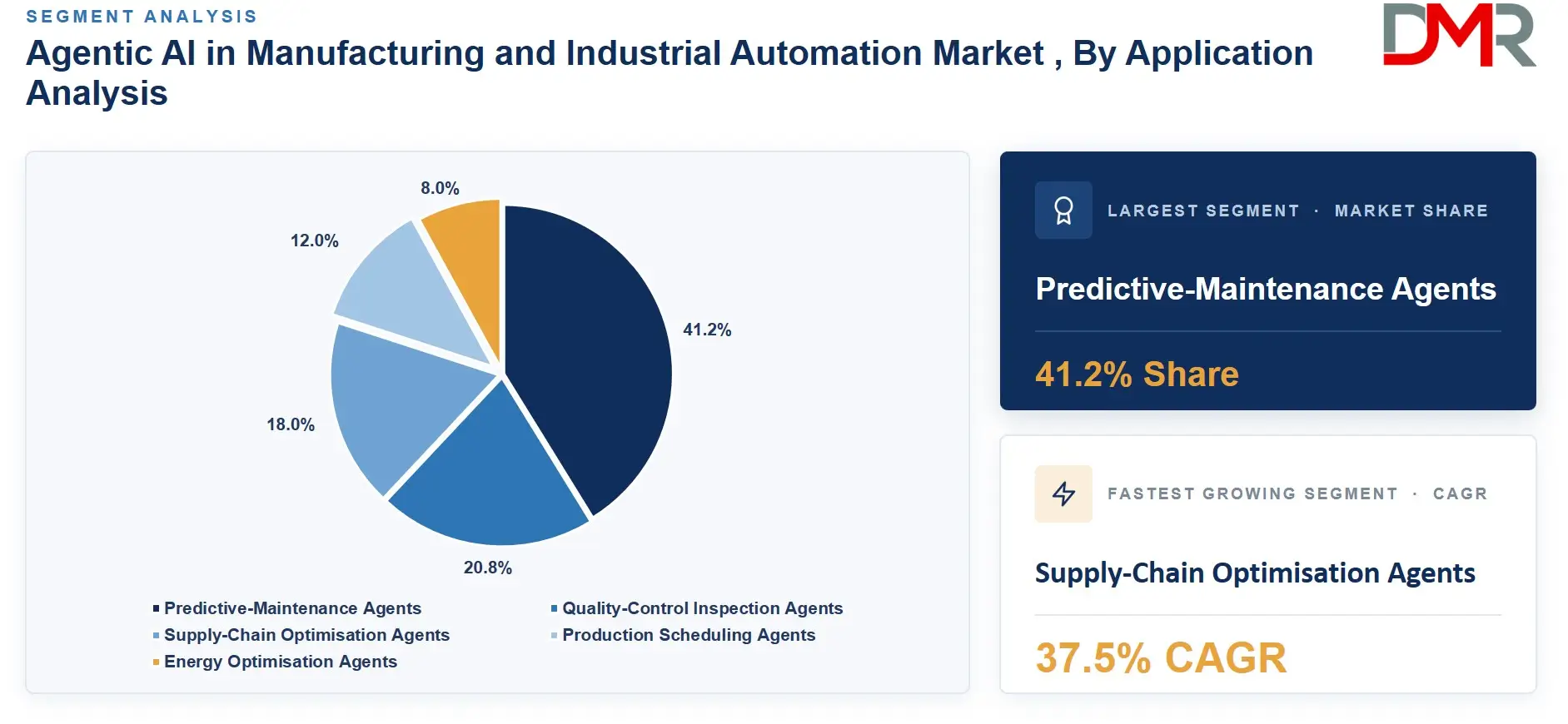
- By Application: Predictive-Maintenance Agents led with a 41.2% share in 2026.
- By Deployment Mode: Cloud led with a 49.3% share in 2026.
- By Manufacturing Vertical: Automotive led with a 37.8% share in 2026.
- By Component: Software Platforms led with a 61.5% share in 2026.
- By Agent Architecture: Multi-Agent Systems led with a 62.6% share in 2026.
- By Orchestration Layer: Agent Orchestration Frameworks led with a 47.2% share in 2026.
- By Industry 5.0 Pillar: Resilience-Focused Agents led with a 41.6% share in 2026.
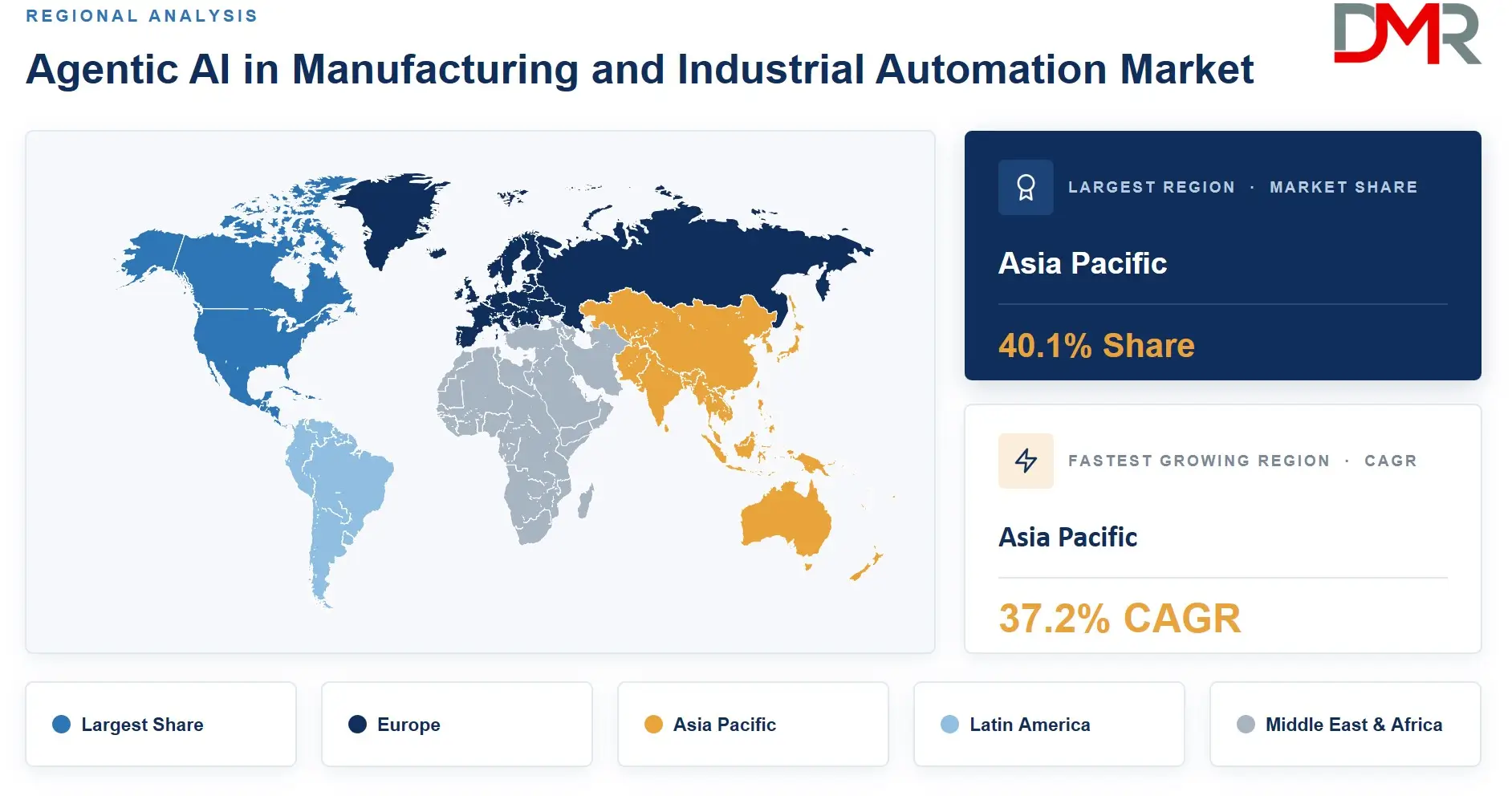
- By Region: Asia Pacific led with a 40.1% share, valued at USD 4.64 Billion, in 2026.
- Top 5 key players: Siemens AG, GE Vernova, Rockwell Automation, Inc., Schneider Electric SE, ABB Ltd.
Application Analysis
Predictive-Maintenance Agents accounted for 41.2% of Application demand in 2026, the highest of any category. Factories chose predictive maintenance as their entry point into agentic AI because the return is measurable and fast. A 2025 study of intelligent maintenance agents found forecast accuracy of 92% up to 72 hours before failure, with F1 scores above 88% across models, as reported by a peer reviewed manufacturing journal. Plant managers can now schedule parts and labor before a machine fails, not after, and that shift converts unplanned downtime into a budgeted maintenance window. Supply-Chain Optimisation Agents grew fastest among application categories as manufacturers pushed autonomy beyond the factory floor into logistics and procurement. Documented deployments delivered fuel savings of 10 to 25% and logistics cost cuts of 5 to 20%, while demand-forecasting agents cut forecast error by 20 to 40% and trimmed inventory by 31%, based on data from case studies spanning 2025 and 2026. Quality-Control Inspection Agents, Production Scheduling Agents, and Energy Optimisation Agents fill out the remaining share, each tied to a specific cost center rather than a general efficiency claim. Vendors that once sold a single point solution now bundle these categories into platforms, and buyers increasingly expect a Digital Twin layer to sit underneath all five, feeding live plant data into every agent at once.
ℹ
To learn more about this report –
Download Your Free Sample Report Here
Key Market Segments
By Application
- Predictive-Maintenance Agents
- Quality-Control Inspection Agents
- Supply-Chain Optimisation Agents
- Production Scheduling Agents
- Energy Optimisation Agents
Deployment Mode Analysis
With a 49.3% share in 2026, Cloud outpaced all other Deployment Mode categories. Cloud deployment won because agentic systems need constant retraining against fresh plant data, and centralized infrastructure makes that update cycle cheaper to manage across multiple factory sites. Large manufacturers running plants across regions standardize on cloud orchestration first, then push specific agents to the edge only where latency demands it. Edge deployment serves a narrower but critical use case: agents controlling machinery that cannot tolerate network delay, such as robotic safety interlocks. On-Premise and Hybrid modes persist mainly among defense contractors and pharmaceutical plants bound by data residency rules. Vendors selling into regulated sectors now design for hybrid architecture by default, splitting decision logic between cloud training and local execution.
Manufacturing Vertical Analysis
A 37.8% share made Automotive the clear leader across Manufacturing Vertical categories in 2026. Automotive plants adopted agentic AI earliest because the sector already runs the densest sensor networks in industrial manufacturing, giving agents more data to learn from on day one. Assembly lines with thousands of interconnected stations also carry the highest downtime cost per hour, which makes the payback case for autonomous maintenance and scheduling agents easy to defend internally. Electronics and Semiconductors grew fastest among verticals as chipmakers, squeezed by yield pressure, turned to agentic quality inspection to catch defects that human reviewers miss at nanometer scale. Heavy Machinery, Food and Beverage, and Chemicals round out the remaining demand, each adopting agents for different reasons: heavy machinery for predictive maintenance, food and beverage for compliance-driven traceability, and chemicals for energy-intensive process optimization tied to Industrial Robotics already installed on their lines.
Component Analysis
Software Platforms captured 61.5% of the Component segment in 2026, ahead of all rivals. Software carries most of the value because the intelligence, not the hardware, is what differentiates one agentic system from another. Buyers pay premium licensing for orchestration and decision logic while treating sensors and edge devices as commodity inputs sourced separately. Services and Edge Hardware and Devices split the remaining share, with services growing on the back of integration work needed to connect agentic platforms to decades-old plant control systems. Vendors that once sold hardware exclusively now push toward software-first business models, since recurring licensing revenue scales faster than one-time equipment sales.
Agent Architecture Analysis
Multi-Agent Systems accounted for 62.6% of Agent Architecture demand in 2026, the highest of any category. Manufacturing environments involve dozens of interdependent decisions happening at once, from scheduling to quality checks to energy load, and no single agent can hold that much context reliably. Multi-agent architectures split the problem into specialized agents that negotiate outcomes together, mirroring how human plant teams already divide responsibility. Single-Agent Systems still serve narrow, well-defined tasks where coordination overhead is not worth the complexity. Vendors building multi-agent frameworks now compete less on individual agent accuracy and more on how well their orchestration layer resolves conflicts between agents pursuing different goals.
Orchestration Layer Analysis
With a 47.2% share in 2026, Agent Orchestration Frameworks outpaced all other Orchestration Layer categories. Orchestration frameworks became the layer buyers evaluate first because they determine whether independently built agents can actually work together on a shop floor. A framework that manages handoffs between a maintenance agent and a scheduling agent prevents the kind of conflicting decisions that erode trust in autonomous systems. Agent Runtime Environments and Governance and Monitoring Layers trail but are gaining urgency as deployments scale past pilot stage. Boards now ask who audits an agent's decision after the fact, and that question is pulling monitoring tools from an afterthought into a purchase requirement.
Industry 5.0 Pillar Analysis
Resilience-Focused Agents led the Industry 5.0 Pillar segment with a 41.6% share in 2026. Manufacturers weighted resilience above sustainability or human-centric design because supply shocks since 2023 taught plant leaders that adaptability protects revenue faster than any efficiency gain. Agents that reroute production around a disrupted supplier deliver value the same week they are deployed. Human-Centric Agents and Sustainability-Focused Agents make up the remaining share, with human-centric design becoming a procurement requirement wherever labor unions negotiate deployment terms. Sustainability-focused agents remain smaller today but carry outsized attention from regulators watching industrial energy use.
Key Market Segment
By Application
- Predictive-Maintenance Agents
- Quality-Control Inspection Agents
- Supply-Chain Optimisation Agents - Fastest Growing
- Production Scheduling Agents
- Energy Optimisation Agents
By Deployment Mode
- Cloud
- Edge
- On-Premise
- Hybrid
By Manufacturing Vertical
- Automotive
- Electronics & Semiconductors - Fastest Growing
- Heavy Machinery & Industrial Equipment
- Food & Beverage
- Chemicals & Materials
By Component
- Software Platforms
- Services
- Edge Hardware & Devices
By Agent Architecture
- Multi-Agent Systems
- Single-Agent Systems
By Orchestration Layer
- Agent Orchestration Frameworks
- Agent Runtime Environments
- Governance & Monitoring Layers
By Industry 5.0 Pillar
- Resilience-Focused Agents
- Human-Centric Agents
- Sustainability-Focused Agents
Regional Analysis
Asia Pacific led the regional landscape with a 40.1% share, valued at USD 4.64 Billion, in 2026.
Asia Pacific
Asia Pacific leads because its manufacturing base is the densest in the world, and electronics and automotive plants across China, Japan, and South Korea already run the sensor infrastructure agentic systems need to function. Governments across the region also treat industrial AI as a strategic export capability, not just a productivity tool, which speeds procurement approval inside state-linked manufacturing groups.
North America
North American manufacturers concentrate spend on US Agentic Automation deployments inside defense, aerospace, and automotive plants where downtime cost per hour justifies premium software licensing. Rockwell Automation, Honeywell, and Emerson Electric all operate from this region, giving domestic buyers shorter vendor relationships and faster support cycles than competitors sourcing from overseas suppliers.
Europe
ℹ
To learn more about this report –
Download Your Free Sample Report Here
Europe pairs deep industrial engineering expertise with an energy cost problem that agentic optimization directly addresses. A European automotive manufacturer cut energy consumption by 27% using agentic scheduling to manage production timing and equipment load without cutting output, based on data from a 2025 case study. Siemens and Bosch Rexroth, both headquartered in the region, treat that kind of energy result as a core sales argument against higher-cost European power grids.
Latin America
Latin American manufacturers adopt agentic systems more slowly, constrained by capital access and older plant infrastructure that resists retrofitting. Food and beverage and mining-adjacent chemical processors lead early adoption, since export commodity pricing rewards even modest efficiency gains.
Middle East and Africa
Middle East manufacturing investment concentrates in Gulf state diversification programs building new industrial capacity from scratch, which lets these plants deploy agentic systems natively rather than retrofit legacy equipment. That greenfield advantage could let the region skip a full technology generation that older industrial economies must work around.
Key Regions and Countries
North America
Europe
- Germany
- France
- The UK
- Spain
- Italy
- Rest of Europe
Asia Pacific
- China
- Japan
- South Korea
- India
- Australia
- Rest of APAC
Latin America
- Brazil
- Mexico
- Rest of Latin America
Middle East & Africa
- GCC
- South Africa
- Rest of MEA
Macroeconomic Impact
Capital keeps flowing into this market even as broader technology funding tightens elsewhere. Agentic AI startups raised USD 8.64 Billion across 112 funding rounds in the first eight months of 2026, a 156.34% jump over the USD 3.37 Billion raised in the same period of 2025, as reported by market ecosystem tracking data. That surge shows investors treating industrial agentic AI as a distinct category worth backing on its own, separate from general enterprise AI spend. Energy costs shape adoption speed more directly than interest rates do in this market. Smart energy monitoring tied to agentic systems cut energy use by 19% within six months and reduced monthly costs from USD 284,000 to USD 217,000, a drop of 23.6%, according to 2025 case data. Manufacturers in high-energy-cost regions like Europe adopt faster than those in low-cost energy markets, since the payback period shrinks wherever electricity is expensive.
Market Dynamics
Driver: Sensor Data Volume Outpaces Human Capacity
Factory floors connected to industrial internet of things networks now generate sensor data faster than any human operator can review it in real time. Plant managers who once relied on periodic manual checks cannot process thousands of continuous data streams, and that gap is what agentic systems close by making decisions autonomously as data arrives. Siemens launched its Intelligence Center X orchestration environment in June 2026, letting specialized agents collaborate safely across factory functions and cutting production issue resolution time by up to 85%, based on data from the company's own deployment results. Labor scarcity in advanced manufacturing economies compounds the problem, since fewer skilled operators are available to backstop automated systems when something goes wrong. Agentic work-order planning accuracy improved by 40% through AI-generated parts lists in documented 2026 deployments, cutting root-cause identification time from days to hours and giving understaffed maintenance teams leverage they did not have before.
Restraint: Legacy OT Networks Resist Integration
Older factories built operational technology networks decades before anyone imagined autonomous software making floor-level decisions, and that segmentation from modern IT systems now blocks agentic deployment. Integration projects that should take weeks stretch into months when engineers must bridge protocols never designed to talk to each other. Workers on the floor add a second layer of resistance, worried that autonomous decision-making agents threaten their jobs directly. Plant leaders report change management overhead eating into the productivity gains agentic systems were supposed to deliver, since retraining and trust-building take longer than the technology rollout itself.
Opportunity: OEMs License Agents as Embedded Intelligence
Tier-1 industrial equipment makers now see agentic AI licensing as a way to differentiate machinery platforms from commodity competitors selling similar hardware. A machine bundled with an autonomous optimization agent commands a premium price that hardware specifications alone cannot justify. Bosch committed over EUR 2.5 Billion and ABB invested USD 150 Million into its Shanghai facilities in September 2026, both designing next-generation plants natively around agentic AI rather than retrofitting older lines, according to industrial market data. Documented agentic predictive-maintenance deployments cut maintenance cost by 15 to 25% and extended equipment lifespan by 10 to 20% through condition-based scheduling, based on data from 2026 deployment records, giving OEMs a concrete efficiency story to sell alongside their hardware.
Porter's Five Forces
New entrants face a steep barrier because building a reliable multi-agent orchestration layer requires deep plant-floor data that incumbents like Siemens and Rockwell Automation have accumulated over decades. Suppliers of specialized sensors and edge hardware hold moderate power, since a handful of industrial hardware makers dominate the components agentic systems depend on. Buyers, particularly large automotive and electronics manufacturers, can negotiate aggressively because they represent massive contract volumes and can threaten to build custom agents in-house. Substitutes remain limited today, though traditional rules-based automation still satisfies buyers unwilling to hand decisions to autonomous software. Rivalry runs high among software platform vendors, and a hybrid multi-agent system tested on industrial datasets achieved 97.2% classification accuracy with a regression R squared of 0.9209, flagging 1% of samples as anomalies, as reported by a 2025 preprint, showing how tightly matched leading technical approaches have become. That technical parity pushes competition toward orchestration quality and integration speed rather than raw model accuracy alone.
AI and Gen AI Impact
Generative AI reshapes this market most visibly inside quality control, where agents now combine computer vision with decision logic once reserved for human inspectors. Siemens cut faults at its Amberg electronics plant to roughly 12 per million actions, down from 500, reaching a defect rate near 99.99885% quality while cutting defect costs by 90% and warranty claims by 50%, as reported by a 2025 case analysis. That result reset buyer expectations across the entire quality-control agent category, and vendors unable to match Amberg-level precision now struggle to close enterprise deals. Related reporting on the same facility found energy optimization cut usage by 15% per unit produced, showing how a single AI deployment can compound gains across quality and energy lines simultaneously. Early movers embedding Artificial Intelligence into core production logic now capture both cost and quality advantages at once, while laggards relying on separate point tools risk losing on both fronts to competitors running unified agentic platforms.
Market Trends
Multi-Agent Orchestration Converges With Physical Robotics
Collaborative agent frameworks now manage production, logistics, and procurement decisions at the same time instead of running as separate tools bolted together. Stripe agreed to acquire OpenRouter in September 2026, a move aimed at cutting cost and latency while connecting payment infrastructure to over 400 AI models used by operational software agents, signaling how deeply agentic tooling is becoming embedded in transactional infrastructure. McKinsey found agentic AI could free up 25 to 40% of organizational capacity by automating routine tasks, with 75 to 85% of pharmaceutical workflows containing automatable steps, based on data from 2026 research, and manufacturers watching that pharma result are asking whether their own plants carry similarly large hidden capacity. Convergence with Smart Warehousing and humanoid robotics is emerging as the next automation category, where physical and cognitive tasks run through a single system rather than separate hardware and software layers.
Market Competition Overview
This market stays fragmented at the application layer even though a small group of industrial automation giants controls plant-level trust and existing customer relationships. Siemens, Rockwell Automation, and ABB hold the largest installed base and win deals by bundling agentic software into hardware buyers already trust, rather than competing purely on algorithm quality. In a May 2025 survey of 300 senior executives, 79% said AI agents were already being adopted inside their companies, and among adopters, 66% reported measurable productivity gains while 17% had reached near-universal workflow adoption, as reported by PwC. Cloud and software vendors like Microsoft, IBM, and NVIDIA are gaining ground by supplying the orchestration and compute layer underneath incumbent hardware brands, capturing margin without owning the factory relationship directly. JPMorgan runs more than 450 agentic use cases in production daily, and Klarna's AI agent handled workload equivalent to 853 employees, saving USD 60 Million by the third quarter of 2025, based on data from enterprise deployment tracking, a scale of return that is pulling non-industrial technology vendors deeper into manufacturing-specific agentic tooling.
Pricing Analysis
Vendors price agentic platforms mostly on subscription licensing tied to the number of agents deployed or the volume of decisions processed, a structure that scales with plant size rather than a flat enterprise fee. Return data supports premium pricing: average return on enterprise agentic AI deployment reached 171% in 2025, with 74% of companies reaching positive return within the first year and US enterprises averaging 192%, as reported by enterprise ROI research. That return profile lets incumbent vendors hold pricing firm even against smaller challengers. Challenger vendors compete instead on lower upfront integration cost, targeting mid-sized manufacturers priced out of Tier-1 platform contracts. Market leaders bundle hardware, software, and services into a single contract, while challengers unbundle pricing to win narrower, faster deals.
Company Profiles
Siemens AG holds the deepest agentic AI portfolio among industrial automation incumbents, spanning maintenance, quality, and engineering agents deployed across its own factories before external sale. The company introduced its Eigen Engineering Agent in April 2026 after extensive global pilots, allowing multi-step automation engineering tasks to run autonomously inside industrial workflows, as confirmed by the company's own product announcement. That internal proof point gives Siemens a credibility advantage competitors without comparable in-house manufacturing operations cannot easily match. Rockwell Automation, Inc. is building its agentic strategy through partnership rather than solely internal development, announcing a partnership with Augury in July 2026 aimed at bridging machinery diagnostic telemetry with autonomous maintenance planning and execution. That partnership model lets Rockwell move faster into specialized predictive maintenance capability without the multi-year build cycle Siemens invested to reach the same point, though it also leaves Rockwell more dependent on a partner's technology roadmap.
Key Players
- Siemens AG
- GE Vernova
- Rockwell Automation, Inc.
- Schneider Electric SE
- ABB Ltd.
- Honeywell International Inc.
- Mitsubishi Electric Corporation
- Emerson Electric Co.
- Yokogawa Electric Corporation
- Bosch Rexroth AG
- IBM Corporation
- Microsoft Corporation
- NVIDIA Corporation
- Augury Inc.
- PTC Inc.
- Dassault Systèmes SE
- Amazon Web Services, Inc.
- SAP SE
- Synera GmbH
- Arrakis, Inc.
Supply Chain and Value Chain Analysis
Value in this market runs from sensor and edge hardware makers, through orchestration software vendors, to system integrators who connect agentic platforms into individual factory environments. Maximum value concentrates at the orchestration software layer, where vendors capture recurring licensing revenue rather than one-time hardware margin. A predictive-maintenance proof of concept built on the CMAPSS dataset costed a high-priority repair action at USD 6,000 across four labor hours and a critical engine stop at USD 15,000 across eight labor hours for a 20-engine fleet, as reported by a June 2025 preprint, illustrating how granular agentic cost modeling has become at the maintenance-execution stage of the chain. The biggest bottleneck sits at the integration stage, where legacy plant control systems slow the handoff between new agentic software and decades-old machinery. Integrators who can bridge that gap fastest currently capture outsized service revenue relative to their headcount.
Regulatory Landscape
Regulators have not yet built a dedicated framework for agentic decision-making inside manufacturing, but liability questions are already reaching board level in aerospace and pharmaceutical sectors where autonomous errors carry outsized safety consequences. Trust data reflects that caution directly: Capgemini's 2026 research found only 2% of organizations had deployed AI agents at full scale and 12% at partial scale, while trust in fully autonomous agents fell from 43% to 27% within a single year, as reported by the firm's research library. That trust decline creates a near-term barrier for vendors selling full autonomy, pushing many toward human-in-the-loop designs that satisfy risk committees even where the underlying technology supports unsupervised operation. Regions moving fastest on formal AI liability rules will likely see slower agentic adoption in regulated verticals until the rules settle.
Investment and White Space Analysis
Investment is concentrating in supply-chain optimization and energy-management agents, the two categories showing the clearest dollar return in case data available today. General Mills' AI-driven supply-chain optimization system assessed more than 5,000 daily shipments and produced over USD 20 Million in savings since fiscal 2024, based on data from enterprise case tracking, a result that is drawing capital toward similar logistics-focused agent categories across the broader industry. White space remains largest in mid-sized manufacturing plants that cannot afford Tier-1 platform contracts but generate enough sensor data to benefit from lightweight agentic deployment. IBM's 2025 research found that by 2026, 57% of executives expect agentic AI to make proactive recommendations and 62% expect AI agents to make autonomous supply-chain decisions, according to the company's institute for business value, a gap between expectation and current deployment that specialized challengers can exploit before incumbents scale downmarket.
Recent Developments
- September 2026 Bosch and Dassault Systèmes rolled out an agentic AI orchestration system on Indian factory floors, blending Delmia Apriso MES with Bosch's cognitive factory platform for connected operations.
- September 2026 CIQ launched Fuzzball 4.2, updating its sovereign AI and HPC orchestration platform to let autonomous agents operate workloads and infrastructure directly.
- September 2026 Industrial market data showed OEM smart factory mega-investments scaling rapidly as Bosch and ABB designed next-generation plants natively around agentic AI, alongside separate reporting on Stripe's move to acquire OpenRouter.
- June 2026 Siemens launched Intelligence Center X, a data and agent orchestration environment cutting production issue resolution time by up to 85%.
- April 2026 Siemens introduced its Eigen Engineering Agent after global pilots, enabling multi-step automation engineering tasks to run autonomously.
- July 2026 Rockwell Automation and Augury announced an agentic industrial AI partnership bridging machinery diagnostic telemetry with autonomous maintenance execution.
Report Details
| Report Characteristics |
| Market Value (2026) |
USD 15.82 Billion |
| Forecast Revenue (2035) |
USD 258.58 Billion |
| CAGR (2026–2035) |
36.4% |
| Base Year for Estimation |
2025 |
| Historic Period |
2020 – 2024 |
| Forecast Period |
2026 – 2035 |
| Report Coverage |
Revenue Forecast, Market Dynamics, Competitive Landscape, Recent Developments |
| Segments Covered |
By Application (Predictive-Maintenance Agents, Quality-Control Inspection Agents, Supply-Chain Optimisation Agents, Production Scheduling Agents, Energy Optimisation Agents), By Deployment Mode (Cloud, Edge, On-Premise, Hybrid), By Manufacturing Vertical (Automotive, Electronics & Semiconductors, Heavy Machinery & Industrial Equipment, Food & Beverage, Chemicals & Materials), By Component (Software Platforms, Services, Edge Hardware & Devices), By Agent Architecture (Multi-Agent Systems, Single-Agent Systems), By Orchestration Layer (Agent Orchestration Frameworks, Agent Runtime Environments, Governance & Monitoring Layers), By Industry 5.0 Pillar (Resilience-Focused Agents, Human-Centric Agents, Sustainability-Focused Agents) |
| Regional Analysis |
North America – US and Canada; Europe – Germany, France, The UK, Spain, Italy, and Rest of Europe; Asia Pacific – China, Japan, South Korea, India, Australia, and Rest of APAC; Latin America – Brazil, Mexico, and Rest of Latin America; Middle East & Africa – GCC, South Africa, and Rest of MEA |
| Competitive Landscape |
Siemens AG, GE Vernova, Rockwell Automation, Inc., Schneider Electric SE, ABB Ltd., Honeywell International Inc., Mitsubishi Electric Corporation, Emerson Electric Co., Yokogawa Electric Corporation, Bosch Rexroth AG, IBM Corporation, Microsoft Corporation, NVIDIA Corporation, Augury Inc., PTC Inc., Dassault Systèmes SE, Amazon Web Services, Inc., SAP SE, Synera GmbH, Arrakis, Inc. |
| Customization Scope |
Customization for segments and region or country level will be provided. Additional customization can be done based on requirements. |
| Purchase Options |
Three license options: Single User License, Multi-User License (Up to 5 Users), and Corporate Use License (Unlimited Users and Printable PDF) |
Frequently Asked Questions
What is the biggest investment opportunity in the Agentic AI in Manufacturing and Industrial Automation Market?
▾ Supply-chain disruption response agents and energy optimization agents for energy-intensive industries offer the clearest near-term return. Energy-intensive sectors like metals and chemicals can autonomously manage furnace load and grid tariff timing, converting a cost center directly into measurable savings.
Who are the top companies in the Agentic AI in Manufacturing and Industrial Automation Market?
▾ Siemens AG, Rockwell Automation, ABB Ltd., Schneider Electric SE, and GE Vernova lead the competitive field. Siemens holds the deepest agentic portfolio, having proven its own agents inside its factories before selling externally.
Which segment is growing fastest in Manufacturing and Industrial Automation Market and why?
▾ Supply-Chain Optimisation Agents are growing fastest within Application, as manufacturers extend autonomy beyond the factory floor into logistics and procurement decisions. Electronics and Semiconductors lead growth within Manufacturing Vertical, driven by yield pressure that rewards agentic quality inspection.
Which region is growing fastest in Manufacturing and Industrial Automation Market and why?
▾ Asia Pacific leads in both share and growth, holding a 40.1% share in 2026 on the strength of its dense automotive and electronics manufacturing base. Government backing for industrial AI as a strategic export capability further accelerates regional deployment.
What is the biggest challenge holding in Manufacturing and Industrial Automation Market back?
▾ Legacy operational technology networks segmented from modern IT systems remain the largest integration barrier. Workforce resistance tied to job displacement concerns adds change management overhead that slows rollout even after the technical integration is complete.