What is the AI Agent Orchestration Platform Market Size?
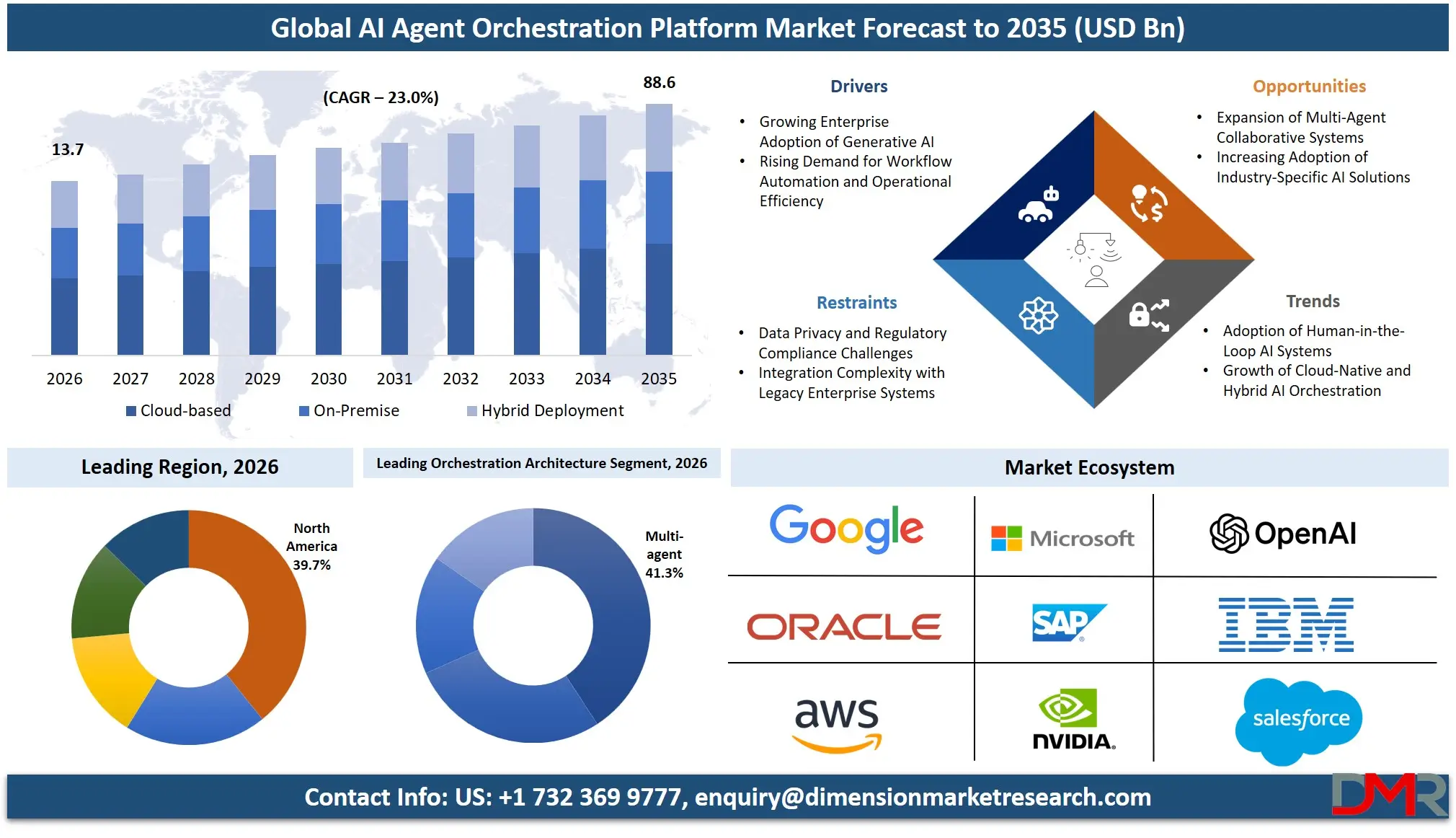
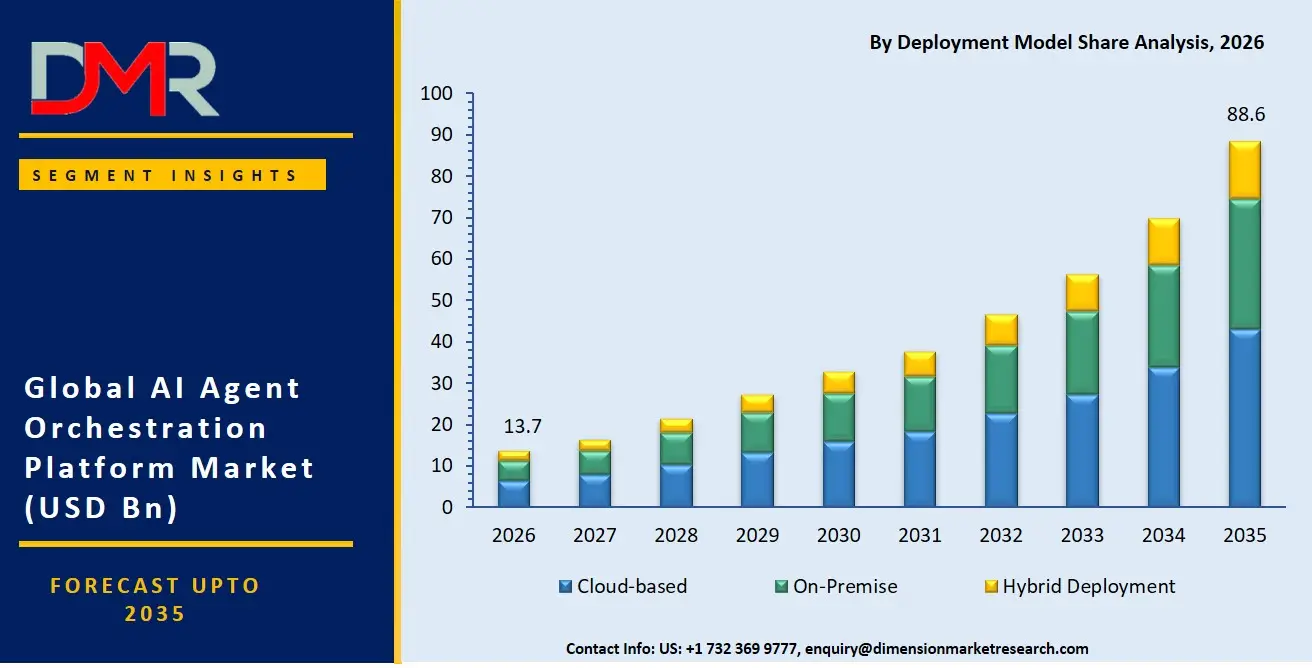
The AI Agent Orchestration Platform Market size is expected to be USD 13.7 billion in 2026 and increase at a compound annual growth rate of 23.0% to USD 88.6 billion in 2035 driven by the growing need for platforms that can integrate, coordinate, and manage multiple AI systems, agents, and enterprise workflows efficiently.
ℹ
To learn more about this report –
Download Your Free Sample Report Here
AI Agent Orchestration Platforms are defined as technologies that facilitate coordination, management, monitoring, and optimization of autonomous and semi-autonomous AI agents within enterprise processes, cloud infrastructures, and business application scenarios. The importance of AI agent orchestration platforms has been increasing as more and more companies are adopting generative AI to automate their business tasks, engage customers, develop software solutions, and derive insights from operational data. Some of the upcoming trends in this area include multi-agent systems, human-in-the-loop agent orchestration, cloud-native agent orchestration platforms, and agent governance frameworks, driving their adoption in BFSI, healthcare, manufacturing, retail, and government sectors.
ℹ
To learn more about this report –
Download Your Free Sample Report Here
The US AI Agent Orchestration Platform Market
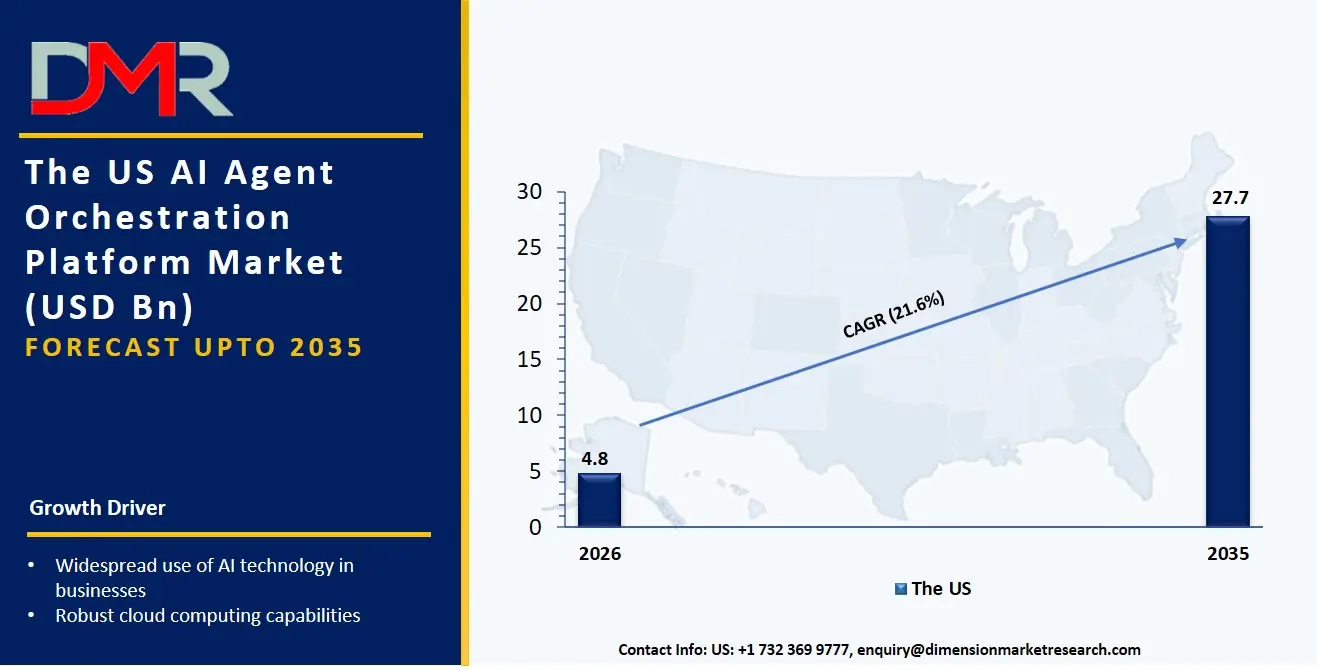
The US AI Agent Orchestration Platform Market size is estimated to be USD 4.8 billion in 2026 and is expected to increase at a CAGR of 21.6% over the forecast period.
The US AI Agent Orchestration Platform market is fueled by the widespread use of AI technology in businesses, robust cloud computing capabilities, and high investment from tech companies and venture capital firms. Large-scale organizations are increasingly adopting AI orchestration technologies in applications like customer service, cybersecurity, and software development processes. Growing government initiatives toward AI research and innovations, high demand for automation technologies, and growing generative AI ecosystems are contributing to market growth. The availability of large cloud providers, AI startups, and enterprise software firms is aiding in the quick commercialization and platform innovations. In addition, stringent data regulations are making organizations adopt more advanced orchestration platforms.
ℹ
To learn more about this report –
Download Your Free Sample Report Here
Europe AI Agent Orchestration Platform Market
The Europe AI Agent Orchestration Platform Market size is estimated to be USD 3.6 billion in 2026 and is expected to increase at a CAGR of 21.9% over the forecast period.
The Europe AI Agent Orchestration Platform Market is growing owing to increased spending on enterprise automation, digital sovereignty programs, and AI governance laws. Regional initiatives such as the EU AI Act and digital sovereignty programmes are promoting transparency, security, and efficiency in the use of artificial intelligence systems. Some industries that have been early adopters of AI agent orchestration platform include BFSI, manufacturing, healthcare, and governmental organizations. The need for human-centric artificial intelligence systems and compliance-based workflow processes has resulted in an increase in the adoption of platforms that can offer explainability and governance services.
Japan AI Agent Orchestration Platform Market
The market size of Japan AI Agent Orchestration Platform will be USD 685 million in 2026 and at a CAGR of 22.1% in the forecast period.
The market for AI agent orchestration platforms in Japan is growing owing to industrial automation, robotic superiority, and digitalization of enterprises. Various industries including manufacturing, telecommunications, and logistics are implementing AI orchestration solutions in their businesses to increase efficiency and productivity. Initiatives of the government and innovations in AI technology are driving technological adoption. Enterprises in Japan have realized the importance of having secure and dependable AI systems that integrate with enterprise systems. The need for autonomous workflow management and shortage of labor in the country presents excellent opportunities for AI agent orchestration platforms.
Key Takeaways
- Market Size & Forecast: The AI Agent Orchestration Platform Market size is projected to reach USD 13.7 billion in 2026 and is anticipated to have a value of USD 88.6 billion in 2035.
- Growth Rate & Outlook: The AI Agent Orchestration Platform Market size is set to grow at a compound annual growth rate of 23.0% during the forecast period of 2026 to 2035.
- Primary Growth Drivers: Some of the major growth drivers in the market include Increasing Use of Generative AI Technologies by Enterprises, and more.
- Key Market Trends: Some of the major trends in the market are Implementation of Human-in-the-Loop AI Systems, and more.
- By Deployment Model: The cloud based segment is anticipated to get the majority share of the AI Agent Orchestration Platform market in 2026.
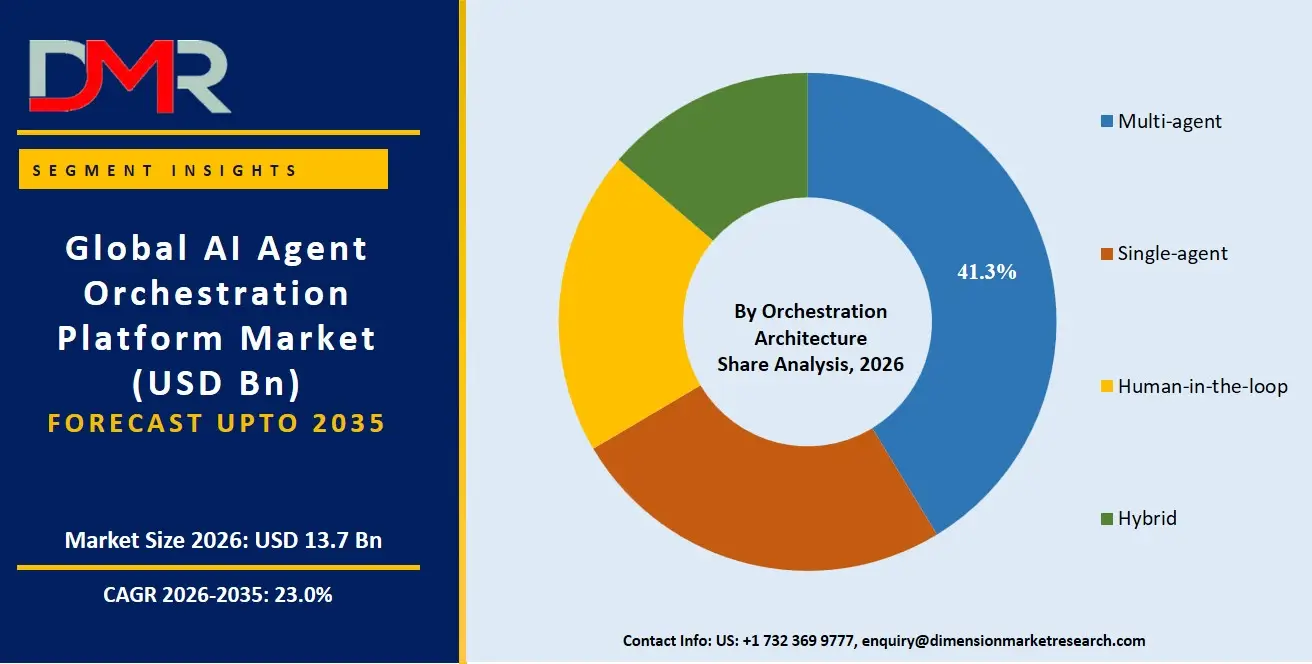
- By Orchestration Architecture: The multi-agent orchestration segment is expected to get the largest revenue share in 2026 in the AI Agent Orchestration Platform market.
- By Industry Vertical: The BFSI segment is expected to get the largest revenue share in 2026 in the AI Agent Orchestration Platform market.
- Regional Leadership: North America is set to lead the AI Agent Orchestration Platform market with an estimated 39.7% share in 2026.
What is the AI Agent Orchestration Platform?
The AI Agent Orchestration Platform represents a technical solution aimed at orchestrating, managing, and automating the collaboration of numerous AI agents, machine learning algorithms, APIs, enterprise solutions, and human actors within the same workflow framework. Such platforms allow for performing tasks like workflow management, task distribution, data and memory management, AI agent communication, monitoring, governance, and the integration of enterprise solutions into AI-based processes. In addition to allowing for self-governance, they enable collaborative multi-agent approaches and hybrid AI/human decision making. The development of AI agent orchestration platforms becomes crucial in the context of digital transformation as they facilitate efficiency, scalability, intelligent automation, and enterprise productivity.
Use Cases
- Automation of Customer Support: These AI orchestration platforms can be used for coordinating the activity of conversational agents, sentiment analysis engines, CRM tools, and escalation workflows. With the help of AI automation, companies can get faster responses, more personalized interactions, and lower costs of customer service without decreasing the quality of support provided.
- IT/DevOps Automation: Companies use the capabilities of AI orchestration platforms to automate the processes related to infrastructure monitoring, incident management, code generation, deployments, and diagnostics of IT systems. The use of multiple agents facilitates faster delivery cycles and better uptime management.
- Business Process Automation: Large enterprises use AI orchestration platforms for the automation of repetitive tasks within financial, human resources, procurement, and regulatory activities. Such automation is based on the combination of enterprise apps, generative AI, and workflow engines.
- Cybersecurity Operations: Companies may leverage AI orchestration solutions to perform autonomous threat detection, event correlation, analytics, and incident response. Thanks to multi-agent orchestration, it is possible to monitor enterprise networks, detect vulnerabilities and risks, and perform mitigation activities automatically.
Market Dynamic
Driving Factors in the AI Agent Orchestration Platform Market
Increasing Use of Generative AI Technologies by Enterprises
The rapid adoption of generative AI technologies by enterprises has been identified as one of the main reasons behind the growth of the AI Agent Orchestration Platform market. Companies are utilizing AI agents for different uses like customer service, creating content, coding, workflow automation, and analyzing data. With the increasing adoption of AI technologies among enterprises, the requirement for an orchestration platform that could integrate different AI systems emerges. In addition to this, firms require a unified platform that would allow integrating large language models, APIs, enterprise apps, and automation software.
Growing Demand for Enterprise Workflow Automation
Enterprises are increasingly automating repetitive and complex business processes across finance, human resources, IT operations, and customer service. AI agent orchestration platforms coordinate tasks across enterprise applications, enabling faster execution, consistent workflows, and improved resource utilization. Rising demand for operational efficiency is encouraging organizations to adopt centralized solutions that manage AI-driven automation at scale.
Restraints in the AI Agent Orchestration Platform Market
Data Privacy and Compliance Issues
Regulatory data privacy rules as well as governance regulations concerning artificial intelligence act as significant limitations on the AI Agent Orchestration Platform industry. Companies that process personal information of customers, healthcare, and financial data should adhere to strict data privacy rules that regulate issues of AI transparency, cybersecurity, and data sovereignty. Additional compliance concerns arise when the orchestration solutions are used in several jurisdictions and cloud platforms. Furthermore, organizations worry about AI bias and accountability in autonomous systems.
Integration Complexity with Existing Enterprise Systems
Integrating orchestration platforms with legacy applications, databases, cloud environments, and existing automation tools can be technically challenging. Differences in data formats, system architectures, and communication protocols may disrupt workflows and require substantial customization. Organizations may also face interoperability issues when coordinating agents built on different models and frameworks, increasing deployment costs and extending implementation timelines.
Opportunities in the AI Agent Orchestration Platform Market
Expanding Multi-Agent Collaborative Systems
The increasing use of multi-agent collaborative systems in artificial intelligence has opened up many possibilities for orchestration platforms vendors. More businesses now need AI-based agents that can cooperate within their work processes. The collaboration of AI systems is being considered by various sectors, such as cybersecurity, software development, logistics, and the medical industry, in order to boost efficiency and effectiveness. Platform vendors providing a scalable orchestration system, as well as effective real-time monitoring and coordination services, will benefit greatly from this growing trend.
Growing Demand for Industry-Specific Orchestration Solutions
Enterprises across banking, healthcare, manufacturing, and retail require orchestration platforms tailored to their operational workflows, security requirements, and regulatory obligations. Industry-specific solutions can provide preconfigured integrations, domain-oriented workflows, and specialized governance capabilities. Vendors developing targeted platforms can differentiate their offerings, simplify implementation, and capture demand from organizations seeking practical AI automation solutions aligned with industry requirements.
Trends in the AI Agent Orchestration Platform Market
Implementation of Human-in-the-Loop AI Systems
Human-in-the-loop coordination is fast emerging as a dominant trend as businesses strive to have more command and responsibility over their autonomous AI processes. Businesses are beginning to implement AI systems that include automated agent processing coupled with human approval for exceptional cases, management of governance, and other aspects. Human-in-the-loop systems are especially vital in sectors such as healthcare, BFSI, legal, and governmental sectors where crucial decisions depend on both AI suggestions and human input.
Increasing Adoption of Cloud-Native Orchestration Platforms
Cloud-native orchestration is gaining traction as enterprises seek scalable infrastructure for deploying and coordinating AI agents across distributed environments. These platforms support rapid deployment, flexible computing capacity, and integration with cloud-based enterprise applications. Managed services and software-as-a-service offerings can also reduce infrastructure management requirements, making orchestration capabilities more accessible to organizations expanding their AI-driven operations.
Research Scope and Analysis
The research scope of the AI Agent Orchestration Platform market includes segmentation by platform type, orchestration architecture, deployment model, application, and industry vertical. It also studies trends in adoption, technology development, and integration. In addition, the research considers market drivers such as increasing demand for AI automation and cloud adoption, along with market restraints such as compliance issues and integration complexities.
ℹ
To learn more about this report –
Download Your Free Sample Report Here
By Platform Type Analysis
Enterprise AI agent platforms are expected to lead the market with a forecasted market share of 36.8% in 2026 owing to the wide range of applications of the platform across large corporations who need to centralize their AI work process automation needs. Enterprise orchestration platforms that offer low-code automation, enterprise copilots, workflow optimization, and governance are favored by many companies due to their ease of use and scalability. BFSI, health care, and telecom organizations will be most interested in using such platforms owing to easy implementation and scalability. On the other hand, cloud-native orchestration platforms are expected to witness rapid growth since enterprises are adopting cloud-based solutions at a rapid pace and implementing distributed AI solutions. Developers and AI startups favor open-source orchestration solutions due to flexibility and reduced costs.
By Orchestration Architecture Analysis
The multi-agent orchestration market is anticipated to have the dominant share of 41.3% by 2026 as corporations will need AI systems that collaborate with each other and can manage complicated workflows within different operating environments. With the multi-agent architecture, the AI system can plan tasks, exchange contextual information, and independently optimize their enterprise processes. The adoption rate of the collaboration of AI systems in sectors like cybersecurity, IT automation, and customer service will rise rapidly to enhance efficiency and resilience. Hybrid orchestration will be the fastest-growing market segment, which integrates artificial intelligence with rule-based automation and robotic process automation systems. Human-in-the-loop orchestration will also register significant growth due to compliance, governance, and human-involvement issues.
By Deployment Model Analysis
The cloud-based deployment strategy will hold 48.7% of the share of the AI Agent Orchestration Platform Market in 2026 due to increased enterprise demand for an efficient and affordable infrastructure. Cloud-native orchestration ensures rapid deployment of AI agents, integration with enterprise infrastructure, and orchestration of workflow across locations. SaaS-delivered AI orchestration platforms oriented towards enterprises will gain traction from companies seeking reduction in expenditure on infrastructure and quicker adoption cycle times. Hybrid deployment strategy is anticipated to show highest growth as companies adopt the scale provided by cloud and security benefits of an on-premise infrastructure. On-premise deployment solutions continue to be significant in sectors such as government, defense agencies, and highly regulated industries.
By Application Analysis
Customer Service & CX segment such as customer service and customer experience are anticipated to dominate the market by occupying a share of 29.6% in 2026 owing to high investments in the use of conversational AI, virtual assistants, and automation of customer support services. In AI Orchestration Platforms, the use of AI orchestration platforms can help firms to integrate chatbots, CRM platforms, analytics software, and workflow automation applications, leading to better customer engagement. Personalized customer support and round-the-clock online support services are driving the application across retail, telecommunications, and BFSI sectors. Cybersecurity automation among all other application segments, cybersecurity automation is likely to witness the highest growth rate during the forecast period owing to cyber threats and firm investments in autonomous threat detection and mitigation software.
By Industry Vertical Analysis
BFSI is anticipated to contribute around 24.9% of the market share in 2026 as there has been a rapid implementation of AI orchestration solutions within the financial organizations to enhance their fraud detection capabilities, customer experience, compliance management, and automation. The BFSI organizations need secure and scalable AI solutions that have the capability of managing large transactional workloads. In addition, the health care and life sciences industries are anticipated to grow rapidly as more money is being invested in AI-enabled diagnostic solutions, clinical workflow automation, and intelligent healthcare operations. The manufacturing industry continues to deploy AI orchestration solutions within the manufacturing processes such as predictive maintenance and industrial automation.
The AI Agent Orchestration Platform Market Report is segmented on the basis of the following:
By Platform Type
- Enterprise AI agent platforms
- Workflow automation
- Low-code/no-code platforms
- Enterprise copilots
- Open-source orchestration frameworks
- Multi-agent frameworks
- Workflow engines
- Autonomous agent runtimes
- Cloud-native orchestration platforms
- Managed orchestration
- Kubernetes-native platforms
- Multi-cloud orchestration
- Vertical-specific orchestration platforms
- BFSI
- Healthcare
- Manufacturing
- Retail & e-commerce
By Orchestration Architecture
- Single-agent orchestration
- Sequential workflows
- Autonomous execution
- Multi-agent orchestration
- Collaborative agents
- Supervisor-agent models
- Swarm orchestration
- Human-in-the-loop orchestration
- Human approvals
- Assisted AI workflows
- Hybrid orchestration
- AI + rule-based workflows
- AI + RPA integration
By Deployment Model
- Cloud-based
- SaaS platforms
- Public cloud deployment
- On-premise
- Private deployments
- Air-gapped environments
- Hybrid deployment
- Edge-cloud orchestration
- Distributed AI systems
By Application
- Customer service & CX
- AI support agents
- Conversational AI
- IT & DevOps automation
- Infrastructure automation
- AI-assisted coding
- Business process automation
- Finance & accounting
- HR automation
- Sales & marketing automation
- Lead generation
- Campaign orchestration
- Knowledge & research automation
- Enterprise search
- RAG orchestration
- Cybersecurity automation
- Threat detection
- SOC automation
By Industry Vertical
- BFSI
- Healthcare & life sciences
- Retail & e-commerce
- Manufacturing
- Telecom
- Government & defense
- Logistics & supply chain
Regional Analysis
Leading Region in the AI Agent Orchestration Platform Market
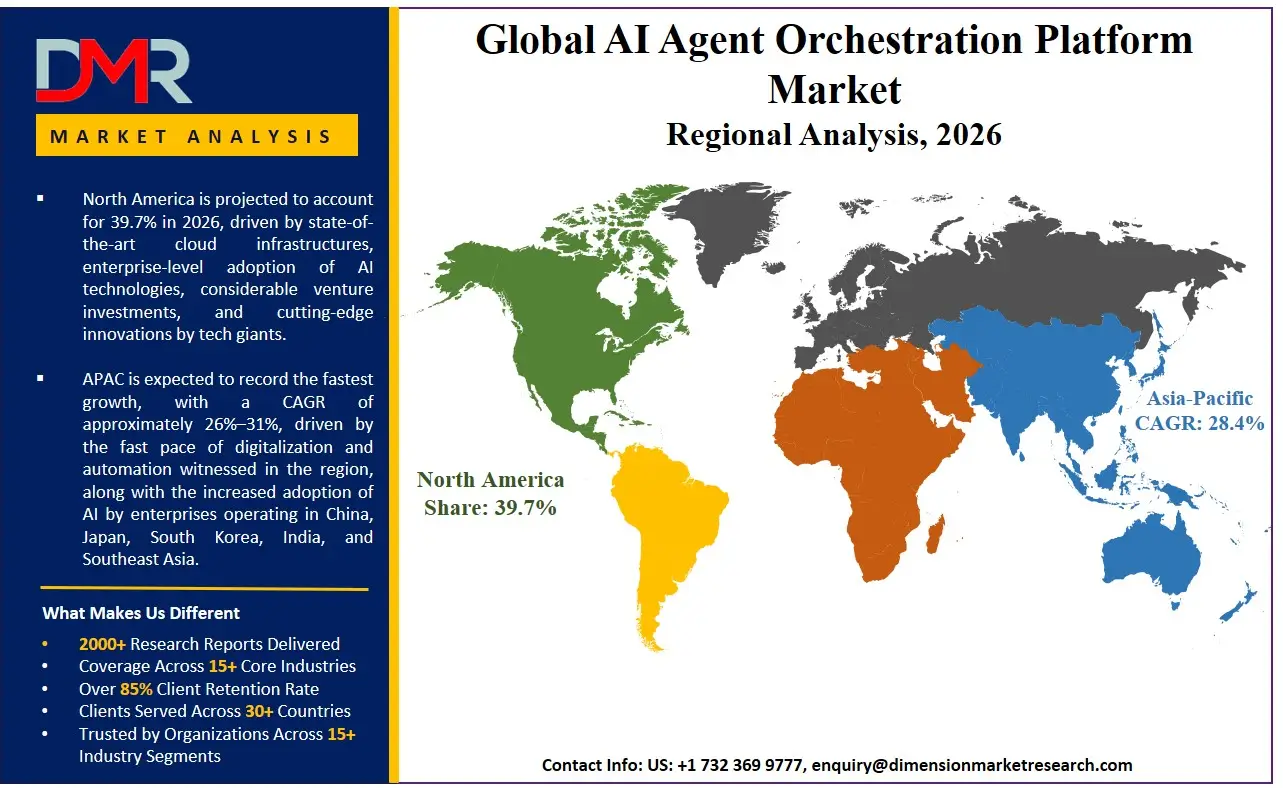
North America is anticipated to be at the forefront in the AI Agent Orchestration Platform market and hold a projected market share of 39.7% by 2026. The region enjoys state-of-the-art cloud infrastructures, enterprise-level adoption of AI technologies, considerable venture investments, and cutting-edge innovations by tech giants. BFSI, health care, retail, and software industry players are keenly integrating AI orchestration platforms into their business operations for process automation and efficiency. Other contributing factors include government initiatives towards AI innovation, cyber security upgrades, and advanced digital infrastructures. The region's developed AI environment and heavy investments in research and development will contribute to its dominance in the market.
ℹ
To learn more about this report –
Download Your Free Sample Report Here
Fastest Growing Region in the AI Agent Orchestration Platform Market
The Asia-Pacific region is forecast to emerge as the fastest-growing market for the AI Agent Orchestration Platform owing to the fast pace of digitalization and automation witnessed in the region, along with the increased adoption of AI by enterprises operating in China, Japan, South Korea, India, and Southeast Asia. There have been massive investments made by governments in the region for research and innovation into AI technology, smart manufacturing, cloud services, and automation technology. The demand for enhanced workflows and automation, especially in the realm of customer service and industrial operations, is contributing significantly to the market growth.
By Region
North America
Europe
- Germany
- The U.K.
- France
- Italy
- Russia
- Spain
- Benelux
- Nordic
- Rest of Europe
Asia-Pacific
- China
- Japan
- South Korea
- India
- ANZ
- ASEAN
- Rest of Asia-Pacific
Latin America
- Brazil
- Mexico
- Argentina
- Colombia
- Rest of Latin America
Middle East & Africa
- Saudi Arabia
- UAE
- South Africa
- Israel
- Egypt
- Rest of MEA
Competitive Landscape
The AI Agent Orchestration Platform industry is highly competitive due to the dynamic nature of technological advances, enterprise AI usage, and automation needs. Competitors in the industry have been emphasizing product differentiation through sophisticated multi-agent coordination, cloud-native technology, low-code programming, and management structures. Partnerships between companies and cloud services, enterprise software, and AI infrastructure suppliers have been on the rise. Investments in R&D aimed at improving scalability, interoperability, security, and business process management have also increased significantly. High entry barriers due to technical skills, infrastructure, and customer trust persist within the industry.
Some of the prominent players in the global AI Agent Orchestration Platform are:
- Microsoft
- Amazon Web Services (AWS)
- Google Cloud
- IBM
- Salesforce
- ServiceNow
- UiPath
- Databricks
- LangChain
- CrewAI
- Kore.ai
- Workato
- Automation Anywhere
- Oracle
- SAP
- OpenAI
- Anthropic
- LlamaIndex
- Dify
- n8n
- Other Key Players
Recent Developments
- In May 2026, UiPath introduced UiPath for Coding Agents, which is a system-wide integration to make coding agents enterprise-deployable using visual orchestration and conversational UI. It allows people of all skill levels to author, test, deploy, manage, and control enterprise automation. By integrating coding agents into the processes of enterprises, UiPath seeks to avoid any manual handoffs and ensure greater collaboration between AI agents and enterprises, resulting in increased productivity in enterprise automation.
- In October 2025, "A Physical AI Orchestrator" was introduced by Accenture, a cloud-based solution that is expected to help industries convert their manufacturing plants and warehouses into software-defined facilities. This solution combines NVIDIA's Omniverse and NVIDIA Metropolis with Accenture's "AI Refinery™" to form digital representations of the assets or processes in the industry. These simulations can sense any change in the process and issue intelligent commands for optimizing manufacturing processes in the facilities.
- In September 2025, AI agents for personalization, built on the Adobe Experience Platform (AEP) Agent Orchestrator, have been released by Adobe to assist firms in creating, optimizing, and customizing their customers' experiences and marketing initiatives. With the ability to deploy AI agents within its own and third-party ecosystems, the company can facilitate intelligent decisions and sequential actions within a specific context. By utilizing real-time data from an enterprise, Adobe seeks to optimize workflows, orchestrate customer experiences, and support marketing efforts.
Report Details
| Report Characteristics |
| Market Size (2026) |
USD 13.7 Bn |
| Forecast Value (2035) |
USD 88.6 Bn |
| CAGR (2026–2035) |
23.0% |
| Historical Period |
2021 – 2025 |
| Forecast Period |
2026 – 2035 |
| Base Year |
2025 |
| Estimate Year |
2026 |
| Segments Covered |
By Platform Type, By Orchestration Architecture, By Deployment Model, By Application, By Industry Vertical |
| Regional Coverage |
North America – The US and Canada; Europe – Germany, The UK, France, Russia, Spain, Italy, Benelux, Nordic, & Rest of Europe; Asia-Pacific – China, Japan, South Korea, India, ANZ, ASEAN, Rest of APAC; Latin America – Brazil, Mexico, Argentina, Colombia, Rest of Latin America; Middle East & Africa – Saudi Arabia, UAE, South Africa, Turkey, Egypt, Israel, & Rest of MEA |
Frequently Asked Questions
How big is the AI Agent Orchestration Platform Market?
▾ The AI Agent Orchestration Platform Market size is expected to reach USD 13.7 billion by 2026 and is projected to reach USD 88.6 billion by the end of 2035.
What is the CAGR of the AI Agent Orchestration Platform Market from 2026 to 2035?
▾ The market is growing at a CAGR of 23.0 percent over the forecasted period.
What factors are driving the growth of the AI Agent Orchestration Platform Market?
▾ Increasing Use of Generative AI Technologies by Enterprises, and more are the factors driving the growth of the AI Agent Orchestration Platform Market.
What are the major trends in the AI Agent Orchestration Platform Market?
▾ Implementation of Human-in-the-Loop AI Systems, and more are some of the major trends in the market.
Who are the key players in the AI Agent Orchestration Platform Market?
▾ Some of the key players in the AI Agent Orchestration Platform Market include Google, IBM, Microsoft, and more.
How is the AI Agent Orchestration Platform Market segmented?
▾ The AI Agent Orchestration Platform Market is segmented by platform type, orchestration architecture, deployment model, application, industry vertical.
Which region held the largest share of the AI Agent Orchestration Platform Market in 2026?
▾ North America is set to lead the AI Agent Orchestration Platform market with an estimated 39.7% share in 2026.
Which region is expected to grow the fastest in the AI Agent Orchestration Platform Market?
▾ Asia Pacific is the fastest-growing region in the AI Agent Orchestration Platform market during the forecast period.