Global AI Guardrails Market Snapshot
- Global AI Guardrails Market Size in 2026: USD 3.09 billion
- Global AI Guardrails Market Size in 2035: USD 21.44 billion
- Global CAGR from 2026 to 2035: 24.0%
- Software is the leading component segment in 2026: 68.4%
- Healthcare is the leading application segment in 2026: 23.6%
- Cloud is the leading deployment mode segment in 2026: 64.8%
- Large Enterprises is the leading enterprise size segment in 2026: 72.5%
- BFSI is the leading end-user industry segment in 2026: 24.7%
- North America is the leading region in 2026: 39.5%
What is the Global AI Guardrails Market and Its Market Size?
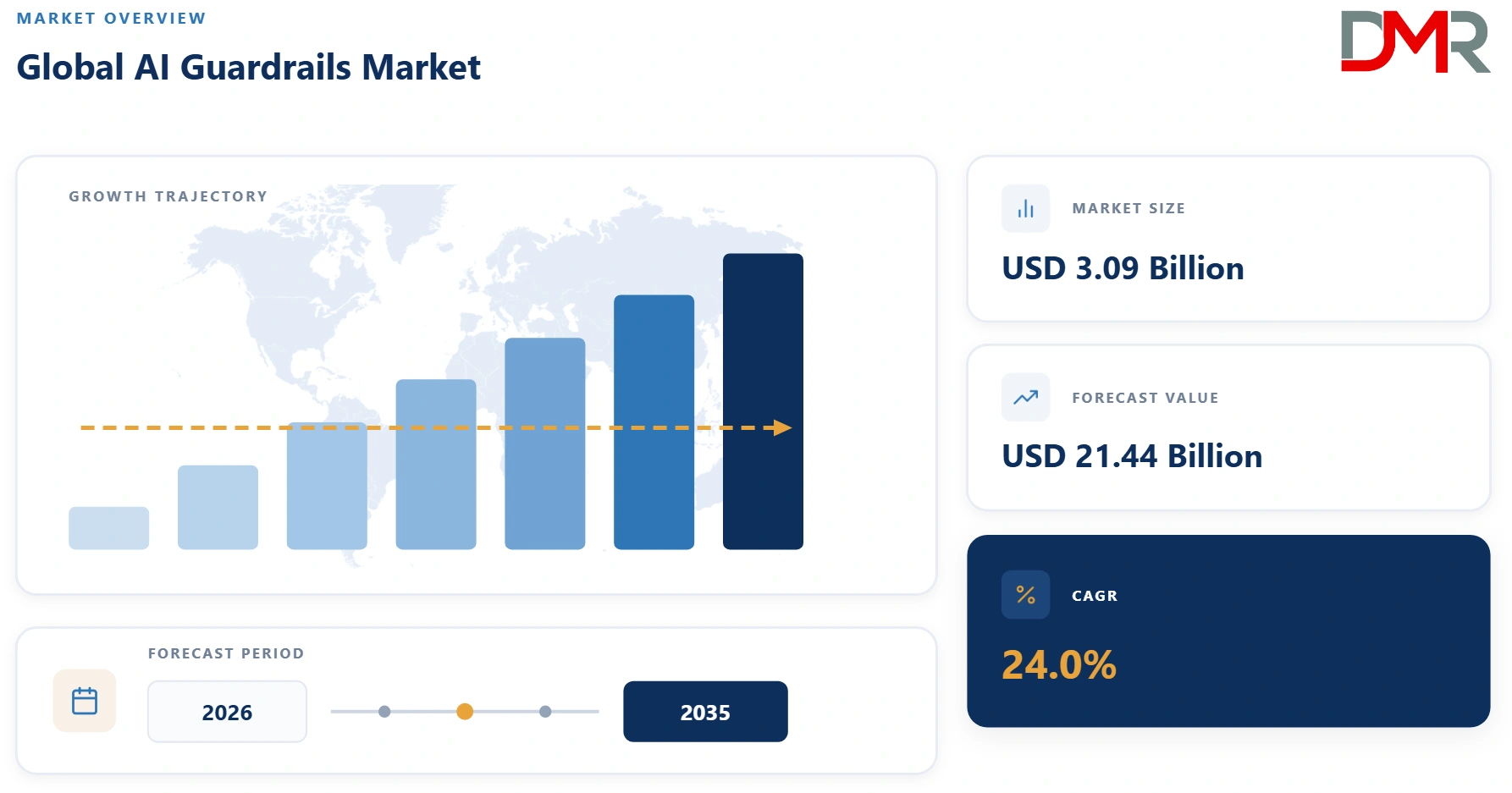
The Global AI Guardrails Market is projected to reach USD 3.09 billion in 2026 and grow at a compound annual growth rate of 24.0% through 2035 to reach approximately USD 21.44 billion.
ℹ
To learn more about this report –
Download Your Free Sample Report Here
AI guardrails are technological and policy-based controls that govern how artificial intelligence systems receive information, generate responses, access data, and perform actions. These solutions detect harmful content, hallucinations, prompt injection, privacy violations, bias, data leakage, and policy breaches. Growing deployment of generative and agentic AI is increasing demand for configurable safeguards across models, applications, tools, users, and enterprise workflows.
Use Cases
- Financial Services Compliance: Banks and financial institutions deploy AI guardrails around customer-service assistants, credit workflows, fraud analytics, and investment applications. These controls restrict unauthorized recommendations, prevent disclosure of financial information, detect biased responses, enforce regulatory policies, and maintain audit trails. Real-time monitoring also helps institutions identify hallucinations and prompt-injection attempts before model outputs influence customers, employees, or regulated decisions.
- Healthcare AI Safety: Healthcare providers use guardrails to prevent clinical AI systems from generating unsafe recommendations, exposing patient information, or operating outside approved medical contexts. Guardrails verify retrieved information, redact sensitive data, restrict unsupported diagnoses, and escalate uncertain responses to qualified professionals. These controls support safer deployment of clinical assistants, medical documentation tools, patient chatbots, research applications, and administrative automation.
- Enterprise AI Assistants: Organizations apply guardrails to internal copilots and knowledge assistants that access proprietary documents, databases, and business applications. Guardrails enforce role-based access, prevent confidential information leakage, filter inappropriate content, and require answers to remain grounded in authorized sources. They also monitor employee prompts, tool calls, model outputs, and downstream actions while maintaining security policies across departments and locations.
- Autonomous AI Agents: Developers use guardrails to control AI agents capable of executing transactions, accessing tools, modifying records, or communicating with external systems. Runtime policies define permitted actions, spending limits, approval requirements, and access boundaries. Continuous evaluation detects unusual behavior, prompt attacks, unsafe tool use, and policy violations, allowing organizations to interrupt, redirect, log, or escalate agent activities before damage occurs.
Key Takeaways
- Market Size: The Global AI Guardrails Market is anticipated to be valued at USD 3.09 billion in 2026 and is forecast to reach approximately USD 21.44 billion by 2035, expanding at a CAGR of 24.0%.
- Growth Rate and Outlook: Expansion is supported by generative AI adoption, autonomous agent deployment, evolving AI regulations, rising concern over hallucinations and prompt injection, and growing requirements for privacy protection, content safety, model monitoring, policy enforcement, explainability, and human oversight across enterprise AI environments.
- Primary Growth Drivers: Increasing enterprise AI adoption, production deployment of large language models, regulatory compliance requirements, cybersecurity risks, sensitive data exposure, harmful content generation, biased model outcomes, and demand for reliable AI-assisted decisions are accelerating investment in guardrail platforms, runtime controls, red-teaming tools, evaluation systems, and governance services.
- By Component Analysis: Software is projected to dominate the component segment with a 68.4% share in 2026, supported by demand for content filtering, hallucination detection, prompt security, privacy controls, model evaluation, runtime enforcement, and policy management. Services are anticipated to register the highest CAGR as enterprises require integration, customization, testing, regulatory advisory, and managed monitoring.
- By Application Analysis: Healthcare is expected to lead the application segment with a 23.6% share in 2026 due to strict patient-data requirements and the potential consequences of inaccurate AI outputs. Automotive applications are projected to grow fastest as AI becomes embedded in connected vehicles, autonomous systems, customer interfaces, engineering workflows, and intelligent manufacturing.
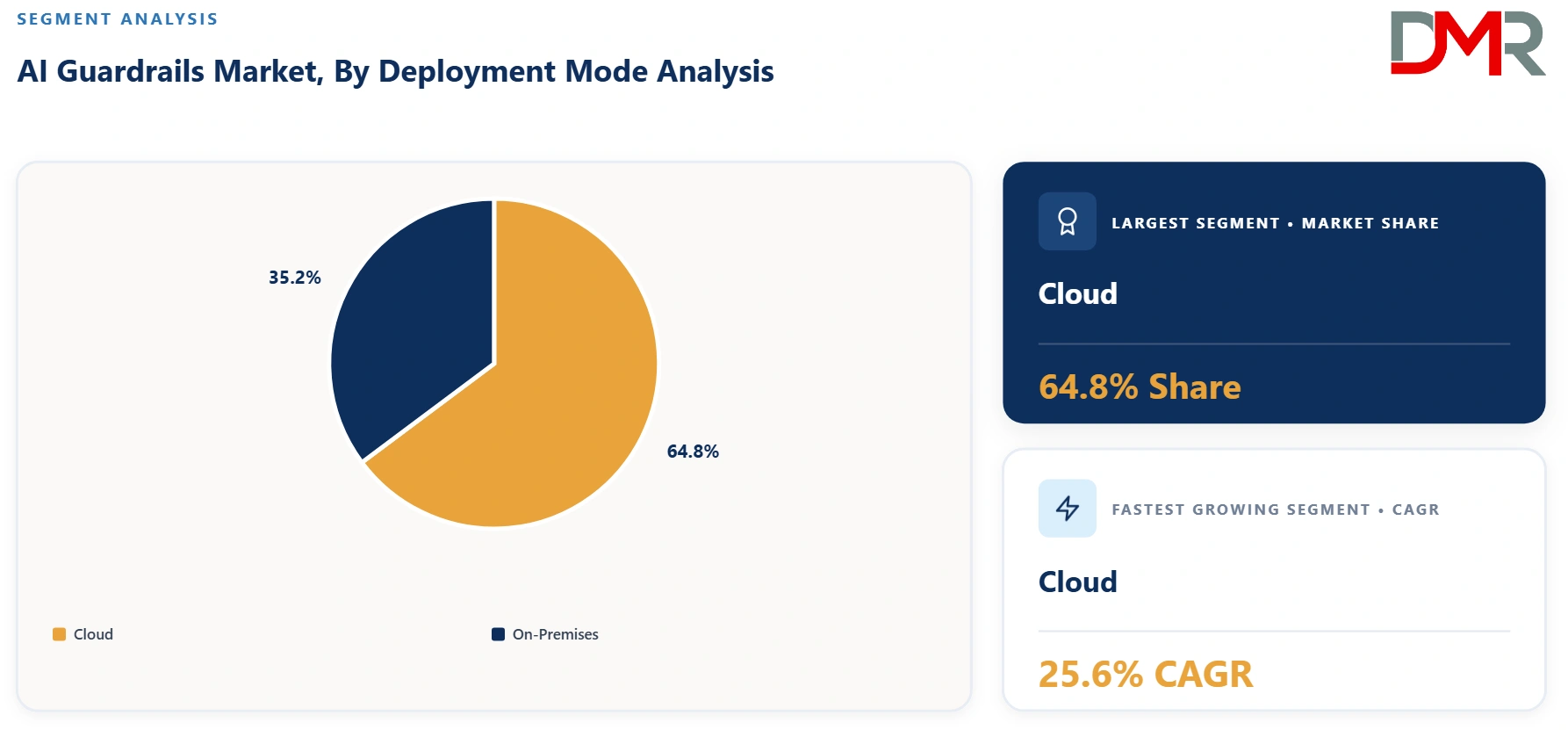
- By Deployment Mode Analysis: Cloud is anticipated to lead with a 64.8% share in 2026, driven by scalable APIs, rapid implementation, centralized updates, and integration with cloud-hosted foundation models. Cloud deployment is also expected to record the highest CAGR as enterprises expand generative AI applications across distributed users, models, data sources, and agentic workflows.
- By Enterprise Size Analysis: Large Enterprises are projected to dominate with a 72.5% share in 2026 due to greater AI expenditure, complex compliance requirements, and extensive sensitive-data environments. Small and Medium Enterprises are anticipated to expand fastest as API-based safeguards, subscription pricing, open-source frameworks, and managed cloud platforms reduce implementation complexity.
- By End-User Industry Analysis: BFSI is expected to lead with a 24.7% share in 2026 because of stringent regulatory, privacy, explainability, security, and audit requirements. Healthcare is projected to register the highest growth as providers increasingly deploy AI for clinical documentation, patient engagement, diagnostics support, medical research, administration, and revenue-cycle management.
- Regional Leadership: North America is projected to account for 39.5% of global revenue in 2026, supported by its concentration of foundation-model developers, cloud providers, cybersecurity companies, and enterprise AI adopters. Asia-Pacific is anticipated to grow fastest due to expanding digital economies, government AI initiatives, technology investment, and rapid enterprise adoption.
How AI and Generative AI Are Transforming the AI Guardrails Market
AI and generative AI are transforming guardrails from static rule engines into adaptive systems capable of interpreting context, detecting novel attacks, evaluating factuality, and applying policies dynamically. Specialized models can classify harmful content, identify personal information, assess groundedness, detect jailbreaks, and score behavioral risk in real time. Generative AI also supports automated red teaming by producing adversarial prompts and testing system weaknesses at scale. As autonomous agents gain access to enterprise tools, guardrails are evolving to monitor multi-step reasoning, tool calls, permissions, transactions, and outcomes throughout the complete agent lifecycle.
Key Drivers in the Global AI Guardrails Market
Rapid Enterprise Adoption of Generative AI
Enterprise adoption is creating an urgent requirement for safety controls that operate across prompts, outputs, models, data, and connected tools. As experimentation moves into customer-facing and operational applications, organizations face greater exposure to hallucinations, harmful content, prompt injection, privacy breaches, and unauthorized actions. Guardrails help establish acceptable-use policies, verify model responses, control sensitive information, and interrupt unsafe behavior, allowing enterprises to scale AI while preserving operational reliability and stakeholder trust.
Strengthening Regulatory and Risk-Management Requirements
AI regulation and governance frameworks are pushing enterprises toward demonstrable, continuously enforced safeguards. The European Union’s AI Act became broadly applicable on August 2, 2026, while obligations covering prohibited practices and AI literacy had already applied from February 2025. Meanwhile, the NIST Generative AI Profile provides organizations with structured guidance for identifying and managing risks unique to generative systems. These developments increase demand for documented policies, risk classification, evaluation, transparency, monitoring, auditability, incident reporting, and human oversight. Guardrail technologies enable organizations to translate governance requirements into operational controls embedded directly within AI applications and workflows.
Restraints in the Global AI Guardrails Market
Accuracy Limitations and False Intervention Risks
Guardrails may incorrectly block legitimate content or fail to recognize sophisticated attacks, particularly when prompts are multilingual, ambiguous, domain-specific, or deliberately manipulated. Excessively restrictive controls can reduce model usefulness, interrupt valid workflows, and frustrate users, while permissive thresholds may allow harmful or inaccurate responses. Guardrail models can also inherit biases and coverage limitations from their training data. Organizations must therefore balance safety, precision, recall, latency, and user experience. Continuous testing, contextual policies, human review, and domain-specific customization are required, increasing operational complexity and preventing guardrails from functioning as fully autonomous safety guarantees.
Integration Complexity and Performance Costs
Implementing guardrails across multiple foundation models, applications, cloud environments, and legacy systems can require extensive integration and governance work. Each safeguard adds processing requirements, potentially increasing response latency and inference expenses, particularly when applications combine content classification, retrieval verification, privacy screening, policy checks, and factuality evaluation. Enterprises must also coordinate AI, cybersecurity, legal, compliance, and business teams to define acceptable behavior. A shortage of experienced AI safety professionals further complicates implementation. Smaller organizations may postpone adoption when integration costs, monitoring requirements, and technical complexity outweigh the immediate perceived benefits of additional protective controls.
Growth Opportunities in the Global AI Guardrails Market
Runtime Protection for Autonomous AI Agents
Agentic AI creates a substantial opportunity for guardrail vendors because autonomous systems can access tools, execute transactions, modify records, and communicate across external platforms. Conventional input and output filtering is insufficient when risk arises from action sequences, tool selection, credential use, and cumulative decisions. Vendors can develop agent-specific controls covering identity, permissions, transaction limits, memory, tool access, multi-agent communication, and approval workflows. Platforms that deliver real-time interception, behavioral monitoring, policy enforcement, and complete action tracing can become essential infrastructure as enterprises progress from conversational copilots toward autonomous systems operating within sensitive business environments.
Industry-Specific Guardrail Platforms
Healthcare, finance, government, automotive, and other regulated industries require safeguards aligned with specialized terminology, regulations, risk tolerances, and workflows. This creates opportunities for vendors to offer vertical guardrail libraries, domain-trained classifiers, compliance templates, approved knowledge boundaries, and industry-specific evaluation benchmarks. Healthcare solutions can emphasize patient privacy and clinical reliability, while financial platforms can address suitability, discrimination, fraud, and explainability. Vendors providing configurable industry packages can reduce implementation time and improve accuracy compared with generic filters. Partnerships with consulting firms, regulators, insurers, and domain specialists can further strengthen credibility and accelerate commercial adoption.
Trends in the Global AI Guardrails Market
Shift Toward Multimodal and Model-Agnostic Guardrails
Guardrails are expanding beyond text moderation to evaluate images, audio, video, computer code, documents, and combined multimodal interactions. Enterprises increasingly require consistent policies across different foundation models and media types rather than controls restricted to a single model provider. Model-agnostic platforms allow organizations to maintain standardized safety requirements while switching models or operating multi-model architectures. This trend is supporting independent guardrail APIs, centralized policy layers, open-source frameworks, and interoperable evaluation tools. Vendors are also improving language coverage, contextual interpretation, and domain customization to protect increasingly diverse generative AI experiences across markets and customer groups.
Integration of Guardrails with AI Observability
Enterprises are combining guardrails with AI observability, evaluation, governance, and security platforms to obtain unified oversight of production AI. Instead of only blocking individual responses, integrated systems record prompts, outputs, retrieved data, model versions, risk scores, user identities, and policy decisions. These records support root-cause analysis, compliance reporting, model improvement, and incident investigation. Continuous feedback allows organizations to update thresholds and policies when new jailbreak techniques or business requirements emerge. This convergence is encouraging partnerships and consolidation among AI safety, model-monitoring, cybersecurity, data-governance, and machine-learning operations providers seeking to deliver comprehensive AI control platforms.
Research Scope and Analysis
The report analyzes the AI Guardrails Market by component, including software, hardware, and services; by application, including healthcare, finance, automotive, retail, IT and telecommunications, government, and others; by deployment mode, including on-premises and cloud; by enterprise size, including small and medium enterprises and large enterprises; and by end-user industry, including BFSI, healthcare, retail and e-commerce, media and entertainment, manufacturing, IT and telecommunications, and others. It also covers market demand, competitive positioning, regional developments, technological adoption, regulations, opportunities, risks, and forecasts.
ℹ
To learn more about this report –
Download Your Free Sample Report Here
By Component Analysis
Software is projected to hold the largest component share of 68.4% in 2026, supported by widespread demand for runtime filtering, prompt security, policy enforcement, and model evaluation. Services are expected to register the highest CAGR of approximately 26.8%, as organizations require consulting, system integration, testing, customization, training, and managed monitoring support.
By Application Analysis
Healthcare is anticipated to account for the highest application share of 23.6% in 2026, driven by patient privacy requirements and the need to prevent unsafe clinical outputs. Automotive is projected to record the highest CAGR of around 27.1%, as connected, autonomous, engineering, manufacturing, and customer-service applications increasingly incorporate AI safeguards.
By Deployment Mode Analysis
Cloud deployment is projected to dominate with a 64.8% share in 2026 because it provides scalable APIs, centralized updates, rapid configuration, and integration with cloud foundation-model services. Cloud is also expected to grow fastest at a CAGR of approximately 25.6%, as enterprises scale distributed generative and agentic AI workloads.
By Enterprise Size Analysis
Large Enterprises are expected to lead with a 72.5% share in 2026, reflecting their substantial AI expenditure, regulatory exposure, sensitive data, and complex application portfolios. Small and Medium Enterprises are projected to register the highest CAGR of around 26.4%, supported by affordable APIs, cloud subscriptions, open-source frameworks, and managed safety services.
By End-User Industry Analysis
BFSI is projected to account for the highest end-user share of 24.7% in 2026, supported by strict requirements for security, privacy, explainability, and regulatory compliance. Healthcare is expected to register the fastest CAGR of approximately 26.7%, as providers scale AI across clinical, research, patient-engagement, and administrative workflows.
The Global AI Guardrails Market Report is Segmented Based on the Following:
By Component
- Software
- Hardware
- Services
By Application
- Healthcare
- Finance
- Automotive
- Retail
- IT and Telecommunications
- Government
- Others
By Deployment Mode
By Enterprise Size
- Small and Medium Enterprises
- Large Enterprises
By End-User Industry
- BFSI
- Healthcare
- Retail and E-commerce
- Media and Entertainment
- Manufacturing
- IT and Telecommunications
- Others
Regional Analysis
North America is the Leading Region in the Global AI Guardrails Market
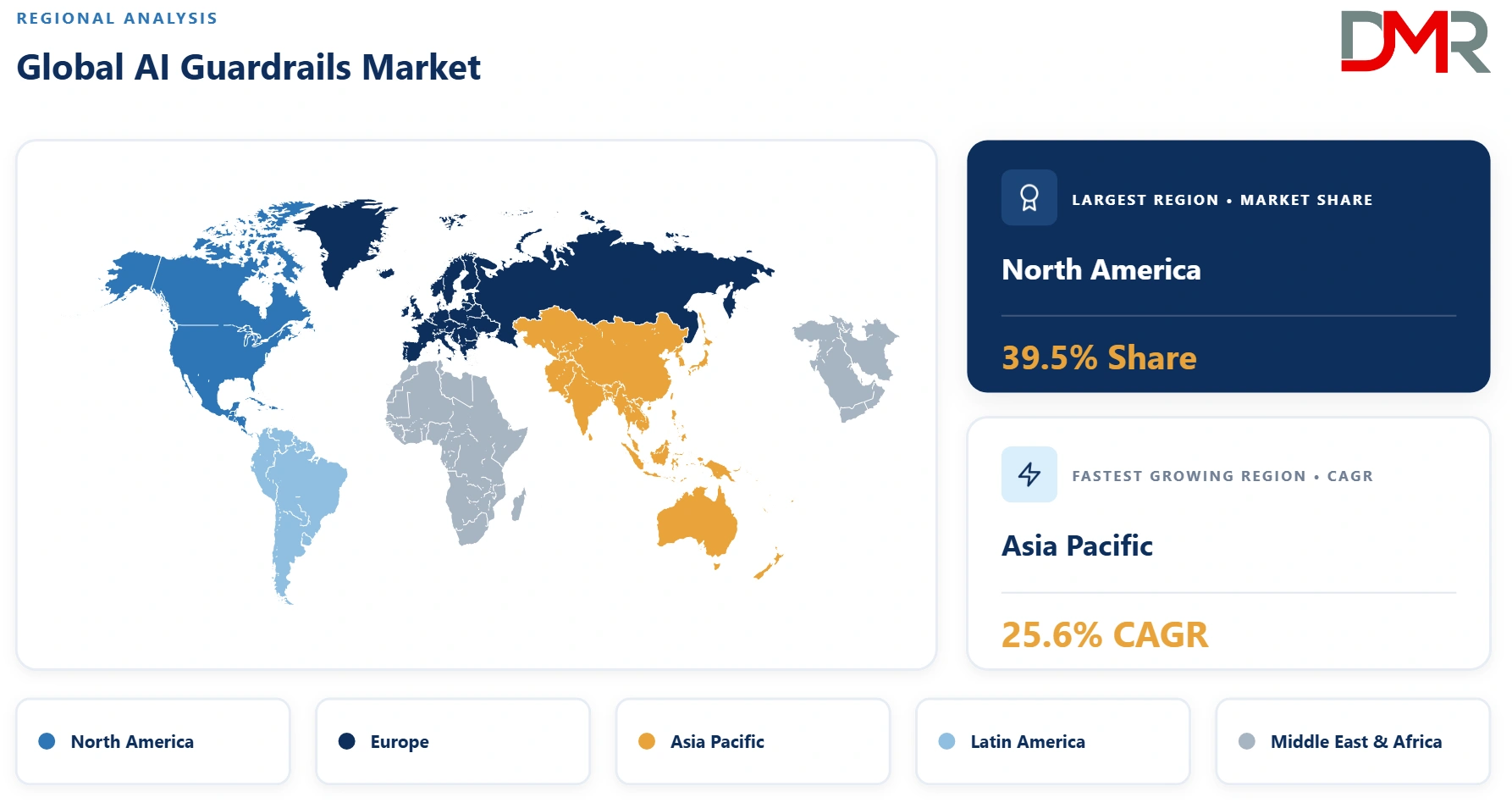
North America is projected to dominate the Global AI Guardrails Market with approximately 39.5% of revenue in 2026. Leadership is supported by the presence of major cloud providers, foundation-model companies, cybersecurity vendors, and AI governance specialists. Rapid generative AI deployment across finance, healthcare, government, technology, and retail is strengthening demand. Evolving federal and state requirements, extensive venture investment, advanced cloud infrastructure, and enterprise concern over hallucinations, data leakage, prompt attacks, and autonomous-agent risks further support regional adoption.
ℹ
To learn more about this report –
Download Your Free Sample Report Here
Asia-Pacific is the Fastest-Growing Region in the Global AI Guardrails Market
Asia-Pacific is anticipated to be the fastest-growing region, expanding at a CAGR of approximately 25.6% from 2026 to 2035, compared with the global CAGR of 24.0%. Growth is supported by enterprise digitalization, expanding cloud infrastructure, government AI strategies, and rapid adoption across China, Japan, India, South Korea, Australia, and Southeast Asia. Multilingual safety requirements, financial technology expansion, large digital populations, data-sovereignty concerns, and increasing deployment of customer-facing AI applications create substantial demand for localized and configurable guardrails.
The Europe AI Guardrails Market
The Europe AI Guardrails Market is estimated to be valued at approximately USD 0.99 billion in 2026 expanding at a CAGR of approximately 24.4%. Growth is strongly influenced by the EU AI Act, privacy regulations, and enterprise requirements for transparency, documentation, and risk controls. Adoption is increasing across banking, automotive, healthcare, public administration, manufacturing, and telecommunications as organizations operationalize responsible AI policies and compliance requirements.
Latin America AI Guardrails Market
The Latin America AI Guardrails Market is developing as banks, retailers, telecommunications providers, governments, and digital-platform companies increase generative AI adoption. Demand is supported by growing cloud usage, cybersecurity awareness, data-protection requirements, and the expansion of conversational AI in Portuguese and Spanish. Limited AI governance expertise and budget constraints may slow implementation among smaller organizations. Nevertheless, cloud-based APIs, managed services, and multilingual moderation solutions provide opportunities for vendors to support scalable and locally relevant AI safety programs.
Middle East and Africa AI Guardrails Market
The Middle East and Africa AI Guardrails Market is expanding alongside government digital-transformation programs, smart-city initiatives, financial technology investment, and enterprise adoption of generative AI. Gulf countries are emerging as important markets due to sovereign AI strategies, cloud infrastructure investment, and demand for Arabic-language safeguards. Banking, healthcare, telecommunications, energy, and public services offer significant opportunities. Adoption across parts of Africa remains constrained by infrastructure, budgets, and limited skills, although cloud delivery and regional partnerships are improving accessibility.
Major Countries Analysis
United States AI Guardrails Market
The United States AI Guardrails Market is valued at approximately USD 0.99 billion in 2026 and is expected to reach around USD 6.62 billion by 2035, registering a CAGR of approximately 23.5% from 2026 to 2035. The market benefits from strong cloud infrastructure, foundation-model development, cybersecurity innovation, and enterprise AI spending. Demand is increasing across financial services, healthcare, government, retail, defense, and technology as organizations address prompt injection, hallucinations, privacy exposure, discriminatory outcomes, and agent autonomy.
Japan AI Guardrails Market
Japan’s AI Guardrails Market is developing through growing adoption of generative AI in manufacturing, automotive, finance, healthcare, retail, telecommunications, and public services. Demand is shaped by strong expectations surrounding reliability, privacy, quality control, and human-centered technology. Japanese-language safety evaluation and culturally appropriate content moderation create opportunities for localized providers. Enterprises are also seeking safeguards for robotics, connected mobility, customer service, industrial automation, and knowledge assistants while balancing innovation with organizational accountability and established data-governance practices.
Saudi Arabia AI Guardrails Market
Saudi Arabia’s AI Guardrails Market is expanding alongside Vision 2030, government digitalization, smart-city development, and investment in sovereign cloud and artificial intelligence infrastructure. Public agencies, banks, healthcare providers, energy companies, and telecommunications operators require controls that protect sensitive information and support secure Arabic-language AI interactions. Opportunities are emerging for policy-management platforms, localized moderation, agent governance, and compliance consulting. Demand will strengthen as organizations transition from experimental generative AI projects toward customer-facing and operational applications requiring consistent safety assurance.
Regulatory Landscape
The regulatory landscape is a central influence on AI guardrails because organizations increasingly need technical controls that demonstrate compliance rather than relying solely on written policies. The EU AI Act, privacy laws, sector-specific rules, and emerging national frameworks are increasing requirements for transparency, risk assessment, human oversight, documentation, and incident management. Opportunities exist for vendors offering preconfigured regulatory templates, automated evidence collection, audit logs, policy mapping, and continuous compliance monitoring. Risks arise from regulatory fragmentation, changing definitions, jurisdictional conflicts, and uncertainty concerning responsibility across model developers and deployers. Guardrail providers must maintain adaptable architectures that translate evolving legal obligations into testable runtime controls.
Technology Analysis
AI guardrail technology is advancing from keyword filters and fixed rules toward context-aware classifiers, retrieval verification, automated reasoning, red teaming, behavioral analytics, and agent-level policy enforcement. Multimodal controls increasingly evaluate text, images, audio, video, code, and tool interactions through unified interfaces. Opportunities are emerging for lightweight models, low-latency processing, multilingual protection, privacy-preserving deployment, and model-agnostic APIs. However, adversarial prompts evolve continuously, and guardrail models remain vulnerable to false positives, false negatives, bias, and performance degradation. Competitive differentiation will increasingly depend on detection accuracy, explainability, deployment flexibility, response speed, customization, benchmark transparency, and integration with enterprise observability and security systems.
By Region
North America
Europe
- Germany
- France
- The U.K.
- Italy
- Spain
- Rest of Europe
Asia-Pacific
- China
- Japan
- India
- Australia
- South Korea
- Rest of APAC
Latin America
- Mexico
- Brazil
- Rest of LATAM
Middle East & Africa
- Saudi Arabia
- The UAE
- South Africa
- Rest of MEA
Competitive Landscape
The Global AI Guardrails Market is fragmented across cloud providers, cybersecurity companies, AI governance platforms, model-observability vendors, and specialized startups. Major companies compete through multimodal filtering, prompt-injection protection, hallucination detection, privacy controls, agent governance, automated evaluation, and regulatory reporting. Cloud providers benefit from native integration with hosted models, while independent vendors differentiate through model-agnostic deployment and specialized risk intelligence. Partnerships, open-source ecosystems, acquisitions, regional expansion, and industry-specific solutions are expected to shape competition as enterprises seek comprehensive, low-latency, and configurable protection.
Some of the Prominent Players in the Global AI Guardrails Market Are
- Amazon Web Services
- Microsoft Corporation
- Google LLC
- IBM Corporation
- NVIDIA Corporation
- Oracle Corporation
- SAP SE
- Salesforce Inc.
- Cisco Systems Inc.
- Palo Alto Networks Inc.
- Cloudflare Inc.
- Broadcom Inc.
- ServiceNow Inc.
- Fiddler AI
- Arthur AI
- Arize AI
- WhyLabs
- Credo AI
- Holistic AI
- Saidot
- Monitaur
- TruEra
- Protect AI
- HiddenLayer
- Robust Intelligence
- Lakera AI
- CalypsoAI
- Prompt Security
- Lasso Security
- Giskard
- Patronus AI
- Guardrails AI
- Galileo
- Aporia
- Enkrypt AI
- Preamble
- Aim Security
- Nightfall AI
- DataRobot
- Cloudera Inc.
- Other Key Players
Recent Developments
- In September 2026, NVIDIA launched its Open Agent Safety Platform, combining OpenShell open-source software and the NVIDIA Sentry reference design to strengthen AI agent security. The platform establishes runtime boundaries, monitors agent behavior, and enforces policies to prevent unauthorized actions, supporting safer deployment of autonomous AI agents across enterprise applications and infrastructure.
- In April 2026, Virtue AI launched PolicyGuard, a platform designed to create and enforce customized AI guardrails across models, agents, and applications. The solution translates organizational policies and regulatory requirements into enforceable runtime controls, providing explainable decisions, audit trails, and real-time protection to help enterprises manage AI risks.
- In January 2026, F5 announced the general availability of F5 AI Guardrails and F5 AI Red Team. The solutions provide runtime protection, continuous adversarial testing, and governance for enterprise AI systems. Their capabilities address prompt injection, jailbreak attacks, sensitive-data leakage, and compliance requirements, helping organizations secure AI applications and agents throughout their operational lifecycle.
- In March 2026, SandboxAQ announced enhancements to its AQtive Guard platform, expanding AI security posture management and runtime guardrails. The new capabilities help enterprises discover AI usage, monitor interactions, enforce policies, and reduce risks associated with unmonitored AI systems and agents, while supporting governance and regulatory reporting requirements.
Report Details
| Report Characteristics |
| Market Size (2026) |
USD 3.09 Bn |
| Forecast Value (2035) |
USD 21.44 Bn |
| CAGR (2026–2035) |
24.0% |
| The US Market Size (2026) |
USD 0.99 Bn |
| Historical Data |
2021 – 2025 |
| Forecast Data |
2026 – 2035 |
| Base Year |
2025 |
| Estimated Year |
2026 |
| Segments Covered |
By Component, By Application, By Deployment Mode, By Enterprise Size, By End-User Industry |
| Regional Coverage |
North America – The US and Canada; Europe – Germany, France, The UK, Italy, Spain, Rest of Europe; Asia-Pacific – China, Japan, India, Australia, South Korea, Rest of APAC; Latin America – Mexico, Brazil, Colombia, Argentina, Rest of LATAM; Middle East & Africa – Saudi Arabia, The UAE, South Africa, Rest of MEA |
Frequently Asked Questions
How big is the AI Guardrails Market?
▾ The Global AI Guardrails Market is expected to reach USD 3.09 billion in 2026 and approximately USD 21.44 billion by 2035.
What is the CAGR of the AI Guardrails Market from 2026 to 2035?
▾ The market is projected to expand at a compound annual growth rate of 24.0% from 2026 to 2035.
What factors are driving the growth of the AI Guardrails Market?
▾ Growth is driven by generative AI adoption, autonomous AI agents, regulatory compliance, cybersecurity risks, hallucination concerns, sensitive-data exposure, harmful content, and demand for accountable AI.
What are the major trends in the AI Guardrails Market?
▾ Major trends include agentic AI safeguards, multimodal filtering, model-agnostic controls, automated red teaming, hallucination detection, adaptive policies, and integration with AI observability and governance platforms.
Which region held the largest share of the AI Guardrails Market in 2026?
▾ North America is projected to hold the largest share, accounting for approximately 39.5% of global revenue in 2026.
Which region is expected to grow the fastest in the AI Guardrails Market?
▾ Asia-Pacific is anticipated to grow fastest at a CAGR of approximately 25.6% from 2026 to 2035.
Who are the key players in the AI Guardrails Market?
▾ Key players include AWS, Microsoft, Google, IBM, NVIDIA, Fiddler AI, Arthur AI, Arize AI, Credo AI, Protect AI, Lakera AI, CalypsoAI, and Guardrails AI.
How is the AI Guardrails Market segmented?
▾ The market is segmented by component, application, deployment mode, enterprise size, end-user industry, and region.