Market Snapshot
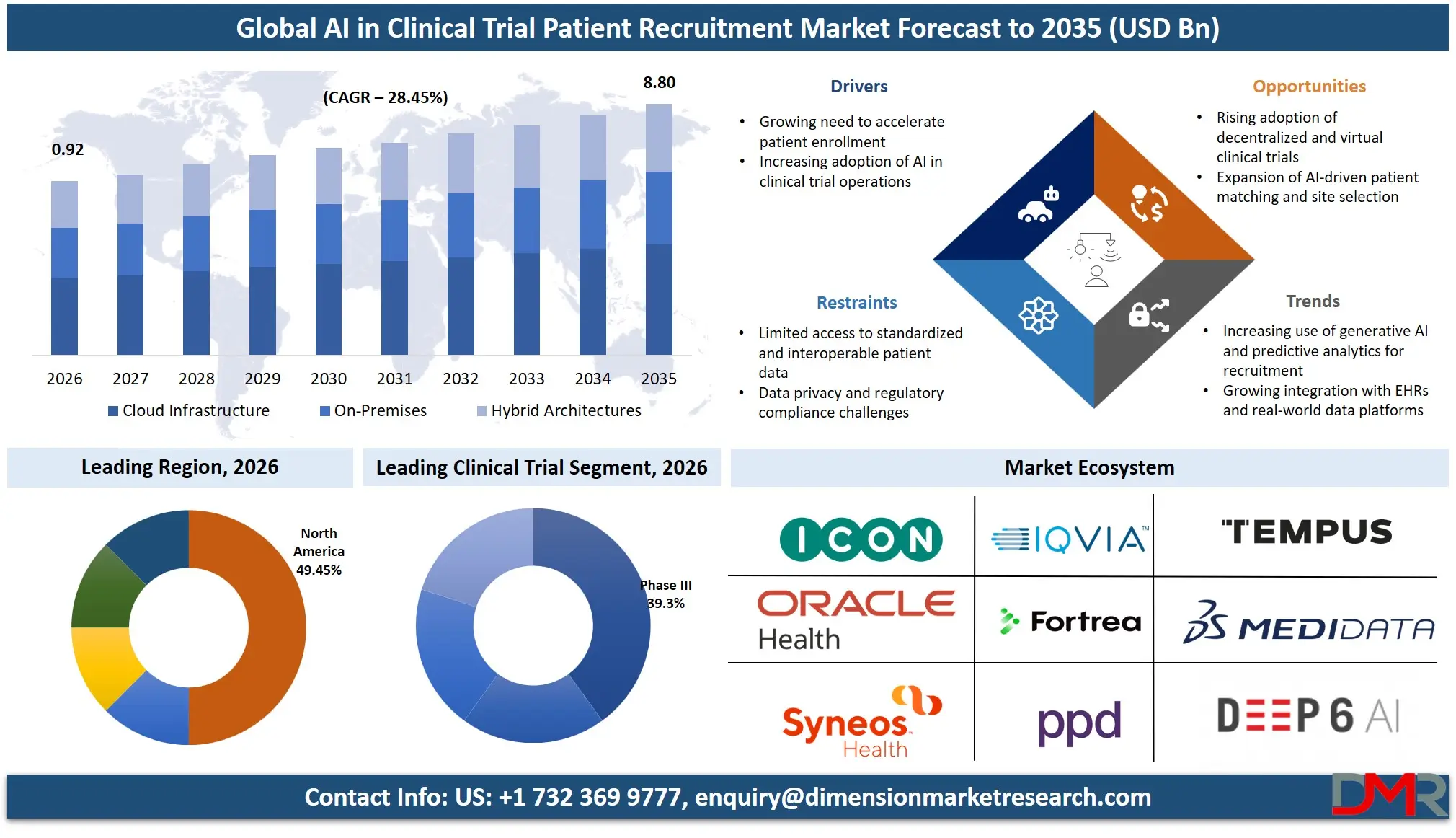
- The market size is USD 0.72 Billion in 2025, reached USD 0.92 Billion in 2026, and is projected to hit USD 8.80 Billion by 2035 at a CAGR of 28.45%.
- Machine Learning leads the By AI Technology segment with a 48.22% revenue share in 2026.
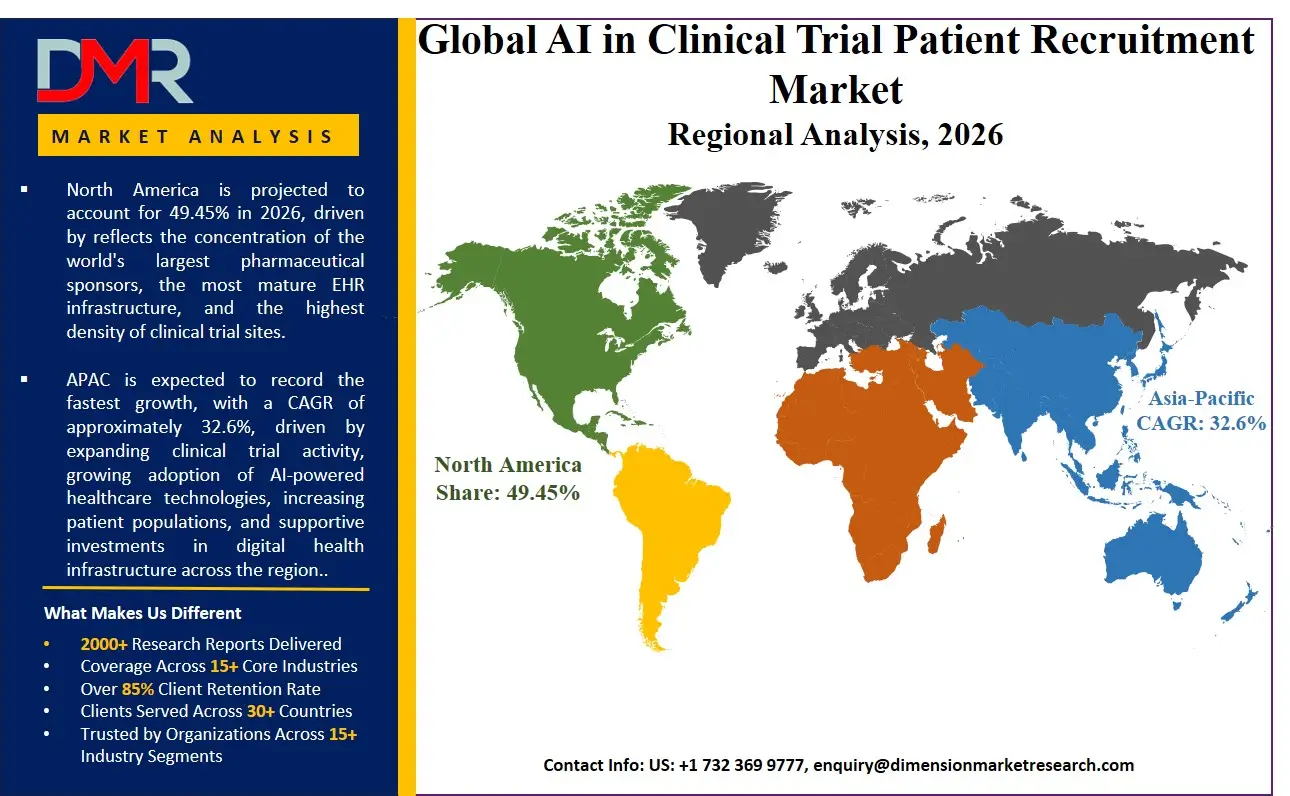
- North America dominates regional revenue with a 49.45% share in 2026.
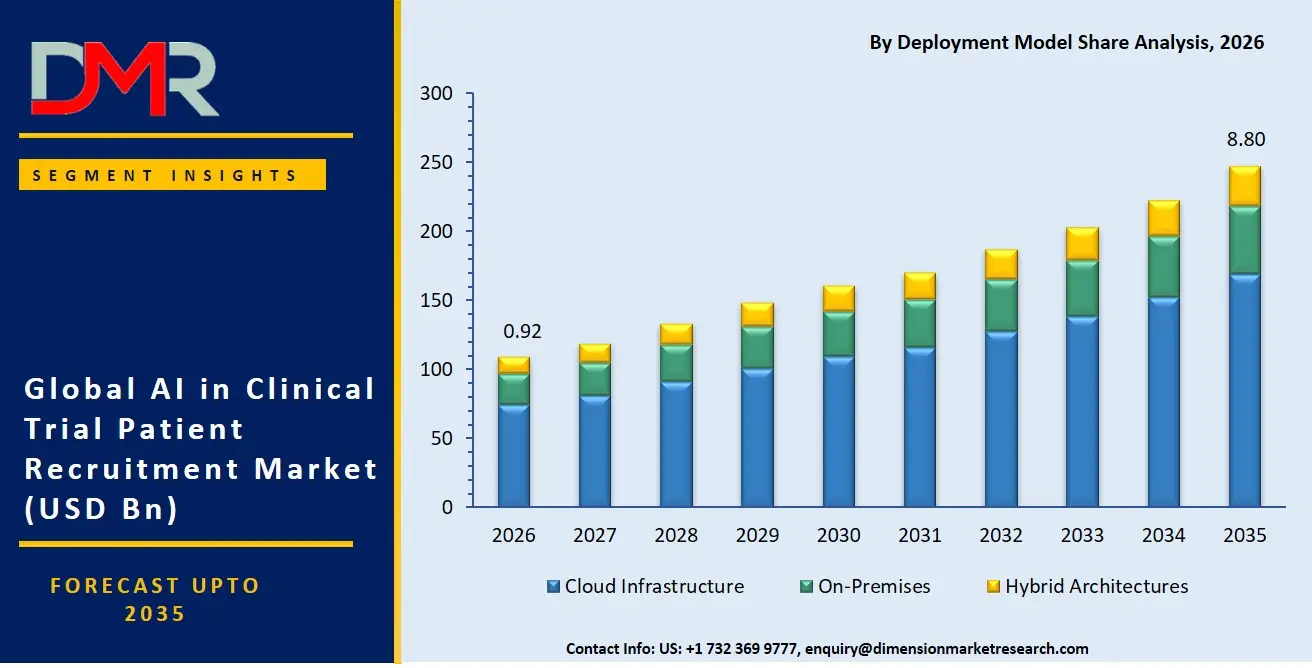
- Cloud Infrastructure holds a 68.23% share of the By Deployment Model segment in 2026.
- Pharmaceutical Sponsors lead the By End User segment with a 49.38% revenue share in 2026.
- Electronic Health Records lead the By Data Source segment with a 55.2% revenue share in 2026.
- Oncology leads the By Therapeutic Area segment with a 31.42% revenue share in 2026.
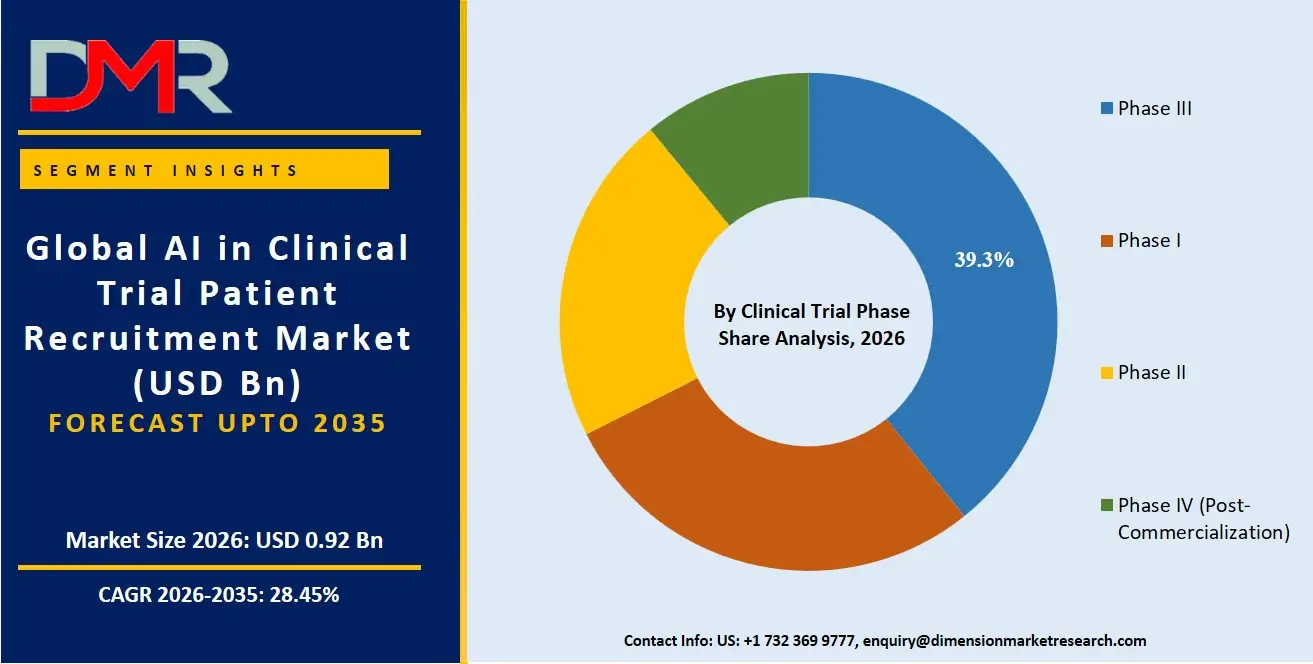
- Phase III clinical trials hold the largest share within the By Clinical Trial Phase segment at 39.25% in 2026.
Market Overview
The AI in Clinical Trial Patient Recruitment Market covers software platforms, algorithmic matching engines, and data-integration systems that automate the identification, screening, and onboarding of eligible patients for clinical studies. Broader clinical data management suites and general hospital information systems fall outside its scope unless directly deployed for eligibility matching. Pharmaceutical sponsors, contract research organizations, academic medical centers, and patient recruitment agencies all operate within its boundaries.
ℹ
To learn more about this report –
Download Your Free Sample Report Here
As reported by PPD, 45% of clinical research sponsors stated their standard trial durations had grown longer over the two years preceding 2024. Manual screening sits at the center of that problem. AI-driven recruitment replaces manual chart review with automated, real-time patient identification, converting a chronic operational cost into a manageable technology expenditure.
Cloud-native deployment and EHR integration are the two structural forces reshaping procurement decisions. Cloud infrastructure connects geographically dispersed sites into a single eligibility screening layer. EHRs supply the longitudinal clinical histories, lab results, and diagnostic codes that matching algorithms require. Both layers are now operationally mature in North America and Europe, explaining why commercial deployment accelerated sharply from 2023 onward.
Market Size and Forecast
The Global AI in Clinical Trial Patient Recruitment Market size is estimated at USD 0.92 Billion in 2026 from USD 0.72 Billion in 2025, and is projected to reach USD 8.80 Billion by 2035, exhibiting a CAGR of 28.45% during the forecast period.
Validated performance outcomes anchor the forecast assumptions. As reported by PPD, AI-driven protocol optimization delivered a 25% reduction in protocol approval durations and a 30% to 50% drop in mid-trial amendments in 2024. The NIH's validation of TrialGPT confirmed a 40% cut in human review timelines that same year. Procurement teams at large sponsors can now build a defensible return-on-investment case from independently verified data, converting AI recruitment from a discretionary pilot into a budgeted operational line item.
Deep 6 AI secured enterprise SaaS contracts ranging from USD 500,000 to USD 3 million annually per client in FY2025, confirming that deal sizes had reached enterprise scale well before market maturity. The upside scenario plays out if federated EHR networks expand faster than current projections. The downside risk materializes if regulatory compliance costs suppress adoption, extending procurement cycles and delaying vendor revenue recognition across the forecast period.
AI Technology Analysis
Machine Learning led the AI Technology segment with a 48.22% share in 2026.
Machine learning algorithms parse structured and unstructured EHR data against complex inclusion and exclusion criteria faster than any alternative method. Sponsors committed to this architecture because performance was independently verified, not merely claimed. IQVIA's Research and Development Solutions segment carried a contracted backlog of USD 32.7 Billion as of December 31, 2025, the majority of which runs on machine learning matching infrastructure, confirming that buyer confidence has translated into long-term capital commitment.
Natural Language Processing occupies the second functional tier by extracting eligibility criteria from free-text clinical notes and discharge summaries that structured query systems cannot parse. Predictive Analytics serves sponsors at the protocol design stage, forecasting site-level recruitment performance before a single patient is contacted. Large Language Models represent the fastest-evolving capability. Computer Vision supports eligibility determination in orthopedic, dermatological, and ophthalmological trials where image-based biomarkers define enrollment criteria, a nascent but clinically credible application gaining institutional recognition.
Deployment Model Analysis
With a 68.23% share in 2026, Cloud Infrastructure outpaced all other Deployment Model categories.
ℹ
To learn more about this report –
Download Your Free Sample Report Here
Cloud deployment enables sponsors to connect geographically dispersed trial sites into a unified eligibility screening layer without building site-level IT infrastructure. Multi-site recruitment programs have made cloud architecture the operational default. On-Premises deployment retains share among large academic medical centers and government-linked institutions where data sovereignty regulations limit external data transmission.
Hybrid Architectures address the reality that most large sponsors operate across both regulated and open data environments. Hybrid models allow cloud-based cohort matching to run against federated on-premises EHR nodes, keeping patient identifiers local while transmitting only anonymized eligibility flags to sponsor systems. Vendors who cannot support hybrid deployment face structural exclusion from enterprise contracts where compliance teams will not approve full cloud data transmission.
Clinical Trial Phase Analysis
Phase III accounted for 39.25% of Clinical Trial Phase demand in 2026, the highest of any category.
ℹ
To learn more about this report –
Download Your Free Sample Report Here
Phase III trials require the largest patient populations, carry the highest cost-per-delay, and face the most complex eligibility criteria of any trial phase. These conditions make AI-driven recruitment most economically justifiable at Phase III, where a single enrollment delay can cost sponsors millions in extended site operating costs. Phase I applies AI recruitment primarily for dose-escalation cohorts in oncology and rare disease programs where eligible patient pools are clinically narrow.
Phase II sponsors are committing to AI infrastructure earlier in the development cycle to reduce enrollment shortfall risk before progressing to larger Phase III programs. NetraMark Holdings and Worldwide Clinical Trials entered a global collaboration in April 2025 to integrate the NetraAI engine into Phase II and Phase III workflows using specialized machine learning to optimize patient-centric selection models. Phase IV studies draw on insurance claims data and wearable device biomarkers rather than standard EHR records, requiring platforms with flexible data ingestion architectures capable of processing non-standard formats at scale.
Therapeutic Area Analysis
Oncology captured 31.42% of the Therapeutic Area segment in 2026, ahead of all rivals.
Oncology trials require patients who meet narrow molecular and histological criteria, making manual chart review prohibitively slow and error-prone at scale. Mount Sinai Tisch Cancer Center launched the PRISM platform in January 2026, powered by Triomics' OncoLLM, to automate record reviews within electronic medical records and accelerate cancer trial access across its health system. Cardiovascular programs apply AI tools to identify patients dispersed across thousands of primary care sites, where the eligible cohort is statistically significant but geographically diffuse.
Neurology trials face extended enrollment timelines because disease markers progress slowly and patients must be captured at specific disease stages. Rare Diseases command the highest per-patient recruitment cost in the market. HEALWELL AI and WELL Health Technologies launched the WELLTRUST platform in February 2026 with an explicit focus on patients with complex, rare, or chronic conditions, confirming that specialist vendors are moving to address the structural gap between oncology's commercial maturity and rare disease's unmet recruitment need.
End User Analysis
A 49.38% share made Pharmaceutical Sponsors the clear leader across End User categories in 2026.
Sponsors control protocol design, enrollment timelines, and recruitment budgets, making them the primary procurement decision-makers for AI matching platforms. Contract Research Organizations serve as the operational layer between sponsors and trial sites. CROs have strong commercial incentives to deploy AI recruitment tools because enrollment speed directly affects their service delivery timelines and contract renewal rates. PSI CRO launched its SYNETIC platform in February 2026, using agentic AI to query data across over 500,000 unique institutions to optimize site identification and enrollment predictability.
Academic Medical Centers deploy AI tools to expand patient access to clinical research within their own health systems. Patient Recruitment Agencies manage outreach and engagement channels on behalf of sponsors and CROs, increasingly integrating AI tools to automate language-targeted hyper-local campaigns and transparent opt-in patient networks. Hospital Sites and Investigator Groups represent the point of care where matched candidates are ultimately screened and enrolled, making their EHR data access agreements a gatekeeper variable for every upstream platform vendor.
Data Source Analysis
Electronic Health Records led the Data Source segment with a 55.2% share in 2026.
EHRs contain the longitudinal clinical histories, lab results, and diagnostic codes that eligibility algorithms require to match patients against complex protocol criteria. Health systems that control large EHR repositories occupy a gatekeeper position, determining which platform vendors receive data access agreements and on what commercial terms. Genomic and Omic Datasets extend matching precision into molecular profile, enabling eligibility determination for precision medicine trials where standard EHR fields are insufficient.
Patient Registries serve therapeutic areas where existing disease-specific databases allow pre-built cohort identification. Wearables and Digital Biomarkers represent an emerging data layer capturing real-time physiological data outside clinical settings, particularly relevant for Phase IV and decentralized trials. Insurance Claims data fills gaps in clinical records for chronic disease populations, and vendors with flexible data ingestion architectures capable of processing all five source categories hold a structural advantage over single-source EHR-dependent platforms.
Key Market Segments
By AI Technology
- Machine Learning
- Natural Language Processing
- Predictive Analytics
- Computer Vision
- Large Language Models
By Deployment Model
- Cloud Infrastructure
- On-Premises
- Hybrid Architectures
By Clinical Trial Phase
- Phase I
- Phase II
- Phase III
- Phase IV (Post-Commercialization)
By Therapeutic Area
- Oncology
- Cardiovascular
- Neurology
- Metabolic Disorders
- Infectious Diseases
- Rare Diseases
By End User
- Pharmaceutical Sponsors
- Contract Research Organizations (CROs)
- Academic Medical Centers
- Hospital Sites and Investigator Groups
- Patient Recruitment Agencies
By Data Source
- Electronic Health Records (EHRs)
- Genomic and Omic Datasets
- Patient Registries
- Insurance Claims
- Wearables and Digital Biomarkers
By Outreach and Engagement Channel
- Automated Digital Campaigns
- Language-Targeted Hyper-Local Ads
- Transparent Opt-In Patient Networks
- Mobile Health Clinic Registries
By Recruitment Funnel Stage
- Automated Matching and Pre-Screening
- Protocol Feasibility Evaluation
- Patient Outreach and Intake
- Real-Time Adherence Tracking
Regional Analysis
North America held a 49.45% share in 2026, the largest of any region in AI in Clinical Trial Patient Recruitment Market.
ℹ
To learn more about this report –
Download Your Free Sample Report Here
North America's dominance reflects the concentration of the world's largest pharmaceutical sponsors, the most mature EHR infrastructure, and the highest density of clinical trial sites. IQVIA's patient network covered over 100 million patients across 100 countries in FY2025, with operations headquartered in North America and primarily serving US-based sponsor programs. This network scale anchors regional procurement volumes above every other geography and creates a self-reinforcing cycle where platform investment flows to where patient data density is highest.
Europe is advancing AI recruitment adoption under frameworks that simultaneously accelerate and constrain deployment. The European Commission's 2025 framework strengthened diversity and speed requirements for digital sourcing agencies, pushing CROs to upgrade matching architectures to meet new compliance standards. Asia Pacific is building recruitment infrastructure through government-backed research initiatives, with South Korea demonstrating visual and biometric data modeling solutions at the World Congress on Osteoarthritis in April 2025. Latin America participates primarily through multinational sponsor programs, constrained by lower EHR adoption rates and cross-border data-sharing limitations. The Middle East and Africa remain in early-stage development, with GCC countries investing in health data infrastructure as part of broader national digital health strategies.
Key Regions and Countries
North America
Europe
- Germany
- France
- The UK
- Spain
- Italy
- Rest of Europe
Asia Pacific
- China
- Japan
- South Korea
- India
- Australia
- Rest of APAC
Latin America
- Brazil
- Mexico
- Rest of Latin America
Middle East & Africa
- GCC
- South Africa
- Rest of MEA
Market Dynamics
Validated AI Outcomes Convert Recruitment from Cost to Competitive Advantage
Automated site prediction tools driven by machine learning reduced cohort recruitment timelines by 15% to 20% under real-world conditions in 2024, as reported by PPD. Sponsors who previously accepted slow enrollment as a fixed operational cost now have a quantified performance benchmark to present to procurement committees. Budget approvals that once required internal advocacy now have an external evidence base, compressing the sales cycle for platform vendors and accelerating adoption timelines across mid-sized and large sponsor organizations.
Medidata's AI platform reduced data review cycles by 80% in 2024. Data review is among the most labor-intensive steps in site-level recruitment. An 80% compression translates directly into fewer full-time equivalents required per trial, giving sponsors a measurable cost-reduction argument that converts platform adoption from a strategic ambition into a line-item budget decision.
Algorithmic Compliance Requirements and Workforce Gaps Raise Total Ownership Costs
The FDA issued multi-domain AI guidance in 2024 requiring detailed dataset disclosures and version control documentation for all AI systems active in trial enrollments. Vendors without built-in version control architecture face retroactive compliance costs and potential enrollment invalidation risks during FDA inspections. The European Commission's 2025 framework added diversity and speed requirements for digital sourcing agencies operating across EU member states, forcing vendors to build region-specific matching logic or face structural exclusion from multinational sponsor programs.
Workforce readiness data from 2024 confirmed that 43% of surveyed healthcare professionals lacked the internal data competencies to manage and audit digital clinical trial applications, as reported by PPD in November 2025. Even when sponsors buy AI recruitment platforms, deployment timelines extend as organizations build internal governance capabilities. Vendors who underestimate implementation support requirements face project delays and client dissatisfaction that erode renewal rates before the platform reaches full operational deployment.
Federated EHR Networks and Decentralized Trial Models Open New Revenue Channels
HEALWELL AI and WELL Health Technologies launched the WELLTRUST platform in February 2026, combining WELL's clinical footprint with HEALWELL's AI platform to screen and recruit patients with complex, rare, or chronic conditions. The consent-first governance model directly addresses the health system data access bottleneck that prevents EHR-dependent platforms from scaling beyond their existing provider network agreements. Vendors who build equivalent consent-compliant architectures gain access to patient populations that were previously commercially unreachable.
Paradigm raised a cumulative total of USD 203 million through its Series A financing to scale clinical research infrastructure and data networks for structured trial matching, as reported via Tracxn in April 2026. This level of institutional capital commitment confirms that investors view federated recruitment infrastructure as a durable contracted-revenue asset. The FDA's 2024 digital health technology framework expansion created an explicit regulatory pathway for remote patient identification and telehealth onboarding, making decentralized trial sourcing operationally viable at scale for the first time.
Market Trends
LLM Accuracy and Cloud Interoperability Reshape Eligibility Matching Architecture
The National Library of Medicine mapped over 1,000 patient summaries against trial criteria using zero-shot LLM frameworks in 2024, achieving 87.3% textual evaluation accuracy. Zero-shot capability removes the retraining overhead that made earlier AI tools impractical for novel or rare-disease protocols, allowing sponsors to deploy matching engines against first-in-class study criteria without lengthy fine-tuning cycles. Netherlands medical centers deployed NLP tools in 2026 to extract unstructured eligibility criteria from local clinical archives, confirming that LLM-native eligibility parsing is advancing from proof-of-concept to institutional production deployment across multiple geographies simultaneously.
Market Competition Overview
The AI in Clinical Trial Patient Recruitment Market is fragmented, with large full-service clinical research organizations and specialized AI-native vendors competing for the same sponsor procurement budgets. No single player commands a dominant majority of global revenue. IQVIA closed FY2025 with full-year revenues of USD 16,310 million, as reported by IQVIA in February 2026, representing the scale ceiling that specialized competitors must navigate rather than match directly. Large sponsors prefer vendors who manage AI recruitment alongside broader clinical monitoring and data management contracts, giving full-service players a structural bundling advantage over point-solution specialists.
Specialized AI-native vendors compete by delivering deeper algorithmic performance within specific therapeutic areas or data environments. The consolidation phase has begun, with well-capitalized data platform companies absorbing best-in-class matching specialists rather than building competing capabilities organically. Vendors who lack proprietary patient data networks face a structural disadvantage as the market shifts toward platform competition, where the ability to connect providers, sponsors, and patients within a single consent-compliant architecture has become the primary differentiator.
Company Profiles
Antidote Technologies positions itself as a patient-facing recruitment network that connects trial sponsors with pre-consented patient populations through transparent opt-in channels. Cleveland Clinic's partnership with Dyania Health in August 2025 to deploy the Synapsis AI platform matched eligible trial candidates up to 100 times faster than manual methods, illustrating the operational benchmark that opt-in network competitors like Antidote must match to retain sponsor relevance. Antidote's core advantage lies in reaching patients whose records are not digitized or shared across institutional EHR networks, a structurally complementary asset that pure EHR-matching competitors cannot easily replicate.
Medidata Solutions competes on the strength of its integrated clinical data platform, where AI recruitment tools operate within the same environment as trial design, data collection, and regulatory submission workflows. IQVIA's Technology and Analytics Solutions segment generated USD 1,821 million in Q4 2025 revenue, setting the revenue benchmark that integrated platform competitors like Medidata must close through product breadth and sponsor loyalty. Medidata Protocol Optimization, launched in May 2025, gives sponsors a pre-enrollment risk-reduction tool that justifies platform adoption before recruitment challenges emerge, shifting the procurement conversation from reactive problem-solving to proactive trial design investment.
Key Players
Supply Chain and Value Chain Analysis
The value chain begins with raw data origination at health systems, patient registries, insurance networks, and wearable device providers. Health systems controlling large EHR repositories occupy a gatekeeper position, determining which platform vendors receive data access agreements and on what commercial terms. The second layer is data processing and AI model development, where platform vendors ingest, clean, and structure raw clinical data into matchable patient profiles. Vendors who have built proprietary NLP and machine learning pipelines trained on millions of patient records hold compounding advantages that new entrants cannot close without equivalent data access and model training investment.
The third layer is protocol matching and eligibility determination, where AI engines score patient profiles against sponsor-defined inclusion and exclusion criteria. Inato's AI module reduced site pre-screening processing times by 50% to 90% across validated medical institutions in FY2025, as reported via ITHS in April 2026. Vendors who control this matching layer capture the highest margin in the chain because their output directly determines trial enrollment speed, which sponsors price at a premium. The fourth layer covers patient outreach, consent, and onboarding, where the primary bottleneck sits at health system data access agreements that AI technology alone cannot overcome without consent-compliant governance structures in place.
Regulatory Landscape
The FDA issued multi-domain AI guidance in 2024 requiring detailed dataset disclosures and version control documentation for all AI systems active in trial enrollments. Sponsors must maintain auditable records of which algorithm version screened which patient and against which dataset version. Vendors without built-in version control architecture face retroactive compliance costs and potential enrollment invalidation risks during FDA inspections. The FDA's parallel expansion of its digital health technology framework in 2024 created an explicit regulatory pathway for remote patient identification and telehealth onboarding, converting decentralized trial sourcing from a regulatory gray area into a defined compliance structure.
The European Commission's 2025 framework strengthened diversity and speed requirements for digital sourcing agencies operating across EU member states. Vendors must produce algorithmic fairness documentation confirming their matching engines do not systematically exclude patient subgroups defined by age, gender, ethnicity, or geography. Failure to meet this requirement risks exclusion from EU-based trial programs run by multinational sponsors subject to the framework. The NIH's validation of TrialGPT in 2024 and its Director's Challenge Innovation Award for zero-shot LLM frameworks signal active US public-sector endorsement of specific AI architectures, reducing regulatory risk perception for sponsors at academic medical centers where NIH funding relationships create implicit compliance alignment.
Investment and White Space Analysis
Investment capital is concentrating in platforms that combine proprietary patient data networks with AI matching engines. The Tempus AI acquisition of Deep 6 AI in 2025, integrating 30 million patient health records into automated eligibility matching engines, represents the most significant capital deployment event in the dataset. North America's 49.45% revenue concentration confirms that investment has disproportionately flowed into US-based infrastructure. Europe and Asia Pacific represent the most underpenetrated high-potential regions, with neither market yet attracting the platform-scale investment that would shift global revenue distribution materially before 2030.
The rare disease and neurology therapeutic segments represent underserved white space relative to oncology's revenue dominance. Rare disease trial recruitment commands the highest per-patient revenue premium in the market, and no vendor in the dataset has yet built a full-stack decentralized recruitment platform combining remote consent, wearable-based eligibility verification, and real-time adherence tracking. Sponsors automated risk-based quality controls in 2024 to manage rising endpoint counts across CRO ecosystems, confirming that protocol complexity is rising faster than current platform architectures can address. Early movers who close this infrastructure gap before decentralized trial models become the regulatory standard will capture a disproportionate share of the next growth cycle.
Recent Developments
- May 2025 Medidata Solutions. Product Launch. Medidata launched Medidata Protocol Optimization, an advanced data-driven analytical tool engineered to streamline clinical trial protocol designs, anticipate site and participant burdens, and use predictive modeling to optimize patient recruitment metrics before the first patient enters a trial.
- April 2025 NetraMark Holdings and Worldwide Clinical Trials. Global Collaboration. NetraMark and Worldwide Clinical Trials integrated the NetraAI engine into Worldwide's research offerings, using specialized machine learning architectures to optimize clinical trial designs and enhance patient-centric selection models during Phase II and Phase III trials.
- March 2025 Trial Library and American Oncology Network. Commercial Agreement. Trial Library finalized a commercial agreement with the American Oncology Network to deploy specialized matching technologies for community-level patient outreach and accelerating operational recruitment cycles for diverse oncology-based clinical trials.
- March 2025 Splash Clinical and C2N Diagnostics. Agreement. Splash Clinical entered an agreement with C2N Diagnostics to coordinate clinical trial outreach and enrollment using diagnostic biomarkers, directly targeting enhanced patient recruitment for specialized Alzheimer's disease clinical trials.
Report Details
| Report Characteristics |
| Market Value (2025) |
USD 0.72 Billion |
| Market Value (2026) |
USD 0.92 Billion |
| Forecast Revenue (2035) |
USD 8.80 Billion |
| CAGR (2026–2035) |
28.45% |
| Base Year for Estimation |
2025 |
| Historic Period |
2020 – 2024 |
| Forecast Period |
2026 – 2035 |
| Report Coverage |
Revenue Forecast, Market Dynamics, Competitive Landscape, Recent Developments |
| Segments Covered |
By AI Technology (Machine Learning, Natural Language Processing, Predictive Analytics, Computer Vision, Large Language Models), By Deployment Model (Cloud Infrastructure, On-Premises, Hybrid Architectures), By Clinical Trial Phase (Phase I, Phase II, Phase III, Phase IV), By Therapeutic Area (Oncology, Cardiovascular, Neurology, Metabolic Disorders, Infectious Diseases, Rare Diseases), By End User (Pharmaceutical Sponsors, CROs, Academic Medical Centers, Hospital Sites and Investigator Groups, Patient Recruitment Agencies), By Data Source (EHRs, Genomic and Omic Datasets, Patient Registries, Insurance Claims, Wearables and Digital Biomarkers), By Outreach and Engagement Channel (Automated Digital Campaigns, Language-Targeted Hyper-Local Ads, Transparent Opt-In Patient Networks, Mobile Health Clinic Registries), By Recruitment Funnel Stage (Automated Matching and Pre-Screening, Protocol Feasibility Evaluation, Patient Outreach and Intake, Real-Time Adherence Tracking) |
| Regional Analysis |
North America – US and Canada; Europe – Germany, France, The UK, Spain, Italy, and Rest of Europe; Asia Pacific – China, Japan, South Korea, India, Australia, and Rest of APAC; Latin America – Brazil, Mexico, and Rest of Latin America; Middle East & Africa – GCC, South Africa, and Rest of MEA |
| Competitive Landscape |
Antidote Technologies, Medidata Solutions, Syneos Health, IQVIA, Parexel, Deep 6 AI, TriNetX |
| Customization Scope |
Customization for segments and region or country level will be provided. Additional customization can be done based on requirements. |
| Purchase Options |
Three license options: Single User License, Multi-User License (Up to 5 Users), Corporate Use License (Unlimited Users and Printable PDF). |
Frequently Asked Questions
What is the biggest investment opportunity in AI in Clinical Trial Patient Recruitment Market?
▾ The highest-value white space lies in decentralized trial recruitment infrastructure, rare disease matching platforms, and federated EHR connectivity tools. The market expands from USD 0.72 Billion in 2025 to USD 8.80 Billion by 2035 at a 28.45% CAGR. No vendor has yet built a full-stack decentralized recruitment platform combining remote consent, wearable-based eligibility verification, and real-time adherence tracking.
Who are the top companies in AI in Clinical Trial Patient Recruitment Market?
▾ Key players include Antidote Technologies, Medidata Solutions, Syneos Health, IQVIA, Parexel, Deep 6 AI, and TriNetX. IQVIA leads by revenue scale, supported by a multi-year contracted backlog of USD 32.7 Billion in its Research and Development Solutions segment as of December 31, 2025.
Which segment is growing fastest in AI in Clinical Trial Patient Recruitment Market and why?
▾ Large Language Models represent the fastest-evolving capability within the By AI Technology segment. Zero-shot LLM frameworks achieved 87.3% textual evaluation accuracy mapping over 1,000 patient summaries against trial criteria in 2024, as confirmed by the National Library of Medicine. Zero-shot capability eliminates the retraining overhead that previously made AI tools impractical for novel protocols.
Which region is growing fastest in AI in Clinical Trial Patient Recruitment Market and why?
▾ Asia Pacific is the fastest-growing region, building AI recruitment infrastructure through government-backed research and private-sector platform deployments. South Korea demonstrated visual and biometric data modeling solutions at the World Congress on Osteoarthritis in April 2025. China, India, and Japan offer large underpenetrated patient populations that cloud-based recruitment platforms are beginning to reach through multinational sponsor programs.
What is the biggest challenge holding AI in Clinical Trial Patient Recruitment Market back?
▾ Regulatory compliance cost and workforce readiness are the primary constraints. The FDA's 2024 AI guidance mandates detailed dataset and version control disclosures, and 43% of healthcare professionals surveyed in 2024 reported lacking the internal competencies to manage and audit digital clinical trial applications, as reported by PPD. This skills gap extends implementation timelines and slows vendor revenue recognition across the forecast period.