Global AI in Game Development Market Snapshot
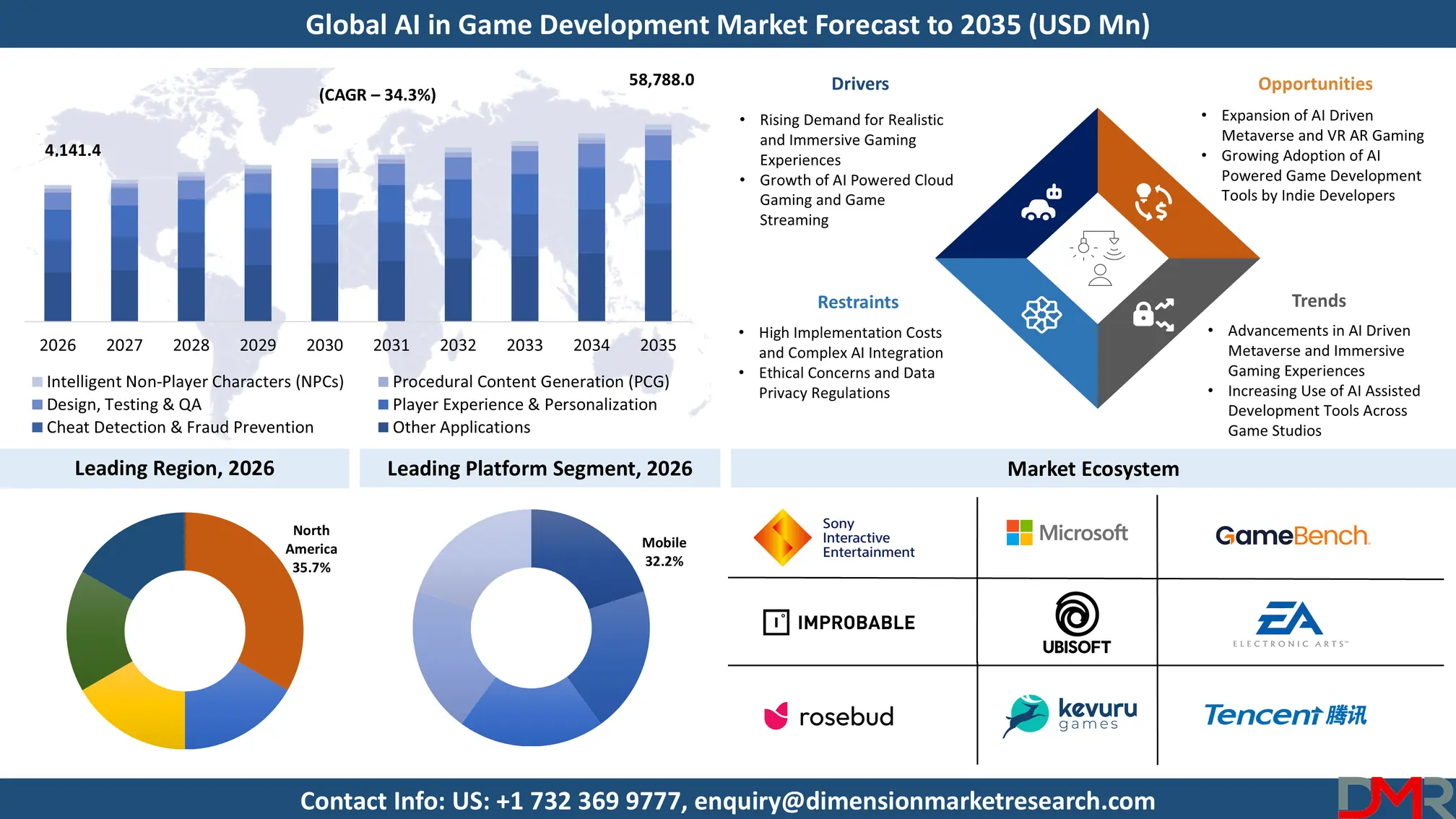
- Global AI in Game Development Market Size in 2026: USD 4,141.4 Million
- Global AI in Game Development Market Size in 2035: USD 58,788.0 Million
- Global CAGR from 2026 to 2035: 34.3%
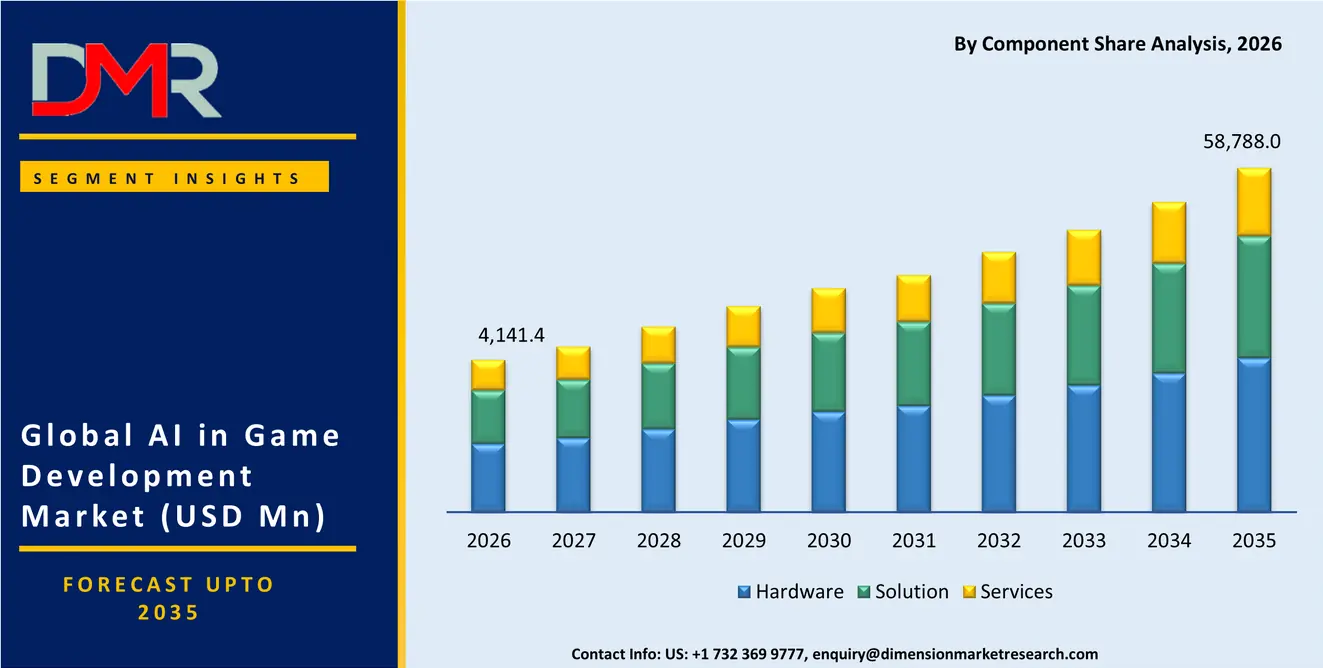
- Hardware is the leading Component segment in 2026: 46.4%
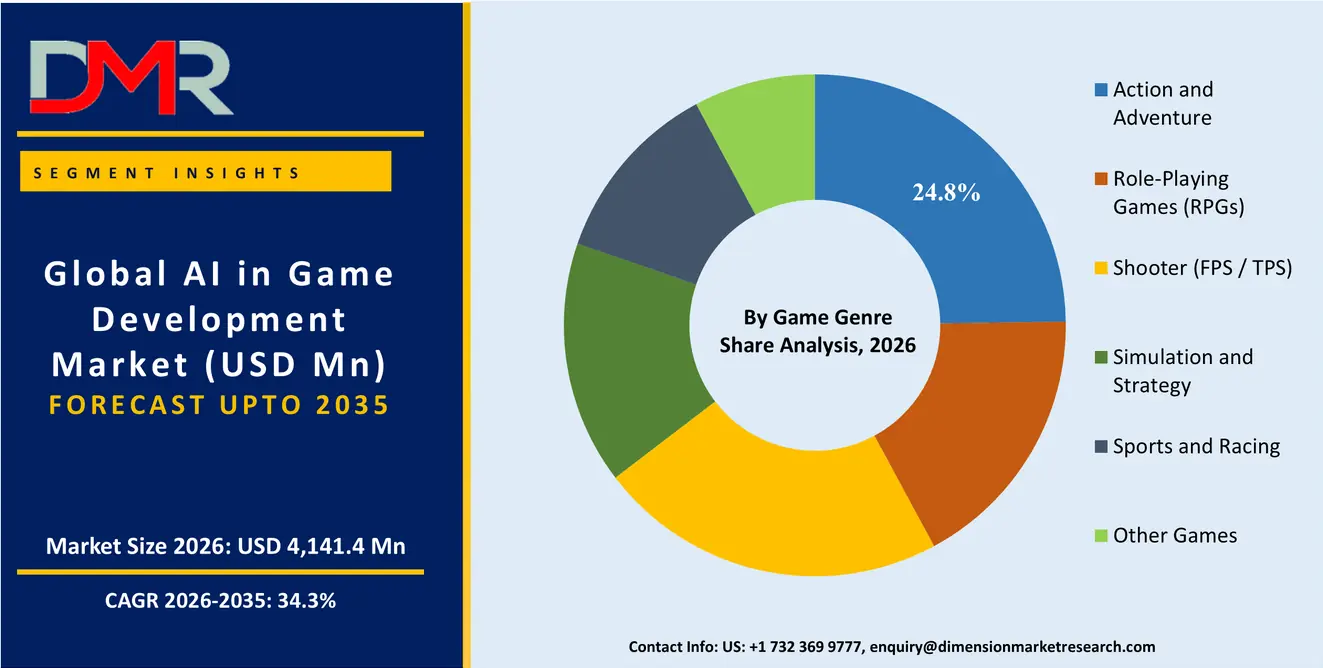
- Action and Adventure is the leading Game Genre segment in 2026: 24.8%
- Mobile is the leading Platform segment in 2026: 32.2%
- Intelligent Non-Player Characters is the leading Application segment in 2026: 28.0%
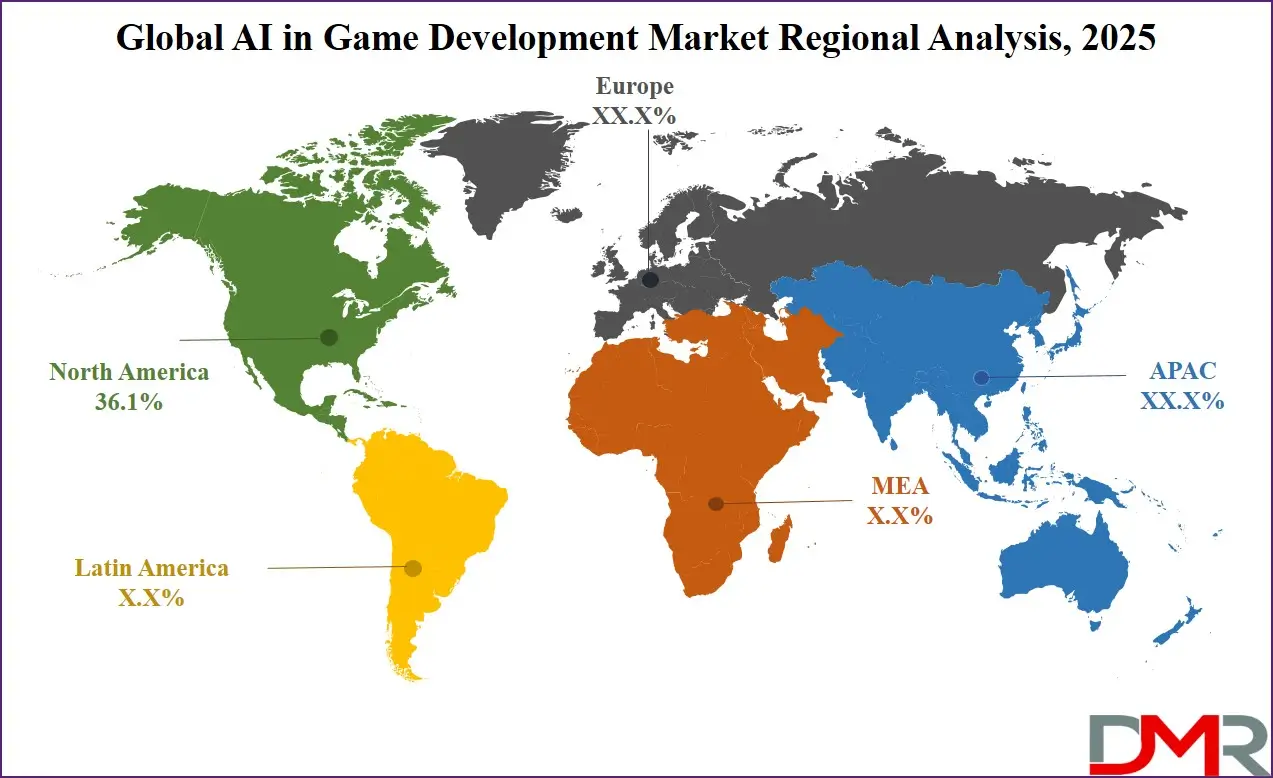
- North America is the leading Region in 2026: 35.7%
- Asia Pacific has the highest CAGR in 2026-2035: 38.1%
What is the Global AI in Game Development and its Market Size?
The Global AI in Game Development Market is estimated to be valued at USD 4,141.4 million in 2026 and is further anticipated to reach USD 58,788.0 million by 2035 at a CAGR of 34.3%.
ℹ
To learn more about this report –
Download Your Free Sample Report Here
The advent of AI technologies is changing the game development pipeline, highly influenced by the rising popularity of machine learning and deep learning, which speed up procedural content generation, realistic AI agent behaviors, text-to-speech and speech-to-text systems, automatic QA, and intelligent matchmaking, thus allowing studios to reduce iterations and offer personalized experiences. This trend is driven by higher penetration rates of the Internet and smartphones: today more than half of people in the world use the Internet. Among other trends, we can mention inference on devices for real-time games, cloud AI for running big models and live ops, synthetic data generation, generative assets for art and text, as well as advanced animation systems.
Use Cases
- AI-Driven Procedural Content Generation: Artificial intelligence can be used by game developers for the purpose of procedural content generation. The use of AI algorithms is helpful for creating large, dynamic worlds that can automatically be generated without manual effort through the use of Generative Adversarial Networks and procedural algorithms for landscapes, cities, dungeons, and missions in role-playing games.
- Smart NPCs and Adaptive Enemy AI: The artificial intelligence of the game helps to make the non-player characters intelligent and realistic through dynamic responses and reactions. AI helps enemies to learn about the player's movements to adapt themselves according to the player's movements and past experiences.
- AI-Powered Game Testing and Bug Detection: AI-based testing allows for automatic detection of bugs and glitches, as well as balancing problems at any moment. Through machine learning, the patterns of gameplay are analyzed, and possible problems are detected to minimize the need for testing by humans.
- Personalized Gaming Experiences: Machine learning can be used for personalization of the gameplay depending on how players behave during it. Through analyzing the in game actions, preferences, and skills of players, different difficulties can be offered.
Key Takeaways
- Market Value: The global AI in Game Development Market is projected to grow from USD 4,141.4 million in 2026 to USD 58,788.0 million by 2035, advancing at a strong 34.3% CAGR worldwide.
- By Component Segment Analysis: Hardware is projected to lead the component segment with 46.4% market share in 2026 and achieve the highest CAGR of 37.7%, driven by demand for GPUs, accelerators, and computing infrastructure.
- By Game Genre Segment Analysis: Action and adventure games are projected to dominate game genres with a 24.8% share in 2026, whereas simulation and strategy games are expected to record the highest CAGR of 43.0%.
- By Platform Segment Analysis: Mobile gaming is projected to lead platforms with 32.2% share in 2026, supported by broad accessibility and player reach. AR and VR are forecast to grow fastest at 44.1% CAGR.
- By Application Segment Analysis: Intelligent non player characters are projected to lead applications with a 28.0% share in 2026, while procedural content generation is expected to grow fastest, at a 40.8% CAGR through 2035.
- Technology Analysis: AI technologies are transforming game production through generative assets, adaptive NPC behavior, automated testing, localization, analytics, and cloud inference, enabling faster workflows, personalized gameplay, scalable live operations, and improved realism.
- Regional Analysis: North America is anticipated to lead the global market with 35.7% revenue share in 2026, while Asia Pacific is projected to record the highest regional CAGR of 38.1% through 2035.
How AI/Gen AI is Transforming the AI in Game Development Market?
AI and generative AI are revolutionizing the AI in game development market through automated generation of assets, dialogue, localization, testing, animations, and levels. Game developers can create prototypes of environments and characters quickly, produce variations more affordably, and create personalized experiences based on player signals. Machine learning enables better decision-making by non-player characters (NPCs), effective matchmaking, identification of fraud, balancing the challenge levels, and prediction of live operations, whereas generative algorithms enable dynamic storylines and dialogues. The cloud infrastructure helps in increasing the availability of models, and small game development studios can leverage APIs rather than developing proprietary solutions that are expensive. Nonetheless, developers need to manage issues related to hallucinations, copyright issues, biases, privacy threats, and poor quality of generated results.
Key Drivers in the Global AI in Game Development Market
Rising Demand for Realistic and Immersive Gaming Experiences
The modern gamer demands high standards of realism in graphics, character interaction, and physics within a game. This necessitates the use of advanced AI technology in order to meet such demands. Procedural animation enabled by AI brings about realism in character animations because the characters are able to interact dynamically with in game physics and the environment, and changes in the environment. Furthermore, through AI, behavior modeling can be achieved in NPCs to enable them to make decisions like a human and thus make the interactions more realistic.
Growth of AI-Powered Cloud Gaming and Game Streaming
The gaming platforms of Xbox Cloud Gaming (xCloud), NVIDIA GeForce Now, and PlayStation Plus cloud streaming services are employing artificial intelligence to optimize streaming performance, minimize latency, and automatically adjust the resolution of the games being streamed depending on the state of the network connection. Technologies of AI upscaling like DLSS by NVIDIA allow generating high-quality images at a low power of processing. The ability of AI to predict how to balance the load of servers is critical for ensuring that multiplayer games run seamlessly with minimum latency.
Restraints in the Global AI in Game Development Market
High Implementation Costs and Complex Integration
Designing AI-powered elements is associated with having specific expertise, high computational power, and large amounts of data training, which all come at an expense. Smaller studios that develop video games are unable to pay for AI-driven technologies such as procedural content generation, AI-based animation, and behavior of non-player characters in real time. In addition to this, integration of AI into popular game engines such as Unreal Engine or Unity is possible only by developing special tools, thus increasing the development cost and time.
Ethical Concerns and Data Privacy Regulations
Personalized and behaviorally driven usage of AI technology in gaming is raising ethical issues and problems associated with data privacy, especially in jurisdictions such as the U.S. and Europe where strict regulations such as CCPA and GDPR are enforced. AI-based technology uses and analyzes vast amounts of data collected from users in relation to their gameplay behavior, preferences, and decisions in order to personalize the gaming experience. However, questions about potential abuse of data, unauthorized tracking of players' behavior, and biases in AI algorithms have raised the question of ethics of AI in gaming. Increased regulatory pressure regarding data privacy is creating barriers for innovation through the need for transparency, encryption, and opt-in policies.
Growth Opportunities in the Global AI in Game Development Market
Expansion of AI-Driven Metaverse and VR/AR Gaming
AI-powered development tools are becoming increasingly integrated into modern game production workflows. Engine-native AI assistants, generative asset tools, conversational character technologies, procedural content generation systems, and automated testing platforms are helping developers accelerate prototyping and production. Cloud-based AI services and open-source models are also lowering technological barriers for smaller studios by providing access to advanced scripting, asset creation, localization, animation, NPC intelligence, and quality-assurance capabilities without requiring extensive proprietary AI infrastructure.
Growth of AI-Powered Game Development Tools for Indie Developers
The advent of new AI platforms such as generative AI coding, scripting, dialogue, and development assistants, NVIDIA Omniverse for collaboration, and Unity's AI-driven game development tools is helping to make it easier for smaller teams to enter the market. Using AI, developers will be able to automate asset creation, game testing, and generation of environments, making it possible for indie developers to create high-quality games. As access to AI technology becomes easier via cloud platforms and open source tools, indie game developers will be able to rival the big studios.
Trends in the Global AI in Game Development Market
Rise of Generative AI for NPC Dialogue and Character Interaction
Generative AI is increasingly being integrated into game development to create more responsive non-player characters, dynamic dialogue, contextual conversations, and adaptive character behavior. Developers are combining language models with speech recognition, text-to-speech, memory systems, and animation technologies to create characters capable of reacting naturally to player actions. AI character platforms are also enabling developers to build personalities and contextual knowledge into NPCs rather than relying entirely on predefined dialogue trees. This trend is supporting more immersive role-playing, simulation, adventure, and open-world gaming experiences while expanding opportunities for real-time narrative generation.
Growing Adoption of AI-Based Testing, Rendering, and Production Automation
Game studios are increasingly deploying AI across testing, quality assurance, animation, graphics optimization, and production workflows. AI-powered testing systems can simulate player behavior, identify bugs, assess game balance, and automate repetitive QA processes. At the same time, neural rendering, AI-assisted animation, upscaling, frame generation, and intelligent asset creation are helping developers improve visual quality while accelerating production. Integration of AI directly into game engines and development environments is further shifting AI from isolated experimental tools toward broader production pipelines covering design, development, testing, localization, optimization, and live operations.
Research Scope and Analysis
The market is segmented by component into hardware, solutions, and services; by genre into action and adventure, RPGs, shooters, simulation and strategy, sports and racing, and others; by platform into mobile, PC, console, AR and VR, and cloud gaming. Applications include NPCs, PCG, quality assurance, personalization, cheat and fraud prevention.
ℹ
To learn more about this report –
Download Your Free Sample Report Here
By Component Analysis
Hardware is estimated to take the lead in the components segment by holding the largest market share of 46.4% in 2026. This dominance is attributed to growing demand for GPUs, AI accelerators, high-end processors, servers, and other specialized hardware needed for developing gaming AI.
ℹ
To learn more about this report –
Download Your Free Sample Report Here
Further, hardware is estimated to witness the highest CAGR among the component categories, which stands at 37.7% in 2026-2035. With ongoing investments in the area of generative AI, real-time rendering, intelligent characters, and advanced gaming development software environments, adoption of hardware can be strengthened.
By Game Genre Analysis
It is estimated that action and adventure games will lead the game genre category in 2026 and capture the highest market share of 24.8%. This leadership is going to be driven by the large audience base of such games and the wide application of artificial intelligence for the purpose of defining enemy behavior, companion intelligence, storylines, navigation, and open worlds. It is also expected that simulation and strategy games will witness the highest CAGR of 43.0% during the forecast period of 2026–2035.
By Platform Analysis
The mobile platform is forecasted to be dominant in terms of platform segment in 2026 with the highest market share of 32.2%. Its dominance is attributed to factors such as a huge user base on mobile, availability of distribution channels, high frequency of release, and increasing use of AI-based personalization, monetization, content creation, and live operations. The highest CAGR in terms of platform segment is forecasted to be of the AR/VR segment, which is forecasted to be 44.1% from 2026 to 2035. This would be possible due to the use of AI for various tasks related to the AR/VR technology.
By Application Analysis
The Intelligent non-player characters are predicted to dominate the applications sector in 2026, with the highest market share of 28.0%. The prediction of the dominance of intelligent non-player characters comes about because of the increasing use of AI to create lifelike behavior in characters, adaptive dialogue, strategic thinking, and interactions with the players. However, the application that is predicted to grow at the fastest pace is procedural content generation with a CAGR of 40.8% between 2026 and 2035.
The Global AI in Game Development Market Report is segmented based on the following:
By Component
- Hardware
- Solution
- Services
By Game Genre
- Action and Adventure
- Role-Playing Games (RPGs)
- Shooter (FPS/TPS)
- Simulation and Strategy
- Sports and Racing
- Other Games
By Platform
- Mobile
- PC
- Console
- AR/VR
- Cloud and Streaming Gaming
By Application
- Intelligent Non-Player Characters (NPCs)
- Procedural Content Generation (PCG)
- Design, Testing & QA
- Player Experience & Personalization
- Cheat Detection & Fraud Prevention
- Other Applications
Regional Analysis
North America is the Leading Region in the Global AI in Game Development Market
North America is poised to lead the AI in game development market, as it is expected to hold 35.7% of revenue share globally in 2026. Its leading position results from a developed technology environment, a highly advanced gaming sector, a highly developed cloud infrastructure, significant amounts of research on AI, and available venture capital funds. The USA and Canada house major game developers, publishers, platforms, and semiconductor companies working on AI-based game design, intelligent NPCs, analytics, automated testing, and personalized gaming experiences for players. Increasing adoption of cloud gaming platforms fueled by developing 5G infrastructure in the region further facilitates implementation of AI technologies.
ℹ
To learn more about this report –
Download Your Free Sample Report Here
Asia-Pacific is the Fastest-Growing Region in the Global AI in Game Development Market
It is expected that the Asia Pacific region will show the highest CAGR of 38.1% during the forecast period in the AI in game development market, as it is poised to have 24.5% of the global revenue share in 2026. This includes China, Japan, South Korea, India, Australia and New Zealand, ASEAN, and the rest of Asia Pacific, backed up by the gaming population, usage of mobile devices, 5G technology, cloud services, and increasing demands for AI-based personalized experiences, adaptive levels, auto-content generation, and intelligent NPCs. Mobile gaming, which rules the APAC gaming industry, is highly supportive of using AI technology.
The Europe AI in Game Development Market
Europe AI in Game Development Market is expected to hold a value of USD 1,193.0 million in 2026, and it is further projected to witness a rise to USD 17,934.6 million in 2035, growing at a CAGR of 35.1%. In 2026, Europe will contribute to 28.8% of global market revenue. The Europe region is well supported by its digital infrastructure, high household broadband connection, and digitally literate population. As a result of the wide adoption of the internet, European game development companies have access to an extensive and well-connected community, which is perfect for developing interactive and AI-driven live services.
Middle East and Africa AI in Game Development Market
Growth can be aided by growing mobile gamer populations, better connections, regional developer communities, and the need for localization. Lack of financing, uneven cloud computing facilities, and the lack of AI experts can limit its use, but available software and partnerships provide genuine possibilities for the studios in the region. The collaboration allows partnerships between universities, research centers, and private studios, allowing technology to be put to use in practical applications such as procedural environments, NPC behavior, and real-time language processing.
Major Countries Analysis
United States AI in Game Development Market
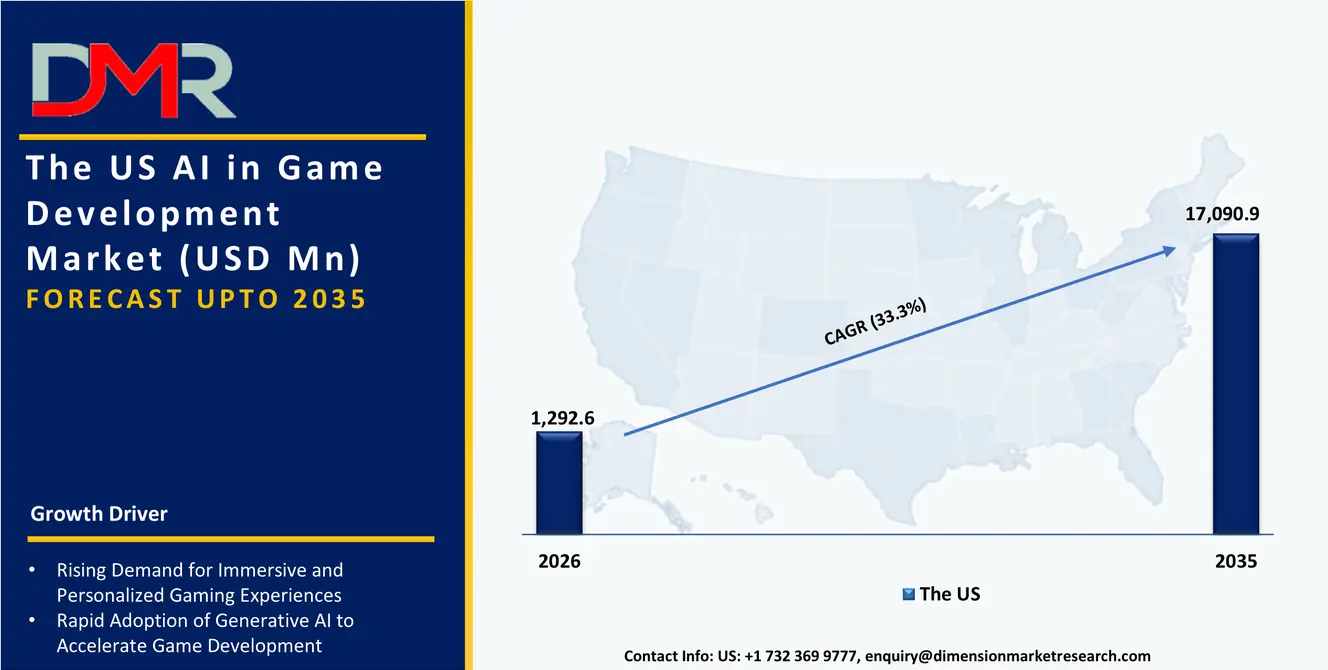
The U.S. AI in Game Development Market is projected to be valued at USD 1,292.6 million in 2026. It is expected to reach USD 17,090.9 million by 2035 at a CAGR of 33.2%. The market in the United States is supported by its high density of game developers, robust cloud computing capabilities, and its digitally active populace. The employment opportunities in computer and information technology jobs keep growing, thereby providing the professionals needed for integrating AI into games.
ℹ
To learn more about this report –
Download Your Free Sample Report Here
Japan AI in Game Development Market
The Japan AI in Game Development Market is projected to be valued at approximately USD 165.4 million in 2026. It is expected to reach USD 2,963.5 million by 2035 at a CAGR of 37.8%. The gaming industry in Japan has rich cultural IPs, world-renowned franchises, and a well-developed market of consoles and smartphones, making it ideal for AI technology integration. The country's high internet penetration rate and almost all-inclusive use of smartphones guarantee easy access to AI-supported functions. Major cities, such as Tokyo and Osaka, house IT professionals and gamers, forming innovation hubs.
Saudi Arabia AI in Game Development Market
The Saudi Arabia AI in Game Development Market is projected to reach USD 65.4 million in 2026 and is expected to increase to USD 618.1 million by 2035, expanding at a CAGR of 28.3% during 2026–2035. Growth is supported by government investment in gaming and digital technologies, expansion of esports, increasing development of local gaming capabilities, and the Kingdom's broader ambitions under Vision 2030 and the National Gaming and Esports Strategy.
Game developers in Saudi Arabia are increasingly exploring AI across Arabic-language localization, procedural content generation, intelligent NPCs, player analytics, automated testing, personalization, and live operations. Expansion of cloud infrastructure, training programs, international partnerships, and investment in game development ecosystems is expected to support adoption, although shortages of specialized talent, high development costs, cultural adaptation requirements, and dependence on external technology providers remain challenges.
Technology Analysis
Artificial intelligence applications in games are moving away from discrete tools towards comprehensive production pipelines that cover concept creation, asset creation, animation, testing, localization, analytics, and live ops. Generative models help in the fast production of content, reinforcement learning and behavioral models optimize the decision-making of non-player characters and adaptive difficulty, cloud inference helps make models available, and edge optimizations enable low-latency mobile/console experiences. The areas of opportunity are controllable models, engine-native solutions, multi-language voice systems, synthetic data, and automated QA. Areas of risk are inconsistent output, intellectual property issues, high computing costs, cybersecurity concerns, and poor explainability.
Investment and White Space Analysis
Funding will continue to focus on middleware for AI, conversational agents, test automation, generative asset pipeline tools, and cloud computing for game developers. Major publishing houses can design proprietary platforms, while independent studios open up new markets through subscription services, pay-per-use API, licensing data sets, and plug-and-play engines. Regional opportunities are best where mobile gaming is growing, and there is an expanding demand for localization and a developer base, especially in Asia-Pacific and other emerging markets. Investors need to look at consumer retention, model economics, rights management, workflow optimization, and platform reliance. Unresolved regulatory issues, commodity models, and fast technological developments could lead to reduced margins.
By Region
North America
Europe
- Germany
- France
- The U.K.
- Italy
- Spain
- Rest of Europe
Asia-Pacific
- China
- Japan
- India
- Australia
- South Korea
- Rest of APAC
Latin America
- Mexico
- Brazil
- Rest of LATAM
Middle East & Africa
- Saudi Arabia
- The UAE
- South Africa
- Rest of MEA
Competitive Landscape
There is high competition in the game development sector within the AI space, comprising cloud and semiconductor companies, game engine providers, game publishers, specialist middleware providers, and AI-focused startups. Cloud and computing infrastructure services are provided by Microsoft, Google, Amazon, IBM, and NVIDIA. Meanwhile, Unity and Epic Games offer AI capabilities within the game-development workflow, while game publishers such as Tencent, Sony, Ubisoft, Electronic Arts, among others, utilize AI technology for purposes of content creation, NPC behavior, testing, anti-fraud measures, personalization, and live operations. The specialist middleware companies focus on conversational characters, quality assurance automation, animations, procedural generation, and production services.
Some of the prominent players in the Global AI in Game Development Market are:
- Microsoft Corporation
- NVIDIA Corporation
- Unity Technologies
- Epic Games, Inc.
- Google LLC
- Amazon Web Services
- Tencent Holdings Limited
- Sony Interactive Entertainment
- Ubisoft Entertainment S.A.
- Electronic Arts Inc.
- Roblox Corporation
- NetEase, Inc.
- KRAFTON, Inc.
- NCSOFT Corporation
- Capcom Co., Ltd.
- Square Enix Holdings Co., Ltd.
- Bandai Namco Entertainment Inc.
- Inworld AI
- Modl.ai
- Scenario
- Promethean AI
- Convai
- Charisma Entertainment
- Rosebud AI
- Altered AI
- Didimo
- Improbable
- Adobe Inc.
- Intel Corporation
- Advanced Micro Devices, Inc.
- Qualcomm Incorporated
- Other Key Players
Recent Developments
- In May 2026, Unity launched its AI tools in open beta for developers using Unity 6.0 or later. The suite includes an in-editor AI Assistant, agent-based workflows, AI generators, an MCP Server, and an AI Gateway, supporting faster prototyping, asset creation, development assistance, and production automation within the Unity environment.
- In March 2025, Scopely announced an agreement to acquire Niantic’s games business for USD 3.5 billion, including Pokémon GO, Pikmin Bloom, Monster Hunter Now, and related gaming applications and services. The acquisition expanded Scopely’s mobile and location-based gaming portfolio while bringing Niantic’s game development teams and major gaming franchises under its operations.
- In February 2025, NVIDIA expanded its ACE ecosystem for game development with its In Game Inferencing technology, enabling developers to integrate generative AI models directly into games. The technology supports AI-driven character perception, reasoning, memory, speech, animation, and autonomous behavior, strengthening the development of more interactive and responsive in game characters.
Report Details
| Report Characteristics |
| Market Size (2026) |
USD 4,141.4 Mn |
| Forecast Value (2035) |
USD 58,788.0 Mn |
| CAGR (2026–2035) |
34.3% |
| The US Market Size (2026) |
USD 1,292.6 Mn |
| Historical Data |
2021 – 2025 |
| Forecast Data |
2027 – 2035 |
| Base Year |
2025 |
| Estimate Year |
2026 |
| Segments Covered |
By Component, By Game Genre, By Platform, and By Application |
| Regional Coverage |
North America – The US and Canada; Europe – Germany, France, The UK, Italy, Spain, Rest of Europe; Asia-Pacific – China, Japan, India, Australia, South Korea, Rest of APAC; Latin America – Mexico, Brazil, Colombia, Argentina, Rest of LATAM; Middle East & Africa – Saudi Arabia, The UAE, South Africa, Rest of MEA |
Frequently Asked Questions
How big is the AI in Game Development Market?
▾ The global AI in Game Development Market is projected at USD 4,141.4 million in 2026 and is expected to reach USD 58,788.0 million by 2035, reflecting strong adoption across gaming development workflows worldwide.
What is the CAGR of the AI in Game Development Market from 2026 to 2035?
▾ From 2026 to 2035, the global AI in Game Development Market is forecast to expand at a 34.3% CAGR, driven by broader use of intelligent automation, content generation, and immersive gaming technologies globally.
What factors are driving the growth of the AI in Game Development Market?
▾ Market growth is driven by demand for realistic, adaptive gameplay; generative content; intelligent NPCs; automated testing; cloud gaming; mobile adoption; localization; and the need to reduce development time and improve production efficiency globally.
What are the major trends in the AI in Game Development Market?
▾ Major trends include generative assets and dialogue, AI-assisted development workflows, on-device inference, cloud AI, intelligent NPCs, automated quality assurance, real-time personalization, AI-powered localization, and neural rendering for improved visual realism in modern games.
Which region held the largest share of the AI in Game Development Market in 2026?
▾ North America is projected to hold the largest regional share of the AI in Game Development Market in 2026, representing 35.7% and a market value of USD 1,478.4 million, supported by gaming infrastructure.
Which region is expected to grow the fastest in the AI in Game Development Market?
▾ Asia-Pacific is expected to be the fastest-growing regional market, registering a forecast CAGR of 38.1% from 2026 to 2035. Growth will be supported by expanding game studios, mobile gaming, and AI investments further.
Who are the key players in the AI in Game Development Market?
▾ Key participants include Microsoft, Google, Amazon, IBM, NVIDIA, Unity Technologies, Epic Games, Tencent, Sony Interactive Entertainment, Ubisoft, Electronic Arts, Baidu, Inworld AI, Modl.AI, and other specialized AI gaming technology vendors worldwide, increasingly active.
How is the AI in Game Development Market segmented?
▾ The market is segmented by component, game genre, platform, application, and region. These categories assess AI infrastructure, gaming formats, delivery environments, development use cases, and geographic opportunities across the global industry for stakeholders.