Market Overview
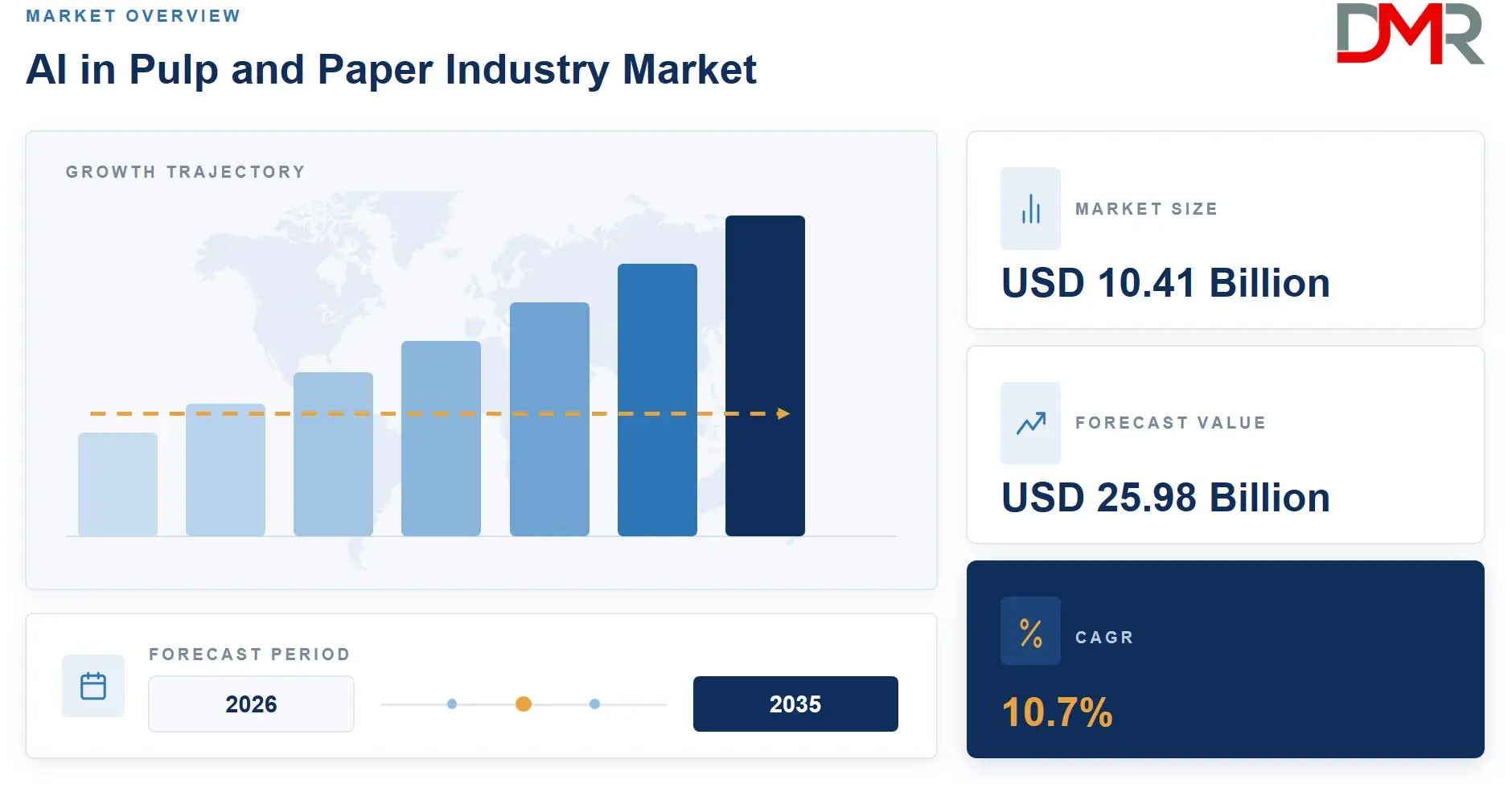
The Global AI in Pulp and Paper Industry Market size is estimated at USD 10.41 Billion in 2026, and is projected to reach USD 25.98 Billion by 2035, exhibiting a CAGR of 10.7% during the forecast period.
Pulp and paper manufacturers operate in one of the world's most energy-intensive industrial segments, where input cost volatility and tightening emissions standards create structural pressure to deploy intelligent automation. The sector's adoption trajectory reflects a broader shift: as reported by a 2025 Rootstock survey, 77% of manufacturers adopted AI in 2024, up from 70% in 2023, with production operations identified as the most common deployment area. This surge in factory-floor AI uptake directly benefits the pulp and paper segment, where process complexity creates high returns on machine learning investments.
Valmet AI optimization reduced steam consumption in evaporation by 3–8% and lime kiln energy consumption by 4–8%, according to IPPTA-published findings. Numbers at this scale, sustained across continuous production cycles, shift AI from a cost center to a direct margin driver. The forecast assumes sustained capital allocation toward energy and yield optimization modules through 2035. AI in Manufacturing and Industrial Automation and Industrial Automation form the adjacent technology layers from which this market draws both tooling and talent.
The market covers AI software, hardware, and services deployed across pulp production, papermaking, packaging conversion, and integrated mill operations. Adjacent markets such as general industrial automation and process control systems are excluded. The pulp and paper sector's position as one of the world's top five industrial energy consumers makes AI-driven energy attribution and steam recovery a financial imperative, not a discretionary upgrade.
ℹ
To learn more about this report –
Download Your Free Sample Report Here
Key Takeaways
- The market size is USD 10.41 Billion in 2026, and is projected to hit USD 25.98 Billion by 2035 at a CAGR of 10.7%.
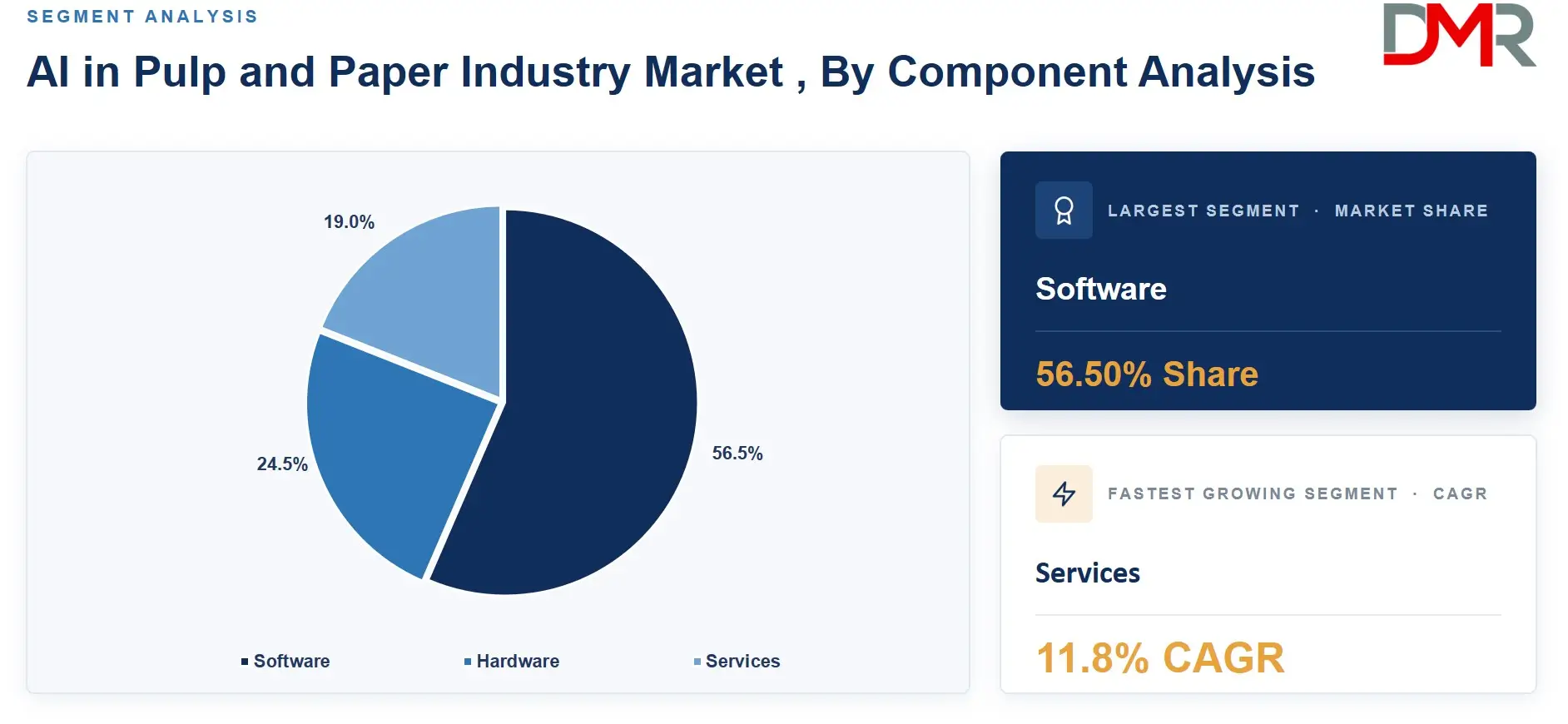
- By Component: Software led as the largest category with a 56.50% share in 2025.
- By Application: Process Optimization led as the largest category with a 40.90% share in 2025.
- By End User: Paper Manufacturers led as the largest category with a 50.60% share in 2025.
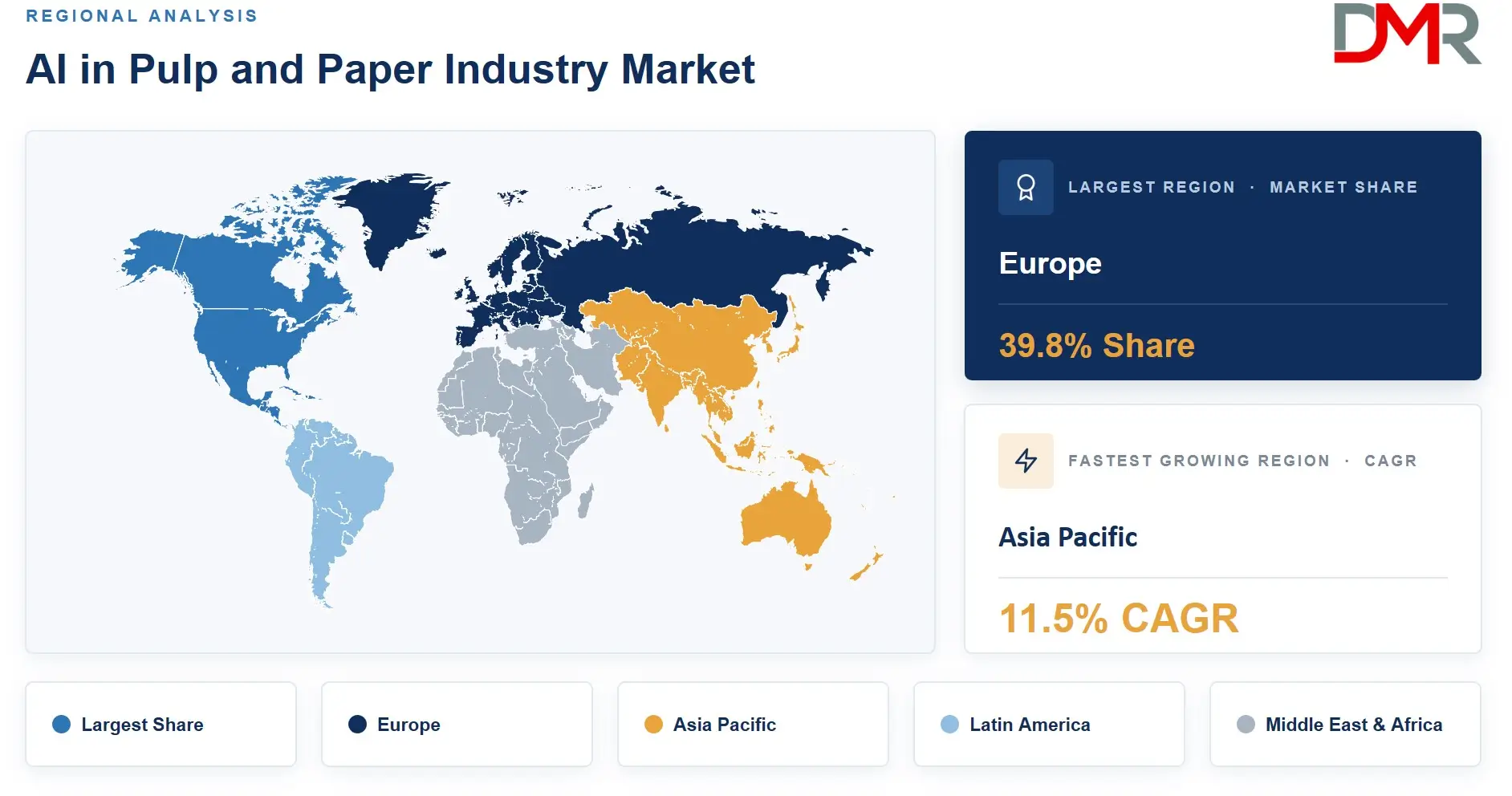
- By Region: Europe led with a 39.8% share in 2025.
- Top 5 key players: ABB Ltd., Valmet Corporation, Siemens AG, Honeywell International Inc., Andritz AG.
Component Analysis
Software led the Component segment with a 56.50% share in 2025.
Software commands the dominant share because mill operators buy AI capability primarily through process optimization platforms, quality control algorithms, and predictive analytics suites rather than through proprietary hardware. The 56.50% share reflects how vendor business models have shifted toward SaaS and subscription licensing, making software the fastest route to measurable returns on AI investment. Valmet AI optimization delivered +2–6% liquor throughput in the recovery boiler and +4–10% CaO production in the lime kiln, as reported by IPPTA, demonstrating the scale of gains software-layer deployments now routinely produce.
Hardware retains a necessary role as the sensor and edge-computing layer that feeds AI models with real-time process data. Services represent the fastest-growing component category, driven by the complexity of model calibration, system integration, and ongoing retraining requirements across diverse mill environments. Buyers in emerging markets particularly depend on services providers to bridge workforce digital literacy gaps that would otherwise stall deployment. Predictive Maintenance Automation sits at the intersection of hardware and services, where sensor networks feed AI models that require continuous tuning by specialist teams.
ℹ
To learn more about this report –
Download Your Free Sample Report Here
Application Analysis
Process Optimization accounted for 40.90% of Application demand in 2025, the highest of any category.
Process optimization commands the largest application share because yield and throughput losses in continuous-process manufacturing compound directly into margin erosion at scale. AI applications in Indian pulp and paper production improved product quality by 10% to 40% depending on defect type, as reported by IPPTA. AI-based automated quality control achieved defect detection accuracy of up to 95% and enabled a 10% to 30% reduction in defective products, confirming that process intelligence investments generate measurable, auditable gains that justify capital allocation.
Quality Control represents the second largest application category, supported by machine vision deployments across sheet inspection and coating lines. Predictive Maintenance is the fastest-growing application, propelled by aging mill infrastructure in North America and Europe where asset replacement costs are prohibitive. A paper manufacturer using AI-powered vibration analysis on dryers and cylinders reduced unplanned downtime by 25% and improved energy efficiency by 8%, as reported by MIPU. AI demand-forecasting programs cut mill-finished-goods inventory by approximately 18% while holding service levels above 97% and lowering per-metric-ton transportation cost by approximately 12%, as reported by ISM World, establishing Supply Chain Management as an application category with rapidly building commercial traction.
AI demand-forecasting also reduced forecast error by approximately 28% at the four-week horizon and cut system-wide safety stock by approximately 19% without loss of on-shelf availability, as reported by ISM World. Energy Management and other niche applications round out a portfolio where every sub-category now has a documented performance case rather than a theoretical one.
End User Analysis
With a 50.60% share in 2025, Paper Manufacturers outpaced all other End User categories.
Paper manufacturers hold the majority end-user share because continuous high-speed paper machines generate volumes of real-time process data that create immediate AI training advantages. Consistent grammage, moisture profiles, and formation uniformity are commercial contract requirements, so even marginal AI-driven quality improvements translate directly into customer retention and premium pricing power. Pulp producers represent the second-largest end-user group, deploying AI heavily in kraft chemical recovery circuits and digester control.
Packaging manufacturers are the fastest-growing end-user segment, pulled by e-commerce-driven containerboard demand that requires AI-optimized fiber blending at higher throughput rates. Integrated pulp and paper mills occupy a strategically advantageous position: their cross-process data environments support enterprise-wide AI deployments that siloed single-process operators cannot replicate. The Others category captures tissue, specialty, and functional paper producers, where defect costs per roll are disproportionately high and AI-based quality control paybacks are correspondingly faster.
Key Market Segments
By Component
- Software
- Hardware
- Services
By Application
- Process Optimization
- Quality Control
- Predictive Maintenance
- Supply Chain Management
- Energy Management
- Others
By End User
- Paper Manufacturers
- Pulp Producers
- Packaging Manufacturers
- Integrated Pulp and Paper Mills
- Others
Regional Analysis
Europe led the regional segment with a 39.8% share in 2025, reflecting the continent's early regulatory mandate for real-time emissions intelligence across mill operations.
Europe
European mills operate under the EU Industrial Emissions Directive and country-level carbon pricing schemes that make AI-assisted process control a compliance necessity rather than a competitive option. The region's high concentration of integrated kraft and chemical pulp producers creates large-scale data environments where AI optimization models achieve faster convergence. Scandinavia, Germany, and Finland anchor the regional market through both production volume and technology vendor headquarters, giving Europe a structural first-mover advantage in enterprise AI deployment for pulp and paper.
Asia Pacific
Asia Pacific is the fastest-growing regional market, driven by new greenfield capacity additions in China, India, and Southeast Asia. New mills commission without legacy OT infrastructure, removing the interoperability barriers that slow retrofit AI deployments in older Western facilities. India's pulp and paper sector, with documented AI-driven quality gains of up to 40% on specific defect types, signals that mid-sized Asian operators are moving past pilot programs into scaled deployments. Southeast Asian kraft pulp expansions present a particularly concentrated opportunity for chemical recovery circuit AI modules.
ℹ
To learn more about this report –
Download Your Free Sample Report Here
North America
North American mills carry the oldest average asset base among major producing regions, making predictive maintenance AI the dominant application category. Capital replacement costs for continuous digesters, recovery boilers, and paper machines are prohibitive at current interest rate levels, so operators extend asset life through AI-driven condition monitoring instead. The US market benefits from a mature IT-OT integration services ecosystem that accelerates AI deployment timelines relative to emerging market counterparts.
Latin America
Latin America, anchored by Brazil's large eucalyptus pulp industry, is an emerging market for AI deployment. Brazilian producers export heavily to European and Asian buyers who increasingly impose sustainability and traceability requirements, creating a demand-side pull for AI-assisted carbon accounting and yield documentation at the mill level.
Middle East and Africa
The Middle East and Africa market remains early-stage, with AI adoption concentrated in a small number of large integrated facilities. Gulf Cooperation Council packaging investments tied to petrochemical diversification strategies represent the most likely near-term entry point for AI vendors targeting this region.
Key Regions and Countries
North America
Europe
- Germany
- France
- The UK
- Spain
- Italy
- Rest of Europe
Asia Pacific
- China
- Japan
- South Korea
- India
- Australia
- Rest of APAC
Latin America
- Brazil
- Mexico
- Rest of Latin America
Middle East & Africa
- GCC
- South Africa
- Rest of MEA
Macroeconomic Impact
Wood fiber and chemical input costs remain the primary margin variable for pulp and paper operators globally, and both categories are exposed to currency and commodity cycles that AI process controls help absorb. Valmet AI optimization achieved –7–15% chemical use reductions in bleaching, alongside 2–5% evaporation steam savings and 5–15% washing loss reductions, as reported by IPPTA. These operating cost shields become structurally more valuable during inflationary input cycles, making AI investment counter-cyclical from a financial management standpoint.
Rising energy prices across Europe and Asia accelerate AI adoption by improving the payback calculation on energy management modules. Currency depreciation in key emerging market producing countries, particularly Brazil and India, compresses margins on export-priced fiber and forces productivity-led responses rather than price-led ones. Trade policy volatility in recovered paper and packaging board categories adds a supply chain forecasting premium to AI platforms with demand intelligence capabilities.
Market Dynamics
Driver: Input Cost Pressure and Emissions Standards Mandate AI-Driven Process Control
Wood fiber and chemical input cost volatility gives AI-driven process optimization a direct financial mandate at the mill level. At Seshasayee Paper and Boards Limited (SPB) Unit Erode, AI-driven bleaching control raised production from 443 TPD to 453.5 TPD while holding final brightness essentially constant, as reported by IPPTA. Valmet mill-wide AI optimization reported a +2–4% production increase in washing through debottlenecking and a +3% increase in bleaching capacity, confirming that yield gains of this magnitude are reproducible across different mill configurations.
Tightening EU, North American, and Indian effluent and emissions compliance standards force real-time process intelligence deployments that manual monitoring cannot replicate. In January 2025, Schneider Electric SE unveiled a specialized AI-driven platform built directly for the pulp and paper sector, designed to identify energy inefficiencies and reduce carbon footprints at the mill level. Valmet AI optimization also reduced residual carbonate variability in the lime kiln by 20–40% and improved green liquor stability in the recovery boiler by 30–60%, as reported by IPPTA, illustrating how emissions-related chemical control precision has become a core AI deliverable.
A mid-sized pulp mill that deployed IIoT sensors and an AI predictive model cut unplanned downtime by 18% and energy use by 7% within six months, as reported by Pulp and Paper Technology. Aging North American and European mill infrastructure makes predictive maintenance AI an asset-life extension strategy, removing the need for full capital replacement at current high interest rate levels.
Restraint: OT-IT Segregation and Workforce Literacy Gaps Slow AI Deployment
Legacy mill environments maintain hard operational technology and information technology separations that were originally designed for safety and uptime stability. These architectural divides prevent AI model training pipelines from accessing the continuous process data they require, effectively locking optimization potential inside systems that cannot communicate with machine learning platforms. An AI/IIoT predictive-maintenance deployment reduced unintentional stoppages by 15% in a pulp mill test environment, as reported by Pulp and Paper Technology, but achieving this outcome required custom integration work that many smaller operators cannot fund independently.
Workforce digital literacy gaps among frontline operators in emerging market production hubs slow human-in-the-loop AI systems that require operator validation to act on model outputs. Mills in South and Southeast Asia face a compound challenge: new greenfield capacity is being commissioned while experienced process engineers who understand both the chemistry and the AI tooling remain scarce. Vendors who embed AI within familiar control system interfaces reduce this friction, but the gap between deployment capability and workforce readiness remains the primary non-technical barrier to market expansion.
Opportunity: Non-Wood Fiber, Specialty Grades, and Chemical Recovery Circuit Intelligence
AI-powered pulp yield optimization for non-wood fiber inputs including bamboo, kenaf, and agricultural residue targets a segment where process parameters remain poorly standardized, creating a high-value first-mover advantage for vendors who build proprietary training datasets. Valmet AI bleaching optimization reduced final brightness variability by 20–40% and improved black liquor stability in evaporation by 30–60%, as reported by IPPTA, establishing performance benchmarks that can be adapted to non-wood fiber chemistries where variability challenges are even greater.
At SPB Unit Erode, AI bleaching control reduced total chlorine dioxide use from 17.47 to 15.84 kg/ton, a reduction of approximately 9.3%, and total caustic from 14.05 to 12.66 kg/ton, approximately 9.9%, as reported by IPPTA. Chemical recovery circuit intelligence platforms for kraft pulping operations in Southeast Asia, where new greenfield capacity is being commissioned without legacy system constraints, represent an entry-point that allows vendors to build integrated relationships before competitors establish default positions. AI deployment in that context also produced approximately 11% less trim waste and reduced disruption recovery time from approximately 47 minutes to under 90 seconds, as reported by ISM World, confirming that AI operational benefits extend well beyond chemical optimization. Sustainable Construction Materials intersects this opportunity through fiber-based packaging substrates that require AI-verified quality certification before brand-owner acceptance.
Porter's Five Forces
The competitive structure of the AI in pulp and paper market reflects a high-barrier, moderately concentrated environment where entry difficulty and supplier concentration reinforce the position of established vendors. New entrants face steep data moat requirements: AI models trained on real continuous-process mill data take years to build, and established players like ABB, Valmet, and Honeywell have accumulated proprietary datasets across hundreds of mill deployments that challengers cannot replicate quickly. Supplier bargaining power is elevated among the handful of industrial AI platform providers and semiconductor manufacturers who supply the edge compute hardware that underpins real-time process control. Buyer bargaining power is constrained by switching costs once AI systems are embedded into distributed control system layers, though large integrated mill operators with multi-site estates retain pricing leverage through volume negotiations. Substitute threats from non-AI process control alternatives remain low, as conventional advanced process control systems cannot match AI in handling the multi-variable, non-linear interactions characteristic of kraft and bleaching circuits. Competitive rivalry centers on outcome-based contracting, integration depth, and the ability to demonstrate ROI within a single production cycle, which compresses differentiation windows and pushes vendors toward vertically specialized product development. An ANDRITZ Metris-optimized mill achieved 97% autonomous operation versus an industry norm of 60–65% and boosted productivity by 18%, as reported by ANDRITZ, setting a performance benchmark that competitors must now match or explain their shortfall.
AI and Gen AI Impact
AI reshapes the pulp and paper value chain most profoundly at the process control and quality assurance layers, where model inference cycles now operate faster than human reaction times allow. Mills using digital-twin process modeling cut maintenance outlays by 20% and raised production rates by 15% on average, as reported by Pulp and Paper Technology, establishing the digital twin as the primary AI infrastructure layer in modern mill optimization. In August 2026, ABB introduced its "industrial knowledge vault" implementation, which uses AI to capture, structure, and contextualize specialized domain knowledge from retiring operators, directly addressing the institutional knowledge loss that threatens production continuity as mill workforces age.
Generative AI adds a layer above process control AI by enabling mill engineers to query operational data in natural language, generate scenario plans for process parameter adjustments, and produce compliance documentation automatically from sensor logs. Early movers who build gen AI interfaces onto existing process data historians gain a knowledge acceleration advantage. Laggards who delay face compounding disadvantage as the gap between AI-assisted and manually operated mills widens on every production efficiency metric.
Market Trends
Digital Twins and Lightweighting Mandates Drive Process Intelligence Adoption
Digital-twin deployment across continuous digester and bleaching circuits enables real-time scenario modeling that was previously confined to offline engineering studies. Digital-twin process modeling reduced heat loss by 5% and cut NOx emissions by more than 10%, as reported by Pulp and Paper Technology, making emissions compliance a deployable operational outcome rather than a capital project. AI quality control cut rejections by 5%, as per Pulp and Paper Technology, a gain that compounds across high-speed paper machine runs. In March 2025, Voith Group launched MillOne, a digital platform aggregating operational data and using AI to increase productivity, automate workflows, and reduce machine downtime, giving physical form to the autonomous mill concept. FMCG brand owners' packaging substrate lightweighting mandates push AI-assisted fiber furnish reformulation into containerboard and folding boxboard lines as a commercial prerequisite. Digital Twin technology anchors the trend by creating the simulation environment where AI optimization models are validated before live deployment.
Market Competition Overview
The AI in pulp and paper market is moderately concentrated, with a tier of established industrial automation and process control vendors holding dominant share by virtue of long-standing mill relationships, proprietary integration frameworks, and accumulated process data assets. Leaders compete on depth of process knowledge rather than on AI technology alone, bundling optimization software with hardware commissioning and long-term services contracts that create durable switching barriers. In June 2025, Fedrigoni Group partnered with Palantir Technologies to combine operational data with enterprise AI capabilities, signaling that paper producers are now building direct AI relationships with software vendors outside the traditional automation supplier ecosystem, a structural shift that challenges incumbent bundled-service business models.
An ANDRITZ Metris-optimized mill achieved 97% autonomous operation versus an industry norm of 60–65% while boosting productivity by 18%, as reported by ANDRITZ, establishing a performance benchmark that forces competitors to demonstrate comparable autonomy levels or cede share in high-value integrated mill accounts. Challengers differentiate through niche application specialization, particularly in predictive quality control for specialty paper grades and non-wood fiber process optimization, where the largest vendors have thinner proprietary datasets.
Challengers differentiate through niche application specialization, particularly in predictive quality control for specialty paper grades and non-wood fiber process optimization, where the largest vendors have thinner proprietary datasets. New entrants backed by industrial AI platform funding are targeting the mid-market mill segment in Asia, where greenfield deployments allow clean-sheet integration architectures that bypass the OT-IT segregation problems constraining retrofit opportunities in Western facilities.
Pricing Analysis
AI solution pricing in the pulp and paper sector follows a tiered structure: software-as-a-service subscription models for cloud-connected optimization modules, outcome-based contracts for full-process AI deployments, and time-and-materials fee structures for integration and retraining services. Larger integrated mills negotiate volume and multi-site licensing discounts that challengers offering point solutions cannot match. AI chemical-dosing management reduced chemical use by 8% and supply-chain optimization delivered 12% faster delivery times, as reported by Pulp and Paper Technology, creating a directly quantifiable cost offset that vendors use to anchor outcome-based pricing negotiations.
Price pressure comes from the growing number of AI software vendors entering the industrial market with horizontal platforms that mills can configure themselves, undercutting the premium charged by specialist process vendors. Regional pricing disparities are significant: European and North American mills pay a premium for certified emissions-compliant AI systems, while Asian buyers prioritize total cost of ownership and favor subscription models that reduce upfront capital commitment. Services pricing is rising as specialist OT-AI integration talent becomes scarce relative to demand.
Company Profiles
ABB Ltd. positions itself as the technology partner for mills transitioning from automated to fully autonomous operations. In March 2026, ABB Process Automation detailed its strategic roadmap for the pulp, paper, and fiber industry, focusing on progressively deploying AI-driven decision-making systems to address labor shortages, rising energy costs, and sustainability mandates. ABB's competitive advantage rests on the breadth of its installed base across global mill estates, which generates the cross-site data volumes needed to train generalizable AI models that point-solution vendors cannot replicate.
Valmet Corporation holds a leadership position built on deep kraft process expertise embedded directly into its AI optimization platforms. Valmet's documented performance outcomes across bleaching, recovery boiler, and lime kiln operations give it a credible quantified ROI argument that accelerates procurement decisions among operators who demand proof before commitment. The company's acquisition strategy, including the purchase of Demuth Máquinas Industriais Ltda in 2024, extends its geographic reach into South American pulp markets where new capacity additions represent the next major AI deployment cycle.
Key Players
- ABB Ltd.
- AFRY AB
- Andritz AG
- Aspen Technology Inc.
- AVEVA Group Plc
- Ecolab Inc.
- Emerson Electric Co.
- General Electric Co.
- Honeywell International Inc.
- Kadant Inc.
- Metso Corporation
- Rockwell Automation Inc.
- Schneider Electric SE
- Seeq Corporation
- Tietoevry
- Valmet Corporation
- Voith GmbH and Co. KGaA
- Yokogawa Electric Corporation
- Siemens AG
- Cargill
Supply Chain and Value Chain Analysis
The AI in pulp and paper value chain runs from raw data infrastructure at the mill edge through AI model development and integration services to end-user process optimization outcomes. Maximum value is created at the software and analytics layer, where proprietary process models trained on real mill data command the highest margins and the deepest switching barriers. Raw material inputs for the technology chain, including semiconductors for edge compute and cloud infrastructure for model training, carry concentration risk among a small number of global suppliers whose capacity constraints directly affect deployment timelines for new mill AI projects.
Bottlenecks concentrate at the system integration layer, where OT-IT interoperability work requires process chemistry knowledge combined with software engineering skills. Vendors who own this integration capability in-house capture a disproportionate share of project value. Distribution to end users increasingly flows through long-term performance-based contracts, shifting revenue recognition from upfront license sales to recurring outcome fees that align vendor and operator incentives across multi-year operating cycles.
Regulatory Landscape
European mills face the most demanding regulatory environment, with the EU Industrial Emissions Directive and the European Green Deal imposing real-time reporting obligations for effluent, energy consumption, and greenhouse gas output that manual monitoring systems cannot satisfy at required precision levels. These mandates create a compliance-driven AI adoption floor that sustains European market leadership independent of purely economic investment calculations. India's Bureau of Energy Efficiency and state pollution control boards are progressively tightening mill-level reporting standards, pulling Asian operators toward real-time process intelligence faster than market economics alone would dictate.
North American environmental regulations, including US EPA air quality and wastewater discharge standards, also create demand for AI-assisted compliance monitoring. Carbon credit and emissions trading scheme participation requires granular, auditable energy and emissions data that AI attribution systems produce as a byproduct of process optimization. Regulatory divergence across producing regions creates a fragmented compliance market, benefiting vendors with modular AI platforms that can be configured to regional reporting standards without full system replacement.
Investment and White Space Analysis
Investment flows in the AI in pulp and paper market concentrate in three areas: process optimization software for kraft chemical recovery circuits, predictive maintenance platforms targeting North American and European legacy asset bases, and quality control AI for specialty paper grades where defect costs are disproportionately high. White space exists in non-wood fiber AI optimization, where bamboo, kenaf, and agricultural residue inputs lack the standardized process parameter libraries that softwood and hardwood models benefit from. Vendors who build proprietary non-wood training datasets now face a narrow window before larger competitors enter this sub-segment with generalized models.
Southeast Asian greenfield kraft capacity represents the highest-growth, lowest-competition regional entry point for AI vendors. New mills commission without legacy OT constraints, accept integrated AI architectures from day one, and operate under export-market sustainability requirements that mandate AI-verified process documentation. Chemical recovery and energy management AI modules targeting these facilities carry both financial and strategic value for vendors building long-term regional installed bases.
Recent Developments
- February 2024: Emerson Electric Co. acquired an AI startup specializing in predictive analytics for manufacturing, structured to bolster its smart solutions portfolio and enhance process reliability and efficiency for the pulp and paper industry.
- March 2024: Siemens AG announced a new AI-driven software tailored to boost operational efficiency in the pulp and paper industry, using real-time data analysis to predict equipment failures and optimize maintenance schedules.
- August 2024: Valmet Oyj acquired Demuth Máquinas Industriais Ltda, extending its competitive automation and wood handling technology reach into South American pulp, paper, and energy sectors.
- September 2024: Siemens AG launched its Xcelerator platform, a tool designed to integrate AI into manufacturing operations with a focus on improving efficiency and meeting climate goals in mills.
- December 2024: General Electric revealed a strategic partnership with Cargill focused on developing AI-driven solutions for sustainable packaging materials and greener manufacturing processes.
Report Scope
| Report Characteristics |
| Market Value (2026) |
USD 10.41 Billion |
| Forecast Revenue (2035) |
USD 25.98 Billion |
| CAGR (2026 to 2035) |
10.7% |
| Base Year for Estimation |
2025 |
| Historic Period |
2020 to 2024 |
| Forecast Period |
2026 to 2035 |
| Report Coverage |
Revenue Forecast, Market Dynamics, Competitive Landscape, Recent Developments |
| Segments Covered |
By Component (Software, Hardware, Services), By Application (Process Optimization, Quality Control, Predictive Maintenance, Supply Chain Management, Energy Management, Others), By End User (Paper Manufacturers, Pulp Producers, Packaging Manufacturers, Integrated Pulp and Paper Mills, Others) |
| Regional Analysis |
North America (US and Canada), Europe (Germany, France, The UK, Spain, Italy, and Rest of Europe), Asia Pacific (China, Japan, South Korea, India, Australia, and Rest of APAC), Latin America (Brazil, Mexico, and Rest of Latin America), Middle East & Africa (GCC, South Africa, and Rest of MEA) |
| Competitive Landscape |
ABB Ltd., AFRY AB, Andritz AG, Aspen Technology Inc., AVEVA Group Plc, Ecolab Inc., Emerson Electric Co., General Electric Co., Honeywell International Inc., Kadant Inc., Metso Corporation, Rockwell Automation Inc., Schneider Electric SE, Seeq Corporation, Tietoevry, Valmet Corporation, Voith GmbH and Co. KGaA, Yokogawa Electric Corporation, Siemens AG, Cargill |
| Customization Scope |
Customization for segments and region or country level will be provided. Additional customization can be done based on requirements. |
| Purchase Options |
Three license options: Single User License, Multi-User License (Up to 5 Users), Corporate Use License (Unlimited Users and Printable PDF) |
Frequently Asked Questions
What is the biggest investment opportunity in the AI in Pulp and Paper Industry market?
▾ Chemical recovery circuit intelligence platforms for kraft pulping operations in Southeast Asian greenfield facilities represent the clearest near-term investment opportunity. New mills in this region commission without legacy OT constraints, enabling clean AI integration architectures from day one. The absence of retrofit complexity compresses deployment timelines and reduces the integration cost that erodes returns in established Western markets.
Who are the top companies in the AI in Pulp and Paper Industry market?
▾ ABB Ltd., Valmet Corporation, Siemens AG, Honeywell International Inc., and Andritz AG lead the competitive landscape. Each combines deep process engineering expertise with AI software development capabilities that generalist technology vendors cannot replicate without years of mill-specific data accumulation. Their installed base relationships create persistent share advantages in existing account retention.
Which segment is growing fastest in the AI in Pulp and Paper Industry market and why?
▾ Services is the fastest-growing component segment, and Predictive Maintenance is the fastest-growing application segment. Both reflect the same underlying dynamic: deploying AI in legacy mill environments requires specialist integration and ongoing model retraining that buyers cannot perform with internal teams alone. Aging asset bases in North America and Europe sustain demand as operators extend equipment life rather than fund capital replacement at current interest rate levels.
Which region is growing fastest in the AI in Pulp and Paper Industry market and why?
▾ Asia Pacific is the fastest-growing regional market, driven by greenfield capacity additions in China, India, and Southeast Asia that commission without the OT-IT segregation barriers slowing retrofit deployments in Western facilities. India's documented AI-driven quality improvements of up to 40% on specific defect types signal that mid-sized Asian operators are moving from pilots to scaled deployments. Southeast Asian kraft pulp expansions add a chemical recovery circuit AI demand layer that compounds regional growth momentum.
What is the biggest challenge holding in the AI in Pulp and Paper Industry market back?
▾ OT-IT segregation within legacy mill environments remains the primary structural barrier. Data interoperability failures prevent AI models from accessing the continuous process streams needed for effective training, nullifying the value of software investments in retrofit contexts. Workforce digital literacy gaps in emerging market production hubs compound this barrier by slowing operator adoption of human-in-the-loop systems that require frontline validation to generate actionable outputs.