Market Overview
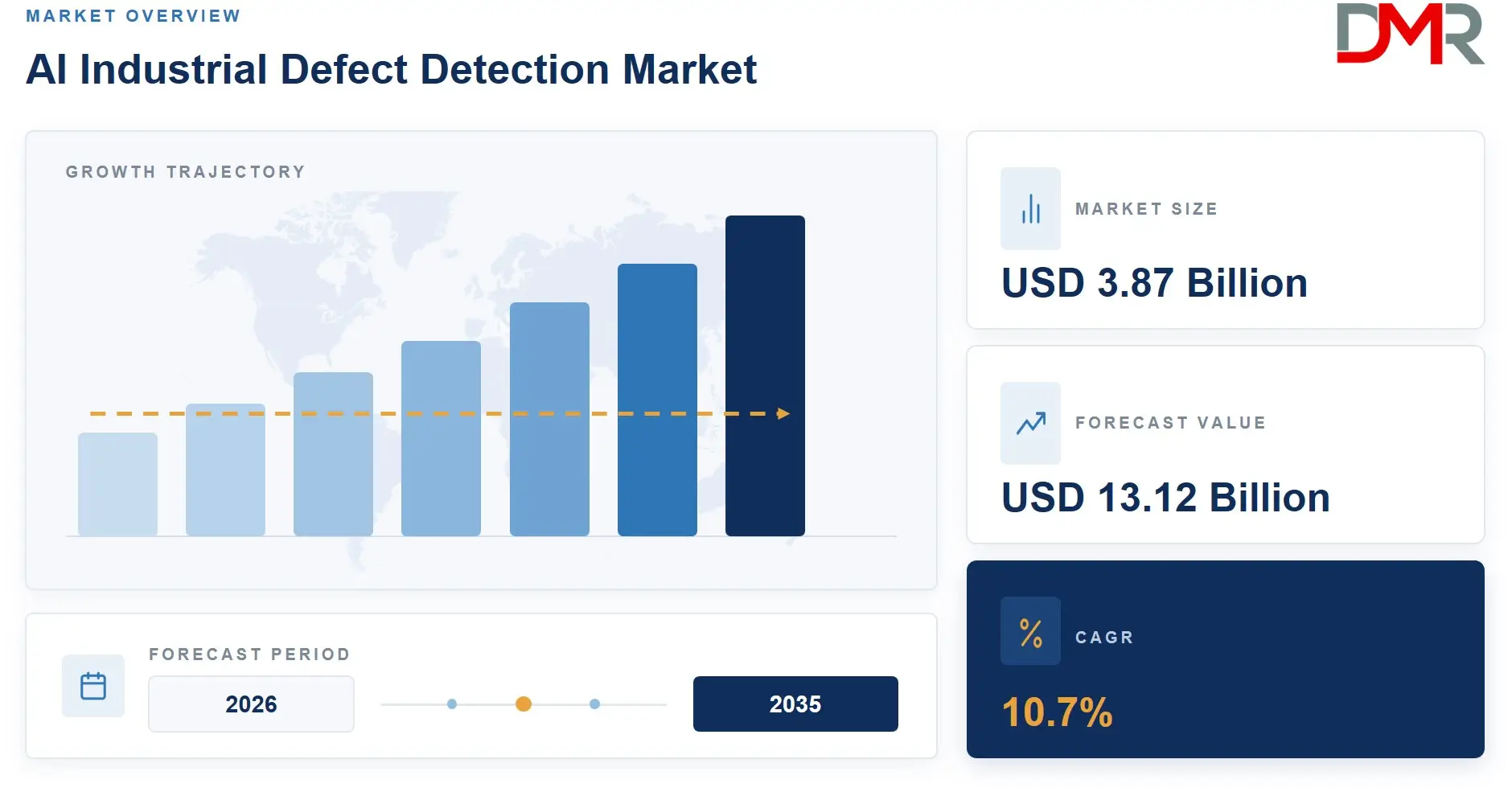
The Global AI Industrial Defect Detection Market size is estimated at USD 3.87 Billion in 2026, and is projected to reach USD 13.12 Billion by 2035, exhibiting a CAGR of 10.7% during the forecast period. Manufacturers across electronics, automotive, and aerospace sectors accelerated capital deployment into automated inspection systems between 2020 and 2025. Contract requirements from Tier-1 OEMs, not discretionary upgrades, drove the bulk of this spending. Huawei's 2025 R&D investment reached 192.3 billion yuan, totaling more than 1.38 trillion yuan over the past decade, signaling that hardware suppliers underpinning vision systems are scaling R&D commitments that will sustain component availability through the forecast window, as reported by Huawei. Siemens announced a 165 million USD investment in March 2026 to expand U.S. manufacturing for AI infrastructure, creating more than 350 new jobs. That capital commitment confirms that leading industrial technology vendors are treating AI-enabled inspection as a production-grade infrastructure category, not an experimental overlay.
The scope of the market covers AI-powered systems that detect, classify, and report manufacturing defects in real time. Manual visual inspection, non-AI statistical process control, and standalone metrology tools fall outside its boundaries. Artificial Intelligence is the enabling layer connecting edge computing hardware, trained neural networks, and factory execution systems into a unified quality assurance architecture.
ℹ
To learn more about this report –
Download Your Free Sample Report Here
Key Takeaways
- The market size is USD 3.87 Billion in 2026, and is projected to hit USD 13.12 Billion by 2035 at a CAGR of 10.7%.
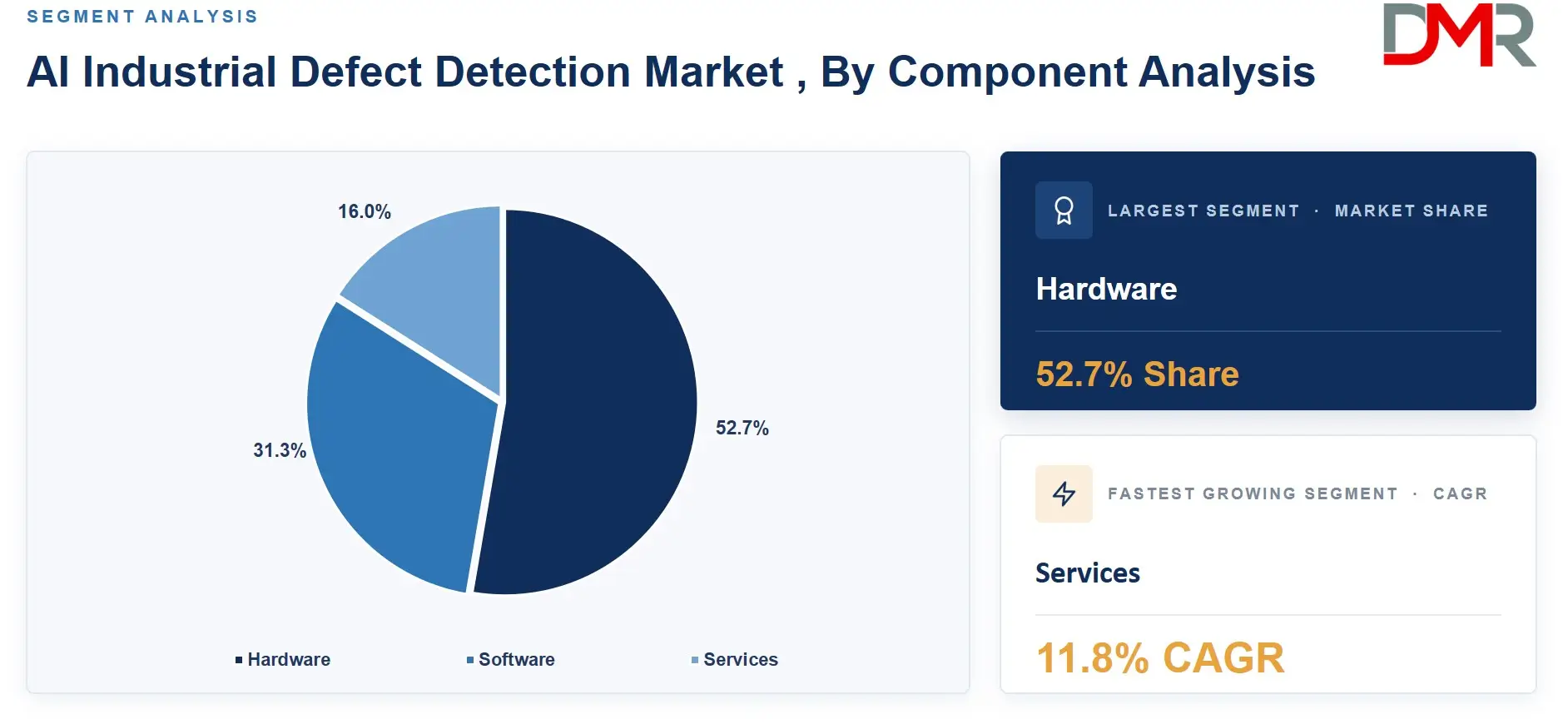
- By Component: Hardware led as the largest category with a 52.7% share in 2026.
- By Detection Technology: Deep Learning led with a 57.4% share in 2026.
- By Inspection Method: Optical/Vision Inspection led with a 57.10% share in 2026.
- By Defect Type: Surface Defects led with a 44.10% share in 2026.
- By Deployment Mode: Edge-Based led with a 49.2% share in 2026.
- By Application: Electronics Manufacturing led with a 37.30% share in 2026.
- By End User: Large Manufacturers led with a 66.1% share in 2026.
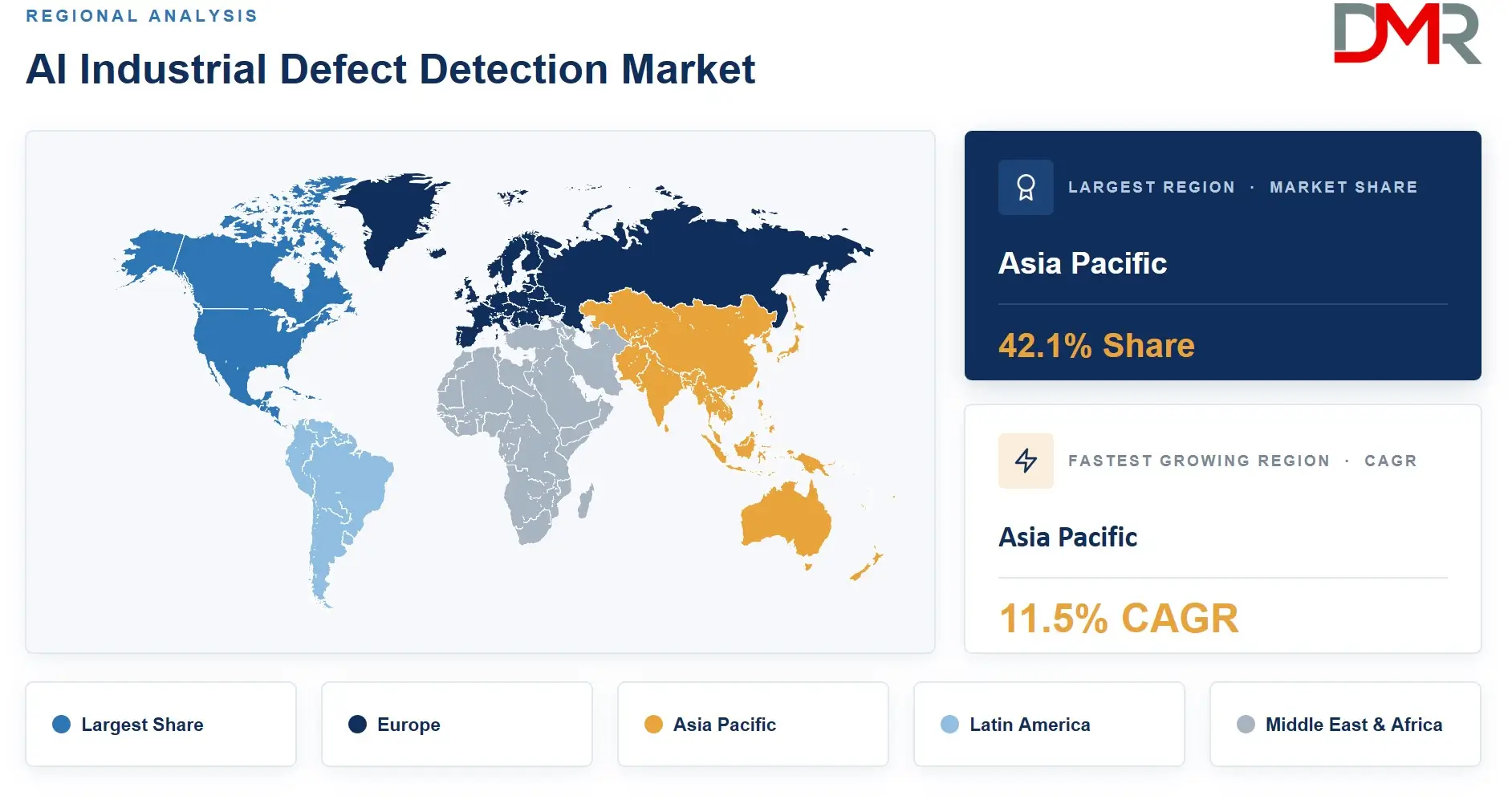
- By Region: Asia Pacific led with a 42.1% share in 2026.
- Top 5 key players: Siemens AG, Cognex Corporation, KEYENCE Corporation, OMRON Corporation, Teledyne Technologies Incorporated.
Component Analysis
Hardware led the Component segment with a 52.7% share in 2026. Cameras, lighting arrays, edge AI accelerators, and frame grabbers collectively represent the largest spend category because every AI defect detection deployment requires purpose-built physical infrastructure before any software model can operate. Semiconductor manufacturing equipment billings reached a record 135 billion USD in 2025, as reported by SEMI, confirming that the fab and precision electronics sectors are expanding the installed base of production lines that require machine vision-grade inspection hardware. Hardware dominance reflects CapEx-first buying behavior among large manufacturers who prioritize control over inspection infrastructure. Software holds the second-largest share and carries structurally higher margins than hardware because model retraining, dashboard licensing, and analytics modules generate recurring revenue. Services represent the fastest-growing sub-segment as manufacturers without internal AI competency buy inspection-as-a-service packages that bundle hardware deployment, model tuning, and uptime guarantees. Vendors that convert hardware customers into managed service contracts extend customer lifetime value while locking out lower-cost hardware-only competitors. Industrial Machine Vision Camera technology sits at the intersection of this hardware-software spending shift, with image quality requirements driving both sensor upgrades and retraining cycles.
ℹ
To learn more about this report –
Download Your Free Sample Report Here
Detection Technology Analysis
Deep Learning accounted for 57.4% of Detection Technology demand in 2026, the highest of any category. Convolutional neural networks and transformer-based vision models outperform rule-based systems on unstructured defect patterns that vary by batch, material lot, or machine wear state. Global semiconductor test equipment sales were projected to surge 48.1% to 11.2 billion USD in 2025, per SEMI data, and the inspection density required in semiconductor fabrication makes deep learning the only architecture capable of sub-micron defect classification at line speed. Electronics and semiconductor buyers drove deep learning adoption to its current majority position. Traditional Computer Vision and Machine Learning retain share in high-volume, low-mix lines where defect categories are well-defined and training data is abundant. Hybrid AI Detection is the fastest-growing sub-segment because it combines the interpretability of rule-based logic with the generalization power of neural models, appealing to quality engineers who need audit trails for ISO and OEM certification. Unsupervised Learning is gaining traction in new product introduction phases where labeled defect samples do not yet exist. AI in Manufacturing and Industrial Automation serves as the commercial framework under which these competing detection architectures are evaluated and procured by plant managers.
Inspection Method Analysis
With a 57.10% share in 2026, Optical/Vision Inspection outpaced all other Inspection Method categories. RGB and monochrome cameras paired with structured lighting remain the default inspection architecture because they deliver microsecond-speed image capture at costs compatible with high-volume line deployment. Electronics and consumer goods manufacturers adopted optical systems first, and their scale established the dominant installed base that sustains this segment's lead. Laser-Based Inspection is the fastest-growing method, driven by demand for three-dimensional surface profiling in precision machined components and battery cell inspection. X-Ray and Ultrasonic Inspection serve aerospace and casting applications where sub-surface defect detection is a contractual requirement rather than an optional upgrade. Thermal Inspection addresses applications in electronics and solar panels where heat signature anomalies indicate assembly faults. Acoustic Inspection remains a niche method applied primarily to weld integrity and composite structure evaluation.
Defect Type Analysis
Surface Defects captured 44.10% of the Defect Type segment in 2026, ahead of all rivals. Scratches, cracks, pitting, and coating irregularities on external product surfaces are the most common quality rejection cause across metals, plastics, and glass, making surface inspection the primary commercial use case for AI vision systems. The concentration of demand in this sub-segment reflects the breadth of industries, from consumer electronics to automotive body panels, where surface finish is a primary acceptance criterion. Process Anomalies is the fastest-growing defect category because manufacturers are moving beyond reactive defect identification toward real-time process correction. Structural and Internal Defects require multi-modal inspection and command higher per-unit revenue, sustaining vendor investment in X-ray and ultrasonic AI integration. Dimensional and Assembly Defects occupy mid-tier share positions, with demand concentrated in precision engineering and printed circuit board assembly lines where tolerances are sub-millimeter.
Deployment Mode Analysis
Edge-Based led the Deployment Mode segment with a 49.2% share in 2026. Manufacturers prefer edge deployment because real-time defect classification at line speed cannot tolerate cloud round-trip latency, particularly on lines running at hundreds of units per minute. Semiconductor and automotive assembly plants, where sub-second decision cycles are standard, drove edge architecture to its majority position. Cost deflation in edge AI chips further lowered the entry barrier for mid-tier plants. Hybrid deployment is the fastest-growing mode as manufacturers route latency-sensitive classification to edge nodes while sending aggregate defect telemetry to cloud analytics layers for yield optimization. On-Premises deployment retains share among manufacturers with strict data sovereignty requirements. Cloud-Based deployment serves pilot programs, multi-site benchmarking, and SME customers without on-site IT infrastructure.
Application Analysis
Electronics Manufacturing accounted for 37.30% of Application demand in 2026, the highest of any category. Printed circuit board assembly, semiconductor packaging, and flat panel display manufacturing collectively place the highest inspection density requirements of any production environment, generating the largest per-line AI vision revenue. The combination of microscale defect tolerances, high output volumes, and established automation infrastructure made electronics the earliest and deepest adopter of AI defect detection. Aerospace and Defense is the fastest-growing application sub-segment because OEM quality contracts now mandate AI-traceable inspection records, and no dominant AI-native incumbent has locked up the segment. Automobile Manufacturing holds the second-largest application share, supported by robot-dense assembly lines. Photovoltaics is an emerging high-growth category as solar panel manufacturers face cell efficiency requirements that manual inspection cannot consistently meet. Packaging, Apparel and Textiles, and Metal Processing represent underpenetrated segments where modular vision systems are beginning to displace manual line inspection.
End User Analysis
Large Manufacturers led the End User segment with a 66.1% share in 2026. Fortune 500 tier manufacturers in electronics, automotive, and aerospace had the capital, IT infrastructure, and quality compliance obligations to deploy enterprise-grade AI inspection systems ahead of smaller peers. Their procurement decisions set the performance and integration benchmarks that the broader supply chain subsequently adopted. Small and Medium Manufacturers are the fastest-growing end user category because subscription-priced inspection-as-a-service platforms have lowered the upfront commitment from a seven-figure capital project to an opex line item. Contract Manufacturers, System Integrators, and Quality Inspection Service Providers each represent distinct channel routes to market, with integrators playing a critical role in bridging the gap between AI platform vendors and plant-level deployment.
Key Market Segments
By Component
- Hardware
- Software
- Services
By Detection Technology
- Deep Learning
- Traditional Computer Vision
- Machine Learning
- Hybrid AI Detection
- Unsupervised Learning
- Others
By Inspection Method
- Optical/Vision Inspection
- X-Ray Inspection
- Thermal Inspection
- Ultrasonic Inspection
- Laser-Based Inspection
- Acoustic Inspection
By Defect Type
- Surface Defects
- Dimensional Defects
- Structural & Internal Defects
- Assembly Defects
- Contamination & Foreign Materials
- Process Anomalies
By Deployment Mode
- Edge-Based
- On-Premises
- Cloud-Based
- Hybrid
By Application
- Electronics Manufacturing
- Automobile Manufacturing
- Metal Processing
- Aerospace & Defense
- Packaging
- Photovoltaics
- Apparel & Textiles
- Other Manufacturing
By End User
- Large Manufacturers
- Small & Medium Manufacturers
- Contract Manufacturers
- System Integrators
- Quality Inspection Service Providers
By Deployment Mode
- Edge-Based
- On-Premises
- Cloud-Based
- Hybrid
Regional Analysis
Asia Pacific led the regional landscape with a 42.1% share in 2026, the largest of any region.
Asia Pacific
China alone installed 295,000 industrial robots in 2024, up 7%, representing 54% of global demand, as reported by IFR. That concentration of new robot deployments creates a directly addressable market for AI vision systems because every new robotic cell in a production line is a candidate for inline defect detection integration. Japanese and South Korean electronics OEMs operate some of the world's most inspection-intensive production environments, reinforcing regional dominance across both volume and revenue metrics.
Europe
Western Europe reached a record 267 robots per 10,000 manufacturing employees in 2024, ahead of North America at 204 and Asia at 131, per IFR data. That robot density translates directly into inspection system demand because automated production lines require machine-speed quality assurance that manual inspection cannot sustain. Germany, France, and the Nordic countries house the automotive and industrial equipment manufacturers driving European AI inspection procurement.
ℹ
To learn more about this report –
Download Your Free Sample Report Here
North America
The Americas installed 50,100 industrial robots in 2024, with the United States accounting for 34,200 units, based on IFR figures. U.S. reshoring of semiconductor and defense manufacturing is pulling AI inspection systems into new facilities where zero-defect contractual standards apply from day one. Federal procurement requirements and OEM quality mandates are accelerating adoption timelines that would otherwise take two to three years in purely commercial settings.
Latin America
Brazil and Mexico host the largest manufacturing bases in the region, with automotive assembly and consumer electronics contract manufacturing representing the primary AI inspection addressable markets. Adoption lags the other regions due to lower automation density and limited local systems integration capability, but nearshoring investment from North American OEMs is beginning to raise inspection standards at Tier-2 and Tier-3 supplier facilities.
Middle East & Africa
Gulf Cooperation Council economies are investing in industrial diversification away from hydrocarbons, and new manufacturing zones in Saudi Arabia and the UAE are specifying automation-first production standards. AI defect detection adoption in this region is early-stage but high-potential, given that greenfield plants face no legacy system migration burden and can deploy current-generation inspection architectures from commissioning.
Key Regions and Countries
North America
Europe
- Germany
- France
- The UK
- Spain
- Italy
- Rest of Europe
Asia Pacific
- China
- Japan
- South Korea
- India
- Australia
- Rest of APAC
Latin America
- Brazil
- Mexico
- Rest of Latin America
Middle East & Africa
- GCC
- South Africa
- Rest of MEA
Macroeconomic Impact
World trade in goods and commercial services increased 8% to 34.89 trillion USD in 2025, with world merchandise trade volume growing 4.6% driven by surging demand for AI-related goods, per WTO data. Export-oriented manufacturing growth across Asia and North America pulled forward capital investment in production quality systems because trade partners and retailers raised defect rejection thresholds as global supply alternatives multiplied. Higher trade volumes amplify the cost of escaped defects, strengthening the ROI case for automated inspection. Global growth is projected at 3.0% for 2026 and 3.4% for 2027, per IMF forecasts. Moderate but stable GDP expansion supports continued capital equipment spending without triggering the sharp budget freezes that disrupted automation investment in 2023 and early 2024. Regions growing faster than the global average, particularly parts of Southeast Asia and the Gulf, represent above-average opportunity for greenfield inspection system deployments.
Market Dynamics
Driver: Industry 4.0 Mandates and OEM Quality Contracts Accelerate Adoption
Global industrial robot installations reached 542,000 units in 2024, more than double the level of ten years earlier, and the global operational stock hit a record 4.66 million units, up approximately 9% year over year, as reported by IFR. Each new robot installation in a production line creates demand for inline inspection because automated assembly at high speed generates defect patterns that only machine-speed detection can catch. The scale of robot deployment has made AI inspection a standard line item in smart factory capital budgets rather than a discretionary upgrade. Robot installations in the U.S. automotive industry rose 10.7% to 13,700 units in 2024, per IFR. Tier-1 automotive OEMs have embedded zero-defect contractual clauses into supplier agreements, converting AI inspection from optional technology into a compliance requirement. Suppliers that cannot provide AI-traceable inspection data face disqualification from new program awards, compressing adoption timelines across the supply chain. Smart Manufacturing frameworks accelerate this compliance dynamic by standardizing the data formats through which inspection results integrate with broader factory execution systems.
Restraint: Dataset Scarcity and Integration Complexity Slow Deployment
Annotated industrial defect datasets are scarce in low-volume, high-mix production environments because defect instances per SKU are too infrequent to train generalizable models without years of collection. A manufacturer switching to a new product family or material faces a cold-start problem where the inspection model cannot be validated until enough defective samples accumulate. Vendors that cannot offer synthetic data augmentation or transfer learning from adjacent industries lose deals to competitors who address this barrier directly. Integrating AI vision systems with existing SCADA, MES, and PLC architectures creates multi-quarter deployment timelines that stall ROI realization. Plant IT teams managing legacy protocols lack the middleware expertise to connect new inspection software to existing factory data layers without external systems integrators. Buyers in mid-market manufacturing consistently cite integration complexity as the primary reason for delaying purchase decisions, not cost.
Opportunity: Underserved Verticals and Predictive Intelligence Layers Create New Revenue
Global vehicle production rose from 92.7 million units in 2024 to 96.4 million units in 2025, per OICA, and electric vehicle platform ramp-ups require battery cell and power electronics inspection standards that existing optical-only systems cannot fully address. Pharmaceutical blister pack and tablet inspection faces FDA 21 CFR Part 11 compliance pressure with no dominant AI-native incumbent in place, representing an open field for vendors willing to build regulatory-grade audit trail capabilities. Industrial Automation investment in both EV and pharmaceutical manufacturing is directing capital toward AI inspection as a non-negotiable production quality layer. Predictive yield optimization built atop defect detection telemetry delivers process root cause intelligence beyond binary pass/fail output. Manufacturers pay a substantial premium for systems that identify which upstream process parameter caused a defect cluster, not just that defects occurred. Textile and apparel inspection in South and Southeast Asia remains almost entirely manual despite high defect variability, and SME contract manufacturers globally represent an addressable market for modular, subscription-priced inspection platforms that established vendors have not prioritized.
Porter's Five Forces
OMRON Q3 FY2025 net sales were 614.3 billion yen, up 6.0% year over year, supported by Industrial Automation recovery and AI-related demand, as reported by Japan IR, illustrating how incumbent diversified automation conglomerates generate the revenue scale to cross-subsidize vision system R&D and distribution, raising the effective capital threshold for pure-play entrants. Competitive rivalry is high but segmented: established players like Cognex and KEYENCE compete on algorithm accuracy and ecosystem depth in high-end segments, while low-cost Asian hardware assemblers contest entry-level optical inspection on price. Supplier bargaining power is moderate because specialized CMOS image sensor fabrication is concentrated among a small number of fabs, giving camera component suppliers pricing leverage during periods of supply tightness. Buyer power is rising as large manufacturers run multi-vendor proof-of-concept evaluations before committing, forcing vendors to demonstrate measurable yield improvement within weeks rather than months. Substitutes remain weak for AI-native inspection because manual visual inspection cannot match the throughput or consistency demanded by current OEM quality contracts, and traditional rule-based machine vision cannot generalize across defect variability without costly reprogramming cycles that AI systems eliminate.
AI and Gen AI Impact
U.S. private AI investment reached 285.9 billion USD in 2025, more than 23 times China's 12.4 billion USD, per Stanford HAI. The concentration of foundation model development in North America accelerates transfer learning pipelines that industrial AI vendors can fine-tune for defect classification without training from scratch. Early movers who integrated large vision-language models into their inspection platforms in 2024 and 2025 can now deliver zero-shot defect classification on new product categories, a capability that laggards relying on manually labeled datasets cannot match at comparable speed. Generative AI is reshaping the training data bottleneck by producing synthetic defect samples that augment scarce real-world datasets. Vendors who embedded synthetic data generation pipelines before 2025 can onboard new production lines in weeks rather than quarters, compressing the time-to-value gap that historically caused deployment stalls. Laggards who have not integrated generative data augmentation face a widening accuracy gap as competitor models trained on larger synthetic-plus-real datasets outperform them on novel defect types.
Market Trends
Synthetic Data and Multimodal Fusion Redefine Inspection Capabilities
Global assembly and packaging semiconductor equipment sales increased 20.8% in 2025, per SEMI, raising the inspection precision requirements for the packaging and substrate layers where AI vision systems operate. KEYENCE launched the IV4 series vision sensors with built-in AI in April 2025, including AI Identify, AI OCR, AI Count, and AI Trigger modules, embedding model inference directly into sensor hardware and eliminating the need for separate inference servers on the production line. Multimodal sensor fusion combining hyperspectral imaging, thermal, and acoustic data is opening a sub-surface defect detection capability that standard vision systems cannot access, and ISO/IEC 42001 AI Management System certification is emerging as a procurement prerequisite in regulated industries.
Market Competition Overview
Teledyne Technologies recorded net sales of approximately 6.1 billion USD in 2025, as reported in its annual report, reflecting how the largest players in industrial imaging and sensing generate revenue streams broad enough to fund continuous AI model development while sustaining competitive pricing across multiple product tiers. GFT Technologies reported 2025 group revenue of 888 million euros, exceeding guidance per BusinessWire, demonstrating that AI integration services firms adjacent to the hardware market are also capturing inspection-related revenue growth. The competitive landscape is moderately concentrated at the top, with five to seven global automation conglomerates holding the majority of enterprise contracts, while a fragmented tier of specialized AI inspection startups and regional systems integrators contests mid-market and vertical-specific opportunities. Competitive differentiation is shifting from hardware specification toward AI model performance, integration support, and recurring software revenue. Vendors who converted one-time hardware sales into managed service or SaaS inspection subscriptions between 2023 and 2025 now report lower revenue concentration risk and higher valuation multiples. Challengers are gaining share by targeting the pharmaceutical, textile, and SME contract manufacturing segments that established leaders have not fully addressed with purpose-built offerings.
Pricing Analysis
Basler AG reported 2025 sales of 224.5 million euros, up 22%, with incoming orders up 23%, per EQS News. Rising order intake ahead of revenue confirms that buyers are committing to multi-unit inspection system purchases on extended delivery schedules, which gives vendors pricing power to hold margins even as component costs moderate. Entry-level optical inspection systems for standard surface defect detection have experienced price compression as Asian hardware manufacturers entered the market, while high-complexity configurations combining deep learning inference, multi-camera arrays, and MES integration command premiums of three to five times entry-level pricing. Subscription and inspection-as-a-service pricing models are restructuring the revenue profile of the market by shifting buyer commitment from capital expenditure to operating expenditure. Vendors offering per-unit-inspected or per-month licensing capture SME and pilot-phase demand that fixed-price hardware configurations exclude. Pricing pressure concentrates in commoditized optical inspection for simple surface defect detection, while structural, pharmaceutical, and semiconductor inspection segments sustain higher average selling prices driven by regulatory and contractual requirements.
Company Profiles
Cognex Corporation reported full-year 2025 revenue of 994.4 million USD, an increase of 9% year over year, with 642 million USD in cash and investments and no debt, per PR Newswire. That balance sheet position gives Cognex the capacity to fund AI model development cycles and absorb the longer sales cycles that accompany enterprise inspection deployments without debt leverage risk. Cognex's strategic positioning centers on deep learning vision software layered over its proprietary camera hardware, creating a switching cost structure that sustains gross margins well above the hardware-only peer group. Siemens AG posted its highest-ever industrial profit in Q3 FY2026, driven by AI and data-center demand, as confirmed by Reuters. Siemens differentiates by embedding AI defect detection within its broader industrial software and automation ecosystem, including MES, digital twin, and SCADA platforms, making it structurally difficult for pure-play inspection vendors to displace Siemens in accounts where the full automation stack is already Siemens-sourced. The Altair Engineering acquisition strengthens Siemens' simulation and AI model development capabilities, extending its competitive reach from inspection hardware into the predictive yield optimization layer.
Key Players
- Siemens AG
- Huawei Enterprise
- Advantech Co., Ltd.
- Intelgic
- GFT Technologies SE
- Cognex Corporation
- KEYENCE Corporation
- OMRON Corporation
- Teledyne Technologies Incorporated
- Basler AG
- Gramener
- Kili Technology
- Optimax
- Unilin Group
- Extreme Vision
- NeuroSYS
- Mobidev
- TrueFlaw
- Averroes AI
- IVISYS
Supply Chain and Value Chain Analysis
The value chain opens with semiconductor and optical component suppliers who produce CMOS image sensors, lenses, illumination modules, and edge AI processors. Camera and hardware OEMs integrate these components into inspection-grade products sold to AI software platform vendors or directly to systems integrators. Software vendors supply trained models, inference engines, and analytics dashboards that convert raw image streams into actionable defect classifications. Systems integrators connect hardware and software to plant SCADA, MES, and PLC layers, representing the highest-friction stage of the chain because integration complexity drives deployment timelines and cost overruns. Maximum value creation concentrates at the AI software and model layer because proprietary trained models and labeled datasets are difficult to replicate and generate recurring licensing revenue. The biggest supply chain risk sits at the edge AI chip level, where concentration among a small number of fabless chip designers creates a single-source dependency. Manufacturers that own their inspection data and retrain models continuously hold a compounding competitive advantage that new entrants cannot acquire quickly.
Regulatory Landscape
FDA 21 CFR Part 11 in the United States mandates electronic records and audit trail requirements for pharmaceutical manufacturing inspection systems, creating a compliance-driven adoption pathway for AI inspection vendors that build regulatory-grade logging and traceability into their platforms. The European Union's AI Act classifies industrial inspection AI systems by risk tier, with high-risk manufacturing applications facing conformity assessment obligations before market deployment. ISO/IEC 42001, the AI Management System certification standard, is emerging as a procurement prerequisite for vendors supplying regulated industries including aerospace, pharmaceutical, and automotive sectors. China's national standards body has issued AI quality inspection guidelines aligned with its smart manufacturing policy framework, and suppliers to Chinese state-owned manufacturers increasingly require compliance documentation before purchase order approval. Vendors that achieve multi-jurisdiction certification across FDA, EU AI Act, and ISO/IEC 42001 hold a structural procurement advantage in regulated verticals that certification-free competitors cannot overcome without multi-year compliance investment.
Investment and White Space Analysis
Global foreign direct investment fell 11% to 1.5 trillion USD in 2024, a second consecutive year of decline, per UNCTAD, but AI-enabling manufacturing technology sustained inflows because reshoring and supply chain resilience programs in North America and Europe directed capital toward domestic production upgrades rather than offshore expansion. SixSense raised 8.5 million USD in Series A funding in July 2025 for its AI-powered semiconductor defect detection platform, bringing total funding to 12 million USD, confirming that early-stage capital is reaching specialized AI inspection verticals with clear regulatory demand signals. White space is most pronounced in pharmaceutical inspection, textile and apparel QC in South and Southeast Asia, and SME contract manufacturing globally. None of these segments has a dominant AI-native incumbent, and each faces a structural demand catalyst: FDA compliance pressure, labor cost escalation, and OEM quality mandates respectively. Investors entering these segments through purpose-built vertical solutions face less competition from established automation conglomerates, which have prioritized electronics and automotive over these underpenetrated verticals.
Recent Developments
- October 2024 Siemens signed an agreement to acquire Altair Engineering at approximately 113 USD per share, representing an enterprise value of about 10 billion USD, strengthening its industrial software and AI simulation capabilities.
- February 2025 Teledyne Technologies completed the acquisition of select aerospace and defense electronics businesses from Excelitas Technologies for approximately 710 million USD, expanding its sensing and imaging portfolio for defense inspection applications.
- November 2025 Delvitech secured a major funding round to scale its AI-native automated optical inspection platform, marking a shift toward purpose-built AI architectures in printed circuit board and semiconductor inspection.
- March 2026 OMRON agreed to sell its Device and Module Solutions business to The Carlyle Group at an enterprise value of approximately 81 billion yen (about 540 million USD), signaling a strategic pivot toward core industrial automation and AI inspection segments.
- April 2026 Cognex completed the divestiture of its Japan-focused trading business, which generated approximately 16 million USD in 2025 revenue, for a purchase price of approximately 11.9 million USD, sharpening its focus on direct AI vision system sales.
- June 2026 KEYENCE launched the VS-G series AI-powered high-performance vision system, extending its AI inspection product line with advanced classification capabilities for high-mix production environments.
Report Scope
| Report Characteristics |
| Market Value (2026) |
USD 3.87 Billion |
| Forecast Revenue (2035) |
USD 13.12 Billion |
| CAGR (2026 to 2035) |
10.7% |
| Base Year for Estimation |
2025 |
| Historic Period |
2020 to 2024 |
| Forecast Period |
2026 to 2035 |
| Report Coverage |
Revenue Forecast, Market Dynamics, Competitive Landscape, Recent Developments |
| Segments Covered |
By Component (Hardware, Software, Services), By Detection Technology (Deep Learning, Traditional Computer Vision, Machine Learning, Hybrid AI Detection, Unsupervised Learning, Others), By Inspection Method (Optical/Vision Inspection, X-Ray Inspection, Thermal Inspection, Ultrasonic Inspection, Laser-Based Inspection, Acoustic Inspection), By Defect Type (Surface Defects, Dimensional Defects, Structural & Internal Defects, Assembly Defects, Contamination & Foreign Materials, Process Anomalies), By Deployment Mode (Edge-Based, On-Premises, Cloud-Based, Hybrid), By Application (Electronics Manufacturing, Automobile Manufacturing, Metal Processing, Aerospace & Defense, Packaging, Photovoltaics, Apparel & Textiles, Other Manufacturing), By End User (Large Manufacturers, Small & Medium Manufacturers, Contract Manufacturers, System Integrators, Quality Inspection Service Providers) |
| Regional Analysis |
North America (US and Canada), Europe (Germany, France, The UK, Spain, Italy, and Rest of Europe), Asia Pacific (China, Japan, South Korea, India, Australia, and Rest of APAC), Latin America (Brazil, Mexico, and Rest of Latin America), Middle East & Africa (GCC, South Africa, and Rest of MEA) |
| Competitive Landscape |
Siemens AG, Huawei Enterprise, Advantech Co. Ltd., Intelgic, GFT Technologies SE, Cognex Corporation, KEYENCE Corporation, OMRON Corporation, Teledyne Technologies Incorporated, Basler AG, Gramener, Kili Technology, Optimax, Unilin Group, Extreme Vision, NeuroSYS, Mobidev, TrueFlaw, Averroes AI, IVISYS |
| Customization Scope |
Customization for segments and region or country level will be provided. Additional customization can be done based on requirements. |
| Purchase Options |
Three license options: Single User License, Multi-User License (Up to 5 Users), Corporate Use License (Unlimited Users and Printable PDF) |
Frequently Asked Questions
What is the biggest investment opportunity in the AI Industrial Defect Detection market?
▾ Pharmaceutical inspection under FDA 21 CFR Part 11 compliance pressure and SME contract manufacturing represent the two largest underserved segments. Neither has a dominant AI-native incumbent, and both face structural demand catalysts that will compress adoption timelines through 2030. Investors targeting purpose-built vertical platforms in these segments face materially lower competitive pressure than in electronics or automotive inspection.
Who are the top companies in the AI Industrial Defect Detection market?
▾ The leading companies are Siemens AG, Cognex Corporation, KEYENCE Corporation, OMRON Corporation, and Teledyne Technologies Incorporated. Cognex reported 994.4 million USD in 2025 revenue, while KEYENCE posted 1.17 trillion yen in fiscal year revenue ended March 2026. Both companies combine proprietary hardware with AI software ecosystems that create high switching costs for enterprise buyers.
Which segment is growing fastest in the AI Industrial Defect Detection market and why?
▾ Within Detection Technology, Hybrid AI Detection is the fastest-growing sub-segment because it combines rule-based interpretability with neural network generalization, satisfying both engineering audit requirements and the accuracy demands of high-mix production lines. Across end users, Small and Medium Manufacturers are the fastest-growing category as subscription-priced inspection platforms lower the entry cost below the capital expenditure threshold that previously excluded them.
Which region is growing fastest in the AI Industrial Defect Detection market and why?
▾ Asia Pacific leads with a 42.1% regional share and sustains the fastest absolute growth because China alone accounts for 54% of global industrial robot installations, and every new robot cell creates incremental demand for inline AI inspection. Japan and South Korea add inspection density through their electronics and semiconductor OEM bases, compounding regional volume growth above the global CAGR.
What is the biggest challenge holding in the AI Industrial Defect Detection market back?
▾ Annotated industrial defect dataset scarcity is the primary constraint, particularly in low-volume, high-mix manufacturing where defect instances per product type are too infrequent to train generalizable models without synthetic data augmentation. Integration complexity with legacy SCADA and MES architectures compounds the problem by extending deployment timelines to multiple quarters, which delays the ROI realization that justifies continued investment for mid-market buyers.